Fintech Email Marketing for B2B Companies
How does your fintech's conversion layer compare? Compare your newsletter capture and next-step CTAs with other fintechs in our fintech conversion benchmarks.
Book a CallFintech email marketing, for a B2B fintech, is the owned channel that captures interested buyers, keeps a bank, credit union, or corporate buying committee informed through a long evaluation, and brings stalled deals back to life. It is the one channel you control from the first download to the signed contract, and it is a core part of how we build content systems for B2B fintech.
Part of Fintech Content Marketing for B2B Fintechs That Already Have Content.
This guide is for fintechs that sell to banks, credit unions, corporates, and other fintechs. It is not about consumer app onboarding or savings tips. If you want the wider picture first, start with what B2B fintech marketing covers.
The B2B reality shapes everything below. In The Hoffman Agency's survey of 500 senior technology buyers at banks and fintechs, 56% said their typical technology sales cycle runs 6 to 12 months. Finance and IT take part in about two in three of those purchasing decisions. That is a long time, and a lot of people, for a deal to survive between sales calls. Email is what holds it together.
A lifecycle campaign in B2B fintech follows that path: first download, committee evaluation, contract, then expansion. Deals that stall or go closed-lost re-enter it later. In practice, a B2B fintech needs four kinds of email.
Email type | Who gets it | The job it does | What counts as success |
Newsletter | Subscribers who are not in a deal yet | Builds an audience you own | Steady list growth, replies, hand-raises |
Nurture by deal stage | Contacts on open opportunities | Moves the buying committee forward | Meetings booked, stage movement |
Reactivation | Stalled, no-decision, and closed-lost deals | Reopens pipeline you already paid for | Replies, reopened opportunities |
Customer and onboarding | Signed accounts | Drives adoption and expansion | Usage, renewals, upsell opportunities |
The sections below take each one in order, then cover compliance, delivery into bank inboxes, and measurement.
How do fintechs build an email list without buying one?
Fintechs build an email list by giving buyers a reason to subscribe on every useful page, and most fintech websites have not built that front door yet. In our State of Content Marketing for Fintech 2026 report, fewer than three in ten fintech websites (28.7%) offer a newsletter signup. It is the rarest conversion element in the whole study.
The capture gap on fintech websites
Compare that with the sales ask. About two in five fintech websites ask visitors for a demo or a quote. That is a buy-now request, and it offers nothing to the buyer who is six months away from a decision.
On a fintech site with no signup, the reader who is still learning, which is most readers on a long cycle, has no easy way to stay in touch. Our report calls email "the least-built mechanism in the sector". The same pattern shows up in other regulated finance markets, as our guide to building the list before the newsletter for asset managers explains.
The software is usually not the problem. The same report finds HubSpot on about a third of fintech websites and Google Tag Manager on about three in four. The tracking and the email tool are often already installed. What is missing is the capture point that feeds them.
The placement matters too:
Only about two in five active fintech sites put a call to action inside the article body.
Fewer than one in five match that call to action to the buyer's stage.
The most common wording is still "Get a demo" or "Contact us".
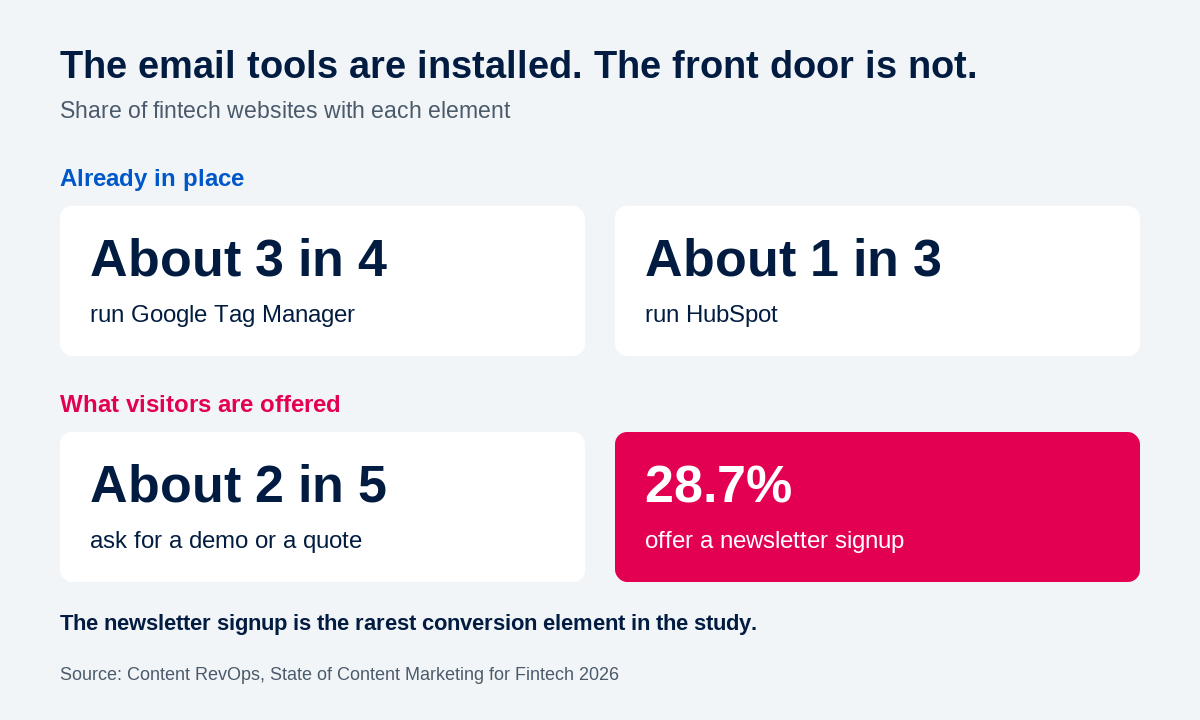
You can compare your own site against these fintech conversion benchmarks, and see more of the sector's numbers in our fintech marketing statistics.
What to offer for a work email
A bank buyer gives a work email in exchange for something worth keeping. The Hoffman survey shows what that is. Whitepapers and reports rank as important when buyers are learning about a vendor. Case studies, reports, analyst reports, and vendor webinars rank as most important when they are choosing one. The report sums it up plainly: "Webinars and email support buyers throughout the process."
That gives a simple rule for fintech lead magnets:
Gate original research, benchmark reports, and webinars. These earn a form fill.
Leave open articles, explainers, and comparison pages. These earn trust and search traffic.
Put the ask inside the article, next to the point it extends, not only in the footer.
Match the ask to the stage: a newsletter or a report for early readers, a case study or a process call for later ones.
Buyers in general are willing to make that trade. In Demand Gen Report's 2024 Content Preferences survey of B2B buyers across industries, 38% said they were very likely to fill out a form for a high-value asset, and webinars were the assets they registered for most often (75%). If webinars are your main capture asset, our webinar email templates cover the invite and follow-up side.
We built this conversion layer for Banking Crowded, a company serving banking and fintech professionals. It ran on topic-specific conversion paths, gated assets mapped to intent, and progressive profiling across several touchpoints. Over the 12-month engagement, inbound leads rose to 120-150 a month, up from about 15. Our page on lead nurture and database reactivation covers how that layer connects to the emails that follow.
Consent basics for B2B email
Record where and when every subscriber opted in. Then check the rules for each market you send to.
UK: the ICO's business-to-business guidance says the email consent rule does not apply to corporate subscribers, as long as you identify yourself and give an opt-out address. Sole traders and some partnerships count as individuals. A named work address is still personal data under UK GDPR. (The ICO notes this guidance is under review after the Data (Use and Access) Act.)
US: the FTC's CAN-SPAM guide says the law makes no exception for business-to-business email.
A bought list fails twice in fintech. You cannot show consent for it, and bank mail systems treat unknown senders harshly, as the delivery section below explains.
What a B2B fintech newsletter needs
A B2B fintech newsletter is the main capture point, so treat it as a product. Write for one buyer, such as the head of payments at a mid-size bank or the treasury lead at a corporate. A general fintech news roundup competes with every free fintech newsletter already in that reader's inbox.
Each issue needs four parts:
One lead idea the reader can use this month.
One proof point or data point.
One regulatory or market note relevant to their job.
One soft next step, such as a report, a webinar, or a reply.
ComplyAdvantage, which sells financial crime risk software to regulated firms, shows how this works. Its weekly newsletter, The Briefing, carries three stories with a short paragraph each. Will Thompson, its Director of Content and Communications, told Mint Studios that moving the full stories into the email, instead of linking out to three blog posts, lifted its open rate from 20% to 35% and its click-through rate from 1.5-2% to 2.5%.
Those are ComplyAdvantage's own figures, not benchmarks. The more useful number is what the newsletter did for revenue. Thompson says it has influenced well over $1M in closed-won deals. Syndicating it on LinkedIn also added 18,000 LinkedIn subscribers in a few months, a separate audience from the email list. Our guide to fintech social media marketing covers that LinkedIn side, and our tips on using email for content distribution cover how each issue carries your published work.
Pick a cadence your team can keep through compliance review, fortnightly or monthly for most teams. A skipped issue costs more trust than a slower schedule.
How should fintech lead nurturing emails follow the buying committee and the deal stage?
Fintech lead nurturing emails should follow the deal stage and the buying committee. A generic welcome, education, and offer sequence ignores how a bank buys. Map each sequence to a CRM deal stage, give each committee role the content it needs, and stop the sequence when a person starts talking to sales.
What each committee role needs in the inbox
The Hoffman survey shows who is in the room. Finance takes part in 67% of fintech and banking technology purchases, IT in 65%, and compliance in 24%. Those are shares of decisions each function joins, not the size of a committee.
The same survey names the biggest obstacles to buying: ensuring compliance (44%), supplier due diligence (42%), and ease of integration (41%). Those three obstacles tell your nurture emails what to carry.
Committee role | What they worry about | What to send them |
Finance | Cost, return, and budget timing | A business case, an ROI model, a customer result in money terms |
IT | Integration, security, and effort | Integration guides, security documentation, an architecture overview |
Compliance | Regulatory risk and due diligence | Regulatory proof, a due-diligence pack, audit and certification detail |
Operations or the business owner | Daily workflow and adoption | Case studies from similar institutions, onboarding plans |
Much of this material is thin on fintech websites. In our fintech report, ROI or business-case content appears on about a third of sites (34.2%), and objection-handling content on about a quarter (25.8%). If the asset does not exist, the nurture email has nothing to send, which is why we start with building the supporting assets before the sequences.
Sequences by deal stage
Each stage gets its own short sequence with a clear trigger and a clear exit.
Deal stage | What triggers it | What the emails carry | When it stops |
New contact | Report download, webinar sign-up | The asset they asked for, one related read, a soft next step | A reply or a meeting booked |
Evaluation | Discovery call held | Role-specific content for finance, IT, and compliance | A proposal is requested |
Proposal | Proposal sent | Case studies, due-diligence answers, implementation plan | Contract signed or deal stalls |
Stalled | No activity for a set period | One useful asset tied to the known blocker | A reply, which moves it to reactivation or back to sales |
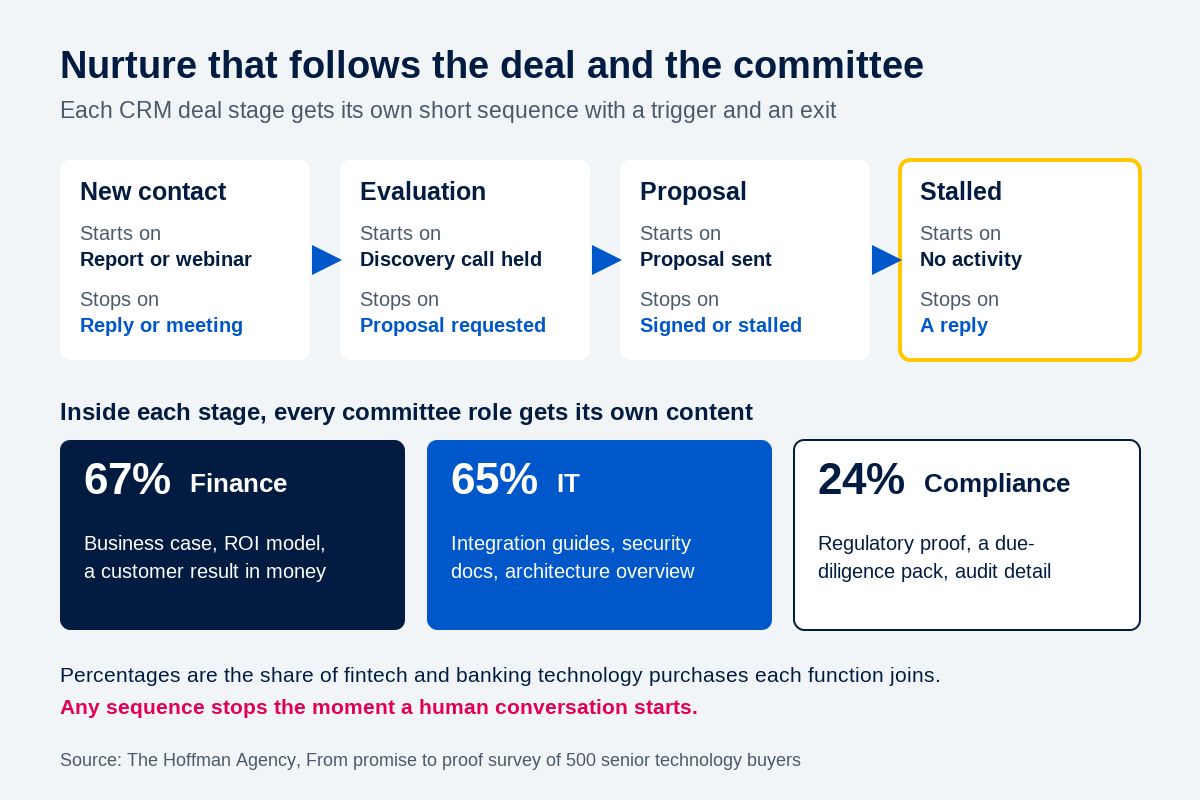
This is the decision-stage layer most fintech content lacks. In our fintech content execution study, only about one in six fintech content pieces is aimed at the decision stage.
The wiring between email and sales
What you send after the first conversation decides whether you stay on the shortlist. In the Hoffman survey, 25% of buyers ruled out a vendor because of a "lack of relevant information after contact". The top reason, at 28%, was that the vendor was slow to respond.
So the nurture program needs three rules in the CRM, the same rules behind aligning sales and marketing in a fintech firm:
Replies go to the deal owner, the same day, logged on the opportunity.
Sales can see every email the contact received, and what they did with it.
The sequence stops the moment a human conversation starts.
Our lead handover process shows how we set those rules up in practice.
HubSpot's sequence documentation shows how this works in one common tool. Contacts leave a sequence automatically when they reply, book a meeting, unsubscribe, or bounce. You can also unenroll everyone at the same company when one person replies, which matters when five people from one bank are in the same sequence. Marketing-email workflows do not track replies, so they need goal criteria, such as a meeting booked, to stop. Our page on automation architecture covers how those triggers fit together.
For Banking Crowded, we layered content into deal-stage-specific nurture journeys and personalised follow-ups mapped to known objections. Before that work, its pipeline stalled mid-funnel with limited nurture. Content then supported sales before, during, and after outreach.
How do you reactivate stalled and closed-lost fintech pipeline with email?
You reactivate stalled and closed-lost fintech pipeline by segmenting old deals by why they stopped, then sending each group one useful email that asks for a reply. These buyers already know you, many already sat through a demo, and all of them had a reason to look.
Where the money sits in your CRM
On a 6 to 12 month cycle, fintech deals stall for ordinary reasons: the budget moves to next year, a champion leaves, a security review drags on, or a competitor wins.
None of those contacts are cold. Too often they get a "just checking in" email, or nothing at all. Database reactivation treats them as a segment with its own sequence, built on the same idea as our content-led outreach system: lead with something useful, not a nudge.
A reactivation method for fintech pipeline
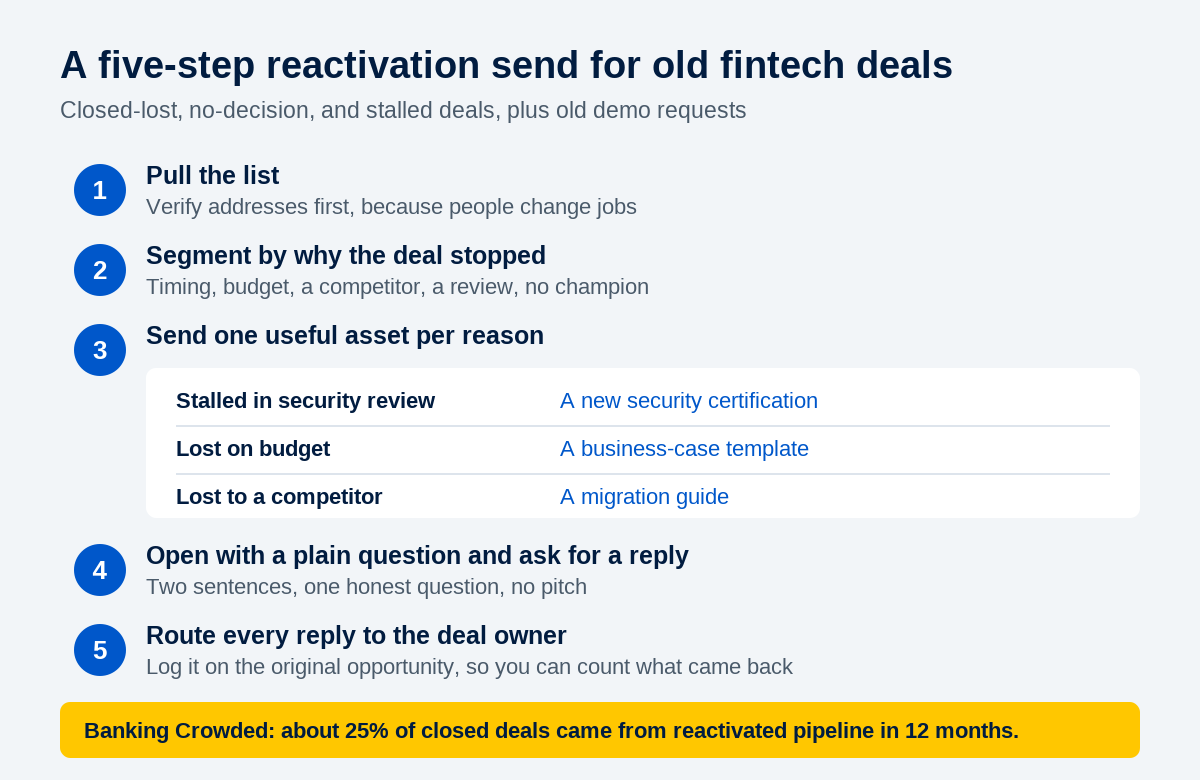
Pull the list. Export closed-lost, no-decision, and stalled opportunities, plus old demo requests that never became deals. Verify the addresses first, because people change jobs.
Segment by why the deal stopped. Timing, budget, a competitor, a compliance or security review, or no internal champion.
Send one useful asset per reason. A new security certification for the deal that stalled in review. A business-case template for the budget loss. A migration guide for the deal lost to a competitor.
Open with a plain question and ask for a reply. Keep links few and the layout simple.
Route every reply to the deal owner and log it on the original opportunity, so you can count what came back.
For the opening line, borrow from sales. Kyle Van Vorst of Vouris, in a video on his channel, describes what he calls lost opportunity outreach to prospects who saw a demo and did not move forward. He opens with a low-pressure question about whether anything pushed them away. He then asks what made them look at the solution in the first place. He frames the whole call as quality control, to defuse any sales pressure.
His script is for the phone, but it works as an email opener. Keep it to two sentences with one honest question and no pitch. A reply tells you whether the reason the deal stopped has changed.
How Banking Crowded used reactivation
When we started with Banking Crowded, it had no scalable way to reactivate dormant opportunities. The system we built included reactivation of dormant pipeline segments, alongside the stage-based nurture described above.
Over the 12-month engagement, about 25% of its closed deals came from reactivated pipeline. That is one in four won deals coming from contacts the company already had. Email did not do that alone; it worked as part of a full content system with nurture and sales follow-up inside it. The lead nurture and database reactivation page walks through how we set that up.
What to expect from a reactivation send
No public benchmark exists for how many closed-lost B2B deals reopen. The numbers you will find online come from vendor blogs with no stated method. Even Refolk, a vendor in this space, says the revivable share is not established publicly.
So set your own baseline. Count replies, reopened opportunities, and closed-won deals from the first send. Your second send will have a real number to beat.
What compliance rules apply to fintech email marketing?
Fintech email marketing has to meet general email law in every market you send to, plus any financial marketing rules that cover your firm type or your customers. Most B2B fintech vendors are not directly named by financial marketing rules. They meet bank-grade standards because their bank customers require it.
Rule | Who it binds | What it means for email |
Anyone sending commercial email in the US, with no B2B exception | Accurate headers and subject lines, a postal address, an opt-out honoured within 10 business days; penalties up to $53,088 per email | |
UK senders | Corporate subscribers can be emailed if you identify yourself and give an opt-out; sole traders and some partnerships count as individuals | |
Personal data of identifiable people, including named work addresses | A lawful basis, usually legitimate interests; the right to object to direct marketing is absolute, so suppress the address rather than delete it | |
Commercial email received in Canada, including from abroad | Consent, sender identification, and an unsubscribe option | |
FINRA member broker-dealers | Communications are classed as correspondence, retail, or institutional; retail communications need principal approval before use | |
SEC-registered investment advisers | Governs adviser advertisements, testimonials, and performance claims | |
FCA-authorised banks, plus payment and e-money institutions since August 2019 | Communications must be "fair, clear and not misleading", applied in proportion to the recipient | |
US banks supervised by the Fed, FDIC, and OCC | A bank stays responsible for compliance when it uses a vendor, so it reviews vendors through due diligence, contracts, and monitoring |
How bank oversight reaches a fintech vendor
The last row is the one that matters most to B2B fintechs. The interagency guidance says a bank's use of third parties does not diminish or remove its own responsibility. Banks pass that oversight down to the fintechs they buy from, and marketing claims are part of it.
Griffin, a UK bank that offers banking-as-a-service to fintech partners, publishes what that looks like. Partners submit marketing for approval, and Griffin gives feedback within 5 working days. Maximum review times run from 7 days for social posts to 14 days for blog and website content and 21 days for advertorials. Nothing goes live without written approval, and partners keep a record of who approved what.
Compliance knowledge shows up in hiring too. In our fintech marketing hiring study, about two in five fintech marketing roles (roughly 41%) ask for compliance or regulatory knowledge.
A compliance review workflow for fintech email
The law list rarely slows a fintech email program. The review process does. One compliance practitioner on r/fintech put the real need plainly: a workflow that shows "a record of what was reviewed, by whom and when".
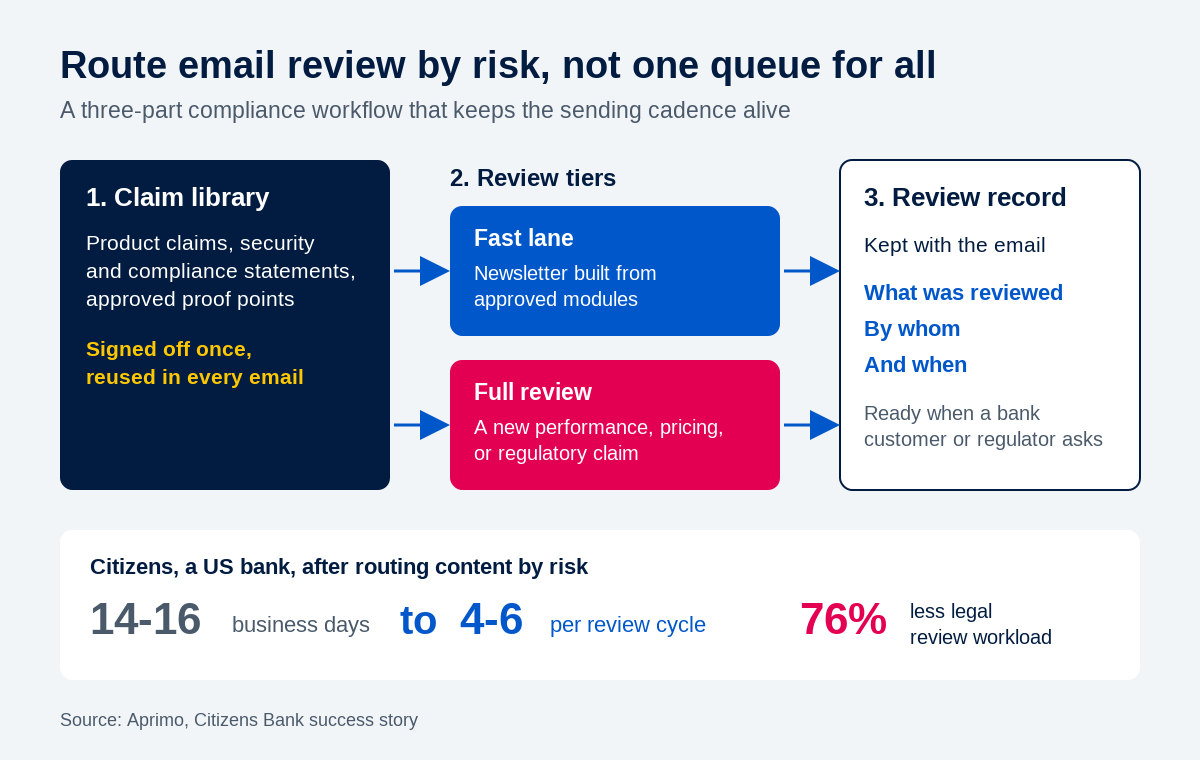
A workflow that keeps cadence alive has three parts:
A pre-approved claim library and email modules. Product claims, security and compliance statements, and approved proof points, each signed off once and reused.
Review tiers by risk. A newsletter built from approved modules moves fast. A new performance, pricing, or regulatory claim gets full review.
A review record kept with the email. What was reviewed, by whom, and when, so the answer is ready when a bank customer or regulator asks.
Tiering is where the time comes back. Citizens, a US bank, worked with Aprimo after every piece went through the same review regardless of its complexity or risk. Kathly Greene, a business system analyst at Citizens, said, "We sometimes had six different people reviewing a simple document." After the bank routed content by risk, review cycles fell from 14-16 business days to 4-6, and legal review workload dropped 76%.
Bring compliance in at the brief, not at the final draft. A claim that is approved before the email is written never holds up the send.
How do you get fintech emails delivered to banks and financial institutions?
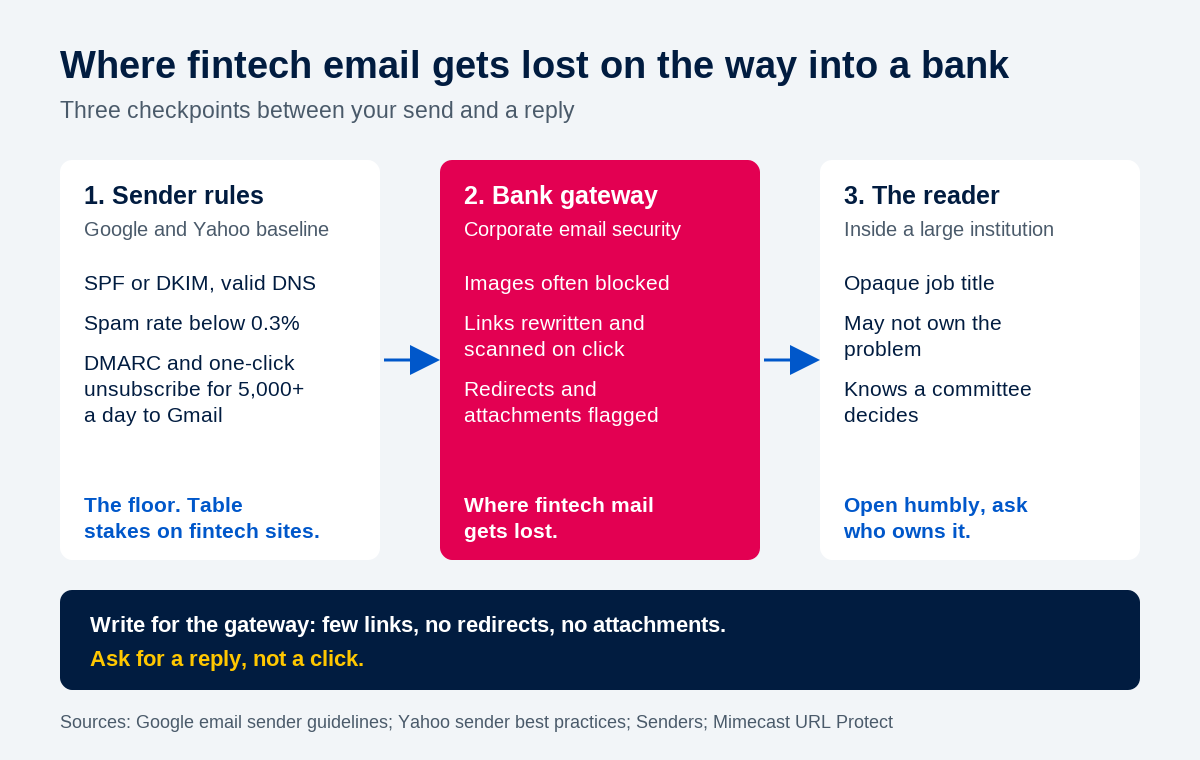
You get fintech emails delivered to banks by meeting the basic sender rules, then writing for mail systems that filter harder than most. Authentication is the floor. Our fintech report finds that security and deliverability hygiene (SSL, SPF, DMARC) is effectively table stakes on fintech sites. The bank's own email gateway is where fintech mail gets lost.
The sender rules every fintech must meet
Since February 2024, Google and Yahoo have set the baseline for bulk email.
All senders need SPF or DKIM authentication, valid DNS records, and a spam rate below 0.3%, according to Google's email sender guidelines.
Senders of more than 5,000 messages a day to Gmail also need SPF and DKIM, a DMARC policy, a From address that aligns with the sending domain, and one-click unsubscribe.
Yahoo applies the same 0.3% spam ceiling, asks bulk senders for DMARC, and wants unsubscribes honoured within 2 days. Its sender best practices also say plainly: don't purchase mailing lists.
These rules govern personal Gmail and Yahoo inboxes. Bank staff read email behind corporate security gateways, which add their own checks on top.
What bank email gateways do differently
A deliverability specialist at Senders, a deliverability services firm, explains the difference in a video on fintech email. Financial institutions have higher email security, so they sort incoming mail more aggressively. Lending-related email gets looked at dubiously by receiving servers.
The specialist lists three more things that change how you write and measure:
Images often do not load. Many financial institutions block images because they can carry malware. A delivered email may never register as an open.
Links get inspected. The hygiene list includes no attachments and no links with redirects.
Titles hide the owner. At large institutions, job titles are opaque, so the reader may not own the problem. The advice is copy that is more humble.
Gateway vendors describe the same behaviour. Mimecast's URL Protect rewrites every link in inbound email and scans the destination site in real time when someone clicks. Opensense's documentation notes that gateways such as Proofpoint, Mimecast, and Barracuda often click tracked links during routine scans, which inflates engagement numbers.
How to write email that bank gateways let through
The copy register follows from the filters:
Keep links few, link only to reputable domains, and avoid redirects and link shorteners.
Skip attachments. Host the report and link to it once.
Open humbly. Acknowledge the reader may not own the problem and ask who does.
Ask for a reply, not a click. Replies get through gateways and are a clean signal.
Soften the ask. The Senders specialist notes that finance buyers know they sit in a large buying committee, so a demo request can turn them off, while asking what their process would be works better. For community banks and credit unions, the specialist recommends very light calls to action, such as a fact sheet.
How should fintechs measure email marketing?
Fintechs should measure email marketing on replies, meetings, and pipeline, read from the CRM. Open rates do not survive bank inboxes, and the open-rate figures often quoted for fintech come from consumer apps, not from B2B sales. Our guide to which metrics to track and which to drop applies the same test across channels.
Why open rates mislead in fintech email marketing
Opens break in both directions.
Apple inflates them. Apple's Mail Privacy Protection downloads remote content in the background by default, whether or not the reader engages. Many of those "opens" never happened.
Bank gateways hide them. When images are blocked, a real read never registers, as the Senders specialist explained above.
Gateways inflate clicks. Link scanning creates machine clicks, so a click from a bank may be software, not a person.
A reply, a booked meeting, or a moved deal stage cannot be faked by a filter. Build the scorecard on those.
A pipeline scorecard for fintech email
Metric | What it tells you | Where to read it |
Replies | Whether the email started a conversation | Inbox and CRM activity log |
Meetings booked | Whether interest turned into sales time | CRM meetings and calendar links |
Opportunities created | Whether email produced new pipeline | CRM deals, by source |
Opportunities reactivated | Whether old deals came back | CRM, closed-lost deals reopened |
Deal-stage movement | Whether nurture moves deals forward | CRM stage history |
Influenced closed-won | Whether email touched deals that signed | CRM or attribution tool |
ComplyAdvantage tracks the influence of its newsletter this way, in two stages: first the business development meeting, then the opportunity. That is how it can put a closed-won figure on a newsletter. Our reporting approach reads email the same way.
What the CRM shows that the email platform does not
Email does its work late in a B2B deal, which is why last-touch reports miss it. Dreamdata's B2B email benchmarks studied 200 B2B companies on its attribution platform, across industries, not only fintech. About one in ten deals at the first conversion stage had clicked a marketing email. That rose to 29% of deals at creation and 41% of won deals.
The same study found the average won deal took 218 days from the first email click to close. Only 3% of leads had an email click as their last touch. Under a data-driven attribution model, email was credited on almost 30% of won deals.
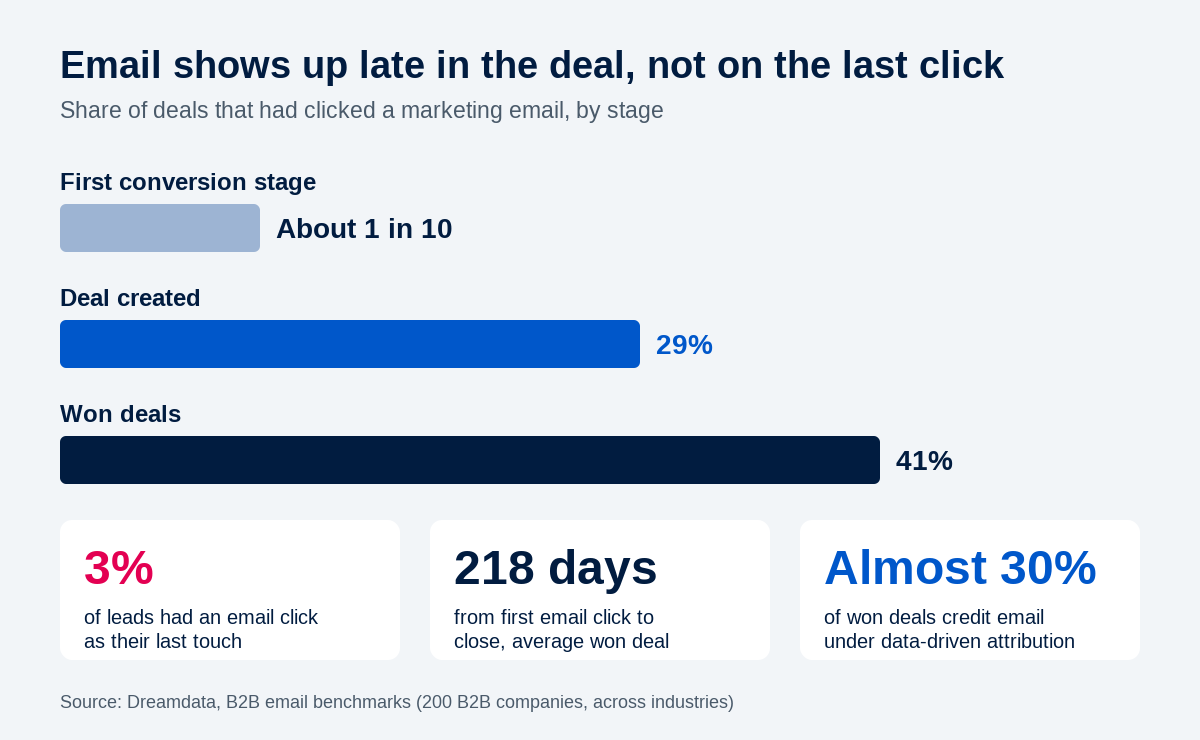
For a fintech team, the meaning is plain. If you judge email on the last click before a lead converts, it looks like it does almost nothing. If you look at the deals that closed, it shows up on a large share of them.
Banking Crowded's results were read the same way, as pipeline outcomes. Over the 12-month engagement, the system produced $3-4M in content-influenced pipeline and a 30-35% shorter sales cycle. Those are whole-system results, with nurture and reactivation inside them, and they show where to look for email's effect: in the CRM, on the deals.
To see how your traffic and conversion numbers compare with other fintechs, start with our fintech performance benchmarks.
Fintech email marketing pays when four things are in place: a capture point on every useful page, nurture that follows the deal stage, reactivation of the pipeline you already own, and a scorecard built on pipeline instead of opens. Our fintech content benchmarking tool gives you 12 numbers, a score out of 100, and your top three fixes, and our financial services page shows how we build that system with fintech teams.
Ready to turn fintech email into pipeline?
We build fintech content systems and the go-to-market wiring around them, so what you publish turns into conversations, accounts, and referrals. Start with the fintech content benchmarking tool for 12 numbers, a score out of 100, and your top three fixes.
Frequently Asked Questions
About the Author

Founder & CEO, Content RevOps
Stefan Kalpachev is the founder and CEO of Content RevOps, where he helps B2B SaaS companies transform their content into predictable pipeline. With a background in content marketing and revenue operations, Stefan has developed a unique methodology that bridges the gap between content creation and revenue generation.
Connect on LinkedIn