How to Align Sales and Marketing in a Fintech Firm in Six Steps
See where your fintech's handover breaks. Score your content and conversion paths against other fintechs with our fintech content benchmarking tool and get your top three fixes.
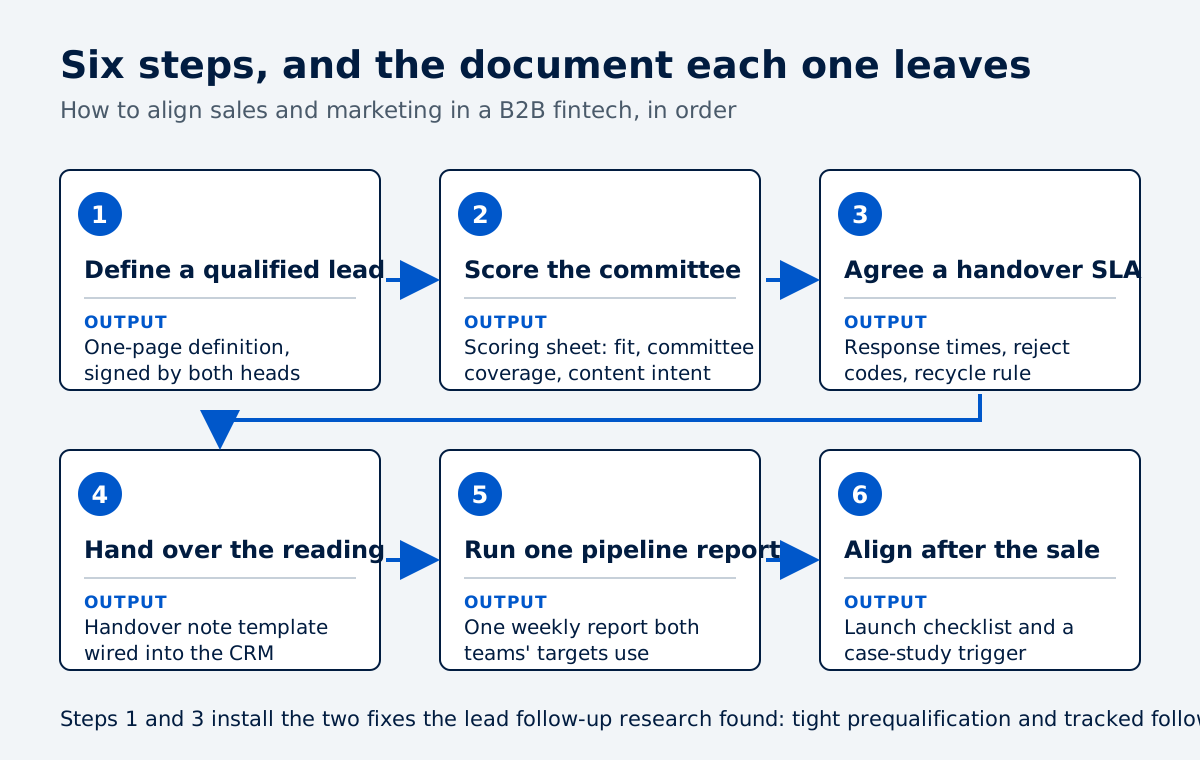
Book a CallAligning sales and marketing in a fintech firm comes down to six things you write down and keep running. Agree one definition of a qualified lead built for your fintech's buyers. Score accounts on fit, on how much of the buying committee is engaged, and on what they read. Set a handover SLA where sales works every lead fast and gives one reject reason. Pass the content a lead consumed to sales as the "why now" note. Run one pipeline report both teams are measured on. Then keep the handover going after the contract is signed. We call this Content RevOps: content is what the system runs on, and RevOps is the wiring (CRM, routing, scoring, and reporting) that carries it between teams.
Part of The Complete Guide to B2B Demand Generation Strategy.
The rest of this guide walks through each step for a B2B fintech, with the document each step should leave you holding.
How do you know sales and marketing are out of step in your fintech?
Most fintech teams can tell in two minutes. Score your fintech against five signs, one point each:
- Sales ignores a chunk of the leads marketing calls "qualified".
- Nobody can say in one sentence what makes a lead belong to sales.
- Leads score on one contact, while the bank or lender you sell to decides as a committee.
- When sales rejects a lead, the reason is "bad lead" and nothing more.
- Marketing reports leads, sales reports pipeline, and the two numbers never meet.
Two or more points means the problem sits in your operating system, and new meetings will not fix it.
Why fintech teams drift apart
The people are rarely the issue. Cross-functional collaboration appears in about 91% of the fintech marketing roles in our fintech marketing hiring study, which looked at about 160 roles. Fintechs already hire marketers to work across teams.
What is missing is the written agreement and the wiring underneath it. A marketer on r/b2bmarketing put the symptom plainly: "no matter how tight the lead scoring model is, sales still treats a chunk of 'qualified' leads as noise."
What misalignment costs
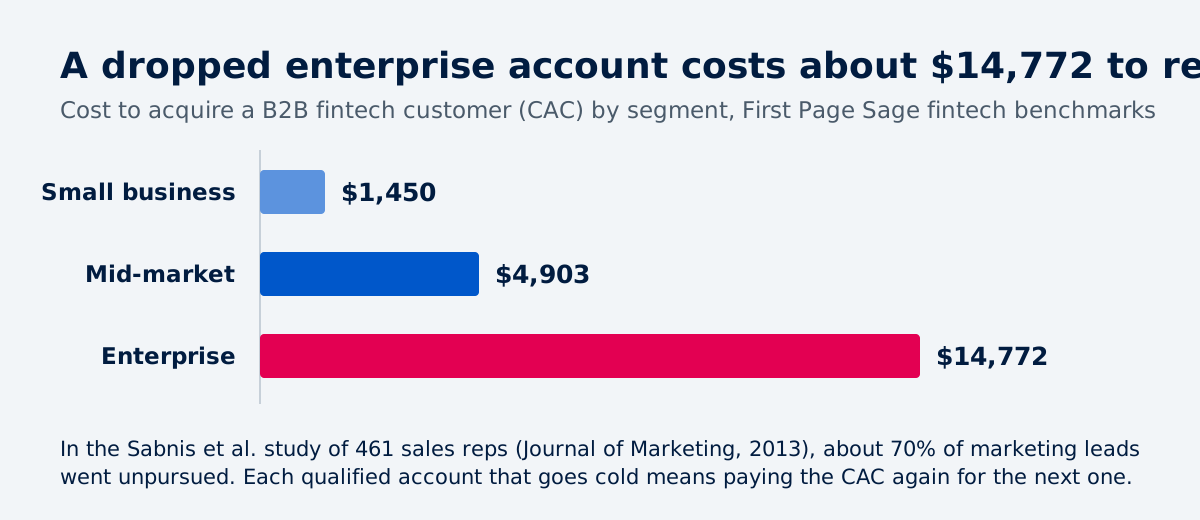
That pattern has been studied. In "The Sales Lead Black Hole", published in the Journal of Marketing in 2013, Goutam Sabnis and colleagues studied 461 sales reps at four firms. About 70% of marketing leads went unpursued.
The reasons are the useful part. Reps followed up more when marketing had prequalified the leads well and when managers tracked follow-up. They followed up less when they got too many leads. Steps 1 and 3 below install exactly those two fixes.
In fintech, every dropped account is expensive. First Page Sage's fintech CAC benchmarks, drawn from the SEO agency's client data, put the cost to acquire a B2B fintech customer at about $1,450 for small businesses, $4,903 for mid-market, and $14,772 for enterprise. That is the cost of a customer won. So every qualified enterprise account sales lets go cold means paying close to $14,772 again to win the next one.
Step 1. Write one definition of a qualified lead for your fintech
The first step is one page, signed by the heads of sales and marketing, that says what a qualified lead is for your fintech. If the two teams have never agreed on this in writing, every later step argues about it.
A commenter on the same r/b2bmarketing thread asked the question every fintech team should answer first: "have you and sales ever agreed in writing on what makes a lead theirs to work?"
Lead stages in plain words
Most CRMs split leads into stages. HubSpot's lifecycle stages are a common default:
- Marketing qualified lead (MQL): marketing judges the lead ready for sales.
- Sales accepted lead: sales agrees to work it. B2BProcess's handoff guide makes this stage explicit, because sales "must actively accept or reject each MQL within the SLA".
- Sales qualified lead (SQL): sales confirms a real potential customer.
In this guide, "qualified lead" means the MQL stage. The definition below decides what crosses that line.
What the fintech definition covers
Our method writes the definition tightly, in four parts:
- Which roles count. Name the committee roles, not one job title. For a fintech selling to banks, that usually means finance, IT, and compliance, plus the business owner.
- Which fit criteria matter. Institution type and size, charter or licence, the core banking or loan system in place, payments volume, and any partner-bank or embedded-finance relationship.
- Which signals count. Content consumed, an event conversation with an agreed next step, or a demo request.
- What context sales needs at handover. The account, who engaged, and what they read. Step 4 turns this into a template.
Why fintech fit criteria are different
Kevan Savage, a partner who leads the marketing practice at Alexander Group, makes this point in the firm's fintech go-to-market video. He lists the questions a fintech has to answer about its ideal customer: which banks, which embedded payments and software targets, which partnerships, and which loan systems. He calls those attributes "fairly unique to fintech". Writing them down is not enough. He argues for "putting the right weighting and the right criteria there", which is Step 2.
Signals that mean something
Count signals that show real interest, and drop the ones that only show presence. One marketer described the switch after events: "a badge scan scores the same as a 20 min conversation, so we stopped counting scans and only pass on people who agreed to a specific next step."
Content works the same way. With Banking Crowded, a banking media and intelligence fintech, we built the qualified-lead logic on content interaction. Leads qualified on what they read and engaged with across the resource hub, through topic-specific conversion paths and progressive profiling.
Let sales shape the definition. As one commenter put it, "Let sales define what qualified means and score against that."
Output: a one-page qualified-lead definition for your fintech, signed by the heads of sales and marketing.
Step 2. Build a lead scoring model for a fintech buying committee
A fintech scoring model should score the account, not one contact. It needs three parts: fit, committee coverage, and intent from content. Sales sits in the room when you set the weights.
Why one contact misleads in fintech
Banks and larger fintechs buy as a group. The Hoffman Agency's Fintech Catalyst survey, published by CCGroup, is a PR-agency survey of 500 senior tech buyers at fintechs and banks in the UK, US, and Singapore. Finance was involved in 67% of their technology purchases, IT in 65%, and compliance in 24%.
So a lead score built on one person's clicks sees one seat at a table of several. A marketer on r/b2bmarketing summed it up: "Still scoring one contact when the buying group is six people deep."
The three scoring columns
- Fit. The Step 1 attributes: institution type and size, licence, core system, payments volume, partner relationships.
- Committee coverage. How many of the roles that buy are engaged on the account: finance, IT, compliance, and the business owner.
- Content intent. Which decision-stage pages the account read, such as pricing, integration docs, security and compliance pages, or an ROI model.
Why committee coverage predicts deals
Committee coverage earns its own column because it predicts progress. In a Forrester client story from cybersecurity, Palo Alto Networks dropped MQLs and tracked buying groups instead. In the pilot, an opportunity with several people attached was 8x more likely to advance than one with a single person, and the closed-won rate rose 17%.
A fintech selling to banks can apply the same logic. An account where finance and IT are both reading is worth more than a single eager analyst.
A worked fintech scoring example
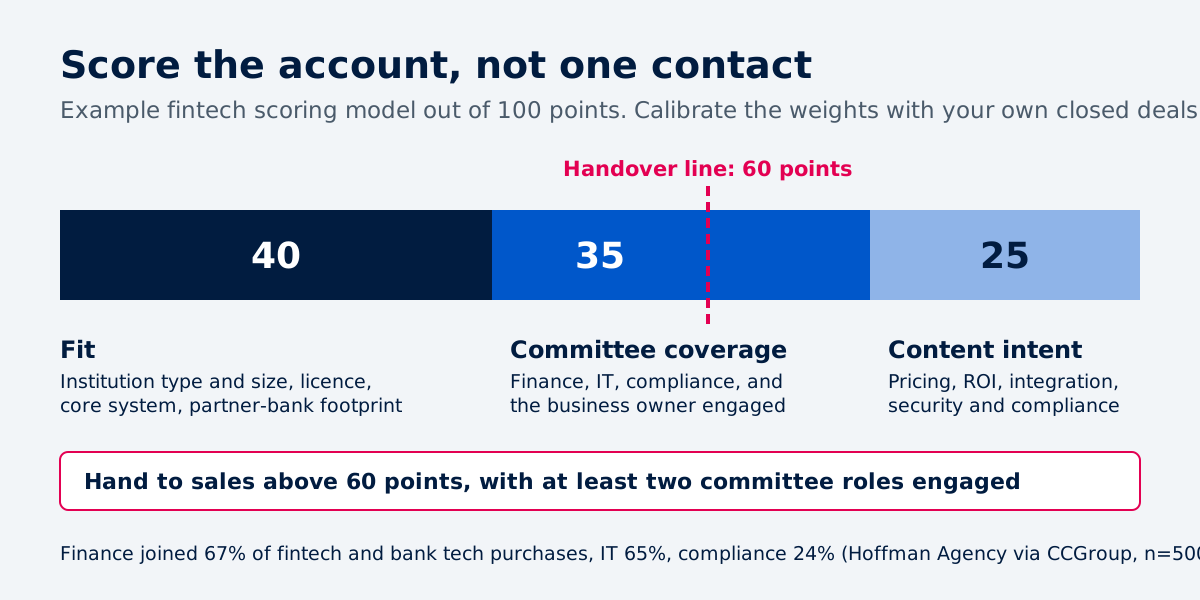
There are no published standard weights for fintech or banking-software scoring, so treat these as a starting point to calibrate with your own closed deals.
Column | Example signals | Example weight |
Fit | Target institution type and size, licence, core or loan system you integrate with, partner-bank footprint | 40 points |
Committee coverage | Finance, IT, compliance, and the business owner engaged, split across the four roles | 35 points |
Content intent | Read pricing or ROI content, integration docs, security and compliance pages, attended a webinar with a next step | 25 points |
Hand an account to sales above an agreed line, such as 60 points, with at least two committee roles engaged.
Pages that produce signals
Content intent only works if your site offers pages that show intent. In our study of fintech content execution, fewer than 1 in 5 active fintech sites (about 18%) match the call to action to the reader's buying stage. When the only offer is "book a demo", sales has little to score until someone books.
Calibrating with sales
Reset the weights every quarter against what actually closed. One team found what made scoring stick: "making sales sit in on the scoring calibration meetings."
Output: a fintech scoring sheet with three columns and agreed weights, recalibrated with sales every quarter.
Step 3. Agree a handover SLA between fintech marketing and sales
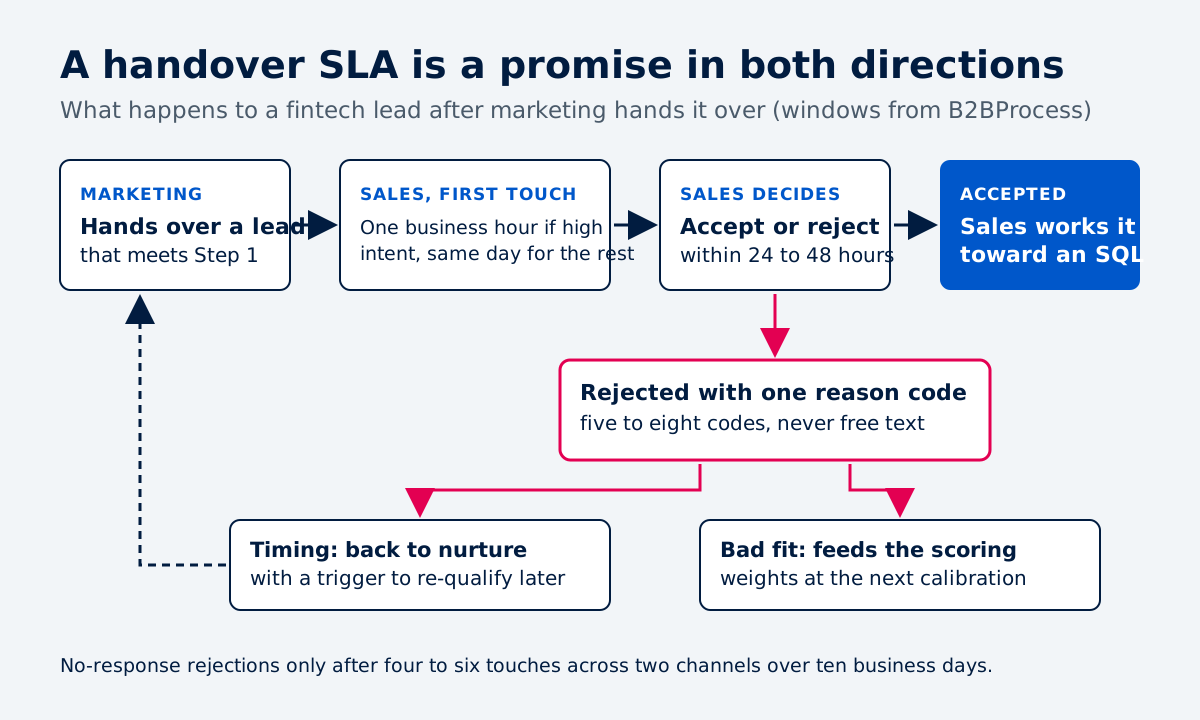
A handover SLA is a short promise in both directions. Marketing commits to hand over leads that meet the Step 1 definition. Sales commits to a response time, to work every lead it receives, and to give one reason code for every rejection.
Why speed matters to fintech buyers
Fintech buyers notice slowness. In the same Hoffman Agency survey via CCGroup, "slow to respond" was the top reason buyers ruled out a vendor, named by 28%.
The size of the effect shows up in wider data. The InsideSales Lead Response Study, vendor platform data from 5.7 million inbound leads at more than 400 companies (not fintech-specific), found conversion more than 8x higher when the first attempt came within five minutes, compared with five minutes to 24 hours.
What goes in a fintech handover SLA
B2BProcess's MQL-to-SQL handoff guide by Ramin Assemi gives workable windows. We use them as the base:
- First touch within one business hour for high-intent leads, and the same day for the rest.
- Accept or reject within 24 to 48 hours.
- Reject reasons from a short picklist of five to eight codes, never free text.
- No-response rejections only after an agreed effort, such as four to six touches across two channels over ten business days.
Fintech reject reasons
Generic codes like "bad fit" teach marketing nothing. Use reasons a fintech marketer can act on:
- Wrong institution type or size
- Outside our partner-bank or licence footprint
- No compliance or IT owner engaged
- Timing, such as a core-system contract renewing in more than a year
- Already a customer or partner
- Duplicate
A marketer who ran this well said: "Sales had to touch every MQL fast and give one clear reject reason so marketing could fix junk leads."
What happens to rejected leads
Rejected does not mean deleted. B2BProcess routes timing rejections back into nurture with a trigger to re-qualify, and feeds bad-fit rejections into the scoring weights. A renewal two years out today is a qualified account later, and lead nurture and database reactivation is how you catch it.
The rejection rate becomes the number marketing fixes against. As one r/revenuemarketer post puts it, "our ops are inefficient" is not a diagnosis, while "MQL rejection is 35%" is.
Output: a one-page fintech SLA with response times, the accept or reject window, your reason-code list, and a recycle rule.
Step 4. Hand over what the fintech buyer read, not just the lead
The handover note should tell sales what the account read, who on the committee engaged, and why they are looking now. In fintech, content is the most honest record of what a buyer cares about, so build the note from it.
Why the handover note matters
A name and a score give sales nothing to open with. One team cut the complaints by adding "a quick 'why now' note into the handoff, one sentence on what changed for the account recently". Another marketer asked the sharper question: "if sales can't answer 'why is this account buying now?', what exactly is the score adding?"
How we run content through the handover
With Banking Crowded, content supported sales before, during, and after outreach. Enrichment and engagement signals guided the handover, so reps could see what an account had engaged with before reaching out. Follow-ups were personalised and mapped to known objections, with content doing the answering.
That is the shape we recommend for any B2B fintech. The content a lead read becomes the "why now". The next asset you send answers the committee member who has not spoken yet.
What sales needs to send next
Some fintech buyers drop a vendor after the first conversation. In the Hoffman Agency survey via CCGroup, 25% ruled out a vendor for "lack of relevant information after contact".
Finance needs a business case before it signs, so sales needs ROI content to forward. Yet ROI or business-case content appears on only 34.2% of fintech sites in our fintech content marketing report. If that asset is missing, the handover note will point at a gap, and that gap goes on marketing's list. Our guide to fintech content marketing sets out which proof format each seat on the committee needs, starting from the content you already own.
The fintech handover note template
Keep it short enough that a rep reads it before every first call:
- Account: institution, type, size, and fit score
- Who engaged: names and roles, marking which committee seats are still empty
- What they read: the three most telling pages or downloads
- Why now: one sentence on what changed for the account
- Suggested next asset: the piece that answers the next committee member
Output: a fintech handover note template wired into the CRM record, filled in automatically where possible.
Step 5. Run one pipeline report both fintech teams read
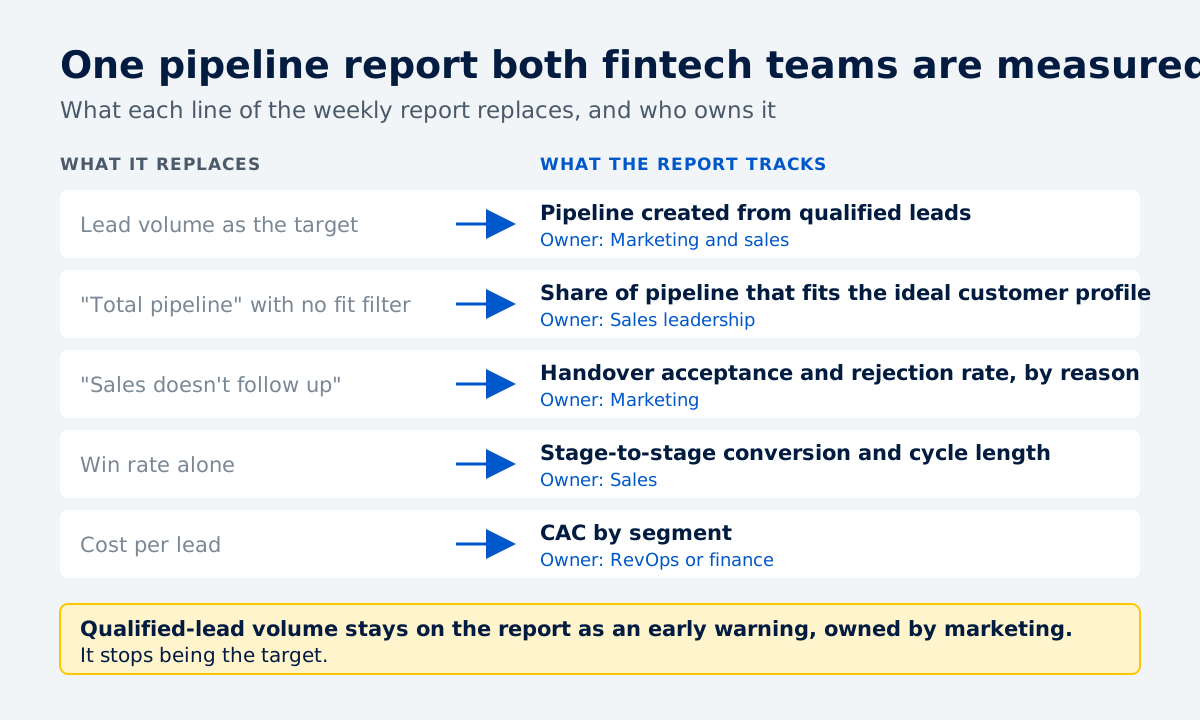
The fifth step replaces lead counts with one pipeline report that both fintech teams are measured on. Qualified-lead volume stays on the report as an early warning. It stops being the target.
Why lead counts mislead
A lead count tells you how busy marketing was, not whether revenue moved. Forrester's "Goodbye MQLs! Hello Opportunities!" makes the case for measuring opportunities and buying groups instead of individual leads.
There is a catch worth planning for. One marketer who switched to pipeline created said "the thing that broke was I lost any early read on campaigns." Keep lead volume visible for that reason.
The question to ask on every forecast call
Kevan Savage of Alexander Group describes sales leaders who "run a forecast call and ask this very basic question, what percent of our pipe is ICP aligned versus non-ICP aligned?" If most of it is off-profile, he warns, you will not see conversion, and you will see wasted marketing dollars. That share belongs on your report.
What the fintech pipeline report tracks
Metric | Owner | What it replaces |
Pipeline created from qualified leads | Marketing and sales | Lead volume as the target |
Share of pipeline that fits the ideal customer profile | Sales leadership | "Total pipeline" with no fit filter |
Handover acceptance and rejection rate, by reason | Marketing | "Sales doesn't follow up" |
Stage-to-stage conversion and cycle length | Sales | Win rate alone |
CAC by segment | RevOps or finance | Cost per lead |
Qualified-lead volume | Marketing | Kept as an early warning only |
What the report shows when the system runs
Cycle length and pipeline are the numbers that showed the change for Banking Crowded. Over a 12-month engagement, the Banking Crowded case shows sales cycles 30-35% shorter and $3-4M in content-influenced pipeline. If you want to see which page started each deal, we wire that attribution into the CRM.
Fintech employers already expect marketers to work this way. Analytics appears in about 69% of fintech marketing roles in our hiring study. Give that skill one report to work on.
Budget follows the sales segments
Split marketing program budget by the same segments sales is organised around: enterprise, mid-market, and smaller institutions. Savage notes that companies are starting to allocate program dollars to their coverage model, and that marketing teams historically have not, but "your sales teams are organized that way". The CAC ladder from the self-check shows why. An enterprise customer costs about ten times what a small-business customer does to win, so the segment rows on your report should decide where money goes.
Who reads the report, and when
One owner keeps the report: RevOps, or whoever owns the CRM. It then sets the agenda for a joint monthly review and a quarterly planning review. Savage recommends bringing the marketing operating model together with the sales one, through marketing reviews "that are also including sales leaders".
Output: one weekly fintech pipeline report that both teams' targets are written against, used as the fixed agenda for a joint monthly review and a quarterly planning review that splits budget by sales segment.
Step 6. Keep fintech sales and marketing aligned after the contract is signed
In fintech, the signature starts a second handover, from sales to implementation to customer success. Revenue often depends on the customer launching and ramping up usage, so marketing stays involved after the deal closes.
Jeff Wood, a principal who leads the fintech practice at Alexander Group, says that "in probably 80% of our fintech engagements, we're always dealing with this kind of handoff". In the same conversation, Savage notes that fintechs rarely tell the full customer story, from onboarding through to volume, in their customer marketing.
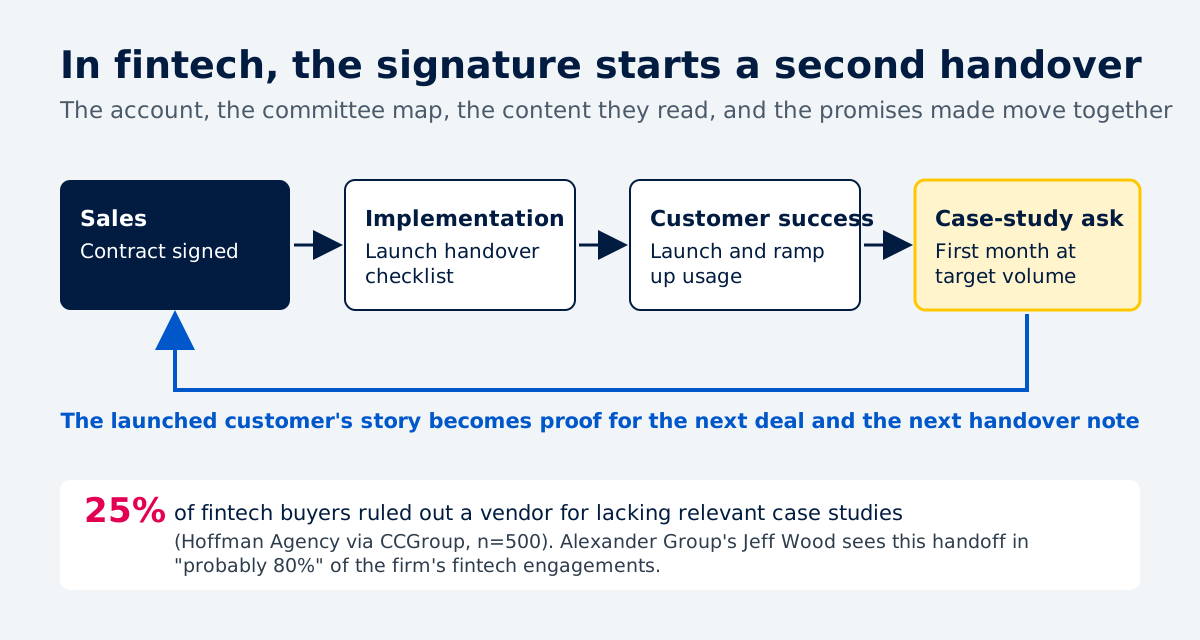
That story is a sales asset. In the Hoffman Agency survey via CCGroup, 25% of fintech buyers ruled out a vendor for lacking relevant case studies. The customer you launch well this quarter is the proof that wins next year's deals, and the material for Step 4's handover notes.
Two things keep this running:
- A launch handover checklist that moves the account, the committee map, the content they read, and the promises made in the sale from sales to implementation to customer success.
- A case-study trigger at a set point after go-live, such as the first month at target volume, when marketing asks for the story.
Output: a fintech launch handover checklist and a case-study request trigger, both owned in the CRM.
To see where your own fintech stands before you start, run our fintech content benchmarking tool, or see how we install this system for financial services teams.
Turn alignment into a system that runs
We build fintech content systems and the go-to-market wiring around them, so what you publish turns into conversations, accounts, and referrals. See how we install it for financial services teams.
Frequently Asked Questions
About the Author

Founder & CEO, Content RevOps
Stefan Kalpachev is the founder and CEO of Content RevOps, where he helps B2B SaaS companies transform their content into predictable pipeline. With a background in content marketing and revenue operations, Stefan has developed a unique methodology that bridges the gap between content creation and revenue generation.
Connect on LinkedIn