How to Choose an Asset Management Marketing Agency
See where your content leaks before you hire anyone. Run your firm through the asset management content benchmarking tool and walk into agency conversations knowing the one problem you need solved.
Book a CallMost asset managers grow through a few trusted channels: referrals, consultant and gatekeeper relationships, a known brand, and a distribution team that works the phones and the conferences. Marketing is supposed to make those channels faster. So when a firm decides to hire outside help, the search usually starts with a single question: which asset management marketing agency is the best one?
Part of Content Marketing for Asset Managers: The 2026 Playbook.
That is the wrong first question, and it is the reason so many of these engagements disappoint.
The pages that rank for "asset management marketing agency" are mostly vendor rankings, where the publisher happens to place itself at number one, or generic "types of agencies" explainers written for any business at all. None of them helps an asset management firm work out what it is actually hiring for, which is the decision that determines whether the money works.
This guide fixes that. It covers what an asset management marketing agency does, why the choice is harder in asset management than in most industries, the partner types you are really choosing between, how to evaluate them, the red flags, what it costs, and how to tell whether the work is paying off. The order matters, so read it as a sequence.
What does an asset management marketing agency actually do?
An asset management marketing agency is a firm you hire to win and keep assets through marketing, rather than through your distribution team alone. The first thing to get straight is that it is not an "asset management company," which is the firm that manages the money. If you searched for help marketing your fund and landed on pages about picking a manager to invest with, that is the search engine confusing the two. This guide is about the marketing partner.
The second thing to get straight is that "agency" is not one job. It is a bundle, and different firms sell different parts of it. The scope you are choosing to buy usually includes some mix of:
Positioning and brand, which is how you describe who you are for and why you are different.
Website, SEO, and answer-engine optimization, which is whether buyers and AI tools can find and understand you.
Content, meaning the commentary, guides, research, and case material that educate a buyer.
PR and communications, meaning media relations, awards, and executive profile-raising.
Paid media and distribution, meaning advertising and getting your content in front of the right advisors and institutions.
Marketing operations and attribution, meaning the CRM, the automation, and the reporting that connect activity to pipeline.
No single firm is equally good at all of this, and you do not need all of it on day one. The point of naming the parts is that your choice of agency should follow from which parts you actually need, not from which firm has the most impressive client logos.
Why is choosing a marketing agency harder for asset managers?
Choosing a marketing agency is harder in asset management because the work sits inside constraints a generalist agency does not know how to handle, and because most of the market, including many specialist agencies, is weak at the one part that actually moves assets.
Start with what is broken. Our 2026 review of 1,628 asset management firms found that only about one firm in 28 runs content as a system; the rest is a brochure site or scattered posts with nothing behind them. The median firm earns around 214 organic visits a month, which is presence without performance. And nearly half of all the content produced is news and press releases: publishing as a press function, not a demand engine.
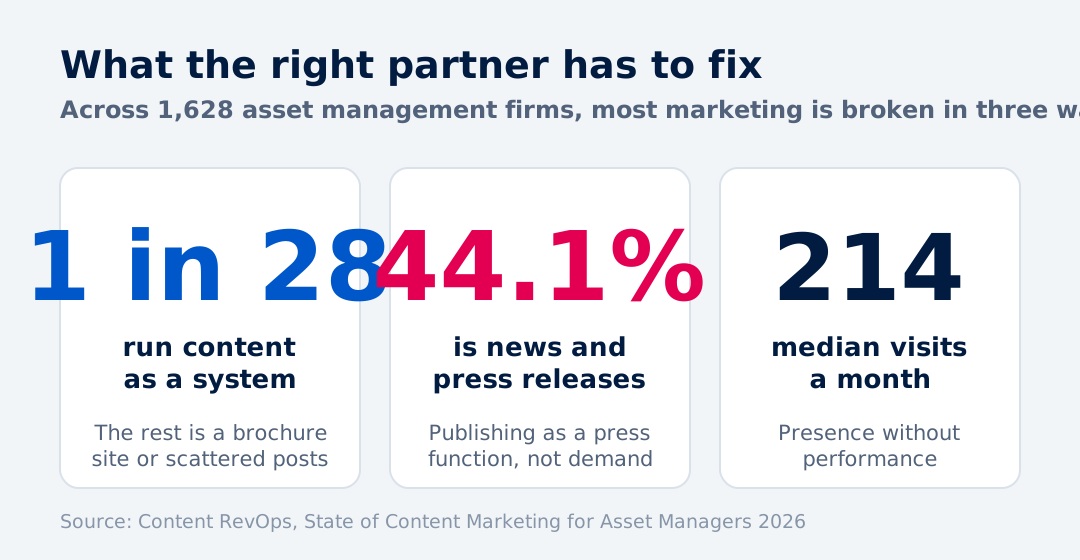
That last number is the trap. If you hire a partner whose instinct is to pump out announcements, you are buying more of the thing that already does not work.
What compliance reality does a partner have to live in?
Asset management marketing runs inside rules that most agencies have never read. Under the SEC's Marketing Rule 206(4)-1, an adviser's marketing counts as advertising, so gross performance has to appear with net at equal prominence, and testimonials and endorsements are allowed only with specific disclosures. Under FINRA Rule 2210, anything sent to more than 25 retail investors in 30 days is "retail communication" that needs principal pre-approval, while smaller and institutional communications are supervised more lightly.
None of this makes marketing impossible. It makes it a workflow. A partner who knows the rules builds review into the calendar; a partner who does not either freezes or exposes you. A specialist financial-services agency guide puts the overhead plainly: compliance review adds five to ten business days to every deliverable. That is a planning fact, not a reason to avoid the work.
Why does the buyer reward substance over noise?
The institutional and intermediary buyer you are trying to reach makes slow, high-trust decisions and rewards firms that help them think. CoreData's 2025 institutional research found that thought leadership directly influences which managers investors select. BCG's 2026 industry report goes further, arguing that distribution has replaced investment performance as the primary advantage, and that most firms lack the systems to compete on it because execution "remains dependent on individuals rather than on a system."
That is the job the right agency does. It builds the system. A partner that only chases coverage and reach is selling you activity in a market that pays for architecture.
Why start with your problem, not the agency's pitch?
Before you shortlist a single agency, write down the one problem you are hiring to solve. This is the step that separates engagements that work from engagements that drift, and almost nobody does it first.
The people who choose agencies for a living say the same thing. In one widely-read discussion on choosing a marketing agency, a commenter who does this professionally put it this way: "'which agency' is the wrong first question. The right one is 'what specific problem am I hiring for.'" His single best signal for a good partner was simple: "do they diagnose before they pitch?" Another framed the test for a good fit as an agency that feels "like a partner, not a sales team."
For an asset manager, the real problem is usually one of a few things, and each one points to a different kind of help:
Nobody can find us, or AI tools never mention us. That is a findability problem, and it points to SEO, answer-engine work, and a real website.
We get found but nothing happens. That is a conversion problem. Most publishers cover awareness and consideration well but give a ready-to-act buyer nothing to act on at the decision stage, so leads never form.
We all sound the same. That is a positioning problem. Fewer than one firm in 20 commits to a narrow, specific ICP; the rest fall back on generic "sophisticated investor" language. The way we think about this is to choose the ICP first and let everything else follow.
Our sales team has nothing to work with. That is an enablement and distribution problem.
You can run the diagnosis yourself before you ever talk to an agency. Our asset management content benchmarking tool scores where your content actually leaks and prices the gap, so you walk into agency conversations knowing what you need rather than being told. Name the problem first. Then choose the partner built for it.
What types of marketing partners do asset managers choose between?
Once you know your problem, you can see that "asset management marketing agency" covers at least five different kinds of partner, plus the option of hiring in-house. Each is good at a different job, and the mismatch between what you need and what the partner is built for is the most common reason an engagement fails. If you want a checked starting point, our review of content marketing agencies for financial services companies labels each firm by what it does best, so you can match a name to the type you need.
The PR and communications firm
These partners lead with media relations, messaging, reputation, and executive visibility. Peregrine Communications, for example, has worked exclusively with asset managers for over 20 years and is built around strategic communications, with brand and digital attached. A communications-led firm is the right call when your problem is reputation, media presence, or a specific situation like a launch or a crisis. It is the wrong call when your problem is pipeline, because coverage is not capture.
The brand and design studio
These partners build positioning, narrative, and identity. Darien Group works exclusively with investment managers on brand strategy, messaging, and fundraising materials like pitchbooks for LP and GP audiences. A brand studio is the right call when you are raising and your story is muddy. It is the wrong call when you need an engine that runs every month, because identity is a foundation, not an operating system.
The distribution-led full-service firm
These partners combine positioning, marketing, and distribution. Sondhelm Partners offers turnkey marketing and distribution for fund managers, from thought leadership to a lead-scoring website. This type fits when you want one partner to connect brand, content, and the sales-facing side of distribution.
The digital content-and-demand system
These partners build the whole machine: positioning, content, website and search, CRM and automation, sales enablement, and measurement, all pointed at growing assets. GK3 Capital is an example, with a "digital operating model" that ties content and campaigns to pipeline and AUM. This type fits when your problem is that marketing and sales are disconnected and nothing is measured. It is the closest match to the "build a system" argument the BCG report makes.
The fractional CMO
A fractional CMO is not an agency; it is a part-time senior marketing leader who owns strategy, channel mix, budget, and vendor management, usually one to three days a week. The clean distinction, laid out in one financial-services comparison, is that an agency executes but does not lead, while a fractional CMO leads but does not execute. Most firms need leadership before they need more execution, so this fits when you have budget and activity but no one owning the strategy.
In-house
Hiring your own marketer gives you control and context but costs the most and carries the most risk if you hire wrong, since a full-time marketing leader runs well into six figures of total compensation. In-house fits once marketing is a core, funded channel and you need someone in the room every day. The trade-offs mirror the wider in-house versus outsourced decision in B2B.
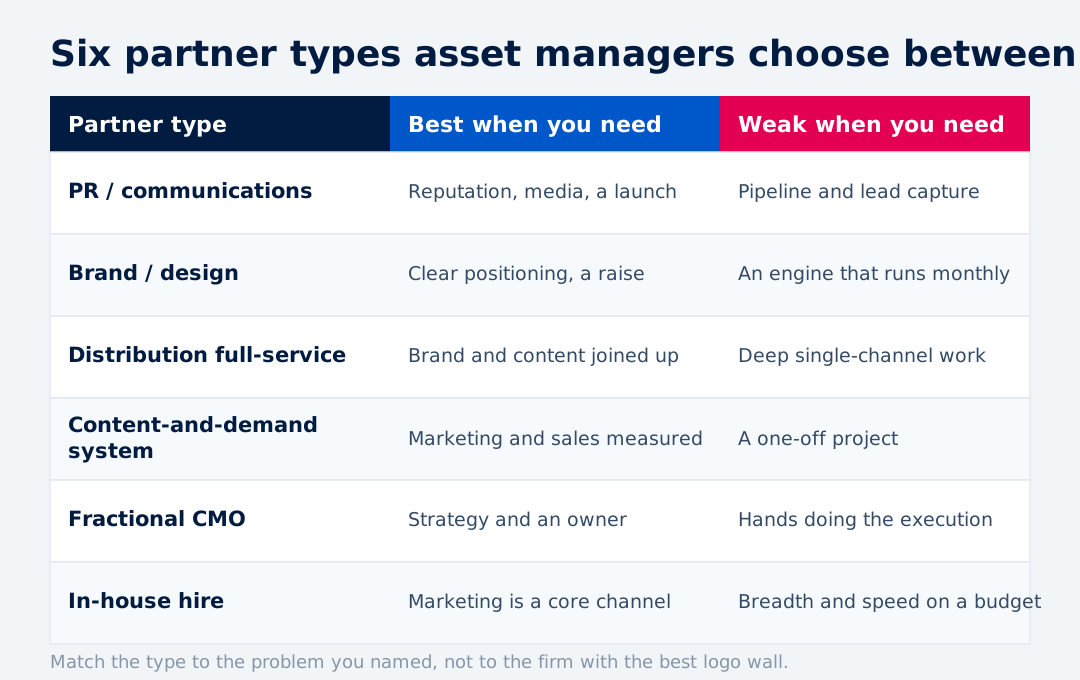
Here is the quick version:
Partner type | Best when your problem is | Weak when you need |
PR / communications | Reputation, media, a launch or crisis | Pipeline and lead capture |
Brand / design | Muddy positioning, a raise | An engine that runs monthly |
Distribution full-service | Connecting brand, content, and sales | Deep single-channel specialism |
Digital content-and-demand system | Marketing and sales disconnected, nothing measured | A one-off project |
Fractional CMO | Activity with no strategy or owner | Hands doing the execution |
In-house hire | Marketing is now a core funded channel | Breadth and speed on a budget |
How do you evaluate an asset management marketing agency?
Once you have a shortlist of the right type, evaluate each firm against the things that actually predict results for an asset manager. For each one, there is a question to ask and an answer worth trusting.
Do they build a system, or just produce content?
Ask how the work connects. A good partner describes a system: positioning feeds content, content feeds a hub that is built to convert, and the hub feeds capture and sales. A weak partner describes a content calendar. Only about one asset manager in 28 runs content as a system today, so a partner who can build one is rare and worth paying for.
Can they build decision-stage content and proof?
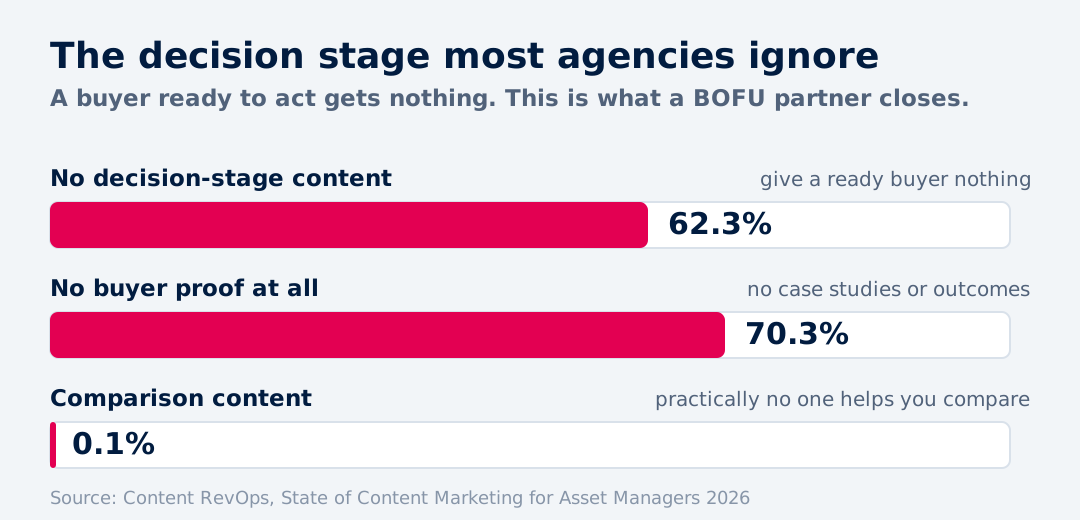
Ask to see how they help a buyer who is ready to decide. This is where the sector fails: 62.3% of publishers offer no decision-stage content, seven in ten show no buyer proof at all, and practically no one offers comparison content. A partner who only builds awareness content leaves the most valuable buyers with nothing.
Will they build capture and nurture you do not have to run?
Ask what happens after someone reads a good piece. Fewer than one firm in 20 captures a contact, which means most content has no way to turn a reader into a relationship. The way we approach this with clients is to treat a download as the start of the funnel, with an automated follow-up the client never has to run by hand, because speed of first follow-up is the lever. A good partner wires that; a weak one hands you a PDF and a hope.
Do they know the compliance workflow?
Ask directly whether they have worked under SEC Rule 206(4)-1 and FINRA Rule 2210, and how they build review into their process. You are not asking them to be your compliance officer; your CCO still approves. You are checking that they will not freeze when the rules apply or expose you when they do not.
Who actually does the work?
Ask who runs your account day to day, and meet that person before you sign. The senior people in the pitch are often not the ones doing the work, and a marketing manager spread across 30 to 50 accounts cannot give you real attention. Ask how many accounts each manager carries.
How do they report, and do you own your data?
Ask what you keep when you leave. You should own your website, your ad accounts, and your CRM data; if a partner runs ads under their own account or holds your site hostage, you start from scratch the day you leave. Insist that everything is built in your accounts, with CRM integration so you can see what converts.
What are the red flags when choosing an asset management marketing agency?
Some signals tell you to walk away before you waste a quarter and a budget. Watch for these.
They pitch before they diagnose. A partner who promises a big return on the first call, before understanding your numbers, is selling, not solving.
They brag about reach. If the proof is impressions, followers, or "awareness," and never leads, meetings, or assets, you are buying vanity. As one buyer put it, bragging about unmeasurable values "doesn't mean anything if you don't get any results."
Their only move is press releases. News and PR already make up nearly half of all asset management content and the median firm still earns about 214 visits a month. A partner who reproduces that pattern reproduces the result.
They want to own your accounts. If the website, ad accounts, or data live with them, that is a no.
They open with a big retainer and no scope. A large monthly fee before anyone has defined the problem is a flag, not a sign of seniority.
Their proof is thin or suspicious. Real case studies name the client and the number. Be wary of fresh, anonymous five-star reviews that read like they were planted, and call a reference yourself, ideally a client who left.
What does it cost to hire an asset management marketing agency?
Asset management marketing agencies charge in three main ways, and the right one depends on the problem you named earlier.
Retainer. A monthly fee for an ongoing scope. Most common, easiest to budget, best when you need a system run every month.
Project. A fixed fee for a defined deliverable like a website, a rebrand, or a launch campaign. Best for a one-time job.
Fractional or coaching. A monthly fee for leadership and guidance rather than execution.
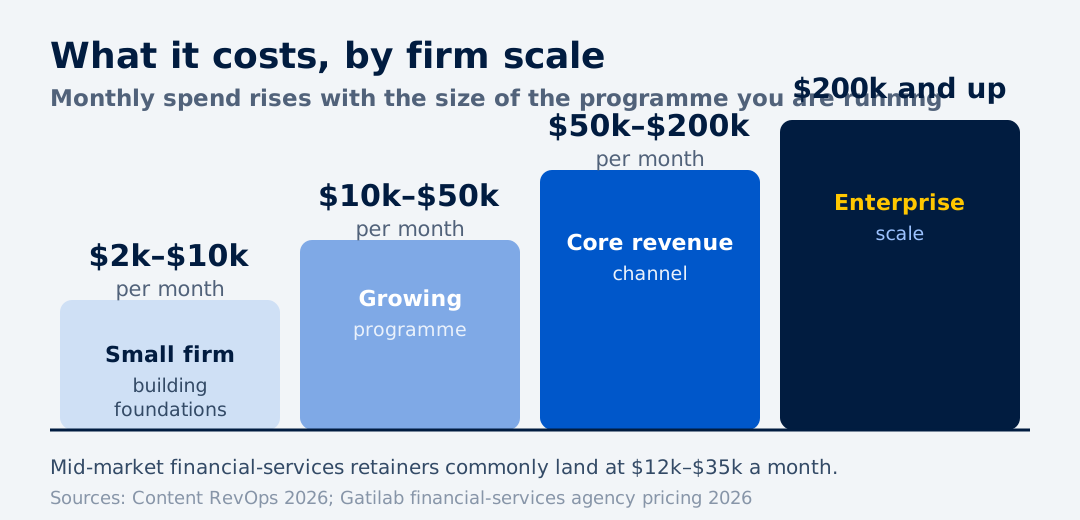
On price, our own data on how asset managers invest in content lines up with the broader market. A small firm building foundations should expect roughly $2,000 to $10,000 a month; a growing programme $10,000 to $50,000; a firm treating content as a core channel $50,000 to $200,000 and up. A specialist financial-services agency pricing guide reports the same shape: retainers from about $5,000 a month at the boutique end to $100,000 and more at the enterprise end, with a common mid-market band of $12,000 to $35,000. A fractional CMO in financial services typically runs $12,000 to $15,000 a month for leadership without the execution.
Two cost facts worth planning around. Compliance review adds five to ten business days to each deliverable, and ranking and pipeline impact take 6 to 12 months to show, so judge price against a real timeline, not a quick win.
How do you know an asset management marketing agency is working?
Agree on how you will measure the work before you sign, then hold the partner to it after. The sector's default is to measure traffic and stop; most firms cannot connect content to pipeline at all, so they report numbers they never act on. Do not accept that.
The metrics that matter for an asset manager sit down the funnel, not at the top:
Pipeline and meetings sourced, meaning qualified conversations with advisors or institutions that marketing started or touched.
Leads captured and nurtured, meaning named contacts entering a sequence, not anonymous page views.
Content-influenced flows and AUM, meaning the assets that can be traced back to a marketing touch.
Payback, meaning the cost to produce a paying relationship against what that relationship is worth.
This is the general rule in B2B marketing too: the honest measure is dollars and deals, not clicks, and a large share of closed-won deals carry a tracked marketing touch when you measure down the funnel instead of at the top. The way we price the gap for clients is to put a number on each leak, with the assumptions shown, so the result is arguable rather than a black box; you can run that same exercise with the benchmarking tool.
In the first 90 days, you are not looking for assets yet. You are looking for a clear plan, the system being built, and the measurement wired in. If a partner cannot show you what they will report before you sign, they will not report anything useful after. Our framework of marketing KPIs for asset managers separates the leading indicators you can read monthly from the pipeline and AUM numbers you read across the mandate cycle, which makes a useful template for that conversation.
What does the decision come down to?
Choosing an asset management marketing agency comes down to three moves, in order. Run the diagnosis first, with the benchmarking tool or your own honest audit, so you know the one problem you are hiring to solve. Match that problem to the partner type built for it, not to the firm with the best logo wall. Then evaluate the shortlist on the things that predict results for an asset manager: a real system, decision-stage content and proof, capture you do not run by hand, compliance fluency, clear ownership of your data, and measurement tied to pipeline and AUM.
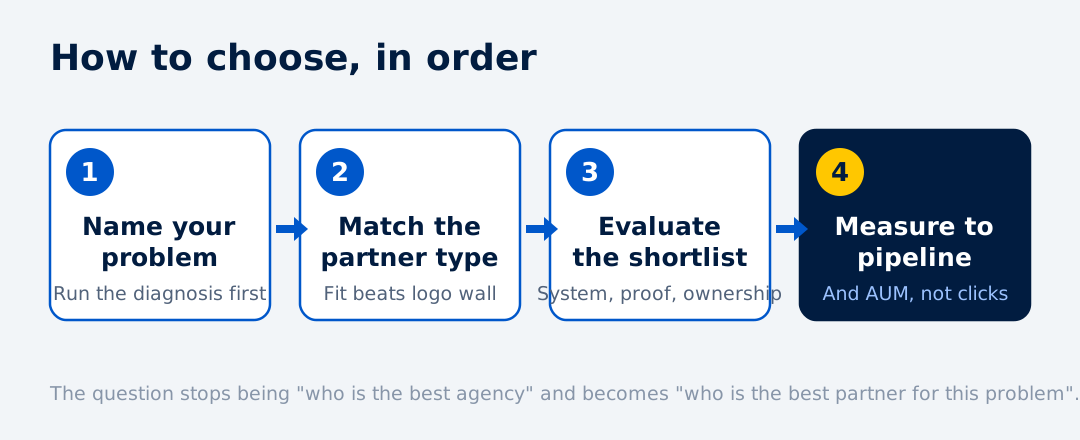
Do that, and the question stops being "who is the best agency" and becomes "who is the best partner for this problem," which is the only version of the question with a right answer. If you want to see how we think about building that system, start with how we work with financial services firms.
Hire for the problem, not the logo wall
See how we build the revenue system an asset manager actually needs, then choose the partner that can prove it. Start with how we work with financial services firms.
Frequently Asked Questions
About the Author

Founder & CEO, Content RevOps
Stefan Kalpachev is the founder and CEO of Content RevOps, where he helps B2B SaaS companies transform their content into predictable pipeline. With a background in content marketing and revenue operations, Stefan has developed a unique methodology that bridges the gap between content creation and revenue generation.
Connect on LinkedIn