Why Asset Managers Don't Show Up in AI Search (and How to Fix It)
Not sure whether AI answers name your firm or skip it? Benchmark your asset management content against 1,628 firms in minutes.
Book a CallMost asset management firms do not show up in AI search because answer engines cite content that is structured, specific, and decision-useful, and the industry mostly publishes press releases and brochures instead. When tools like ChatGPT and Google AI Overviews name an asset manager, they default to five consumer giants: Vanguard, BlackRock, Fidelity, State Street Global Advisors, and J.P. Morgan Asset Management. For almost everyone else, AI visibility sits near zero. The fix is not a new channel. It is the same build that fixes a leaking funnel: decision-stage content, visible proof, credentialed authors, and proprietary data an engine can lift and cite.
Part of Content Marketing for Asset Managers: The 2026 Playbook.
Why don't asset managers show up in AI search?
Asset managers do not show up in AI search because the content they publish is not the kind AI answer engines cite. Engines pull from pages that answer a specific question in a clear, liftable structure. Most asset management firms publish pages that announce the firm instead.
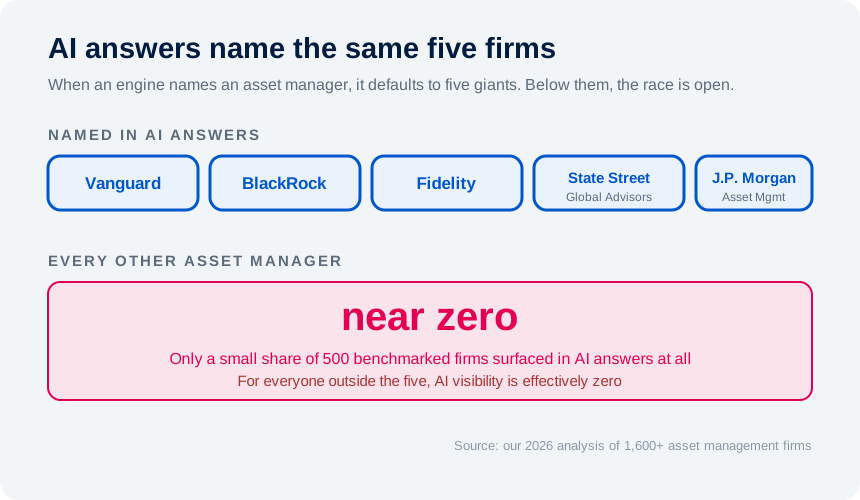
Our 2026 analysis of more than 1,600 asset management firms found that 59.6% show no meaningful content presence at all, and only about 1 in 28 run an active content system. When we tested the top non-branded industry questions across conversational search, only a small share of the 500 benchmarked firms surfaced in AI answers. The rest were invisible.
This is not bad luck, and it is not a mystery about how the models work. It is structural.
What AI answer engines actually reward
A University of Toronto study of ChatGPT, Perplexity, and Gemini ran controlled experiments across many queries and found that AI search has a "systematic and overwhelming bias towards earned media," meaning independent, third-party, authoritative sources, over brand-owned and social content. Google spreads its results across a more balanced mix. AI engines lean hard toward content built to be cited, which is also why ranking on Google does not guarantee a place in ChatGPT or Perplexity answers.
Content built to be cited is specific, well structured, and answers a real question on its own. A page that exists to say the firm has a "client-focused, experienced team" gives an engine nothing to lift. A page that explains how a corporate pension should evaluate a transition manager gives it a quotable, checkable answer.
The asset management industry publishes very little of the second kind. That gap, not the firm's size, is why it stays out of the answer. We see the same pattern across categories in why one brand gets cited while a better-known competitor gets ignored.
Which firms do AI answers name, and why those five?
When AI answers name a specific asset manager, they overwhelmingly name the same handful. In our testing, the engines defaulted to Vanguard, BlackRock, Fidelity, State Street Global Advisors, and J.P. Morgan Asset Management. Below that handful, the citation race is wide open.
Two things put those five in the answer, and only one of them is brand size.
They publish the content engines prefer
Conductor's 2026 analysis of financial queries found that article content is by far the most-cited page type in Google AI Overviews, and that financial publishers out-cite the institutions themselves. The engines reward the clearest explainer of a topic, not the biggest balance sheet. The giants happen to publish a lot of clear, structured explanation, so they win the citation by default while most firms publish none.
They own named, proprietary reference content
The clearest example is J.P. Morgan Asset Management's Guide to the Markets, the quarterly chart book led by Chief Global Strategist Dr. David Kelly. It is sourced, refreshed, and built as a reference, so advisers, journalists, and now answer engines lean on it. A smaller firm will never match its scale, but it can copy the model at its own: one named, proprietary, regularly updated resource that answers a question nobody else owns.
Every question has its own leaderboard
The reassuring part for a non-giant is that the five firms do not win every answer. Gregory's study of 201,233 AI citations in wealth management found that the mix of cited sources changes with every prompt. As its CEO Joe Anthony put it, "in traditional search there was one leaderboard; in AI search, every question creates a different leaderboard." For broad questions, big directories and media win. For a specific, niche question, a single well-structured firm page can beat national media outright. In one case a firm's page built for professional-athlete clients was cited in 42.8% of answers, ahead of Forbes at 2.9%. That is the opening for a firm that is not a household name.
Is AI search even worth it for asset managers right now?
Yes, because the opening is uncontested and the buyer has already moved. Outside those five giants, AI visibility in asset management is close to zero, which our research calls the single clearest first-mover opportunity in the sector. This is land that is empty right now and will not stay empty.
The reason to claim it now is not traffic. The AI-specific search terms in asset management barely register any volume yet, so this is a bet on being the cited answer when the buyer arrives, not on clicks this quarter. For the clicks that do exist today, SEO for asset managers is the foundation the AI layer sits on, and our search and traffic benchmarks show how thin that base is across the sector.
And the buyer is arriving. In Wealthtender's 2025 study of affluent US households, a quarter said they plan to start their search for a financial adviser in ChatGPT, Gemini, or a similar tool, and the same analysis notes that most searches now end without a click because the answer sits right on the results page. That figure is wealth and advisor scoped rather than institutional, but the direction is the same across the money: research starts in the answer engine, and if your firm is not in the answer, you are not in the consideration set.
Being in the answer matters because published insight already sways the decision. CoreData's 2025 survey of 154 institutional investors and consultants, who oversee about $4.9 trillion, found that 59% say thought leadership directly influences which manager they pick, and 99% say content shaped a decision. If the content that sways a mandate is now read inside an AI answer, being absent from that answer is a selection-stage problem, not a marketing one.
What makes content get cited by AI answer engines?
AI engines cite content that is easy to lift, easy to verify, and clearly tied to an authority. The giants have it by accident of scale. A smaller asset manager has to build it on purpose, and the moves are specific.
Structure the content so a machine can lift it
The Toronto researchers put "engineer content for machine scannability and justification" at the top of their practical agenda for AI visibility. In plain terms, that means a direct answer near the top, clear headings that match real questions, and self-contained claims an engine can quote without the surrounding page. We cover how to do that without hurting the reader in optimizing for AI Overviews without wrecking the page for humans, and whether it needs separate pages at all in do you need different content for AI search visibility.
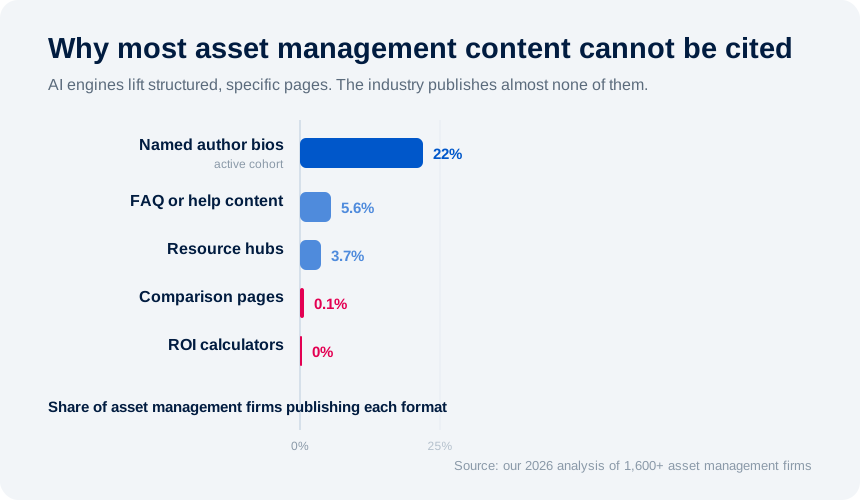
Most asset management content is the opposite. Resource hubs, the structural marker of organized content, appear on only 3.7% of firms. FAQ or help content sits on 5.6%. Comparison pages, which answer a question buyers actually ask, appear on roughly 1 in 1,000 sites, and ROI calculators are effectively nonexistent. The industry mostly publishes prose that announces, which an engine cannot cleanly lift.
Earn independent authority, not just brand presence
The same study found the earned-media bias is strong, so coverage and references from independent sources carry weight that your own homepage never will. The practical reading for a non-giant is to become the firm that credible third parties quote and link, through original data, named experts, and genuinely useful explanation.
Attribute every piece to a credentialed human
Only about 22% of even the active cohort maintain named author bios tying a piece to a real expert with credentials such as a CFA or CPA. In a category where the buyer is weighing trust, a credentialed, named author is one of the most direct authority signals available, and most firms skip it.
Publish proprietary data nobody else has
The firms in our active cohort that build real authority do it on proprietary data. Burgiss and Cerulli Associates publish original datasets that attract high-quality references and establish an authority competitors cannot copy. A proprietary number is the most citable asset a firm can own, because an engine answering a factual question has to point somewhere, and it points at whoever produced the figure.
Why is being invisible in AI search the same problem as your leaking funnel?
Because it is the same missing content. The pages that would get an asset manager cited by AI are the exact pages that would convert a visitor into a conversation, and most firms publish neither.
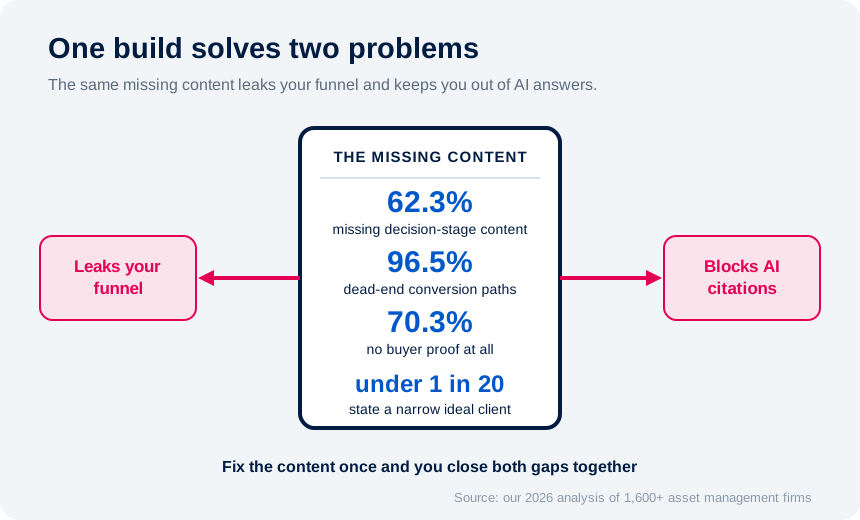
Look at where the funnel leaks in asset management. Among firms that produce any content, 62.3% are entirely missing decision-stage material like comparisons, pricing logic, and proof. 96.5% score at the bottom for conversion architecture, so content sits in isolation with no path to a conversation, and only 4.7% tie any lead capture to content at all. 70.3% show no buyer proof of any kind, and fewer than 1 in 20 state a narrow, specific ideal client.
Each of those gaps is also a citation gap.
The decision-stage content you are missing is the content AI cites
An engine answering "how should a mid-sized pension compare transition managers" needs a page that compares transition managers. Nearly two-thirds of content-producing firms do not have one. The same page would also be the page that helps a real buyer decide. One gap, two consequences.
Generic positioning breaks both at once
When a firm cannot say precisely who it serves, it cannot write the specific comparison, use-case, or proof content a specific buyer needs, and it cannot write the specific page an engine would cite for a specific question. The clarity problem and the content problem are the same problem. Vague positioning produces vague content, which produces the brochure, which produces invisibility in search and a stalled funnel together.
The PR reflex produces content that helps neither
The single most common asset in asset management is the press release, published by 44.1% of firms. A press release talks about the firm, not the buyer's problem, so it rarely converts a visitor and rarely earns a citation. The industry's default content type does the least work on both fronts, one of the biggest content marketing mistakes asset managers make.
This is why the fix is one build, not two. Closing the missing middle is also how a firm becomes citable. The decision-stage pages, the proof, the proprietary data, and the clear positioning that would make the funnel convert are the same assets that make a firm the answer an engine lifts. You are not choosing between AI visibility and pipeline. You build once and get both, and the content marketing strategies that work for asset management firms follow the same order.
How can asset managers get cited in AI search without breaking compliance?
You treat AI visibility as another distribution channel, which means it runs through your normal review process, not around it. The compliant path and the citable path are the same path.
The rules have not changed. The SEC Marketing Rule 206(4)-1, in force since November 2022, and FINRA Rule 2210 still govern how a firm presents performance, testimonials, and claims, whether that content lands on your website or inside an AI answer. AI visibility is not an exemption from your public-material standards.
The practical answer is a simple workflow. Split content into stable firm facts that marketing can publish and controlled claims, like performance and comparisons, that need review. Marketing drafts the answer, a subject-matter expert checks the facts, compliance approves the controlled language, then you publish and re-check the answer. SearchEye's asset-management AEO guide lays out the same sequence, and it is standard practice, not a special case.
There is an upside hiding in the constraint. Only about 1 in 5 of the active cohort turn the compliance calendar into thought leadership, publishing impact analyses of new rulings and tax changes. In a regulated industry the compliance calendar is a free, recurring content roadmap, and the compliant explanation of a new rule is exactly the structured, decision-useful page an engine wants to cite. The path that satisfies compliance is the path that earns the citation.
What should an asset management firm fix first to show up in AI answers?
Fix the content you already have before you commission anything new, then build the missing pages in the order that compounds. The moves below are ranked by what returns the most visibility for the least effort.
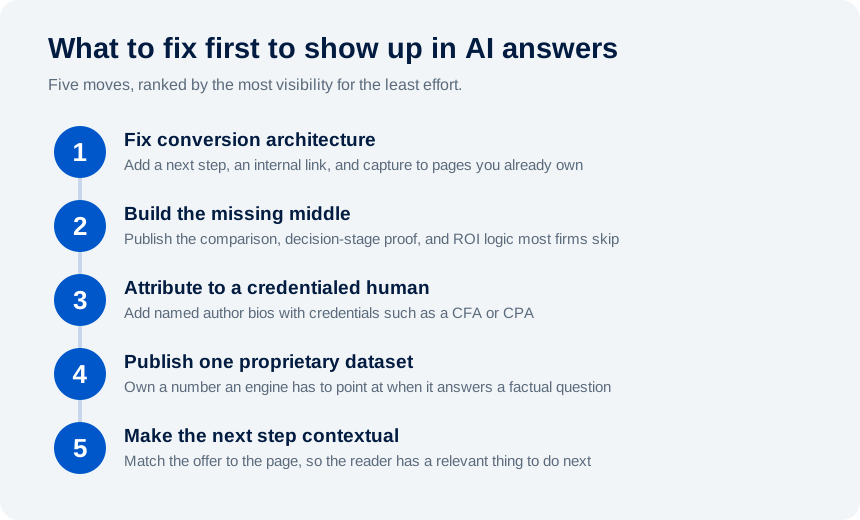
- Fix conversion architecture first. Add a contextual next step, an internal link, and a capture point to the content you have already published. This is the fastest return in the whole program because it is configuration, not budget, and it fixes the 96.5% dead-end problem on pages you already own. It is also why AI traffic so often fails to convert.
- Build the missing middle. Publish the comparison, the decision-stage proof, and the ROI logic two-thirds of firms skip. These are the pages that win deals and the pages engines cite.
- Attribute every piece to a credentialed human. Add named author bios with credentials such as a CFA or CPA. It is cheap to do and hard for the brochure majority to match.
- Publish one proprietary dataset. Own a number nobody else has, so an engine answering a factual question has to point at you.
- Make the next step contextual. Match the offer to the page, so a reader who just learned something has a relevant thing to do next.
Most firms already have the raw material for this. 90% keep a YouTube presence, and 64% posted organically on LinkedIn in the last quarter. The problem is that activity does not connect to a hub or a next step, and video on its own earns almost no AI citations, so the move is to turn that existing material into structured, citable pages rather than to post more of it. We break down how to do that in video marketing for asset managers and LinkedIn marketing for asset managers, and the wider sequence sits in content marketing best practices for asset managers.
Before you spend anything, find out where you actually stand. You can benchmark your own content against the industry and see our full approach to financial services marketing. When we run a content audit, we price AI-search invisibility as a real line of lost revenue, the share of category questions where the brand is absent, with the math shown so a firm can argue with the inputs. The point is not a score. It is knowing which of the five moves above closes the biggest gap first, and if you are still deciding where to begin, marketing for asset management firms, where to start maps the first move to your buyer.
The firms that treat content as revenue infrastructure rather than a brochure to be admired will own the AI answer while the rest are still publishing press releases. Outside five giants, the room is empty. The firm that walks in first gets to stay.
Want to know which questions your firm is missing from in AI answers?
Our content revenue audit tests your firm across the answer engines, names who gets cited instead, and puts a number on the gap.
Frequently Asked Questions
About the Author

Founder & CEO, Content RevOps
Stefan Kalpachev is the founder and CEO of Content RevOps, where he helps B2B SaaS companies transform their content into predictable pipeline. With a background in content marketing and revenue operations, Stefan has developed a unique methodology that bridges the gap between content creation and revenue generation.
Connect on LinkedIn