Marketing Funnel Optimization for Asset Managers
Not sure where your asset management funnel leaks? Benchmark your funnel shape against the field in minutes.
Book a CallMarketing funnel optimization for asset managers means fixing the points where buyers fall out between the first visit and a client conversation, which is the job a demand generation system built around pipeline exists to do. For most firms that is not a traffic problem. It is a shape problem.
Part of The Complete Guide to B2B Demand Generation Strategy.
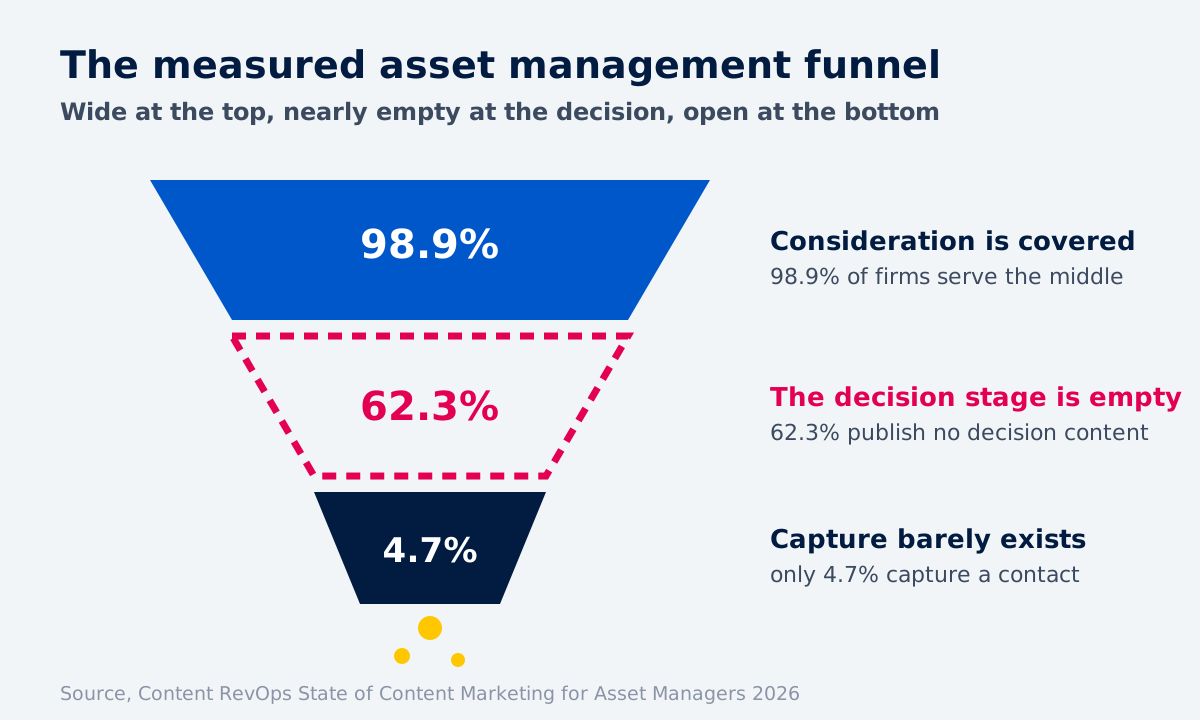
The typical asset management funnel is wide at the top and open at the bottom. Firms publish news and build awareness, then give a ready-to-act buyer almost nothing to act on. In our 2026 review of 1,628 asset management firms, 62.3% of publishers had no decision-stage content and 96.5% of their content ended with no meaningful next step.
So optimizing the funnel is not about pouring more visitors into the top. It is about building the missing lower half: the decision-stage content that helps an allocator choose, a capture layer that turns readers into contacts, and a way to measure the whole thing in money. This guide walks the five stages and fixes each one, and it sits inside our wider content marketing playbook for asset managers. You can see where your own funnel breaks in minutes with our asset management content benchmarking tool.
What does an asset management marketing funnel actually look like?
A marketing funnel for an asset manager is the path a buyer takes from first hearing about your firm to becoming a client. It has five stages.
Attract. A prospect discovers you through search, social, an event, or a referral.
Engage. They read more and go deeper into your thinking.
Convince. They weigh you against the alternatives and decide.
Capture. They give you a way to stay in touch.
Nurture and measure. You follow up, build the relationship, and track it to assets under management.
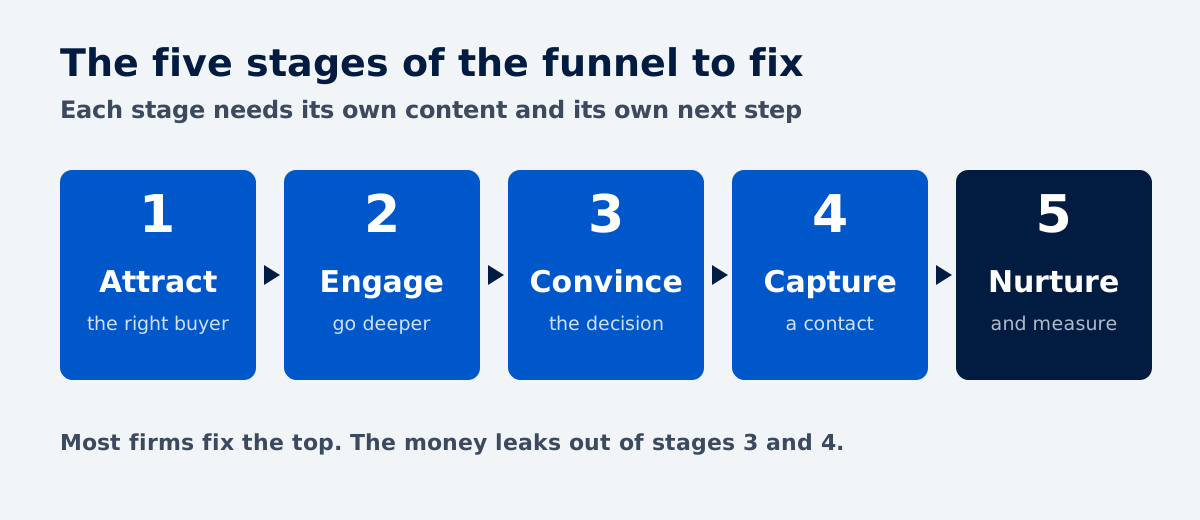
The textbook draws this as a neat triangle that narrows as buyers drop away, the shape we break down stage by stage in how the demand generation funnel works. The measured reality in asset management is different. Consideration content is well covered, with 98.9% of firms serving the middle of the funnel. Yet fewer than 1 in 20 firms capture a contact, and the decision stage in between is nearly empty.
That is a funnel wide at the top and open at the bottom. The money leaks out of the lower half. The way we design a funnel is to map that movement before any content gets made, with a named next action at every stage and a fast-track exit for buyers whose intent is already clear. The rest of this guide fixes the stages in order.
Stage 1, attract the right asset management buyer, not just traffic
The top of an asset management funnel should pull in the buyer who can become a client, not raw volume. Most firms get this backwards.
What the census shows asset managers doing wrong
Awareness is the biggest slice of search demand in the category, with 38.1% of keyword demand sitting at the awareness stage. That is a large pool to attract from. But firms attract badly.
Nearly half of what asset managers publish, 44.1%, is news and press releases. That is publishing as a press function, not a demand engine, and it is the first of the content marketing mistakes asset managers make. It fills the top of the funnel with people who read a headline and leave.
Fewer than 1 in 20 firms name a specific buyer, so most content speaks to no one in particular. And it shows in the result: the median firm earns about 214 organic visits a month. That is presence without performance.
How to fix the attract stage
The good news is that the category is winnable on the merits. 62.1% of the keywords asset managers rank for are non-branded, meaning most visibility comes from category terms, not just people typing a firm's own name. Our SEO playbook for asset managers covers how to earn that search demand in detail.
Three moves do the work.
Pick one buyer and answer the question that buyer actually types. We treat the ideal client as a hypothesis to pressure-test against won and lost deals, not an aspiration. A pension consultant, a wealth platform's due-diligence team, and a family office all search differently.
Educate on the terms people search, not the news you want to announce. The head term "asset management" draws about 33,100 searches a month and "what is asset management" draws about 6,600. Those reward the best educator, not the biggest brand.
Hold a clear position long enough to compound. A marketing manager in European asset management, Victor Roodhorst, found that a boutique named Lindsell Train is cited by AI tools more often than firms 160 times its size, because it tells one consistent story year after year. Size matters less than a position held, which is also why AI is changing top of funnel demand generation in favour of focused firms.
Start where the buyer starts. A new institutional sales director at Allspring, Jan-Hein Alfrink, told AMWatch his first move was to speak with investors and understand the challenges they are trying to solve before building any strategy. The top of the funnel works the same way, and so does marketing an asset management firm from a standing start: one buyer first, then one channel.
How to know it worked
The right CTA at the attract stage is a light one, like a subscribe or a follow, never a "request a meeting." You are checking whether the right people arrive and come back, not whether they buy on the first visit.
Stage 2, engage the considering buyer with somewhere to go deeper
The engage stage is where an interested buyer wants to learn more. Asset managers are present here but rarely organized, so the interest has nowhere to go.
What the census shows asset managers doing wrong
On paper, consideration is covered. Two-thirds of asset managers have an organic presence on LinkedIn, 64%, and consideration-stage content is nearly universal. The problem is structure, and our guide to LinkedIn marketing for asset managers shows how that presence rarely turns into pipeline.
Only 3.7% of firms run a real resource hub. So an investor who reads one good post finds no path to the next one. The content exists as scattered pieces, not as a journey. Consideration search is modest, at 12.3% of demand, but it is high-value, and it leaks straight back out when there is nowhere to go.
How to fix the engage stage
Give the interested reader a place to go deeper and a reason to take the next step.
Build a hub, not a blog. We treat the hub as a content product with several sensible next steps on every page, so a blog leads to a guide, the guide to a webinar, the webinar to a case study. The test is simple: if someone spent thirty minutes there, would they leave more capable?
Plan the stack so every piece points somewhere. We plan content top-down and publish bottom-up, anchoring blogs and social posts to a cornerstone asset rather than letting them float. For an asset manager that cornerstone is usually the manager's point of view on a theme, or a framework an allocator can use.
Concrete formats that work at this stage for asset managers include an explainer series on a strategy, a framework for a portfolio decision, and the portfolio manager's take on a live macro question. A short video series built from the input you already have is one of the cheapest ways to fill it.
How to know it worked
The CTA here is a download or a registration, something that signals real interest. You are watching whether readers move from one piece to the next, not whether they bounce after a single page.
Stage 3, convince the buyer with the decision-stage content the sector skips
This is the stage asset managers skip, and it is the one that decides who wins. Fixing it is the single highest-value move in the whole funnel.
What the census shows asset managers doing wrong
The decision stage is where a buyer compares options and commits. In asset management it is almost empty. 62.3% of publishing firms have no decision-stage content at all, so a ready-to-act allocator reaches the moment of choice and finds nothing to help.
Look at the specific formats that do the convincing, and the gap is stark.
Decision-stage format | Share of asset managers who publish it |
0.1% | |
3.6% | |
3.4% | |
0.0% |
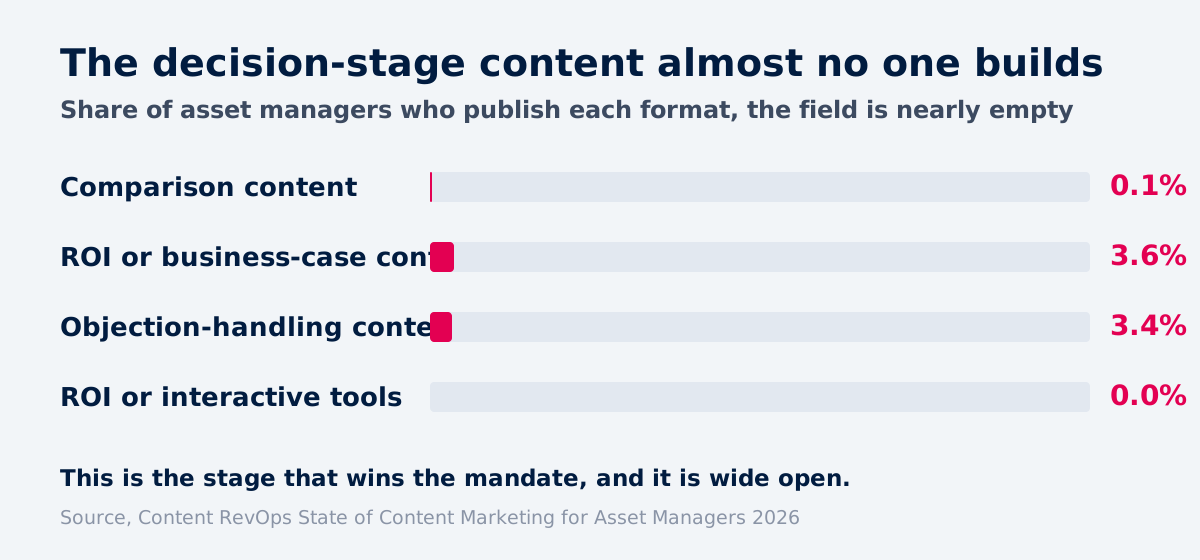
On top of that, 70.3% of firms show no buyer proof at all, no case studies, data, or outcomes, and only 5.5% publish a case study. Buyers get assertions where they need evidence.
Decision-stage search is small, at 3.8% of demand, but it is the money. This is exactly where intent is highest and competition is lowest.
Why decision content wins the mandate
Investors tell you plainly that this content moves the decision. CoreData surveyed 154 institutional investors and consultants overseeing more than $4.9 trillion, and 59% said the thought leadership a manager publishes directly influences their likelihood of investing with that firm over another. CoreData's own conclusion is that thought leadership rarely clinches a deal but keeps a manager on the shortlist, which makes it the price of entry.
How to fix the convince stage
Build the content a buyer uses to decide. For an asset manager that means five things.
The comparison. Help the buyer weigh you against the alternative honestly, whether that is a passive index product, the incumbent manager, or doing nothing.
The business case. Make the financial argument a champion needs to sell your firm internally, with the numbers shown.
The objection-handler. Answer the hard questions on fees, liquidity, capacity, and track record in content, rather than leaving them for the sales call.
The proof. Show a named case study or an attributed track record, so the claim is checkable. Our B2B demand generation case studies show what that looks like when the numbers are on the page.
The decision tool. Offer a diagnostic, an allocation modeler, or a simple calculator. Not a single firm in the study offered one, so a useful interactive tool tied to one real decision is pure open field.
How to know it worked
The CTA at this stage is the high-intent ask, a "talk to us" or "book an intro," and it belongs only here. You are measuring whether the buyers who reach your decision content convert faster and arrive at the sales conversation already half-sold.
Stage 4, capture the reader as a contact you own
Capture is the floor of the funnel, and in asset management it barely exists. A buyer can read everything you publish and leave without you ever knowing they were there. It is the demand capture half of demand generation, and the sector has barely started on it.
What the census shows asset managers doing wrong
Capture is the rarest competency in the sector. Only 4.7% of firms capture a contact, so email and nurture have nothing to work with. The reasons are mechanical.
Only 13.5% place a relevant CTA in the flow of the content, rather than a site-wide button that ignores what the reader is reading.
Only 5.2% use internal links that guide a reader toward converting.
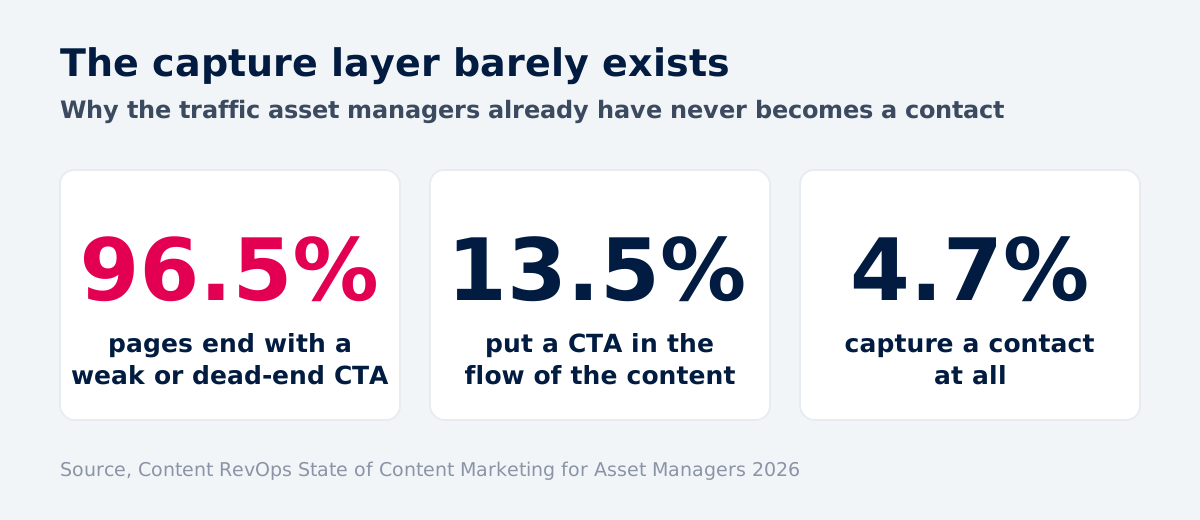
The traffic that does arrive leaves. The median firm's bounce rate is 40.7%, weak relevance and no next step.
How to fix the capture stage
Turn reading into a relationship with three mechanics.
Gate the asset that matches the intent. The research report, the benchmark, the allocation model. A buyer who wants it will trade an email for it.
Put the CTA in the content. Tie the ask to the subject on the page, not a generic banner. Someone reading about fee structures should meet an offer about fee structures.
Route with internal links. We design the hub so every asset points at a higher-intent one, moving a reader from a blog to a checklist to a case study. That is how you lift the 5.2% who guide readers to convert into the majority.
Capturing the contact is the start of the funnel, not the finish, which is exactly what the last stage is for.
How to know it worked
The CTA here is the capture itself. You are tracking the share of readers who leave a way to reach them, and watching that number climb from the sector's 4.7% toward something that feeds a real pipeline.
Stage 5, nurture the contact and measure the funnel to AUM
The last stage compounds the contact and proves the whole funnel in money, not clicks. It is where optimization finally has a scoreboard.
What the census shows asset managers doing wrong
Most firms cannot connect content to pipeline. Attribution and automation are rare in the sector, so firms measure traffic they never act on. Without that, funnel optimization is guesswork, because you cannot see which stage is leaking.
The irony is that the measurement stack usually exists. The content and the capture that would feed it do not.
How to fix the nurture and measure stage
Close the loop with three habits.
Automate the follow-up, and make it fast. In a recent gated-report campaign we ran for an asset manager, we treated the download as the start of the funnel, with an automated nurture and a fast first follow-up the firm never has to run by hand. Speed is the lever: the Harvard Business Review study on online leads found that contacting a lead within an hour makes you about seven times more likely to have a qualifying conversation than waiting even an hour longer, and sixty times more likely than waiting a day. That is a general B2B finding, and it holds for a slow institutional sale too.
Measure stage to stage, then reallocate. Watch where buyers fall out and move budget to that stage, using the demand generation metrics worth tracking rather than page views. A finance marketing agency, Fundamental Media, runs asset management campaigns as a three-phase funnel, broad reach, then converting awareness into demand, then retargeting for conversion, and reports cutting cost per visitor by 65% on one integrated campaign by reallocating rather than spending more.
Price every gap so the funnel reads in money. We convert each gap into a dollar figure with the assumptions shown, running visitors through a visitor-to-lead-to-client model at category economics, so the number is one a buyer can argue with rather than dismiss.
This is the stage that matters most to the business. BCG argues that for asset managers, distribution has replaced investment performance as the primary competitive advantage, but most firms lack the systems to compete on it. A funnel you can measure is that system.
How to know it worked
The CTA for this stage, and for the whole piece, is to benchmark your own funnel against the sector. You can score your shape in minutes with our asset management content benchmarking tool.
Where asset managers should start fixing the funnel
Fix the bottom before you widen the top. More traffic into a funnel with no decision content and no capture just wastes more money, and a marketer on LinkedIn put it well: more traffic makes a good system better and a broken one worse. It is the same reason most demand generation frameworks get built backwards.
So build in this order. Add the decision-stage content first, because 62.3% of firms have none and it is what wins the mandate. Add the capture layer next, because only 4.7% of firms have one. Then optimize the attract stage, once there is somewhere for the traffic to go. The content marketing best practices for asset managers cover what good looks like at each step.
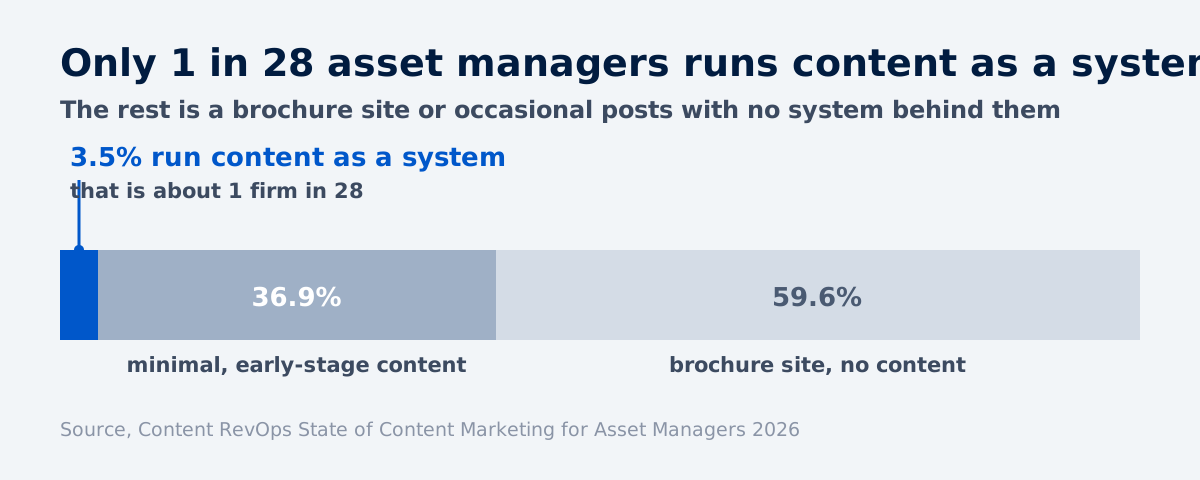
This is less common than it should be. Only about 1 in 28 asset managers runs content as a system; the rest is brochure or noise. A funnel is not a diagram, it is a management system, where each stage has an owner, a definition of a qualified lead, and a next action. That discipline, not more traffic, is what turns an asset management funnel into a pipeline. See where yours breaks first with the benchmarking tool, or how we help asset managers build the system.
Want to see where your asset management funnel breaks first?
Our asset management content benchmarking tool scores your funnel against the sector and shows which stage to fix first.
Frequently Asked Questions
About the Author

Founder & CEO, Content RevOps
Stefan Kalpachev is the founder and CEO of Content RevOps, where he helps B2B SaaS companies transform their content into predictable pipeline. With a background in content marketing and revenue operations, Stefan has developed a unique methodology that bridges the gap between content creation and revenue generation.
Connect on LinkedIn