The Biggest Content Marketing Mistakes Asset Managers Make
Not sure which of these mistakes is costing your firm the most? Run your site through the asset management content benchmarking tool and get a scored gap list in minutes.
Book a CallThe biggest content marketing mistakes asset managers make are not creative failures. They are structural ones, and each has a price. Most of the challenges in asset management marketing come down to a single habit: firms treat content as a press function instead of a revenue engine built on content marketing, so the spend produces output that informs but never moves a mandate.
Part of Content Marketing for Asset Managers: The 2026 Playbook.
We reviewed 1,628 asset management firms and found that only about 1 in 28 runs content as a system. The rest publish into a void. Below are the six mistakes we see most often, what each one costs your firm, and how to fix it.
Mistake 1. Running content as a press function, not a revenue engine
Most asset managers publish announcements and market commentary. It feels like marketing because something ships every week, but almost none of it is built to help an investor make a decision.
That is the costly part. When content is a press function, every dollar and every hour goes to output that informs and then stops. It does not qualify a buyer, it does not capture a contact, and it does not move a mandate. You are paying to stay visible, not to grow.
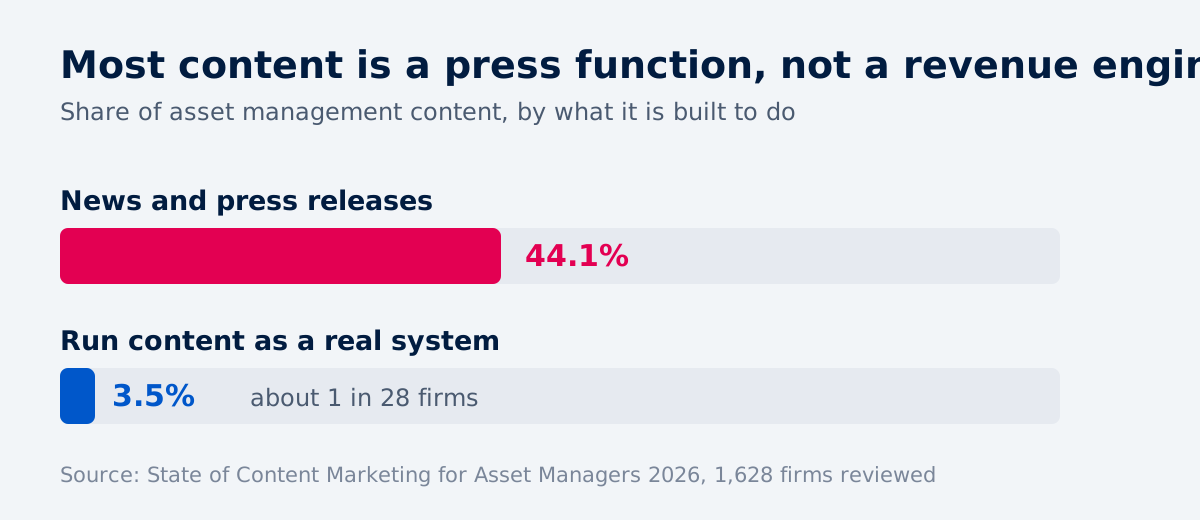
The numbers show how widespread the habit is. Across the firms we reviewed, news and press releases make up 44.1% of all content, the single largest category. Publishing runs as a press function, not a demand engine. Only 3.5% of firms run content as a real system, about 1 in 28.
An outside study says the same thing from a different angle. Peregrine Communications reviewed 100 asset managers and found that 56% of their websites are mostly promotional and 62% focus on market commentary, while only 14% carry genuinely educational, varied content. The material exists; it just is not built for the buyer.
BCG's 2026 Global Asset Management Report names the root problem plainly. Distribution across the industry is "artisanal, under-instrumented, and difficult to scale," and these "are not sales problems, they are architecture problems." Most firms, in BCG's words, "lack the systems to compete." Content is part of that architecture, and run as activity it never becomes a system.
The fix. Give every piece a job in the buyer's decision: attract, educate, prove, or capture. Retire the announcements that do none of those. If most of your output is news and commentary, this mistake is yours.
Mistake 2. Sounding exactly like every other asset manager
Open ten asset managers' websites and you will read the same words. Global. Long-term. Innovative. Independent. The firm is specialized, but the language could belong to anyone.
The cost of sounding generic is that the investor cannot judge your value, so the decision falls back to fees and past performance. You end up competing on the two things you control least, and you drop off the shortlist in favor of a manager who is merely clearer about what they do.
The gap is measurable. Fewer than 5% of asset managers commit to a narrow, specific ICP; generic sophisticated-investor language dominates the rest. Peregrine's review found managers leaning on the same ten "elevator pitch" terms: global (34%), long-term (32%), innovative (24%), leading (20%), experience (13%), independent (13%), expertise (12%), diversity (11%), values (11%), and responsible (10%). One manager focused on mid-term European credit described itself as "international, long-term, multi-asset." When the words are identical, the investor has nothing to compare.
That matters because the content is part of the selection. CoreData's 2025 survey of 154 institutional investors and consultants found that 59% say thought leadership directly influences which manager they invest with. CoreData calls strong content "the price of entry." Sameness costs mandates.
The fix. Name one narrow ICP and say the specific thing you do for them. Cut the "global, long-term, innovative" register. If your elevator pitch could belong to any manager, this mistake is yours. The small active cohort of asset managers shows what specific sounds like.
Mistake 3. Publishing for awareness and skipping the decision stage
Most asset managers cover the top of the funnel well. They explain markets, post outlooks, and comment on the news. Then the content stops exactly where the buyer is deciding.
The cost here is the steepest, because the expensive end of the funnel sits empty. You attract readers who are not ready to act, and the investor who is ready to allocate finds nothing that helps them choose you. Demand you created with all that awareness content walks over to a competitor who answered the decision question.
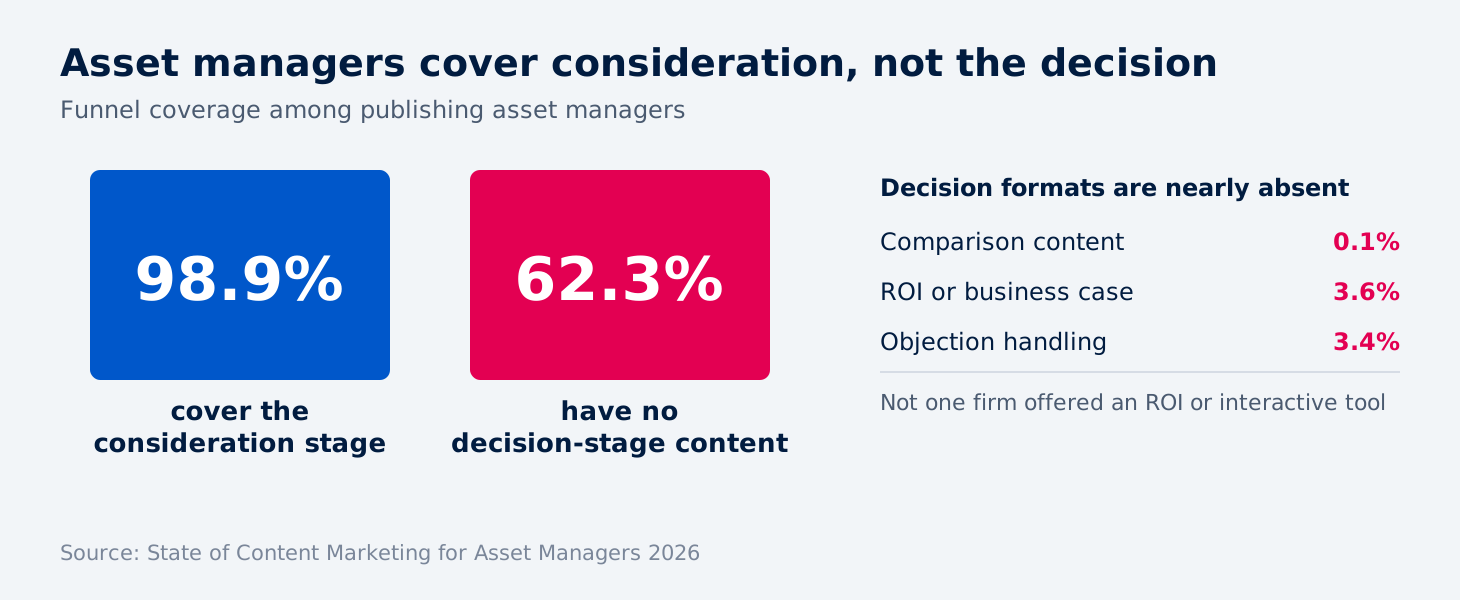
The gap is specific. 62.3% of publishing asset managers carry no decision-stage content at all, even though 98.9% cover the consideration stage. The decision-stage formats a buyer actually needs are nearly absent: comparison content appears in 0.1% of firms, ROI or business-case content in 3.6%, and objection-handling content in 3.4%. Not one firm we reviewed offered an ROI or interactive tool.
Even the search demand is unclaimed. Decision-stage keywords make up 3.8% of the category's search, small but high-value, and almost nobody is writing for it. VettaFi makes the same case to asset managers, urging them to "lean into lower-funnel tactics that demonstrate intent."
The fix. Build the pieces a buyer needs to choose: a comparison, an ROI or business case, and honest objection-handling. If you have a blog but no page that helps a buyer choose you over the next manager, this mistake is yours.
Mistake 4. Giving investors no proof they can check
Asset managers make claims in their content. Disciplined process, strong risk management, alignment with clients. What they rarely do is show proof a reader can check.
The cost is a stalled mandate. Without evidence, the content is an assertion, and an institutional allocator or an advisor does not move money on an assertion. The trust gap opens at exactly the point where a case study or a piece of outcome data would have closed the deal.
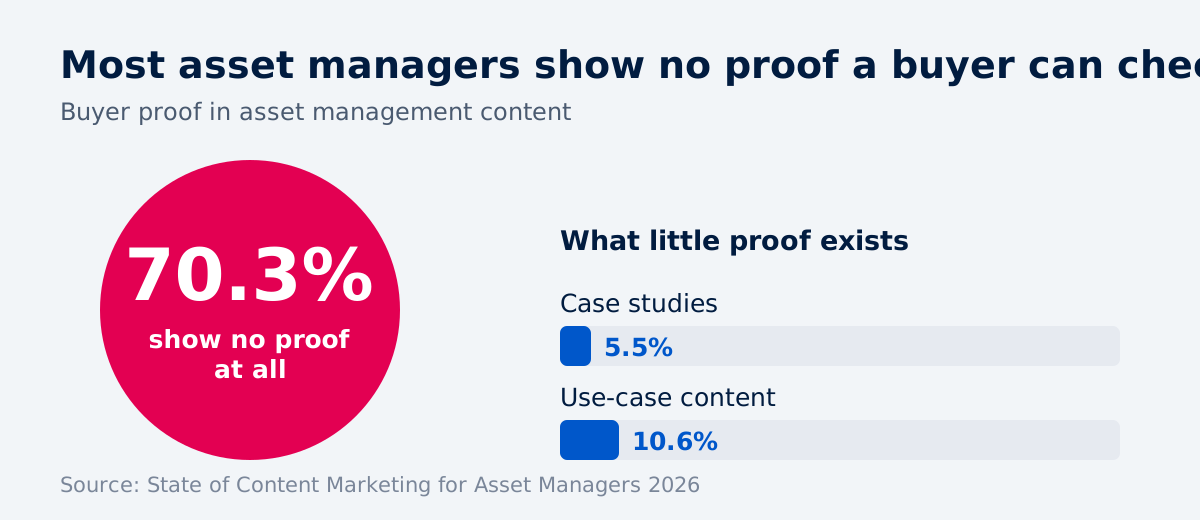
Proof is the rarest thing in the category. 70.3% of asset managers show no buyer proof at all, no case studies, no data, no outcomes. Case studies appear in just 5.5% of firms and use-case content in 10.6%. Buyers are handed claims and asked to believe them.
Practitioners feel it. Sune Mortensen, a partner and chief financial and capital officer at IIP Denmark, put it this way to AMWatch: "People outside the asset management industry tend not to understand how much of the business comes down to trust." Proof is how content earns that trust before a sales conversation ever starts.
The fix. Put checkable proof inside the content: named case studies, outcome data, and specifics instead of adjectives. If your content asks to be believed rather than shows evidence, this mistake is yours.
Mistake 5. Letting content dead-end with nowhere to go
An investor reads your market outlook, nods, and leaves. There was no next step, no offer, and no way to stay in touch. The visit you worked to earn is gone.
This is the cheapest mistake to fix and the most common one we see. You pay in time and spend to bring a reader in, then you let them leave with nothing. The funnel has no floor, so nothing compounds; every month starts from zero.
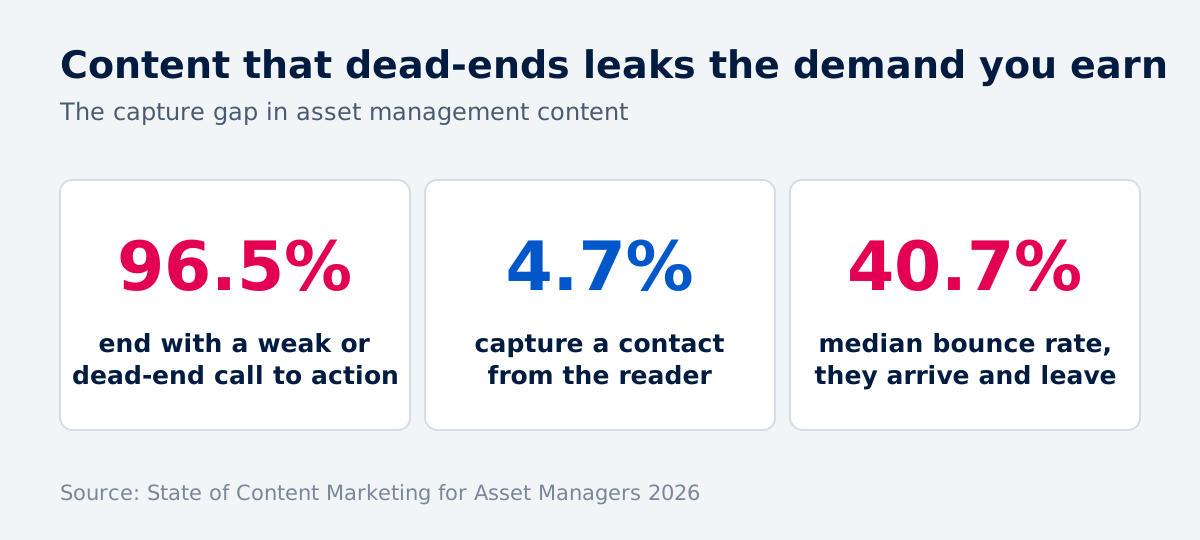
The leak is almost universal. 96.5% of asset management content ends with a weak or dead-end call to action. Only 4.7% of firms capture a contact, 13.5% place a relevant CTA in the flow of the content, and 5.2% use internal links to walk a reader deeper toward a decision. The result shows up in the traffic: the median firm's bounce rate is 40.7%, readers arrive and immediately leave.
The fix. Give every page one relevant next step and a simple way to capture the contact, then keep the conversation going and link readers deeper toward a decision. If your content ends with nothing to click, this mistake is yours, and it is the fastest one to repair.
Mistake 6. Measuring reach instead of AUM and pipeline
Ask most asset management marketing teams how content is doing and you will hear impressions, followers, and page views. You will rarely hear about pipeline, mandates, or assets under management.
The cost is the one that ends programs. When you measure reach, you optimize the wrong number, you cannot tie content to a single mandate, and the moment budgets tighten the program cannot defend itself. It gets cut before it ever had the chance to compound.
Few firms can connect content to money. Attribution and marketing automation are rare across the category; most firms measure traffic they never act on. And the traffic itself is thin: the median asset manager earns about 214 organic visits a month, presence without performance.
Cindy Fox-Toner, who supports asset managers on social at Hewes, named the mistake directly: asset management marketers keep "measuring that against mass-market metrics: impressions, follower counts, reach," which are "vanity metrics" that "mean almost nothing to the advisor deciding whether to allocate." Her rule is the right one: resonance beats reach, the same principle behind LinkedIn marketing that moves asset managers from presence to pipeline. BCG points at the plumbing behind the problem, noting that insights like share-of-wallet analysis "remain disconnected from CRM systems." If content never reaches the CRM, you cannot manage it to AUM.
The fix. Measure to pipeline and AUM, connect content to the CRM, and report mandates influenced rather than impressions earned. If your marketing report leads with reach, this mistake is yours.
Which mistake should you fix first?
Fix these in the order of what they cost, not what they take.
Stop the leak first. Mistake 5 is the cheapest to repair and the fastest to pay back. Adding a real next step and a way to capture contacts keeps the demand you already earn from walking out the door.
Fill the decision stage and add proof next. Mistakes 3 and 4 are the highest-value gaps, because they win mandates that are already in motion. A comparison, a business case, and a real case study move buyers who are close to choosing.
Fix measurement so the rest can be funded. Mistake 6 is what protects the budget. Once content reports to pipeline and AUM, the program can prove its worth and keep investing.
Reset the press-function habit and the sameness last. Mistakes 1 and 2 are the slower, structural fixes, a change in how the whole content function is briefed and positioned. They matter most over time, and they are the hardest to turn.
The honest first step is to see which of the six apply to you. Run your own site through our asset management content benchmarking tool, read the full State of Content Marketing for Asset Managers to see where you sit against the field, and start with the mistake that is costing you the most. For the fixes written out as a playbook, see the content marketing best practices for asset managers. If you want the model behind this, our approach to content as revenue infrastructure explains how the pieces fit together.
Ready to stop the leaks and turn content into a system that moves AUM?
We install the system behind it, so your content works as revenue infrastructure instead of a press function.
Frequently Asked Questions
About the Author

Founder & CEO, Content RevOps
Stefan Kalpachev is the founder and CEO of Content RevOps, where he helps B2B SaaS companies transform their content into predictable pipeline. With a background in content marketing and revenue operations, Stefan has developed a unique methodology that bridges the gap between content creation and revenue generation.
Connect on LinkedIn