How We Help You See Which Page Started the Deal

Try this with your last five closed deals: name the first piece of your content each buyer read. Not the form they converted on, the page that started them moving.
Almost nobody can. Not because the answer is unknowable, but because nothing in the standard setup records it.
The tools are rarely the problem. Web analytics runs on three quarters of B2B sites, and whether a page connects to pipeline is a question a tag never answers on its own.
This page completes a promise. Our pages on getting more business from content and making expensive channels work harder both lean on measurement; this is the measurement itself, the wiring we build inside our marketing automation engagements.
One position stated up front, because it shapes everything below: perfect attribution is impossible, and that is fine. Some influence happens in channels nothing can track. The teams that measure well have stopped pretending otherwise, and build a decision-grade map from three honest sources instead of a court-grade model from one dishonest one.
What does the measurement gap look like?
Four symptoms, and most companies we audit show at least three.
Blindness with a dashboard
56% of B2B marketers say they struggle to attribute ROI to their content, and the same share struggle to track customer journeys. Only about 1 in 5 rate their own measurement as highly effective.
And the problem is getting worse, not better: industry surveys now put proving ROI as the top challenge for 68% of B2B marketers, up from 40% in 2023.
The paradox deserves unpacking. Teams have more dashboards than at any point in marketing history: sessions, rankings, downloads, engagement, all measured to the decimal. What is missing is the join between any of it and a closed deal, so the data is plentiful exactly where the decisions are not made.
The missing spine
Measurement assumes there is somewhere to record the journey. Often there is not: 45% of high-growth B2B companies show no web-detectable CRM, and in some verticals about 70% lack an integrated CRM-and-automation backbone.
Without the spine, every content touch evaporates on contact. The buyer read four articles and attended a webinar; the CRM shows a name, an email, and a created date. You cannot read back a path that was never written down as it happened.
Credit lands in the wrong place
Even with the tools installed, the default models over-credit the end of the journey. Last-touch attribution hands the win to branded search and direct traffic, which is usually the buyer who already decided, typing your name to come convert. The model credits the symptom of the decision, not its cause.
How wrong can it get? Refine Labs ran software attribution and buyer self-reports side by side across 620 conversions and $21.5M in closed revenue. Buyers attributed 53% of that revenue to a podcast; the software attributed 0% to it. The mechanics are simple: there is no pixel on a podcast, a community thread, or a peer recommendation, so the software hands their credit to whatever trackable step came last.
Even the asking gets botched. One analysis found 47% of leads who chose the first dropdown option in a "how did you hear about us" field were inaccurately attributed; a dropdown invites the lazy click, so the first option absorbs everyone in a hurry.
The invisible majority
Gartner research puts 70 to 80% of the B2B buying journey before any vendor contact, and 6sense's study of nearly 4,000 buyers puts first vendor contact at around 61% of the way through the journey. Forrester finds 92% of buyers begin the process with at least one vendor already in mind.
That preference forms in channels with no pixel: peer conversations, communities, review sites, podcasts, and increasingly AI answers. By the time your form fires its first tracked event, most of the persuasion has already happened, and the research says the eventual winner is almost always on the buyer's day-one shortlist.
The honest implication: some of the journey stays dark no matter what you install. That argues for triangulating what you can see and investing in presence where you cannot, never for surrendering measurement entirely, and never for trusting the one model that claims to see everything.
Why does it happen?
Nobody owns the join. Analytics ends where the CRM begins. The web team owns one system, sales operations owns the other, and the connection between them sits in nobody's job description, so it never gets built.
Models report the visible slice as the whole. Standard attribution windows capture an estimated 20 to 40% of a buying journey that averages around 211 days. A model built on that slice still reports with total confidence, and precise-but-wrong beats vague-but-honest in most dashboards, so budgets follow the mirage.
Teams are staffed to report, not to wire. In our hiring analysis, data and analytics fluency appears in roughly two of three marketing roles. Companies hire people to prove results; the plumbing that would make proof possible is assumed to exist, and usually does not.
Perfection paralysis. Because full attribution is impossible, many teams conclude the effort is pointless and keep whatever default their tool shipped with. The right response to an unmeasurable portion is to measure the measurable portion well.
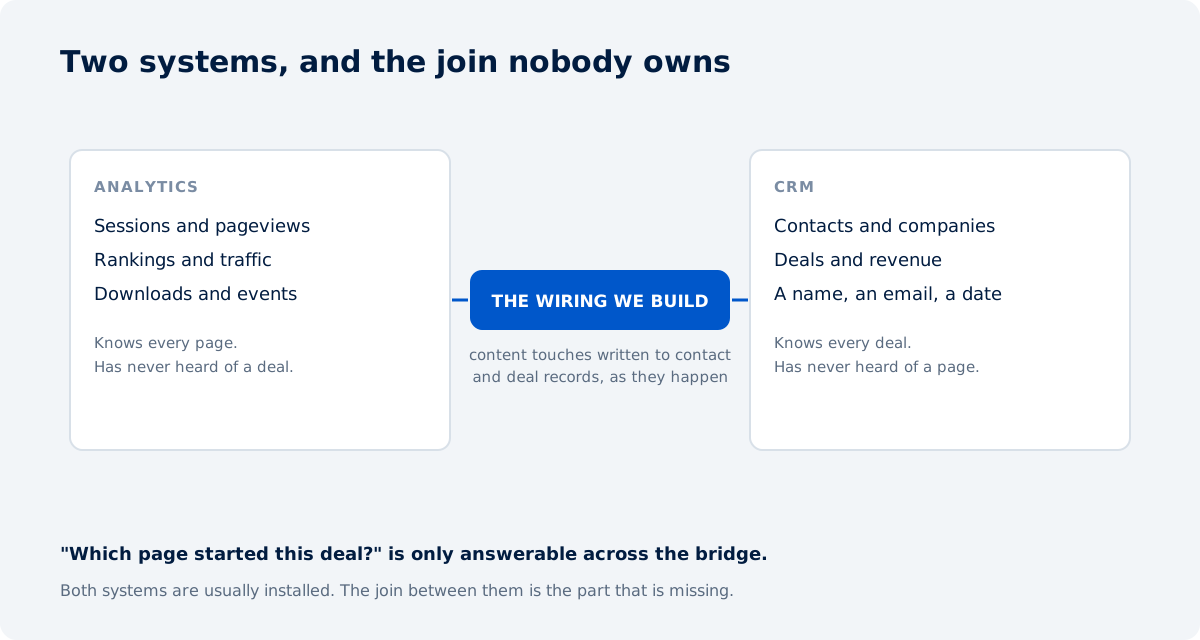
How do we wire the visible path?
We make the trackable part of the journey actually get tracked, end to end, into the system where the deals live.
The principle: every content touch becomes a fact on a contact record, and every deal record can answer the question this page is named after.
What we record | Where it lives | The question it answers |
Consistent tracking on every page and asset | Analytics, passed through to the CRM | Which page and asset each visit came from |
Content touches as contact fields and campaign memberships | The CRM contact record | What this person read, downloaded, and attended before converting |
First content touch and converting asset | The CRM contact record | Which page started it, and which asset closed the loop |
The content path, rolled up per deal | The deal record | Which pages, assets, and webinars sat behind this revenue |
None of this is exotic. It is discipline, not tooling: a standing rule that no asset ships without tracking, forms that write to fields instead of inboxes, and one owner for the join between the systems. Inside our engagements, that owner is us.
The payoff shows up in what becomes provable. For one self-serve software client, clean event and tracking design was the entire difference between organic looking like a cost and organic proving its revenue deal by deal. The capture and routing machinery this feeds is covered on its own page.
How do we ask the buyer?
A free-form "how did you hear about us" goes on every conversion surface, and the answers get treated as first-class data.
Free-form is the load-bearing word. A dropdown pushes people toward the first plausible option, which is how 47% of first-option answers turn out to be wrong. A blank box gets the real story: "a colleague shared your teardown in our Slack," "I heard the CEO on a podcast," "ChatGPT recommended you."
The question also does a different job than software does. Tracking records how someone arrived today; the question asks where the journey actually began, which is usually further back and somewhere untrackable. This is the only instrument that captures podcasts, communities, peer referrals, and AI recommendations, because it asks the one witness who was present for the whole journey.
Operationally: the answers get classified into channels every month and read next to the software numbers. One client asks the question directly on the demo booking form, so every sales meeting arrives with the buyer's own account of what brought them; that account regularly names content the tracking never saw.
One pattern worth watching in those answers: buyers increasingly write some version of "I asked ChatGPT." When that starts appearing, the AI-search page is the playbook for making it appear more often.
How do we read it without fooling ourselves?
Three lenses on the same deals, and a rule: trust the agreements, investigate the disagreements.
The wired path. What the software recorded: pages, assets, webinars, sequences.
The buyer's answer. What the person says started it, catching the channels software cannot see.
The proxies. Branded search volume, direct traffic to high-intent pages, and share-of-answer probes for the AI layer, the signals that move when invisible presence is growing.
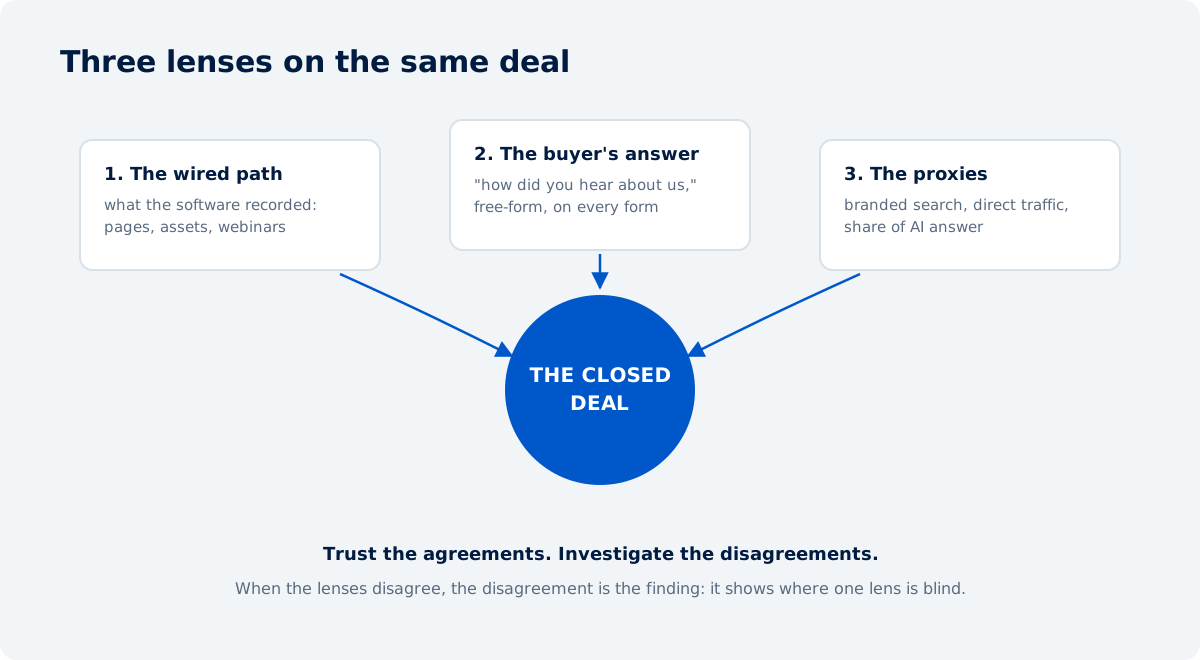
Triangulation is what makes the map honest. When the software says the comparison guide starts deals and buyers keep naming it too, invest with full confidence. When the software credits nothing to webinars and buyers keep mentioning them, the software is blind there, not the webinar worthless; that disagreement is the Refine Labs finding in miniature, and it should redirect budget, not get reconciled away.
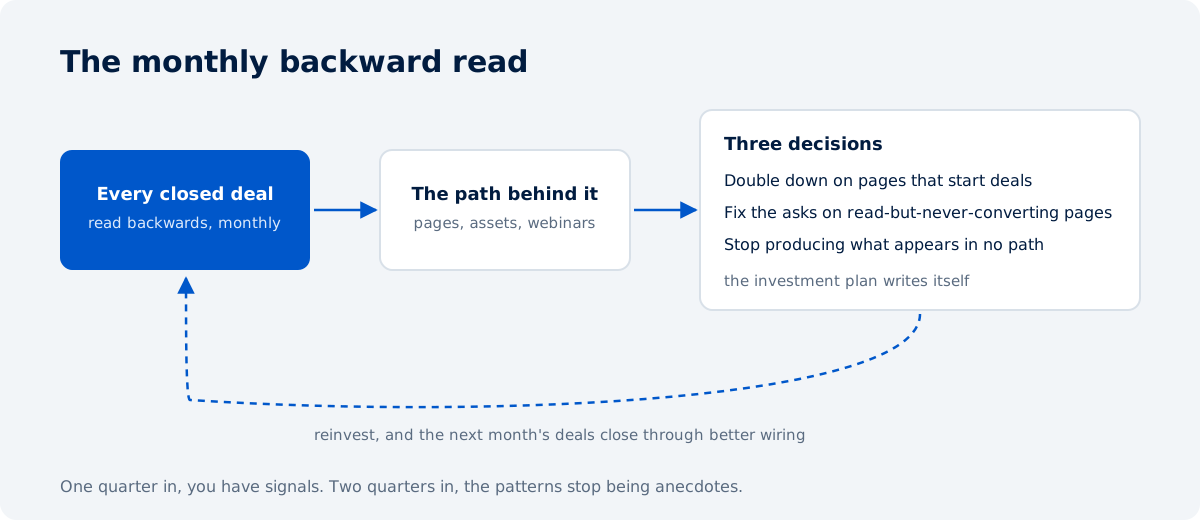
Then the reading becomes a ritual: once a month, every closed deal gets read backwards, and the read drives three decisions. Double down on the pages that keep starting deals. Fix the asks on pages that get read but never appear in a path. Stop producing the categories that appear in no path at all. Our chapter on reporting and progress covers the cadence this feeds.
And the honesty that holds it together: this map is decision-grade, not court-grade. It will never capture the Slack DM or the recommendation over dinner. The answer to the unmappable part is presence, being in the communities, the answers, and the feeds where preference forms, and the map's job is to tell you whether that presence is paying. The same triangulation is how we price the expensive channels against the estate underneath them.
What does it change?
The first change is political, and it matters more than teams expect: the budget conversation. High-growth companies are about twice as likely to track revenue attributed to marketing, and the causality runs both ways: proof protects budget, budget feeds the system, the system generates more proof. Teams that cannot show the number are first in line for cuts, whatever their actual contribution was.
The client results read differently on this page than on the others, because here the measurement is the point. For GRC, an education-led program produced more than $1M in attributable revenue within six to nine months, and attributable is the word doing the work: the wiring existed from day one, so the number was readable and defensible rather than argued about. For Westlab, the content investment returned a measured 869%, with $120K in influenced quotes readable straight from the deal records.
We have also watched engagements expand for no reason other than the influence number finally being visible. The work had not changed; the proof had.
The wiring lands in weeks
Tracking conventions, CRM fields, form updates, and the self-report question are plumbing, not production. Nothing waits on new content or new rankings.
The reads compound as deals close
Each closed deal adds a data point to the map. One quarter in, you have signals; two quarters in, the patterns stop being anecdotes and start being the investment plan.
How do you find out where you stand?
The measurement pass of our free content revenue audit runs the diagnosis:
The five-deal test, live: pick your last five closed deals and trace what each buyer touched.
A stack inventory: what exists versus what is actually wired to what.
The mirage check: what your software credits versus what your buyers say.
A dollar band on what the blindness costs, with every assumption stated.
Request the free audit or book a discovery call and we will run the five-deal test with you on the call.
Frequently asked questions
Can content marketing ROI actually be measured?
To decision grade, yes; perfectly, no. Some of the buying journey happens in channels nothing can track.
The goal is a map good enough to decide where to invest: the wired path in your CRM, the buyer's own answer on your forms, and proxy signals, read together against closed deals.
Which attribution model is best for B2B?
None on its own. Software multi-touch sees the trackable path but misses the dark funnel; self-reported attribution sees the dark funnel but depends on memory; proxies fill the edges.
We run all three and treat disagreement between them as the finding, not a nuisance. Distrust any single model that reports with confidence.
What is self-reported attribution?
A free-form "how did you hear about us" field on your conversion forms, treated as first-class data. It is the only method that captures podcasts, communities, peer referrals, and AI recommendations, because you are asking the one witness who was present for the whole journey.
Free-form matters: dropdown versions push people to the first option.
What is the dark funnel?
The part of the buying journey that happens before a buyer identifies themselves: peer conversations, communities, review sites, podcasts, and AI research. Gartner research puts 70 to 80% of the B2B journey there.
It cannot be fully tracked, which is why we triangulate measurement and invest in presence rather than pretending a model can see it.
How long does the measurement wiring take?
The plumbing lands in weeks: tracking conventions, CRM fields, form updates, and the self-report field. The reads become reliable as deals close through the new wiring, so patterns firm up over one to two quarters.
Start before you need the proof, because the wiring only records forward.