Content Marketing Best Practices for Asset Managers
Not sure which of these best practices your firm is already failing? Run your site through the asset management content benchmarking tool and get a scored gap list in minutes.
Book a CallMost best-practice advice for asset managers is generic and hard to argue with. Produce thought leadership. Vary your formats. Educate, do not sell. It all sounds right, and none of it tells you which practice you are failing, or how to turn content marketing into a system that brings in mandates.
Part of Content Marketing for Asset Managers: The 2026 Playbook.
So here are eight content marketing best practices for asset managers built the other way around. Each one is the inverse of a behavior we measured in a hands-on review of 1,628 asset management firms, 657 of them with any meaningful content. The data shows what the field actually does; each practice is the fix; the number tells you how common the mistake is.
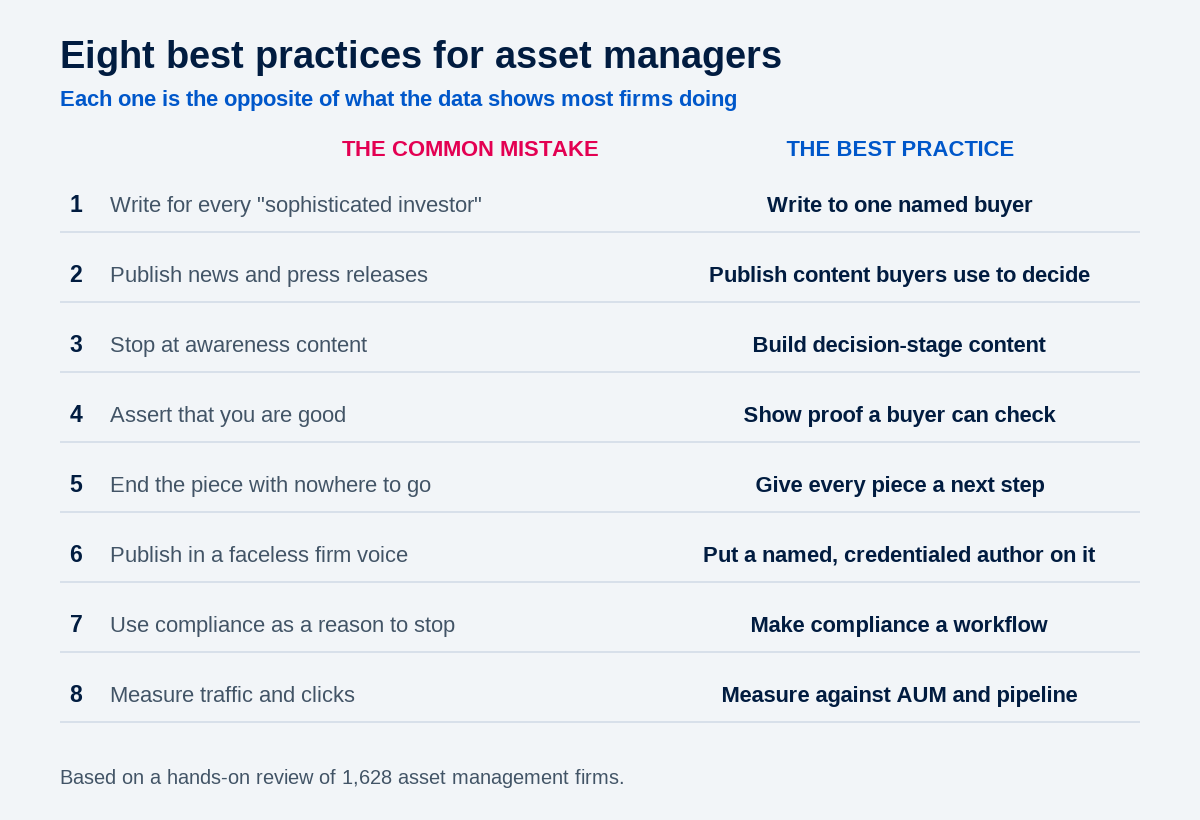
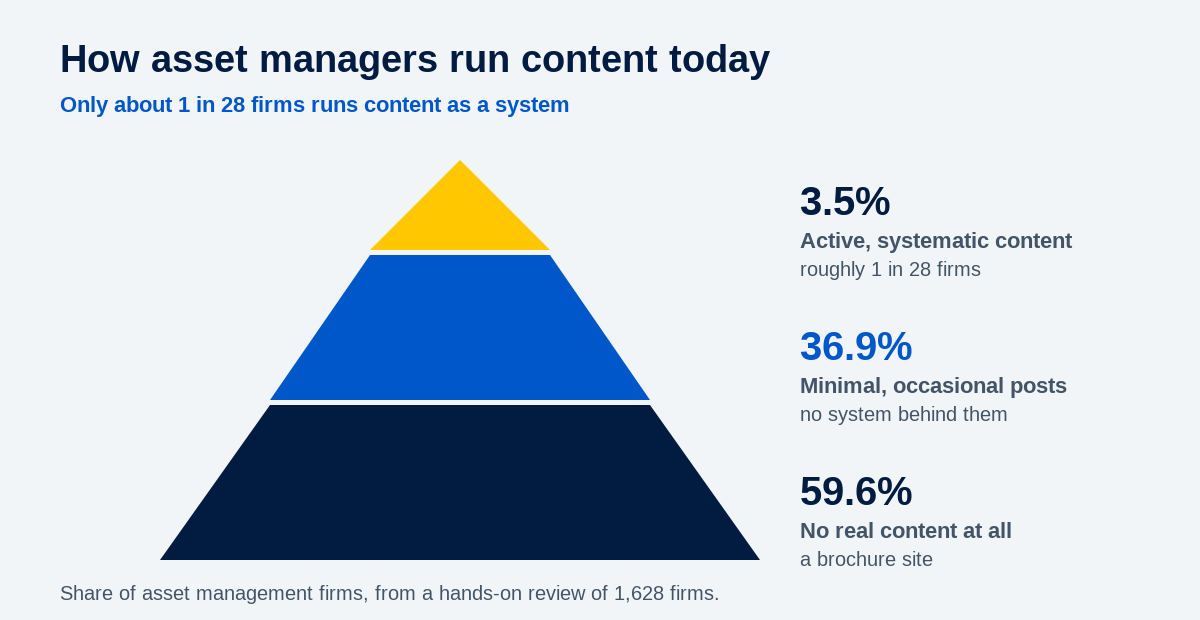
One figure frames the rest. Only about 3.5% of asset managers run content as a system, which is roughly 1 in 28. If you recognize your firm in more than one mistake below, you are in good company. The list ends with the order to fix them in.
1. Write to one asset management buyer, not every sophisticated investor
Pick one buyer and write to that buyer. The firms that struggle most write to everyone, which means they write to no one.
Across asset managers, fewer than 1 in 20 commit to a narrow, specific ideal client. The rest reach for the same language every competitor uses, variations on serving "sophisticated investors" with an "experienced, client-focused team." That phrasing feels safe, and it breaks the content before it is written.
Here is the mechanism. When a firm cannot say precisely who it serves, it cannot write the specific use case, comparison, or proof a real buyer needs. Vague positioning produces vague content, which produces the brochure. A tightly defined buyer is what makes every later practice possible, which is why choosing the right ICP comes before any editorial calendar, and why the research has to turn into positioning before it turns into posts.
Compound, a financial planning firm, shows the fix in action. As its marketing team describes in a case study, the firm went from serving "too much audience" to one named group, tech employees and founders navigating equity compensation, career transitions, and liquidity events. It even built a shortlist of real target profiles so everyone writing knew exactly who they were talking to. The content got sharper, and a single newsletter turned into several multimillion-dollar referrals.
Your next step: write one sentence naming the single buyer you serve best, specific enough that a competitor could not paste it onto their own site. If you cannot, that is the first thing to fix. Our content marketing strategy for asset management firms shows how to choose that buyer and test the choice against the mandates you have won and lost.
2. Publish fewer press releases and more content asset buyers actually use
Shift the content mix away from announcements and toward the material a buyer reads when they are deciding. Running content as a press function is the first of the biggest content marketing mistakes asset managers make.
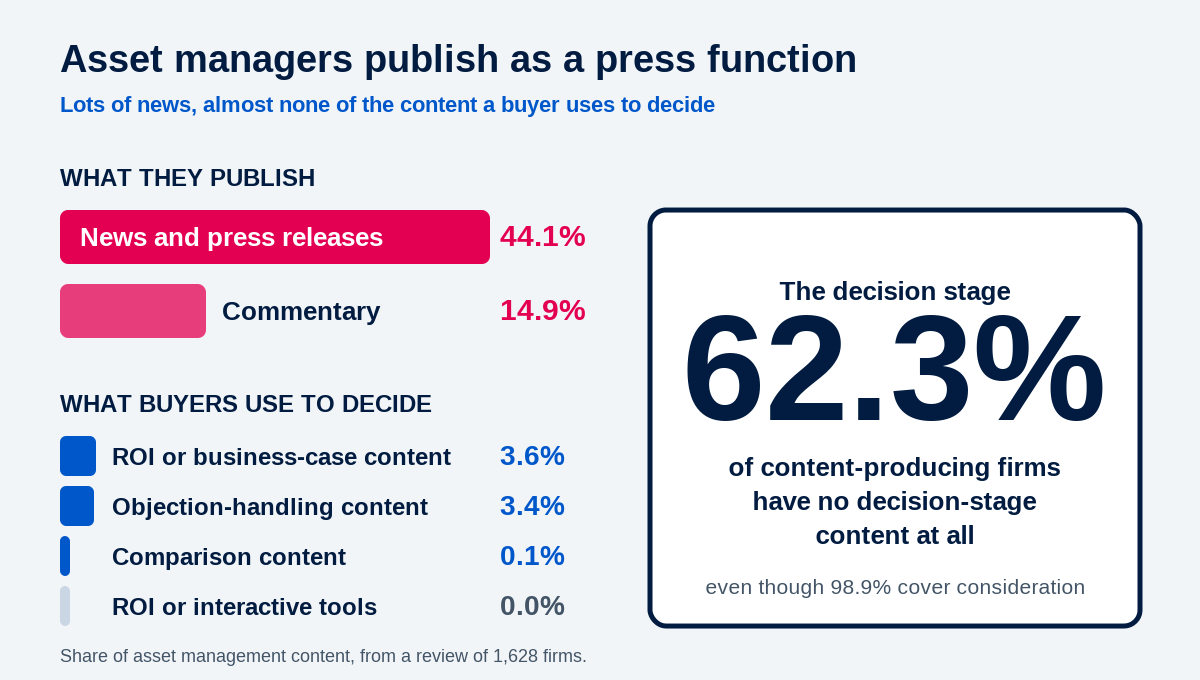
Asset managers publish as a press function. News and press releases make up 44.1% of all content, and industry commentary another 14.9%. Nearly six in ten pieces are talking about the firm or the market, not helping anyone choose.
That is backwards, because buyers reward the opposite. CoreData's 2025 research, which surveyed 154 institutional investors and consultants overseeing roughly $4.9 trillion, found that 59% say thought leadership directly influences which manager they invest with. CoreData calls it the price of entry, not a nice-to-have. If your team is unsure what counts, start with what thought leadership actually is, because a market outlook with your logo on it rarely qualifies.
The expensive part of the fix often already exists. Among asset managers that publish at all, around 90% already have a YouTube presence, yet most of that video sits unused as a marketing asset. You are already making the thing; the practice is to route it into content a buyer actually reads and watches while deciding. That means extracting the raw material your team already produces and pushing it through the channels your buyers use, starting with LinkedIn, where allocators and consultants already read.
Your next step: look at your last ten published pieces. If more than half are announcements or market commentary, rebalance the next ten toward education and decision content.
3. Build the decision-stage content most asset managers skip
Make the content a buyer uses at the moment of choosing. This is the single biggest open gap in asset management.
The field covers the easy stages and abandons the hard one. Consideration-stage coverage reaches 98.9% of content-producing firms, while 62.3% have no decision-stage content at all. The specific formats a buyer reaches for are almost absent.
- Comparison content: 0.1%, roughly one firm in a thousand.
- ROI or business-case content: 3.6%.
- Objection-handling content: 3.4%.
- ROI or interactive tools: 0.0%. Not a single firm in the review offered one.
When that content is not on the site, the work does not disappear. It moves onto a sales rep who has to build the comparison, the proof, and the ROI case by hand on every call, or onto the buyer's internal champion, who has to make the case to a committee you never meet. Mapping the funnel stage by stage shows exactly where those pieces are missing, and core asset builds are how they get made. A firm that publishes even one credible comparison or a working ROI model competes in an empty room.
Your next step: build one decision-stage asset this quarter. A head-to-head comparison framework or a simple ROI model will do more than another market outlook.
4. Show proof, not assertions
Back every claim with evidence a buyer can check. Most asset managers assert; the ones that prove stand out instantly.
Proof is the rarest signal in the category. 70.3% of firms show no buyer proof at all, no case studies, no outcomes, no data. Case studies appear on just 5.5%, and use-case content on 10.6%, where firms describe what they do but rarely the result it produced. Because proof is so scarce, building it separates you from 19 in 20 firms the moment you publish one credible example.
Compliance is the usual reason given for the gap, and it no longer holds. The SEC's Marketing Rule, 206(4)-1, amended in December 2020, now permits testimonials and endorsements when you include the required disclosures. FINRA Rule 2210 governs how you present performance, requiring communications to be fair and balanced. Both let you show a track record done properly. The rules shape how you prove it, not whether you can.
Your next step: turn one real client outcome into a short, disclosed case study. One specific, outcome-led example beats a page of adjectives.
5. Give every piece of asset management content a next step
End every piece with one clear next step, and give the reader a way to raise their hand. Most asset management content ends nowhere.
This is the most common failure in the whole category. 96.5% of content ends with a weak or dead-end call to action. The reader finishes, finds nothing to do, and leaves. The supporting numbers tell the same story: only 4.7% capture a contact, 13.5% place a relevant call to action inside the content, and 5.2% use internal links to guide a reader toward a decision. Meanwhile the median page bounces at 40.7%, so even the traffic that arrives often leaves without acting.
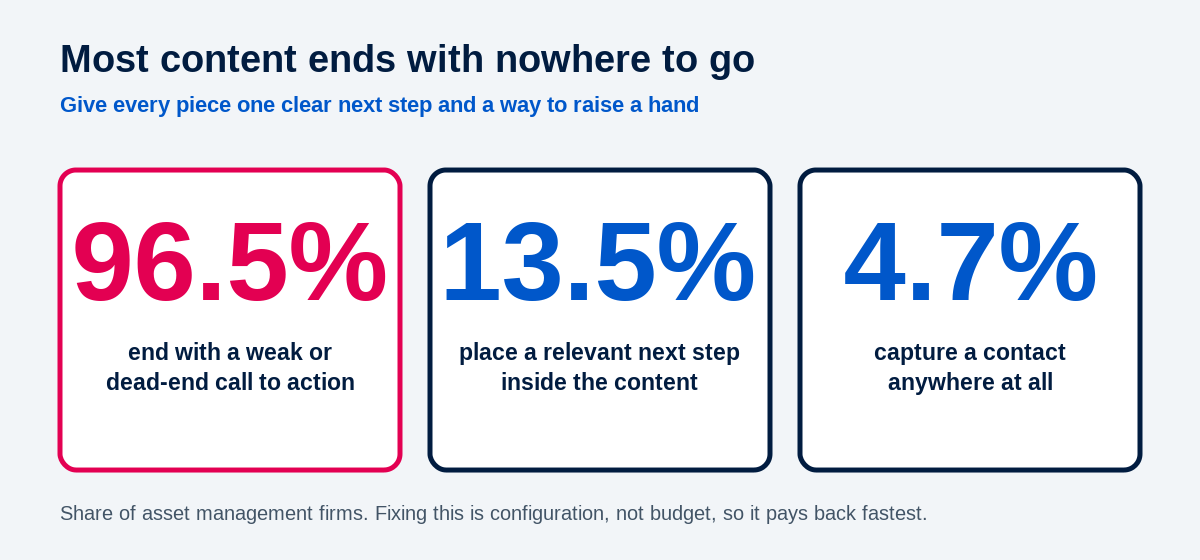
The firms that have solved presence mostly have not solved relevance. They rely on a generic sidebar or footer form that ignores what the reader just read. What works is a next step that matches the article, built as a proper conversion layer with lead capture and qualification behind it. A piece on manager selection should offer a selection checklist rather than a generic "contact us." The same leak shows up well beyond finance, as our analysis of blogs that get traffic but fail to convert found.
This is also the fastest return available, because it is configuration, not budget. You are fixing content you already published.
Your next step: add one contextual next step and one capture point to your five most-read pages this week.
6. Put a named, credentialed author on every piece
Attribute every piece to a real, credentialed person. In a business built on trust, anonymous content throws away an easy edge.
Even among asset managers that publish, only about 22% put a named author bio on their content. The rest publish in a faceless firm voice, which is a strange choice in an industry where, as one asset management leader put it recently, so much of the business comes down to trust.
Search engines read it the same way. Google's Search Quality Rater Guidelines treat financial content as "Your Money or Your Life," the category held to the highest bar for expertise and author trust. A visible author with a CFA or CPA credential is a direct signal that the page was written by someone qualified. Named authors and original data also tend to earn citations in AI answers, where most of the category is still invisible, which is the pattern behind why one brand gets cited while a better-known competitor gets ignored. The AEO guide covers the rest of what earns those citations.
A byline is cheap to add and hard for the brochure majority to match, which is exactly why it is worth doing. Your portfolio managers do not need to write the piece themselves; working with subject-matter experts through interviews gets their expertise onto the page without eating their week. The same habit works on camera: a portfolio manager's recorded market take, cut into short video, reaches the directors and C-suite readers who engage with video more than any other format.
Your next step: put a real author, with name, title, and credential, on every piece you publish from now on, and backfill your best existing pages.
7. Treat compliance as a workflow, not a reason to publish less
Build a pre-clearance workflow so compliance speeds content up. Used as an excuse, compliance is why most firms publish nothing worth reading.
The excuse does not survive the data. Compliance applies to every asset manager equally, yet only 3.5% run a content system. If regulation were the blocker, no one would clear the bar; the real blocker is the absence of a system, not the rulebook.
The leaders prove it by turning the same rules into material. About 22% of active firms publish regulatory thought leadership, using the compliance calendar as a steady supply of topics their buyers genuinely need explained. The two rules that govern this, the SEC Marketing Rule 206(4)-1 and FINRA Rule 2210, both describe content you can publish, with principal approval and proper records, not content you cannot.
The practice is to move review into the pipeline instead of treating it as a gate at the end. Pre-clear reusable building blocks, your standard disclosures, approved descriptions of each strategy, and your risk language, so each new piece assembles from parts compliance has already seen. Pharma, the other heavily regulated sector we studied, runs the same play, as our guide to compliance-ready content workflows in pharma shows.
Your next step: write down your publishing workflow and put the compliance review step where the draft is built, not where it ships.
8. Measure asset management content against AUM, not traffic
Judge content by the pipeline and assets it brings in, not by clicks. The field measures the wrong thing, then wonders why content feels like a cost.
Most firms cannot connect content to revenue. Attribution and marketing automation are rare, so firms watch traffic they never act on. And the traffic is thin to begin with: the median asset manager earns about 214 organic visits a month, which is presence without performance. Counting those visits tells you nothing about whether content is winning mandates.
The reason this matters now is structural. BCG's 2026 Global Asset Management Report argues that distribution has replaced investment performance as the primary competitive advantage, and that most firms lack the systems to compete on it. Content is part of that distribution system, and a system you cannot measure against assets under management is one you cannot improve.
The fix is to track content to pipeline. Tie a known contact to the pieces they read, connect that to the opportunities and mandates that follow, and report content in the language of AUM, not sessions. That is the work of seeing which page started the deal, and our guide to reporting on content marketing success shows how to present it to a leadership team.
Your next step: pick one metric that ties content to pipeline, such as content-sourced meetings booked, and start reporting it alongside traffic.
Where should an asset manager start, and in what order?
Eight practices is a lot to take on at once, so fix them in the order that pays back fastest. Where you start depends on where you sit today, and most asset managers sit near the bottom: 59.6% show no real content at all, another 36.9% publish occasionally with no system behind it, and only 3.5% run content as a system.
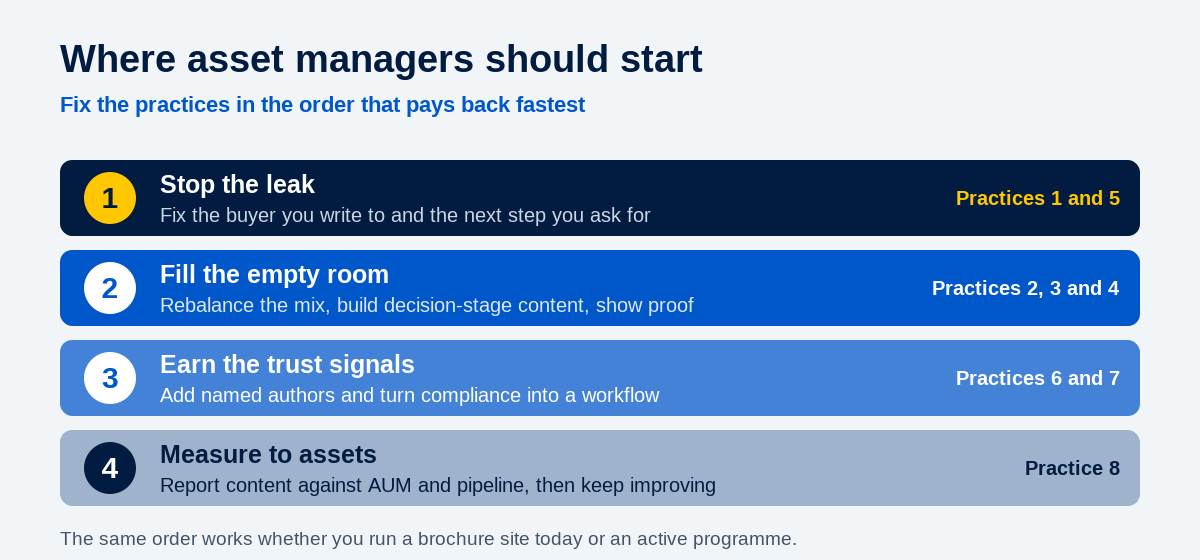
The order below works for every tier.
- Stop the leak first. Fix your buyer (Practice 1) and your next step (Practice 5). There is no point publishing more if you do not know who it is for or what you want the reader to do. These are the cheapest fixes and the fastest return.
- Fill the empty room. Rebalance the mix (Practice 2), build decision-stage content (Practice 3), and back it with proof (Practice 4). This is where mandates are won, and almost no competitor is there.
- Earn the trust signals. Add named authors (Practice 6) and turn compliance into a workflow (Practice 7). Both are low-cost and compound over time.
- Measure to assets (Practice 8). Once content is worth measuring, measure it against AUM so you can keep improving it.
If you want to see which of these you are already failing, the asset management content benchmarking tool scores your site against the same review, and the full report on the state of content marketing for asset managers shows where the whole field stands. For the bigger picture of how these practices fit together as one program, the asset management content marketing playbook walks through the full system. You can also start with the core content builds most firms are missing.
Ready to turn these best practices into a content system that moves AUM?
We install the system behind them, so your content works as revenue infrastructure instead of a press function.
Frequently Asked Questions
About the Author

Founder & CEO, Content RevOps
Stefan Kalpachev is the founder and CEO of Content RevOps, where he helps B2B SaaS companies transform their content into predictable pipeline. With a background in content marketing and revenue operations, Stefan has developed a unique methodology that bridges the gap between content creation and revenue generation.
Connect on LinkedInRelated Articles

How Can I Tell Whether AI Citations Are Driving Real Pipeline or Just Vanity Mentions?
Nov 11, 2026

Which Prompts to Track to Know Whether Your AI Search Visibility Is Improving?
Nov 10, 2026
Marketing for Asset Management Firms: Where to Start
Oct 26, 2026