Content Marketing Strategies for Asset Management Firms
Not sure which of the four steps your asset management firm is weakest on? A content revenue audit shows you where to start.
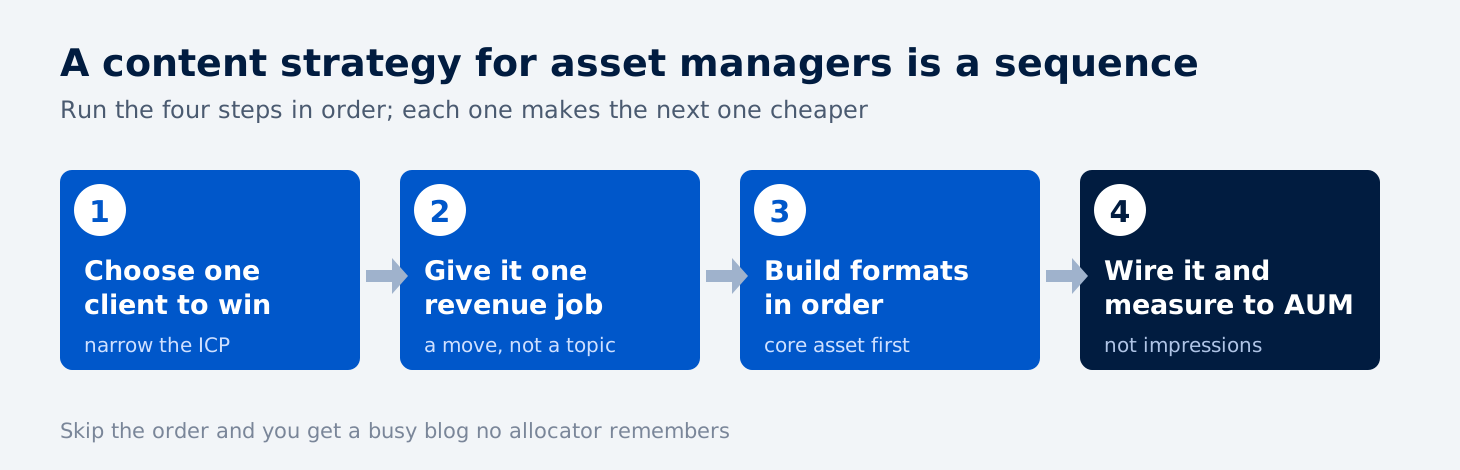
Book a CallA content marketing strategy for an asset management firm is a sequence, not a menu. You choose one client you will win, give that client's content one revenue job, build the formats in the order that compounds, then wire every piece to a next step you can measure back to assets under management. Run those four steps in order and content becomes a system that brings in mandates. Skip the order and you get a busy blog that no allocator remembers. You do not have to guess which version works. Only about 1 in 28 asset management firms run content as a real system, so the winning pattern is small, visible, and easy to copy.
Part of Content Marketing for Asset Managers: The 2026 Playbook.
Why do asset managers need a content strategy instead of a content checklist?
Search for how to do this and you get a menu. Publish thought leadership, do SEO, post on LinkedIn, start a podcast, repurpose everything. Every item is fine. The list is still not a strategy, because it has no order and no owner, so firms start from formats and from "sophisticated investors" in general and end up with content that stays busy and sells nothing.
The firms that win do the opposite. They decide who they are for and what the content must achieve before they pick a single format. The rest of this guide is that decision, in four steps you run in order.
Step 1. Choose one asset management client you will win
Start by naming one client you intend to win, not the whole investor universe. This is the step the field skips, and skipping it is why most asset managers sound identical.
Why is sameness the real problem?
When nobody chooses, everybody blurs. A Peregrine Communications study of 100 asset managers across Europe and the US found managers leaning on the same ten words to describe themselves: global, long-term, innovative, leading, experience, independent, expertise, diversity, values, and responsible. The same study found one firm that invests mainly in mid-term European credit describing itself as "an international, long-term, multi-asset manager." A specialist erased its own specialism.
That blur shows up in our own numbers too. Across the asset management firms we reviewed, fewer than 1 in 20 commit to a narrow, specific client. Generic sophisticated-investor language dominates, so the content reads the same from firm to firm and gives an allocator no reason to click, stay, or remember.
How do you choose the one?
Pick the client the firm already wins, then prove it before you build anything.
List the plausible clients. Write out each one you could serve, with the asset class, the mandate size, and who actually decides (the allocator, the consultant, the gatekeeper).
Score them on value and reachability. Rank each on the size of the opportunity, the lifetime value of a mandate, and how easily you can actually reach the decision-maker.
Pressure-test against won and lost mandates. The right client is a pattern in your own book, not an aspiration. Look at the mandates you have won and lost and find the repeated sector, size, and reason the deal closed.
Simplify to one primary client. Choose a single named buyer and a single named problem. "Insurance asset owners who need clearer multi-asset risk reporting" beats "institutional and retail investors."
This is the way we pick an ideal client before any content gets briefed, and it is a hypothesis you test against closed deals, not a guess you make in a workshop. Once you have the one client, every later step gets cheaper, because you are writing for a person instead of a market.
Step 2. Give that content one revenue job
A chosen client still needs a job for the content to do. Content fails when it has no job; it informs, the reader nods, and nothing moves. So name the job before you name the format.
Why is a job a move and not a topic?
A job is the specific move you want the content to make, measured in your pipeline. "Move a shortlisted allocator from a vague sense of our firm to a first conversation" is a job. "Raise awareness" is not. Pick the job from where your chosen client actually decides, then build a theme around one real pain rather than a list of topics.
The job is worth doing because content genuinely moves mandate decisions. In a Coalition Greenwich study, two-thirds of global investors said thought leadership had a high impact on the likelihood of winning a mandate, and half said it was fundamental to becoming familiar with a manager in the first place. CoreData's 2025 research puts it plainly from the buyer's side: strong thought leadership is now the price of entry, with 59% of institutional investors saying it directly shapes which manager they pick.
Where does the demand already sit?
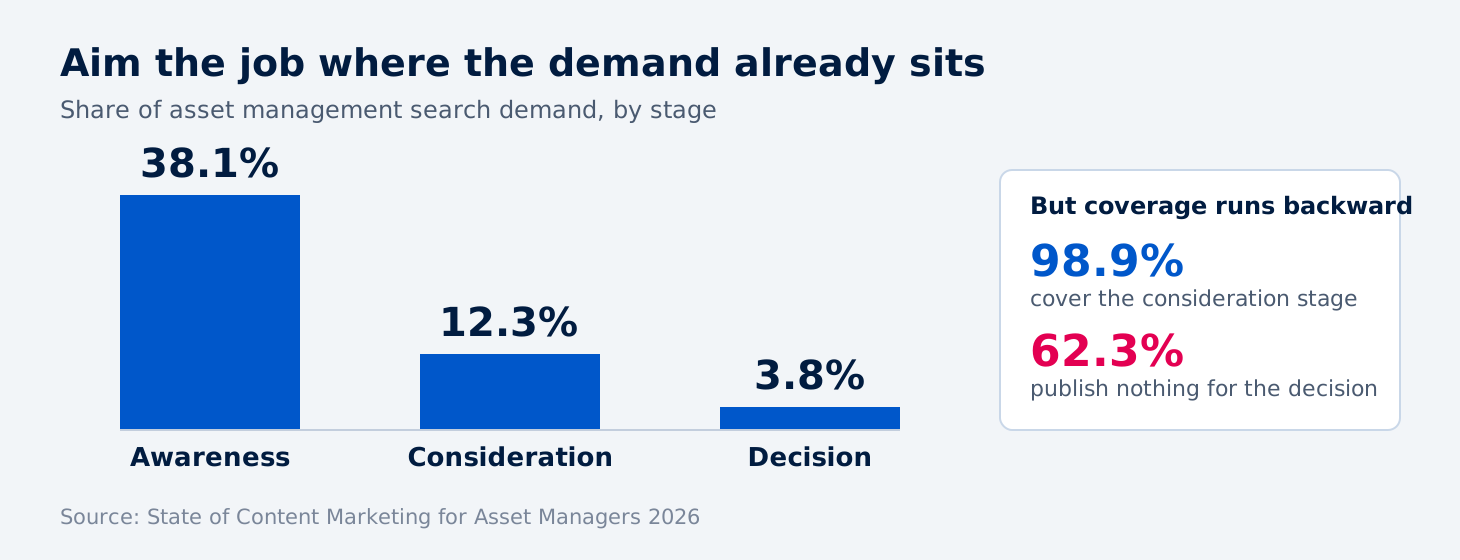
The asset management search landscape tells you where the jobs are. Across the firms we studied, demand splits roughly into awareness, consideration, and decision:
Stage of the search | Share of demand | What the reader wants |
Awareness | 38.1% | to understand a problem or an asset class |
Consideration | 12.3% | to compare approaches and shortlist managers |
Decision | 3.8% | to justify choosing one manager over another |
Most firms pour effort into the top of that table and abandon the bottom. Consideration-stage coverage reaches 98.9% of the firms with any content, while 62.3% publish nothing for the decision stage at all. The same firms publish plenty of the wrong thing; 44.1% of all asset management content is news and press releases, which treats publishing as a press function instead of a demand engine. Pick the job at the stage your client actually decides, and you are already ahead of the field.
Step 3. Build the formats in the order that compounds
Now, and only now, choose formats. The mistake is a format grab-bag, a blog here and a podcast there, each one starting from zero. Build in an order instead, so every piece feeds the next.
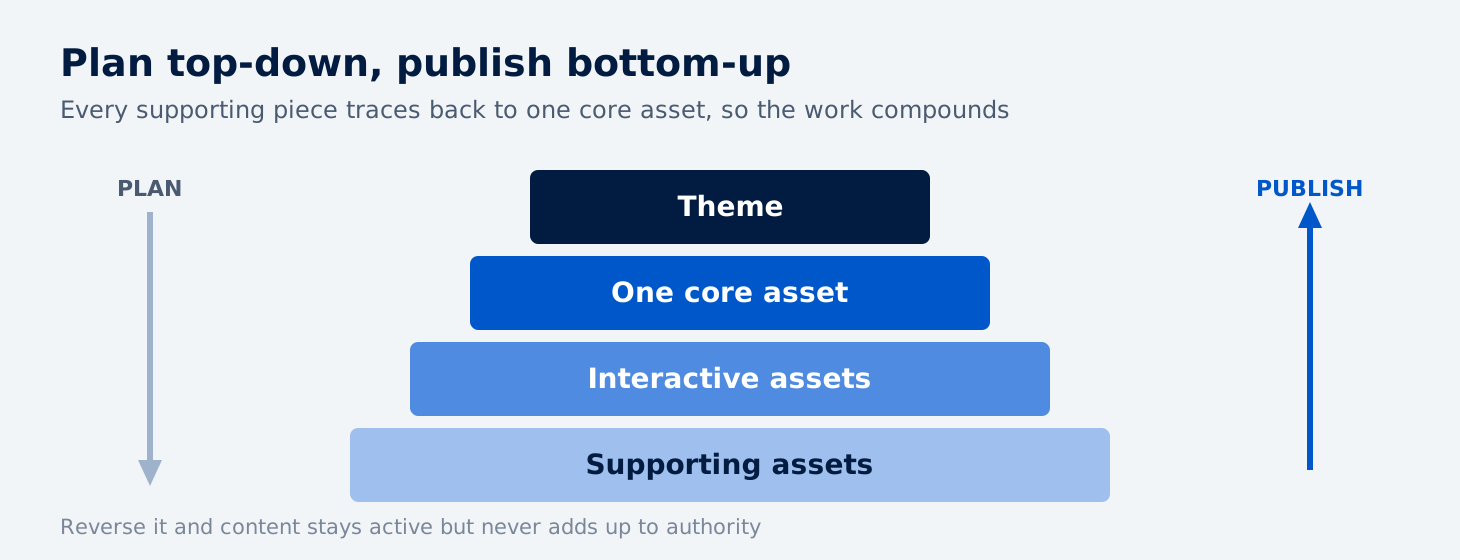
Why plan top-down and publish bottom-up?
Work the levels in this order so the work compounds rather than resets each month:
Theme. One pain your chosen client feels, broad enough to carry a year of work and specific enough to recognize instantly.
One core asset. A single cornerstone that owns the theme, usually an original research report, a deep guide, or a benchmark.
Interactive assets. A webinar or a simple tool that turns the core asset into a conversation.
Supporting assets. The blogs, emails, and social posts that each trace back to the core and point readers toward it.
That is the stack we plan from the top and publish from the bottom. Reverse it, start with the supporting blogs, and you get activity that never adds up to authority.
What does the working cohort actually build?
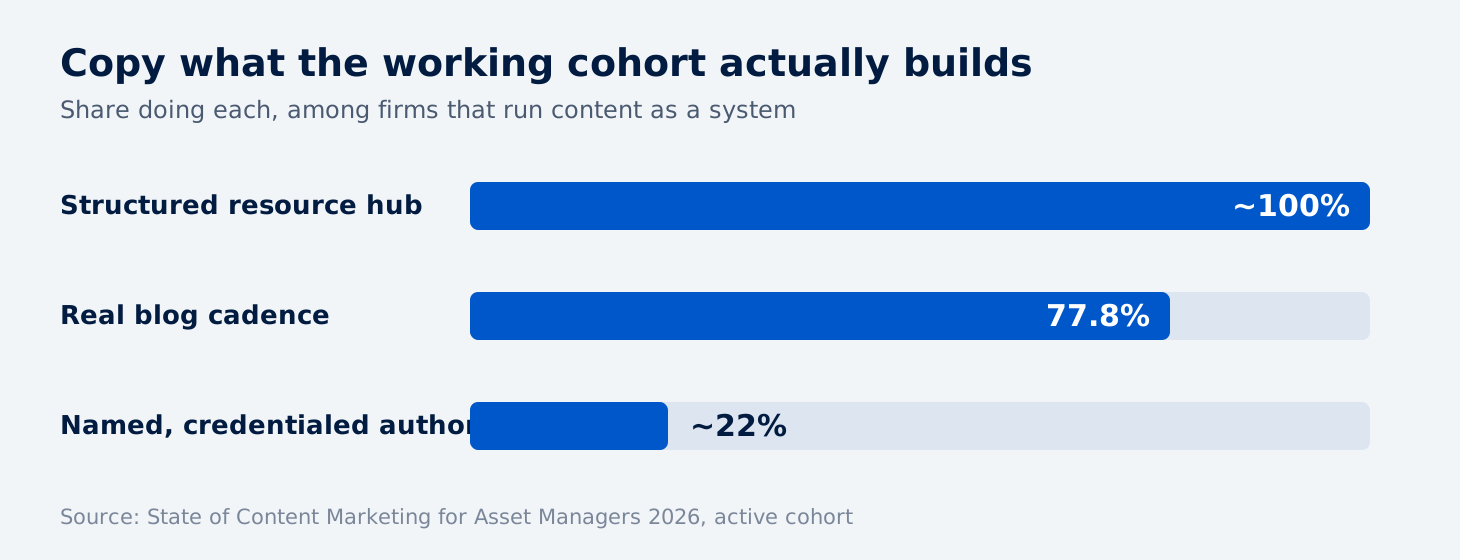
The firms that run content as a system are rare, so their pattern is easy to see. Among the asset managers who run content properly, almost all keep a structured resource hub, roughly 78% maintain a real blog cadence, and about 22% put a named, credentialed author on the work. The hub is where the work lives, and a steady cadence keeps it current. A named, credentialed author is the trust signal most firms still leave off.
Vontobel Asset Management shows the pattern in practice. The firm runs one Insights hub, a regular cadence of portfolio insights signed by named investors, and webinar replays, all organized in a single place and repurposed across formats. It is one system feeding many outputs, not a scatter of one-off posts.
The high-value formats stay wide open. Genuine thought leadership appears on only 5.8% of asset management sites and case studies on 5.5%, so the firm that builds one strong core asset in its chosen lane stands out quickly.
How do you fold compliance into the pipeline?
Compliance is the reason most firms give for moving slowly, so build it into the sequence instead of bolting it on at the end. In the US, FINRA Rule 2210 asks that communications be fair, balanced, and not misleading, and the SEC Marketing Rule 206(4)-1 now permits testimonials and endorsements with the right disclosure. Both are workable inside a pipeline. Template the standard disclosures and risk warnings, make principal sign-off a defined stage rather than a last-minute scramble, and the review stops being a blocker.
Treated well, compliance becomes the content. About 22% of the firms running content as a system turn the regulatory calendar into thought leadership, explaining rule changes their clients are already worried about. That is expertise rivals cannot fake, produced on a schedule the regulator hands you for free.
Step 4. Wire every piece to a next step and measure it to AUM
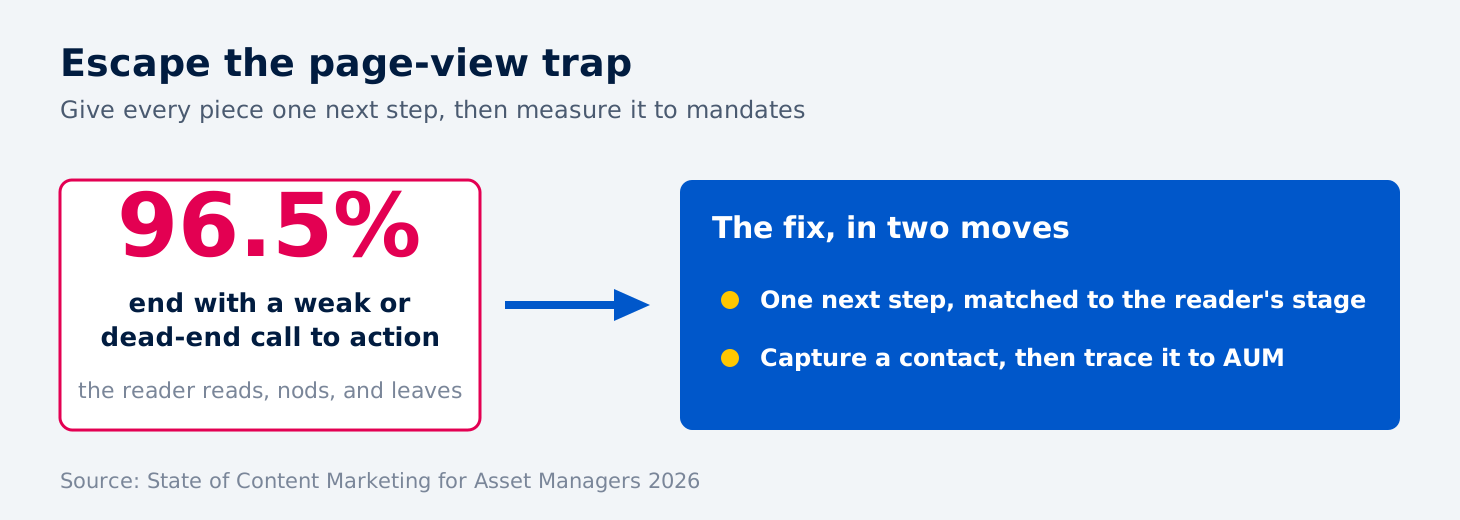
A format with no next step is a dead end, and dead ends are the rule. Across the asset management firms we studied, 96.5% end their content with a weak call to action or none at all. The reader finishes, nods, and leaves. That is the page-view trap, and it is the enemy this step kills.
How do you give every piece one next step?
Put a single, relevant next step in the flow of each piece, matched to where the reader is. An awareness article offers a deeper guide. A consideration piece offers a comparison or a benchmark. A decision piece offers a conversation. What matters is what the reader does after the read; as Cindy Fox-Toner, a VP at Hewes who supports asset managers on social, puts it, impressions and reach "mean almost nothing to the advisor deciding whether to allocate," because resonance beats reach.
Then capture something you can follow up. A gated report or a newsletter sign-up turns an anonymous visit into a name you can nurture. We treat the download as the start of the funnel rather than the finish; in our work with one client, the move that mattered was an automated follow-up that warmed the lead toward a call without the client running it by hand, because speed of first follow-up is the lever most firms never pull.
How do you measure to mandates instead of engagement?
Decide how a lead moves before you brief the content, so you can trace it afterward. Map the path from aware to interested to engaged to a qualified conversation, define what counts as qualified, and put a number against each stage. The gap here is wide; across asset managers, the ability to connect content to pipeline is rare, because most firms measure traffic they never act on.
This is the same shift BCG calls for across asset management distribution, that winning takes "a system, not a set of activities." Content is no different. Tie it to conversations and to assets under management, and it earns a budget. Report it as impressions, and it stays a cost.
How do you fit the strategy to your firm?
The sequence is the same at every size; the resourcing changes. Our analysis of asset management content spend lines up roughly with where a firm sits on organic traffic:
Firm stage | Rough monthly content investment |
Early, under 1,000 organic visits a month | $2,000 to $10,000 |
Growing, 1,000 to 10,000 visits a month | $10,000 to $50,000 |
Established, 10,000 to 100,000 visits a month | $50,000 to $200,000 |
Start at the step you are weakest on, not at the top. Most firms already produce content, so the fastest gain is usually Step 1 or Step 4, choosing the one client and wiring the next step, rather than making more. If you want to see the size of your own gap before you spend, our asset management content benchmarking tool scores your estate against the firms that run content as a system.
More output will not close the gap. Fundamental Media notes that nearly nine out of ten of the world's top 200 asset managers already produce videos, whitepapers, insights, and podcasts, so "success depends less on how much content is created, and more on how well it informs, engages and converts." The sequence is what turns the content you already make into mandates.
Want to see how your asset management content compares to the firms that run it as a system?
Our content revenue audit benchmarks your firm against the field, finds where pipeline leaks, and puts a number on the gap.
Frequently Asked Questions
About the Author

Founder & CEO, Content RevOps
Stefan Kalpachev is the founder and CEO of Content RevOps, where he helps B2B SaaS companies transform their content into predictable pipeline. With a background in content marketing and revenue operations, Stefan has developed a unique methodology that bridges the gap between content creation and revenue generation.
Connect on LinkedIn