Compliance-Friendly Marketing for Asset Managers
See where your content estate stands against 1,628 asset managers with the benchmarking tool, then pick the compliant formats to start with.
Book a CallMost asset managers treat compliance as the reason they cannot market. Under the SEC Marketing Rule, compliance is the richest source of authority content an asset manager has, because it is the one input a competitor cannot shortcut and an AI model cannot invent, and it is the raw material for thought leadership that holds up under review.
Part of Content Marketing for Asset Managers: The 2026 Playbook.
This guide is for the marketer, growth leader, or compliance partner at an asset management firm who wants to publish more, not less, and wants it to survive an exam. It covers what you can put out under the rules, the two unlocks most firms have not used yet, and how the firms that win turn the compliance calendar into a content calendar.
Across our 2026 study of 1,628 asset management firms, about 1 in 5 of the active cohort already does this. The rest leave the advantage on the table. Here is how to take it.
What does compliance-friendly marketing mean for an asset manager?
Compliance-friendly marketing means content built to clear review and stand up to a regulator by design, rather than patched after the fact. It treats the rulebook as a format spec.
Two rulebooks decide what an asset manager can say.
What is the SEC Marketing Rule?
The SEC Marketing Rule, formally Rule 206(4)-1 under the Investment Advisers Act of 1940, governs how registered investment advisers advertise. Most asset managers are registered advisers, so this is the rule that matters most.
It is newer than people assume. The SEC adopted it in December 2020, it became effective on May 4, 2021, and the compliance date was November 4, 2022. It merged two old rules, the advertising rule from 1961 and the cash solicitation rule from 1979, into one modern framework built for websites, social media, and digital advertising.
Where does FINRA Rule 2210 come in?
If your firm also distributes funds through an affiliated broker-dealer, a second rule applies to that entity. FINRA Rule 2210 governs communications by broker-dealers. The two rules overlap in spirit but bind different legal entities, so a dual-registered firm manages both. We cover the practical difference in the FAQ at the end.
Why does the definition catch almost everything?
The Marketing Rule defines an "advertisement" in two parts, and the first part is wider than most teams expect. As InnReg lays out, it covers any direct or indirect communication that offers your advisory services, sent to more than one person, if the content is promotional.
Your website is an advertisement. So is your newsletter, your LinkedIn post, and your webinar invite. The second part covers any testimonial or endorsement you pay for, in cash or in kind. Smarsh notes that the rule is technology-neutral, so it reaches social posts, influencer partnerships, and AI-assisted content the same way it reaches a print brochure.
Genuine one-to-one messages, replies to unsolicited questions, and regulatory filings like Form ADV sit outside the definition. Almost everything else a marketer makes sits inside it.
Why do asset managers treat compliance as a brake on marketing?
Because the fear is real and the usual response to it is to publish nothing worth reading.
Ask marketers at asset management firms what slows them down and compliance is the assumed answer. One recent thread on the r/CFP forum opened a question about marketing with the aside "besides compliance, of course." It is taken as the given obstacle, the thing you work around rather than through.
The fear is rational. The SEC has enforced the Marketing Rule hard and in public.
What does the enforcement record show?
In September 2023 the SEC ran a sweep and charged nine registered investment advisers for advertising hypothetical performance on their public websites without the policies the rule requires. All nine settled and paid $850,000 in combined penalties.
The sweep kept going. In April 2024 five more advisers settled for $200,000 combined. In September 2024 another nine settled for using untrue or unsubstantiated claims and for running testimonials, endorsements, and third-party ratings without the required disclosures.
Read those cases closely and a pattern shows up. The firms were punished for process gaps: no written policy, no disclosure, no file backing a performance claim. The violation was the missing workflow.
What does the safe choice cost?
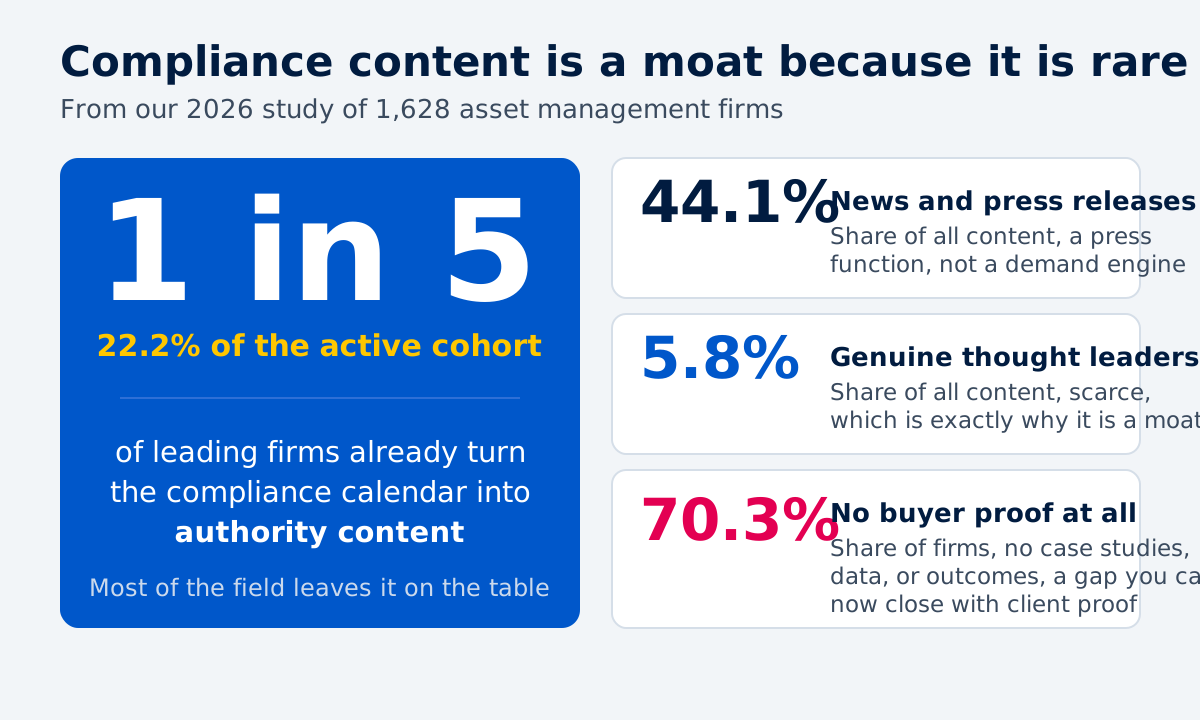
So firms pick the safe-looking option and publish as a press function. Across our study, nearly half of all asset management content, 44.1%, is news and press releases. It announces; it does not help a buyer decide anything, which is the first of the content marketing mistakes asset managers make. Only about 1 in 28 firms, 3.5%, runs content as a real system.
That is the true cost of treating compliance as a brake. The firm skips the work, keeps the risk it was trying to avoid, and leaves the moat unbuilt while a fifth of its competitors build theirs.
What can an asset manager publish under the SEC Marketing Rule?
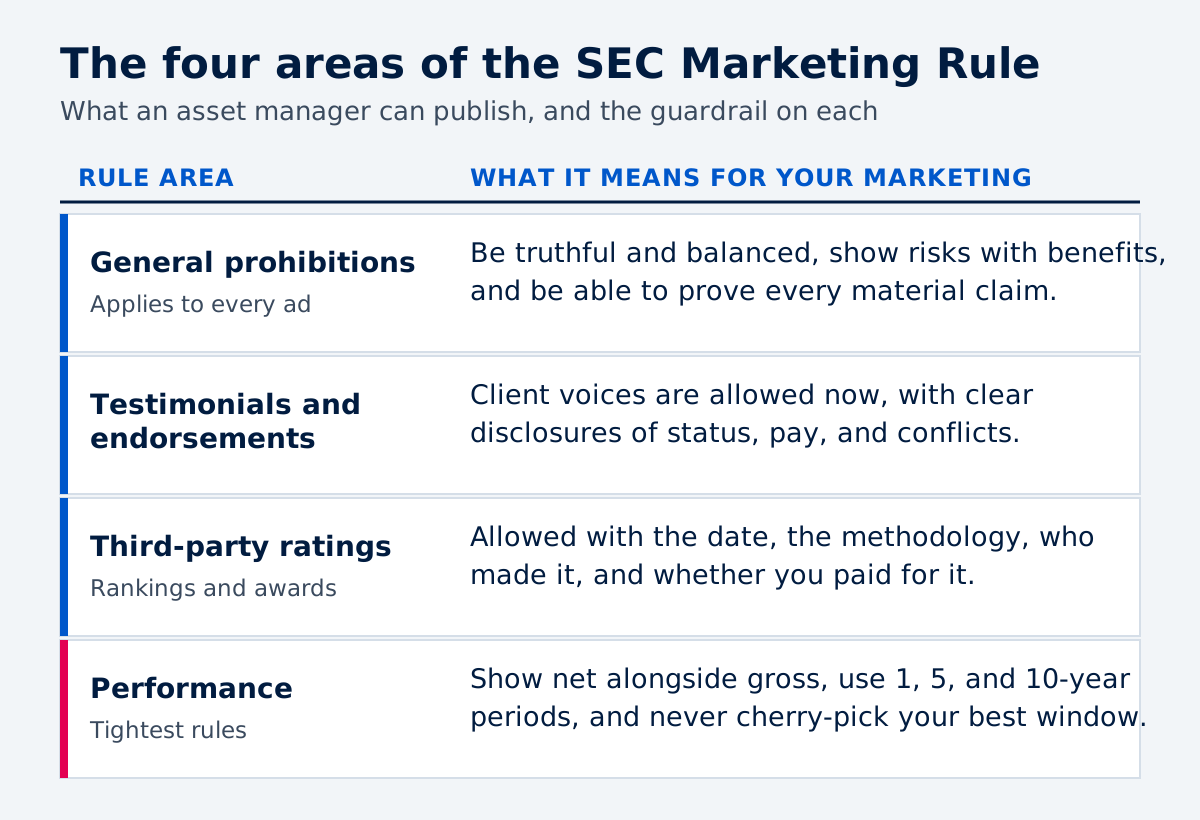
Almost anything, as long as it is true, substantiated, and balanced. The rule sets content standards, not a list of banned topics. It covers four areas, and here is what each one means for your content.
Rule area | What it means for your marketing |
General prohibitions | Be truthful, balanced, and able to prove what you say |
Testimonials and endorsements | Client voices are allowed, with disclosures |
Third-party ratings | Rankings are allowed, with context and methodology |
Performance | Show results fairly, net alongside gross |
What do the general prohibitions require?
Every advertisement is subject to a set of general prohibitions, listed by Smarsh and explained in plain terms by InnReg. In practice they come down to a few habits.
Do not state a material fact that is untrue. Do not leave out a fact that would otherwise mislead. Do not make a material claim you cannot back up; if the SEC asks, you must be able to substantiate it. When you show a benefit, show the related risk with it. And do not cherry-pick your best call and present it as the whole story.
None of that stops you from being useful. It stops you from being sloppy.
How do the four areas fit together?
The law firm Dechert summarizes the rule as these four buckets, and it is a useful map. The general prohibitions set the floor for everything. The other three, testimonials, ratings, and performance, each carry their own conditions, and two of them are genuine openings most firms have not walked through yet.
Can asset managers use testimonials, client reviews, and case studies now?
Yes, and this is the biggest unlock in the rule. Client voices are back on the table for the first time in decades.
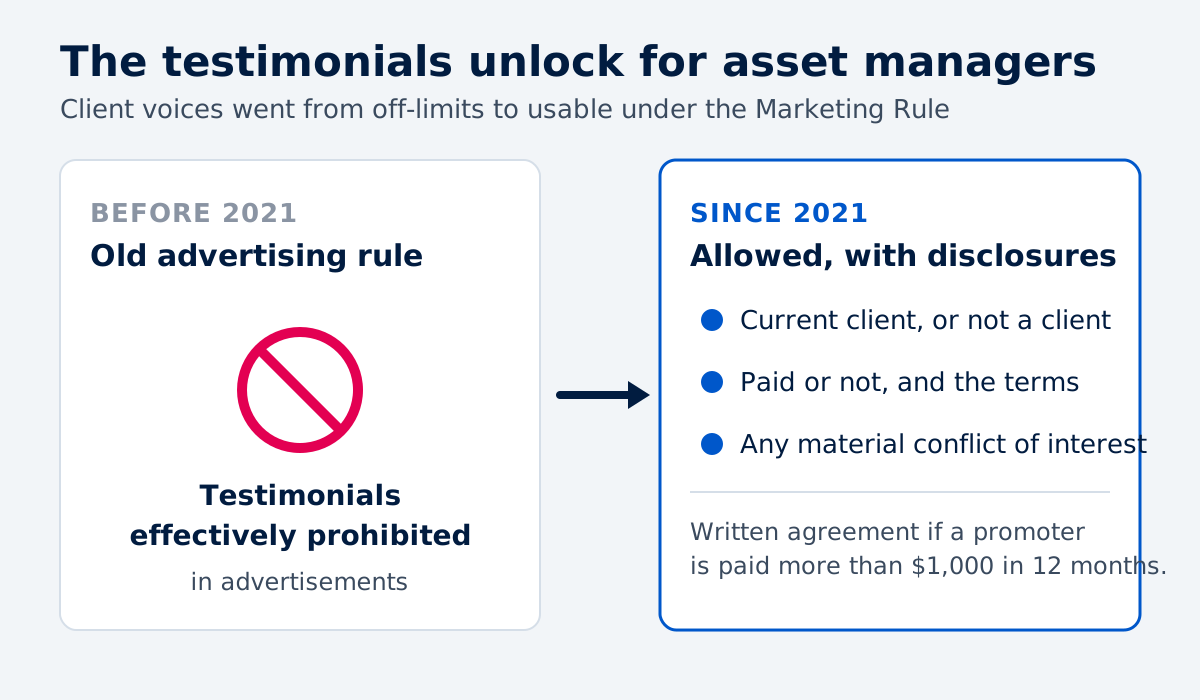
Before the Marketing Rule, the old advertising rule effectively prohibited testimonials in adviser advertising. That is why the industry spent years with assertion-only websites. The current rule, in force since 2021, permits testimonials and endorsements as long as you disclose properly.
Which disclosures make a testimonial compliant?
InnReg sets out the conditions. When you use a testimonial or endorsement, you disclose, clearly and prominently and not buried in a footnote or a hyperlink:
- whether the person is a current client or not a client,
- whether they were paid, in cash or otherwise, and the material terms,
- and any material conflict of interest.
If you pay a promoter, you need a written agreement with them, unless they receive $1,000 or less over the prior twelve months. You oversee what they say, and a disqualified "bad actor" cannot be a paid promoter. Those are workflow steps, and a workflow can be built once.
Where do case studies fit?
A case study is two things under the rule, so treat it as two.
If the case study quotes a client, it is a testimonial, and the disclosures above apply. If it shows returns or results, it is governed by the performance rules in the next section, including the net-alongside-gross requirement. Handle each kind of proof in its own lane and you can publish both.
Why does this matter so much?
Because the proof gap in asset management is enormous, and it is now mostly a choice. In our study, 70.3% of firms show no buyer proof at all, no case studies, no outcomes, no evidence, and only 5.5% publish case studies. Buyers get assertions where they want evidence, which is why visible proof sits near the top of the best practices for asset managers. The rule that firms blame for the silence is the same rule that now lets them break it.
How do you show performance or track record without breaking the rule?
Show it fairly, show the net result, and do not pick your best window. Performance advertising is the most regulated area, and it is where the enforcement sweeps landed, so it rewards care.
The core rules, as InnReg details them, are straightforward to follow once you know them.
Why must net sit alongside gross?
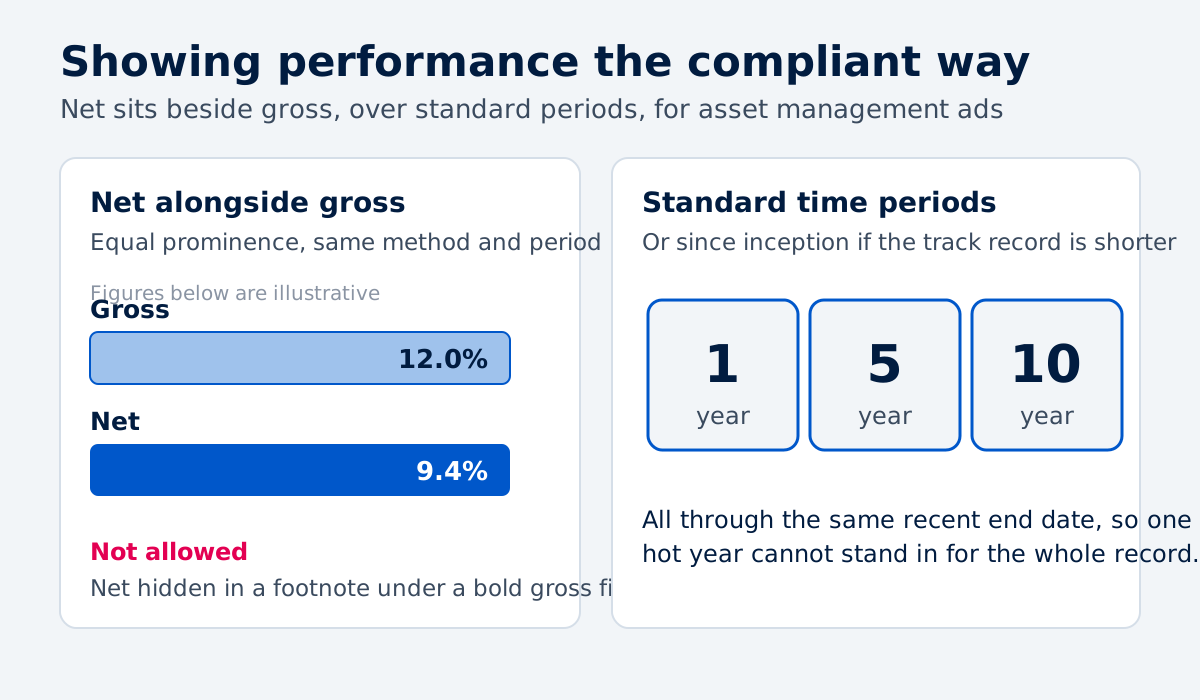
If you show gross performance, before fees, you must also show net performance, after fees, with equal prominence, over the same period, and calculated the same way. Net does not go in a footnote under a bold gross number. Both figures sit together.
Which time periods are standard?
When you present performance to an audience, show returns over one, five, and ten years, or since inception if the track record is shorter, all through the same recent end date. The standard periods stop a firm from framing a single hot year as the whole story.
How do you avoid cherry-picking and handle projections?
If you extract one slice of a portfolio, like the technology names, you show it in the context of the whole. If you show one strategy, you account for the similar accounts. Predecessor performance from a prior firm is allowed only when the same team runs a substantially similar strategy and you disclose it.
Hypothetical and backtested numbers carry the tightest conditions. You need written policies, full disclosure of the assumptions and risks, and an audience the numbers are actually relevant to. That is why advertising hypothetical performance to the general public on a website is what drew the first nine enforcement cases. Keep it off the open website and you avoid the single most-penalized mistake.
How can asset managers turn compliance work into content?
By publishing the thinking the compliance function already produces. Compliance work is a content supply most firms throw away.
The logic is simple. The Marketing Rule makes you substantiate every material claim and keep the file that backs it. That same discipline, a sourced claim with the evidence behind it, is exactly what makes content trustworthy to a careful buyer. The work you do to be compliant is the work that makes the content good.
Is the compliance calendar a content calendar?
Rule changes, exam priorities, new disclosures, the way your firm reads a regulatory shift: each one is a question your buyers and their advisers are already asking. Answering it in public is authority content that a generalist competitor cannot fake and a model cannot invent, because it depends on your firm's actual positions and your subject matter experts. It works as a written briefing, a short video read, or a LinkedIn post, as long as it clears the same review.
Our study shows a fifth of the leaders already treat it this way. Regulatory thought leadership appears in about 1 in 5, 22.2%, of the active cohort. They turn the compliance calendar into authority content while most of the field treats regulation as a reason to say nothing.
Why does scarcity make it a moat?
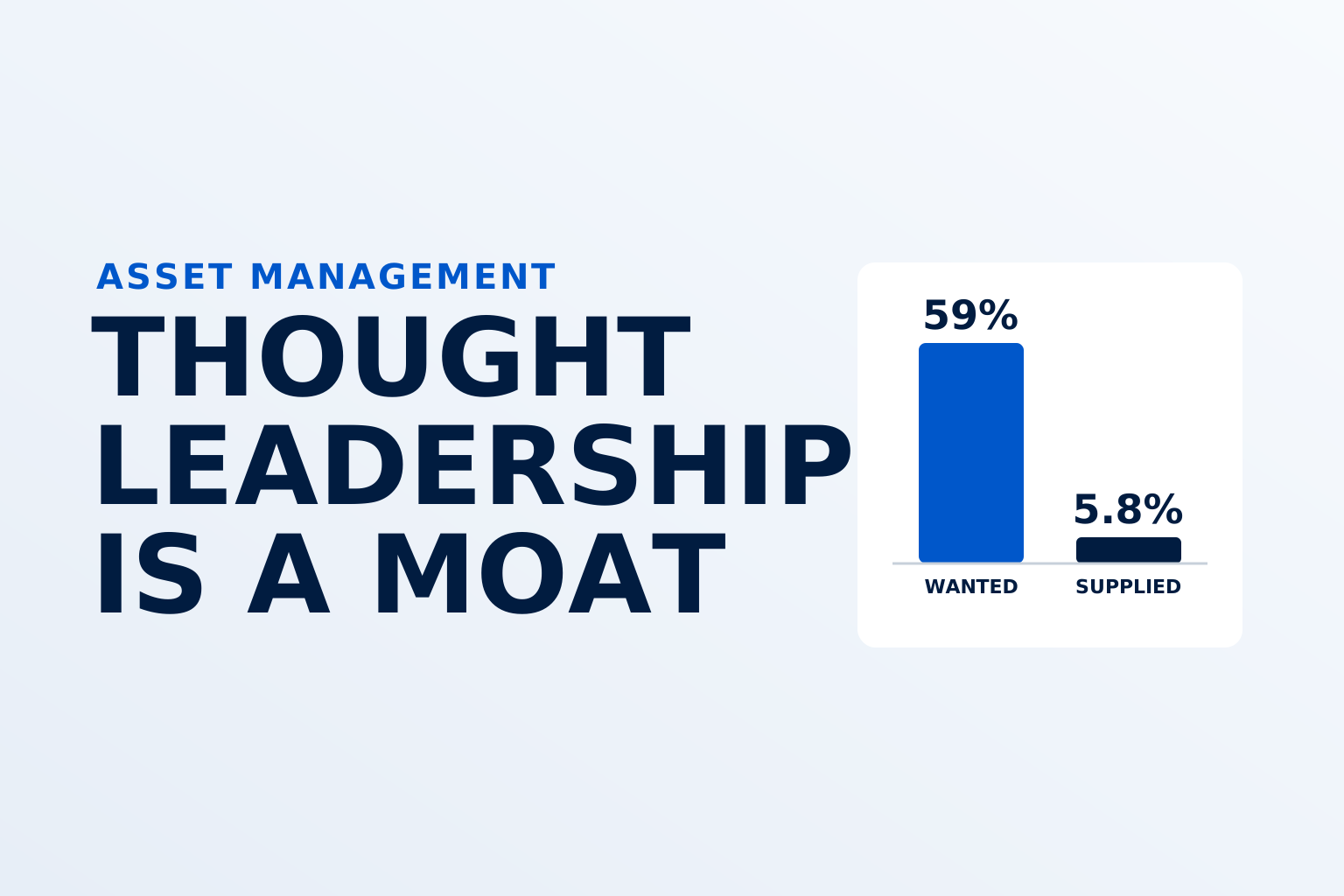
Real thought leadership is rare in this industry, which is the whole point. Only 5.8% of asset management content is genuine thought leadership, and another 14.9% is industry commentary that reads the same from one firm to the next. Commentary is common. A differentiated, substantiated point of view is rare, and scarcity is what turns it into a moat.
Why is the race in AI answers still open?
AI search makes the gap sharper. In our study, only a small minority of asset managers surface in AI answers at all, and the citations concentrate on five giants, Vanguard, BlackRock, Fidelity, State Street, and J.P. Morgan Asset Management. We break down why in why asset managers don't show up in AI search. The race for every citation below the incumbents is wide open. Substantiated, clearly attributed content is the kind an answer engine can quote without risk, and compliance work is what produces it, which fits what we see in why one brand gets cited while a better-known competitor gets ignored. The firms doing the work are the ones showing up in AI search.
How do asset managers run a marketing and compliance review workflow?
With a repeatable process, a short list of pre-cleared formats, and named people who own the review. The firms that call compliance "easy" have turned it into a workflow. One advisor on r/CFP put it plainly, that compliance is easy and the real hurdle is a consistent funnel. Consistency is a workflow problem, and it is solvable. Other regulated industries have built the same thing, as in our pharma marketing compliance workflow.
What does a review workflow that keeps content moving look like?
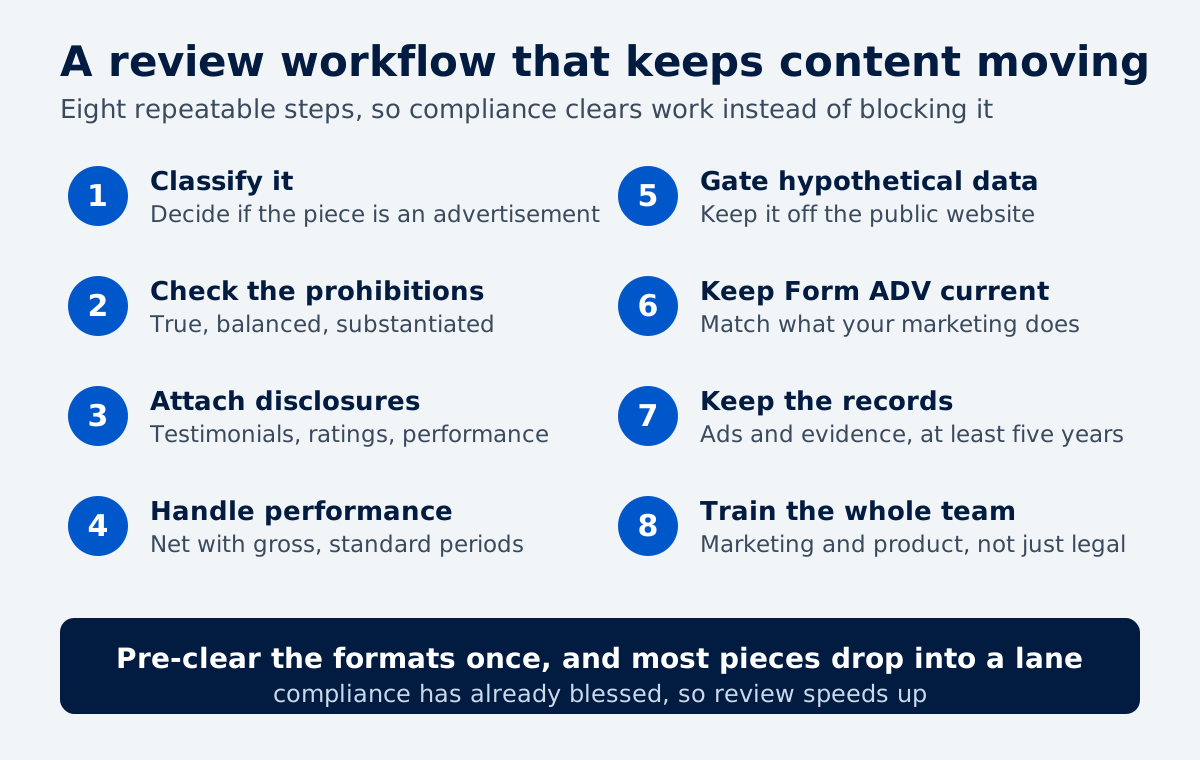
InnReg's compliance checklist translates cleanly into a marketer's sequence. Run every piece through these steps and most reviews get faster.
- 1. Classify it. Decide whether the piece is an advertisement under the rule. Most of what you make is.
- 2. Check it against the general prohibitions. Is it true, balanced, and substantiated, with risks shown next to benefits?
- 3. Attach the disclosures. Testimonials, ratings, and performance each carry their own, and the disclosure is clear and prominent.
- 4. Handle performance by the rules. Net alongside gross, standard periods, no cherry-picking.
- 5. Gate hypothetical performance. Keep it off the public website and limited to the audience it fits.
- 6. Keep Form ADV current. It should reflect what your marketing actually does.
- 7. Keep the records. Under the rule, you retain ads and the evidence behind them for at least five years, including a social post you later deleted.
- 8. Train the whole team. Marketing, growth, and product all need to know what counts as an advertisement, not just compliance.
Smarsh frames the same habits as best practice: one review workflow across web, social, and digital; consistent disclosures; audit-ready records; periodic checks against recent exam findings. Their piece on social media scrutiny and influencer oversight covers the social side in detail.
Why pre-clear the formats rather than every post?
The speed comes from working at the level of templates. Pre-cleared disclosure language, a standard performance presentation, an approved testimonial format: build the library once and most pieces drop into a lane that compliance has already blessed. The lawyers at Stark & Stark frame the goal as moving "from compliance to creativity", a process that lets good ideas through rather than vetoing them one by one.
Why name the author?
Put a credentialed name on the work. Only about 22% of the active cohort uses named author bios, so it is an easy edge, and it serves two ends at once. A named, accountable author is what search and AI systems reward as expertise, and it is also the person who stands behind the claim if anyone asks. The firms that keep a real blog cadence, 77.8% of the active cohort, run on exactly this kind of repeatable ownership, and someone senior has to own it, whether in-house or a fractional CMO.
Where should an asset manager start with compliance-friendly marketing?
Start with the formats that clear review fastest, give every piece a next step, and measure to pipeline rather than traffic. You do not need a new tool. You need to point the work at a decision, the same sequence laid out in marketing for asset management firms, where to start and content marketing strategies for asset management firms.
Where does each piece of content go next?
The most common failure is content that ends in a shrug. In our study, 96.5% of asset management content ends with a weak or dead-end call to action, and only 4.7% of firms capture a contact at all. A compliant call to action is allowed. Ask the reader to do something, capture and qualify the contact, and the content starts earning. The marketing funnel for asset managers shows where those handoffs break.
Why measure to AUM instead of clicks?
The median asset manager earns around 214 organic visits a month, which is presence without performance. Traffic is a weak scoreboard. Measure content against qualified conversations and the mandates they influence, the way a revenue channel is measured, so you can see which page started the deal.
If you want a baseline before you start, our asset management content benchmarking tool scores your estate against the firms in the study, and the financial services overview and our learn library go deeper on the moves above.
Ready to turn your compliance work into authority content?
We build the compliant content system for asset managers: the review workflow, the capture, and the routing into pipeline.
Frequently Asked Questions
About the Author

Founder & CEO, Content RevOps
Stefan Kalpachev is the founder and CEO of Content RevOps, where he helps B2B SaaS companies transform their content into predictable pipeline. With a background in content marketing and revenue operations, Stefan has developed a unique methodology that bridges the gap between content creation and revenue generation.
Connect on LinkedIn