Webinar Marketing for Asset Managers
See where your content estate stands with the asset management content benchmarking tool, then decide whether a webinar is the right first move.
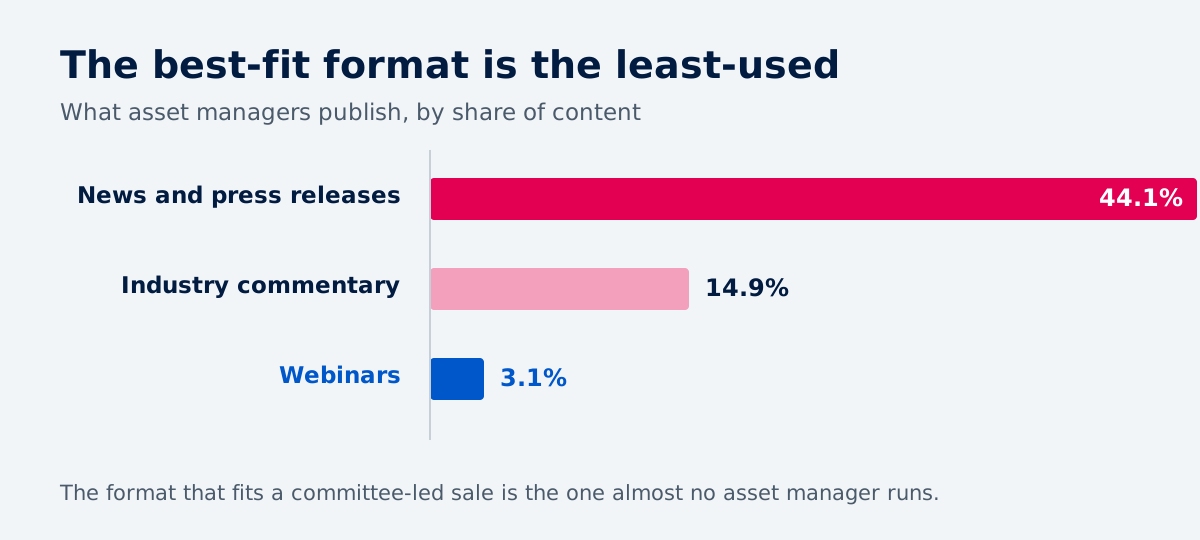
Book a CallWebinar marketing for asset managers is the clearest case of a format that fits the sale and almost nobody uses. The asset management sale is slow, it runs through a committee and its consultant, and it turns on trust built over a long evaluation. A recurring educational webinar is built for exactly that kind of buyer, and a webinar system wired into pipeline is how it earns its place. And yet, across the asset managers we studied, webinars make up just 3.1% of the content they publish.
Part of Content Marketing for Asset Managers: The 2026 Playbook.
So the useful question is why the format that best suits an institutional sale is the one firms skip, and what running it properly actually looks like.
This guide answers that. It treats the webinar as a pipeline channel, which rules out the quarterly update call to clients you already have and the retail seminar funnel borrowed from financial advisors. It walks through whether webinars fit, why so few asset managers run them, what to put on, how to fill the room, how to turn the session into pipeline, how to stay compliant, and how to measure the return in mandates and AUM rather than views.
Do webinars actually work for asset managers?
Yes, and the reason is the shape of the sale. For an asset manager, a new mandate is rarely one person signing off after one meeting. It is a committee decision, mediated by a consultant, reached over a horizon measured in years.
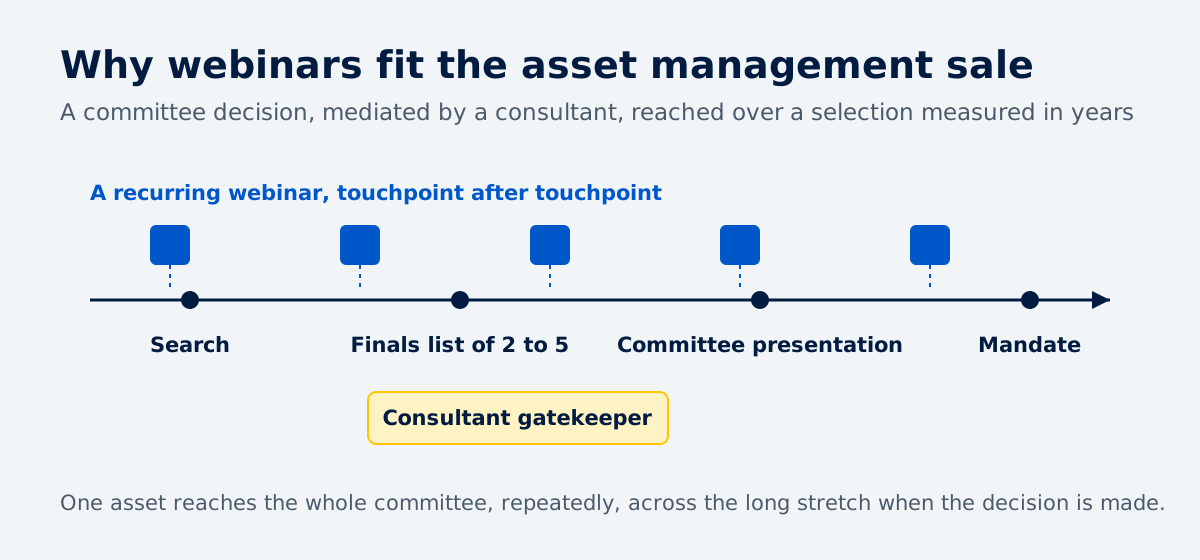
The academic work on manager selection describes the process plainly. Investment committees, often with a consultant, decide allocations, which triggers a search, narrows to a finals list of two to five managers, and ends with finalists presenting to the committee, who then make the hiring recommendation. Consultants sit in the middle of that process as gatekeepers. The same researchers note that institutions tend to evaluate managers over horizons well beyond the usual three to five years.
Read that back and you are describing the ideal audience for a webinar. A room of decision-makers. A gatekeeper who needs to trust you. A long stretch of time in which the manager who stays useful and visible has the advantage.
Why does the format match the buyer?
A webinar does three things the institutional sale needs at once. It reaches a group rather than one contact. It demonstrates how the team thinks, which is what a committee is actually buying. And it repeats, so the manager stays present across a selection that unfolds over quarters.
That matters because the committee is already swayed by the manager's content. In a CoreData survey of 132 institutional investors and 22 consultants overseeing more than $4.9 trillion, 59% said their likelihood of investing with one manager over another is directly influenced by the thought leadership a manager puts out. A webinar is that thought leadership in its highest-trust form, a live person taking a view and answering for it.
Even in the adjacent world of financial advisors, where the buyer is an individual rather than a committee, the format out-converts the alternatives. A 2024 Kitces study of how financial planners actually market their services found webinars generated $4,200 of revenue per new client against $3,750 for cold-calling, and converted prospects to clients at 49%, ahead of social media, email newsletters, blogging, and SEO. That is advisor data, not an institutional benchmark, so treat it as a directional signal rather than a number to plan against. The point it makes is simple. When people give you an hour of attention and you use it to teach, they convert better than when you interrupt them.
Why do so few asset managers run webinars?
If the fit is this good, the 3.1% figure needs explaining. The explanation is that most asset managers never built the habit of publishing anything that earns an hour of a buyer's time, and the webinar is downstream of that habit.
Start with the baseline. In our study of the asset management content estate, only 3.5% of firms run active, systematic content, roughly one in twenty-eight. Most publish little or nothing. When firms do publish, the mix skews to the reflexes of a press function: news and press releases make up 44.1% of the content, and industry commentary another 14.9%.
Which formats does a webinar stand on?
A webinar does not appear from nowhere. It needs a point of view, proof, and an answer to the objections a buyer will raise. Those are precisely the formats asset managers publish least.
Across the firms we reviewed, the decision-stage formats barely register:
- Webinars, 3.1%
- Thought leadership, 5.8%
- Case studies, 5.5%
- Objection-handling content, 3.4%
- Comparison content, 0.1%
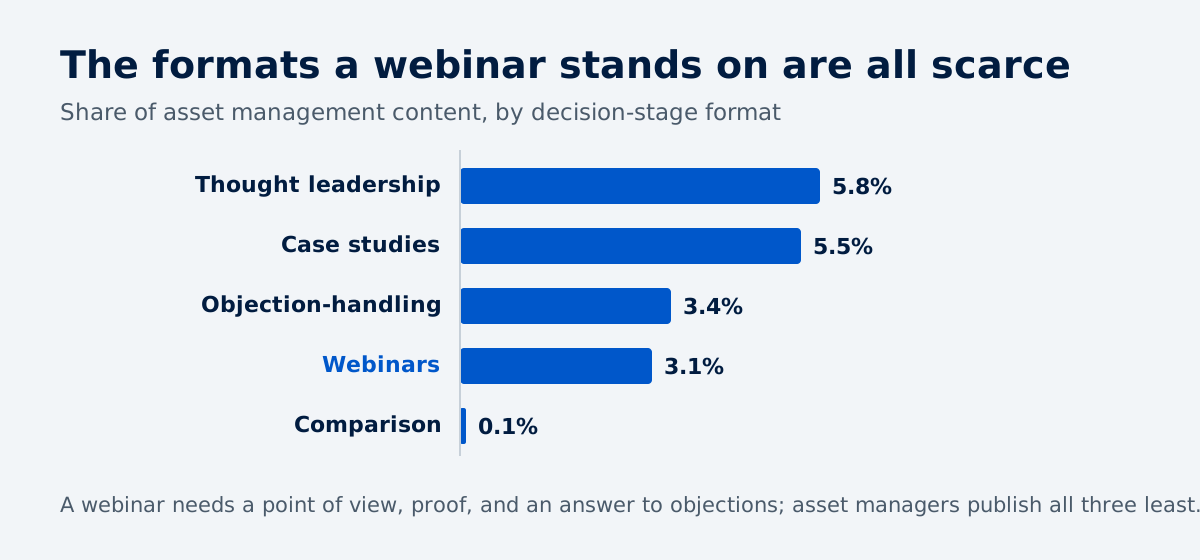
A firm that publishes none of these has nothing to build a webinar around and no habit of putting a named person on record. The webinar is skipped because the groundwork for it was skipped. That is the real cause, and it is also the opening, because the firm that fixes it stands almost alone.
What should an asset management webinar be about?
The topic is the committee's real question, framed for one kind of buyer, and answered by the person best placed to help them think it through. That is a different brief from the retail webinar, which sells a retirement outcome to an individual.
Which question is your buyer actually carrying?
An asset management webinar earns its hour when it takes on a question the allocator cannot avoid. A shift in the rate regime and what it does to a given asset class. A regulatory or allocation change the committee has to respond to. A real debate inside your strategy, taken seriously rather than smoothed over.
The way we build a webinar is to treat it as a content product rather than a side event, and the first rule is to choose a topic specific enough, useful enough, and worth giving up an hour for. Pick the narrow question over the broad theme. That alone sets you apart, because fewer than 5% of asset managers write to a narrow, specific buyer at all. A session built for one type of allocator already stands out from a field talking to everyone.
Who should be the speaker?
The speaker is the person who can change how the audience sees the problem, which is not automatically the most senior name on the masthead. When we prepare a session, we pull the substance out of that person first, their contrarian view, the one idea they want remembered, the framework they use, the proof behind it, and the objections they hear most. A webinar built from that holds attention. A webinar built from a title does not.
The institutional firms that run this well make the pattern easy to copy. The BlackRock Investment Institute runs a recurring quarterly webcast where its senior strategists walk institutional investors through the macro outlook and what it means for portfolios, backed by an on-demand library of webcasts and sessions for institutional investors. Franklin Templeton Institutional runs webinars where named portfolio managers hold cross-asset discussions for an institutional audience. The shared shape is a named investor, one real portfolio question, a steady cadence, and a clearly institutional audience. That is the template, whatever your size.
How do you get allocators and consultants to show up?
You fill the room from the audience you can already reach, with no paid retail ad budget. The institutional buyer is findable, and most asset managers already have a channel open to them.
Which audience should you start with?
Most asset managers have a LinkedIn presence; about 64% of the firms we studied are active there. That is the channel to use to fill a webinar, alongside the lists and relationships the firm already holds, the existing client and prospect base, the consultants the firm talks to, and partners who will co-host and bring their own audience.
Why promote it as a sequence?
One invitation does not fill a room. The way we build webinar promotion is to write one long-form master description of the session and let everything else inherit from it, the landing page, the calendar copy, the social posts, and a staged email sequence.
That sequence has a job at each step:
- 1. The invitation, what the session is and why it is worth an hour.
- 2. The speaker spotlight, who is presenting and why they are worth hearing.
- 3. Why attend, the specific thing the attendee will walk away able to do.
- 4. Who this is for, so the right people self-select in.
- 5. The objection, answering the reason a busy allocator talks themselves out of registering.
- 6. The countdown, the final nudge as the date approaches.
The landing page does the conversion. It names the pain, says what the session covers, establishes the speaker's credibility, and makes registering easy. Keep the registration form short. You want a known, high-value buyer to raise a hand, and twelve fields get in the way.
How do you turn an asset management webinar into pipeline?
This is where most asset management webinars leak, and it is the part worth getting right. The live session starts the funnel. A webinar that ends when the recording stops is a burst of attention that evaporates.
What does the webinar-to-pipeline workflow look like?
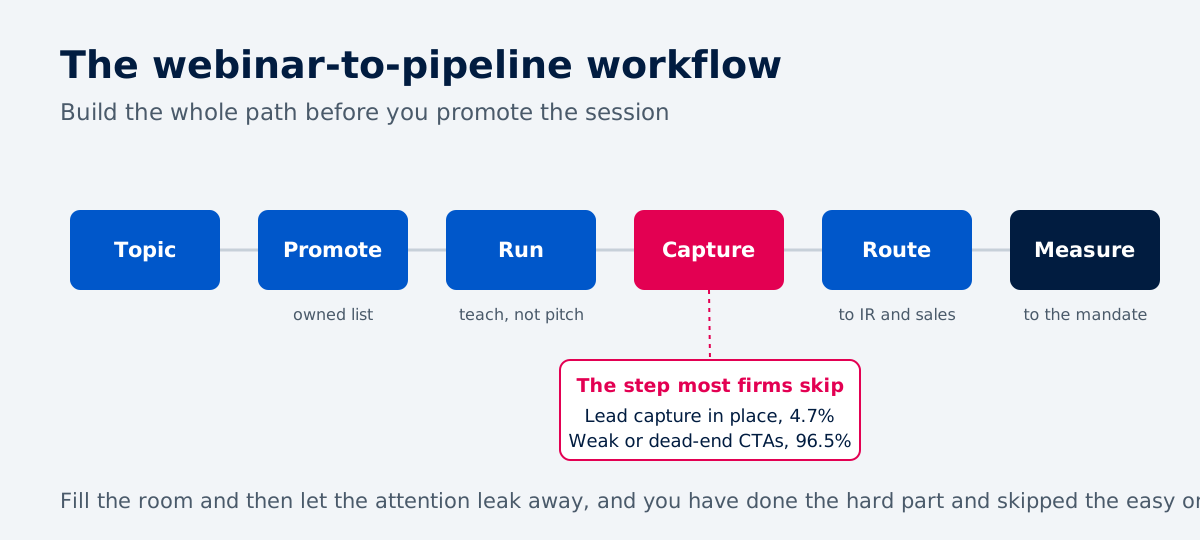
Treat the webinar as a system with one revenue job, and build the whole path before you promote anything:
- 1. Topic, the committee's real question, built for one buyer.
- 2. Promote, the owned audience and relationships, the staged sequence.
- 3. Run, the session delivered as teaching.
- 4. Capture, registration and attendance recorded against a known contact, not left in the webinar platform.
- 5. Route, the engaged attendees handed to the investor relations, distribution, or sales team with the context of what they watched and asked.
- 6. Measure, every stage tracked through to the meeting and the mandate.
The move that separates a pipeline channel from a broadcast is the follow-up. When we build a webinar, the follow-up is designed before the event, the recording and a useful resource go out, a nurture track runs for the people who are not ready, and the strongest signals, the people who asked a real question or stayed to the end, are handed to the team for a direct conversation. The attendee is no longer cold and the brand is no longer abstract, which is why reply rates and pipeline quality improve after a good session.
When should you define the handoff?
Decide in advance what counts as a lead worth a human. In the way we design funnels, a registration is an early signal, attendance a stronger one, and a question or a full-session stay stronger still. The people who clear that bar get routed to the team with their context attached, and buyers whose intent is already obvious, the ones who reply asking for a follow-up, get a fast-track straight to a conversation rather than a drip.
Speed matters here more than firms expect. In a gated-asset campaign we ran, the download was the start of the funnel rather than the goal, and the lever that moved pipeline was an automated nurture plus a fast first follow-up that the client never had to run by hand. A webinar registration behaves the same way. Wire the signal to drop the attendee into a sequence the moment it fires. The sequence itself, and the owned list it depends on, is the subject of our guide to email marketing for asset managers.
Why does the leak happen?
The reason this step is worth spelling out is that asset managers almost never build it. Across the estate, only 4.7% of firms have lead capture in place at all, and 96.5% run weak or dead-end calls to action that ask the reader to do nothing. A firm that runs a webinar and then lets the attention leak away has done the hard part, filling the room, and skipped the easy part, giving the room a next step. The wider lower-funnel gaps follow the same pattern, and capture and qualification is where to close them.
How do you run a compliant asset management webinar?
Compliance shapes the webinar. The rules decide the script, the slides, how you handle live questions, and what you keep on file. Two frameworks matter, and which one bites depends on who is in the room. Our guide to compliance-friendly marketing for asset managers covers the wider picture.
Who is in the room, and which rule applies?
Under FINRA Rule 2210, a communication made available only to institutional investors is an institutional communication, while one made available to more than 25 retail investors in any 30-day period is a retail communication. Retail communications have to be fair, balanced, and not misleading, generally need a registered principal to approve them before use, and have to be kept on file. An institutional-only webinar is lighter-touch, though the firm still has to prevent the material being forwarded to retail investors. This applies where the firm or its distributor is a FINRA member broker-dealer.
So the first compliance decision is the guest list. An institutional-only session carries less review burden than one opened to the public, and knowing which you are running tells you what the review step looks like.
Does the advertising rule apply to the whole session?
For SEC-registered advisers, the SEC Marketing Rule, 206(4)-1, treats a communication that offers advisory services as an advertisement. It has to be fair and balanced, it cannot make untrue or unsubstantiated statements, material claims have to be substantiated, testimonials and performance figures carry specific conditions, and the firm has to keep records of its advertisements. A webinar that markets the firm is an advertisement, so the same standard applies to what the speaker says on camera.
What does the compliance workflow look like?
Put the two rules together and the compliant webinar is a short workflow:
- 1. Before, a compliance or principal review of the script, the slides, and any performance figures, against substantiation and fair-and-balanced standards.
- 2. During, disciplined live delivery and Q&A, with the speaker briefed on what can and cannot be claimed on the fly.
- 3. After, the recording, the slides, and the chat kept on file as records.
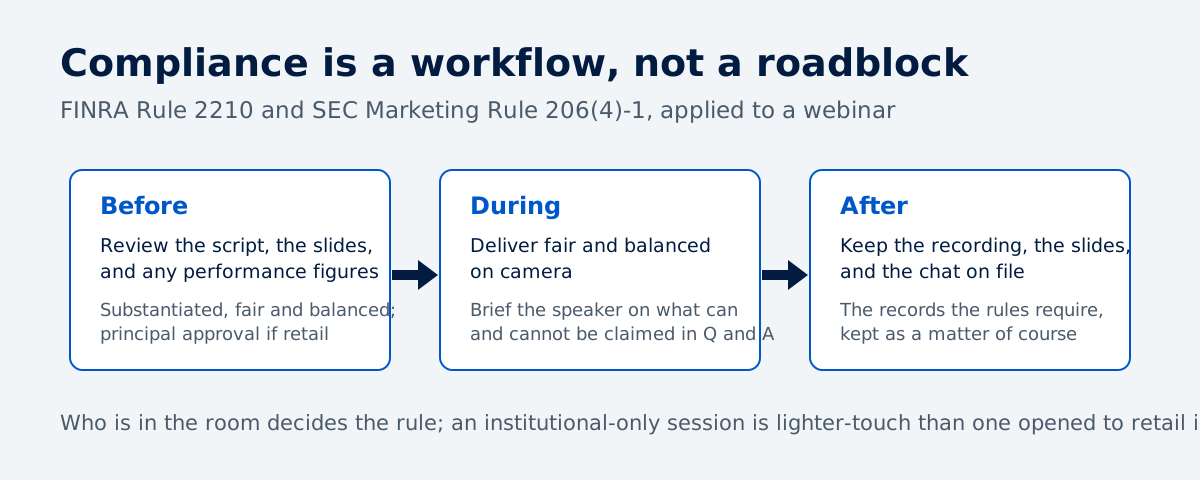
Asset managers already have this muscle. About 22% of firms produce regulatory thought leadership, which means they already route content through review. A webinar is the same discipline applied to a live format.
How do you measure an asset management webinar?
Measure it to the mandate. The reason asset managers struggle to justify a webinar is the same reason they struggle to justify most marketing: attribution and the automation to support it are rare in the sector. Firms report reach and stop there, and the real return goes uncounted. With a median of 214 organic visits a month across the estate, reach is small enough that the pipeline a webinar creates matters far more than the traffic number.
What goes on the measurement ladder?
Track a webinar up a short ladder, with one headline number per rung:
- 1. Registrations, and specifically right-fit registrations, the people you actually want.
- 2. Attendance and engagement, who showed up and who stayed or asked something.
- 3. Captured contact, known people recorded against your CRM, not stuck in the platform.
- 4. Qualified meeting, the follow-up conversations the session created.
- 5. Influenced mandate and AUM, the pipeline and assets the channel touched, which is how you see which asset started the deal.
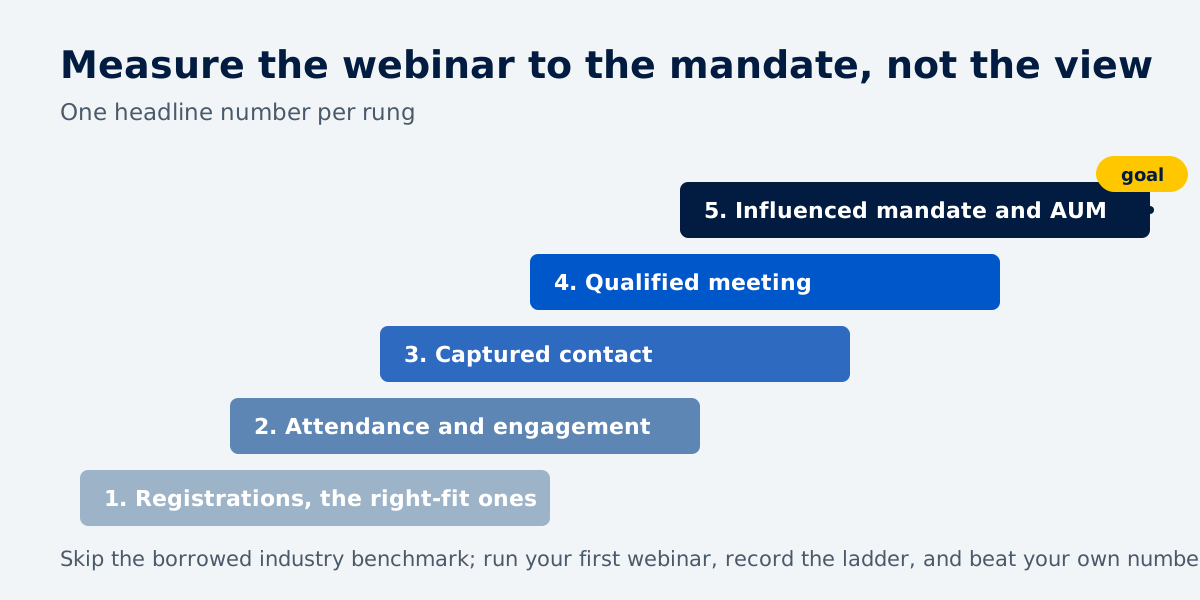
Do not reach for an industry benchmark to judge yourself against, because the ones in circulation are unreliable and audience, topic, and list quality move the numbers too much. Run your first webinar, record the ladder, and make that your baseline. Then beat it next quarter. That is how the firms that take webinars seriously improve, against their own last result rather than a borrowed average.
Where should asset managers start with webinars?
Start with one webinar, one buyer, one job, and one next step. The failure mode is announcing a monthly program before you have proven a single session, so do the opposite and earn the cadence.
Why put the webinar inside a theme?
A webinar works best when it is not a standalone event. In the way we plan content around a theme, a webinar sits between the cornerstone asset and the smaller supporting pieces, drawing on the big idea above it and feeding the blogs, clips, and emails below it. Plan from the top, publish from the bottom, and the session has something to stand on and something to feed.
A healthy cadence settles at roughly one webinar a month once the system runs, and you get there after the first session has proved itself. Your first session should come from a question your buyer already has and a speaker who can answer it, and it should route somewhere, a recording, a resource, a next conversation, rather than dead-end. If you need the wider order of moves first, start with where to start with marketing for asset management firms.
Where do you stand today?
Before you plan a session, it is worth knowing how your content estate actually looks to a buyer and where the gaps are. You can see the full picture in our state of content marketing for asset managers study, and you can score your own firm against it with our asset management content benchmarking tool. That tells you whether a webinar is the right first move or whether the groundwork it needs has to come first.
Building the webinar, the capture, and the routing into a system that actually produces mandates is the work we do for asset managers; you can see how we approach the sector on our financial services page.
Ready to turn your webinars into mandates?
Building the webinar, the capture, and the routing into a system that produces mandates is the work we do for asset managers.
Frequently Asked Questions
About the Author

Founder & CEO, Content RevOps
Stefan Kalpachev is the founder and CEO of Content RevOps, where he helps B2B SaaS companies transform their content into predictable pipeline. With a background in content marketing and revenue operations, Stefan has developed a unique methodology that bridges the gap between content creation and revenue generation.
Connect on LinkedInRelated Articles
Marketing to Institutional Clients: A Guide for Asset Managers
Nov 4, 2026
Email Marketing for Asset Managers: Build the List Before the Newsletter
Nov 3, 2026
Fractional CMO for Asset Management Firms: When You Need One, and When You Don't
Oct 29, 2026