Marketing to Institutional Clients: A Guide for Asset Managers
Not sure whether your institutional marketing leads with positioning or just volume? A content revenue audit shows you where you stand against the field.
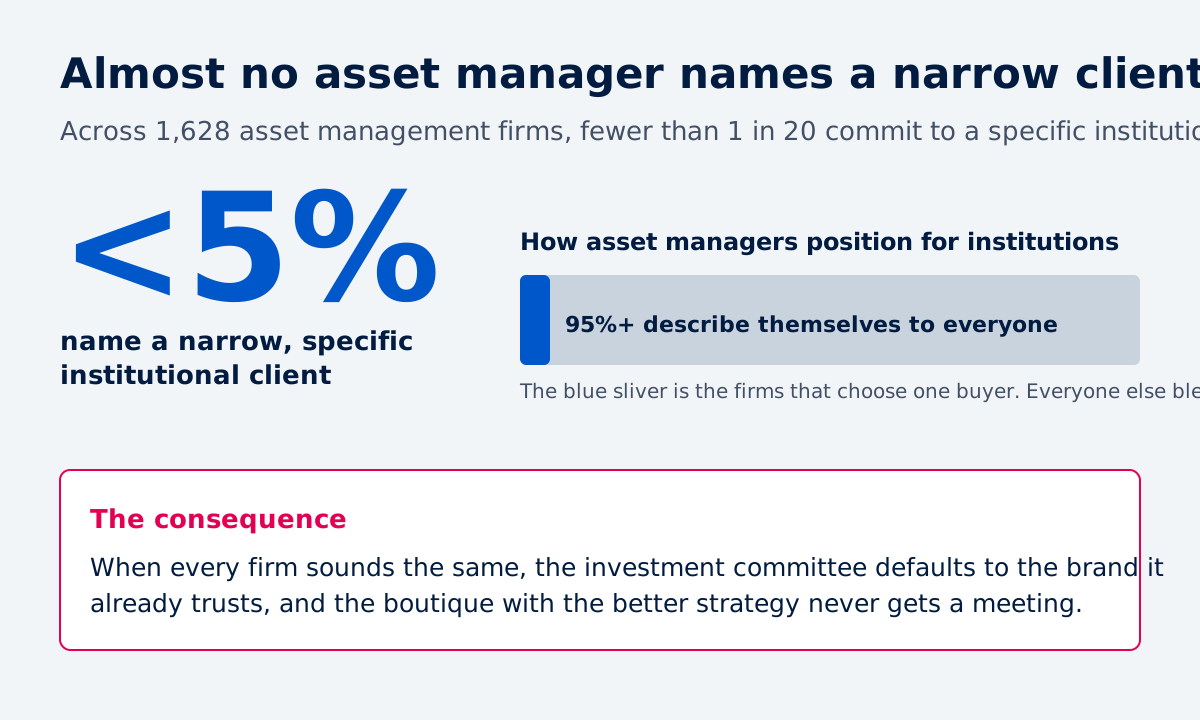
Book a CallMarketing to institutional clients fails for most asset managers long before a demand generation campaign runs. It fails at positioning. In our analysis of 1,628 asset management firms, fewer than 1 in 20 commit to a narrow, specific institutional client, so almost everyone falls back on the same generic sophisticated-investor language. When every firm sounds the same, the committee defaults to the brand it already trusts, and the boutique with the better strategy never gets a meeting.
Part of Content Marketing for Asset Managers: The 2026 Playbook.
This guide is for the marketer or distribution lead at an asset management firm who sells to pensions, endowments, insurers, and the consultants who screen them. It covers who the institutional buyer actually is, why most institutional marketing misses, how to position for a specific client, how to build proof a due-diligence team can check, and where institutional investors actually consume your content. If you are earlier than that and need the first moves, start with where to start with marketing for an asset management firm.
The firms that win do three plain things. They name exactly who they are for, they say the one thing they do better than the giants, and they back it with evidence a consultant and an investment committee can verify.
What does marketing to institutional clients mean for asset managers?
Marketing to institutional clients means marketing to a committee, through a gatekeeper, over a long cycle. The "client" is rarely one person. It is an investment committee inside a pension fund, endowment, foundation, insurer, sovereign wealth fund, or outsourced CIO, and it decides a mandate over months, not days.
Who decides whether you are even considered?
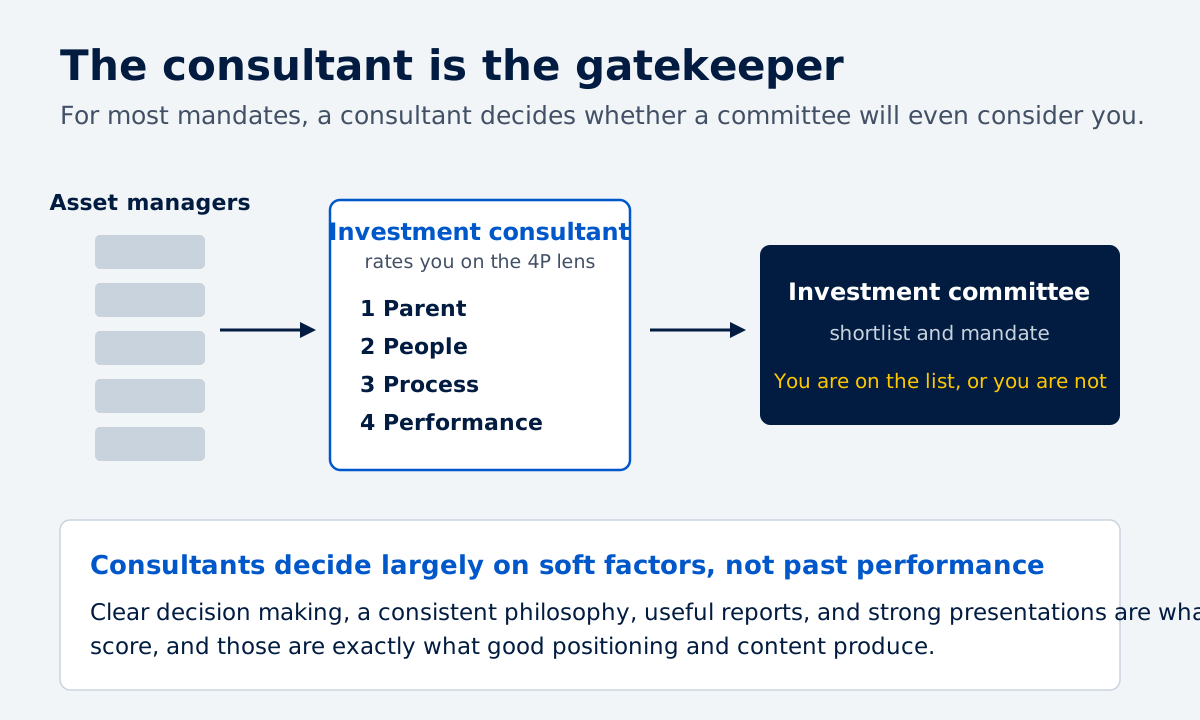
For most institutional mandates, an investment consultant sits between you and the committee. Academic work on the institutional market puts this plainly. The study Picking Winners? Investment Consultants' Recommendations of Fund Managers, published in the Journal of Finance, calls consultants "key gatekeepers, whose opinions determine whether a plan sponsor will even consider a particular fund."
The scale is large. That same research reports that investment consultants advised on close to $25 trillion of institutional assets worldwide, and that roughly 82% of U.S. public pension plans use one. If a consultant has not rated your strategy, a big share of the institutional market cannot buy you, however good the returns are.
What does that make marketing's job?
So the job of marketing to institutional clients is not to generate a flood of leads. It is to get your firm onto the consultant's shortlist, and then to give the committee enough to keep choosing you through due diligence. Every piece of content either helps a gatekeeper rate you and a committee defend you, or it does nothing. That is the same test we apply when we map what each piece of content does at each stage.
That reframes the whole effort. You are not broadcasting to a market. You are equipping a small number of sophisticated people to make and justify a high-stakes decision about your firm.
How is marketing to institutional clients different from retail or advisor marketing?
Marketing to institutional clients differs from retail or advisor marketing in four ways that break the usual playbook. Import a retail funnel here and it stalls, because the buyer, the timeline, and the decision all work differently.
- The buyer is sophisticated and buys on reputation. In the LinkedIn and Coalition Greenwich study of institutional investors, 87% said a reputable brand is the most important consideration when choosing an asset manager, ahead of DE&I, ESG, and governance.
- A gatekeeper stands in the path. A consultant screens you before the committee ever sees you, which almost never happens in retail.
- The cycle is long and multi-person. Mandates move through research, meetings, due diligence, and committee sign-off, so content has to work across months and across people who never meet you. That is why funnel optimization for asset managers starts at the lower funnel, not the top.
- Specific beats loud. The same institutional study found 48% now say customized content is key, up from 33% in 2018. Generic "trusted partner for sophisticated investors" messaging does not move this buyer.
The retail instinct is reach. The institutional reality is relevance to a named buyer and credibility with the person who rates you. The complete guide to B2B demand generation strategy makes the same argument for every complex sale: one buyer, one buying moment, and a point of view that buyer can repeat.
Why does most institutional asset management marketing fail before it starts?
Most institutional asset management marketing fails because it skips positioning and jumps straight to activity. Without a narrow client in mind, messaging defaults to the generic, the content becomes a press feed, and the buyer defaults to the brands they already know. We catalogued the pattern in the biggest content marketing mistakes asset managers make; the three below are the ones that cost institutional mandates.
Fewer than 1 in 20 firms name a narrow institutional client
This is the root cause, and it is measurable. Across the 1,628 firms in our census, fewer than 1 in 20 name a narrow, specific ICP. The rest describe themselves to everyone, which means they describe themselves to no one in particular.
When you have not decided which institutional client you are for, you cannot say anything sharp. You end up with "long-term, research-driven, client-focused," the exact phrases every competitor also uses.
44.1% of asset manager content is news and press releases
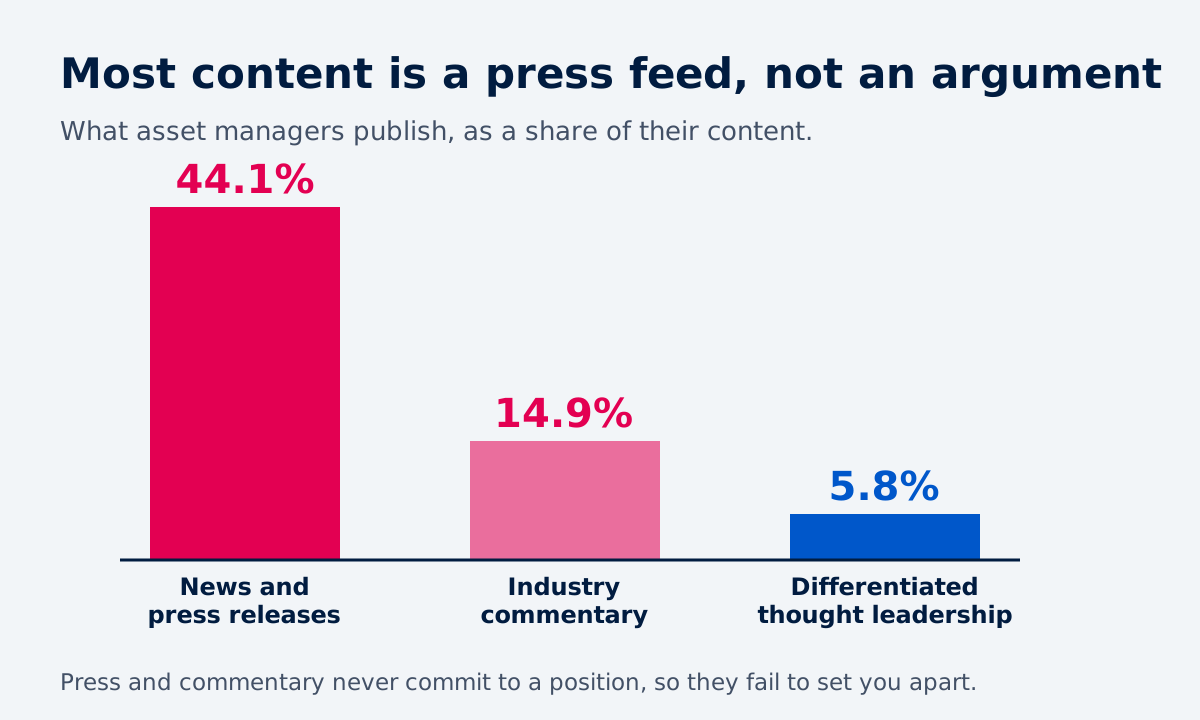
The sameness shows up in what firms publish. In our analysis, news and press releases make up 44.1% of asset manager content, and industry commentary another 14.9%. Commentary is common; a differentiated point of view is not. The content marketing strategies that work for asset management firms start by retiring the press-release reflex.
Press and commentary feel safe because they never commit to a position. That is exactly why they fail to separate you from the firm down the road publishing the same market update.
Why does the committee default to the giants?
When ten firms look interchangeable, the committee picks the safe name. Our citation data shows the pattern already hardening in AI answers, where the most-cited asset management brands are Vanguard, BlackRock, Fidelity, State Street, and J.P. Morgan Asset Management. We unpack why most asset managers do not show up in AI search separately. The race below those five is wide open, but only for firms willing to stand for something specific.
Marketers who advise institutions say the same thing from the field. RFPnetworks argues that boutiques must "differentiate on strengths, not size," and that even for the largest firms, "clarity of expertise becomes a competitive differentiator." FT Longitude puts it as a scenario: picture ten asset managers with a near-identical global dividend fund, where an advertising arms race just drains the smaller firm's budget, and original, specific ideas are the only thing that stands out.
How do you position an asset management firm for a specific institutional client?
You position an asset management firm by choosing one institutional client, naming the one problem you solve better than the giants, and saying it in language the buyer uses instead of language every manager uses. Positioning is the work that makes everything downstream specific.
Which institutional client are you for?
Start by treating your ideal client as a hypothesis, not an aspiration. The way we choose an ICP is to list every plausible institutional buyer with its role in the decision, buyer, user, influencer, or gatekeeper, then pressure-test the shortlist against won and lost mandates rather than picking from instinct. Once the client is chosen, mapping that client's world tells you which consultants, publications, and events sit between you and them.
For an asset manager, that means getting concrete. "Public pension plans in the $1 billion to $10 billion range that use a consultant and allocate to specialist credit" is a client you can speak to. "Institutional investors" is not.
What do you do better, in the buyer's words?
Once you know the client, name what you do for them in terms they recognize. The move we use to get from research to positioning is simple: take the thing you do, ask what it is really about for this buyer, and work out what has to be true next. That shifts you from vendor language to the language of a trusted partner.
The test is whether a prospect could repeat your positioning back to a colleague. "We run concentrated, high-conviction small-cap value for endowments that want active risk they can explain to their board" passes. "We deliver alpha through a disciplined process" does not, because every manager says it.
What is an institutional messaging and proof framework?
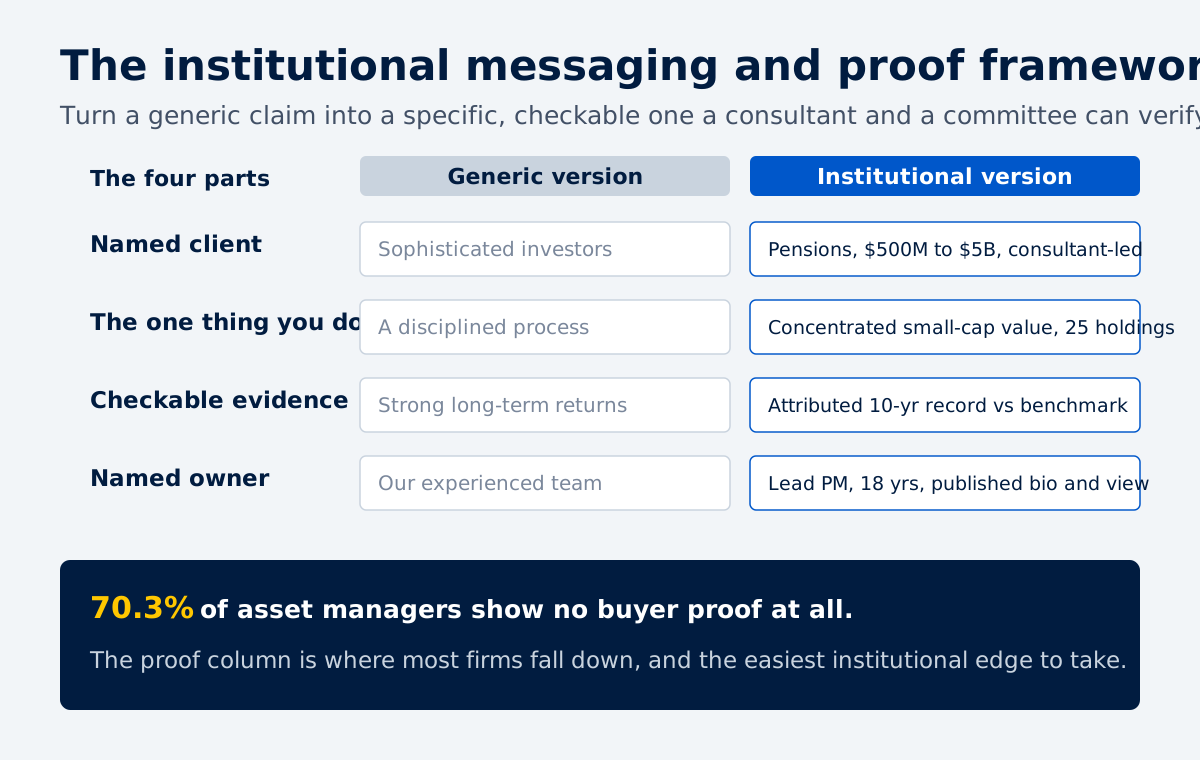
An institutional messaging and proof framework is a repeatable way to turn a generic claim into a specific, checkable one. It has four parts, and the point of each is to give a consultant and a committee something they can verify rather than take on faith.
What are the four parts?
- The named client. Who exactly this is for, stated narrowly enough that the right buyer feels recognized.
- The one thing you do. The single capability you do better than the giants, not a list of five.
- The checkable evidence. The proof a due-diligence team can inspect, not an assertion.
- The named owner. The real person behind the strategy, with a track record and a face.
Here is the same claim run through the framework, generic version beside institutional version.
Part | Generic version | Institutional version |
Named client | Sophisticated investors | Corporate pension plans with $500M to $5B that use a consultant |
The one thing you do | A disciplined, research-driven process | Concentrated small-cap value, 25 holdings, 5-year average hold |
Checkable evidence | Strong long-term performance | Attributed 10-year track record, stock selection as the driver, shown vs the benchmark |
Named owner | Our experienced investment team | Lead PM, 18 years on this strategy, with a published bio and philosophy |
70.3% of firms show no buyer proof at all
The proof column is where most asset managers fall down, and it is the easiest edge to take. In our census, 70.3% of firms show no buyer proof at all, no case studies, data, or outcomes. Case studies appear in just 5.5% of content and use-case content in 10.6%. Most firms hand the buyer assertions and leave the evidence for the sales call. The content marketing best practices for asset managers that matter most are the ones that put proof on the page.
Proof works when the buyer can argue with it. The way we think about proof is the way we built our audit leakage model: show the math and the assumptions on the page so the buyer can interrogate the inputs, rather than trust a number they cannot see inside. A committee treats a figure it can check very differently from a figure it has to believe. Our own case studies are written to that standard, with the named client, the system built, and the numbers it produced.
Who is the person behind the strategy?
The named owner matters more with institutions than most firms assume. In the institutional study, 44% said they consume content based on the individual who produced it, and 24% connect with leading voices to shape their views. Yet named, credentialed author bios appear on only about 22% of asset manager content. Putting a real portfolio manager's name, face, and philosophy on the work is a cheap, direct edge, and compliance-friendly marketing for asset managers shows how to do it without tripping the SEC Marketing Rule. The way we work with subject-matter experts is built to extract that point of view from a busy portfolio manager without asking them to write.
How do you market through investment consultants and win the committee?
You market to institutions by marketing through the consultant and into the committee. That means your content has two jobs: get rated by the gatekeeper, then survive due diligence and stay defensible when the committee argues over the shortlist.
What does the gatekeeper actually rate?
Consultants do not rate your advertising. The same Journal of Finance research found that consultants' recommendations are driven largely by soft, qualitative factors rather than past performance, and that those recommendations move real money into and out of funds. The soft factors it names are clear decision making, capable portfolio management, and a consistent investment philosophy, alongside service factors like the usefulness of your reports and the quality of your presentations.
Read that again, because it is the whole mechanism. The things a consultant scores you on, clear thinking, a consistent philosophy, useful reports, strong presentations, are the exact things good positioning and content produce. Your communication is part of what gets you rated. That is also why thought leadership in this sector means a defensible position with evidence behind it, not commentary.
What does due diligence check?
Institutional due diligence runs on a short, repeatable lens. PFM scores managers on the "4Ps", Parent, People, Process, and Performance; Barclays uses a "5P" framework scored one to five and runs a separate operational due-diligence team with a right of veto. Other consultants converge on the same lens.
Your content should hand a due-diligence team evidence for each of those factors: a stable team and firm, a repeatable and clearly described process, and an attributed track record. When the material already answers the committee's questions, the firm starts the mandate conversation further ahead. This is what we mean by a conversion layer: the decision-stage material that sits behind the informational content and does the committee's homework for it.
62.3% of firms publish nothing at the decision stage
This is where most asset managers go quiet, right when the buyer is ready to act. Our census shows 98.9% of firms cover the consideration stage but 62.3% publish nothing at the decision stage. The failure concentrates exactly at the point of choice.
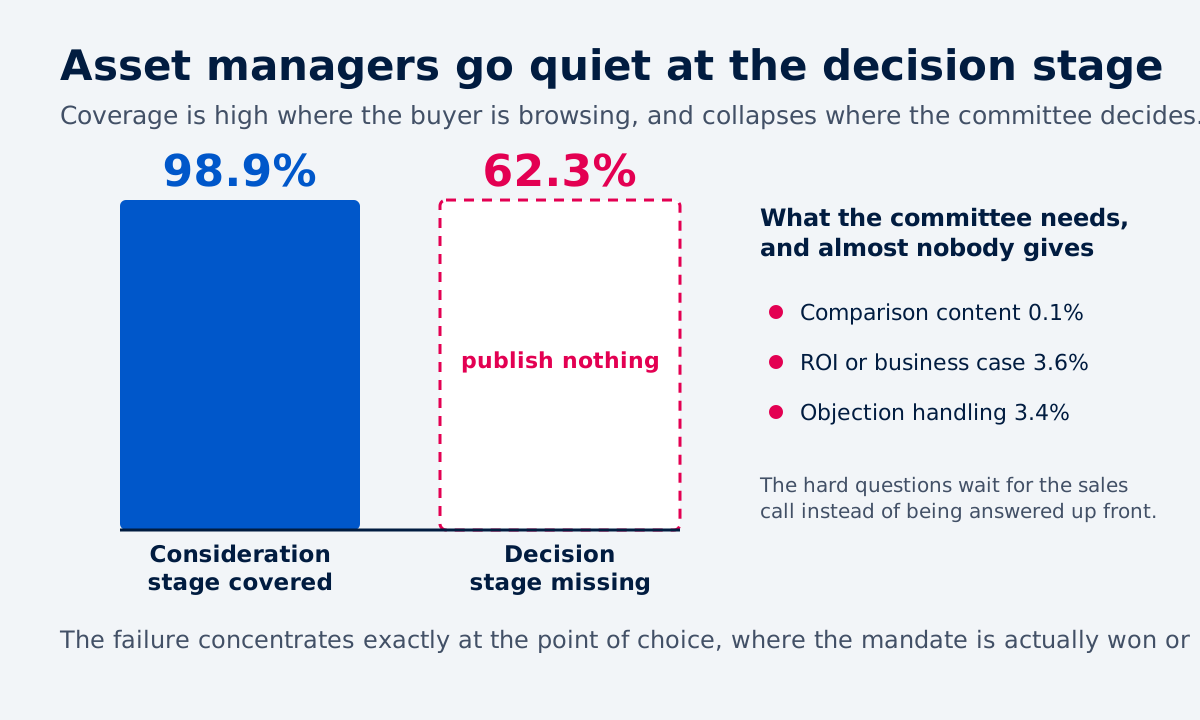
The specific gaps map to what a committee needs. Comparison content sits at 0.1%, even though the committee's whole job is to compare managers. ROI or business-case content is 3.6%, the material a champion needs to make the internal case. Objection-handling content is 3.4%, so the hard questions wait for the sales call instead of being answered up front.
The committee also judges fit, not just quality. As institutional investor Ju Hui Lee frames it, asset managers optimize portfolios while asset owners optimize institutions, so the real question is whether your strategy improves the whole fund. Content that only sells the product's features misses the question the committee is asking. The way we design the funnel before making content is to map what each piece does at each stage, so the decision stage is built, not left to chance. Once a committee is engaged, nurture keeps the proof flowing to the people who never meet you during the months a mandate takes.
Where do institutional investors actually consume your content?
Institutional investors consume your content through relationships, events, industry press, and thought leadership, far more than through blogs or social feeds. Marketing that assumes a blog-and-social funnel aims at the wrong place.
The Coalition Greenwich Elevating Marketing Impact Study found about 80% of institutions attended an online seminar in the past year, with in-person attendance nearly as high. Industry publications remain a top content source, and 45% of North American institutions name manager thought leadership as a key source. Only about 1 in 5 cite blogs, videos, or podcasts, and fewer than 5% get investment content through social media. That seminar figure is the reason webinar marketing for asset managers fits the institutional sale so well, even though only 3.1% of firms run them.
That does not make a digital presence pointless. It makes its job clear. Two-thirds of asset managers have an organic LinkedIn presence, yet few turn it into a system, as LinkedIn marketing for asset managers shows, and the median firm earns around 214 organic visits a month, which is why SEO for asset managers underperforms almost everywhere. Presence is common; performance is rare. Genuine thought leadership, which is scarce at 5.8% of content, is one of the few formats that reaches this buyer where they actually read, and the video most firms already record is the cheapest raw material for it.
So measure what the institutional motion is really about. Track meetings booked, consultant conversations opened, and mandates influenced, not page views; the demand generation metrics worth tracking are the ones that tie back to a mandate, and the wiring to see which page started the deal is what makes that possible. The honest benchmark is maturity, and only about 1 in 28 asset managers runs content as a system. If you want to see where your firm stands on positioning, proof, and decision-stage coverage, the asset management content benchmarking tool scores your estate against the firms in our study, and the full research shows what the leaders do differently. For how we help asset managers put this to work, see our financial services practice.
Want to see how your asset management firm's positioning and proof compare to the sector?
Our content revenue audit benchmarks your estate, finds where decision-stage proof is missing, and puts a number on the gap.
Frequently Asked Questions
About the Author

Founder & CEO, Content RevOps
Stefan Kalpachev is the founder and CEO of Content RevOps, where he helps B2B SaaS companies transform their content into predictable pipeline. With a background in content marketing and revenue operations, Stefan has developed a unique methodology that bridges the gap between content creation and revenue generation.
Connect on LinkedInRelated Articles
Email Marketing for Asset Managers: Build the List Before the Newsletter
Nov 3, 2026
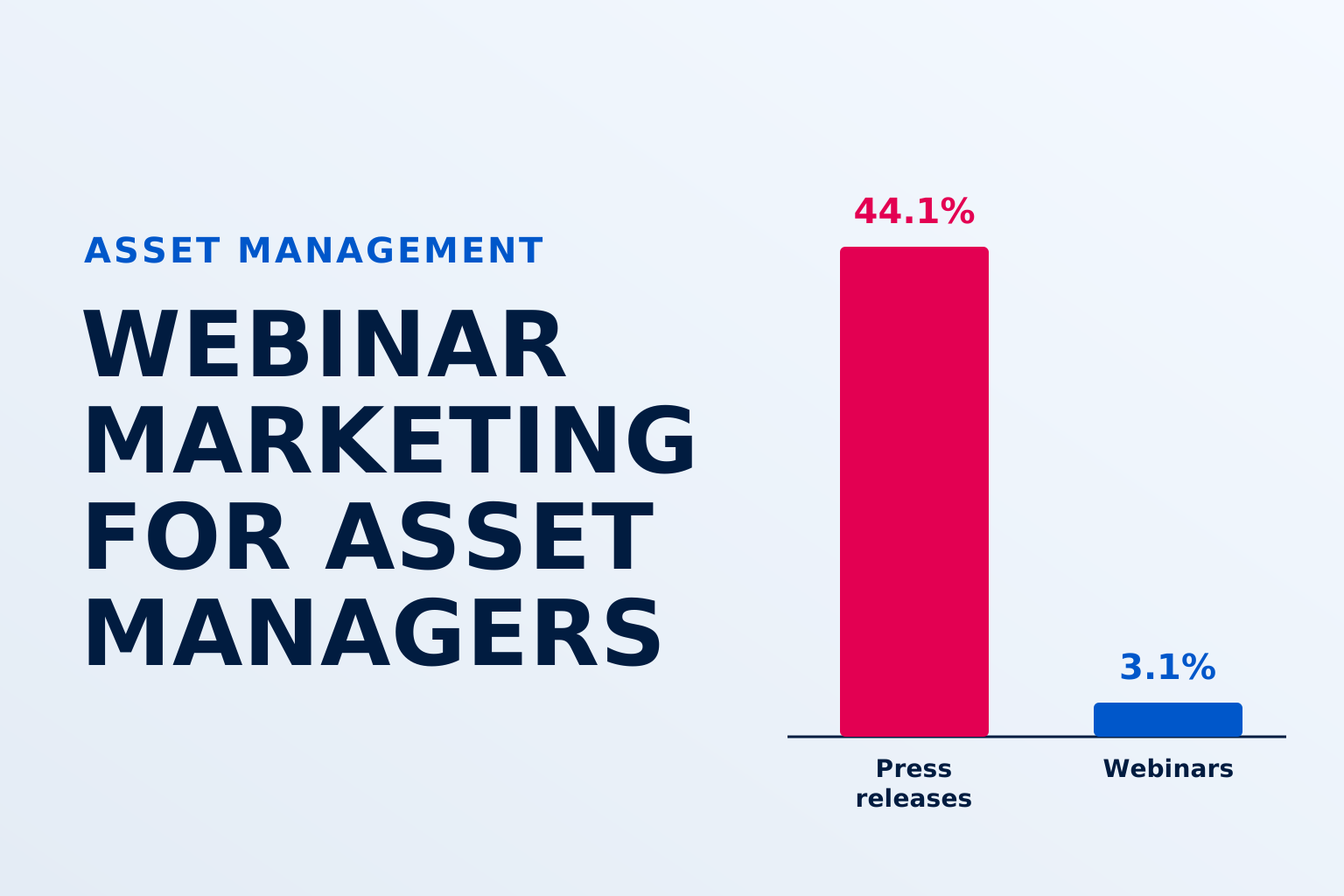
Webinar Marketing for Asset Managers
Nov 2, 2026
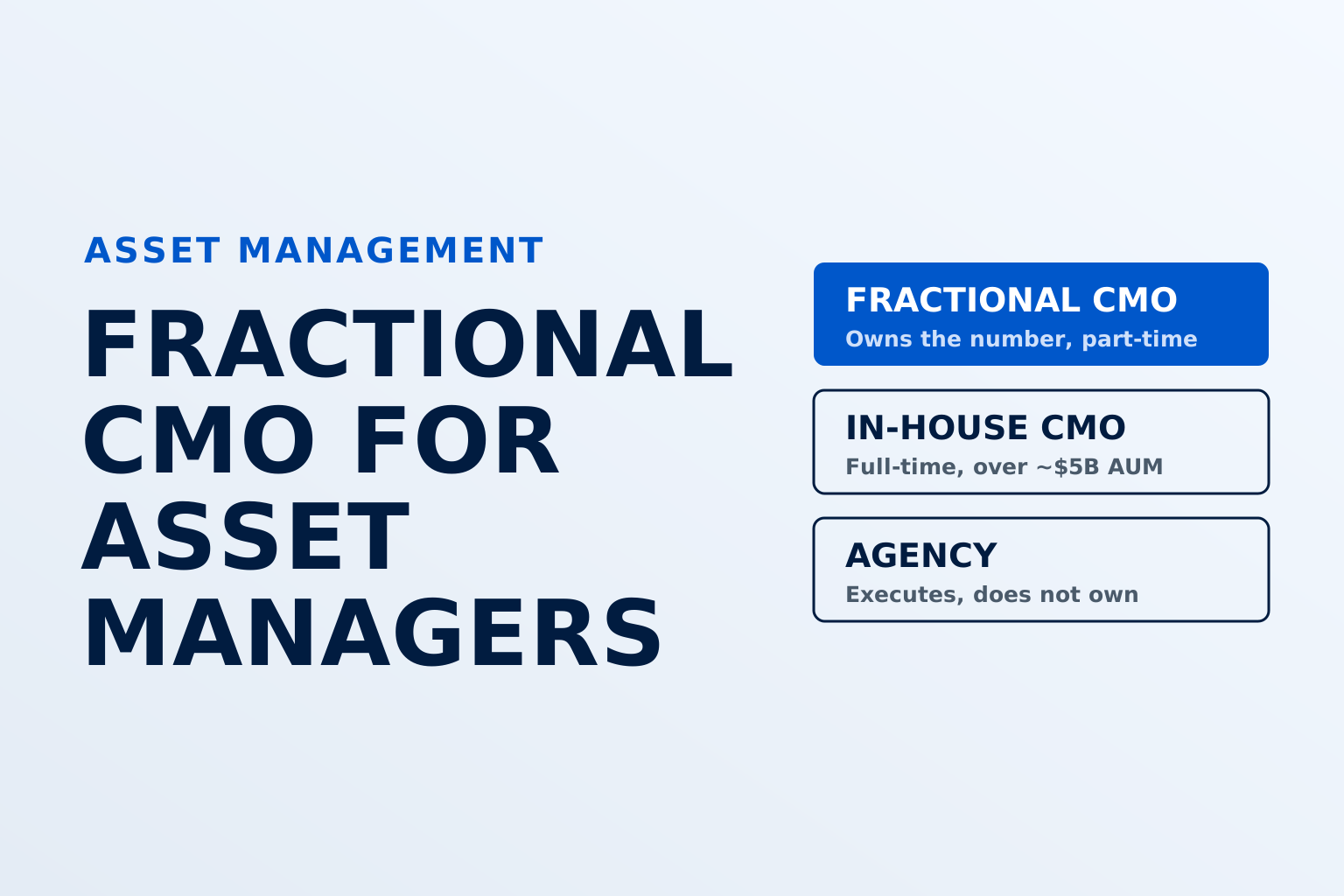
Fractional CMO for Asset Management Firms: When You Need One, and When You Don't
Oct 29, 2026