Email Marketing for Asset Managers: Build the List Before the Newsletter
Not sure whether your firm's email list is an owned asset or a rented one? A content revenue audit shows you where the capture gap is costing you.
Book a CallEmail marketing works for asset managers, but only as a channel you own, built on a list you captured with permission. It is the one channel you are not renting from Google or LinkedIn. The catch is that email only compounds once you have a consented contact to send to, and in asset management, capturing that contact is the rarest skill of all. In our review of 1,628 asset management firms, just 4.7% had any way to capture a lead on their site. So the firms whose email "doesn't work" are almost always emailing a rented or purchased list, because they never built an owned one. Fix the capture gap first, then run email as a capture-and-nurture system, not a newsletter.
Part of Content Marketing for Asset Managers: The 2026 Playbook.
Does email marketing actually work for asset managers?
Yes, and the reason is ownership. Search traffic and social reach are rented; the algorithm changes and your audience disappears. An email list is the one audience an asset manager owns outright, which is why it is worth building properly.
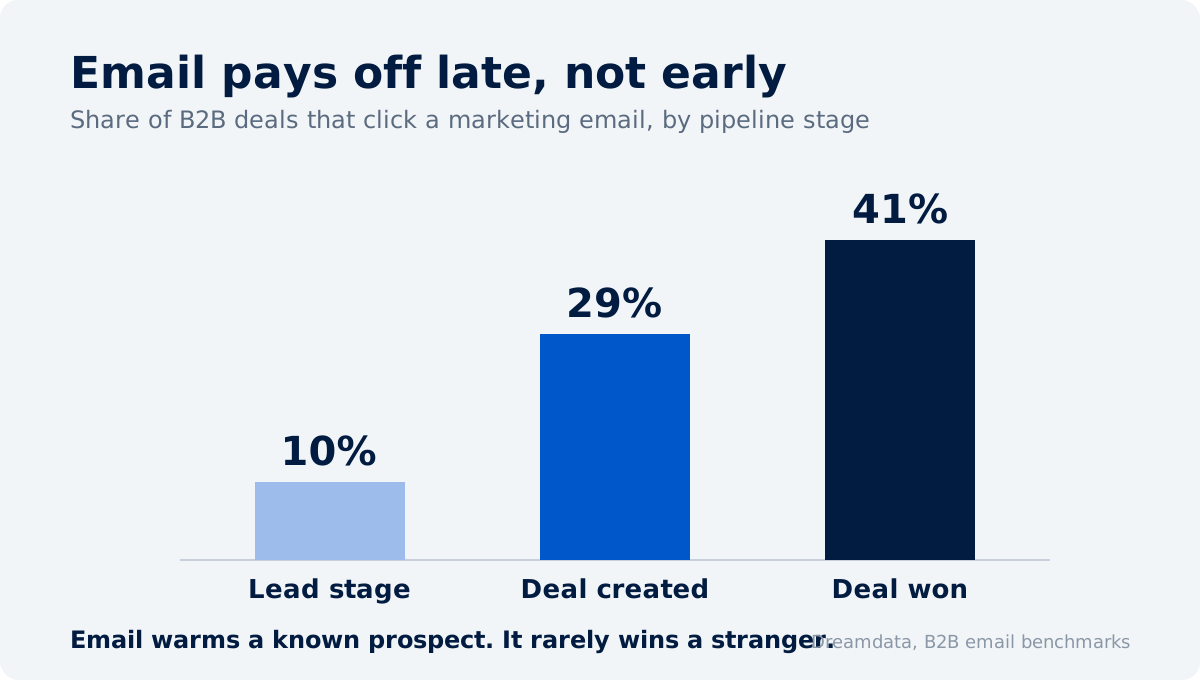
The value shows up late in the buying journey, not early. Dreamdata's analysis of 200 B2B companies found that 41% of closed-won deals clicked at least one tracked marketing email, but only 10% of deals did so at the early lead stage. Email is weak at acquiring a stranger and strong at warming a known prospect toward a decision. That is a nurture channel, and a nurture channel needs a list.
Most asset managers have the opposite setup. They have presence on channels they do not own, and almost nothing on the one they do. In our review, 64% of asset managers had an organic LinkedIn presence and around 90% had a YouTube presence, yet the median firm earned just 214 organic visits a month and 40.7% of visitors bounced. Traffic arrives on rented channels, then leaves without a trace. Email is where you keep it.
Why does most asset-manager email marketing underperform?
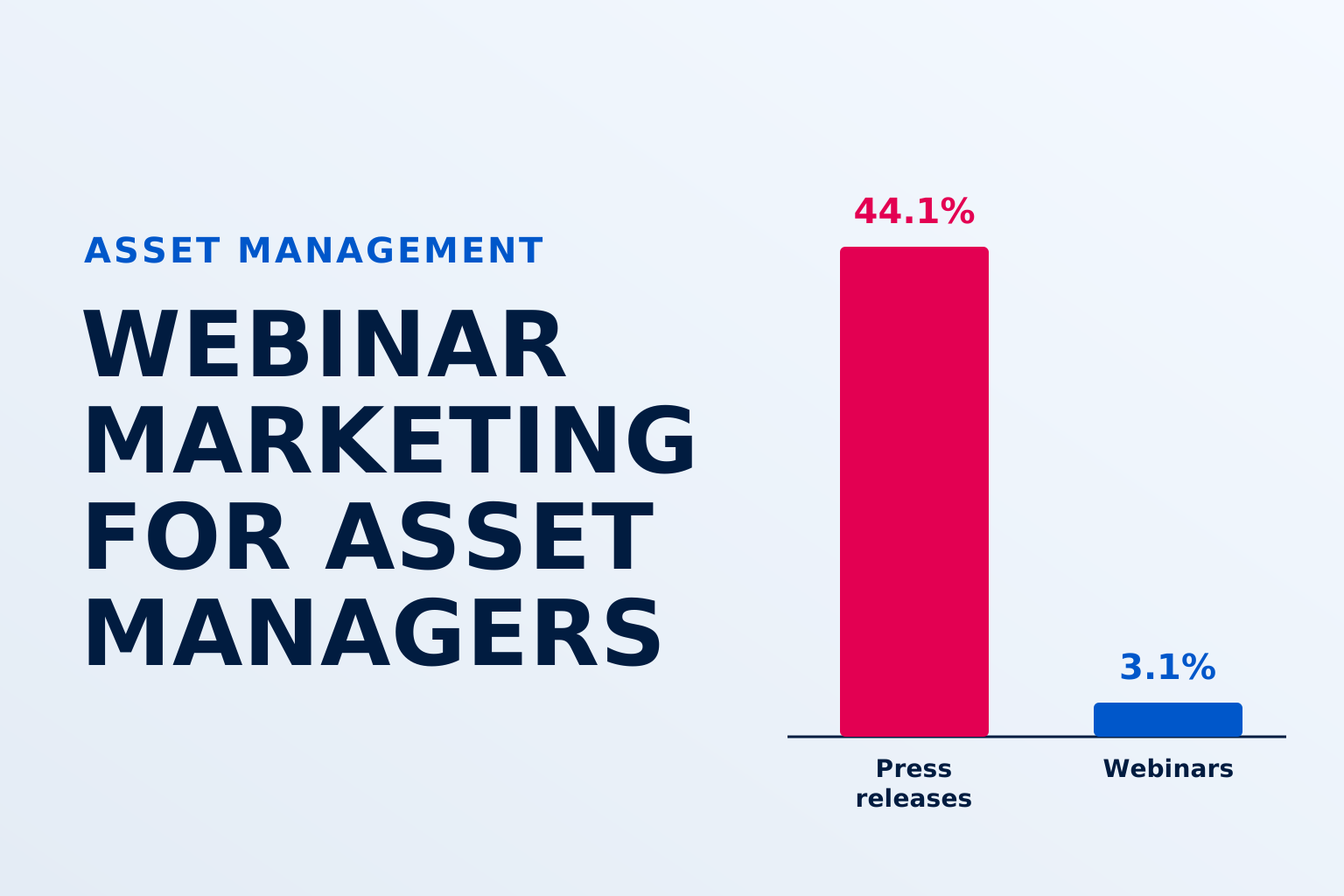
Because most asset managers treat email as a broadcast and never build a relationship. The habit carried over from the press desk. Nearly half of all asset-manager content, 44.1%, is news and press releases, published as an announcement function rather than a demand engine, and the same instinct shapes the inbox: a product update, a performance sheet, a fund fact sheet.
John Gulino, who runs the asset-management marketing agency GK3 Capital, describes the pattern bluntly in his breakdown of what goes wrong with financial-services email: firms send long emails "filled with product details or performance metrics" to large lists, often with a fact sheet as the main call to action, all chasing the same pool of roughly 250,000 advisors. Open and click reports then get passed to sales as "perceived engagement," and salespeople follow up on a signal that means almost nothing.
The content inside those emails has the same problem as the content on the site. 70.3% of asset managers show no buyer proof at all, no case studies, data, or outcomes. An email that asserts without proving gives a cautious institutional buyer no reason to reply. ProFundCom, a specialist email platform for fund managers, frames the same question in asking what holds fund managers back; the answer starts one step earlier than the email itself.
Why does email only compound once you capture a contact?
A firm that never captures a contact has only one kind of list to email: a bought or scraped one. That is why product-blast email is everywhere in this sector. The list was rented, so the relationship was never there to begin with.
The numbers make the gap concrete. Across the 1,628 firms we reviewed:
- Lead capture is present on 4.7%. Fewer than one in twenty asset managers give a reader any way to raise their hand.
- 96.5% end their content with a weak or dead-end call to action. Almost nothing points to a next step.
- Only 13.5% place a relevant call to action inside the flow of content, and just 5.2% use internal links that guide a reader toward converting.
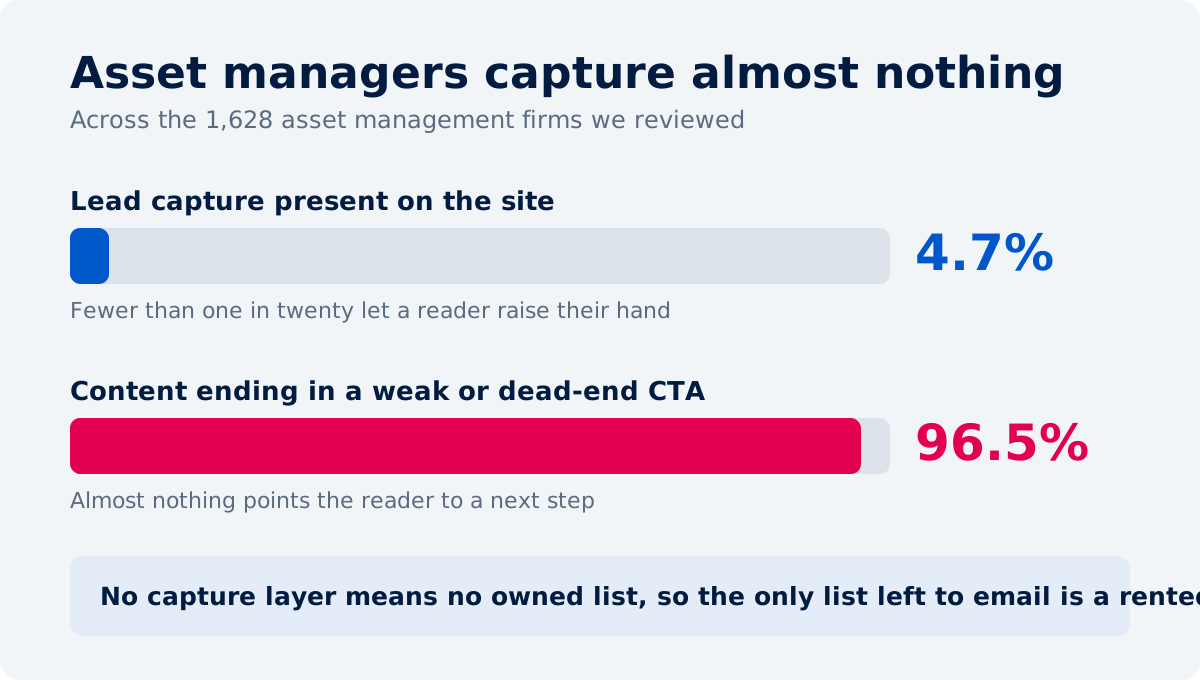
Put those together and the sector's email problem is upstream of the email. There is no capture layer, so there is no owned list, so the only option left is to rent one and blast it. Practitioners who run cold email into finance see the result from the other side; it is a running complaint that the financial industry has one of the worst conversion rates on cold outreach. Build the capture layer and you stop renting the audience. That is the whole move, and how we think about lead capture and qualification starts here.
How do asset managers build an email list?
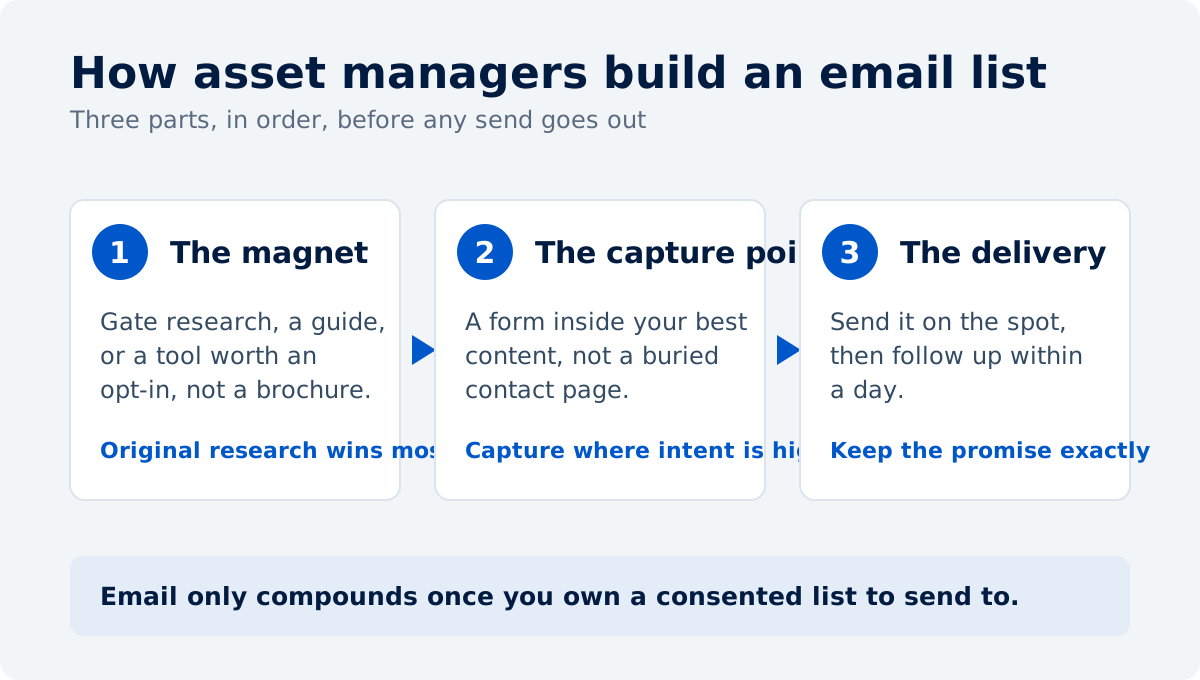
You build a list by giving a reader one genuinely useful thing in exchange for a name and an email, then sending them somewhere worth going. There are three parts: the magnet, the capture point, and the delivery.
What magnet earns an opt-in?
The magnet is a resource good enough that a serious prospect is happy to trade contact details for it. In asset management, that means gated research, an investor's guide, a benchmark, or a tool, not a brochure. Sondhelm Partners, in its guide to gated content for asset management firms, puts original research at the top; it reports that 38% of people will share contact details for original research, more than for any other format.
This is exactly where the sector is weakest, which is what makes it an opening. Genuine thought leadership sits at 5.8% of asset-manager content and case studies at 5.5%. The firm that builds one strong gated asset captures contacts where almost no rival has anything to trade. The kinds of assets that work as magnets, a benchmark report, an original-research study, a deep guide, are the same core asset builds that anchor a content program, so the magnet does double duty.
Where does the capture point go on the page?
A magnet with nowhere to opt in captures nothing, and this is the 96.5% dead-end problem in practice. The fix is to treat the site as a conversion layer, with stage-appropriate capture points rather than one buried contact form. A blog post leads to a checklist, the checklist leads to a webinar, the webinar leads to a case study. Each step asks for a little more and gives a little more.
In funnel terms, capture is the "engaged" moment, the download, the signup, the registration, that sits between a reader's first visit and a qualified conversation. Designing the funnel before the content is what tells you where each capture point belongs.
How do you deliver without frustrating the reader?
When someone opts in, send the asset immediately and keep the promise exactly. Sondhelm's rule is a workable split of about 20% gated and 80% ungated content: open content gets you found in search and AI answers, and you save the strongest material to capture serious prospects. Deliver the download on the spot, then follow up within a day referencing the specific thing they asked for.
What should asset managers send in an email nurture sequence?
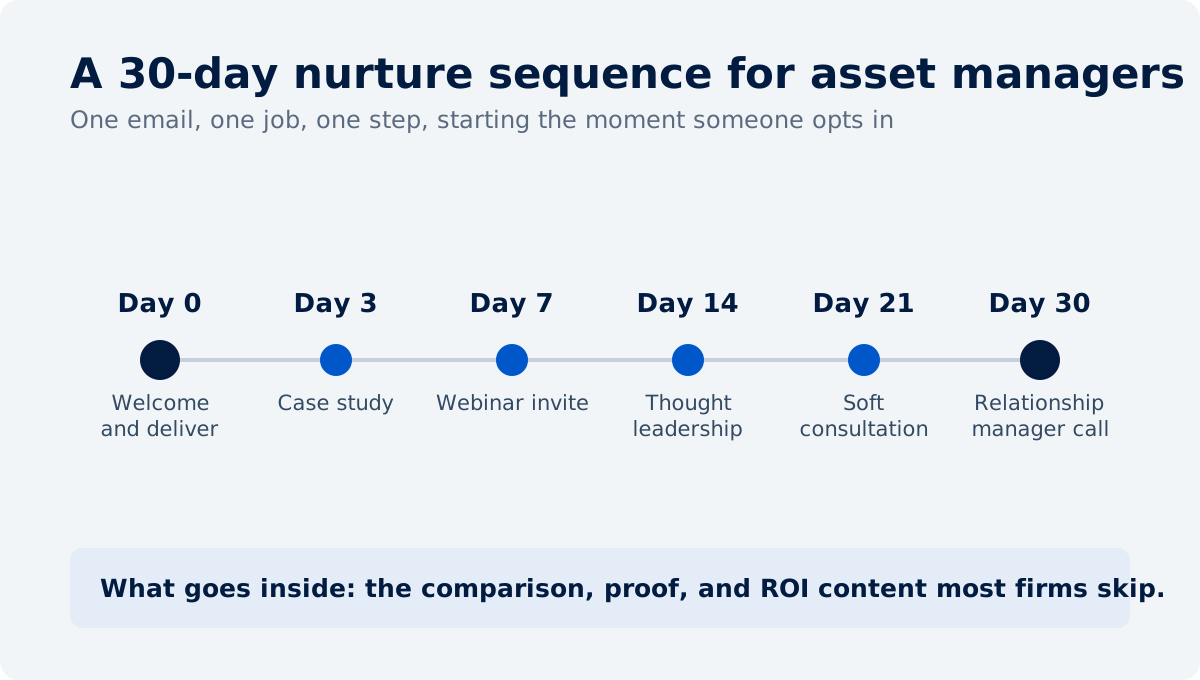
Send a sequence where each email does one job and moves the reader one step. The rule we hold to is simple: one email, one job, one step. A nurture sequence is a short, ordered set of emails that starts the moment someone opts in, with no newsletter calendar behind it.
A download is the start of the funnel, not the finish. Working with Mango PD on a gated-report campaign, we treated the download that way: the asset pulled strong response for a cold audience, so the work that mattered was the automated nurture that followed, an extra piece of value, then a warm path toward a call, running without the client lifting a finger.
What does a worked nurture sequence look like?
A concrete version for institutional asset managers appears in Vantagepoint's walkthrough of AM lead nurture, a 30-day arc that reads like this:
- Day 0, welcome and deliver. Send the promised resource with a short, personal note.
- Day 3, proof. A relevant case study.
- Day 7, go deeper. A webinar invitation.
- Day 14, point of view. Thought leadership from a named portfolio manager.
- Day 21, soft ask. A low-pressure consultation offer.
- Day 30, human. Direct outreach from a relationship manager.
What goes inside the emails?
The content in the sequence is where asset managers can out-execute the field, because the whole sector skips the decision stage. Awareness and consideration content is nearly universal at 98.9% coverage, but 62.3% of firms publish no decision-stage content at all. The scarcity is stark: comparison content sits at 0.1%, business-case or ROI content at 3.6%, objection-handling at 3.4%, and use-case content at 10.6%.
A nurture sequence is the natural home for exactly that material. The reader already raised a hand, so the emails that move them are the comparison, the proof, the answered objection, and the business case their own champion needs to sell internally. Send those, not another performance sheet.
When should you hand a warm lead to sales or distribution?
Hand the lead over when engagement crosses a threshold you set in advance, and do it fast. The mistake GK3 names is passing every open to sales as "interest." The fix is to score engagement across several touches over time and notify sales only when a contact clears a bar, so distribution spends its time on prospects who have actually shown intent.
Scoring makes that concrete. In Vantagepoint's institutional model, a form submission adds points, a title like "Chief Investment Officer" adds more, firm size adds more, and once a contact passes the threshold the system alerts a senior relationship manager. That turns a vague "they seem engaged" into a clear routing rule.
Then move quickly, because the window is short. A classic Harvard Business Review study, The Short Life of Online Sales Leads, found that firms contacting a web lead within an hour were nearly seven times as likely to have a real conversation with a decision-maker as firms that waited just an hour longer, and more than 60 times as likely as those that waited a day. It is a general B2B and B2C finding, not an asset-management promise, but the principle holds: a warm reply cools fast. When we tested competitors' contact forms for Mango PD, only one followed up quickly, so we wired the hand-off to fire the moment a lead triggered it. Speed is the lever most firms leave on the table.
How do asset managers keep email marketing compliant?
Compliance is a workflow you can plan around. Asset managers run under two regimes, and both permit email marketing as long as the process is sound.
What does FINRA Rule 2210 require of broker-dealers?
FINRA Rule 2210 sorts email by audience:
- A marketing email to more than 25 retail investors in 30 days is a "retail communication" and needs principal approval before it goes out.
- An email to 25 or fewer is "correspondence," supervised and reviewed rather than pre-approved.
- An email only to institutional investors is an "institutional communication," governed by the firm's written review procedures, which is a lighter touch than pre-approval and often the right fit for distribution email.
Every communication has to be kept on record, and the content must be fair and balanced, with no misleading or promissory claims and no predicting of performance. Testimonials are allowed, with the required disclosures.
What does the SEC Marketing Rule require of investment advisers?
For an SEC-registered adviser, a marketing email is an "advertisement" under the SEC Marketing Rule, 206(4)-1. The general prohibitions apply, so nothing untrue, unbalanced, or misleading, and if the email shows gross performance it must show net performance with at least equal prominence. Testimonials and endorsements are permitted with disclosures and the required disqualification checks.
The platform carries part of this load. WOLF Financial's comparison of compliant email platforms is clear that no tool is compliant on its own; what matters is message archiving, principal-approval routing, and deliverability setup like SPF, DKIM, and DMARC. That guide adds a practical line: email personalization in finance must avoid implying individualized advice unless the firm is positioned and supervised to give it.
Compliance is universal and workable, yet 96.5% of firms still dead-end the reader. What stops asset managers from building a list is the missing system. A handful of leaders even turn the compliance calendar into content, with regulatory thought leadership present at 22.2% of the active cohort, which doubles as nurture fuel.
How should asset managers measure email marketing?
Measure the outcomes that move the business, not the vanity metrics. Most asset managers cannot connect content to pipeline at all; attribution and automation are rare, so they track traffic they never act on. Email lets you do better, because it is measurable end to end.
Watch three things:
- List growth, meaning net-new consented contacts, because the list is the owned asset everything else runs on.
- Reply and meeting rate, because a reply from a decision-maker is worth more than a thousand opens.
- Pipeline and AUM influenced, the number that justifies the budget.
Stop trusting opens. Since Apple's Mail Privacy Protection began preloading images, an "open" can register without anyone reading the email, which is why specialist finance email operators now run without open tracking at all. Dreamdata's own guidance from its B2B email benchmarks is to measure "in dollars and deals, not clicks." That is the right instinct for asset managers too.
If you want to see where your own capture gap costs you, that is what our asset management content benchmarking tool is built to show, pricing each gap with the assumptions on the page so you can argue with the inputs.
What does email look like when it runs as a system?
Pulled together, the move is straightforward. Build an owned list with a magnet worth opting in for, nurture it with a short sequence where every email does one job, score engagement and hand warm leads to distribution fast, keep the whole thing compliant as a workflow, and measure to meetings and AUM.
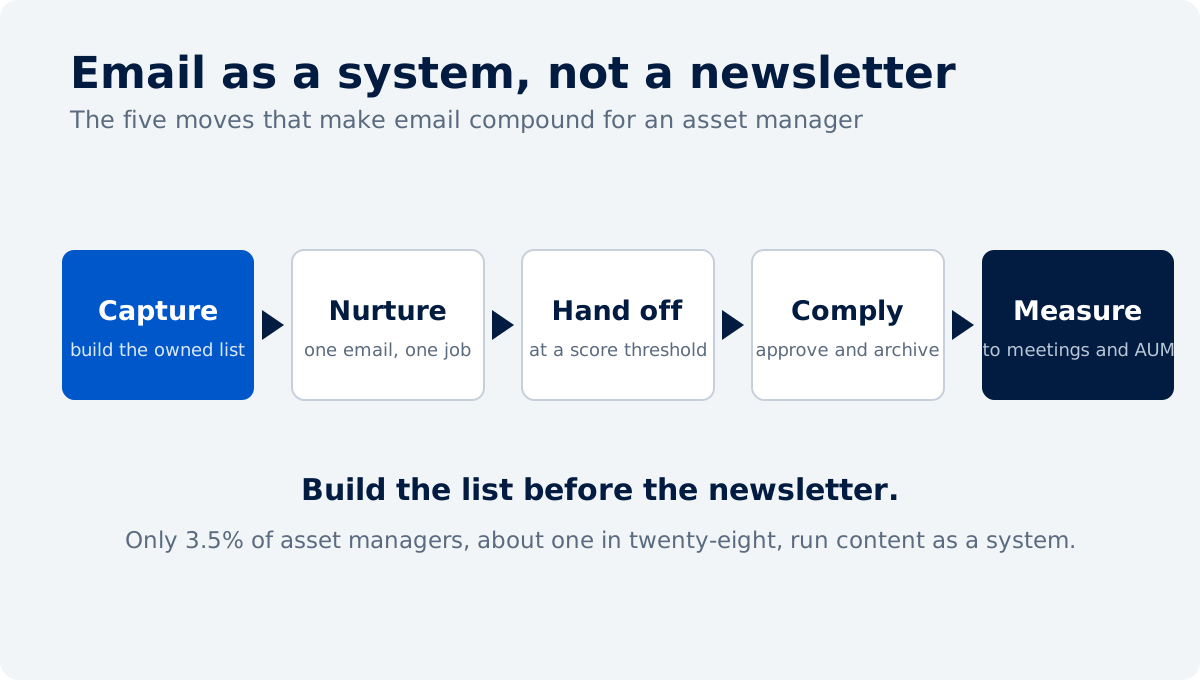
That is a system, and almost nobody in the sector runs one. Of the 1,628 asset managers we reviewed, 59.6% publish nothing beyond a brochure site and only 3.5% run content as a system, about one in twenty-eight. Email is where that system either compounds or leaks. Build the list before the newsletter, and you own the one channel that keeps paying off.
Want to see where your asset management firm's email and content sit against the field?
Our content revenue audit benchmarks your firm, finds where the capture leaks, and puts a number on the gap.
Frequently Asked Questions
About the Author

Founder & CEO, Content RevOps
Stefan Kalpachev is the founder and CEO of Content RevOps, where he helps B2B SaaS companies transform their content into predictable pipeline. With a background in content marketing and revenue operations, Stefan has developed a unique methodology that bridges the gap between content creation and revenue generation.
Connect on LinkedIn