Fractional CMO for Asset Management Firms: When You Need One, and When You Don't
Put your firm against the benchmarks from our study of 1,628 asset managers and find out if anyone owns your marketing number.
Book a CallA fractional CMO is a senior marketing leader who works with your firm part-time and owns the marketing function the way a full-time chief marketing officer would, the same ownership a demand generation system built around pipeline needs before it can work. For an asset management firm, the first question to settle is whether anyone is accountable for marketing at all.
Part of Content Marketing for Asset Managers: The 2026 Playbook.
Most firms have activity without an owner. Someone posts on LinkedIn, someone sends the quarterly commentary, the PR agency pushes out a press release, and no single person is on the hook for whether any of it produces a meeting, a mandate, or a dollar of AUM. A fractional CMO answers that ownership question first, and the cost question second.
This guide compares the three ways an asset management firm can staff marketing leadership: a fractional CMO, a full-time in-house CMO, and an agency. It covers what each one owns, what each one costs, and when each one fits, so you can decide which your firm actually needs.
What is a fractional CMO for an asset management firm, and what do they own?
A fractional CMO is an experienced marketing executive who works for your firm part-time, usually a set number of days each month, and sits in the leadership seat while they do it. The fractional model is already normal in finance through fractional CFOs and in operations through fractional COOs. It has arrived in marketing for the same reason: a smaller firm often needs senior judgment more than it needs a senior headcount.
What a fractional CMO owns is the whole marketing function, not a task list. That means the strategy, the plan, the budget, the people or agencies who execute, the compliant-content workflow, and the number marketing is held to. They are accountable for outcomes, the way a full-time CMO is accountable.
That ownership is what separates the role from the alternatives. An agency executes a plan. A consultant hands you an assessment and leaves. An interim CMO is a full-time, temporary body covering a vacancy. As one marketer put it on Reddit, "Consultant gives you an assessment. Fractional CMO gives you a system that keeps running after they leave the room."
Strategy only, or strategy plus execution?
Not every fractional CMO works the same way, and this is the first thing to pin down. Practitioners describe two versions. Some "only do strategy and no execution work, so you have to hire the people to execute the strategy," and others will set the strategy and also roll up their sleeves, depending on the size of the firm.
For an asset management firm with a lean team, the strategy-only version can leave you with a plan and no one to run it. Decide up front whether you are buying direction, or direction plus a pair of hands, and hire to match. Our breakdown of how strategy-led consulting engagements work shows what the direction-only version usually includes.
The reason this role matters for asset managers specifically is that the buyers reward senior, owned thinking. CoreData Research finds that institutional investors say thought leadership directly influences which managers they select. Someone has to own the production of that kind of thought leadership. In most firms, no one does.
Why do most asset management firms have no one accountable for marketing?
Because almost no asset management firm runs marketing as a system. Our 2026 study of 1,628 asset management firms found that only about 1 in 28, or 3.5%, run content as a real system. Everyone else produces brochure or noise.
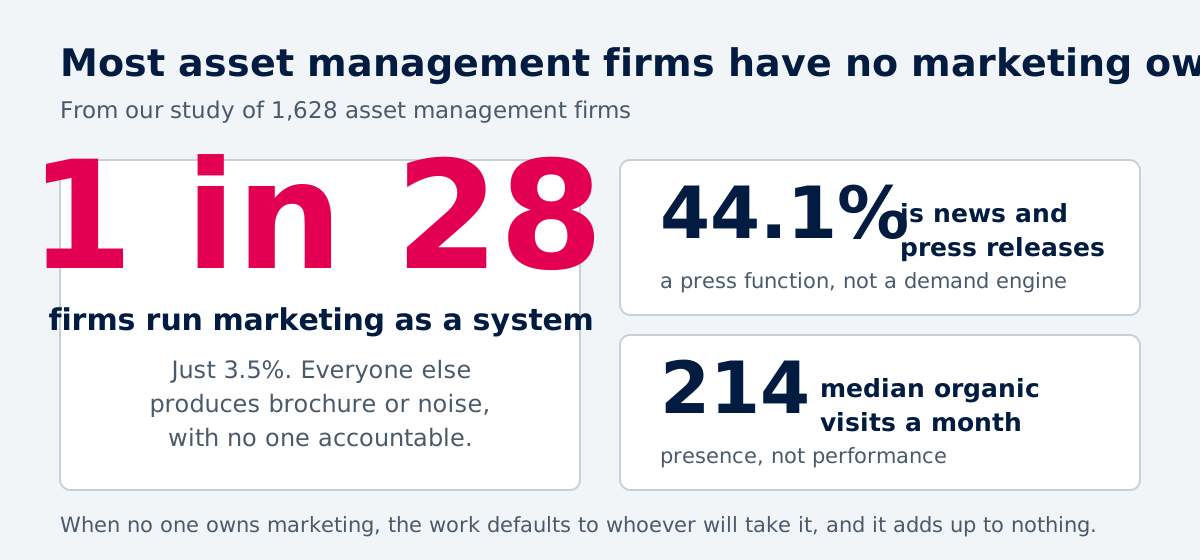
When no one owns marketing, the work defaults to whoever will take it. That is usually communications or PR, which is why nearly half of all asset management content, 44.1%, is news and press releases, one of the most expensive content marketing mistakes asset managers make. A press function publishes to inform. It does not publish to generate pipeline, because that was never its job.
The result is motion without a destination. The median asset management firm earns around 214 organic visits a month: presence, not performance. Plenty of firms are busy. Very few are accountable for the busyness adding up to anything.
The missing piece is ownership, since the effort is already there. BCG reached the same conclusion about asset management from the distribution side, finding that at most firms "execution remains dependent on individuals rather than on a system." A fractional CMO exists to install that system and own it. That is the real case for the role, long before you get to what it costs.
How do a fractional CMO, an in-house CMO, and an agency differ?
The three options do different jobs, and the most common mistake is hiring an agency when the firm actually needs an owner.
An agency executes campaigns and produces content. It does good work inside a plan, but it does not own whether marketing produces mandates. A full-time in-house CMO owns everything and is in the building every day. A fractional CMO owns everything too, but part-time, and usually directs internal staff or an agency to execute. Our honest comparison of in-house and outsourced demand generation covers the same trade-off at the team level.
For an asset management firm, someone has to own the outcome. An agency will not, because that is not what you are paying it for. A marketer on Reddit drew the line cleanly: a fractional CMO "sets that direction first; they help figure out why growth isn't where you want it, who you're going after, and why you win," and only then do agencies and teams execute against it.
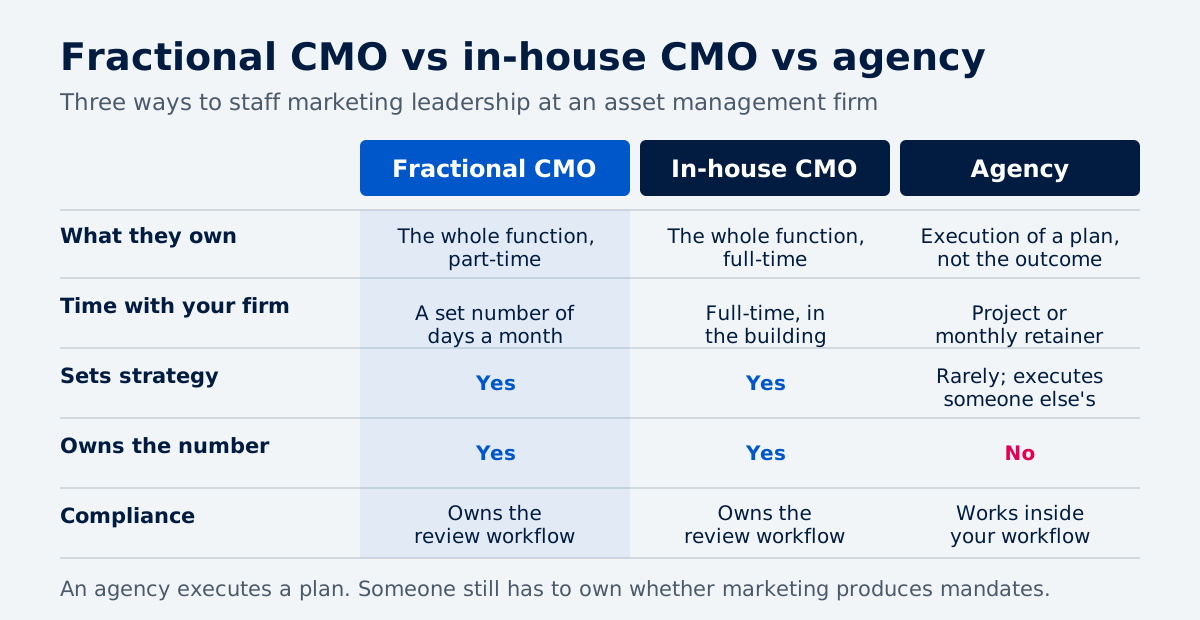
Fractional CMO | In-house CMO | Agency | |
What they own | The whole marketing function, part-time | The whole marketing function, full-time | Execution of a plan, not the outcome |
Time with your firm | A set number of days a month | Full-time, in the building | Project or monthly retainer |
Sets strategy? | Yes | Yes | Rarely; executes someone else's |
Owns the number? | Yes | Yes | No |
Best-fit firm | Needs senior ownership, can't fill a full seat | Large enough to fill a senior seat | Already has an owner, needs capacity |
Compliance | Owns the review workflow | Owns the review workflow | Works inside your workflow |
The skeptical view is worth stating, because you will hear it. Some marketers argue there is "nothing magical about a fractional CMO; it's just a consultant, advisor, or agency," depending on the arrangement. That is true when the person does not actually own anything. Ownership is what makes the role worth paying for, whatever the label, which is why how you vet one matters so much later in this guide.
When does each option fit an asset management firm?
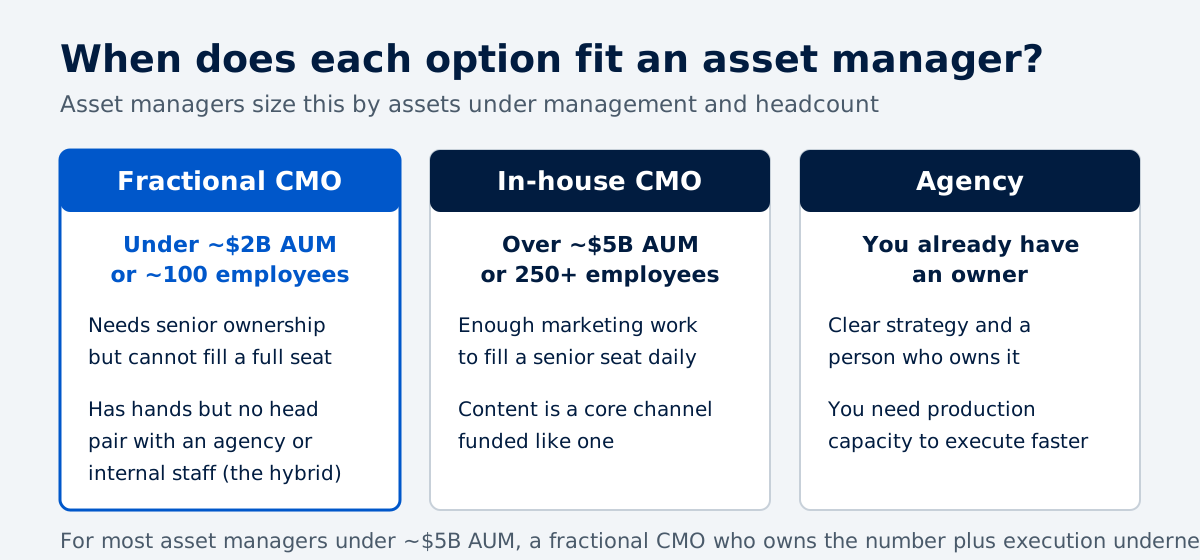
The decision comes down to three things: how big your firm is, whether anyone can own marketing today, and how much work there is to fill a senior seat. Asset managers size this by assets under management and headcount, not by revenue.
When does a fractional CMO fit?
A fractional CMO fits when you need senior ownership but cannot yet justify a full-time chief marketing officer. That describes most of the market. At the smallest firms, those with 11 to 50 employees, only 1.3% run a systematic approach; the senior marketing bench is empty, and a full-time CMO is hard to fill with enough work.
It also fits when you have hands but no head. If you already have a marketer or two, or an agency, producing output with no one steering it, a fractional CMO gives that output a strategy and a number to hit. The hybrid of a fractional lead plus existing execution is often the real answer, and marketers say so: "you get more bang for the buck by combining the fractional CMO with internal resources." Our guide to demand generation team structure, roles, and costs shows how that lead-plus-execution split is usually staffed.
As a rough gauge, specialist agencies put the dividing line for financial firms at around $2B in AUM or 100 employees: below it, a single in-house lead or a fractional CMO plus an agency makes more sense than a full in-house team. One practitioner described the fractional sweet spot as firms that "need senior marketing leadership but can't justify or afford a full-time hire yet."
When does an in-house CMO fit?
A full-time, in-house CMO fits when there is enough marketing work to fill a senior seat every day, and when content is a core channel the firm funds like one. Activity rises with size in asset management: among firms with 501 to 1,000 employees, 13% run a systematic approach, roughly ten times the rate at the smallest firms.
The practical threshold specialist agencies use is around $5B in AUM or 250-plus employees. Above that, you have the volume and the internal complexity to justify a dedicated leader and, usually, a team beneath them. At that scale, firms fund content as a real channel, with program budgets of $200,000 to $1M or more a month, and a full-time owner is the right way to run spend of that size.
When does an agency, or a fractional CMO plus an agency, fit?
An agency fits when you already have a clear strategy and someone who owns it, and you need production capacity to execute faster. The trap is hiring an agency to supply the strategy. It will hand you campaigns without taking on accountability. That is also the screen behind our list of content marketing agencies for CMOs and heads of marketing, which kept the 14 of 25 that can work beside a marketing owner and an in-house team.
Two signs you are not ready for an agency, both from specialist practice. First, if you cannot describe your ideal client in a sentence or two, you are paying an agency to do positioning work a fractional leader or a cheaper consultant should set first; across the sector fewer than 1 in 20 asset managers commit to a narrow client profile, so this gap is the norm. Second, if your sales process cannot convert the meetings you already get, more leads will not help; fix the conversion before you buy volume.
For most asset managers under that $5B line, the strongest setup is a fractional CMO who owns the strategy and the number, with an agency or internal staff executing underneath. You get the ownership of a CMO and the capacity of an agency, without a full-time salary. When you do add the agency, our guide on how to choose a demand generation agency covers what to check.
What does a fractional CMO for an asset management firm cost?
A fractional CMO costs less than a full-time one because you pay for part of their time. Independent 2026 pricing guides cluster the monthly retainer between $5,000 and $25,000, with most engagements in the $8,000 to $15,000 range for one to two days a week, or $200 to $500 an hour for advisory work. That works out to roughly a quarter to a half of the full-time cost.
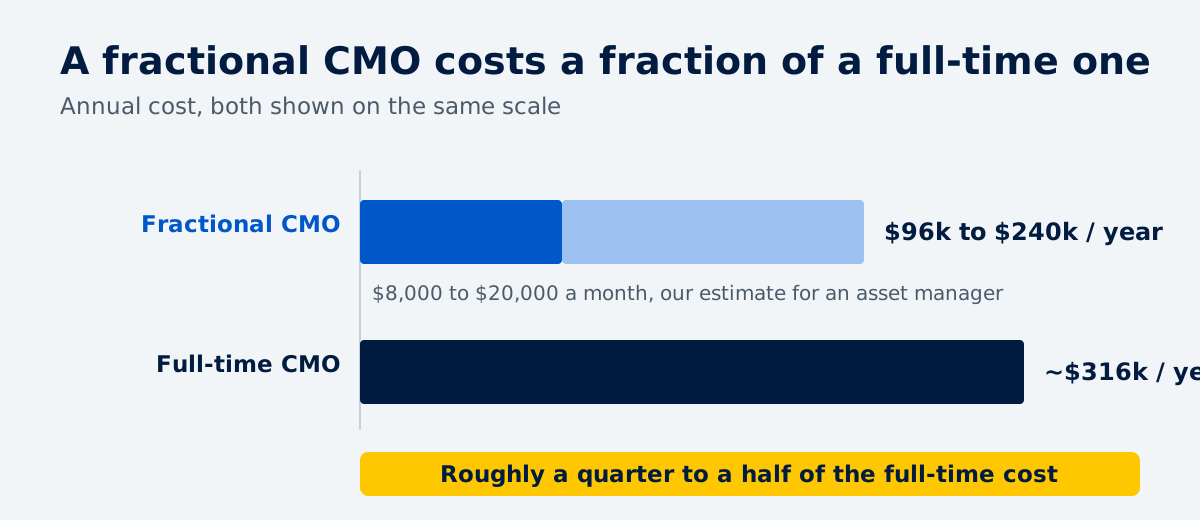
A full-time chief marketing officer, by comparison, runs about $316,000 in average total compensation, within a $237,000 to $440,000-plus range before recruiting fees, equity, and the months it takes to hire and ramp one. For a firm that does not have a full seat of work, that is a large fixed cost for capacity you will not fully use.
Marketing in a regulated industry sits at the higher end of fractional rates, because compliance and brand trust add to the work. Published tiers run from about $5,000 to $12,000 a month for professional services and $10,000 to $25,000 for fintech. An asset manager sits between the two, so our estimate for a typical AM engagement is roughly $8,000 to $20,000 a month, depending on days and scope. For comparison on the execution side, see our total cost of ownership estimate for a demand generation agency.
Set the retainer against the program it leads. The firms that treat content as a channel budget for it by scale, from $2,000 to $10,000 a month at the smallest firms up to $10,000 to $50,000 a month for a growing program. The fractional CMO's fee is the cost of making sure that program spend is aimed at pipeline, not wasted on activity, and how the budget is allocated is part of the job.
Can a fractional CMO handle SEC and FINRA marketing compliance?
Yes, and a good one treats compliance as part of the job rather than a reason to stay quiet. The SEC Marketing Rule 206(4)-1 governs how registered advisers advertise, including testimonials and performance claims. FINRA Rule 2210 governs how broker-dealers communicate with the public. Both shape every piece an asset manager publishes.
A fractional CMO's job is to own the workflow that keeps content compliant: the review, the substantiation of any claim, and the recordkeeping. Run as a system, it stops being a bottleneck. Specialist practice shows compliance review adds roughly 5 to 10 business days to each deliverable, so the leader builds that lead time into the content calendar rather than fighting it each time.
The firms that get this right turn the rules into an advantage. About 1 in 5 of the active cohort, 22.2%, already turn the compliance calendar into authority content, publishing the explanations buyers and advisers actually search for. Owning that workflow is one of the clearest reasons to put a single accountable leader over marketing, and our content marketing best practices for asset managers show what review-friendly formats look like.
How do you know a fractional CMO is working?
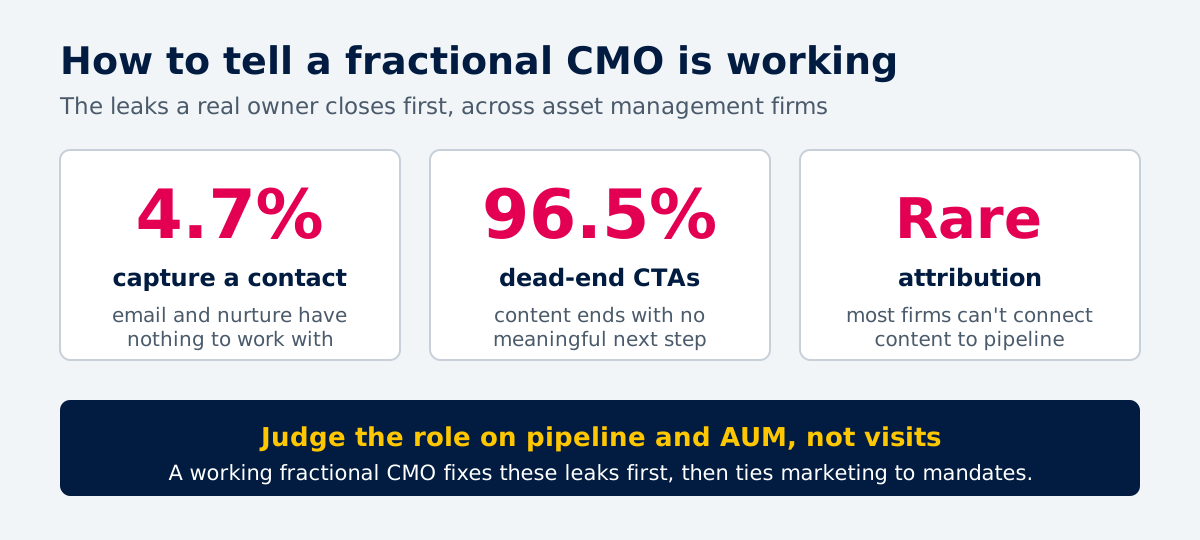
You judge a fractional CMO on pipeline and AUM, not on traffic. Ownership means being on the hook for a number, so agree the number before the engagement starts. A practitioner put the bar plainly: insist on "clear KPIs upfront, not just vanity metrics but actual pipeline contribution and revenue attribution." Our list of which demand generation metrics to track and which to ignore is a useful starting point for that agreement.
The reason this matters in asset management is that most firms cannot connect content to pipeline at all. Our study found that attribution and marketing automation are rare, so firms measure traffic they never act on. A fractional CMO who is working fixes the plumbing first, so marketing can be measured against mandates, the same sequence laid out in our guide to marketing funnel optimization for asset managers.
Watch the early moves, because they tell you whether you hired an owner. In the first months, a real one closes the leaks that make measurement meaningless:
- Lead capture. Only 4.7% of asset management sites capture a contact, so email and nurture have nothing to work with. A working CMO builds a way to capture and keep an audience.
- The next step. Almost all asset management content, 96.5%, ends with a weak or dead-end call to action. A working CMO gives every piece a job and a next step.
- A number that ties to AUM. If the monthly report is still visits and impressions after a quarter, you hired a producer instead of an owner.
How do you vet a fractional CMO for an asset management firm?
Carefully, because anyone can use the title. There is no degree, license, or certification required to call yourself a fractional CMO, so the label has filled with people who have never done the job. When Marketri's founder checked ten self-described fractional CMOs on LinkedIn, only one had ever held a CMO title, and half were nowhere near qualified. The honest Reddit verdict is the same: "a good fractional CMO is worth it; a bad one is useless."
Vet for four things in an asset management context:
- A real CMO track record. Progressive marketing leadership that ended in running a full function, with prior budget authority. A specialist in one channel, like SEO or events, is a good hire for that channel, not for the top seat.
- Asset management or financial-services experience. They should know the institutional sale, the consultants and committees who gatekeep it, and the compliance rules before you explain them.
- A diagnose-before-pitch posture. A strong candidate narrows your problem before selling you a plan. One that pitches tactics in the first meeting is selling activity.
- Ownership of outcomes. They accept a pipeline or AUM number, not a deliverables list. The skeptics who call fractional work "the lazy way out" are right only when no one owns the result; a real fractional CMO owns it.
One more signal worth checking against the sector. Named, credentialed authors are still uncommon in asset management, appearing on only about a fifth of active firms' content. A fractional CMO who insists on putting credentialed names behind your content understands what asset management buyers trust, and what helps a firm show up in AI search.
Where should an asset management firm start?
The decision is simpler than it looks. If no one owns marketing and you cannot fill a full seat, a fractional CMO is the fit. If you are large enough to fill one, hire in-house. If you already have an owner and need capacity, add an agency, with the owner still steering. Our guide to marketing for asset management firms covers the first moves once someone owns the function, and content marketing strategies for asset management firms covers the sequence after that.
Before you choose, size your own gap. Put your firm against the benchmarks from our study of 1,628 asset managers and see where you sit on maturity, capture, and decision-stage content. If the honest answer is that no one owns the number today, you already know which option you need.
If you want help installing and owning that system, that is the work we do for asset management firms.
Ready to put an owner over marketing?
We build the marketing system for asset management firms, and the wiring around it, so what you publish turns into pipeline and AUM.
Frequently Asked Questions
About the Author

Founder & CEO, Content RevOps
Stefan Kalpachev is the founder and CEO of Content RevOps, where he helps B2B SaaS companies transform their content into predictable pipeline. With a background in content marketing and revenue operations, Stefan has developed a unique methodology that bridges the gap between content creation and revenue generation.
Connect on LinkedIn