Demand Generation Agency Total Cost of Ownership Estimated for 2026
Most demand generation agency proposals show you the retainer and hide the other 60 percent of the cost. Want to see your real number?
Book a CallEvery demand generation agency leads with one number, the monthly retainer. It is the number on the proposal, the number you compare across shops, and the number your finance team writes into the budget. It is also the number that hides the most, whether you are pricing a boutique shop or a full-service demand generation agency.
Part of The Complete Guide to B2B Demand Generation Strategy.
The retainer is the license fee. The total cost of ownership is the license fee plus everything you have to spend to make the license produce, and then keep spending to hold the result in place. Once you add those layers up, the all-in cost of a demand generation agency in 2026 runs roughly two to three times the retainer you were quoted. The retainer itself is usually only a third to a half of what the engagement actually costs you.
This guide builds that number line by line, shows you the 2026 figures behind each one, and then asks the question the retainer was hiding. Are you paying to rent deliverables that stop the day you stop paying, or to build a system you keep.
What is the total cost of ownership of a demand generation agency?
The total cost of ownership of a demand generation agency is every dollar the engagement makes you spend to produce and keep the result, not just the fee the agency charges. Finance teams already think this way about software. Nobody budgets a new CRM at the license price alone; they add implementation, seats, admin time, integrations, and the cost of switching later. A demand generation agency is the same kind of purchase, and it has never been priced the same way.
Six layers make up the real number.
- The agency retainer. The monthly fee for the agency's people and management.
- Media and distribution. The paid spend that runs through the campaigns, billed by the ad platforms, not the agency.
- Tools, data, and infrastructure. The CRM, automation, intent data, and reporting the program runs on, often on your card.
- Your own team's time. The hours your marketers, subject-matter experts, and leaders spend feeding and steering the agency.
- The ramp before pipeline. The months of full spend you pay before the program produces real pipeline.
- The switching cost. What it costs to leave, when the assets are not yours and you have to start over.
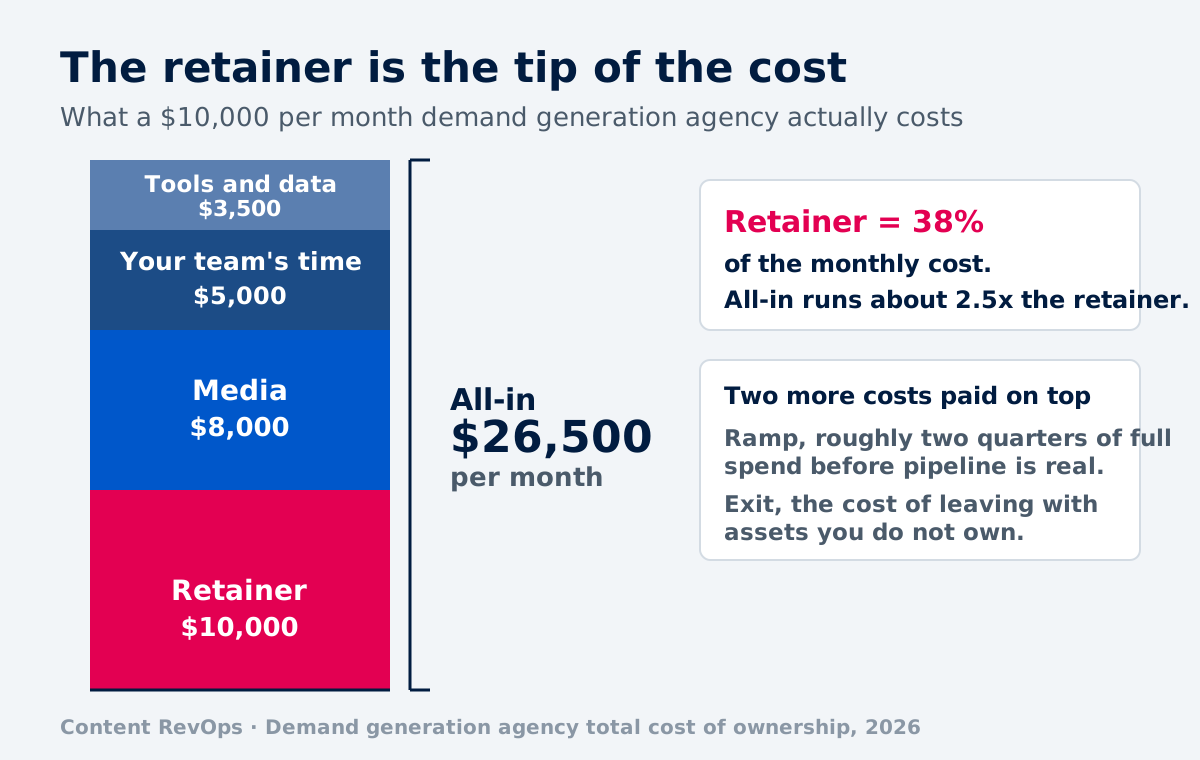
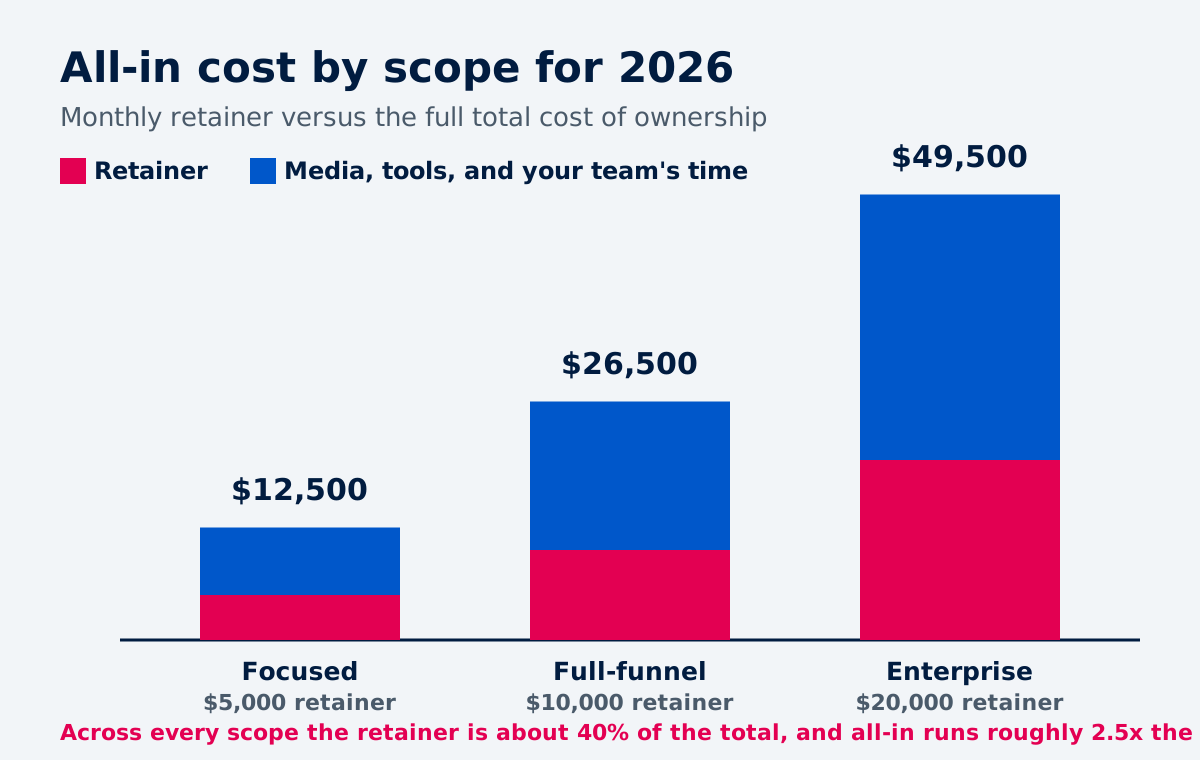
Add them and the pattern is consistent. The all-in total cost of ownership lands around two to three times the quoted retainer, and the retainer is about a third to a half of the total. A $10,000 monthly retainer is rarely a $10,000 monthly decision. It is closer to a $25,000 one. The rest of this guide shows where each layer comes from and what the full number looks like for 2026.
What does a demand generation agency actually cost per month in 2026?
The retainer is the honest place to start, because it is the one number everyone quotes and it is easy to check. B2B demand generation retainers in 2026 run from about $3,000 to $25,000 or more a month, before media, and the band tracks scope.
Three tiers cover most of the market.
Scope | Typical monthly retainer | What it buys |
Focused specialist | $3,000 to $7,000 | One channel and a defined cadence, reporting |
Full-funnel program | $8,000 to $15,000 | Strategy plus several channels, creative, landing pages, measurement |
Full-service or enterprise | $15,000 to $25,000+ | Multi-channel execution, senior strategy, creative, marketing operations, attribution |
These bands are well corroborated. Upwynn Marketing puts small and mid-market management fees at $3,000 to $7,500 a month, with ad spend separate. MoMo85 places mid-market retainers at $8,000 to $25,000 a month and describes that as buying three to five specialists working together. A DeMicco planning tool uses the same $8,000 to $15,000 middle tier and calls it the most common B2B retainer. A SparkToro survey of agencies found that 86% of them charge $10,000 a month or less on average, with roughly half between $1,000 and $5,000.
Which tier you belong in is a scope question before it is a budget question, and it is worth settling before you read a single proposal. We walk through that decision in how to choose a demand generation agency and when to hire a demand generation agency, and you can see how the field prices itself in our roundup of the top 15 B2B demand generation agencies in 2026.
So the number is real and the number is knowable. The problem is that the number is not the cost. It is the first of six lines, and it is usually the smallest one that matters.
What is inside a demand generation agency's total cost of ownership?
Every layer below is a real cash cost of running the program. Some of it goes to the agency, some to the ad platforms, some to your software vendors, and some to your own payroll. The retainer only covers the first. Here is what the other layers cost in 2026, with the assumptions on the table so you can argue with the inputs instead of the total.
The agency retainer
This is the fee from the section above. For a mid-market full-funnel program, call it $10,000 a month. Hold that number; the other layers stack on top of it.
Media and distribution
Paid media almost never sits inside the retainer. The ad spend runs through Google, LinkedIn, and Meta, and the platforms bill it directly. Some agencies even price their fee as a percentage of it, 15% to 25% of media spend on the percentage model, which tells you how large the media line usually is relative to the fee.
For a mid-market demand program, media commonly matches or exceeds the retainer. A program with a $10,000 retainer often carries $6,000 to $12,000 a month in paid spend on top. Call it $8,000. That is money you spend to get the result, so it belongs in the total cost of ownership even though the agency never touches it. How much of it you need depends on which demand generation channels you prioritise, and on how the rest of the budget is split, which we cover in demand generation budget allocation best practices.
Tools, data, and infrastructure
The program runs on software, and a lot of that software ends up on your card, not the agency's. A demand engine needs a CRM, marketing automation, an SEO or content tool, an attribution or reporting layer, and often an intent-data feed. For a mid-market B2B demand program that stack realistically costs $1,500 to $6,500 a month, with intent data and account-based platforms pushing the top end. HubSpot Marketing Hub Professional alone starts around $800 a month, an attribution tool like Dreamdata or HockeyStack adds $1,000 to $1,500, and enterprise intent platforms like 6sense run tens of thousands a year. Lucreya notes that a ZoomInfo-class data contract alone runs around $2,656 a month.
For the worked example, call the tools and data line $3,500 a month. We measured what teams actually run in the top 10 demand gen tools B2B companies actually use, across 478 companies, which is a useful check on whether a proposed stack is standard or padded.
One number puts this in perspective, as long as you read it for what it measures. The average B2B marketing team runs 12 to 18 tools costing $6,500 to $18,600 a month, and about 40% of that spend is redundant or underused. That figure is the whole marketing team's stack, not one demand program, so do not add it to a single engagement. Read it as the ceiling your tooling drifts toward once an agency keeps recommending one more platform.
Your own team's time
An agency does not run on its own. Someone on your side writes the brief, joins the calls, reviews the creative, feeds the customer language, and chases the answers the agency needs. That time is a real cost, and it is the layer buyers forget first.
Two pieces make it up.
A fully loaded mid-level B2B marketing manager costs $110,000 to $155,000 a year, because benefits, payroll taxes, and tools push the loaded figure to 1.25 to 1.4 times the base salary. On an $85,000 salary that lands around $134,000 all in. A managed agency engagement typically consumes a meaningful slice of one such person, plus 5 to 10 hours a week of senior or leadership time spent directing and reviewing the work.
Even at half of one loaded marketer plus a few senior hours a week, this line runs around $5,000 a month. It never appears on the agency invoice, and it is the reason a "cheaper" retainer can cost more once your team has to do more of the lifting. If you are weighing that trade directly, our breakdown of demand generation team structure, roles, responsibilities and costs prices the in-house side of the same question, and in-house versus outsourced demand generation sets the two models side by side.
The ramp before pipeline
Demand generation does not pay back in month one, and you pay full freight while you wait. A B2B demand program takes 90 to 180 days to show meaningful results, and pipeline usually takes 3 to 6 months to show up and 6 to 12 months to stabilize. Salesforce says a full demand engine typically takes 6 to 12 months to make a significant impact on the sales pipeline.
That is not a free trial. It is roughly two quarters of retainer, media, tools, and internal time paid out before the program produces the result you hired it for. On the mid-market example, the first six months cost around $150,000 before the pipeline is real. The ramp is a cost, and it belongs in the total. We publish our own version of that timeline in what results can we expect, and when, and the leading indicators worth watching during the wait are in what demand generation metrics to track and not to track.
The switching cost
The sixth layer is what it costs to leave. It is large enough, and skipped often enough, that it gets its own section below.
What does the full total cost of ownership add up to for 2026?
Stack the layers and the retainer shrinks into its real place. Here are three illustrative scopes for 2026, with the assumptions shown so you can adjust them to your own numbers.
Layer | Focused specialist | Full-funnel program | Enterprise |
Agency retainer | $5,000 | $10,000 | $20,000 |
Media and distribution | $3,000 | $8,000 | $15,000 |
Tools, data, infrastructure | $1,500 | $3,500 | $6,500 |
Your team's time | $3,000 | $5,000 | $8,000 |
All-in monthly | ~$12,500 | ~$26,500 | ~$49,500 |
All-in annual | ~$150,000 | ~$318,000 | ~$594,000 |
Retainer as share of total | ~40% | ~38% | ~40% |
Across all three scopes the pattern holds. The all-in cost is about two and a half times the retainer, and the retainer is roughly a third to a half of the total. On the ramp, add that the first two quarters are paid before pipeline is real, so the true first-year cost carries a return of close to zero for its opening months.
None of this makes an agency the wrong choice. It makes the retainer the wrong number to decide on. A $10,000 retainer that reads as cheap and a $15,000 retainer that reads as dear can swap places once you count the tools each one puts on your card and the hours each one demands from your team. Compare the total operating cost, not the headline fee. The same discipline applies when you are scoping which demand generation services you actually need, or deciding between an agency and demand generation consultants.
Why does the agency model make the total cost of ownership so high?
The agency model runs the cost up for a structural reason. Agencies sell deliverables, the posts, the campaigns, the reports, the qualified leads. You are buying activity, priced by the month, and activity stops the day the retainer stops. Nothing you paid for compounds into an asset you keep, so the cost recurs forever and never builds equity.
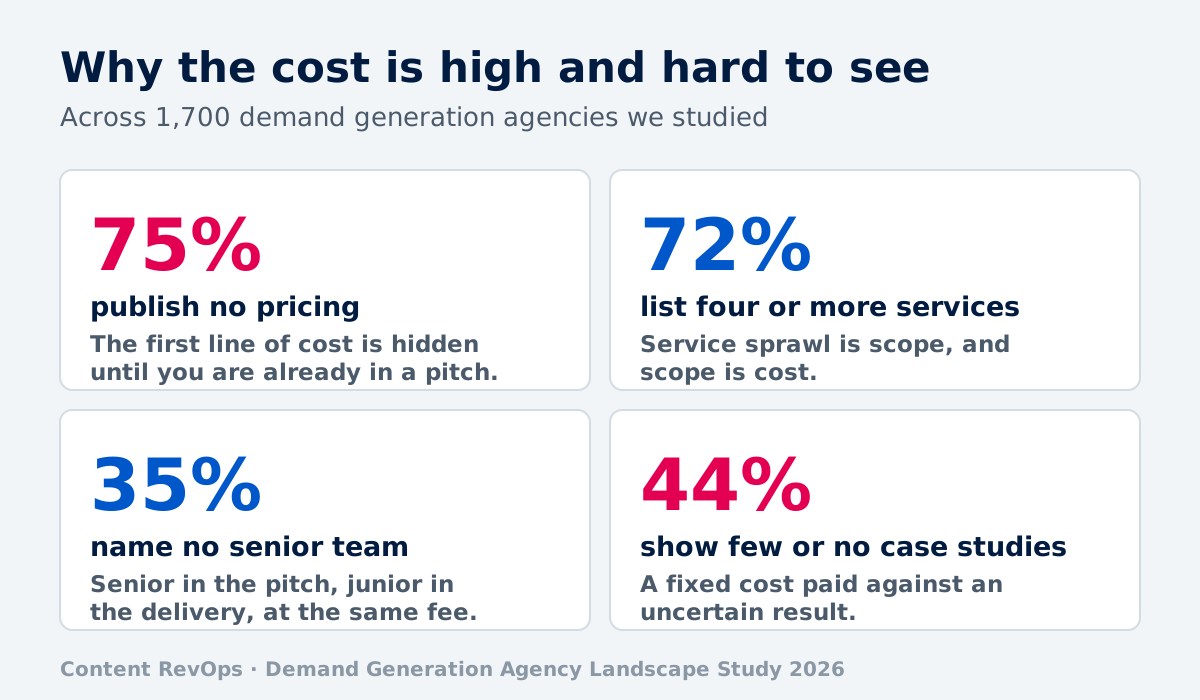
Our research on the field shows three patterns that make the number both higher and harder to see. We enriched 1,700 demand generation agencies against public signals, and the same problems show up again and again.
You cannot see the price before you commit
Three in four agencies hide the number. 75% of demand generation agencies publish no pricing at all, which means the first line of your total cost of ownership is invisible until you are already in a sales conversation. You cannot compare what you cannot see, and opacity at the fee line usually signals opacity everywhere else in the cost stack.
You pay for a laundry list, not a focus
The typical agency claims nearly five services. 72% of agencies list four or more service lines, and 47% describe themselves as "full-service," the label that signals no real focus. Service sprawl is scope, and scope is cost. A team selling everything tends to price for everything and staff thinly across all of it.
You pay senior rates for junior delivery
More than a third of agencies show the shadow-team pattern, senior people in the pitch and junior people in the delivery. 35% name no senior team at all. You meet the strategist who wins the account and then hand the work to someone three years out of school, at the same retainer. That gap between what you are sold and who does the work is a quality tax hidden inside the fee.
You pay a fixed cost against an uncertain result
You commit real money before you know it will work. 44% of agencies show few or no revenue-backed case studies, and 66% carry three or more warning signs at once; only 27 of the 1,700 carry none. The retainer is fixed and the outcome is not, which is exactly the risk the total cost of ownership makes visible.
There is a tell in what agencies sell versus what they run. As one B2B agency review put it, "most agencies selling demand gen are actually running lead gen". You pay demand-generation prices for lead-generation deliverables, and the deliverables stop when the invoice stops. The distinction is not semantic, and we draw it in full in demand generation versus lead generation.
What do you actually own when the demand generation agency engagement ends?
Here is the layer no cost guide prices. When the retainer stops, the deliverables stop, and if the assets are not yours, leaving means starting over. The switching cost of your current agency is really the re-ramp cost of your next one, and most buyers pay it more often than they expect.
Agency engagements end regularly. Around 43% of B2B agency churn happens in the first 90 days, the same opening quarter you paid full freight through during the ramp. A quarter of engagements, 25%, run less than 12 months. Channel-specific retainers turn over fastest; SEO service contracts typically run 6 to 12 months with about 38% annual churn, and paid-media retainers 3 to 6 months with roughly 49% churn. Some retainer relationships do last for years, and that only raises the stakes when the break finally comes, because more has been built inside the agency's walls.
What makes the exit expensive is ownership. When you leave, you should keep the ad accounts, the audiences, the domains, the analytics, the creative files, and the campaign history. Windmill Growth lists exactly these as the things to protect in your contract. If you do not own them, the next agency rebuilds them, and you pay the 3-to-6-month ramp again from zero. Ownership is a contract term, not a good intention, which is why we publish what our contracts look like before anyone signs one.
Buyers feel this directly. On one r/Entrepreneur thread about whether agencies are worth it, a business owner described hiring a LinkedIn ads specialist and "spending about $8-9k before giving up. Zero results." The money left the building and nothing came back into it. That is the deliverables model at its plainest. You rented activity, the activity ended, and you kept nothing.
How does the total cost of ownership compare to owning the demand generation system instead?
This is the decision the total cost of ownership was pointing at all along. There are two ways to buy demand generation, and they have very different cost curves.
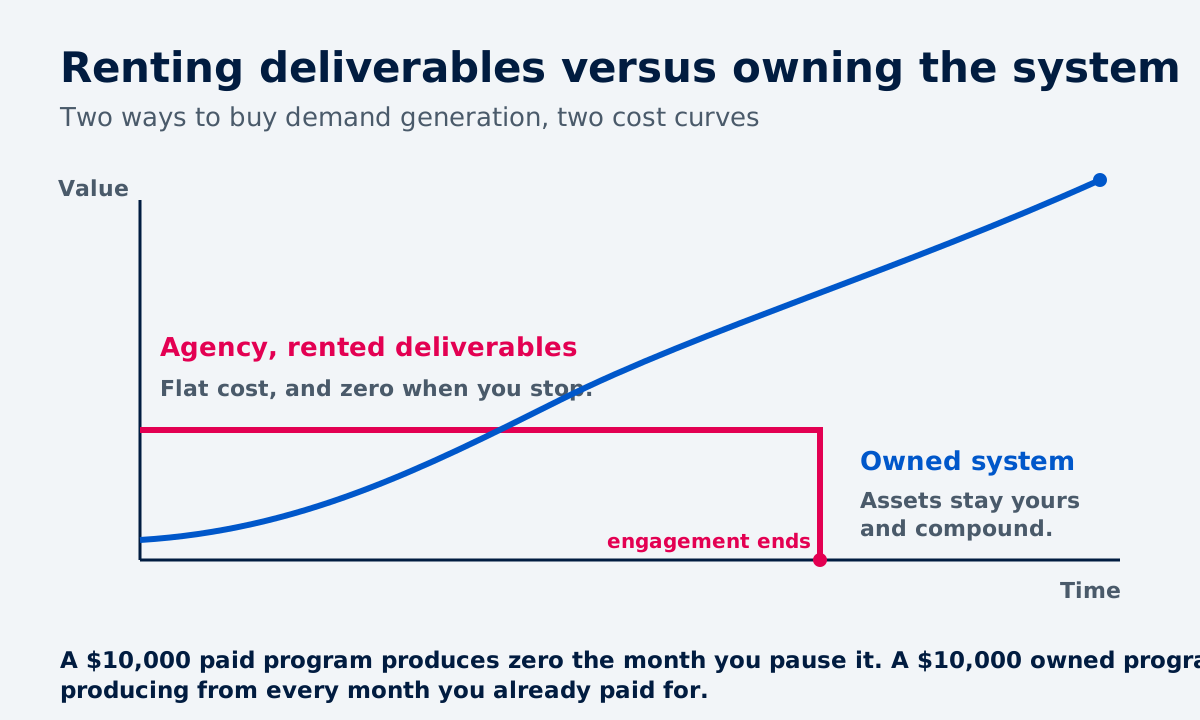
The agency model is a flat, recurring rental. You pay every month, the cost never stops, and when it does stop you are left with nothing that keeps producing. The deliverables were the product, and the product had no residual value.
An owned system has a different shape. It costs more to build at the front, then the cost flattens, because the assets you build stay yours and keep working. A competitor guide on SEO timelines put the contrast cleanly: "A $10,000/month paid search program produces $10,000/month worth of traffic and leads, and exactly zero the month you pause it. A $10,000/month SEO program in month 6 is producing results from content created in months 2, 3, 4, and 5." One rents, the other compounds.
Our own data says the owned motion measurably outperforms. Companies running a real inbound engine of their own score 79 on demand quality against 35 for those running none, a 44-point gap. And the operator standard is rare in the agency field; only 47 of the 1,700 agencies, 2.8%, clear the full operator bar. The very industry selling demand as infrastructure mostly does not run it, and 70% of demand generation agencies run no real demand engine for themselves. If the deliverables model built a compounding asset, the agencies would own one.
That pattern is not confined to agencies. Across roughly 14,000 company websites in seven B2B verticals, content is run as a publishing habit rather than a revenue operation, which is exactly why so much of it stops producing the moment someone stops feeding it.
This is why we build the system rather than sell the output. We install a demand engine the client owns, connected to CRM, automation, and reporting, so the assets accumulate instead of resetting each month. You can see the shape of that work in what we do, the combined inbound and outbound motion in allbound marketing, and the step-by-step engagement method. If you would rather build it yourself, the sequence is laid out in how to build a demand generation engine from scratch, and what the finished thing produces is documented in the Ori Learning case study.
The point is not that agencies are always the wrong call. For a bounded, short-term push with a proven offer, a specialist retainer can be exactly right. The point is that once you count the total cost of ownership, the honest comparison is not agency A versus agency B. It is renting deliverables forever versus owning a system that keeps paying after the build.
How to estimate your own demand generation agency total cost of ownership
You can run this on any proposal on your desk. Rebuild the quote into the full stack, then check it against the pipeline it has to produce.
- Rebuild the quote into six columns. Agency retainer, media and distribution, tools and data, your team's time, the ramp, and the exit. The proposal usually shows you only the first.
- Price your own time honestly. Estimate the hours a week your marketers and leaders will spend on this, and multiply by a loaded rate, not a base salary. A loaded mid-level marketer runs $110,000 to $155,000 a year.
- Add the ramp. Count on two quarters of full spend before pipeline is real, and treat that as part of year one, not a warm-up you get for free.
- Add the exit. Ask what you keep if you leave. If the ad accounts, audiences, analytics, and content are not contractually yours, add the cost of rebuilding them with the next agency.
- Divide by the pipeline it must create. Take the all-in annual number and set it against the pipeline the program has to produce to pay back. Write down your average deal size, close rate, and the payback period you can tolerate first, so the target is real.
Run those five steps and the retainer stops being the number you decide on. You are no longer buying "demand generation." You are pricing a system, and deciding whether to rent it or own it. For the sake of comparison, we publish how our own pricing and payments work, including what sits inside the number and what does not.
Would you rather own a demand engine than rent a retainer forever?
Get a Content RevOps audit. We price your content and pipeline as revenue infrastructure, with every assumption printed next to the number so you can argue with the inputs instead of the ask.
Frequently Asked Questions
About the Author

Founder & CEO, Content RevOps
Stefan Kalpachev is the founder and CEO of Content RevOps, where he helps B2B SaaS companies transform their content into predictable pipeline. With a background in content marketing and revenue operations, Stefan has developed a unique methodology that bridges the gap between content creation and revenue generation.
Connect on LinkedIn