Inhouse vs Outsourced Demand Generation (Honest Comparison)
Ready to transform your content into a predictable pipeline? Let's talk.
Book a CallIf you’re an SMB CEO, you’re not debating whether you need demand generation. You’re deciding how to staff it when headcount is tight, wages are up, and the board (or your own cash flow) wants near-term pipeline. Many businesses are turning to outsourced demand generation as a strategic advantage when internal resources are limited.
B2B demand generation is a comprehensive marketing and sales strategy focused on creating awareness, interest, and engagement among business buyers, encompassing every stage of the buyer's journey.
This is a build-or-buy call:
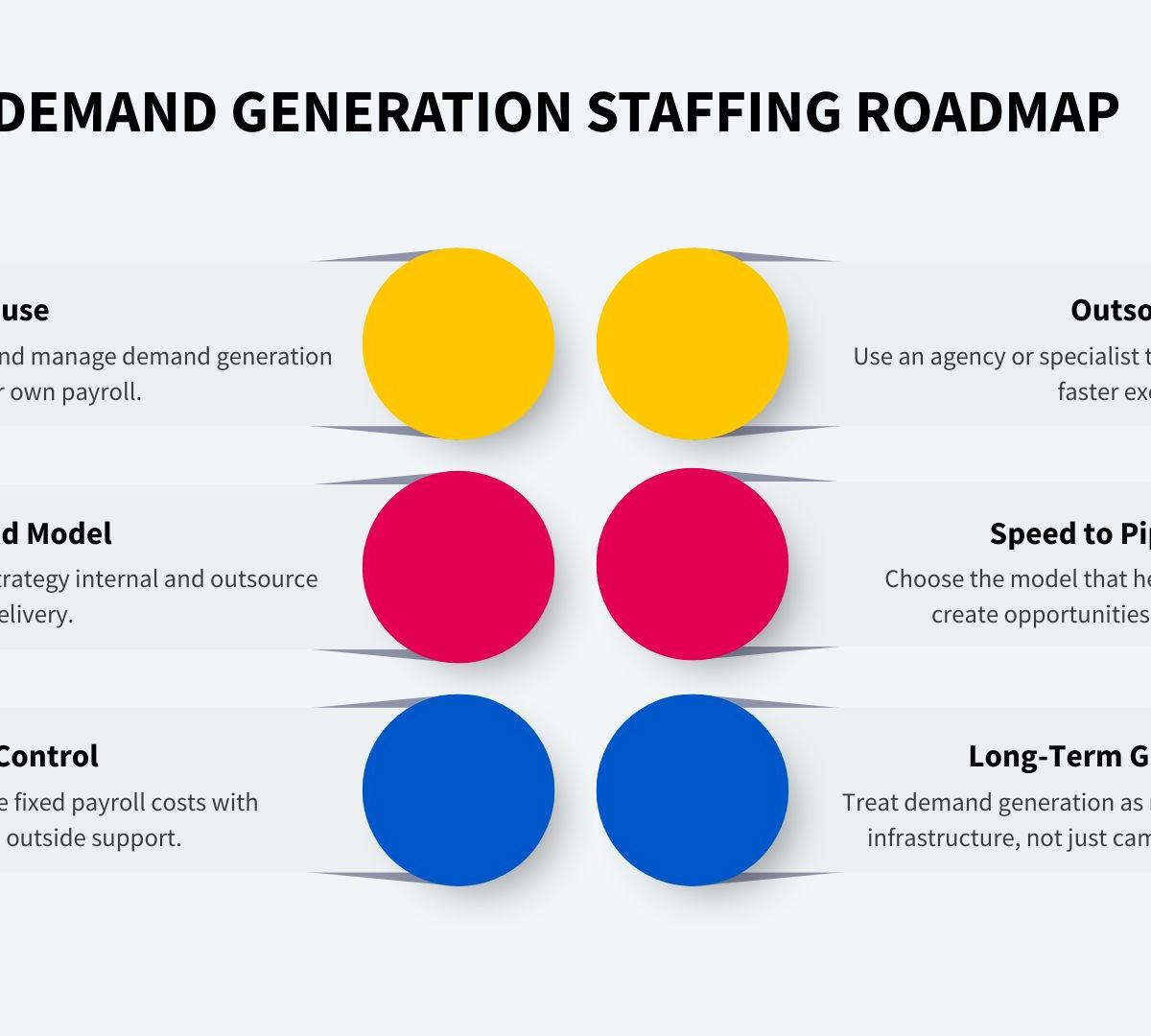
In-house: hire and run demand gen on payroll
Outsourced: use an agency, managed service, or specialist bench, offering immediate access to specialized lead generation resources, cost savings, and proven processes that deliver reliable results
Hybrid: keep a small internal “brain,” outsource most execution
The stakes are practical, not philosophical: speed to pipeline, fixed vs variable cost, access to scarce skills (ops and analytics especially), cost savings, immediate access to expertise, and whether you’re building a capability that increases resilience and valuation over time. That last point carries the most weight when investors are underwriting the next round, which is why we reviewed 85 agencies working with VC-backed companies against the same proof checks.
This is not a primer on tactics. It’s a straight comparison of trade-offs, aimed at making the decision clear.
One lens up front: treat demand gen (including content) as revenue infrastructure, not a calendar of campaigns. The right model is the one that reliably shortens sales cycles, improves lead quality, supports sales follow-up, and shows up in pipeline reporting—without creating a cost structure your business can’t carry. Lead generation is essential for fueling growth and driving business expansion. Proper demand generation requires significant investment and realistic budgeting for long-term nurture activities, not just pay-per-lead models.
What You’re Actually Deciding: Capabilities, Speed, and Cost Structure
The real constraints for SMB CEOs
This decision is rarely “agency vs. hire.” It’s whether you can reliably run a revenue-facing system under real-world constraints.
Budget and headcount: CFO scrutiny and headcount limits push you toward spending that can flex month to month. Fixed payroll is harder to unwind than a services budget, which is why functions like IT and finance already outsource a far higher share of work than marketing does. Outsourced demand generation also offers cost efficiency by reducing operational costs, eliminating the need for internal infrastructure, and delivering scalable results at a lower expense.
Time-to-impact: Owners and boards usually want visible pipeline movement in 1–2 quarters, not after a year of hiring, onboarding, and tooling cleanup.
Talent scarcity: Demand gen isn’t one role anymore. It overlaps with analytics and marketing ops, and those are consistently hard to hire; surveys of B2B marketers rank analytics and ops among the most difficult positions to fill. Outsourcing provides access to a dedicated team of specialists who offer personalized support and campaign optimization, ensuring high-quality lead generation tailored to your needs.
Outsourcing also allows companies to ramp up marketing efforts quickly when launching new products or entering new markets, avoiding delays from hiring and training staff. When the new market has no name for the category yet, the brief changes shape again, and our list of demand generation agencies that create new-category demand records which ones take that work on.
The three levers in this decision
You’re choosing between three practical levers:
Capability: Can you cover strategy, creative, channel execution, ops/automation, and analytics with the team you can actually hire (and keep)? Outsourced partners often provide tailored solutions and specialized expertise, offering customized, industry-specific strategies that align with your business goals and bring in skilled professionals when internal resources are limited. Industry-specific coverage is easier to promise than to verify, which is why our list of demand generation agencies for EdTech companies records the named clients behind each entry.
Speed: How fast can you launch consistent multi-channel programs and fix data/ops debt that slows everything down? A successful demand generation strategy includes key components such as multi-channel execution, analytics, and creative to ensure effective and timely results.
Cost structure and risk:
In-house = salary + tools + management overhead (high fixed cost, slower to scale down).
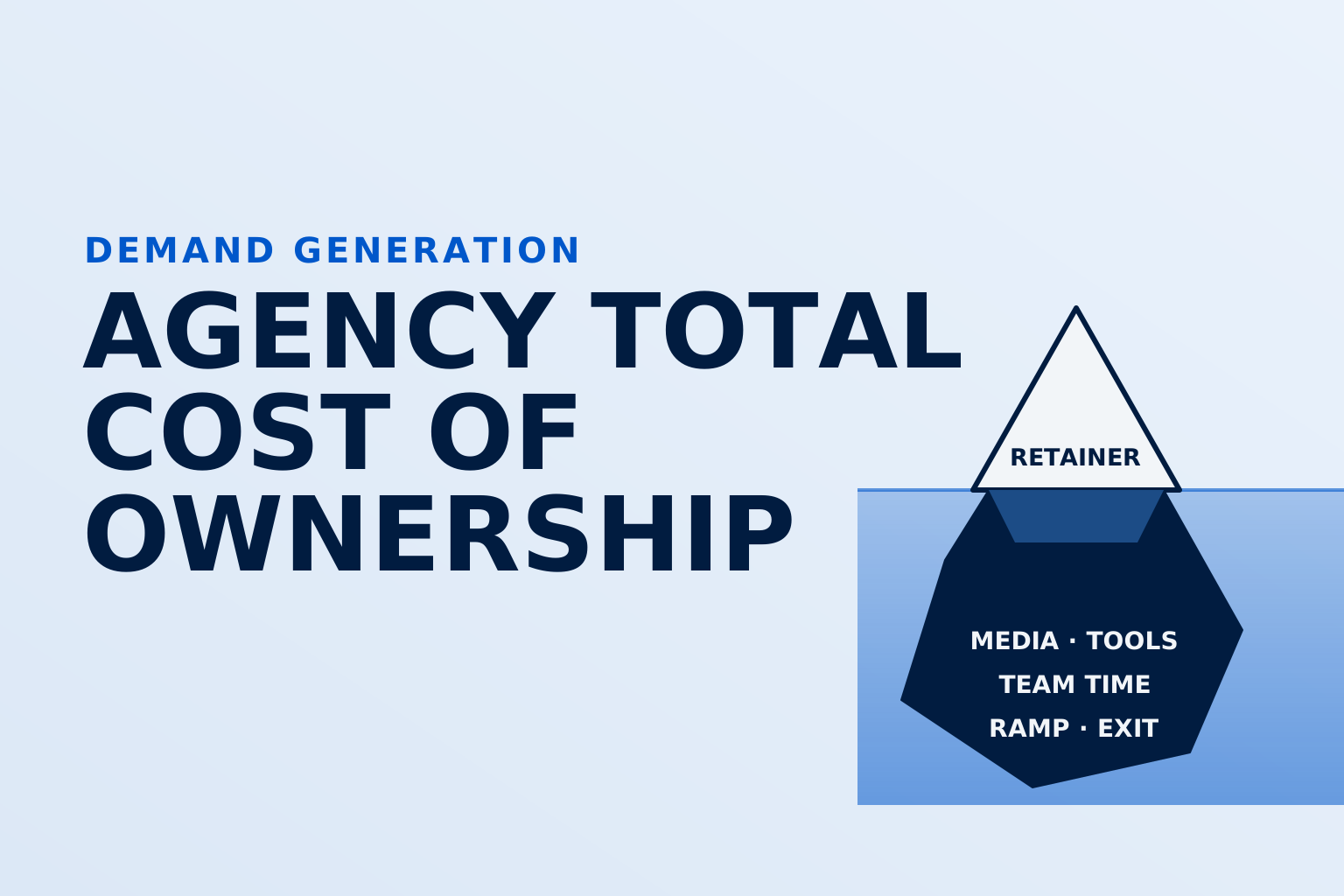
Outsourced = variable capacity, easier to scale up/down, but you take on vendor-management and dependency risk. The fee is not the whole cost either: the total cost of ownership of a demand generation agency runs two to three times the quoted retainer once media, tools, and internal time are added.
A successful partner should offer a full-funnel approach to bridge strategy with execution, not just deliver high-volume leads. Plenty of agencies say they create demand and mostly run more ads, which is why our review of demand generation agencies that create demand, not just capture it kept only the ones with real proof.
In-House Demand Generation: Pros, Cons, and When It Wins
Where in-house is genuinely stronger
Deep product and customer understanding. An internal team sits next to sales calls, customer escalations, renewals, and product decisions. That proximity creates faster feedback loops on what messaging lands, which objections are real, and why deals stall. In-house teams can also nurture prospects through personalized engagement, guiding them through the buyer's journey and turning them into loyal customers. Partners can learn this, but it takes time and constant exposure.
Control, prioritization, and agility. When priorities shift mid-quarter, employees can pivot without re-scoping contracts or debating what’s “in scope.” That matters if your roadmap, pricing, or ICP is changing and you need marketing to move with it.
Long-term capability and IP. You accumulate internal assets that compound: playbooks, segmentation logic, channel learnings, attribution conventions, and practical mastery of your CRM and marketing automation. Leveraging content marketing and account based marketing, in-house teams can distribute valuable assets like whitepapers and webinars through targeted channels, building long-term relationships and brand affinity with high-value accounts. Over time, you’re less dependent on any single vendor (or individual) and less likely to fall into the trap where powerful platforms turn into glorified “email blasters” because no one really knows how to run them.
Cultural alignment and cross-functional impact. The best in-house teams don’t just “run campaigns.” They embed with RevOps and sales leadership, and turn messaging, content, and reporting into decision-making infrastructure the whole GTM team uses.
Demand generation is a holistic strategy that nurtures prospects through the entire buyer's journey to build long-term brand affinity.
The trade-offs and hidden downsides
The hard part isn’t deciding “in-house.” It’s staffing it well.
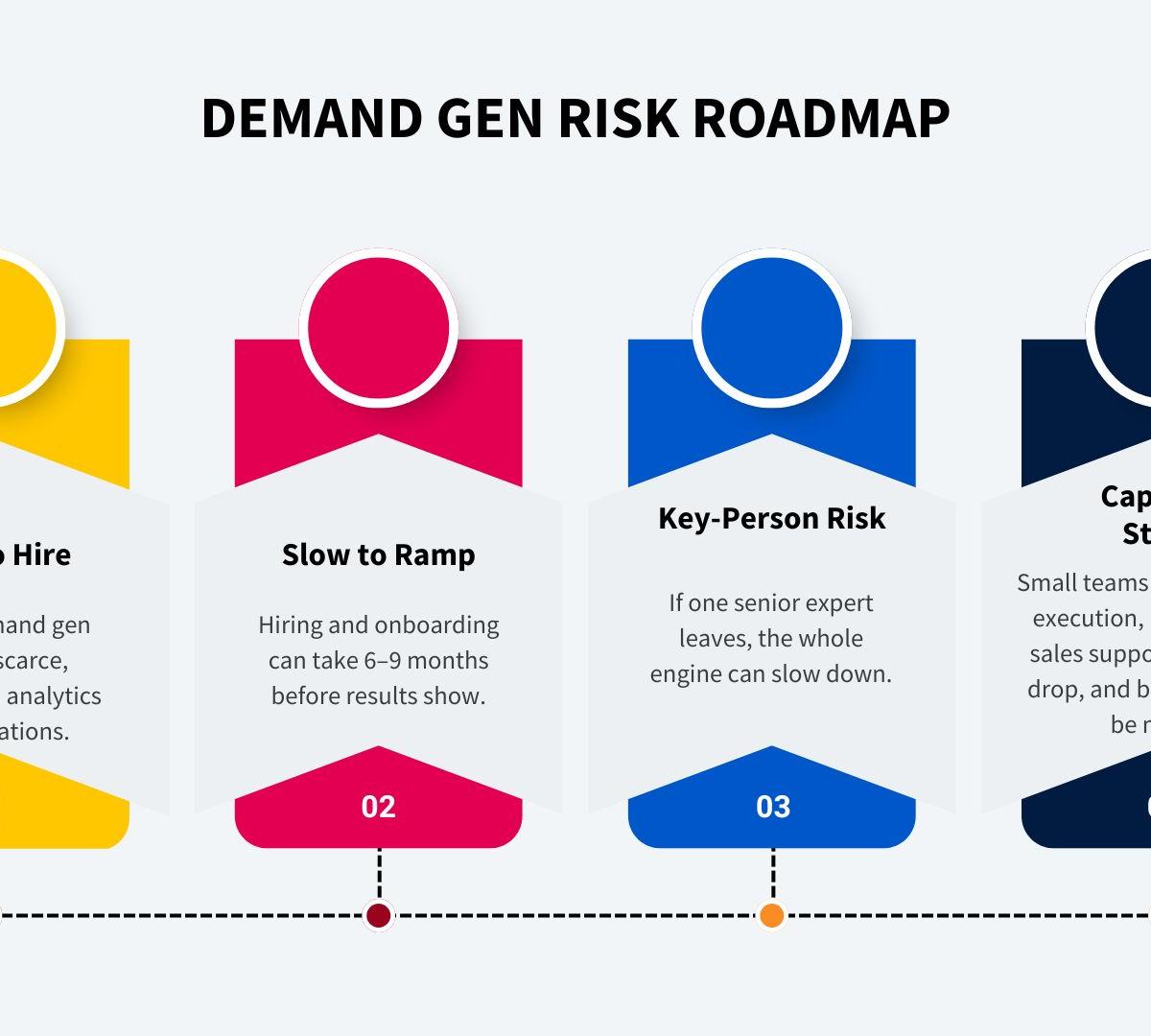
Hiring risk is real: strong demand gen is hard to hire, and analytics/ops talent is even harder. Time-to-hire plus ramp commonly eats 6–9 months (or more), and nearly half of B2B firms report that demand generation roles are difficult to fill, with analytics and operations proving even scarcer in many markets.
Key-person fragility: lose one senior operator and the engine can stall overnight.
Fixed overhead, limited elasticity: headcount is sticky—scaling down hurts, scaling up is slow.
Capacity strain: small teams end up doing strategy, execution, reporting, and enablement—so quality drops somewhere, increasing the risk of missing out on high quality leads and quality leads due to limited resources.
Outsourced partners can help improve lead quality by identifying potential buyers with higher intent to purchase, enhancing alignment between sales and marketing teams. When that capacity strain is at its limit, because the team is one person, the field narrows to partners built to run the whole function rather than hand over a plan, and those are the ones we kept in our list of demand generation agencies for a marketing team of one.
When in-house is the better decision
In-house tends to win when:
You can invest for the long term, accepting slower short-term pipeline while you build a durable engine that is closely aligned with your target market and ideal customers.
You’ll develop talent, not just hire seniors—building a junior-to-mid bench that can run systems and judge AI/vendor output. That matters in a market where many organizations are quietly shrinking entry-level marketing hiring while still growing overall headcount, creating a future shortage of capable mid-level operators.
Additionally, reviewing case studies and references from other clients can provide valuable insights for benchmarking your in-house performance.
Demand Generation Outsourcing: Pros, Cons, and When It Wins
Outsourcing demand gen (especially via a managed-services partner) is strongest when your problem is execution capacity and specialist coverage, not unclear strategy. Demand generation outsourcing, including models like Demand-as-a-Service (DaaS), has become a strategic approach for B2B marketers to efficiently execute comprehensive, performance-driven demand campaigns through specialized external providers. Done well, it functions like a production-and-ops layer that keeps programs running, measured, and improving.
3.1 Where outsourcing is genuinely stronger
Speed to impact. You can stand up (or fix) core programs in weeks, not hiring cycles: email nurture, paid media operations, lead routing, analytics, dashboards, and reporting. Partners bring ready processes, templates, and deep familiarity with common CRM/MAP setups—often turning underused tools into working systems fast, which matters when many teams underutilize platforms like marketing automation and CRM.
Variable cost and flexibility. You swap fixed salaries for capacity you can scale up or down. Outsource demand and outsource demand gen services provide flexibility and scalable execution, allowing you to adjust your demand generation efforts based on performance or market conditions without long-term commitments. This matters if your pipeline is volatile or you need to surge for launches without committing to permanent headcount. In practice, it mirrors how other functions already lean on outsourcing—IT and finance, for example, outsource a far higher share of work than marketing does, despite similar pressure to “do more with less.”
Access to scarce skills. Demand gen depends on ops + analytics as much as creative. Those roles are hard to hire and slow to ramp. Surveys of B2B leaders consistently rank marketing analytics, marketing operations, and demand generation among the most difficult marketing jobs to fill, which is why many teams end up with “Swiss Army knife” generalists instead of true specialists. Outsourcing can immediately cover:
marketing ops and automation
data hygiene and segmentation
attribution and reporting
SEO/SEM execution and content production at scale
Standardization and measurement. Strong providers run with clear workflows, SLAs, and KPIs tied to business outcomes (pipeline, CAC, ROMI), not activity charts. If you cannot trace spend to pipeline today, that is the test we applied in our list of demand generation agencies for companies with no attribution. Many marketing-as-a-service models are explicitly built around standardized processes, tech expertise, and revenue-focused metrics, turning non-core execution work into a repeatable service layer rather than a heroic effort from a few overextended people. These partners are adept at generating qualified, sales ready leads and supporting your sales team so they can focus on closing deals and converting prospects into customers.
Outsourcing demand generation allows marketers to bypass the overhead of building internal teams and tech stacks, gaining instant access to seasoned experts and proven processes at a fraction of the cost. Specialized agencies provide flexibility and scalable execution, enabling businesses to adjust efforts based on performance or seasonal shifts without long-term commitments. Using specialized agencies can also lead to faster results, as they have the experience and resources to launch campaigns quickly, reducing the risk of delayed launches and improving ROI. Many outsourced demand generation providers operate on a pay-for-performance basis, so clients only pay for results, increasing accountability and ensuring spending is tied to qualified leads and revenue potential.
The trade-offs and management overhead
Outsourcing is not “set and forget.” The main risks are context gaps and dependency. External teams won’t catch product nuance or sales objections unless you give them access to the right people and feedback loops.
Watch for:
Knowledge loss: if they work in their own tools, you’re renting your engine.
Quality variability: traditional agencies can be great for launches but weak at daily demand ops.
Data/security overhead: CRM and customer-data access requires governance, especially in sensitive industries.
When outsourcing is the better decision
Outsource when:
You need measurable pipeline impact inside 1–2 quarters.
You want variable cost (or you’re in a headcount freeze).
Your ICP and message are mostly clear, but execution and reporting are the bottleneck.
Your demand motion is repeatable (nurtures, lifecycle flows, list building, SEO/SEM, distribution).
The No-BS Verdict for SMB CEOs
If your primary constraint is time-to-impact and you’re short on specialist capacity (ops, analytics, automation, multi-channel execution), outsourcing execution is usually the rational move. If that points you toward an agency, run the readiness test for when to hire a demand generation agency first. If you are the one signing that invoice as well as making the call, our list of demand generation agencies for founders and CEOs narrows 454 agencies down to the 16 that could prove the work. Lead gen and lead generation are essential for business growth, fueling your pipeline and enabling your company to generate leads and tap into new opportunities. A high-performing generation strategy and marketing strategy should include content syndication, paid campaigns, and multi-channel approaches to attract interest, increase brand visibility, and generate high-quality leads. Outsourcing to specialized partners can help you maintain the same leads quality while reducing costs, and studies show these partners can deliver up to 43% better results than internal campaigns. Effective lead generation strategies also improve conversion rates by attracting warm leads—prospects already interested in your offerings. A strong lead generation strategy fills the top of the funnel and ensures prospects are educated, qualified, and motivated to purchase. Implementing B2B demand generation strategies can lead to increased website traffic, higher MQLs and SQLs, and improved CAC. According to research, 50% of marketers prioritize lead generation in their campaigns, and 42% rate revenue generation as a top KPI (Pipeline360 2025 State of B2B Pipeline Growth report). Using data analytics, you can continuously optimize campaigns to deliver results, while a pipeline protection plan provides quality assurance, ensuring lead validity and campaign reliability. Hiring for these roles is slow and uncertain, and many SMBs end up paying fixed costs for partial coverage—especially in areas like marketing ops and demand gen that are consistently rated among the hardest roles to fill in B2B. A MaaS-style partner works best when they’re embedded in your CRM and marketing stack, so you’re not buying “activity,” you’re buying operating capacity and a way to break the typical “do more with less” resource paradox without bloating headcount. That embedded test is the one a RevOps leader applies first, and it is the screen behind our list of demand generation agencies for RevOps leads.
Keep these pieces in-house:
ICP and positioning
Product marketing and narrative
Sales feedback loops and final decision-making
If your primary goal is long-term capability—especially in a complex, niche, or regulated category—building in-house is worth the slower ramp. You’re buying tighter day-to-day alignment with Sales and Product, plus institutional know-how that compounds and protects you from over-reliance on external vendors or an increasingly thin pipeline of experienced mid-level marketers.
Ready to Transform Your Content Strategy?
Book a call to discuss how Content RevOps can help you build a predictable pipeline.
Frequently Asked Questions
About the Author

Founder & CEO, Content RevOps
Stefan Kalpachev is the founder and CEO of Content RevOps, where he helps B2B SaaS companies transform their content into predictable pipeline. With a background in content marketing and revenue operations, Stefan has developed a unique methodology that bridges the gap between content creation and revenue generation.
Connect on LinkedIn