Content Marketing vs Demand Generation: Same or Different?
Want demand gen that doesn’t collapse when you pause spend? Let’s build the content engine behind it.
Book a CallIn B2B, “content marketing” and “demand generation” often get discussed like they’re two separate channels—or worse, two teams competing for budget. One group says content is the blog, SEO, and a few social posts. Another says demand gen is campaigns, ads, and forms. Both frames miss the point, and they’re why so many programs produce lots of activity but little pipeline.
Part of The Complete Guide to B2B Demand Generation Strategy.
Here’s the shift: content marketing isn’t a pile of assets. When it’s done properly, it’s a business function—a repeatable engine made of process, system, and cross-team execution. That’s the gap many marketers run into when they struggle to maintain consistent quality, align content with buyer needs, or even track ROI in a meaningful way. Demand generation isn’t a synonym for paid media, either. It’s what that content engine produces when it’s wired into distribution, sales motions, and revenue measurement.
A useful way to separate the two—one that lines up with how high-performing B2B teams actually operate:
Content marketing builds the engine: research, standards, workflows, governance, and measurement, run as a cross-functional system rather than a string of one-off campaigns.
Demand generation is the output: awareness, trust, high-intent actions, and pipeline—created through both creation and capture of demand as buyers move through real, often non-linear decision journeys.
This article will clarify the difference, show why content is the foundation demand gen depends on, and explain what changes when you design content as an operating model instead of a publishing habit.
Content marketing is not “publishing”
A lot of teams call it content marketing when what they really mean is output: keyword blog posts, occasional thought leadership, and a dashboard full of traffic, impressions, and clicks. It feels productive, but it’s usually disconnected from how revenue actually happens—and most marketers admit they struggle to link content efforts to ROI or even reach the right audience in the first place.
The problem isn’t that blogs or SEO are “bad.” It’s that publishing without an operating model turns content into a creative island—made in isolation from sales conversations, product priorities, and the data that shows what moves deals forward. Without governance, standards, and reuse, you get content sprawl: lots of pieces, little compounding value, and no clear line to pipeline, which is why so many programs end up over-producing low-impact assets while under-investing in what actually drives demand and sales enablement.
High-performing teams treat content as a business system rather than a blog calendar: they design repeatable workflows, map assets to buying stages, and build measurement that goes beyond vanity metrics to track influence on opportunities, deal quality, and sales velocity. That shift—from “publishing” to an operating model—is what turns content from a cost center into the infrastructure that demand generation, sales, and even customer success rely on.
At a minimum, real content marketing behaves like a business function with:
A process (research, briefs, editorial cadence, post-launch improvement rooted in buyer insight and performance data)
A system (distribution, automation, analytics, and CRM connection so content is discoverable, trackable, and orchestrated across channels)
A team function (marketing + sales alignment on what content must enable, from outbound scripts and one-pagers to case studies and post-sale education)
Commercial measurement (influence on conversion, velocity, and pipeline—not just reach—so you can quantify how content shortens cycles, improves win rates, and lowers acquisition cost)
Demand generation is not “more campaigns”
Demand gen often gets reduced to paid spend and campaign activity: ads, gated ebooks, webinars, nurture sequences—optimized for MQL volume and cost per lead. That can create short spikes, but it’s fragile. When the budget pauses, the pipeline flattens. Worse, sales gets flooded with low-intent leads that don’t convert, creating friction between teams and reinforcing the perception that marketing’s “leads” are disconnected from real opportunities.
When content is weak or generic, campaigns amplify noise. You end up compensating with more spend, more gates, and more follow-ups—without building trust or making it easier for buying groups to choose you. Teams double down on systems (marketing automation, CRM workflows, retargeting) while overlooking the underlying problem: the content itself doesn’t consistently answer real questions, reduce buying friction, or equip sales with the narratives and proof points they need to move deals forward.
Modern demand generation is closer to an orchestration layer than a set of tactics: it uses data, intent signals, and multi-channel distribution to put the right content in front of the right people at the right time. When that content engine is weak, demand gen devolves into a campaign factory chasing form fills; when the engine is strong, demand gen becomes a way to scale trust, relevance, and buying readiness across accounts and segments.
The core reframing: system vs surface
Both terms should describe how a company creates and converts demand over time, not what it publishes or which campaigns it runs.
Content marketing = the engine design. The workflows, tools, decision standards, and measurement that produce useful, reusable content tied to real buyer journeys—from early-stage education and thought leadership through mid-funnel enablement and post-sale expansion.
Demand generation = the engine output. What happens when that content system is connected to distribution and commercial outcomes: awareness that sticks, trust that compounds, and high-intent actions that become pipeline and revenue, measured in qualified opportunities, deal size, and sales velocity rather than just impressions or MQLs.
To really understand the difference, you have to rebuild your view of content marketing from the ground up: as an operating system that informs brand, sales, and product, not a publishing schedule; and to see demand gen as the application of that system, not a shortcut around it.
Content Marketing as an Engine: Process, System, Team, Business Function
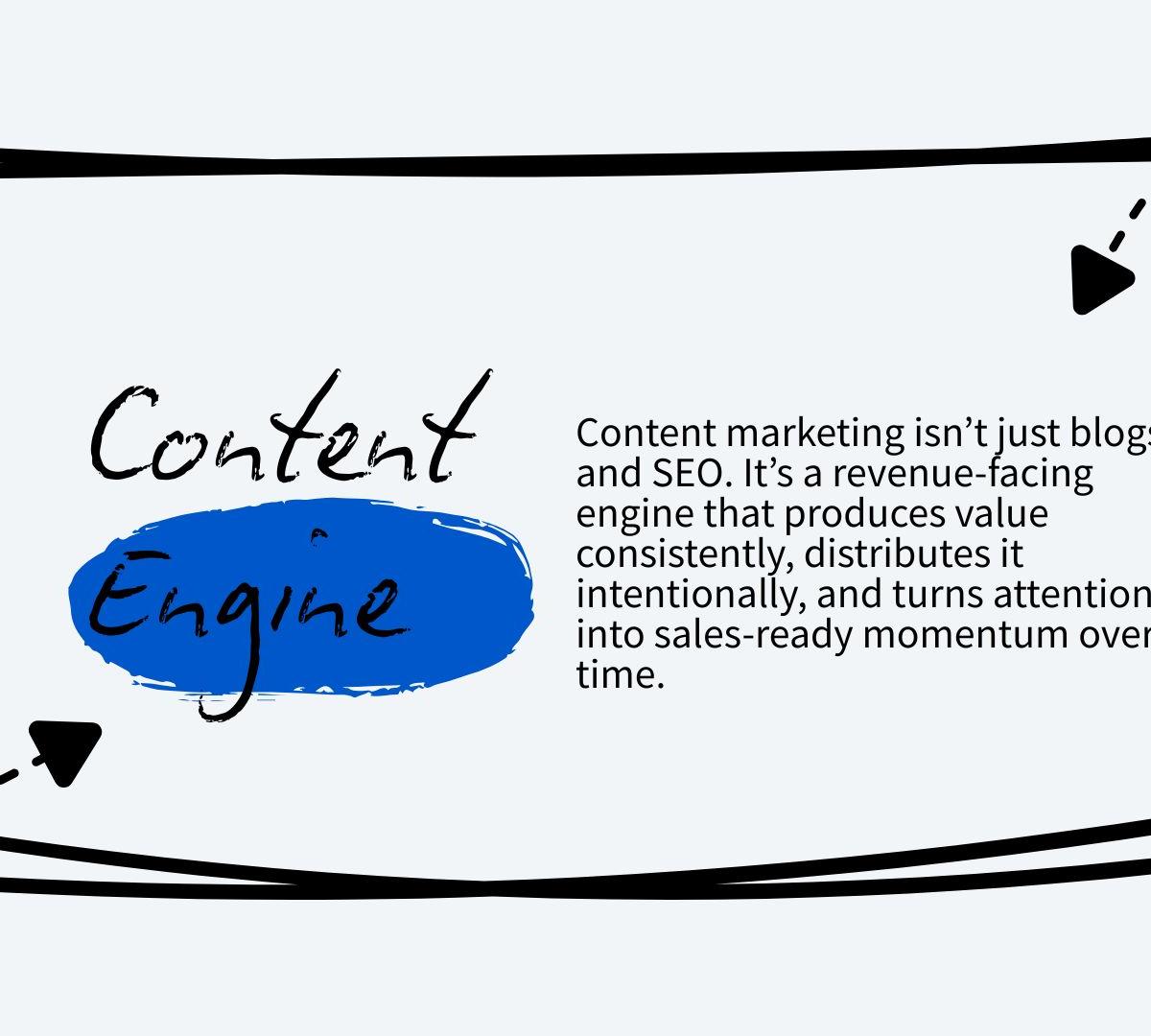
If you want demand generation that’s durable (not a string of short-lived spikes), you need to stop treating content marketing as “blogging and SEO.” Proper content marketing is the engine: a revenue-facing operating model that produces value consistently, distributes it intentionally, and turns it into sales-ready momentum over time. Demand gen doesn’t replace that engine—it plugs into it.
Content marketing as a process: How value gets produced consistently
The process lens starts with discipline, not publishing. Strong content programs are research-heavy and anchored to a single commercial narrative: who you help, what problem you solve, and why your approach wins. That narrative is built from real inputs—jobs-to-be-done thinking, voice-of-customer data, sales call themes, competitor and “alternative” analysis (what buyers pick if they don’t pick you), and structured content research instead of internal opinions.
Most teams don’t work this way: surveys show nearly half of marketers still make content decisions based primarily on budget and internal requests, and only a small minority feel their programs reach the right audience or are “exceptional” in quality—a sign that ad hoc production rarely produces consistent value (example study).
From there, content becomes repeatable production, not random output: structured briefs, editorial standards, governance, and workflows that make quality predictable. High-maturity teams treat content creation more like product development—scoped, prioritized, and iterated—rather than as one-off “blog tasks” [overview of that shift].
Most importantly, the process assigns every asset a job in the journey—moving a buyer from aware → interested → engaged → qualified, instead of chasing vanity metrics or “content volume.” In practice that means mapping assets to specific questions, objections, and micro-conversions, and then measuring them on pipeline impact rather than traffic alone (benchmarks show most teams still struggle here).
Content marketing as a system: Tools, distribution, automation, data
A process creates assets. A system turns assets into outcomes.
Here, content is planned like inventory in a revenue system: mapped in a calendar by channel, funnel stage, persona, purpose, and activation plan. And it’s wired into the tools that make it measurable and usable—CRM, marketing automation, analytics, and intent signals—so performance can be improved instead of guessed at. When that wiring is missing, demand gen teams tend to over-index on campaigns and tools and under-invest in the underlying content engine, which is why so many still default to clicks and form-fills as their primary success metrics (a recurring pattern in industry research).
Distribution is nonnegotiable. Content without distribution does not generate demand; it just exists. Each asset needs a planned path to reach and conversion across the channels buyers actually use (including the ones you can’t fully track, like “dark social” and messaging). Studies of high-performing programs consistently show teams spending at least as much effort on promotion and orchestration as on creation itself (one deep-dive playbook frames this as turning a content engine into demand gen).
A functional content system typically includes:
A distribution plan per asset (search, social and dark social, email, outbound, events, communities, partners)
A conversion path (what happens after consumption, and where the buyer goes next)
A repurposing engine (webinars/interviews/cornerstone pieces turned into clips, posts, BOFU pages, and enablement)
Closed-loop measurement (engagement patterns + downstream actions like high-intent visits, hand-raisers, and pipeline influence)
This is where optimization lives: you learn what content creates action, which messages stick, and where buyers stall. Done well, this is less about cranking out “more assets” and more about using data and content intelligence to refine what already works (a common thread in demand-gen diagnostics).
Content marketing as a team function: Alignment across marketing and sales
Engines fail when teams optimize for different finish lines. Brand/content teams chase reach. Demand teams chase form-fills. Sales chases the next 90 days. The result is content that looks “busy” but doesn’t help deals move.
A better model is integrated pods (or brand-to-demand squads) with shared revenue-facing KPIs. Content is built with input from Sales, Customer Success, and RevOps so it supports real objections, real buying committee concerns, and real deal stages. Where this alignment is missing, you see the classic gap: marketers proud of long-form thought leadership or social reach while sales reps mostly rely on a narrow set of case studies, one-pagers, and email copy that actually move conversations forward (sales-side research makes that disconnect very clear).
In this model, content becomes decision infrastructure—assets sales can actually deploy:
comparison and alternative content
objection-handling guides
proof packs and narratives by industry
follow-up sequences that match how buyers evaluate
Teams that operate this way tend to measure content by its effect on sales cycle length, win rates, and multi-stakeholder engagement rather than by isolated marketing metrics (a shift many B2B organizations are actively making).
Content marketing as a business function: Built for revenue and pipeline
The final lens is commercial accountability. Content isn’t “nice to have” when you measure it like a revenue lever: declared-intent actions (demo, pricing), sales-qualified opportunities, win rate, sales cycle length, pipeline influence, and LTV:CAC. Governance gets stricter, too: assets that don’t play a clear commercial role don’t ship.
This is the Content RevOps view: content as infrastructure, not output. A product, not a post. An operating layer that supports SEO and AI discovery, outbound, sales enablement, and nurture—built for reuse and compounding value. It’s also where content stops being “just marketing” and becomes an organizational capability that underpins brand, demand, and customer expansion alike (a progression you can see in high-maturity content operations).
When content marketing runs at this level, you don’t just have content. You have an engine that can actually create and capture demand—one that makes every campaign, channel, and sales motion more effective instead of scrambling to compensate for a weak content foundation (a distinction echoed in modern demand gen definitions).
So What Is Demand Generation Then? Outcome and Application of the Engine
Demand generation isn’t “running campaigns” any more than content marketing is “writing blogs.” Demand gen is the motion that turns your content engine into measurable pipeline—by connecting what you publish to distribution, conversion paths, and sales follow-through.
In other words: content marketing builds the engine (process, system, team alignment, governance). Demand generation is what happens when that engine is wired into go-to-market, so that content consistently fuels awareness, trust, and revenue rather than sitting in an isolated “blog” function.
Creation + capture: demand gen as motion, not just media
Demand gen has two inseparable sides:
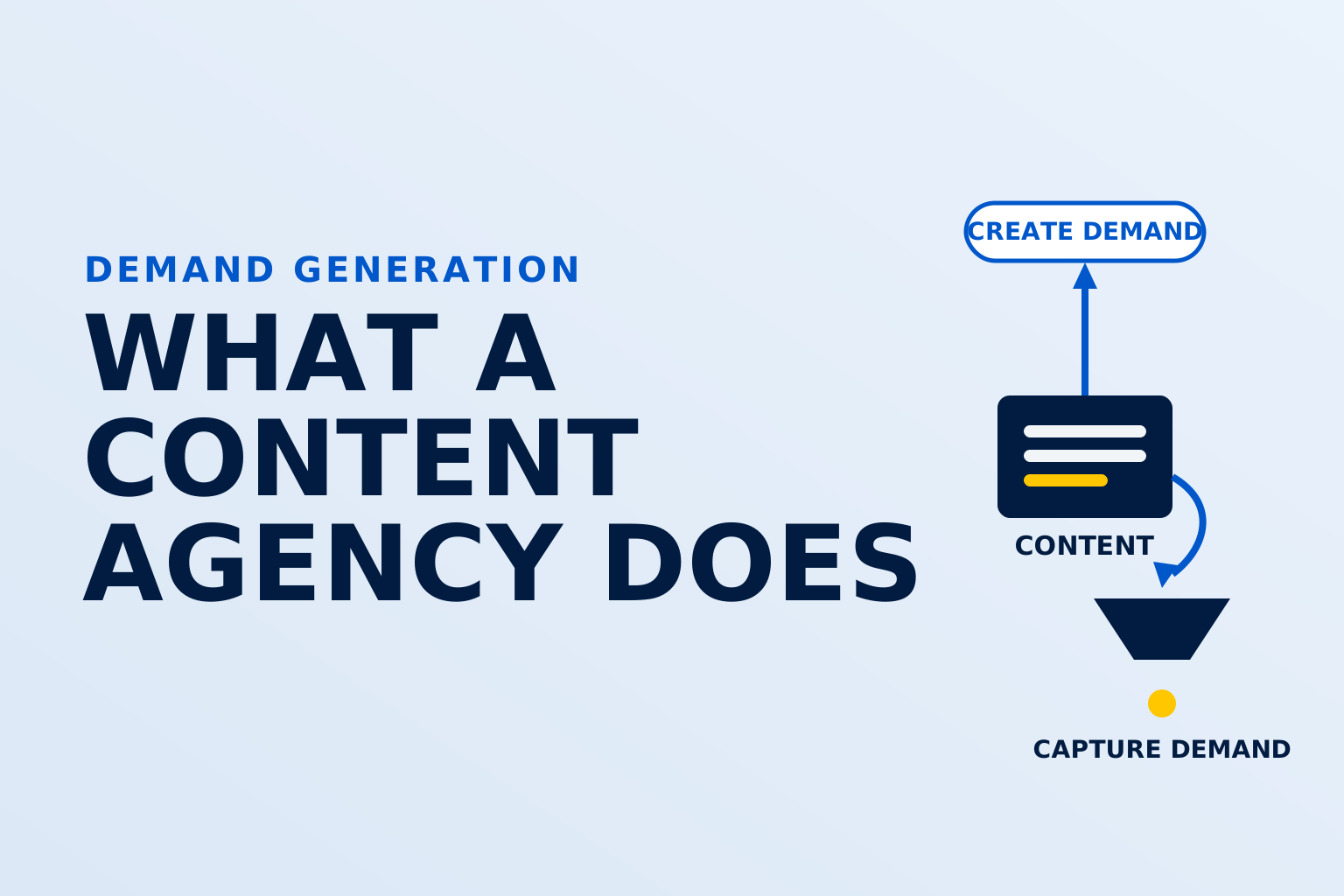
Demand creation: educating the market, introducing a point of view, reframing the problem, and helping buyers make sense of change. This is where you build salience and trust before someone is ready to buy—crucial when only about 5% of a B2B audience is in-market at any time.
Demand capture: converting existing intent into action through high-intent experiences like BOFU search pages, comparisons, pricing, reviews, retargeting, and conversion-focused landing flows. For many teams, this is where bottom-of-funnel content such as pricing, ROI, and competitor pages finally connects to how buyers actually research and shortlist vendors.
Both sides depend on the content engine. Without credible, problem-oriented content, ads and outbound are just amplification with nothing substantial to amplify—exactly the “campaign-first, shallow content” pattern that leads to short-lived spikes and weak lead quality. And without capture-oriented content, awareness stays vague and never turns into revenue, which is why so many organizations see content engagement but struggle to tie it to pipeline.
Demand generation as the outcome of a working content system
When the content engine is connected to distribution and revenue systems, demand gen shows up as downstream business outcomes—not just “more leads.”
What it tends to look like:
More high-intent inbound actions (demo, trial, pricing, “talk to sales”) from buyers who already understand your category and your POV—aligning with research that high-intent demo requests can be orders of magnitude more valuable than low-intent form fills.
Higher win rates and faster cycles because buying groups have consumed decision-grade content before engaging sales; in many B2B studies, buyers now consume multiple pieces of content before ever talking to a rep, which lets well-designed content pre-handle objections and build confidence.
“Silent shortlisting” where prospects follow, share, and evaluate your content in dark social, communities, and peer circles long before any form-fill, mirroring how modern buyers assemble a vendor list before they ever appear in your CRM.
Measurement shifts accordingly: away from counting form submissions and toward pipeline quality, conversion rates across stages, velocity, and multi-stakeholder engagement at the account level. Brand and content exposure may not get last-click credit, but it reliably shows up later in conversion and deal momentum—especially when you track content’s role in accelerating opportunities and improving close rates, not just driving raw traffic.
Demand gen without strong content vs content without demand gen
These failure modes are common—and expensive:
Demand gen without strong content: heavy spend driving to generic assets, short-lived spikes, low trust, weak conversion. This is the classic “MQL factory” that produces volume but not revenue, a pattern echoed in studies where sales leaders say most marketing leads are low intent and rarely convert.
Content without demand gen: great assets stuck in a blog archive or internal folder, with no activation path into campaigns, outbound, nurture, or sales plays—exactly the situation where marketers report creating more content every year while engagement and ROI stay flat.
The synthesis is the point: demand generation is the commercial expression of your content operating system. It’s not a separate team manufacturing demand from scratch—it’s what happens when your content engine is actively plugged into channels, sales workflows, and revenue targets. When that happens, content shifts from “stuff we publish” to the operating layer that powers brand-building, lead influence, and measurable pipeline across the full customer journey.
Putting It Together: Building a Content Engine That Naturally Generates Demand
Start with one commercial narrative, not a topic list
Random “SEO topics” create random outcomes: scattered traffic, mixed messages, and demand that doesn’t compound. Content RevOps starts by choosing a single commercial narrative that maps to a real, urgent problem your ICP is already trying to solve—so every asset reinforces the same point of view and buying motion. That kind of focus is exactly what separates high‑maturity content operations from the “random acts of content” most marketers still struggle with, where more than half admit they cannot reliably measure impact or align with business goals.
To keep it coherent, narrow the ICP by:
Market size and reachability (can you consistently get in front of them?)
Urgency (is the pain active or hypothetical?)
LTV and payback (is the segment worth serving?)
Buying context (how they evaluate, what they fear, what triggers change)
Then validate the narrative using keyword patterns, community conversations, scraped datasets, and jobs-to-be-done thinking—so you’re building around real purchase intent, not internal guesses. When only a small minority of marketers say their content consistently reaches the right audience or is seen as a trusted source, grounding your narrative in observable demand signals rather than internal ideas becomes a genuine competitive advantage.
Design the operating model around movement, not output
The job isn’t “publish content.” It’s move people: aware → interested → engaged → MQL. Different assets own different transitions, and they should be built that way on purpose (not repurposed later as an afterthought). Teams that treat content as an operating system for how the company communicates with the market—rather than as a loose collection of assets—are the ones that see content materially influence pipeline, win rates, and deal velocity.
Operationally, your calendar becomes an operating layer connecting:
Strategy (what we’re trying to change in the market)
Production (repeatable briefs and workflows)
Activation (distribution baked in)
Reporting (closed-loop, revenue-facing)
That means briefs specify the movement an asset is responsible for, how it will be distributed, and what commercial signal will define success—so you are not stuck optimizing for vanity metrics. Standardize workflows for webinars, events, and campaigns so every asset ships with built-in conversion paths and follow-up; without that connective tissue, demand gen quickly devolves into campaign bursts that never add up to a durable system.
Connect inbound, events, nurture, and outbound into one system
Demand gen gets easier when every channel draws from the same backbone. Organic content pulls people in, events deepen trust, nurture reduces friction, and outbound uses the same assets to warm and qualify accounts. In practice, that looks like a unified “brand-gen” system where awareness, consideration, and conversion programs share one content spine, one budget, and one view of the customer journey, instead of being run as disconnected brand, content, and demand teams.
When content is built like infrastructure, “doing demand gen” becomes less about inventing campaigns—and more about routing a working engine into the right plays. This is also how you avoid the common pattern where tech and campaigns outpace the content system: CRMs, marketing automation, and outbound sequences can only generate qualified pipeline if they are orchestrating assets that buyers actually consume, trust, and use to make decisions.
Conclusion – Content Marketing as Engine, Demand Generation as Its Output
Reinforce the core distinction
Content marketing isn’t “blogging and SEO.” Done properly, it’s the engine: a strategic, cross-functional business function that designs, produces, and distributes decision-grade content buyers actually use to evaluate change. In many organizations, that means moving from ad hoc publishing to a documented content operating system that consistently builds trust, authority, and “brand gravity” across the full journey, not just the top of the funnel. Demand generation isn’t “campaigns and ads.” It’s what happens when that engine is plugged into distribution, sales workflows, and revenue measurement so that content powers both demand creation and demand capture across channels.
The dependency cuts both ways:
Content without distribution stays invisible and rarely earns commercial impact, which is why so many teams report strong content production but weak contribution to pipeline and revenue.
Demand gen without strong content becomes shallow, expensive, and short-lived because you’re amplifying noise, not trust—exactly the pattern you see when lead-gen programs over-index on forms and MQL volume instead of substantive education, proof, and guidance.
Connect to our way of working
Most teams don’t have a content problem—they have an operating model problem. Content is already fueling campaigns, sales decks, nurture programs, events, and product launches; it just isn’t being treated as a coherent system. Our approach treats content as infrastructure and revenue leverage, not marketing decoration. That means architecting a repeatable process, shared standards, and cross-functional alignment so content is planned like a product, measured like a revenue program, and reused like a core asset library. When that engine is in place—and integrated with inbound, events, nurture, and outbound motions—demand gen becomes a natural output of how the business communicates with the market, not a separate scramble every quarter.
Is your content engine actually generating demand—or just producing activity?
Audit your content operating model and wire it into distribution, sales motion, and revenue measurement—so pipeline becomes the output, not the hope.
Frequently Asked Questions
About the Author

Founder & CEO, Content RevOps
Stefan Kalpachev is the founder and CEO of Content RevOps, where he helps B2B SaaS companies transform their content into predictable pipeline. With a background in content marketing and revenue operations, Stefan has developed a unique methodology that bridges the gap between content creation and revenue generation.
Connect on LinkedIn