SEO for Asset Managers: A 2026 Digital Marketing Playbook
See where your firm's search actually stands. The asset management content benchmarking tool scores your estate against 1,628 firms in minutes.
Book a CallMost asset managers already have a website, a blog, and a marketing team that publishes. Almost none of it earns search traffic. In our review of 1,628 asset management firms, the median firm pulls in about 214 organic visits a month. Most of the publishing produces almost no search traffic at all, which is the gap a content marketing system built for pipeline exists to close.
Part of Content Marketing for Asset Managers: The 2026 Playbook.
That is the real problem with SEO for asset managers. Presence is common and performance is rare, and the gap is operating discipline rather than tools or budget.
This playbook lays out what asset management digital marketing actually requires, why the median firm underperforms, and the order to fix it. It is built for the growth leaders, marketing operators, and lean teams inside asset and wealth management firms who own search and have to show a return on it. If you want the wider content picture first, start with content marketing strategies for asset management firms.
What does SEO for asset managers actually mean, and what is it not?
SEO for asset managers means getting your firm found by the allocators, advisors, and investors who search before they shortlist. It covers the content and the technical work that make your pages rank in Google, and now the work that gets your firm cited in AI answers from tools like ChatGPT and Google's AI Overviews.
First, clear up a naming clash. Search "asset management digital marketing" and half the results are software for storing files, called Digital Asset Management or Marketing Asset Management. That is not this. This is about marketing an investment firm, the people who manage money for institutions and individuals, so that buyers find, trust, and choose them.
That distinction matters more than it looks. When we pulled the live search results for these terms, Google returned an AI Overview at the top and an AI-written answer under every follow-up question. The answer layer already sits on top of asset management search, so SEO and AI visibility are now one job. If you are wondering whether that means rewriting everything, we covered it in whether strong SEO pages still work for AI search, and the short answer is that the same SEO and content work carries over.
The demand is real and it is educational. The head term "asset management" draws about 33,100 searches a month, and "what is asset management" adds roughly 6,600 more. People are trying to understand the category, not just look up a brand. That rewards the firm that explains best, which is rarely the biggest firm.
Why do most asset managers have a website but almost no search traffic?
Because presence is easy and performance is hard, and the two get confused. Nearly every firm has the website. Almost none has the search performance, and the difference is a system nobody built.
Look at the maturity split. In our review, only 3.5% of asset management firms run content as an active, systematic program, roughly one in twenty-eight. Nearly six in ten show no real signs of content at all, running brochure sites with nothing to engage a buyer, and another 36.9% are dabbling with the odd post and no system behind it. The same pattern shows up across every vertical in our cross-vertical State of B2B Content Marketing 2026 study.
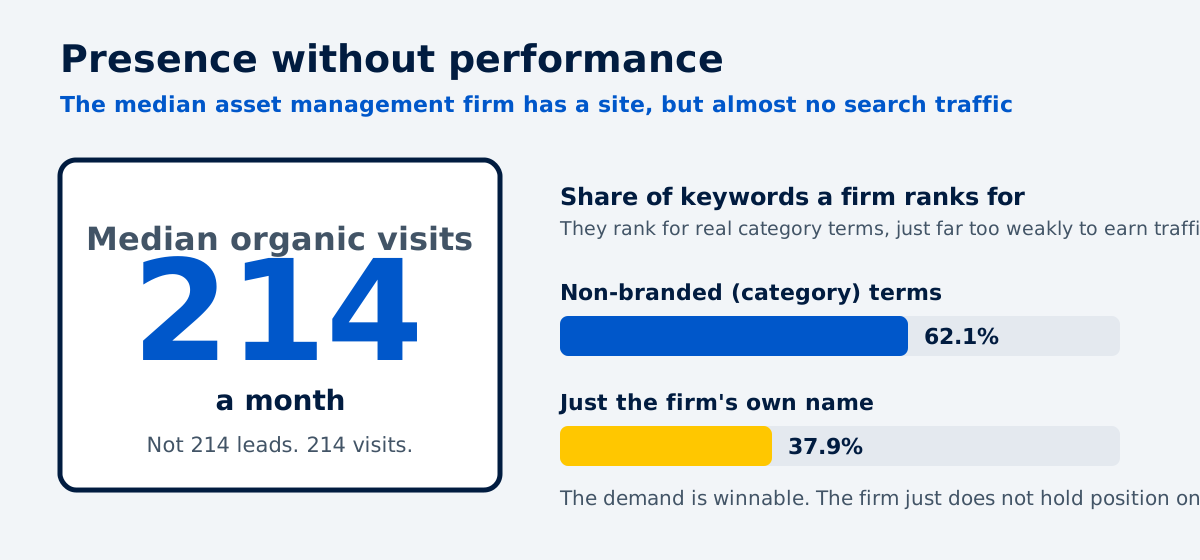
Now look at what that produces in search. The median firm earns about 214 organic visits a month. That is 214 visits, not 214 leads.
These firms do rank for real category terms, not only their own brand. About 62% of the keywords a typical firm ranks for are non-branded, the category and topic terms a buyer would actually search. So the demand exists and the category is winnable on the merits.
The trouble is position. The firm ranks for those terms so weakly that they send almost no traffic, and over a third of the keyword list it does hold, 37.9%, is just the firm's own name. That is coverage without position.
Marketers who work in the space say the same thing in plainer words. Asset management marketer Jon Greene puts it bluntly: most asset managers think marketing is just activity. The growth operator Gard Rogne makes the search version of the point: more content is not automatically better, and SEO is about getting the right traffic, not just traffic. The median asset manager is busy, not found, which is the first of the biggest content marketing mistakes asset managers make.
What should you fix first to turn presence into performance?
Fix search in this order, top to bottom, because each step depends on the one above it. Skipping ahead is the most common way asset management marketing budgets get wasted.
We plan content top down and publish bottom up, across five levels, and the same logic sets the SEO priority order:
- 1. Be findable and readable by Google and AI.
- 2. Target the terms buyers type, not the biggest numbers.
- 3. Build the formats that rank and convert.
- 4. Capture and route the traffic you already earn.
- 5. Measure to pipeline and AUM, not to traffic.
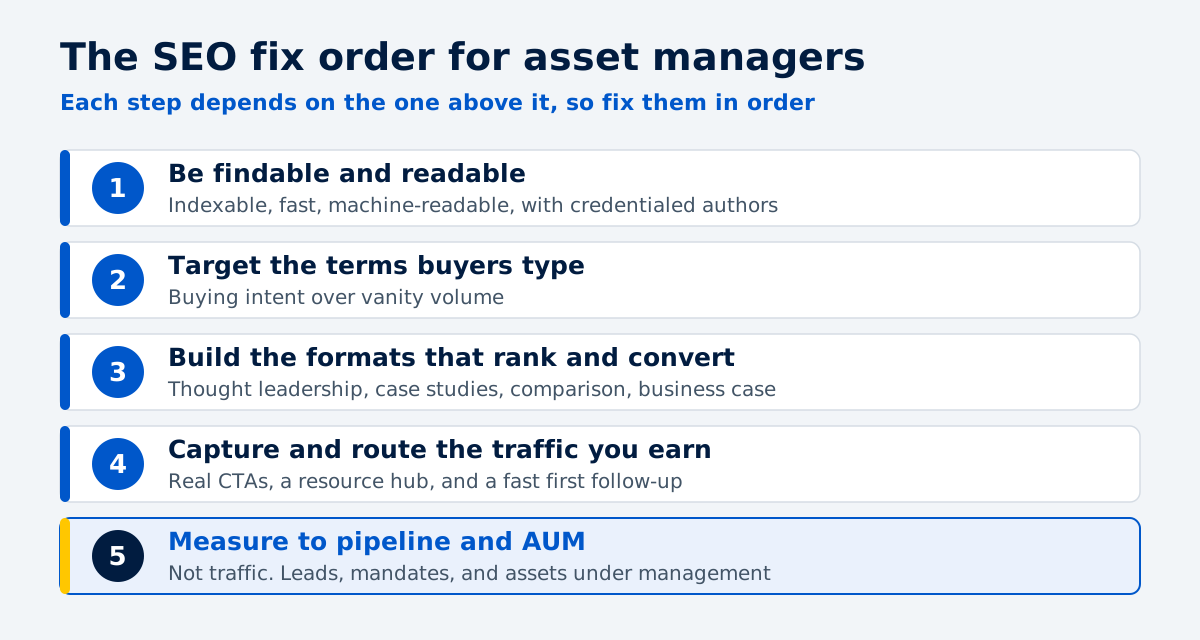
The order is a dependency chain. An unindexed page ranks for nothing, so findability comes first. A brilliant guide aimed at a commercially useless keyword earns nothing, so targeting comes before formats. Capturing traffic you have not earned captures nothing, so formats come before capture. And measuring an empty funnel is theatre, so measurement comes last.
The one step people reorder is putting formats before targeting. Do not. Targeting decides whether the format ever meets a buyer. A firm that writes ten excellent pieces about the wrong things has ten excellent pieces nobody searches for.
Almost no one runs this discipline. 96.5% of asset management content ends with no meaningful next step, which tells you the whole chain, from targeting to capture, is missing at most firms. That absence is also the opening, and it is why our content marketing best practices for asset managers start with the next step, not the next post.
Fix one, is your asset management site findable and readable by Google and AI?
Start by making sure a search engine and an AI model can find, crawl, and understand your pages. If they cannot read the page, nothing else you do to it matters.
The technical basics are the same as any site. Pages have to be indexable, load fast, work on mobile, and use clean structure and headings so a machine can parse what each page is about. On an asset management site, the usual blockers are gated PDFs that hold all the good thinking where no crawler can reach it, and JavaScript that hides the main content. Structure matters for AI too, and you can tune for it without wrecking the page for human readers.
The part specific to finance is trust. Google treats money topics as high stakes. Its Search Quality Rater Guidelines put "Financial Security" in a category it calls Your Money or Your Life, use "how to invest money" as a worked example, and tell raters to hold those pages to the highest standard for accuracy and trust.
That standard rewards a simple, concrete move most firms skip. Put a real, credentialed author on every page. Even among the firms that actively publish, only about 22% show named author bios. A named portfolio manager or strategist with a real bio signals expertise to Google and to the reader, and the same site authority and author credibility that help you rank also help you get cited by AI models. Fewer than one in four does it, so it is an easy edge, and the same named voices carry over to LinkedIn marketing for asset managers.
Fix two, are you targeting the terms buyers type, or just big search numbers?
Chase the searches that show buying intent, not the searches with the biggest volume. A keyword can have great volume and still be worthless to an asset manager.
The way we think about it, SEO is a distribution vehicle, not the strategy. A term with nice volume can be commercially useless, and the guardrail is simple: start from the job your buyer is trying to do, then check volume, never the other way around. We set out how that works in practice in using keyword and topic research to support strategy and building the topical keyword map.
The search demand in asset management sorts into three layers, and each wants a different answer:
- Awareness terms make up about 38% of the demand. Broad, educational searches, a large pool that mostly sits unclaimed.
- Consideration terms are about 12%. Smaller, higher value, the buyer is comparing.
- Decision terms are only about 4%. Tiny, but this is where a mandate gets won, so you take it with proof and comparison content.
The head term "asset management" pulls 33,100 searches a month and is informational, which means it rewards the best educator, not the biggest brand. That is good news for a smaller firm. You will not outrank a giant on brand, but you can out-teach them on the question a buyer actually typed.
So map your terms to the decision, not to a volume report. Own a handful of high-intent commercial and decision terms your buyers really search, and treat the big awareness terms as a place to teach and get discovered, not as a traffic trophy. Mapping the funnel first makes that sort quick.
Fix three, do you have the content formats that actually rank and convert?
Build the specific formats that both earn rankings and move a committee-led sale, because almost none of your competitors do. This is the single biggest opportunity in asset management digital marketing.
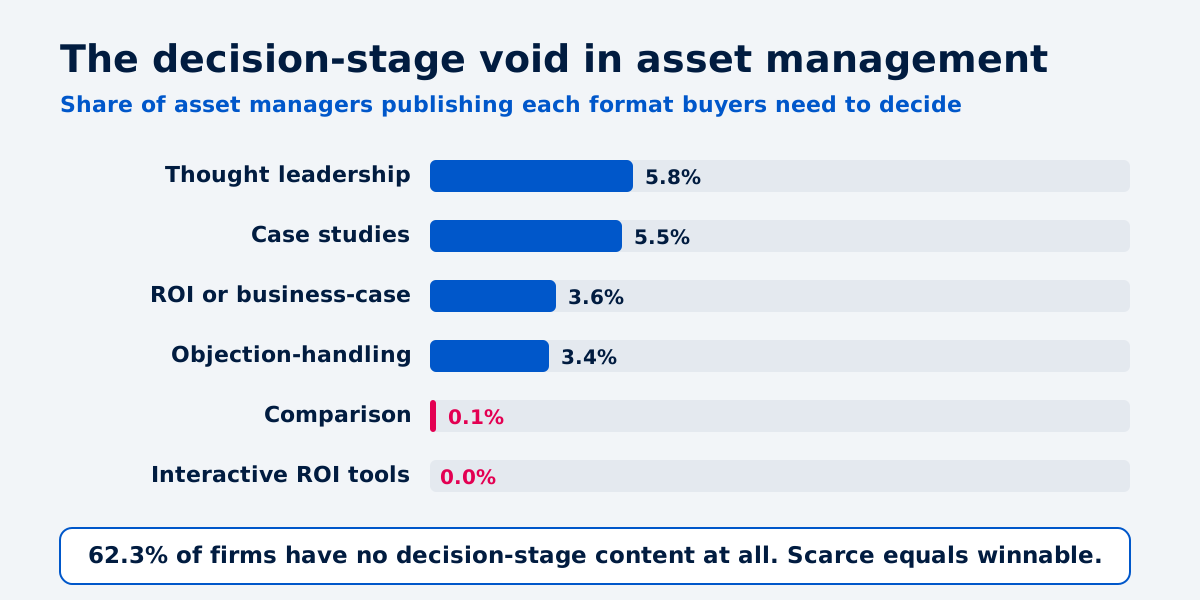
The formats that win a considered, high-trust sale are exactly the ones the field neglects. Across the firms we reviewed:
- Genuine thought leadership shows up on just 5.8% of sites.
- Case studies, 5.5%.
- ROI or business-case content, 3.6%.
- Objection-handling content, 3.4%.
- Comparison content, 0.1%.
- ROI or interactive tools, 0.0%. Not a single firm.
Scarcity is the point. The formats a buyer needs at the decision are the formats the category abandons, which is exactly why they are a moat.
Where do asset managers go silent in the funnel?
Coverage is fine at the top of the funnel and collapses at the bottom. In our review, awareness and consideration content is nearly everywhere, 98.9% of firms have it, but 62.3% have no decision-stage content at all. Firms teach the buyer and then leave them alone at the exact moment they are ready to act.
Proof is missing too. Seven in ten firms show no buyer proof of any kind, no case studies, no outcomes, no data. Buyers get assertions where they came for evidence.
Why do the right formats decide who gets picked?
The stakes are commercial. For institutional buyers, published content shapes who they invest with. CoreData Research surveyed 132 institutional investors and 22 consultants who oversee more than $4.9 trillion, and 59% said the thought leadership a manager puts out directly influences which manager they invest with. Nearly a quarter, 23%, said a manager's content put a firm they had never heard of onto their radar. CoreData's own conclusion is that thought leadership is no longer optional, it is the price of entry. If your team is still debating what counts, start with what thought leadership actually is.
Format and length matter as much as the fact of publishing. In Coalition Greenwich's study of nearly 500 institutional investors, written content was the preferred medium for three-quarters of asset owners, and they wanted it short, pieces of about five pages or less. So the winning move is the right format, tight and aimed at the decision, rather than a longer PDF.
Why should content work as revenue infrastructure rather than a press function?
Set against all of that, look at what firms actually publish. News and press releases make up 44.1% of asset management content, by far the largest share. That is publishing as a press function, not as a demand engine.
The fix is to treat content as revenue infrastructure. Original research earns authority that a press release never will, and building a flagship content product is how a firm turns one study into a year of citable material. The scarce decision-stage formats, the case study, the comparison, the business case, are what turn a search visitor into a shortlisted manager. The firm's existing webinars and recorded commentary are a head start here, as we showed in video marketing for asset managers.
Fix four, are you capturing and routing the traffic you already have?
Once traffic arrives, give it somewhere to go, because most asset management sites let it leave. You do not need more visitors to grow first. You need to stop wasting the ones you have.
The leak is severe. Across the firms we reviewed:
- Only 4.7% capture a contact, so email and nurture have almost nothing to work with.
- 96.5% of content ends in a weak or dead-end call to action.
- Only 13.5% place a relevant call to action inside the content.
- Only 5.2% use internal links that guide a reader toward converting.
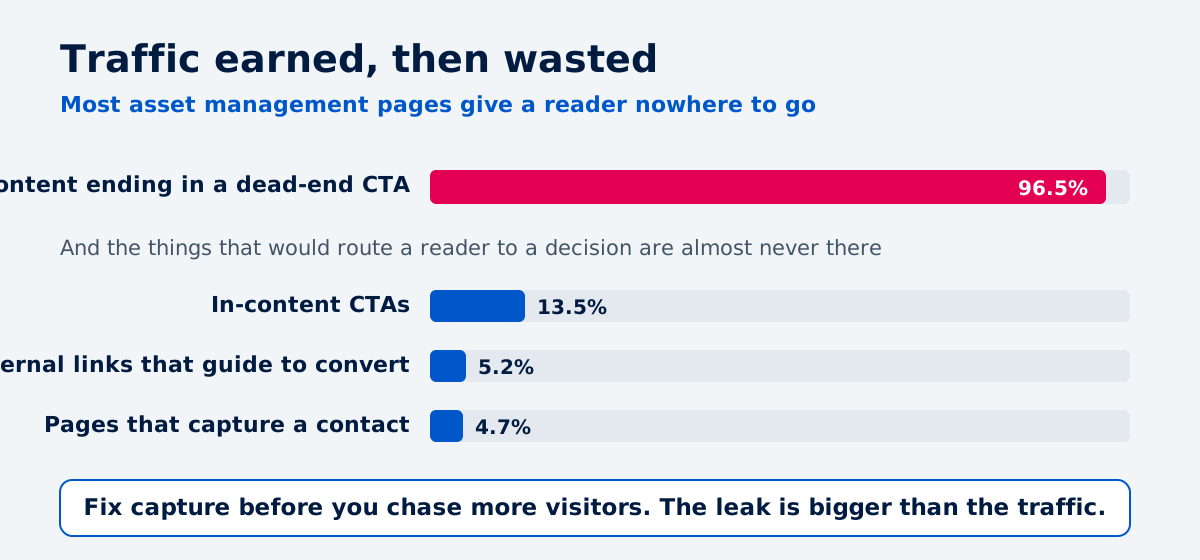
The result is predictable. The median site loses about 41% of visitors to a bounce, traffic that arrives, finds no next step, and leaves. The same failure shows up outside finance, in blogs that get traffic but no signups or demos.
The fix is conversion architecture, not a single button. The way we build it, every page has one primary purpose and several sensible next steps: a guide leads to a related report, the report leads to a webinar, the webinar leads to a conversation. A structured resource hub, which only 3.7% of firms run, is what holds those paths together. We go deeper on that layer in the conversion layer and lead capture and qualification.
Speed matters too. Working with a client running a gated report campaign, we treated the download as the start of the funnel, not the finish, and wired the follow-up to fire the moment a lead came in, because the firm that responds first usually wins the conversation. Capture the contact, then move fast.
Fix five, can you tie asset management SEO back to pipeline and AUM?
Measure search against pipeline and assets under management, not against traffic, or the whole program stays impossible to defend. The 214 visits mean nothing until you can connect them to money.
Most firms cannot. In our review, attribution and marketing automation are rare, so firms measure traffic they never actually act on. A dashboard full of sessions is not a result, and our guide to which metrics to track and which to drop explains why.
The way we approach it, every gap gets a number and every number ties back to revenue with the assumptions shown, so a leader can argue with the inputs instead of dismissing the output. Rankings and visits are the leading signals. Captured leads, qualified conversations, mandates, and AUM are the ones that decide the budget. Seeing which page started the deal is what makes that link visible, and reporting on content marketing success covers how to present it.
The fastest way to see where your own program leaks is to score it. Our asset management content benchmarking tool and the full state-of-content report show where the value concentrates and where the median firm falls down.
Where does paid search and SEM fit for an asset manager?
Paid search buys visibility now, SEO earns an asset that compounds later, so run paid while your organic estate builds and do not confuse the two. They do different jobs.
Almost no asset manager uses paid search at all. Only 3.8% run Google Search ads, and among those that do, the median spend is about $226 a month, which is barely a test. Where firms do pay, LinkedIn is the dominant channel. The paid auction, like the organic category, is wide open.
Paid can work when it is aimed well. A wealth management firm working with GK3 Capital went from under 500 visits a month to over 2,500 after fixing its foundation, then ran a paid search campaign that drew 913,000 impressions and 69,000 clicks and produced 1,464 accredited-investor leads. Read that honestly: the big lead numbers came from paid, not from SEO.
That is the right way to use paid. It buys attention while your organic estate is still young, because organic is slow. Ahrefs found that only 1.74% of new pages reach the top ten within a year, and the average number-one page is five years old. SEO is the asset that keeps paying after you stop spending. Paid is the rent you pay until it does.
How do asset managers show up in AI answers (AEO and GEO)?
You earn AI citations with authority, freshness, and original data, and right now the race below the giants is wide open. Search is stacking a new layer on top of the old one, and asset management has barely noticed.
Right now the AI answers concentrate on five names. Vanguard, BlackRock, Fidelity, State Street, and J.P. Morgan Asset Management are the most-cited brands, and only a small minority of firms surface in AI answers at all. The incumbents own the top of the answer. Everyone else is invisible, which means the citation race just below them has almost no competition. If you rank on Google and still do not appear, the reasons are usually the ones in why your brand is not showing up in ChatGPT or Perplexity answers.
Two mechanics decide who gets cited, and both favor the challenger who publishes with discipline.
First, freshness. Ahrefs analyzed nearly 17 million citations across seven AI platforms and found the pages AI cites are about 26% fresher than the pages Google ranks organically. A site that keeps publishing and updating gets re-crawled and re-cited. A brochure site does not.
Second, evidence. The peer-reviewed Generative Engine Optimization study found that adding statistics, quotations, cited sources, and clear authoritative language raised a page's visibility in AI answers by up to 40%. AI cites on authority and evidence, not only on rank; a separate Ahrefs analysis found 28% of ChatGPT's most-cited pages had no organic search visibility at all. Original data is your way in, and it is the same pattern we found in why one brand gets cited while a better-known competitor gets ignored.
The raw material is already sitting unused. Asset managers have already produced the expensive assets; around 90% have a video presence and 64% an organic LinkedIn presence, and then leave them idle. As wealth marketer David DeCelle puts it, prospects do not just Google advisors anymore, they ask ChatGPT, and template sites get skipped while living sites get found. The growth executive Ginny Pasqualone frames the whole shift well: SEO is still alive, and it is now the base layer that everything else, sponsored results and AI answers, stacks on top of. Build the base, keep it alive, and put real evidence in it. Once the citations arrive, make sure they convert, because AI traffic that does not convert usually lands on a page with no next step. Our approach to this layer is set out in how we help you show up in AI search.
How do you do asset management SEO inside SEC and FINRA compliance?
Compliance shapes how you publish without stopping you, and treating it as a wall is the field's favorite excuse. The rules are workable, and only one in twenty-eight firms runs a real content program, so compliance plainly is not what stops the other twenty-seven.
Two rules govern most of this. The SEC Marketing Rule 206(4)-1, in force since 2022, permits testimonials and endorsements with disclosure and oversight, and permits performance advertising as long as net results run alongside gross. FINRA Rule 2210 requires a qualified principal to approve retail communications and sets a fair-and-balanced content standard, and FINRA has confirmed the same standard applies to AI-generated content too.
Read those as a workflow, not a ban. Build a review step into the content pipeline, use pre-cleared modular blocks and standard disclosures, and route pieces to a principal as part of production instead of treating each one as a fresh legal fight. The asset management content marketing playbook covers how that review step fits the wider program.
Better still, turn the rule into the content. About 22% of the leading firms turn the compliance and regulatory calendar into authority content, explaining new rules to the clients those rules affect. Compliance is universal in this industry, which makes it a topic every buyer cares about and a place a disciplined firm can lead.
What should asset management SEO and digital marketing cost?
Budget it against the traffic tier you are aiming for, because the number scales with the estate you are building. Rough monthly ranges from what we see across the market:
Stage | Traffic | Typical monthly investment |
Early | Under 1,000 visits/mo | |
Growing | 1,000 to 10,000 visits/mo | |
Large | 10,000 to 100,000 visits/mo | |
Category leader | 100,000+ visits/mo |
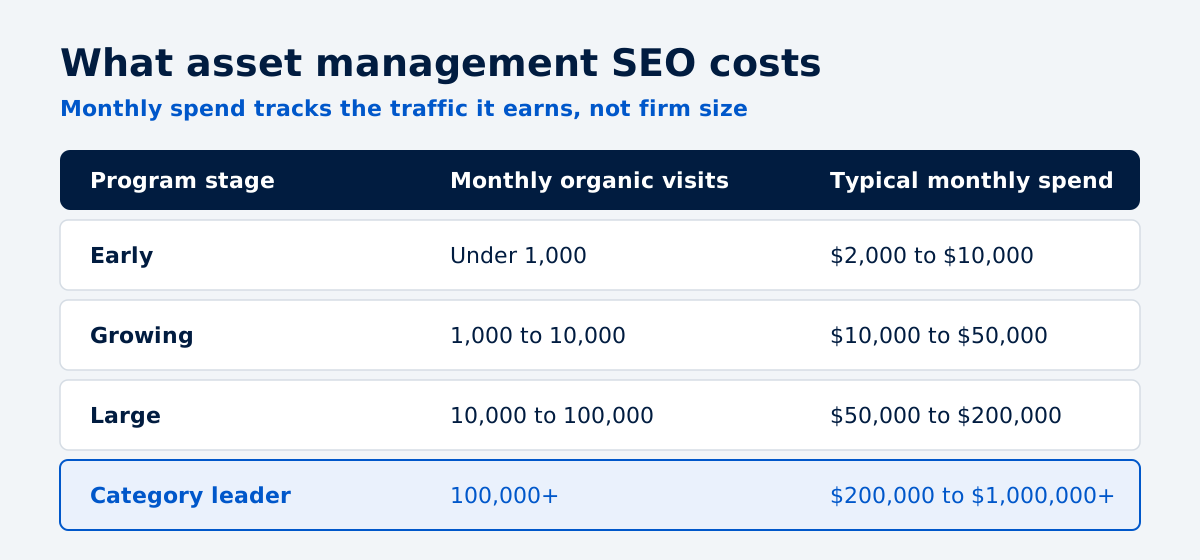
An early-stage firm should expect a modest, steady monthly investment to build foundations, not a one-off project. The category leaders fund content like a core revenue channel because for them it is one. The number that matters is whether the spend ties back to pipeline and AUM, which is the whole point of Fix five.
Turn your content into a search asset that compounds
Read the full State of Content Marketing for Asset Managers 2026 report, or benchmark your own site to see where the value leaks.
Frequently Asked Questions
About the Author

Founder & CEO, Content RevOps
Stefan Kalpachev is the founder and CEO of Content RevOps, where he helps B2B SaaS companies transform their content into predictable pipeline. With a background in content marketing and revenue operations, Stefan has developed a unique methodology that bridges the gap between content creation and revenue generation.
Connect on LinkedInRelated Articles
Video Marketing for Asset Managers: Turn the Input You Already Have Into a Distribution Engine
Oct 24, 2026
Content Marketing Strategies for Asset Management Firms
Oct 23, 2026
The Biggest Content Marketing Mistakes Asset Managers Make
Oct 22, 2026