How do I optimize content for AI Overviews without wrecking the page for human readers?
Getting cited but not converting? We help B2B teams make content the machine can lift and the buyer can't put down.
Book a CallSomeone on the r/copywriting subreddit posted a tidy little guide titled "How writers can optimize their content for AI Overviews." Eight key takeaways. Clear headings. Bullet points. Lead with the answer. Add schema. The works.
The top comment, from an actual copywriter, was four words long:
"This looks and reads like an AI Overview."
That comment is the whole problem in one line. The advice for getting picked up by AI search has gotten so good at describing what a machine wants that, followed literally, it produces content a human can barely stand to read. Front-load every answer. Chop everything into bullets. Slap a TL;DR on top. Add a definition block. Repeat the question as a header. Do all of it, and you end up with a page that ranks fine, gets summarized fine, and bores the one human who actually clicks through into closing the tab.
So the question lands on a lot of desks right now, usually phrased with some anxiety: how do I optimize for AI Overviews without wrecking the page for the people who still read it?
Here is the short version, up front, because that is genuinely good practice for both readers:
The tradeoff is mostly a false binary. What AI extraction rewards and what humans comprehend are, by and large, the same things. The conflict is real in a few narrow spots, and that is exactly where the popular advice does the damage. The fix is to build one page in two layers, not two pages.
We have already argued that you do not need different content for AI search, you need your strong content made extractable. This piece is about doing that without gutting the page. Let's dive in.
The tension is real, but smaller than you think
Start with the reassuring part, because it is the larger part.
Google's AI Overviews are not a separate engine bolted onto search. They run on the same core ranking and quality systems as everything else, and Google AI Overviews are more likely to appear for complex, multi-part searches than for every query. To answer how do ai overviews work, Google synthesizes information from multiple sources with its language models to generate concise summaries, and the feature now appears in over 200 countries and 40+ languages. Google's own guide to optimizing for generative AI features is blunt about it: the features rely on retrieval-augmented generation, which is "rooted in our core Search ranking and quality systems," and the headline instruction is to "apply the same foundational SEO best practices for AI features as you do for Google Search overall."
Read further and the guide gets almost combative about the over-engineering. You do not need an llms.txt file. You do not need to "chunk" your content into tiny pieces. You do not need to rewrite anything in a special machine dialect. But strong technical SEO still matters, because AI systems cannot use pages they cannot crawl or index. This is also the basic context for how ai overviews work in practice: the system still depends on accessible, relevant source pages. The single line that should be taped to every content brief is this one, straight from Google:
"Make pages for your audience, not just for generative AI search."
That is the official position of the company that owns the AI Overview. AI visibility still depends on E-E-A-T and other trust signals that show the page is expert-driven and trustworthy, which is why Google AI is more likely to surface sources it can verify as credible. The thing most likely to get you cited is the same thing that was always going to win: useful, non-commodity content written for a person. So before we talk about conflict, be clear that ninety percent of "AI optimization" is just the content quality bar you were already supposed to be clearing. The two readers want most of the same things.
What the research shows: the two readers and AI overviews mostly agree
This is not just Google being reassuring. It holds up in the actual research, on both sides of the supposed divide.
On the machine side, the foundational study is the Princeton-led GEO paper (Aggarwal et al.), presented at ACM KDD 2024, the first peer-reviewed work on generative engine optimization. It tested nine tactics across thousands of queries and found the moves that lifted a source's visibility in AI answers by up to 40 percent were adding statistics, quotations, and citations from credible sources. Those are not formatting tricks. They are the things that make writing more credible and more useful to a human reader too. In practice, answer engine optimization and ai search optimization are really about optimizing content around user intent, not stuffing in extra terms. Keyword stuffing, the old reflex, actually hurt. By contrast, target long tail keywords—usually three to five words—align better with conversational queries and can surface in ai search results more often than broader terms.
A 2026 follow-up makes the overlap explicit. In "Structural Feature Engineering for Generative Engine Optimization,"Yu, Yang and Ding tested how page structure alone changes citation behavior across six AI engines. Restructuring lifted citation rates by 17.3 percent. Here is the part that matters for our question: the same changes also raised human-judged "perceptual quality" by 18.5 percent. Both numbers moved up together. Structured content and question-based headings also help large language models identify direct answers and entity relationships, which matters for ai overview selection. The catch is that the method only worked because it ran under an explicit "semantic preservation" constraint, keeping meaning intact (verified at a similarity of 0.843). Optimize the structure while protecting the meaning and both readers win. Strip the meaning out and you are left with a skeleton.
On the human side, the reading-comprehension literature has said the same thing for decades. A meta-analysis by Hébert, Bohaty and Nelson in the Journal of Educational Psychology (45 studies) found that clear text structure measurably improves comprehension. Headings, logical organization, signposting: these help people understand and recall, which is precisely why a model can parse them too. Clear organization also helps match search intent, while authoritative content gives systems something better to cite than recycled consensus, and AI models tend to prefer original insights over that kind of repetition. Structure is not the enemy of good writing. It is good writing.
So the honest framing is not "AI versus humans." It is that the same clear, evidence-backed, well-organized content tends to please both. Which raises the real question: if that is true, where does the wrecking actually happen?
Where it actually goes wrong: the narrow conflict zone
The damage is not caused by structure. It is caused by useful structured content turning into overdone ai overview optimization, applied without judgment, until the page stops being writing and becomes a form.
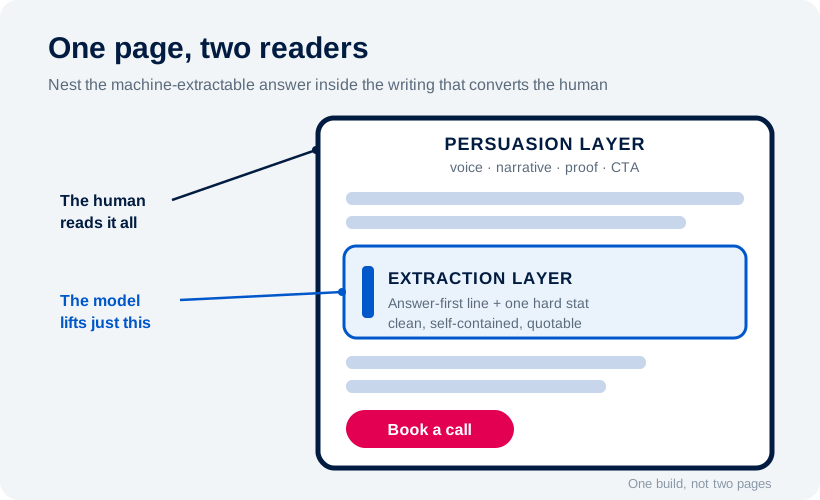
There is a clean finding hiding in that same reading-comprehension research. The Hébert meta-analysis, and a second one by Pyle and colleagues in Reading Research Quarterly (mean effect size .95), both found that comprehension gains were strongest when readers learned one or two text structures, not many. Pile on every organizational device at once and the returns flatten. The page gets harder to follow, not easier. More structure is not linearly better, for humans or for the models trained on what humans wrote.
Here is where the popular AI advice tips a good page over that edge:
Answer-first on everything. Leading with the answer under a heading is a fine technique. The Inverted Pyramid method works well at the section level. Applying it to every paragraph kills momentum. Narrative, tension, and the build-up that makes a reader care all depend on not giving away the ending in line one, every single time.
Bullet and TL;DR overload. Bullets are great for genuine lists. They are terrible at carrying an argument, nuance, or a point of view. A page that is all bullets has no connective tissue, which is to say no thinking, and high-density formatting helps only when it improves readability for humans and AI instead of replacing flow.
Voiceless definition blocks. "What is X? X is..." sections get cited, so people write nothing else. The result reads like a glossary that learned to talk.
Over-fragmentation. The instinct to "chunk" everything into tiny standalone pieces is the one Google explicitly told you to ignore, and it shreds the reading experience for a problem that, as we are about to see, mostly does not exist. Chasing ai generated summaries for ai powered search should not leave the page worse for people scanning traditional search results or for visitors arriving from traditional search.
The practitioners feel it before they can name it. Look at how people actually answer "how do I optimize for AI Overviews" in the r/SEO threads: "Short and clear answers. Small paragraphs. Links to sources and citations." Broken links or outdated references can weaken credibility and make a page less likely to be cited. Sensible enough, taken one at a time. Taken as a total style guide, applied to every page, it is a recipe for the exact thing that copywriter was mocking. The advice is not wrong. The maximalism is.
And here is the first-party evidence that the maximalism is also unnecessary. We ran 800 B2B marketing questions through Perplexity and analyzed 5,761 AI citations across nearly 5,000 pages. When the model used a page, it cited the page as a whole, rather than lifting one isolated section, 71.8 percent of the time. Bullet points appeared on only 51.8 percent of cited pages. Original data showed up on 47.1 percent. In other words, the model is mostly reading and citing the whole, coherent page, and barely half of what it cites is even built on bullets. The page as a complete piece of writing still matters. Fragmenting it into disconnected, liftable shards is solving a problem the data does not show you have.
Why the human who lands matters more than ever
There is a second reason not to gut the page, and it is the one most "GEO" advice forgets entirely: the human who makes it through to your site is now rarer and more valuable than they have ever been.
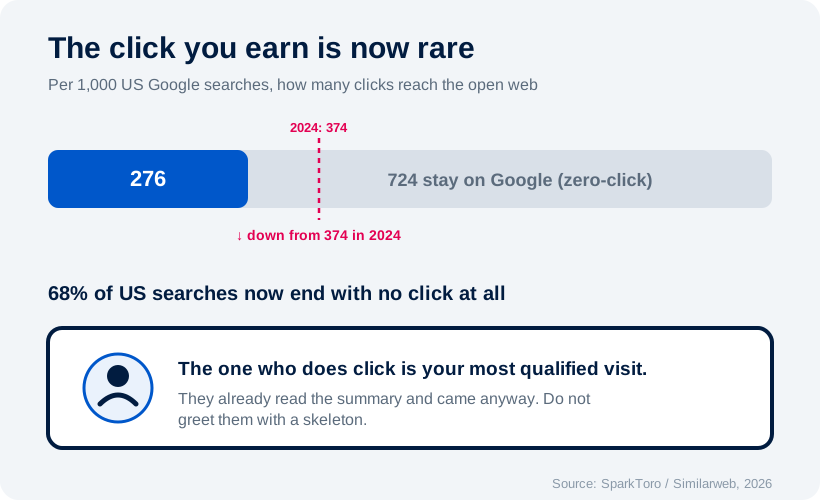
The click is getting scarcer. In google search results, AI summaries and featured snippets often appear before traditional listings. AI Overviews appeared in 48% of tracked queries by March 2026. SparkToro's analysis of Similarweb clickstream data found that in early 2026, 68 percent of US Google searches ended without a click to the open web. Nearly 60% of Google searches on mobile now end without a click. For every 1,000 searches, only about 276 clicks now reach a website, down from 374 two years earlier. Pew Research measured the mechanism directly: when an AI Overview is present, the share of users who click a traditional result roughly halves, from 15 percent to 8 percent. AI generated responses help users find answers faster by summarizing information directly in results, which is why pressure on organic traffic keeps rising.
Most teams read that as a reason to chase the citation and stop caring about the click, and many website owners now worry about losing visibility as an ai generated answer box absorbs more attention. That is backwards. When fewer, more motivated people reach your page, each one is worth more, not less. They have already read the AI summary. They clicked anyway. That means they want depth, proof, a point of view, or a reason to trust you that a three-sentence overview could not give them. Greet that person with a wall of bullet points and a restated definition, and you have wasted the most qualified visit you are going to get that day.
This is not theoretical. We see it in the conversion data, and frankly in our own client work. As I put it on a recent strategy call, AI-era traffic "might be lower volume than traditional SEO, but it converts much better. That is one of the universal facts." One client closed their fastest deal ever from a single resource download: someone grabbed a guide on a Wednesday and signed by Friday. That does not happen if the page is a skeleton. It happens because the page did the human job, persuading, after the machine job, getting found. No wonder 90% of businesses worry about decreasing online visibility due to AI.
And here is the kicker from our citation study: 85 percent of AI-cited pages did carry a call to action, an average of 2.6 per page, but their intent alignment was usually poor, and only 8.8 percent used a contextual in-line CTA. So the pages winning citations are, by and large, neglecting the conversion of the human who arrives. That is the gap. Because content appears in search results differently now, the human visit matters more than ever. Not "do we get cited." It is "do we do anything useful with the person the citation sends us."
The fix: one page, two readers, and how to optimize for ai overviews
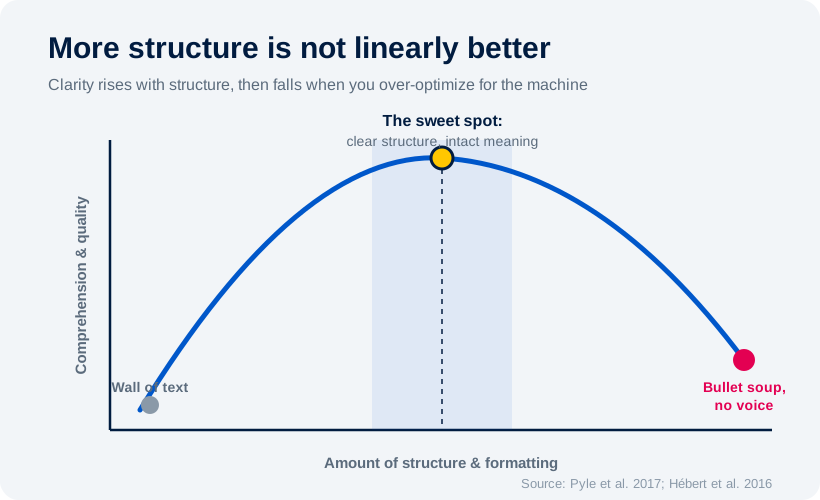
The move is not two pages, one for the bot and one for the human. It is one page built in two layers, with the machine-friendly layer nested inside the human one so that neither cannibalizes the other.
Think of it as an extraction layer living inside a persuasion layer.
The extraction layer is everything a model can cleanly lift: a direct answer near the top of a section, a tight definition, a hard statistic, a genuine list where the content really is a list, a quotable sentence with a number in it. This is what gets you cited, and the Princeton GEO data says the highest-leverage version of it is substance (stats, quotes, citations), not formatting. SE Ranking found that clear definition sections and key-takeaway blocks earn citations reliably. So give the model those handholds, deliberately. Conversational, question-based phrasing also helps with voice search by matching how people speak to AI assistants. To implement structured data, use schema markup so search engines and ai search engines can categorize what is on the web page, and use Google Search Console to monitor which long-tail queries and AI-facing pages are actually gaining visibility.
The persuasion layer is everything that makes the human stay: the narrative that frames why the answer matters, the voice that signals a real person with real experience wrote this, the proof and examples, with backlinks from relevant sitesacting as trust signals that support credibility, the counter-argument you take seriously, and the call to action that fits where the reader actually is. This is the layer the citation studies show is being neglected, and it is the layer that turns a rare, qualified click into a pipeline. User experience is a ranking factor here, and relevant images matter too because AI Overviews can pull visual assets as well as text.
The trick is that a single sentence can serve both. Keep creating content in ways that stay current, because blog posts should be reviewed every 3-6 months and AI visibility depends on fresh content. "AI Overviews cut click-through on affected queries roughly in half, from 15 percent to 8 percent" is a clean, liftable, machine-friendly stat. It is also a strong, specific opening line that earns a human's attention. You did not choose between the readers. You wrote one good sentence.
A few patterns that hold the two layers together without tearing the page:
Answer first, then earn it. Open a section with the direct answer for the skimmer and the model, matched to the user's query, because question-based subheads help AI-generated summaries cite direct answers, then immediately give the human a reason the answer is true, a story, or a wrinkle the summary missed. The answer is the doorway, not the whole room.
Make the TL;DR add value, not replace it. A summary that genuinely frames the piece is useful to everyone. A summary that contains the entire payload tells the human there is no reason to read on, and you taught them that yourself.
Lead with substance, not just format. Per the research, one real statistic or named source does more for citation than three more bullet points, and it is far better for the reader. When you are tempted to add structure, add evidence instead, using structured data, relevant images with descriptive alt text and captions, and internal linking where useful as support rather than decoration.
Protect the through-line. This is the "semantic preservation" constraint from the structural-GEO study, applied by hand. After every optimization pass, read the section straight through. If the meaning, the argument, or the voice got thinner, you optimized too hard. Put it back. Technical seo still matters underneath the prose, including lightweight pages that rely less on heavy JavaScript because static HTML is easier for LLMs to parse.
That last habit is the whole discipline. Optimize the structure, protect the meaning, and you are doing exactly what the research found works for both readers at once. You are not picking a side. You are refusing the false choice that wrecked that copywriter's example in the first place. It all belongs inside a broader seo strategy for ai mode across search engines, not just traditional search engines.
Are your cited pages actually converting the humans they bring in?
Content RevOps builds pages that earn the AI citation and the click behind it, optimized for extraction without losing the voice that closes.
Frequently Asked Questions
About the Author

Founder & CEO, Content RevOps
Stefan Kalpachev is the founder and CEO of Content RevOps, where he helps B2B SaaS companies transform their content into predictable pipeline. With a background in content marketing and revenue operations, Stefan has developed a unique methodology that bridges the gap between content creation and revenue generation.
Connect on LinkedIn