What Does a Content Marketing Consultant Do?
Want content that actually moves pipeline? Let’s build the operating model behind it.
Book a CallMost B2B professional services firms and SaaS SMBs are already producing content: blogs, webinars, one-pagers, LinkedIn posts, the occasional “big” PDF. Yet the pipeline barely moves, sales teams keep asking for custom decks, and leadership starts treating content as a cost center or a creative chore.
That disconnect usually isn’t because you “don’t have enough content.” It’s because content is operating without an operating model. Ideas show up reactively, priorities shift by whoever shouts loudest, approvals drag, and finished assets don’t get reused, mirroring the pattern where 60–90% of marketing-created content is never used by sales or customer success (MarketingProfs). The result is a growing library that looks busy but doesn’t reliably create buyer confidence or revenue impact, even though buyers increasingly expect well-organized, problem-focused content experiences across channels (Moz on content strategy).
A content marketing consultant fixes this by professionalizing content the way you’d professionalize sales ops or revops: turning it into a repeatable business function. Their job is to build the process, roles, systems, and measurement that make content behave like infrastructure, educating buyers, supporting sales conversations, and compounding in value over time, in line with what leading B2B programs describe as becoming the trusted “best answer” in the market (TopRank Marketing). That includes putting real content governance in place so brand voice, standards, and workflows scale instead of devolving into chaos (Content Marketing Institute), and resetting how existing assets are audited, maintained, and retired so teams are not constantly reinventing the wheel (CMI on resetting content programs).
In this article, we’ll break down what a consultant does through four connected lenses, an approach that reflects how mature B2B organizations move from “doing content” to running a true content operation (The Content Strategist):
Content as a process
Content as an internal function
Content as a system
Content as a business function
1. Content as a Process: From Random Acts to a Repeatable Workflow
A content marketing consultant’s first job is rarely “make more content.” It’s to make content happen on purpose (reliably, with less friction) so it functions like an internal operating process instead of a series of one-off requests, much like how mature teams treat sales or revenue operations.
1.1 How content usually happens today
In most B2B professional services firms and SaaS SMBs, content is reactive. A launch pops up, a rep needs a deck for a deal, an executive wants a post about an event, and marketing scrambles to comply. Priorities shift week to week based on the loudest request, the nearest deadline, or the most senior stakeholder. That is exactly the pattern seen in organizations that lack a defined content strategy and buyer journey.
The workflow is usually unclear, too. Reviews and approvals drift. SME feedback arrives late (or changes the angle entirely). Design becomes a bottleneck because nobody knows what’s “urgent” versus what’s just noisy. After publishing, the asset often disappears into a growing library that’s hard to search and harder to reuse, mirroring the “create → publish → ignore” cycle and asset sprawl described in recent content operations research.
Common consequences:
Missed deadlines and last-minute fire drills
Duplicated work and inconsistent quality
A “create → publish → ignore” loop where performance rarely improves
Lots of activity, but unclear impact on pipeline
Under the surface, this also shows up as time waste: teams routinely lose hours each week hunting for existing decks, PDFs, and images instead of creating new value, a pattern backed up by studies on inefficient digital content workflows.
1.2 What a content marketing consultant actually does with your process
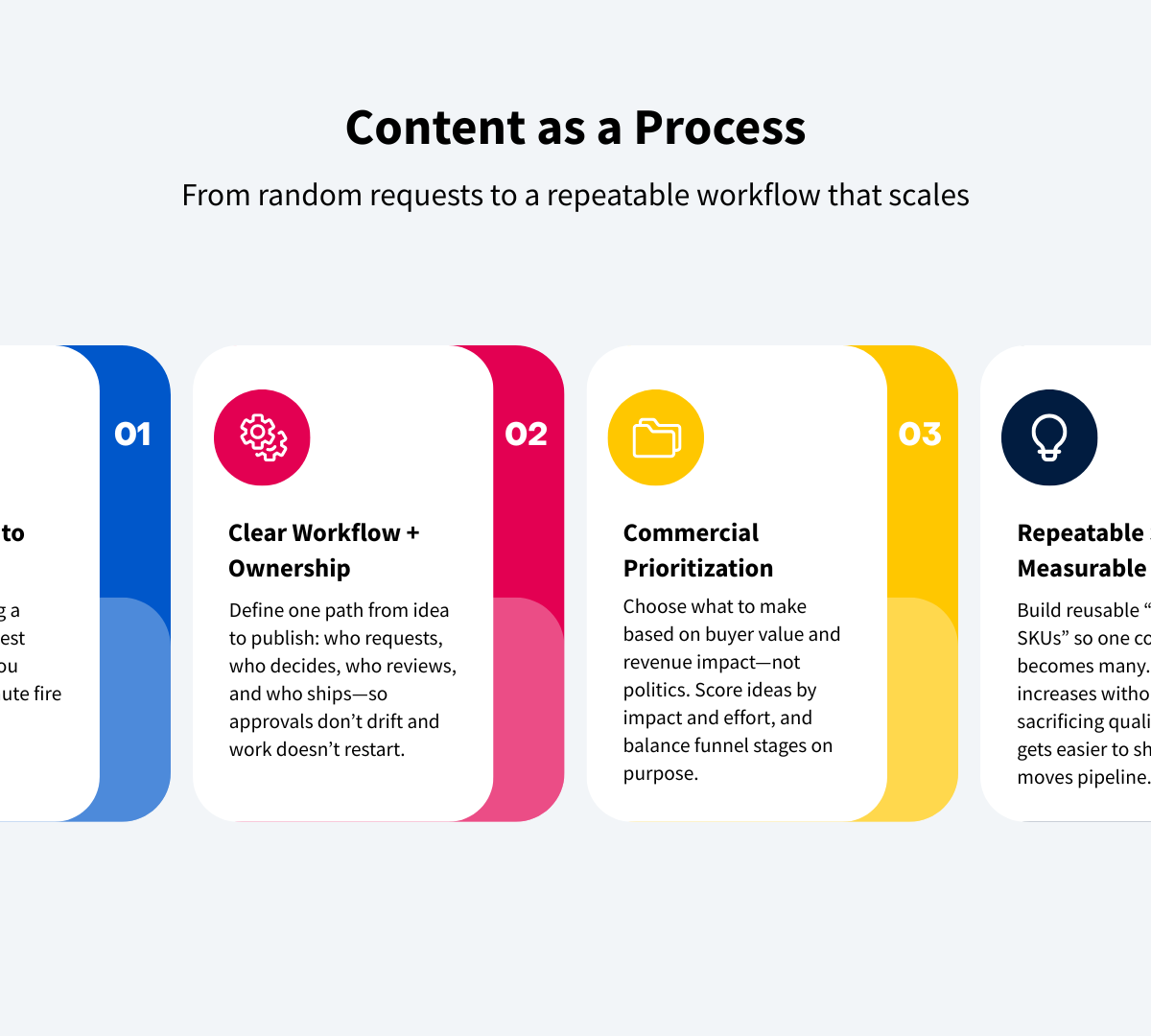
A consultant starts with a content operations audit, mapping how work really moves through the organization. That means tracing the full path from idea to measurable outcome, and flagging the “effort leaks” where work gets stuck, watered down, or restarted. This mirrors the process mapping, workflow audits, and governance work advocated in content strategy and SEO frameworks, but adapted to your specific tech stack and team.
Then they install lightweight governance and cadence so content becomes repeatable:
Intake + briefs: one request path, standardized inputs, comparable requests
Clear roles: who requests, who decides, who reviews, who executes (no guessing)
Planning rhythms: quarterly roadmap, monthly prioritization, weekly status checks
Those elements line up with what experienced practitioners define as core content operations basics: documented workflows, ownership, and templates that keep quality high even as volume and channels increase.
1.3 Making prioritization commercial, not political
Instead of “what should we post next,” the consultant shifts decision-making to “what will do real work for buyers and revenue.” Ideas get scored by buyer value, proximity to revenue, and effort, so the team balances awareness content with consideration and decision-stage assets that sales can actually use. This kind of scoring reflects research showing buyers want content organized around problems and outcomes, not formats, and that companies with structured, buyer-led content planning tend to see stronger pipeline impact.
They also design content as a pipeline, not a one-off. That often means defining repeatable “content SKUs” (standard asset patterns) and planning derivative assets upfront, so one webinar can become clips, articles, sales snippets, and nurture touches without re-inventing the wheel. This portfolio approach aligns with modern guidance on building multi-use, systematized content programs that are durable across channels and search changes, rather than chasing single-hit campaigns.
1.4 The outcome of process work
The end result is a documented workflow that increases throughput without sacrificing quality and doesn’t depend on heroic individuals or frantic freelancers. Content becomes proactive, trackable, and easier to scale because the business finally has an operating model for producing and reusing it.
Over time, that operating model reduces wasted effort, improves consistency, and makes it far easier to prove how content contributes to opportunities and revenue, exactly the kind of maturity jump highlighted in benchmarks comparing ad hoc content efforts to full-fledged content operations.
2. Content as an Internal Function: Aligning Marketing, Sales, and Leadership
2.1 Why content often feels isolated
In many B2B professional services firms and SaaS SMBs, content sits in a strange place: everyone wants it, but few people feel responsible for making it effective. Leadership may treat content as brand decoration or a visibility play. Sales may see it as “nice-to-have” collateral that rarely matches real buyer conversations. Marketing ends up stuck producing assets on demand, without clear direction, input, or internal adoption.
The practical result is predictable: content gets published, then disappears. It is not consistently used in calls, proposals, onboarding, or customer success, even though 60–90% of marketing-created content often goes unused by sales and CS in many organizations. Meanwhile, some of the most persuasive material in the business (customer wins, objections, competitive context) lives in reps’ heads and Slack threads instead of reusable assets, echoing broader findings that teams lose weeks each year just searching for or recreating content they cannot find.
2.2 How a consultant aligns teams around purpose and ownership
A content marketing consultant shifts content from “marketing output” to a shared internal capability. They facilitate cross-functional sessions to align on what content is for and how it should support growth, not just awareness, often mirroring the kind of governance and charter work advocated in modern content operations frameworks.
Key alignment decisions typically include:
Purpose: shorten sales cycles, qualify demand, build trust, support renewals and expansion (objectives that research consistently links to effective B2B content programs rather than vanity metrics alone)
Ownership: who provides inputs, who approves, who maintains, and who uses content in the field, so content stops being a “side job” for SMEs and becomes a defined responsibility within the revenue engine
Definition of content: beyond blogs to include talk tracks, FAQs, objection handling, implementation guides, and proof assets, aligned with the idea that content should form a pathway of assets across the buyer journey, not isolated pieces
This is change management as much as it is marketing: content becomes an enablement layer the business can rely on, supported by clear standards for voice, quality, and reuse similar to the governance models used by mature B2B content teams.
2.3 Operationalizing sales and customer enablement
Once alignment is in place, the consultant turns “content” into tools people will actually use. That often means converting cornerstone ideas into sales-ready formats and mapping them to stages, objections, and roles so reps do not have to guess, an approach that reflects how leading B2B brands structure sales enablement and “Best Answer” assets around real buyer questions.
Common outputs include:
sales kits (one-pagers, deck slides, email snippets, proposal language)
objection handlers and competitive talking points
onboarding content for new reps and CSMs
They also systematize customer stories with a repeatable way to identify candidates, capture outcomes, secure approvals, and produce variations by industry or persona. This elevates case studies from “nice proof points” to core commercial content, in line with research that positions customer stories as the single most important content type for B2B decision-making.
2.4 Building a sustainable contributor ecosystem
To scale without burning out SMEs, a consultant designs lightweight contribution models: short interviews, async Q&A, and quick reviews instead of asking experts to draft full posts. They add simple voice and messaging guidelines so content stays consistent, and define how AI and freelancers can support production without diluting expertise, following emerging best practices for using AI inside structured content workflows.
2.5 The outcome of function work
When content becomes an internal function, it stops being a side project and starts doing real work:
Clear purpose and accountability across marketing, sales, CS, and leadership
Higher adoption: content shows up in decks, demos, onboarding, and QBRs, supported by findable, tagged assets instead of ad-hoc files scattered across drives
Stronger revenue alignment: content is trusted, usable, and tied to real pipeline goals, making it easier to measure its role in opportunity creation, deal velocity, and retention rather than just impressions or clicks
3. Content as a System: Connecting Tools, Data, and Automation
3.1 The hidden system problems behind “we just need more content”
When a team says they need more content, the real issue is often that content isn’t behaving like a go-to-market system. It’s scattered, hard to measure, and disconnected from the moments where revenue teams actually need it.
Common failure points look like this:
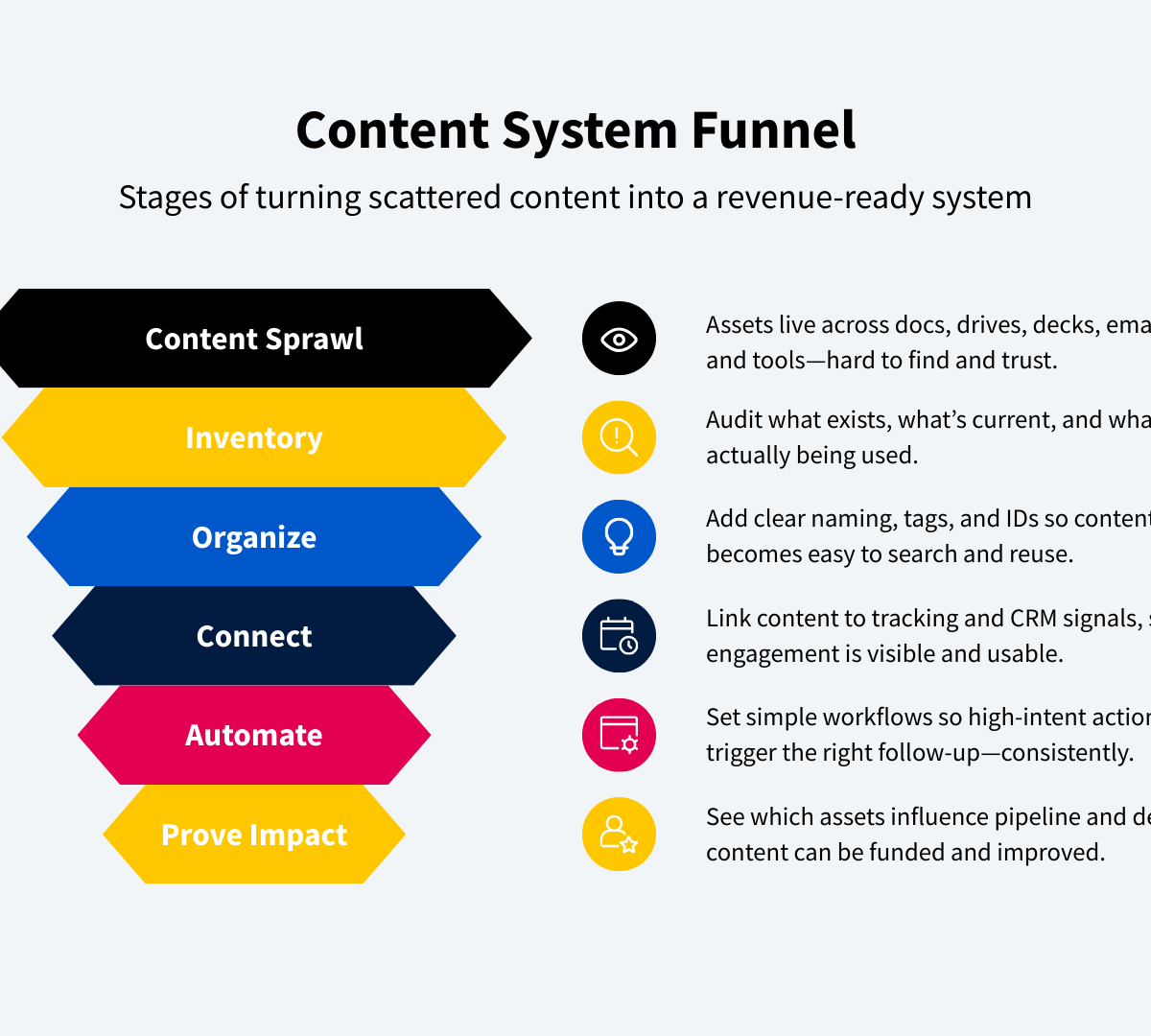
Assets spread across drives, docs, email threads, CMS pages, and slide decks with no single source of truth
Little visibility into what happens after someone reads, watches, or downloads
Manual, inconsistent follow-up from marketing to sales (or none at all)
Ad hoc AI usage that increases volume but creates uneven quality and more editing overhead
The impact is predictable: reps can’t find (or trust) the latest version, and leadership can’t connect content to pipeline, sales velocity, or deal quality. In many organizations, this leads to the pattern where 60–90% of marketing-created content is never used by sales or customer success, and teams keep publishing while confidence drops.
3.2 How a consultant architects the content stack
A content marketing consultant steps in like an operator: they audit the current stack, reduce tool sprawl, and make content findable and trackable across systems. That usually includes reviewing how the CMS, CRM, marketing automation, storage/DAM, sales enablement tools, and analytics actually connect in practice, rather than living as disconnected dashboards.
They also introduce taxonomy and metadata so content stops being “a pile of files” and becomes an addressable library. Typical tagging includes:
Buyer problem and use case
Industry and persona
Journey stage and sales stage alignment
Product area and key narrative
Consistent naming conventions and content IDs reduce version confusion and make reporting possible. Teams that pair this kind of taxonomy with a proper digital asset management approach tend to report significantly fewer issues producing and maintaining content and waste fewer hours each week just trying to locate the right asset.
3.3 Wiring content into demand gen and sales signals
The consultant then connects content to demand generation so it drives action, not just attention. This includes standardizing UTMs and forms, and ensuring engagement becomes a usable CRM signal tied to contacts, accounts, and opportunities. Done well, content stops being isolated assets and starts acting like a structured pathway that tells a coherent story about buyer and customer value across the funnel.
They define intent-based workflows, such as: repeated engagement with high-intent topics triggers alerts, sequences, or targeted nurture. This is where content metrics move beyond basic consumption to include signals like lead generation and sales influence, so high-value assets can be ranked by how often they appear in real buying journeys.
The goal is simple: content becomes part of the revenue motion, not parallel to it.
3.4 Using AI and automation with guardrails
AI helps most when it’s integrated into the workflow, not used randomly. Consultants typically focus AI on low-risk, high-leverage tasks (research support, summaries, outlines, repurposing, QA checks) while keeping humans responsible for insight, narrative, and domain accuracy. This aligns with a broader shift from “more content” to sustainable, audience-driven content programs where AI reinforces a documented strategy instead of driving it.
They also formalize guardrails: prompt standards, fact-checking, review steps, and access controls so quality and IP don’t degrade as production speeds up. Clear guidance on when AI is appropriate, how it should reflect brand voice, and how outputs are validated turns AI from a source of random noise into a governed part of the content operating model.
3.5 The outcome of system work
You end up with a documented flow of how content moves through your stack, fewer manual bottlenecks, faster reuse, and clearer visibility into which assets influence pipeline, so content can be funded and managed like any other go-to-market system. Internally, content starts to function more like a productized capability: governed, measurable, and integrated with RevOps and sales operations, rather than a loose collection of campaigns.
4. Content as a Business Function: Turning Assets into a Revenue Engine
A content marketing consultant makes content operate like RevOps or Sales Ops: with a clear purpose, repeatable outputs, and measurement leadership can trust. The goal isn’t “more content.” It’s content that reliably does business work before, during, and after the sales conversation.
4.1 Moving beyond vanity metrics
Traditional reporting creates false confidence. Pageviews, impressions, and downloads can rise while pipeline stays flat, because those numbers don’t show whether content changed a buying decision. Industry studies routinely show that a large share of marketing-created content is never used by sales, and that most thought leadership fails to influence buyers’ decisions in any meaningful way, even when surface metrics look healthy.
A consultant shifts the scorecard toward revenue-facing outcomes that matter in B2B services and SaaS SMBs, aligning with how leading content programs connect content to pipeline, sales velocity, and deal quality:
Lead quality (better-fit inquiries, fewer “not a match” calls)
Sales cycle length (fewer loops, faster consensus)
Win rate and deal size (stronger conviction and value framing)
Expansion and retention (customers adopting more, churning less)
Cost-to-serve (fewer repetitive explanations, fewer custom decks)
4.2 Defining the commercial logic of your content
Content becomes a business function when it has an explicit job to do. A consultant helps your team decide which growth motions content should support (such as self-serve education, outbound enablement, onboarding, or customer adoption) and where it should remove friction.
That friction is usually predictable: unclear scope, high perceived risk, multiple stakeholders, and complex change. The consultant aligns the roadmap to the go-to-market plan so content coverage matches priorities (segments, verticals, launches, and ABM lists) and spans the full journey, including post-sale. This mirrors how mature content strategies are built around buyer value pathways rather than isolated assets, and how high-performing teams map content to specific buyer pains and decision criteria instead of just formats or channels.
4.3 Treating content like a product (or product extension)
Instead of one-off assets, a consultant helps build content products: durable resources that feel like part of the offering. Examples include education hubs, benchmark-style guides, calculators, and structured use-case libraries that help buyers self-diagnose and move forward with confidence. These kinds of multi-use, “hero” assets are increasingly treated as product extensions in advanced B2B programs, designed to support evaluation, adoption, and ongoing value realization, not just acquisition.
They also design for lifetime value: refresh paths, localization, and intentional reuse (turning one flagship asset into webinars, playbooks, sales talk tracks, and onboarding materials). This reflects best practice in content operations, where teams focus on repurposing and updating high-performing assets to extend their commercial impact rather than constantly starting from scratch.
4.4 Reporting like an operations function
A consultant sets up dashboards that connect content to the realities of revenue work: influenced opportunities, stage progression, and outcomes. Just as important, they establish a feedback loop with sales and customer success to improve, retire, or refresh content based on what actually moves deals. In more mature setups, content is treated as a data-emitting product inside the RevOps stack, tracked for usage, impact on opportunity creation, and presence in closed-won journeys, not just traffic or rankings.
4.5 The outcome of function work
Content stops being a discretionary marketing expense and becomes decision infrastructure: a compounding asset that supports pipeline, velocity, and customer value, sitting alongside RevOps and Sales Ops as part of a coherent go-to-market system. Organizations that make this shift tend to report fewer issues producing and maintaining content, stronger visibility into which assets drive revenue outcomes, and a clearer case for continued investment in content as a governed, measurable business function.
Conclusion: Why This Model of Consulting Matters for Growing B2B Companies
A content marketing consultant’s real work is not producing more assets. It’s building the operating model that lets content behave like infrastructure. When content is designed as a process, an internal function, a system, and a business function, it stops being noise and starts compounding: quietly, continuously, and with far less friction. This shift mirrors how mature teams treat content as part of a broader, revenue-linked content strategy rather than isolated campaigns.
That matters in B2B professional services and SaaS SMBs because you rarely win on volume. With limited headcount and budget, you win on leverage: clear priorities, tight workflows, and content that gets used in real revenue moments. In markets where most companies “do content” but lack a coherent strategy, the ability to operationalize content as a discipline becomes a competitive advantage. And in long, complex sales cycles, content must do more than generate awareness; it must educate stakeholders, reduce perceived risk, and support decisions across the entire journey, especially when 60–90% of marketing-created content typically goes unused by sales.
Our Content RevOps approach applies the same principles that make RevOps effective (documented process, connected systems, and accountable metrics) to content. That includes the kind of governance and standards associated with content operations, not just editorial planning. In practice, that means:
A repeatable workflow instead of reactive requests, reducing the “content admin” time that often consumes weeks of marketer capacity each year
Cross-functional ownership so sales and customer success actually use the content, backed by shared definitions of what content is for and how it supports revenue
Instrumentation that ties consumption to pipeline signals and outcomes, treating content as a data-emitting asset inside your CRM and marketing automation stack
Measurement that reflects revenue impact, not just traffic, including influence on opportunities, deal velocity, and win rates
With the right partner, content becomes a reliable business capability, an operating layer that advances pipeline long after individual campaigns end and that can be managed with the same rigor as other core go-to-market systems. Choosing that partner is its own piece of work, and for firms that sell expertise rather than a product we kept 14 agencies out of 98 with real professional services depth. Law firms, where the expertise sits with a small group of partners, get their own list of demand generation agencies for law firms.
Is your content doing revenue work—or just filling a calendar?
Turn content into Content RevOps: a governed, measurable GTM system that shortens sales cycles, qualifies demand, and compounds over time.
Frequently Asked Questions
About the Author

Founder & CEO, Content RevOps
Stefan Kalpachev is the founder and CEO of Content RevOps, where he helps B2B SaaS companies transform their content into predictable pipeline. With a background in content marketing and revenue operations, Stefan has developed a unique methodology that bridges the gap between content creation and revenue generation.
Connect on LinkedIn