Thought Leadership for Asset Managers
Not sure whether your firm publishes real thought leadership or just commentary? A content revenue audit shows you where you stand against the field.
Book a CallThought leadership for asset managers is content that takes a defensible point of view on something investors care about, backs it with evidence, and puts a named expert behind it. It is not a press release, and it is not another recap of last week's inflation print.
Part of Content Marketing for Asset Managers: The 2026 Playbook.
Here is the gap that should interest you. Institutional investors say thought leadership directly shapes which manager they pick. In a 2025 CoreData Research survey of 154 institutions overseeing $4.9 trillion, 59% said it does. Yet across the sector, real thought leadership is almost absent. In our review of 1,628 asset management firms, only 5.8% of the content firms publish is thought leadership at all.
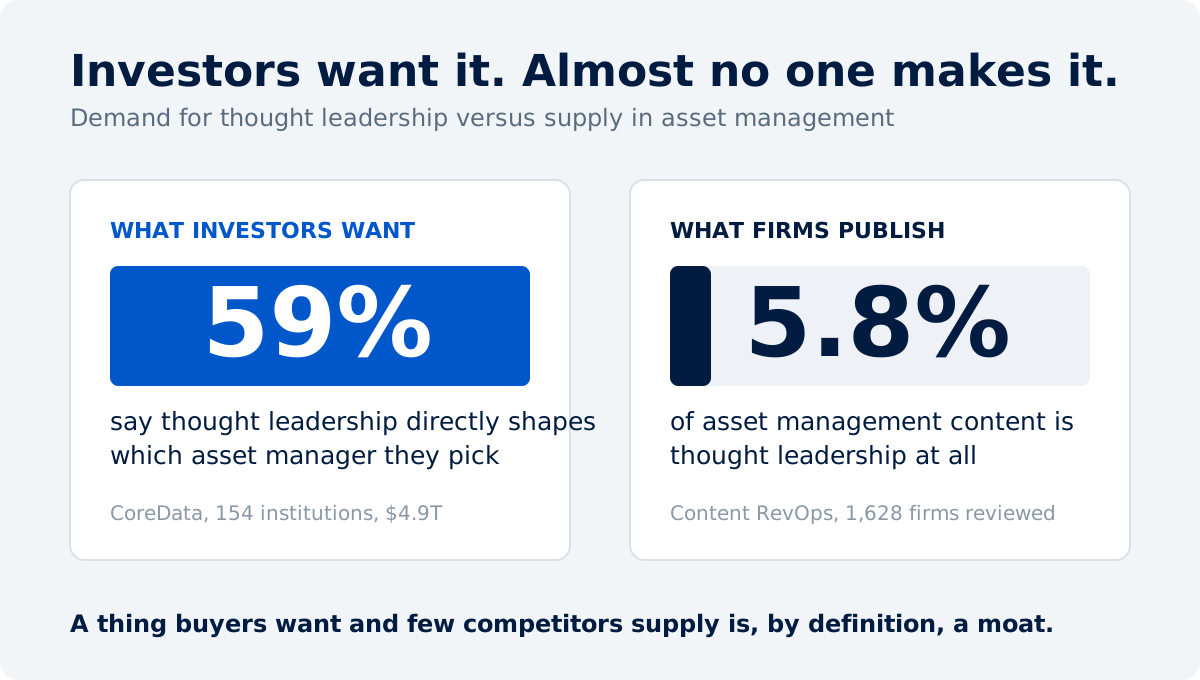
That mismatch, high demand and thin supply, is the whole opportunity. This guide covers what real thought leadership for asset managers looks like, why so little of it exists, whether it actually wins mandates, why its scarcity is a moat, and how to build the engine that produces it.
What is thought leadership for asset managers, and what is it not?
Thought leadership for asset managers is a clear, defensible position on a question that matters to investors, supported by proprietary evidence and attached to a named expert. The test is simple. Does the reader finish it understanding something they did not understand before, and could they tell which firm wrote it with the logo covered?
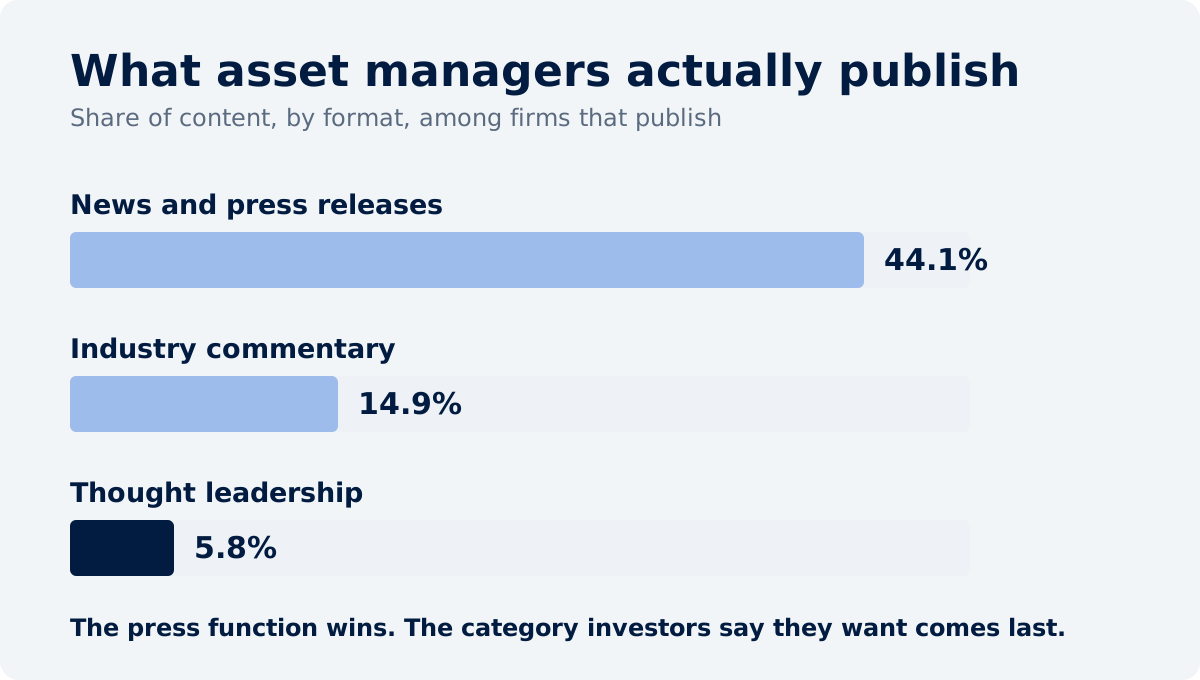
Most asset management content fails that test, because most of it is not trying to pass it. Nearly half of all content firms publish, 44.1%, is news and press releases. That is publishing as a press function, announcements about the firm, not ideas for the investor.
Another 14.9% is market commentary. Commentary is common; a differentiated point of view is not. Reacting to the latest data is not the same as taking a position on what it means and why you see it differently.
So the line is this. Commentary explains or reacts to what happened. Thought leadership adds something, a trend others are missing, an assumption worth challenging, or a reason your team reads the same data differently. CoreData's head of research in the U.S., Michael Morley, put the failure mode plainly in Chief Investment Officer's coverage of the survey: managers go astray "publishing 'me too' content that doesn't add anything new to the discourse, failing to provide clear evidence or actionable investment implications."
Why is real thought leadership so rare in asset management?
Real thought leadership is rare because the sector publishes a lot of content and almost none of it is built to carry a point of view.
Start with the shape of what firms put out. Of the 1,628 asset management firms we reviewed, 657 publish anything with real content on it at all. Inside that output, the mix tells the story:
The press function wins by a wide margin. The category investors say they want comes last.
The deeper reason sits one level up. Only about 1 in 28 asset management firms runs content as a system; the rest is brochure or noise. Thought leadership is hard to produce by accident. It needs a chosen position, evidence to stand on, and a named person willing to own it. When content is an afterthought bolted onto the communications calendar, you get announcements and recaps, because those are the things a firm can produce without deciding what it actually believes.
There is a second trap. A lot of firms treat a repackaged macro outlook, rates, inflation, and earnings, as their thought leadership. It reads like substance. But when every manager publishes the same quarterly view of the same economy, that content is part of the sameness problem. It is the floor every manager already clears.
Does thought leadership actually win mandates for asset managers?
Yes, and the demand data is not subtle. The clearest read comes from CoreData Research's 2025 survey of 132 institutional investors and 22 consultants, together overseeing more than $4.9 trillion, 90% of whom evaluate and select managers directly or oversee that process.
Three numbers carry it:
- 59% said their likelihood of investing with one manager over another is directly influenced by the thought leadership managers put out.
- 99% said asset managers' thought leadership influences their investment decisions, and 48% said it has challenged how they think about strategic asset allocation.
- 23% said thought leadership led them to a firm they had never heard of before.
For a firm trying to get on the radar of an institution that has never heard its name, thought leadership is one of the few things that opens the door before any pitch happens. CoreData also found that 82% of investors said strong thought leadership drove them to engage more with a manager, so the content also pulls the reader closer.
Morley's summary was that thought leadership is "a core part of the asset manager evaluation process, exerting even more influence than many realize." The buyers are telling you the content decides things. Most firms are not acting as if that were true.
Why does scarcity make thought leadership a moat for asset managers?
Put the two sides together and the move is obvious. Demand is overwhelming, supply is 5.8%, and genuine thought leadership is scarce, which is exactly why it is a moat. A thing buyers want and almost no competitor supplies is, by definition, an advantage.
Scarcity is only half of it. The other half is that the lead compounds. More than half of institutional investors, 56%, actively look back to see which managers were most accurate in their past insights and predictions. A point of view you have held and been right about for three years is something a new entrant cannot buy or copy this quarter. Sondhelm Partners, which advises boutique managers, makes the same point about boutiques specifically: once you are established as the voice on a topic, "competitors must work twice as hard to displace you."
The scarcity is sharper than the raw 5.8% suggests, because even the content that exists mostly is not good. In the 2024 Edelman-LinkedIn B2B Thought Leadership Impact Report, a survey of roughly 3,500 business decision-makers across seven countries, only 15% rated the thought leadership they read as very good or excellent. Most of it, even outside asset management, is noise. So the real competition for a genuinely good, genuinely distinct point of view is thinner still.
There is a timing reason too. AI answer engines now sit between investors and the open web, and they lean on a handful of names. In asset management, AI answers concentrate on five giants, Vanguard, BlackRock, Fidelity, State Street, and J.P. Morgan Asset Management; the citation race below them is wide open. The firm that becomes the clear authority on a narrow question now is the firm those engines start quoting.
CoreData's own framing for all of this is blunt. Thought leadership "rarely clinches a deal but helps keep brands on the shortlist," as one CIO in its study put it. It is, in CoreData's words, no longer optional; it is the price of entry.
What separates real thought leadership from commodity commentary?
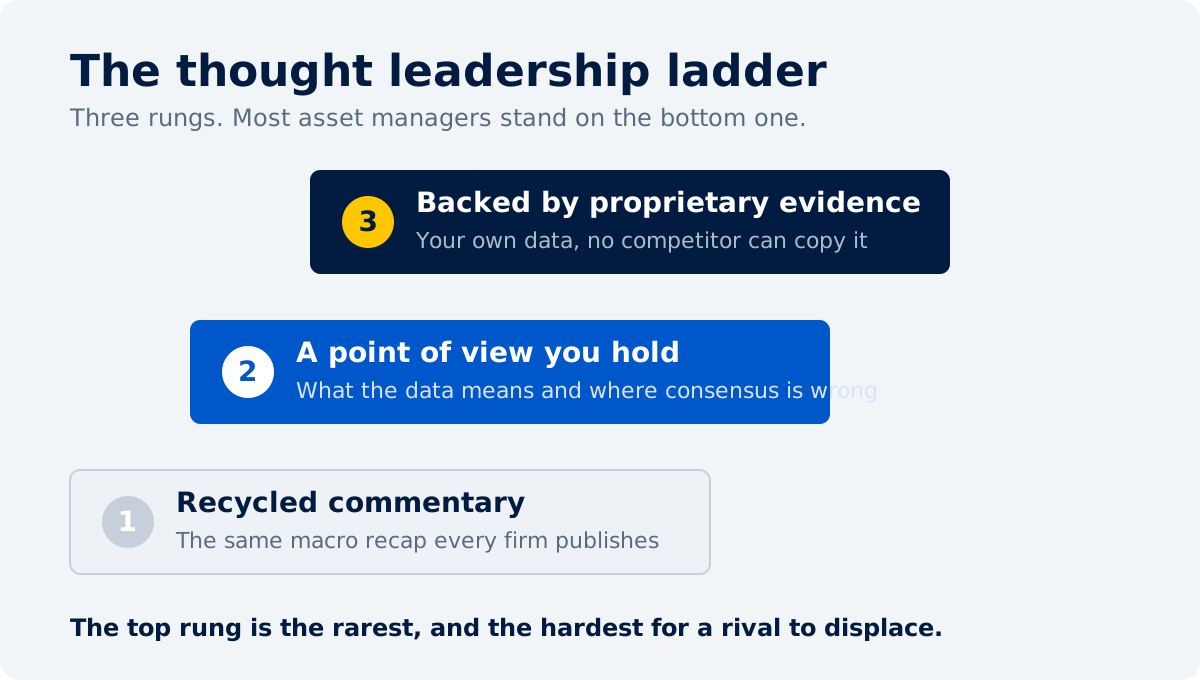
The difference between real thought leadership and commodity commentary is a ladder with three rungs. Most asset managers stand on the bottom one.
What does rung one, recycled commentary, look like?
The bottom rung is the quarterly macro recap, the summary of the jobs report, the note that says uncertainty may bring volatility. It is accurate and it is everywhere, which is the problem. It positions you as one more voice saying the obvious thing, and it does nothing to tell an investor how your firm thinks.
What does rung two, a point of view you actually hold, look like?
The middle rung is a position. You look at the same data and say what it means, where the consensus is wrong, and what you are doing about it in the portfolio. This is where most "good" content tops out, and it already beats the field. Investors are clear that the bar here is substance, not theatrics; in the CoreData survey, only 42% thought thought leadership has to be provocative or contrarian to stand out. A well-argued position beats a hot take.
What does rung three, a point of view backed by proprietary evidence, look like?
The top rung is a position backed by evidence only your firm has. Proprietary research, your own data, a framework you built and keep testing. This is the rarest and most defensible rung, and the buyers are asking for it directly: 48% of investors said they want more detailed evidence to back up managers' rationale, and the single most-cited factor for establishing a firm as a thought leader was unique, differentiated ideas, named by 81%. After that came innovation in strategy, access to named experts, and technical research and whitepapers. The general-market data agrees; in the Edelman-LinkedIn study, robust research and data was the top attribute decision-makers named in thought leadership that actually moved them.
The clearest example of the top rung is J.P. Morgan Asset Management's Guide to the Markets, led by its Chief Global Strategist, Dr. David Kelly. It is a proprietary, named, quarterly research franchise built on the firm's own analysis and curation, refreshed every quarter and produced in seven regional versions across 42 countries. Advisors use it in their own client meetings. For more than 17 years it has been the reference chartbook for a large part of the industry. That is the moat in one artifact; a named expert plus a proprietary, consistently published body of work that competitors now have to displace rather than match.
Who should put their name on thought leadership at an asset manager?
A named person should, and in most firms nobody does. Named, credentialed author bios appear on only about 22% of active asset managers' content; for the rest, the ideas float free of any human who will stand behind them.
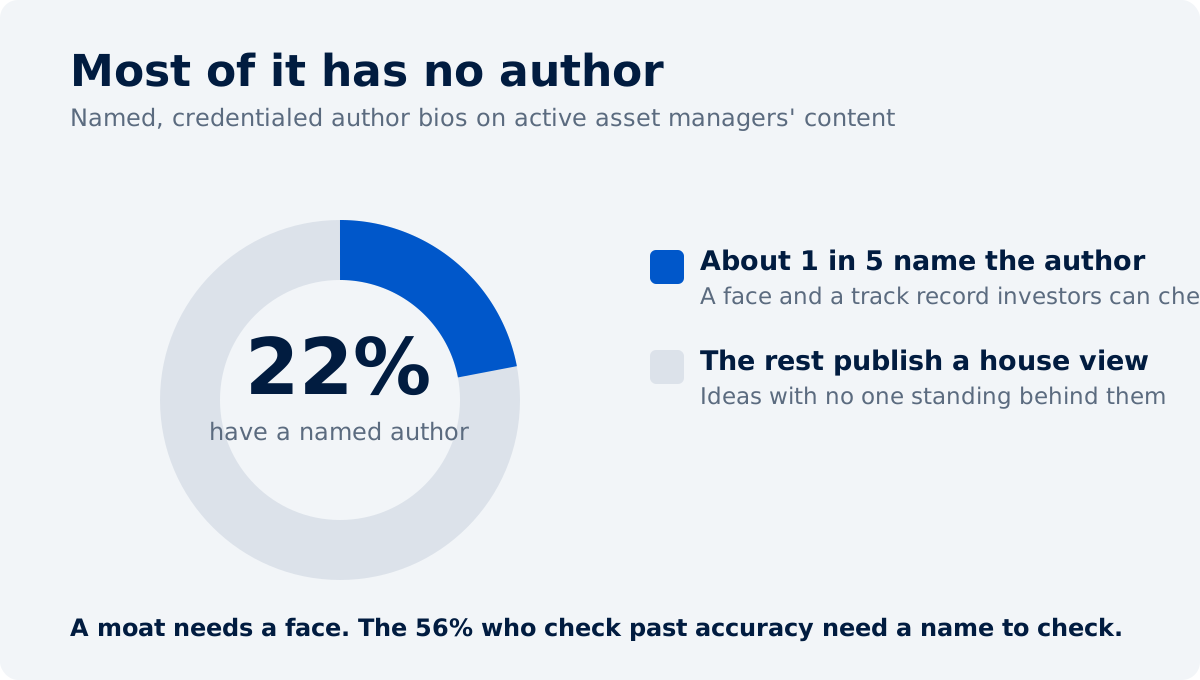
That is a problem, because a moat needs a face. Investors told CoreData that access to named experts and senior leaders who are genuine authorities is one of the things that establishes a firm as a thought leader. And the 56% who check a manager's past accuracy can only do that if there is a name attached to the track record. An anonymous house view has no track record to check.
The name should belong to the person with the expertise, usually a portfolio manager, a CIO, or a strategist, not the marketing desk. The marketing team's job is to extract the point of view and make it usable, not to ghost-write a worldview the investment team does not hold. The way we approach this is to sit with the expert and pull out the parts that make a position: the thing most people get wrong, the view that runs against the market, the framework they use, the proof, and the objections they hear. The expert supplies the thinking; the content team makes it legible and keeps it coming.
A concrete territory makes this easier. About 1 in 5 of the firms that do run content turn the regulatory and compliance calendar into authority content. That is a real, ownable beat for a named expert, and most firms leave it on the table.
How do you build a thought-leadership engine on proprietary points of view?
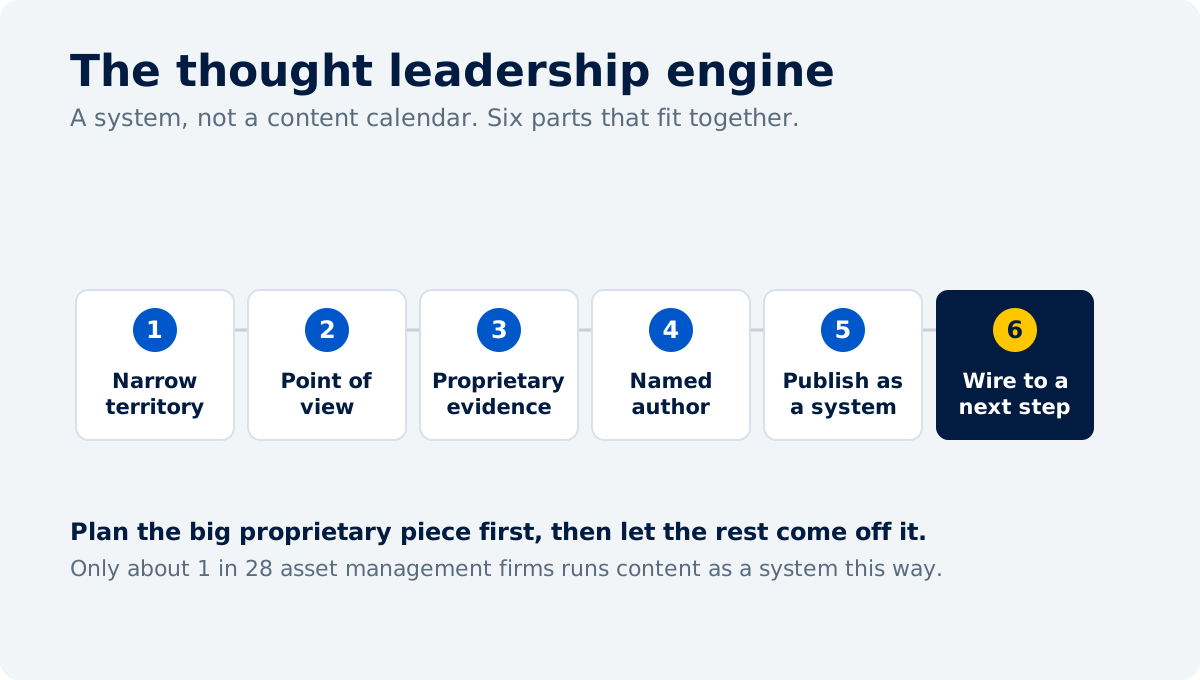
A thought-leadership engine is a system, not a content calendar. The firms that have one are rare, about 1 in 28, which is the same reason the output is rare. Here is how the engine fits together.
Which narrow territory can you own?
Start narrow enough to win. Almost nobody does; fewer than 1 in 20 asset managers commit to a narrow, specific focus, and generic "sophisticated investor" language dominates. A focused, named topic creates gravity, and a boutique has no hope of out-publishing a giant across everything. The winning move for a smaller firm is to become the clear voice on one thing the giants treat as a footnote, rather than another generalist on markets. The way we choose that territory is to pick the problem your buyer feels sharply, that your team can speak to credibly, and that solving would make an investor more likely to trust you.
How do you form a real point of view?
Decide what you believe about that territory, and say the part the consensus misses. The move we use is to push each position one layer deeper, from the surface claim to the force actually driving it, then to what that means an investor should do differently. That is what turns a vendor's description into a trusted partner's argument.
What proprietary evidence backs it?
This is the rung that makes the moat. You do not need a big research budget. Your own book is the data: positioning shifts, what you see in client portfolios, patterns across the deals you win and lose, a recurring observation your PMs trust. Turn that into a framework or a recurring piece of research, and you have something no competitor can copy, because they do not have your book. Evidence is what the buyers keep asking for, and it is the single clearest way off the commodity rung.
Who puts their name on it?
Attach the point of view to the person who holds it, with a short bio that says why they are worth trusting on this specific topic. The byline is what makes the track record checkable and the authority real.
How do you publish it as a system, on a believable cadence?
A moat comes from a body of work, and a single strong piece is only the start. Plan the big proprietary piece first, then let the smaller pieces come off it, so each one reinforces the same position instead of chasing a new topic every week. Consistency is what the 1 in 28 who run a real system have and the rest do not. A predictable presence when investors need guidance beats a burst of activity that fades.
Where does every piece send the reader next?
Most asset managers waste the attention they earn. 96.5% of asset management content ends with a weak or dead-end call to action, and fewer than 1 in 20 firms capture a contact, so email and nurture have nothing to work with. Thought leadership that an investor reads and then leaves, with nowhere to go, is a missed step. Give every piece one sensible next move: a related deep piece, a way to subscribe, or a way to talk to the author. Treat the download as the start of the relationship, not the finish.
How do you measure thought leadership for asset managers?
Measure it against shortlists, mandates, and assets under management, not pageviews. Pageviews are exactly the trap that makes asset managers think their content is working when it is not; the median firm earns around 214 organic visits a month, presence without performance, and a bigger number there would not mean a single extra mandate.
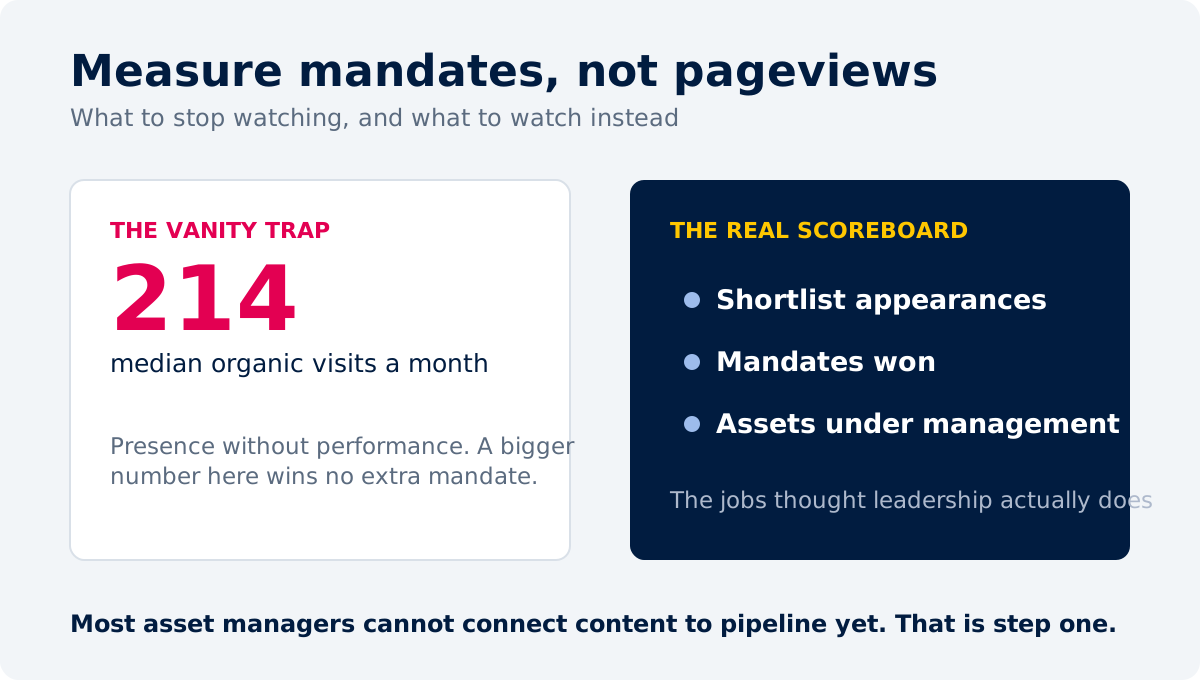
Sondhelm's advice is to skip the vanity metrics and track new meetings, conversations that advanced, and whether investors are forwarding your work. The CoreData data points the same way; the thing to watch is whether thought leadership is doing its real jobs, keeping you on the shortlist, getting you associated with a theme, and putting you in front of institutions that had never heard your name.
The practical problem is that most asset managers cannot connect content to pipeline at all; attribution and marketing automation are rare in the sector. So the first measurement step is often just building the ability to see which content a prospect read before they took a meeting. Until you can see that, you are guessing.
If you want a fast read on where your own thought leadership stands against the sector, our asset management content benchmarking tool scores your estate on the same dimensions this piece draws on, so you can see the gap between the content you publish and the content investors say they want. For the wider picture of how asset managers turn content into a system rather than a cost, that is the work we do.
Want to see how your asset management firm's thought leadership compares to the sector?
Our content revenue audit benchmarks your estate, finds where real thought leadership is missing, and puts a number on the gap.
Frequently Asked Questions
About the Author

Founder & CEO, Content RevOps
Stefan Kalpachev is the founder and CEO of Content RevOps, where he helps B2B SaaS companies transform their content into predictable pipeline. With a background in content marketing and revenue operations, Stefan has developed a unique methodology that bridges the gap between content creation and revenue generation.
Connect on LinkedIn