How to Scale B2B Revenue Through Demand Generation
Want to see what one engine feeding inbound, outbound, and allbound actually looks like? Take a look at how we do it.
Book a CallDemand only turns into B2B revenue through three routes. It comes to you as inbound. You go get it as outbound. Or you run both at once off a shared signal layer, which is allbound. You scale revenue by making one demand generation engine feed all three routes, not by making more demand and hoping it lands.
Part of The Complete Guide to B2B Demand Generation Strategy.
That distinction is the whole game, and most teams miss it. They pour effort into creating demand, then wonder why the pipeline stays flat. The demand is real. The routes it can travel to become revenue are too narrow, so most of it never converts.
This guide walks the mechanism in plain terms. What each route is, how demand actually becomes money on each one, why adding more of any single route stops working, and how the allbound motion lets each unit of demand work more than once. If you want the shorthand version of that motion, we lay it out on our allbound page. Here we go deeper.
What does it actually mean to scale B2B revenue through demand generation?
Scaling B2B revenue through demand generation means growing the pipeline your marketing sources, not growing the number of leads or the size of the budget. Those are inputs. Revenue is the output, and the two move together far less often than teams assume, which is the core of the demand generation vs lead generation split.
The job has already shifted to match. When we looked at 1,000 demand generation leadership roles, director postings named revenue in 52% of cases, pipeline in 37%, and owning a number in 18%. The person running demand generation is now measured on money, not on activity. So the question is not "how do we make more demand," it is "how does the demand we make turn into revenue, and how do we make that happen more often."
That reframes demand generation as a system, not a campaign. The clearest working definition comes from George B. and Kevin Chen of The B2B Playbook, who call it a system that builds awareness, trust, and memory with your market, so that when a buyer's priorities change you are the brand they choose. Their point about timing matters here. You cannot force a buyer to buy. Prioritization happens when a trigger hits, a renewal, a budget reset, a new mandate from the board, and your job is to be present and trusted when it does. That is also why demand generation and brand awareness are not the same line item.
The field is consolidating around exactly this. Search interest in "demand generation specialist" is down 55% year over year. Companies are not hiring task specialists to run more tactics. They are hiring people who can turn demand into revenue, a shift the 1,000 demand generation manager postings we analysed show just as clearly.
How does demand actually become revenue in B2B?
Demand becomes revenue in one of three ways, and every demand generation program is really some mix of them. Naming them is the fastest way to see where your own revenue is leaking.
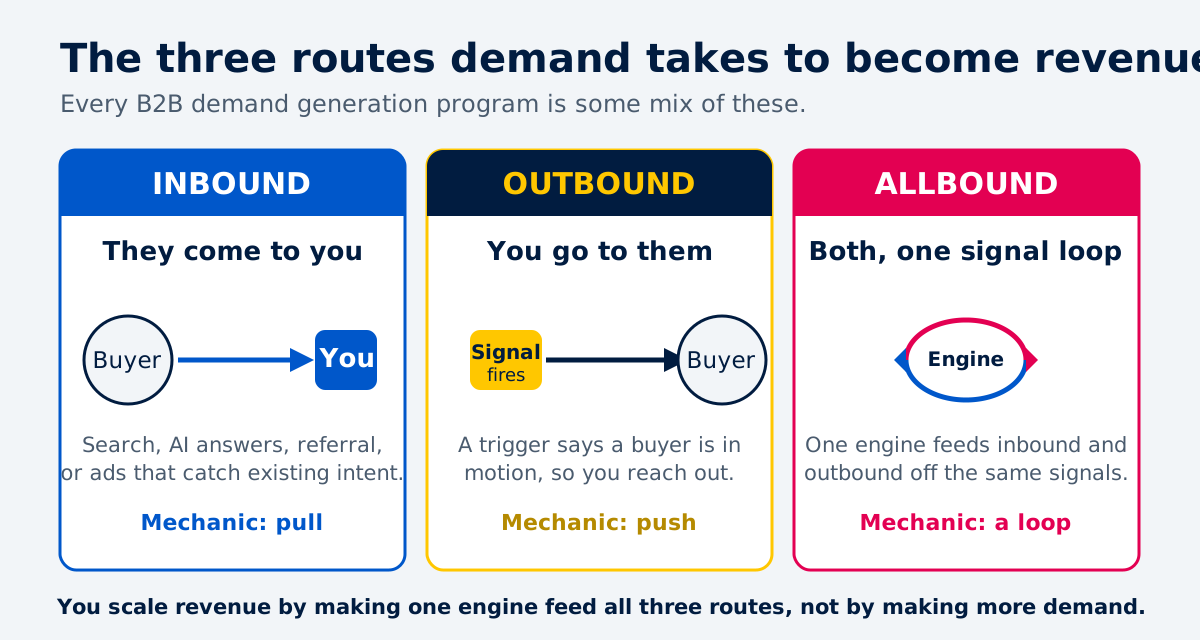
Inbound, the buyer comes to you
Inbound is demand that arrives. A buyer searches, reads, asks an AI assistant, gets a referral, or remembers your name, and pulls themselves toward a form, a demo, or a signup. You can also capture demand that already exists by putting paid ads on high-intent moments, bidding on category searches, showing up on review sites, and retargeting people who already visited. That split between making demand and catching it is the whole subject of demand generation vs demand capture.
The mechanic is pull. The buyer moves first, and your content or your ad is waiting when they do. If you want the finer line between this route and classic inbound, we draw it in demand generation vs inbound marketing.
The inbound surface has changed more in the last two years than in the decade before it. Buyers now start inside AI answers, not just search engines. G2's 2026 research, a survey of 1,076 B2B software buyers, found that 51% now begin their research with an AI chatbot more often than with Google, and 71% rely on AI chatbots somewhere in the process. Semrush's survey of 519 AI-using B2B professionals found 66% use AI specifically to research vendors and 92% say it has already shaped their shortlist. Forrester puts overall AI use in the buying process at 94% and warns that the old model of driving traffic to your site to retarget and nurture is getting weaker as buyers spend more time with answer engines and less on vendor websites. We unpack what that does to the top of the funnel in how AI is changing top-of-funnel demand generation.
Here is the problem that creates. When we studied the state of content marketing, AI Overviews triggered on essentially 100% of the industry queries we tested, while company websites showed up in those answers close to zero in six of seven verticals. The inbound route now runs straight through AI answers, and most companies are invisible on it. The demand exists. They just are not in the answer that shapes it, which is exactly why brands that rank on Google still miss ChatGPT and Perplexity answers.
Outbound, demand is a signal
Outbound flips the direction. Instead of waiting for the buyer to move, you read a signal that says a buyer is in motion, then you go to them. The signal might be a funding round, a new hire in a key role, a competitor's renewal window, or a spike in research activity from an account. You reach out by email, on LinkedIn, through an SDR, or with an account-based play aimed at the whole buying group.
The mechanic is push, but good push is not spray. It is a targeted move made because a signal told you the timing is right.
Allbound, both routes at once
Allbound runs inbound and outbound off the same engine. The content that creates and captures inbound demand also produces the signals that make outbound relevant. Someone reads three of your pages, downloads a guide, and comes back to the pricing page. That behavior is inbound interest and an outbound trigger at the same time. The conversation your outbound then starts tells you what to write next, which feeds the inbound engine again.
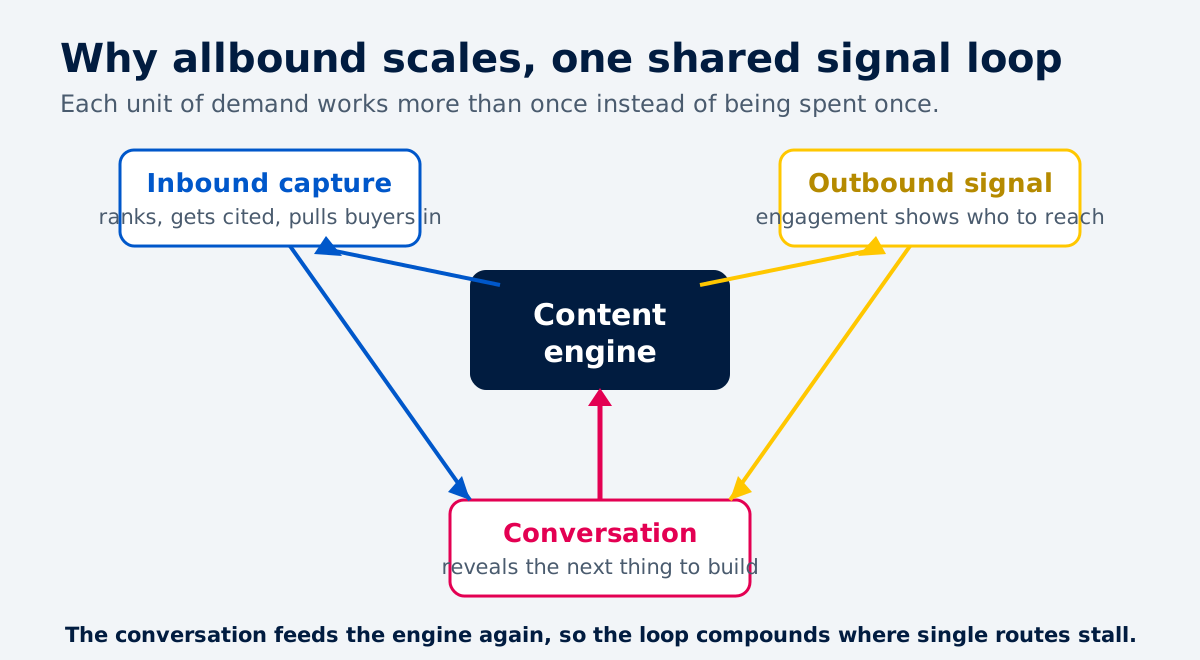
The mechanic is a loop. Each unit of demand throws off information that powers the next move on both routes. That shared signal layer is why allbound scales when the single routes stall, and it is the model we build client engines around, described in full on our allbound page.
Why doesn't more of one route scale B2B revenue?
Most teams try to scale by doing more of whichever route they already run. More emails, or more blog posts. Both hit a wall, for different reasons, and understanding the wall is what points you at allbound. It is also one of the most expensive demand generation mistakes a team can make.
Outbound volume hits a ceiling
Adding outbound volume stops working because the inbox is saturated and reply rates keep falling. Belkins analyzed 7.5 million cold emails sent across 2025 and found an average reply rate of 0.45%. It ran at 0.50% in the first half of the year and fell to 0.40% in the second, a 20% drop inside a single year, bottoming out at 0.35% in December. Belkins names the cause plainly. More teams are running cold outreach, so the signal-to-noise ratio for any one email keeps falling, spam filters keep tightening, and buyer attention is finite.
You can see the ceiling in real operators. In one r/sales thread, an outbound agency stuck at $300,000 a year described sending 50,000 emails a month to sign one or two clients, with a close rate under 10%, and called it "pushing a massive boulder up the hill." They had more than 20 case studies and two accounts with 10,000-plus followers, and still said very few leads came from their content. They had built a pure outbound machine with no inbound pull, and the machine had run out of road.
The decay is not the agency's fault. It is structural, and it gets worse every quarter more teams pile in. Operators in r/b2bmarketing describe the same thing, response rates down over the last 18 months and buyers who can spot cookie-cutter personalization from a mile away. The way out is outreach that carries something worth reading, the approach behind our content-led outreach system.
Inbound alone scales, but slowly, and stalls without capture
Inbound has the opposite problem. It compounds, but it is slow, and it leaks if you never built the capture half.
The compounding is real. An operator who ran demand generation programs for eight years described it on r/marketing: one campaign produced no inbound opportunities for three months, then generated nine qualified opportunities, three contracts at 10x the usual deal size, and a seven-figure pipeline. Their summary is worth keeping. Great content is only 20% of the result. The other 80% is distribution, which is why we treat a content distribution strategy as part of the engine, not an afterthought.
The stall shows up when the engine is too small to compound in the first place. In our landscape study of demand generation firms, 71% pulled under 1,000 organic visits a month, even though selling demand generation is their entire business. An inbound route that thin never reaches the point where it throws off enough demand to matter, and it certainly never feeds outbound.
How does the allbound motion scale B2B revenue faster?
Allbound scales faster because it makes every unit of demand work more than once. The same asset ranks and gets cited, which is inbound. Its engagement reveals which accounts are in motion, which powers outbound. The outbound conversation surfaces the next question to answer, which becomes the next asset. Nothing is spent once.
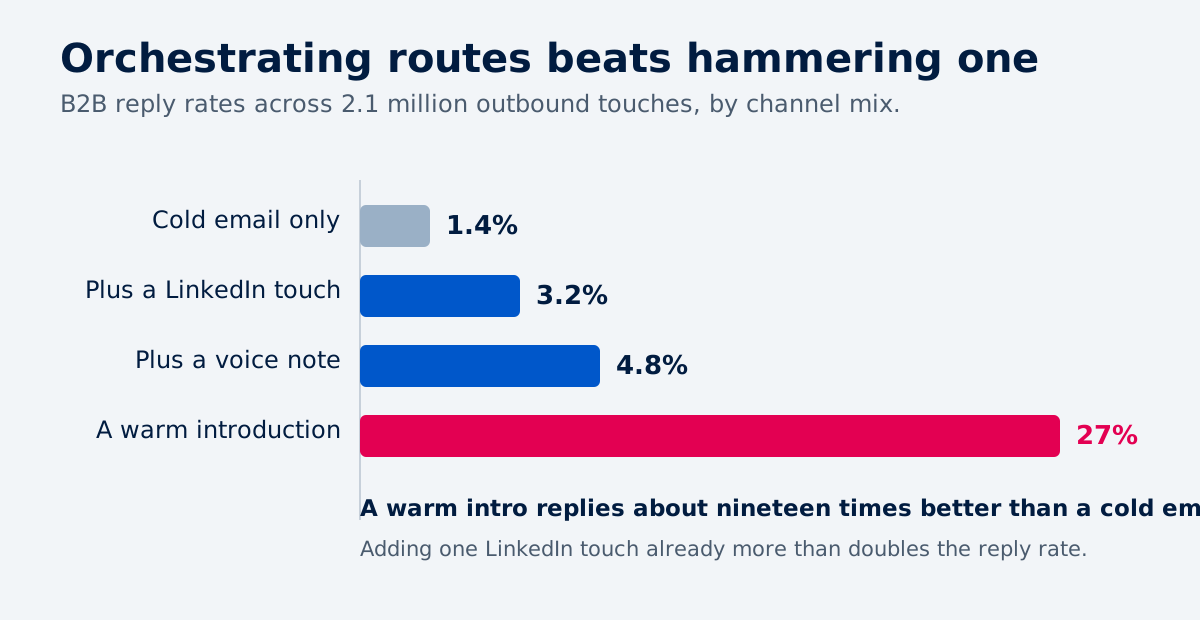
The channel data makes the case on its own. KnowledgeNet analyzed 2.1 million outbound touches across 480 B2B teams and found cold email alone replied at 1.4%. Add a LinkedIn touch and it rose to 3.2%. Add a LinkedIn touch and a voice note and it reached 4.8%. A warm introduction replied at 27%, roughly nineteen times the cold-only rate. Orchestrating routes around the same account beats hammering any single one, by multiples, not margins. We rank the channels worth orchestrating in which demand generation channels to prioritise.
The advantage of owning the engine is measurable too. In our landscape study, firms with a strong owned inbound engine scored 79 on our quality index against 35 for those with none, yet only 10% actually ran one. The owned engine is the difference between a signal layer you control and a rented list you refill forever.
This is where the two halves click together. The B2B Playbook team describe it as gathering signals in the awareness stage, then handing them to the half of the brain that captures demand, or to the sales team. That is allbound in a sentence. The creation motion and the capture motion are not separate departments. They are one loop sharing one set of signals, the same point we make about how demand generation and content marketing work together.
We saw the loop pay off with a client running a gated report campaign. The download was strong for a cold audience, but the money was not in the download. We treated it as the start of the funnel, wired an automated nurture behind it, and put a fast first follow-up in place through a webhook so any inbound trigger dropped the lead straight into a sequence. When we filled in contact forms on competitor sites to test them, only one competitor followed up quickly. Speed of the first touch, triggered by an inbound signal, was the lever. Inbound created the signal, outbound acted on it, and neither would have worked alone. More walkthroughs like this one sit in our B2B demand generation case studies.
Where does B2B demand leak before it becomes revenue?
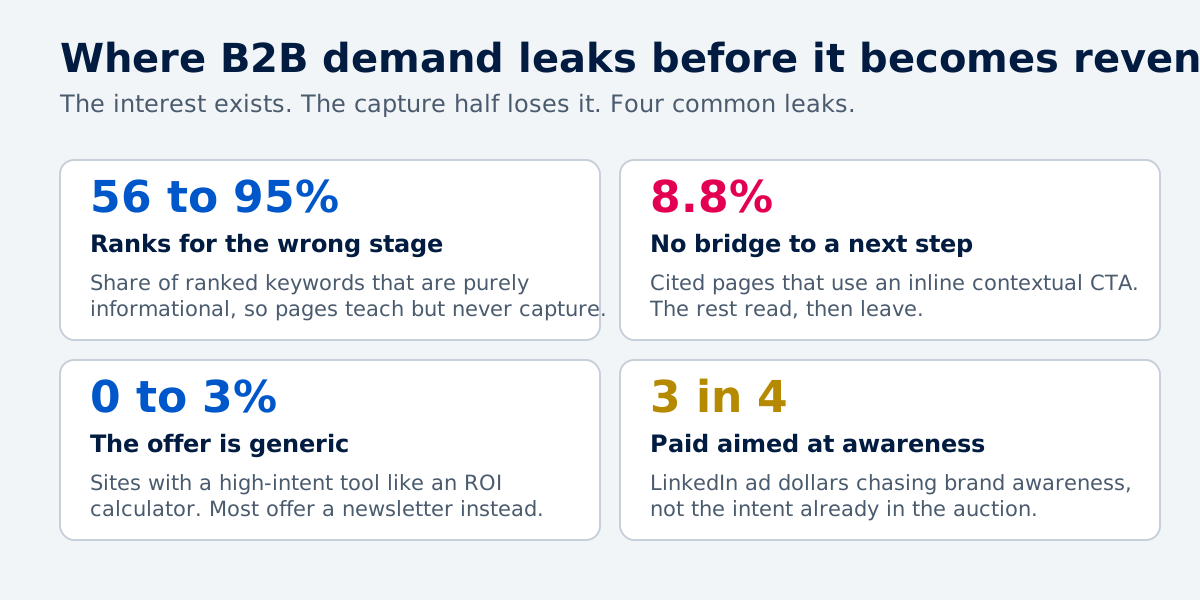
Most demand that fails to become revenue leaks in the capture half, after the interest exists but before anything converts. Four leaks account for most of it, and each one is checkable on your own site this afternoon.
The content ranks for the wrong stage
A lot of B2B content attracts researchers and captures no intent, because it only ever ranks for early questions. Across the sites in our content study, the share of ranked keywords that were purely informational ran from 56% to as high as 95%. Pages pull in people who are learning, then offer them nowhere to go when they are ready to act. The demand generation funnel, by the numbers, shows how much of the value sits in the stages those pages never reach.
The page cannot convert the traffic it earns
Even when the right buyer lands, the page often has no bridge to a next step. When we looked at pages that AI engines actually cite, in why AI traffic is not converting, only 8.8% used an inline contextual CTA, and CTA-intent alignment was strong on just 8.4% to 17.5% of pages. The traffic arrives and reads. Then it leaves, because the page never asked it to do the one thing it was ready to do. It is the same pattern behind SaaS blogs that get traffic but no demos.
The offer is generic
The dominant lead-capture pattern we found was a generic newsletter signup offered in place of an asset matched to what the reader was actually doing on the page. High-intent tools that convert well, like an ROI calculator, showed up on roughly 0% to 3% of sites. The reader is holding a specific question and the page answers with "subscribe."
Paid is aimed at awareness, not capture
Paid budget could catch high-intent demand cheaply and mostly does not. In our data, paid budget pointed at content amplification was close to zero, and around three in four LinkedIn ad dollars chased brand awareness rather than intent. The demand exists in the auction. The spend is pointed somewhere else.
How do you build the content engine that feeds both routes?
You build one content engine that creates demand, captures it, and throws off the signals outbound needs, then you fund it as infrastructure rather than as a series of campaigns. This is where content stops being a cost and starts being the thing that produces revenue on every route. We walk the build step by step in how to build a demand generation engine from scratch.
The way we build it is top-down and published bottom-up, across five levels. A theme sits at the top, the central problem your buyer cares about for the next few quarters. Under it sit the raw inputs, then a core asset like a guide or a benchmark, then interactive assets like webinars and tools, then the supporting blogs, social posts, and emails that route people toward the higher-intent pages. Reverse that order and you get content that is busy but never compounds, because nothing traces back to a single revenue-relevant problem. It is the mistake we describe in the demand generation framework most teams build backwards.
The capture half has to be designed before the content exists, not bolted on after. We map the movement from attention to a qualified opportunity explicitly, with the stages named and a fast-track exit for buyers whose intent is already clear, so a ready buyer can reach a demo without being dragged through a nurture. That design is what turns a piece of content into a route to revenue instead of a page that gets traffic.
Then the same engine feeds outbound. Every asset is a reason for a salesperson to reach out that is not a pitch, and every interaction with it is an intent signal that says who to reach and when. This is what we mean when we call it content revenue infrastructure. AI made content cheap to produce, so the market flooded and most content lost its job. The job we give it back is to be the engine that both creates demand and converts it, on inbound and on outbound at the same time.
If you are weighing whether to build that engine in-house or bring in help, we compare the two honestly in our guide on in-house versus outsourced demand generation, and lay out the roles and costs of a team in our team-structure breakdown. If outside help is on the table, what a demand generation agency really costs puts numbers on it.
How do you measure and fund demand generation that scales revenue?
You measure it on pipeline and revenue, not on leads, and you fund it knowing the budget is flat, so the gain has to come from a better engine rather than a bigger one.
Measure the routes, not the clicks
The metric set should match how the role is now judged. Since demand generation leaders own revenue and pipeline, as their job postings show, the numbers to watch are pipeline sourced, pipeline influenced, and the share of revenue marketing touches. Watch inbound request volume, and keep asking new customers how they first heard of you, because that answer is often the only honest record of a route that worked. We sort the useful numbers from the noise in which demand generation metrics to track, and which not to.
The reason to measure this way, and not by last click, comes straight from the operators. As the eight-year practitioner put it, an attribution-only mindset kills B2B programs, because a real buyer notices you on social, searches later, signs up for a webinar, goes quiet for a month, then arrives through the front door. Last-touch attribution credits the door and misses the journey that built the demand. Measure the pipeline the engine sources, not the final click that closed it.
Fund the engine, do not just enlarge it
The scale of the prize is why this matters. Across Insight Partners' B2B portfolio, marketing sources close to half of all new-business pipeline, the single largest driver ahead of account executives and outbound reps. Their 2026 CMO survey adds that top performers are more than twice as likely to hold themselves accountable for marketing-sourced bookings, not just pipeline. If the demand engine sources half your pipeline, it is a revenue lever, not a support cost.
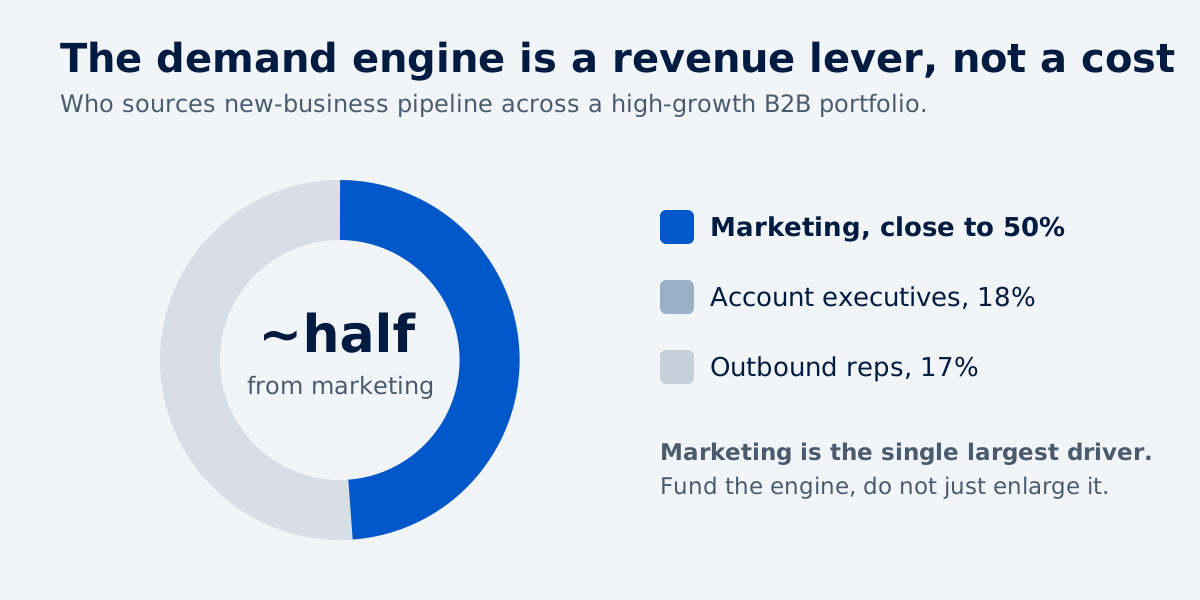
The budget to run it is not growing. Gartner's 2026 CMO Spend Survey puts marketing at 7.8% of company revenue, effectively flat and down from 9.5% in 2022. The CMO Survey breaks B2B out at 7.0% of revenue for product companies and 10.1% for services companies, and SaaS Capital pegs private B2B SaaS at a median of 8% of ARR. The number is not rising. So scaling revenue through demand generation means making a flat budget work harder by getting every unit of demand onto more than one route, which is the whole argument for allbound. For how to split that flat budget across the engine, see our demand generation budget allocation best practices.
The one job your content should hold
Demand does not become revenue by accident. It travels inbound, outbound, or both, and it stops scaling the moment it can only travel one. The companies that grow revenue through demand generation are not the ones making the most demand or sending the most emails. They are the ones running a single engine that creates demand, captures it, and turns every interaction into a signal the next move can use.
That engine is content doing its real job, as revenue infrastructure rather than output. If you want to see the shape of it, our allbound model and what we do lay it out end to end.
Is your demand turning into revenue, or leaking in the capture half?
Get a Content RevOps audit: where your content should be creating demand, where it should be capturing it, and what it is leaving on the table.
Frequently Asked Questions
About the Author

Founder & CEO, Content RevOps
Stefan Kalpachev is the founder and CEO of Content RevOps, where he helps B2B SaaS companies transform their content into predictable pipeline. With a background in content marketing and revenue operations, Stefan has developed a unique methodology that bridges the gap between content creation and revenue generation.
Connect on LinkedInRelated Articles
What Does a Demand Generation Content Marketing Agency Do?
Sep 23, 2026
Demand Generation Agency Total Cost of Ownership Estimated for 2026
Sep 22, 2026
Should you run paid ads in life sciences? A buyer's guide to PPC
Aug 24, 2026