What 1,000 Demand Generation Director Leadership Jobs Reveal About the Role in 2026
Hiring a demand generation leader, or trying to become one? We help B2B teams build the revenue engine the role is actually measured on.
Book a CallA demand generation director is now less a narrow channel owner and more a senior marketing leader expected to build and run a repeatable pipeline engine tied directly to revenue, even when the title on the posting says Director of Marketing, Head of Growth, VP of Performance, or Director of Revenue Marketing. We pulled 1,000 live LinkedIn postings that surfaced under one search, "demand generation director", filtered to the United States, scraped in the middle of June 2026. Then we read them, all of them, and counted what they actually ask for instead of what the role is supposed to be.
Part of The Complete Guide to B2B Demand Generation Strategy.
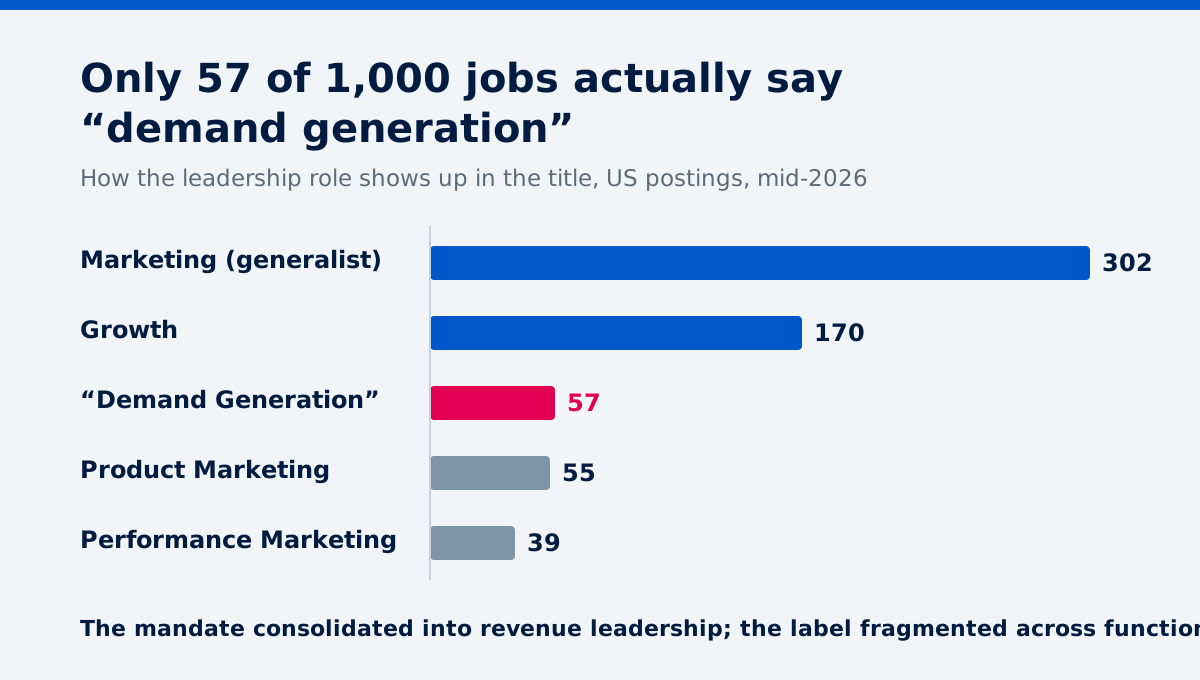
The first surprise is in the titles. Only 57 of the 1,000 postings carry the words "demand generation" at all. The rest hide under other names, Director of Marketing, Head of Growth, VP of Performance, Director of Revenue Marketing. So before any finding about skills or pay, one thing is already clear. The job most people still call "demand gen director" has mostly stopped calling itself that.
A note on scope, because it changes how you should read everything below. This is for marketers aiming at senior demand gen leadership roles and for hiring managers trying to benchmark what the market expects in 2026. The sample is 835 Director-level roles, 70 VPs, 66 Heads of, and 17 C-level seats, with almost no coordinators or managers. It is also fresh, 89% of these postings went live in May or June 2026, so it reflects what companies are hiring for right now, not a backward-looking average. Everything here describes the people who own the demand mandate, not the people executing campaigns under them. From there, we break down how titles and responsibilities are shifting toward pipeline and revenue ownership, where AI is changing requirements and pay, what skills, experience, education, and remote patterns show up most often, and what that means if you are trying to position yourself or make a senior hire in a market that is moving fast.
Why the demand gen title is dissolving into growth and revenue leadership
The function did not shrink. It got absorbed. The same mandate, build a pipeline engine and own a number, now wears whatever label the company prefers, and "demand generation" is losing that naming contest.
Sort the 1,000 titles by what they emphasize and the spread is stark. 302 read as generalist marketing leadership, some flavor of Director or Head of Marketing. 170 lead on Growth. Only 57 say Demand Generation outright. Another 55 frame it as Product Marketing, 39 as Performance Marketing. The word changes; the job underneath it does not move much. A Head of Growth at a Series B SaaS company and a Director of Demand Generation at a mid-market fintech are, on the evidence of their own job descriptions, hiring for the same person.
What unifies them is not a channel or a title, it is accountability. 52% of the postings talk about revenue directly. 37% name pipeline. 24% ask for sales alignment or a partnership with the sales team, and 18% want someone to own a number outright, a quota, a pipeline target, a full-funnel result. This is the through-line of the modern role. Five years ago a demand gen lead was measured on MQLs and program volume. The 2026 version is measured on dollars, and the title flexes to whatever the company files revenue marketing under that quarter, with senior hires typically overseeing the entire demand generation department rather than just campaign execution.
The employer mix explains some of the label drift. Software companies post the most of these roles by a wide margin, 227 of the 1,000, followed by advertising and agency services at 168, then staffing firms at 70, financial services at 42, healthcare at 40, and pharma at 36. And the companies cluster in the scaling band, 455 of the 1,000 sit between 51 and 1,000 employees, the stage where a company has product-market fit and now needs a repeatable demand engine, fast. That stage is exactly why the title wanders. A company scaling from 80 to 800 people is inventing the function as it goes, often for the first time, so it reaches for whatever title signals the mandate it actually needs filled, Growth, Revenue Marketing, Performance, rather than a legacy "demand gen" label it may never have carried. They care that you can build the engine, not what you let HR call the role.
How AI split the demand gen market in two
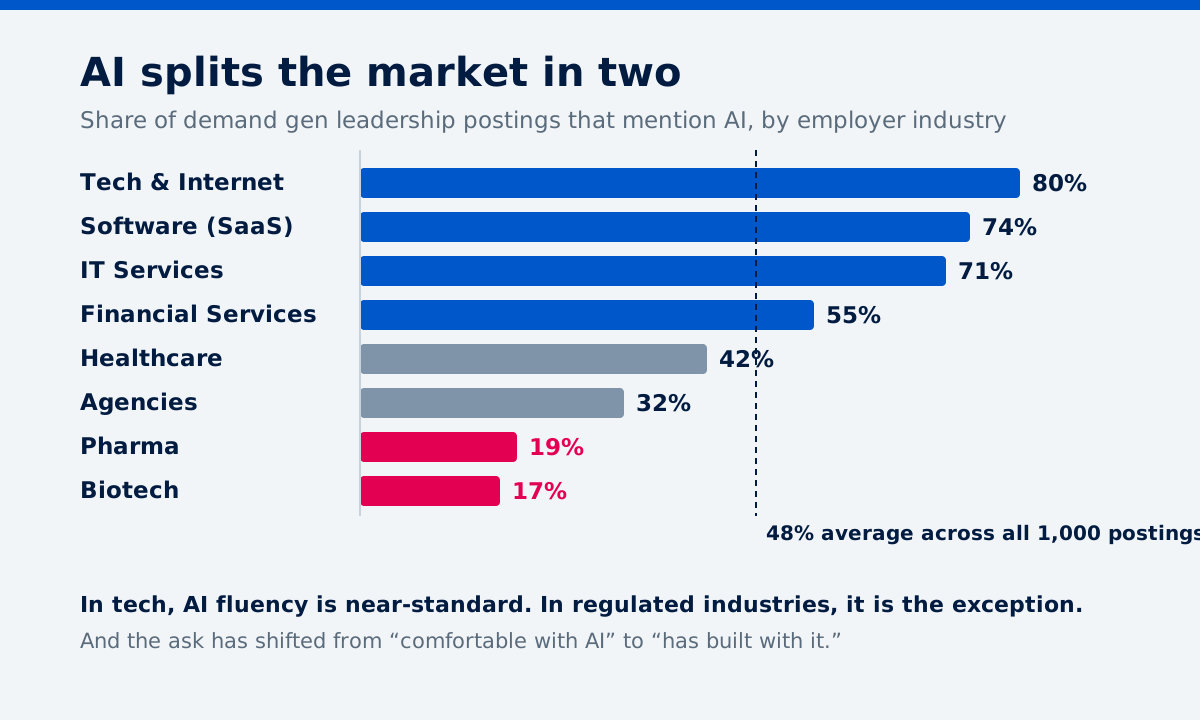
AI in demand gen leadership is not everywhere. It is concentrated, and where it shows up the nature of the ask has changed from "comfortable with AI" to "can build with it."
Across all 1,000 postings, 48% mention AI or machine learning in some form. That number alone is unremarkable until you cut it by industry, and then the real story appears. Among technology and internet employers, 80% of the postings mention AI. Software development sits at 74%, IT services at 71%, financial services at 55%. Then the floor drops out. Healthcare is at 42%, agencies at 32%, and pharmaceutical manufacturing and biotech research come in at 19% and 17%. A demand gen leader hired by a SaaS company and one hired by a pharma company are reading almost different job markets when it comes to AI.
That bifurcation is not random, and we have seen the other side of it in our own data. Our State of Content Marketing in Pharma 2026 analysis found that the defining channel of B2B SaaS demand generation is a niche function in pharma. So the 17 to 19% AI rate in those postings is not regulated industries ignoring a trend; it is a demand-gen function that is structurally smaller and more conservative to begin with, asking less of the role across the board, AI included.
Put the 48% next to how marketers describe their own habits and the gap gets interesting. Industry surveys put personal AI use near universal; the CMI and MarketingProfs B2B research for 2026, a survey of 1,015 B2B marketers, found 95% say their organization uses AI-powered applications, with Salesforce and Demand Gen Report landing at 87% and 96% on similar questions. So nearly every marketer touches AI, yet fewer than half of the people hiring demand gen leaders write it into the role. Using ChatGPT to draft an email is now table stakes; an employer making AI part of the job specification is not.
The same survey shows why the postings that do ask for AI are asking for something scarce. Most adoption is shallow, 68% of those marketers are still in an exploratory or developing phase, and only 28% so much as experiment with AI agents. Now line that up against the demand side. In our postings, 24.7% want AI-powered or AI-native workflows, 15.8% explicitly want someone who has built or shipped something with AI, 6.1% name AI agents or agentic workflows, and 6.2% reach into AI search and LLM visibility, the discipline some of them already call GEO. So roughly a quarter of marketers have ever touched an agent, while the sharpest employers want you to ship one in production. That gap between who can experiment and who can build is the whole supply-demand story, and it is what the verbs give away. These postings do not ask you to use AI, they ask you to build with it.
The language in the actual descriptions is blunter than any statistic. One wants a leader who "treats AI as infrastructure, not a feature." Another draws the line directly, "you don't use AI as a chatbot, you use it to build." A third asks you to "manage a team to build and run a full-funnel demand engine with AI at its core." A fourth rules out tourists in a single sentence, asking for "hands-on experience building AI agents or agentic workflows, not theoretically familiar, not interested in learning." When a survey says a quarter of marketers experiment with agents and a job description says it will not hire someone merely curious about them, you are looking at the exact edge of the skills market, the place where supply has not caught up to what the best-funded employers now demand.
The AI pay premium and average salary, $190,000 versus $162,500
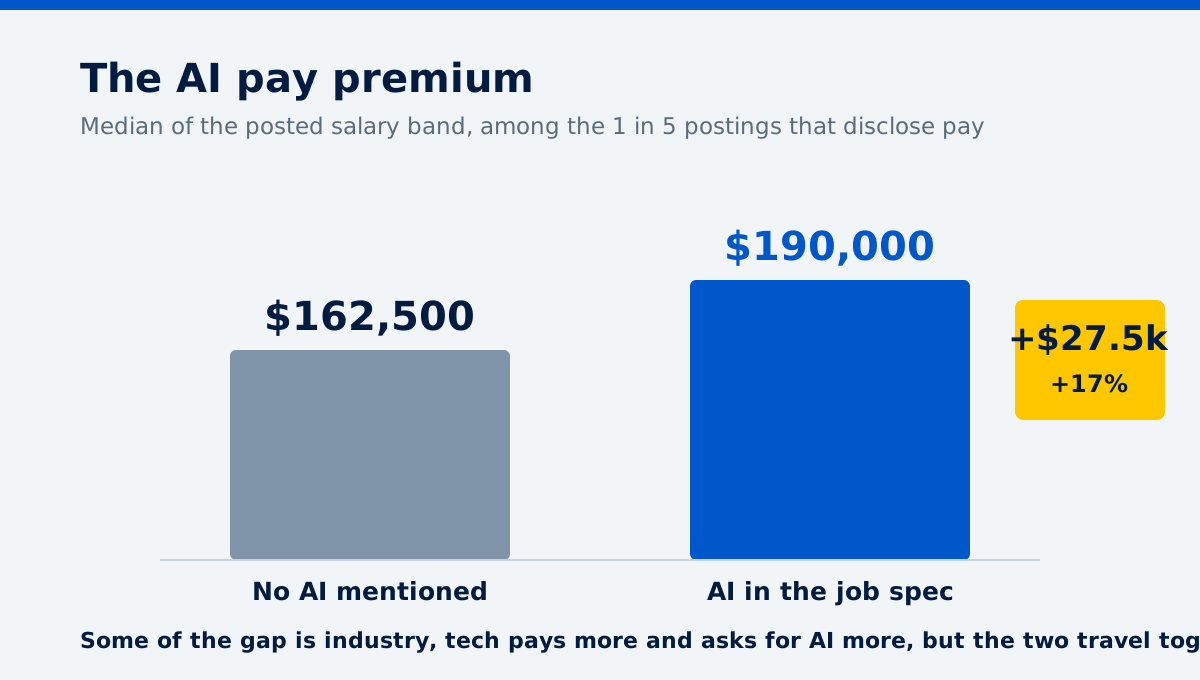
Postings that mention AI carry a higher salary band, and the gap is large enough to notice. Among the roles that disclose pay, the ones that mention AI have a median salary midpoint of $190,000. The ones that do not sit at $162,500. Same function, same seniority band, a $27,500 spread that tracks with whether the role expects you to work with AI.
Set the honesty flag on that number before reading too much into it. AI mentions concentrate in tech, and tech pays more anyway, so some of the premium is industry, not AI skill in isolation. The dataset cannot fully separate the two. What it can say is that the kind of company writing AI into a demand gen role is also the kind writing a bigger number on the offer, and those two facts travel together.
The broader pay picture only comes from the transparent fifth of the market, since just 20% of the 1,000 postings disclose any salary, and that fifth skews toward states with pay-disclosure laws and toward tech. Within it, the median midpoint of the posted band is $175,000, the middle half runs from roughly $146,000 to $210,000, the top decile clears $245,000, and the ceiling in the sample hits $425,000.
That $175,000 sits a little above the public benchmarks, which is what you would expect once you know how it is built. Salary aggregators put a Director of Demand Generation base around $140,000 to $162,000 (Salary.com at $147,000, PayScale at $144,000, Comparably at $162,000). Our figure runs higher because it is the midpoint of a posted min-to-max band, not a base-only median, and because our sample folds in VP and Head-of roles alongside directors. Read together, the external benchmarks and our number agree on the shape of the market, six figures with a wide top end, and the premium for AI sits on top of that, not instead of it. For a head of marketing weighing that number against buying the capability instead, our list of demand generation agencies for CMOs and heads of marketing shows what each agency charges, or marks where a price is not published.
The skill stack the demand generation manager role is actually hired on
Strip the postings down to what they consistently demand and the core is not a tool list, it is ownership of numbers and the ability to pull a company across functions. In practice, the demand generation role sets strategy to meet revenue goals and identify new markets. The platforms matter far less than most candidates assume.
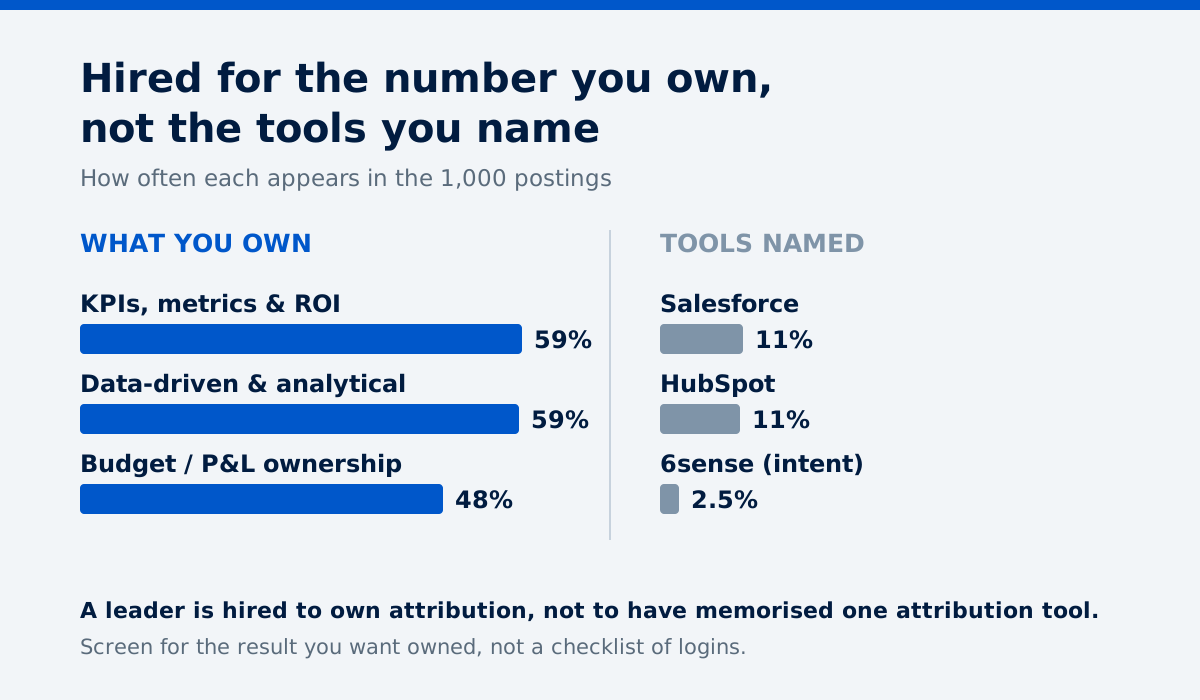
The most common requirements in the entire dataset are not channels at all. 58.9% of postings ask for fluency with KPIs, metrics, and ROI, including analyzing campaign data to track customer engagement and conversion rates. 58.5% want someone data-driven and analytical. 48.4% put budget or P&L responsibility in the role, including managing budgets as a core responsibility. That is the spine of leadership demand gen, you are accountable for spend and for the return on it, and you can defend both with numbers.
Channels and disciplines come next, and they read like a breadth requirement rather than a specialty. This is demand generation work that uses multiple channels and marketing tactics to generate demand and support lead generation across the sales funnel. Pipeline shows up in 37% of postings, field marketing and events in 37%, the funnel as a concept in 35%, lifecycle and nurture in 33%, paid media and paid social in 27.5%, attribution in 25%. Account-based marketing and SEO each land around 17%. No single channel dominates, which tells you these roles want a generalist who can orchestrate a portfolio, not a paid-search specialist who has been promoted.
Here is the part candidates get backwards. The specific martech platforms appear far less often than the concepts they serve. Salesforce shows up in 11% of postings, HubSpot in 10.6%, generic marketing automation in 11.6%, Google Analytics in under 7%, intent platforms like 6sense in 2.5%. A leader is hired to understand systems such as marketing automation platforms, marketing automation tools, CRM software, marketing analytics, and marketing data, not to have memorized one attribution tool, so the postings name the outcome and stay quiet on the software. If you are writing one of these job descriptions, that is the lesson, screen for the result you want owned, not for a checklist of logins.
The soft skills carry real weight and deserve to be read as hard requirements. 60% of postings want cross-functional operators who work closely with sales and marketing teams, including marketing teams and sales teams, and often collaborate with C-suite leaders to align marketing efforts with business objectives. Up to 46% name stakeholder management, 45% want a strategic leader who is still hands-on with campaign execution and campaign performance, bringing analytical skills, leadership qualities, and a proven track record, the player-coach who will build the deck and run the campaign. Storytelling appears in 34.5%, and 16% explicitly want someone who has built a function from scratch or been a first marketing hire. At this level the company is buying judgment and pull across the org, and it is saying so plainly.
Eight years in, and a degree that matters less every year
The seniority bar is high and specific, and the credential bar is quietly falling. These two trends run in opposite directions, and together they tell you the market now prices proven outcomes over pedigree.
On experience, the postings are precise. 88% state a years-of-experience number, and the median ask is eight years. By comparison, a demand generation manager usually needs 3–5 years of B2B marketing experience, while directors of demand generation typically require 7–10 years. The single most common requirement is not eight though, it is ten or more, which appears in 245 of the postings, the largest cluster in the distribution. So while the typical role wants eight years, the modal role, the one you will hit most often, wants a decade. This is a senior market with little room for the ambitious mid-career jump, and it reinforces the usual progression from manager to director.
On education, the bar erodes in plain sight. A bachelor's degree is required or preferred in 44% of postings, an MBA in just 9%, a master's in under 3%. Two-thirds of the postings, 66%, never mention a degree at all, and 12% explicitly add "or equivalent experience" next to any credential they do list. Put those together and the message is unambiguous. A decade of demonstrable pipeline results will open these doors; a degree, increasingly, will not be the thing that does it. The market is reading your track record, not your transcript.
Remote by default, metro by gravity, and brutally competitive
Demand gen leadership is a remote-first market that is still anchored to a handful of coastal hubs, and every opening is contested by a crowd. All three of those things are true at once, and the tension between them is the point.
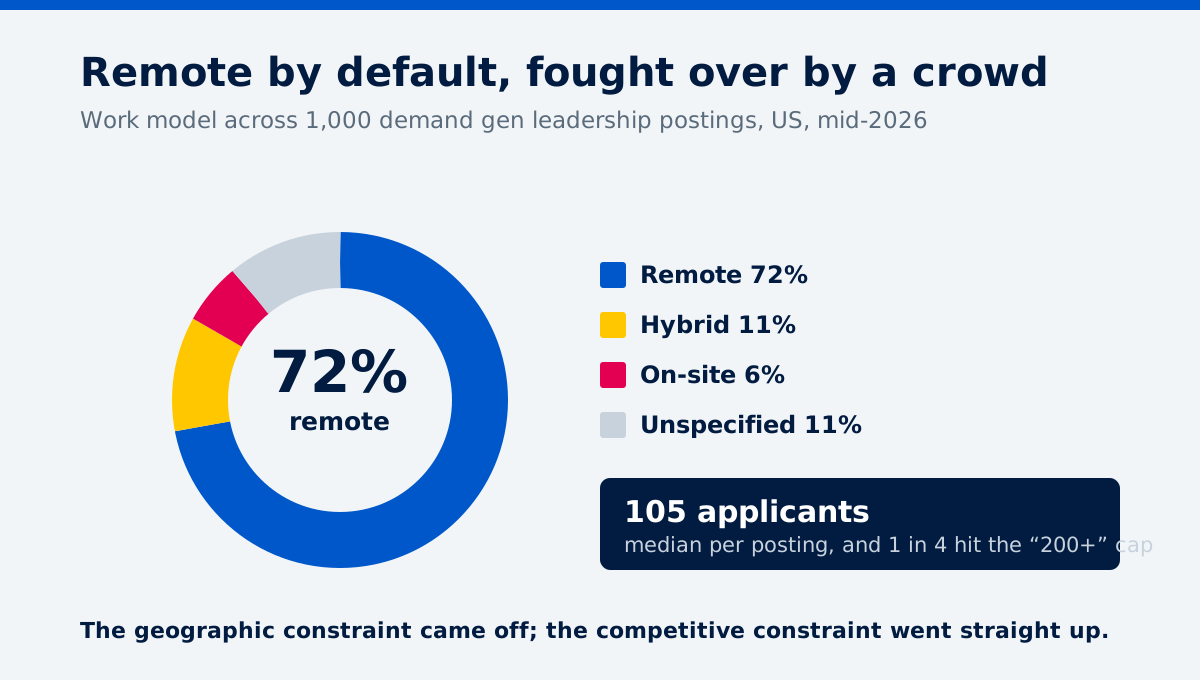
Start with the headline, these roles are remote by default. 72% of the 1,000 postings are fully remote, 11% hybrid, only 6% on-site, with the rest unspecified. Among the postings that state a model at all, 81% are remote. For a senior, build-the-engine role, the office has largely stopped being a requirement.
And yet the geography has not gone anywhere. Even with remote dominant, the postings concentrate hard in a few metros, 152 of them tie to New York City, followed by Los Angeles, Chicago, Austin, Atlanta, and San Francisco. By state, New York alone accounts for 160 postings, California 65, Texas 38. So "remote" here does not mean the work is distributed evenly across the country. It means companies headquartered in New York and California will let you work from home, while the gravity of where these companies exist has not changed. The hubs still set the market; they just stopped making you move there.
The competition is the hard part. The median posting in this dataset has 105 applicants, and roughly a quarter of them sit at LinkedIn's "200-plus" display cap, so for the most contested roles the platform stops counting and you cannot even see how bad it is. The mechanism is the same thing that makes these roles attractive. One-click apply collapses the cost of throwing your hat in to nearly zero, and a remote six-figure leadership title is the most clickable target on the board. That is the trade the remote-default market makes, the geographic constraint came off, and the competitive constraint went straight up. The opening that lets you work from anywhere also lets everyone, anywhere, apply for it.
What this means for sales teams, whether you are hiring or applying
Everything above points to a clear move on both sides of the table.
If you are hiring, write the role around the number you want owned and the AI posture you actually expect, not around a tool checklist. The strongest postings in this dataset do exactly that. They name pipeline and revenue as the mandate. Aligned organizations tend to see 67% higher conversion rates. They say in plain language whether they want someone who uses AI or someone who builds with it, and they leave the platform list short because they are buying an operator, not a license holder. The weakest ones still read like a 2019 demand gen rec with "AI" stapled to the top, and in a market with 100-plus applicants a posting, vague reqs are how you drown in the wrong ones.
If you are the operator, the moat is the intersection of the two things this data keeps circling, owning a number and building with AI across the sales pipeline and the sales process, with a focus on generating high-quality leads instead of raw volume because only 10–15% of B2B leads become paying customers. The first half is the durable core of the role and always has been. The second half is the scarce, fast-appreciating skill, demanded by the best-funded employers, attached to a measurable pay premium, and still rare enough that postings rule out the merely curious. Strong demand generation campaigns can generate leads that produce 209% more revenue when they are built around the right target audience and potential customers. The candidates who can stand in front of a CFO and defend a pipeline forecast, and who have actually shipped something with AI rather than experimented with it, are the ones this market is short of. On the ladder below director, demand gen managers or a demand generation specialist often benchmark against an average salary of $84,876, with a typical $70,000 - $120,000 range and experienced managers earning up to $187,200. We read 771 postings for that rung specifically, and what the demand generation specialist role actually pays shows the same title problem one level down.
That is also why we think the old line between content and demand has stopped being useful. The companies hiring hardest here are not staffing a content team and a demand team and a growth team as separate things; they are hiring one leader to run revenue as a single system, with the demand generation team inside the broader marketing department and coordinated with customer success after handoff, with AI inside the machine rather than bolted to the outside of it. The title on the rec will keep changing. The job, own the pipeline and build the engine that fills it, is the one to get good at.
Want demand gen that's measured on pipeline, not activity?
Content RevOps builds the demand-creation-to-capture system a great demand gen leader runs, content, brand, and automation working as one revenue system, with AI inside the machine rather than bolted to the outside.
Frequently Asked Questions
About the Author

Founder & CEO, Content RevOps
Stefan Kalpachev is the founder and CEO of Content RevOps, where he helps B2B SaaS companies transform their content into predictable pipeline. With a background in content marketing and revenue operations, Stefan has developed a unique methodology that bridges the gap between content creation and revenue generation.
Connect on LinkedIn