What Makes Demand Generation for Enterprise SaaS Hard?
Not sure your demand generation actually fits an enterprise SaaS sale? Start with a content revenue audit.
Book a CallDemand generation for enterprise SaaS is hard because most teams run a playbook built for a different buyer. The standard SaaS demand generation guide assumes one person, moving fast, filling in a form. Enterprise SaaS is the opposite. You are selling to a committee, over quarters, to people who research where you cannot see them and trust marketing less every year. That gap is what a demand generation program built for enterprise sales has to close.
Part of The Complete Guide to B2B Demand Generation Strategy.
Anyone can run ads, publish a blog, and book webinars, so the tactics are rarely what goes wrong. The hard part is that the machine those tactics feed was designed for a self-serve buyer who no longer exists in an enterprise deal.
Here are the six things that actually make demand generation for enterprise SaaS hard, and why each one breaks the usual approach.
1. Why does a buying committee break the usual SaaS funnel?
The first difficulty in enterprise SaaS demand generation is that no single person buys. A group does.
Forrester's State of Business Buying, a survey of more than 16,000 business buyers, found that a typical B2B purchase now runs through 13 people inside the buying organization, and 89% of purchases involve two or more departments. When the software includes generative AI features, which most enterprise SaaS now does, the buying group roughly doubles, from about seven people to fourteen, as more teams demand a say.
A single-persona funnel cannot serve a group like that. The economic buyer cares about payback and risk. The technical evaluator cares about security and integration. End users care about whether it fits their day. Procurement and legal can stop the deal at the finish line. Each one needs a different answer, and your one gated ebook speaks to none of them well.
How fast does the committee grow with the deal?
The bigger the deal, the bigger the room. Adrata, which tracked more than 4,100 buying committees on deals from $30,000 to $2.8 million, found committee size scales almost step for step with contract value.
Deal size | Average committee |
$50,000 | 4.2 people |
$150,000 | 7.1 people |
$500,000 | 11.3 people |
$1 million and up | 15.8 people |
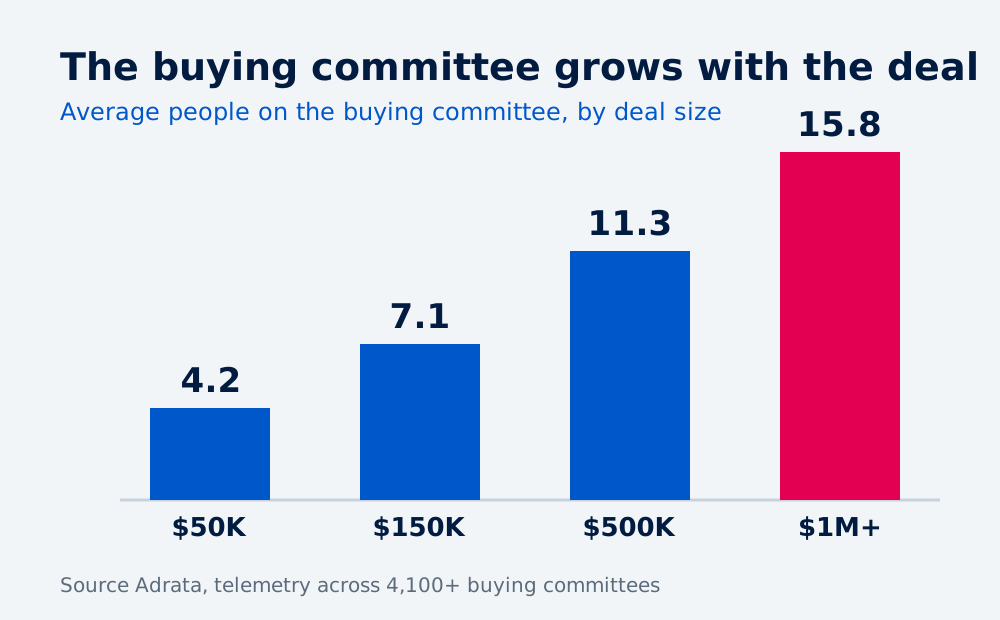
At enterprise contract values, the room holds a dozen or more people across legal, security, finance, procurement, and several business units. The champion who loves your product cannot carry that room alone.
Why does multi-threading decide the deal?
The same data shows why this is a demand generation problem and not only a sales problem. Won deals engaged an average of 8.4 committee members. Lost deals engaged 4.9. Reaching more of the committee, earlier, is the difference between a close and a stall, which is also where ABM and demand generation start to overlap.
That is a job demand generation has to start, long before sales gets involved. If your programs only ever reach one title, you are building pipeline that dies in the committee. This is the real line between demand generation and lead generation, and enterprise SaaS is where the difference gets expensive.
2. How long does an enterprise SaaS deal take to close?
The second difficulty is time. An enterprise SaaS deal does not close this month, so the demand you create this month cannot be judged this month.
Ebsta and Pavilion, analyzing 9,338 sales teams, put the median sales cycle for deals over $100,000 at 84 days, against 21 days for deals under $10,000. Their data also shows enterprise cycles lengthened 16% between 2022 and 2024. The bigger the deal, the longer the wait, and the wait is getting longer.
At the top of the market it stretches further. Optifai's pipeline study of 939 B2B SaaS companies found enterprise deals over $100,000 take 90 to 180 days or more, and that cycles have lengthened 22% since 2022 as committees grow and security reviews pile up. As a rough rule from ICONIQ's go-to-market benchmarks, the cycle roughly doubles for every fivefold step up in contract value.
How long does enterprise SaaS payback take?
The long cycle also lands on demand generation, through cost. Enterprise contract values are large, and so is the cost to win them. At contract values above $150,000, Optifai puts customer acquisition payback at 18 to 24 months.
So the money you spend creating demand today takes one to two years to come back. But most demand generation programs get reviewed every quarter against leads booked this quarter, and budgets get allocated on the same clock. A program that will produce six-figure pipeline in nine months looks like a failure in month two, and it gets cut before it ever pays back. The cadence of the reporting fights the cadence of the sale.
3. Why does attribution break over a long, dark enterprise cycle?
The third difficulty follows from the second. When a deal takes the better part of a year and touches a dozen people across channels you cannot see, you cannot cleanly tie pipeline to a campaign.
6sense's research on more than 900 buyers found the average buying journey lasted about 11 months, and buyers did not speak to a salesperson until roughly month eight. Buyers started the conversation themselves 83% of the time. For most of the deal, you are not in the room and not on the record.
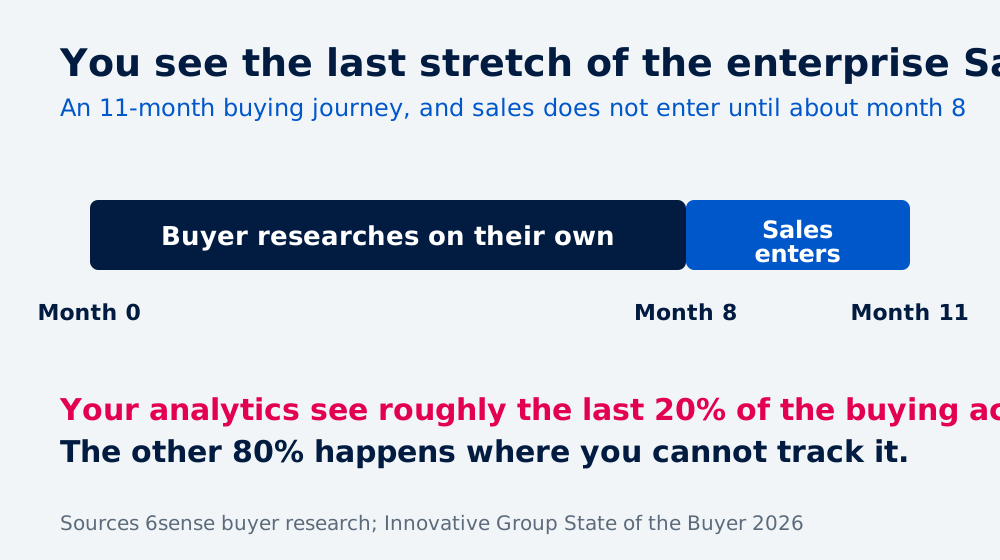
That leaves your measurement blind to most of the work. Innovative Group's State of the Buyer puts it plainly. About 83% of the buying journey now happens away from sales reps, the traffic and pipeline you can measure is roughly a 20% slice of the real activity around your category, and a last-touch model undercounts marketing's contribution by an estimated three to five times. The channels doing the most work, like a founder's posts, a podcast, a community, tend to score worst on last-touch attribution, so they are the first to get cut.
How do you measure committee members who never appear?
Adrata found that "invisible" committee members, people who shape the decision but never take a call, show up in 73% of deals over $100,000, and that a growing share of the committee now engages only asynchronously through shared documents and internal messages. You cannot attribute a deal to a touch when a third of the deciders never touch anything you track.
What should you watch instead of leads?
The way we think about this is to stop scoring content on leads and start pricing what it fails to earn. When we run a content revenue audit, we turn each gap into a dollar figure with the assumptions shown on the page, from striking-distance rankings to weak calls to action to invisibility in AI search. That reframes the conversation away from this month's MQLs and toward pipeline created, deal quality, and cycle length, which is how you tell which page actually started the deal. Those are the numbers a long enterprise cycle rewards.
4. Where does enterprise SaaS demand actually form?
The fourth difficulty is location. The enterprise SaaS buyer builds a shortlist before they ever land on a page you control, in places that have no lead form at all.
Our analysis of 2,094 B2B SaaS blogs found the capture layer is broken even for the traffic that does arrive. Fewer than one in ten of those blogs had both a call to action aligned to the reader's intent and a clear path from the post to a signup or demo. Intent-aligned CTAs showed up on only 8% to 18% of blogs, a clear blog-to-conversion path on only 7% to 10%, while roughly three-quarters of the content sat at the top of the funnel. If you want the mechanics, we wrote up why a SaaS blog gets traffic but no signups, and how we design the conversion layer that fixes it.
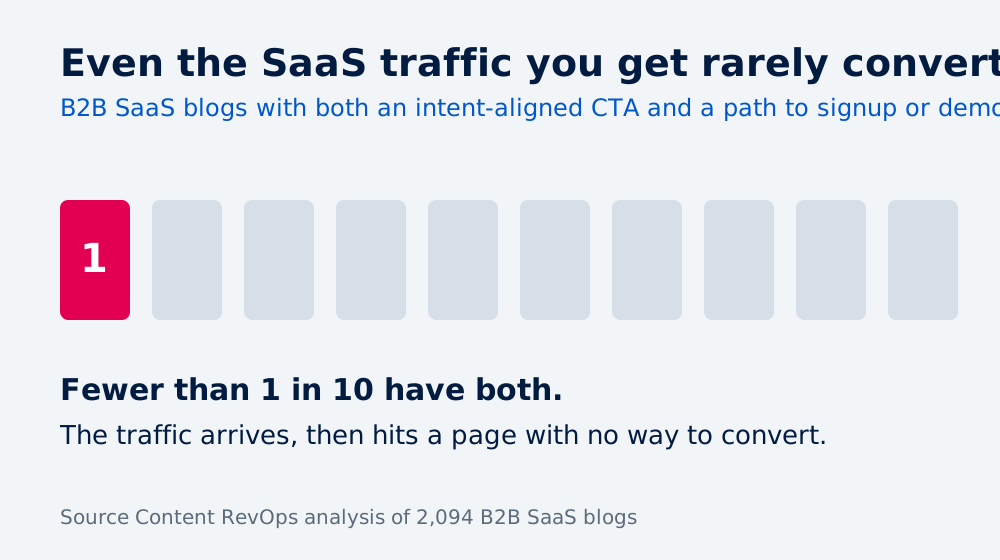
So the model most teams run, drive traffic to a gated asset, is losing on both ends. It measures only the fraction of demand that reaches the site, and it fumbles that fraction when it arrives. It is one of the demand generation mistakes that costs enterprise teams the most.
Which channels build the shortlist?
Ipsos's B2B Buyer Journey report asked buyers which channels they rely on. The top answers were word-of-mouth recommendations at 70%, product review sites at 63%, in-person events at 57%, and webinars at 44%. One technology buyer described the process in the report: "We now use LLMs, review sites, analyst content, public documentation, pricing pages, and peer feedback to narrow the field before engaging sales."
The 2024 Demand Gen Report buyer survey shows the same drift. Peer reviews are now among the first three resources a third of buyers reach for, and reliance on LinkedIn jumped from 36% to 55% in a single year. The buyer on Reddit describing the search for a vendor said it best: the wins come from "channels that already have trust." That is why distribution matters as much as the asset itself.
AI answers are now one of those channels. In one study of 1,800 prompts, B2B SaaS queries returned a Google AI Overview about 46% of the time, so a buyer often gets a synthesized shortlist before they click anything at all. We covered what that does to the top of the funnel in how AI is changing top-of-funnel demand generation.
This is the ground Chris Walker, the founder of Refine Labs, mapped as the dark funnel: demand gets created in places you cannot track, so you have to create it broadly rather than only capture the sliver that reaches a form. For enterprise SaaS, that is the difference between creating demand and capturing it.
5. Why do enterprise buyers trust marketing less since AI?
The fifth difficulty is trust, and it gets harder every year.
The 2026 B2B Buying Disconnect report from TrustRadius, a survey of 1,862 buyers and 444 vendors, found that 63% of buyers used AI in their buying process, yet 47% trust online resources less than they did a year ago, up from 39%. Ninety-four percent fact-check what AI tells them. When they decide what to trust, vendor marketing collateral ranked last, analyst report usage fell 63% since 2022 to just 13%, while 74% consulted customer reviews and 53% talked to a peer. The resources buyers are abandoning are the ones that feel controlled.
AI is the accelerant. When it costs almost nothing to produce a competent article, competent articles stop being worth much. Graphite's crawl analysis found AI-written articles passed human-written ones on the open web in late 2024, reaching 51.7% of new articles by May 2025, and Ahrefs found some AI text on 74.2% of newly published pages. Feed the same models the same prompts and every brand in a category converges on the same voice, which is why finding ideas before a topic is saturated now matters. Even content's influence on the decision is slipping; the Demand Gen Report found the winning vendor's content had a significant impact for 67% of buyers, down from 81% a year earlier.
Who owns the AI answer today?
There is a second trap inside the trust problem. In the place buyers now go first, the answer engine, a few big brands own the citations.
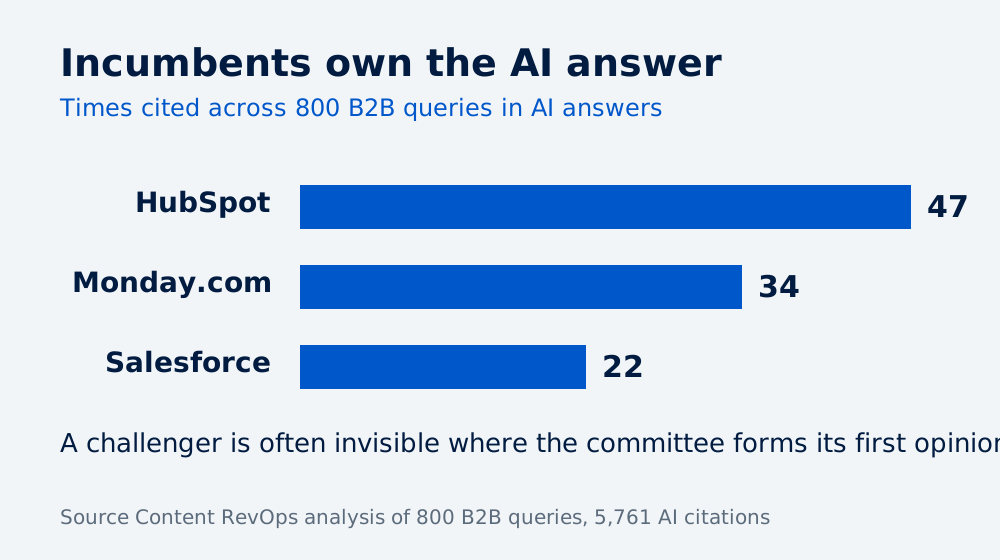
Our analysis of 800 B2B queries, which produced 5,761 citations, found the answers concentrate on incumbents. HubSpot was cited 47 times, Monday.com 34, and Salesforce 22, while comprehensive guides made up only about 11% of all citations. A challenger in enterprise SaaS is often invisible in the exact spot where the committee forms its first opinion, even when it ranks well on Google.
The one piece of good news sits in the same data. Even with machines writing half the web, Graphite found 86% of the pages that actually rank in Google are still human-written. The moat a content engine cannot manufacture is a recognizable brand, an owned audience, and proof you can stand behind, like a flagship piece of original research. Trust is the scarce asset now, and showing up in AI search depends on earning it rather than producing more volume. The same goes for owning what AI says about you once you do appear.
6. Why is demand generation help so hard to buy?
The sixth difficulty is that fixing the first five is hard to outsource, because the market you would hire from is thin and confusing.
Start with the label. As one B2B SaaS practitioner put it in a video comparing agencies, "demand generation is the most misused term in B2B SaaS; most agencies selling demand gen are actually running lead gen." You go looking for help creating demand across a committee and a long cycle, and you get an outbound lead vendor with a new name. The lead generation versus demand generation confusion shows up in the buying process too.
Our study of 1,700 demand generation agencies shows how thin the field is:
- 70% run no real demand engine of their own, and only 10% run a strong one.
- Agencies with a strong own engine scored 79 on content quality against 35 for the rest.
- 35% name no senior team at all.
- 69% are generalist or shallow in any given vertical.
- Only 2.8% clear every operator criterion at once.
Why does the agency's stage matter so much?
Even a good agency can be the wrong one. A team that wins for a seed-stage startup often fails at enterprise scale, and the reverse is just as true. Buyers on Reddit describe it exactly. One warned that "agencies that work for sub-£1m companies often fail at £5m to £20m," and wants a partner that "starts with the commercial bottleneck, pipeline, deal quality, sales cycle length." Another burned £70,000 on an agency whose senior team vanished after week two. That is a total cost of ownership problem as much as a fit problem. If the work you hand over is content rather than the whole program, the same fit check sits behind our list of content marketing agencies for enterprises, which kept the ones that show large named clients and a team that can work next to yours.
For enterprise SaaS, that means choosing a demand generation partner is part of the difficulty itself. The bar is a partner who has actually built demand for a committee-led, six-figure, long-cycle sale, which is a narrow slice of a thin market, and the timing of the hire matters as much as the pick. Some teams weigh it against building in-house. We keep a running view of the ones that clear the bar for enterprise buyers and for B2B SaaS, drawn from the same agency landscape data.
What do all six difficulties have in common?
All six trace back to one problem. The content and demand machine most enterprise SaaS teams run was built for a single buyer, a short cycle, a trackable click, and a market that still trusted marketing. Every one of those assumptions is now false.
The fix is to give your content estate a real job across the sale you actually make: reach the whole committee, hold their attention across quarters, earn trust in the channels they check, and be present where they look before they ever fill in a form. That is content and demand generation working together as revenue infrastructure instead of a lead-capture layer, and it is the version of demand generation an enterprise go-to-market rewards. If you are building that machine, start with how to build a demand generation engine step by step.
If you want to see where your current content is leaking pipeline, that is exactly what a content revenue audit is for.
Is your content creating demand across the whole committee, or just chasing this month's leads?
We turn an enterprise SaaS content estate into revenue infrastructure that reaches the buying committee, earns trust, and shows up where buyers actually look.
Frequently Asked Questions
About the Author

Founder & CEO, Content RevOps
Stefan Kalpachev is the founder and CEO of Content RevOps, where he helps B2B SaaS companies transform their content into predictable pipeline. With a background in content marketing and revenue operations, Stefan has developed a unique methodology that bridges the gap between content creation and revenue generation.
Connect on LinkedIn