SaaS Demand Generation in 2026: What Actually Works
Ready to turn demand gen into a compounding system (not quarterly campaigns)? Let’s build your content operating model.
Book a CallIn 2026, SaaS demand generation is evolving fast for a simple reason: buyers have more options, more content, and more AI-assisted research than ever—yet purchasing still feels slow, risky, and politically hard. Deals stall not because prospects can’t find information, but because they can’t trust it, align on it, or apply it across a buying committee with competing priorities.
Part of The Complete Guide to B2B Demand Generation Strategy.
B2B SaaS adds extra friction: long evaluation cycles, technical scrutiny, security and compliance requirements, and a growing preference for rep-light journeys where people want to learn without booking a call. Analyst data shows 75% of B2B buyers now prefer a rep-free sales experience, even as average buying groups expand to 6–10 stakeholders, which compounds internal misalignment and “unhealthy conflict” around big software decisions. Meanwhile, acquisition costs keep rising, making “run more ads” a fragile plan.
In this context, SaaS demand generation isn’t lead capture. It’s an education-led system that creates, captures, and converts demand over time—by reducing uncertainty and helping multiple stakeholders reach confidence together. Tech marketers who treat content as a strategic asset already report strong results on this front, using content to drive demand, lead gen, and revenue rather than just top-of-funnel traffic.
This article will cover:
Why demand gen works so well for B2B SaaS
What makes SaaS demand gen different from other categories
Which strategies are actually working in 2026
The connective thread is a shift in operating model: content as a product, and content as the go-to-market operating system—built to compound, enable sales, and move pipeline, not just “publish more.” That includes everything from education-led programs that build buyer trust to always-on content products and free mini tools that function like lightweight extensions of the SaaS itself, creating a more retail-like, self-guided buying experience in an enterprise context.
Why Demand Generation Works So Well in B2B SaaS
1.1. Teaching at Scale in a High-Uncertainty Category
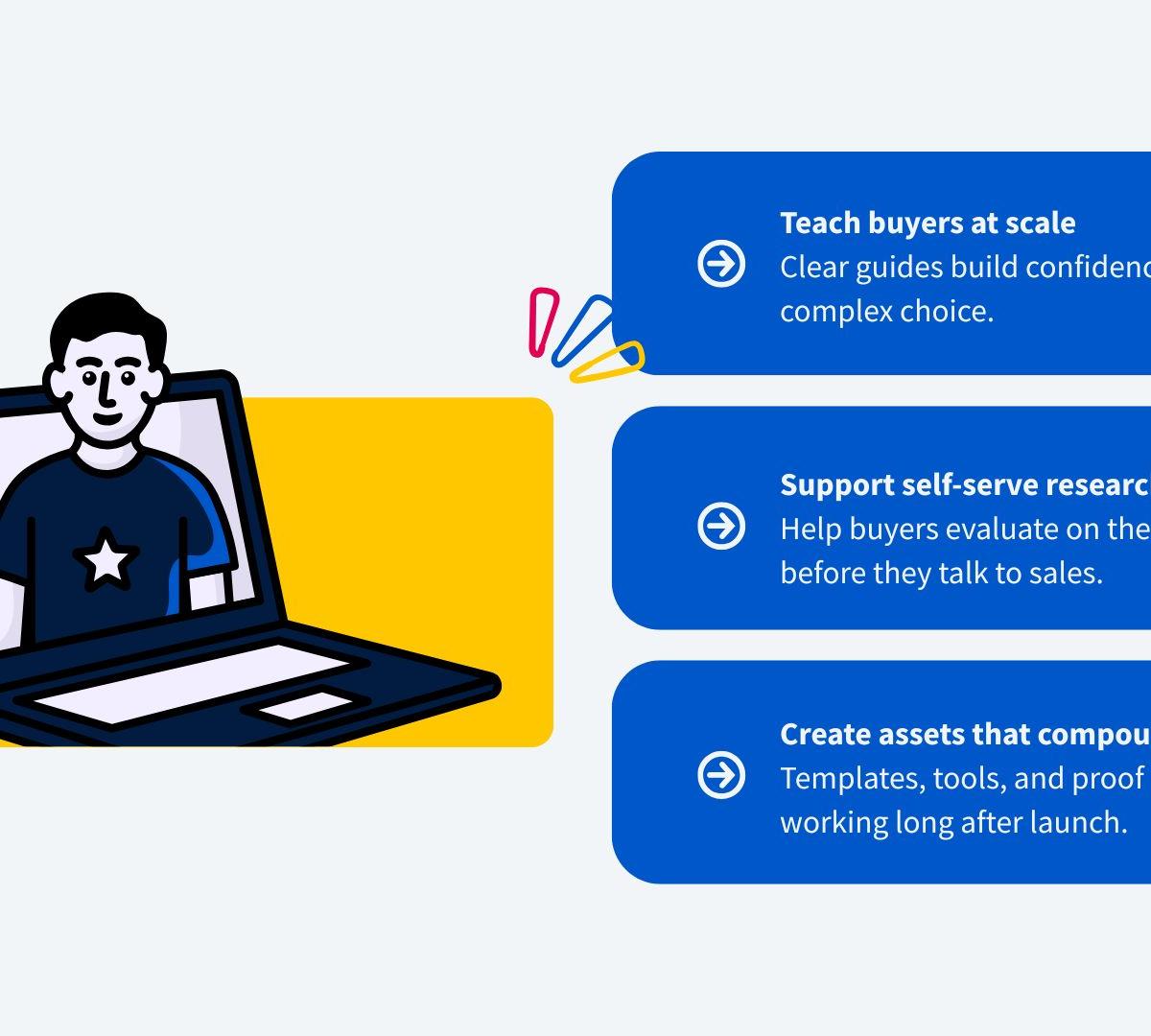
Modern SaaS categories are crowded, features look similar, and the real differentiation often lives in implementation details buyers can’t see from a homepage. That creates uncertainty, which is why demand generation works: it scales teaching, not hype. In complex B2B environments where over three-quarters of buyers describe their last purchase as “very complex or difficult,” structured education is often the clearest differentiator.
When you lead with workshops, explainers, templates, and practical guides, you give buyers a way to understand the problem, compare approaches, and anticipate tradeoffs. In SaaS, that education becomes the product’s “pre-onboarding,” building confidence before anyone clicks Book a demo and functioning as buyer enablement, not just promotion.
It also helps buying committees talk to each other. With 6–8 stakeholders commonly involved in software decisions and a high incidence of “unhealthy conflict” inside those groups, demand gen creates shared language so stakeholders can align without inventing their own definitions (and arguing about them).
1.2. What “teaching at scale” looks like in SaaS
Role-aware explainers (exec outcomes, technical feasibility, day-to-day workflow) grounded in real buyer research rather than generic feature rundowns
“How to evaluate” checklists that reduce internal debate and map directly to risks, tradeoffs, and success metrics
Proof that feels instructional (benchmarks, teardown-style case studies, and research-backed playbooks that show how similar teams actually solved the problem)
1.3. Enabling Rep-Light, Self-Serve Journeys
Most B2B buyers now want to do serious research without a sales rep. Demand gen is how you meet that expectation while still guiding decisions. The goal is to build decision infrastructure: assets that let buyers progress on their own, then make sales conversations faster and more precise when they happen.
Think self-serve demos, interactive tours, sandbox accounts, and deep resource hubs that answer the questions buyers are already circulating internally. In sectors where around 75% of buyers express a preference for a rep-free experience, these self-serve assets become the primary battlefield for shaping the shortlist. The same materials that help someone self-educate also become the collateral a champion uses to sell the decision inside the account, much like cohesive “deal rooms” that centralize everything a committee needs in one place.
1.4. Compounding Assets vs. Linear Spend
Paid campaigns are often linear: when spend stops, so does momentum. That maths matters most on a runway, which is why we keep a separate list of demand generation agencies for startups. Demand gen can compound because the assets remain useful and discoverable. In SaaS, that matters because acquisition is expensive and trust takes time—so you want marketing that gets cheaper per outcome as it matures.
Compounding demand assets include:
Content hubs built around real buyer decisions (not random blog topics), behaving more like a focused “content product” than a traditional blog
Tools, calculators, and templates that keep earning attention—for example, narrow, free SaaS mini-tools that rank for high-intent problems and quietly feed your funnel over time
Case libraries and benchmark reports that repeatedly answer late-stage objections and mirror the kinds of content tech marketers consistently rate as top performers for demand and revenue impact
These assets shorten cycles by pre-answering the same questions across multiple stakeholders—before they become blockers—and they accumulate authority, organic traffic, and brand mentions in a way one-off paid campaigns rarely do.
1.5. Aligning Marketing With Revenue Reality
B2B SaaS doesn’t win on awareness alone; it wins on clarity, risk reduction, and internal consensus. Demand gen aligns with that reality because the best-performing formats—webinars, case studies, and research—are directly usable in active deals and are consistently reported as among the most effective channels for both lead generation and sales impact.
When content is designed as an operating layer across marketing, sales, and success, it stops being “top of funnel” and starts doing measurable work: improving conversion rates, reducing sales cycle length, and supporting expansion by making customers smarter and more successful with the product. Treating this layer as an education-led system—rooted in instructional design and mapped to how committees actually evaluate risk—turns marketing into a structural advantage instead of a set of disconnected campaigns.
What Makes SaaS Demand Gen Different From Everything Else
1.1. Long, Trust-Led Buying Cycles
Most SaaS purchases aren’t “marketing wants it, sales closes it.” They’re commitments that touch sensitive data, core workflows, and multi-year roadmaps. That raises the bar from feature education to risk reduction. Buyers need to believe you’ll be competent, stable, and supportive long after implementation, especially when 77% of B2B buyers describe their last purchase as “very complex or difficult” and cite internal confusion as a major blocker to decisions.
That’s why demand gen works so well in SaaS: it scales teaching in a way that keeps attention and confidence alive over months, not weeks. Education-led programs that act more like buyer enablement than promotion consistently outperform generic campaigns in trust and sales impact. In practice, the goal isn’t to “create leads,” it’s to remove uncertainty until a committee can say yes without feeling exposed.
1.2. Technical Buyers and Buying Committees
SaaS deals rarely have a single buyer. You’re selling to a chain of stakeholders with different definitions of “safe” and “worth it,” and internal conflict is common—Gartner data shows 6–8 people are typically involved in a B2B software deal, and 74% of buying teams report “unhealthy conflict” during decisions.
Effective demand gen pre-packages proof by role so the team can align faster, functioning like a shared reference point instead of a pile of assets no one reads:
Security/IT: security posture, access model, compliance evidence, integration architecture
Finance: ROI logic, TCO model, payback narrative, ideally built around clear calculators and benchmarks rather than high-level promises
Ops/Users: workflow fit, time-to-value, change management, usability walkthroughs grounded in specific use cases and before/after stories
Legal/Procurement: terms clarity, governance, vendor risk answers, plus a coherent “deal room” or resource hub rather than scattered decks and PDFs
When this proof is structured as a cohesive content system, not random collateral, tech marketers report significantly higher effectiveness in lead nurturing and revenue contribution.
1.3. Self-Service Expectations vs. Enterprise Scrutiny
Modern buyers increasingly want a rep-light path: try, evaluate, and learn on their schedule. Surveys show 75% of B2B buyers would prefer a rep-free experience for most of the journey, and adoption of self-serve content and interactive tools keeps rising across tech categories. At the same time, enterprise scrutiny doesn’t go away—it just shows up later as deeper diligence once a shortlist exists.
Winning demand gen bridges both with a two-speed experience: lightweight self-serve entry points (demo, tool, template) paired with “deal room” depth (documentation, proof packs, implementation playbooks). Free “mini tools,” instant demos, and ungated walkthroughs serve as low-friction entry, while structured resource hubs and standardized proof packages let buying committees do serious evaluation without needing a rep at every step.
1.4. High CAC and the Need for a Content Operating System
With SaaS unit economics, inefficient acquisition bleeds margin. The average tech marketer already leans heavily on content for awareness, demand, and revenue, but only a minority feel their approach is truly effective, and attribution remains a top pain point. So demand gen can’t be disconnected campaigns that reset every quarter. It has to compound.
The shift in 2026 is treating content as infrastructure: one narrative, reusable assets, and a RevOps-aligned system that supports awareness and sales progression—reducing reliance on constant ad spend while making each buyer touchpoint more consistent and credible. That often looks like a “content product” or always-on resource hub designed around one ICP and one core trigger, with self-serve tools, webinars, and case-led education woven into a single journey rather than scattered across channels.
The Core Play: Build a Content Product Around One ICP, One Trigger, One Product
In 2026, SaaS demand generation works best when it reduces uncertainty for buying committees and supports rep-light research. That doesn’t happen through “more content.” It happens when you build decision infrastructure: a content product that teaches buyers how to solve a specific problem, then naturally shows why your SaaS is the easiest way to operationalize the solution.
1.1. One ICP: Narrow to Where You Can Win
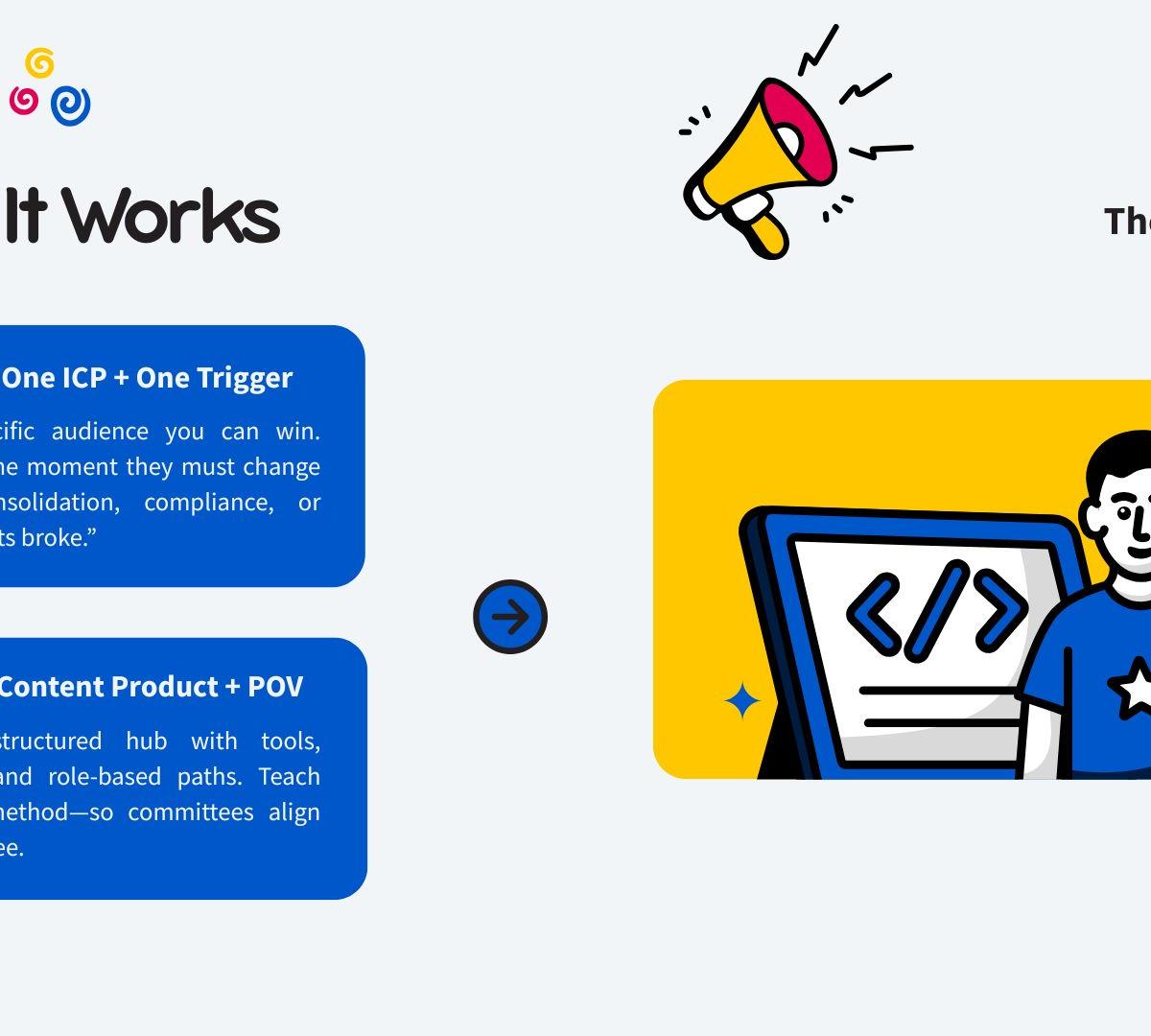
Start with a focused, reachable, commercially meaningful ICP—narrow enough that your message feels like it’s written for them, but large enough to build a pipeline. Think: “VP RevOps at 50–500 employee PLG SaaS companies,” not “B2B revenue teams.”
Use criteria that reflect how SaaS is actually bought:
Urgency of pain (a problem severe enough to justify change)
Online visibility (they self-educate in public: search, LinkedIn, communities)
Willingness to switch (existing tools/workflows are failing)
Buying power + LTV (enough value to amortize CAC)
Committee complexity you can serve (finance, IT, security, end users)
Narrowing isn’t a branding exercise—it’s how you create clarity for multi-stakeholder decisions. Generic messaging can’t align a committee because it doesn’t give each stakeholder a crisp reason to agree, and most tech marketers already admit their content is only “moderately effective” despite high investment, with top performers winning through deeper audience understanding and focus, not volume.
1.2. One Trigger Moment: Anchor on a Job-to-Be-Done
Your organizing center is the trigger, not the product. The trigger is the inflection point that forces a rethink: post-Series B scale, consolidation mandates, compliance deadlines, or “spreadsheets finally broke.” In those moments, buyers are dealing with what research describes as “complex or difficult” purchases driven by fragmented research and larger buying groups, so they gravitate toward whoever can simplify the decision.
Build your narrative around the before → after:
Before: workarounds, manual processes, hidden risk, internal conflict
After: a new operating standard, clearer ownership, measurable outcomes
This is also how you map distribution. When the trigger hits, buyers don’t search for “best SaaS.” They search for answers, compare approaches, and ask communities what’s safe and proven. Your job is to become the teacher they repeatedly run into during that research loop—through education-led content that functions as buyer enablement, not just promotion—so that by the time they talk to sales, they already share your mental model of the problem.
1.3. One Content Product: A Productized Knowledge Hub, Not a Blog
A blog is episodic. A content product is structured, evolving, and designed like software—navigation, paths, outcomes, updates. It should feel like an extension of your SaaS that buyers can use before they’re ready to talk, mirroring the kind of cohesive, one-click “deal room” experience that’s becoming table stakes in modern buying journeys.
Core building blocks:
Diagnostics and calculators (ROI, readiness, cost-of-delay)
Templates, checklists, and scripts (for rollout, stakeholder alignment, evaluation)
Mini tools / free feature spin-offs (frictionless “try” moments)
Benchmarks and scenario planners (to make tradeoffs concrete)
Role-based tracks (IT/security, finance, operator, exec sponsor)
Diagnostics, benchmarks, and interactive tools pull double duty as both education and proof of value; they behave more like “always-on content products” than static assets and steadily lower CAC by compounding organic visibility and demand over time. Mini tools and free feature spin-offs, in particular, have emerged as far more effective demand engines than traditional PDFs or gated assets because they let buyers experience a slice of the solution with near-zero friction.
This is Content RevOps in practice: content as infrastructure that enables decisions, supports sales, and compounds over time—rather than resetting every quarter. Tech marketers who take this productized, journey-aligned approach are the ones reporting the strongest impact on demand, pipeline, and revenue, even in resource-constrained teams.
1.4. Differentiate With a Clear Point of View (POV)
Utility is table stakes now. “How-to” content is everywhere, and buyers are overwhelmed. Your content product needs a POV that cuts through and helps committees agree. In markets where 6–8 stakeholders may be involved in a decision and most of them prefer rep-free research, a clear POV is what turns scattered content into a coherent commercial narrative that can be forwarded, discussed, and defended internally.
A simple SaaS POV framework:
Name the real problem and why common approaches fail in your ICP’s context
Reframe the stakes in the language of risk, time, and internal credibility
Teach a method (your playbook) that your product makes repeatable
Prove it with breakdowns (teardowns, examples, and decision templates)
Consistency is the multiplier. The same POV should show up across your hub, workshops, podcasts, outbound, and sales decks—one commercial narrative tied to one ICP and one trigger. When that POV anchors immersive, education-led experiences (like structured workshops and webinars) and extends into self-serve tools and resources, demand gen becomes compounding, not campaign-based.
Making It Visible Everywhere: Distribution Strategies That Actually Work in 2026
In 2026, distribution isn’t “post it and pray.” SaaS buyers research in loops, often without talking to sales, and they need clarity they can share across a committee. The win goes to teams that turn the same content product (your hub of tools, templates, benchmarks, playbooks, and role-based tracks) into a single operating system that shows up wherever buyers look—search, AI answers, social, communities, and workshops.
1.1. GEO / AEO / SEO: Discovery Beyond Keywords and Backlinks
SEO still matters, but the unit of success is topic authority around a trigger moment, not keyword density. The fastest path is utility: pages that do work for the buyer (and therefore earn attention, links, and repeat visits naturally).
Prioritize:
Tools and mini-calculators that compress “time to insight” and function as always-on content products, not just static lead magnets
Templates and frameworks that teams can reuse internally as buyer enablement assets, not just blog attachments
Comparison and evaluation pages that reduce decision conflict across a buying committee
Role-based proof packs (security, ROI, integrations) that support self-serve diligence for each stakeholder
AEO (Answer Engine Optimization) is about becoming the default response. Structure each core page so an assistant can lift the answer cleanly: explicit questions, a canonical “best answer,” short summaries of your method, and consistent markup.
GEO (Generative Engine Optimization) is the durability layer: keep your company, product, use cases, and definitions consistent across your site, partner pages, and profiles. Generative systems reward repetition and consistency—especially when it’s tied to a specific problem space and POV, and reinforced by education-led marketing that builds trust in complex B2B decisions.
1.2. Brand Mentions, Podcasts, and Thought Leadership Platforms
In generative discovery, unlinked brand mentions and expert citations often function like modern authority signals. Every appearance is another “node” that reinforces your POV and makes your content product easier to discover and trust.
Use platforms like Featured and Podmatch to:
Get your founders/SMEs quoted in relevant publications as category explainers, not just product advocates
Land podcast interviews where you can teach the method (not pitch) and give buyers a shared narrative to circulate internally
Reference your hub’s flagship tool or benchmark as the “next step,” similar to how free SaaS tools act as loss-leading demand-gen engines
The goal is simple: many consistent explanations of the same POV, across many trusted surfaces, so algorithms and humans both recognize your expertise.
1.3. Founder and Expert Branding on LinkedIn + Content-Led Outreach
LinkedIn remains the highest-yield network for reaching buying committees because it’s where stakeholders validate decisions socially, and where tech marketers already report the strongest content ROI. The play is repetition with usefulness: founders and SMEs publish short, practical lessons that all point back to the hub.
What to post:
Teardowns, mini demos, and “how we solved X” threads
Clips from workshops/webinars
Practical POV summaries (“Our method in 6 steps”)
Then combine it with content-led outreach: send a relevant tool output, template, or workshop invite tailored to the recipient’s trigger—no generic pitch, no forced meeting. This blends inbound trust-building with outbound motion into one RevOps-aligned system and mirrors how top-performing tech marketers map content to the full buyer journey instead of relying on one-off campaigns.
1.4. Owning Reddit and Community-Led Demand
Reddit is where buyers say the quiet part out loud. Show up early, and treat it like a long game.
Daily behavior:
Answer questions in relevant subs with real specifics
Share breakdowns that mirror your hub’s playbooks
Build karma and familiarity before you ever promote
Promotion rules:
Keep direct promotion mostly inside your brand subreddit
In neutral subs, link only when it’s clearly the best next step (a mini tool or deep dive)
Done right, Reddit also becomes your research engine for messaging, objections, and new hub modules, at a time when most tech marketers still underuse community and online learning environments despite long, self-serve buyer journeys.
1.5. UGC-Based Funnels and Founder VCLs
User-generated content turns your hub into proof, not just instruction. Run campaigns that invite participation—template remixes, challenge submissions, benchmarks—then curate the best inside the hub as living social proof.
A high-converting flow:
Download template/white paper/mini tool
Route to a short founder VCL: “Here’s the playbook—and here’s how we operationalize it inside the platform.”
Offer a low-friction next step: interactive demo, workshop registration, or a tailored audit
This closes the gap many teams have between high-consumption content and low action rates, by directly connecting educational assets to product value and social proof.
1.6. Webinar-Based Outreach and Relationship Building
Webinars work best when they’re not “events,” but a repeatable workshop series that teaches the method behind the content product. They also create a safe reason to invite gatekeepers and internal champions into a shared learning moment, a format tech marketers consistently rank among their most effective channels for both demand generation and lead nurture.
Operationalize with a standard kit (landing page, reminders, follow-up, nurture), then repurpose everything into:
Hub modules
LinkedIn clips
Reddit answers
Blog breakdowns and tool updates
This is how you turn one teaching asset into omnipresence—without multiplying effort linearly, and in line with how modern SaaS buyers prefer self-guided, low-friction education long before they talk to sales.
Conclusion: From Campaigns to a Demand Operating System
SaaS buying in 2026 is complex, increasingly rep-light, and trust-starved. Buying committees do their own research, disagree internally, and stall when the risk feels unclear. Demand gen works because it teaches at scale: it reduces uncertainty, creates shared language across stakeholders, and compounds over time through durable assets that keep showing up wherever buyers learn, mirroring how 77% of B2B buyers describe their last purchase as “very complex or difficult” and how education-led marketing rebuilds trust in that environment.
The winners aren’t publishing the most. They’re building a content product around one ICP, one trigger moment, and one product, then distributing that point of view everywhere buyers look: search and AI answers, podcasts and quotes, LinkedIn feeds and DMs, Reddit threads, and workshop-style webinars that move from insight to action. In practice, that can look like a modular resource hub with live sessions, deep guides, and even lightweight free SaaS tools or calculators that act as always-on demand assets, not just static content.
A Content RevOps lens is what turns this into an operating system, not a pile of tactics:
Content as infrastructure: one hub, many paths (role-based proof, tools, workshops, demos) that behaves more like a self-serve “deal room” than a traditional blog, aligning with how cohesive, centralized buying experiences shorten cycles and reduce internal conflict.
Every asset has a job: awareness → interest → engagement → MQL, plus sales enablement—mapped deliberately to how tech marketers who outperform their peers design content to prompt action at each stage of the journey, not just drive traffic.
Revenue-grade measurement: pipeline influence, stage conversion, CAC pressure relief—not vanity metrics—using engagement data as “breadcrumbs” to see which assets accelerate deals, which stakeholders engage, and where committees get stuck.
Implementing this takes research, a tightly defined commercial narrative, structured calendars, integrated activation, and reporting that matches how real SaaS deals move. Teams weighing an outside partner for that build can start from our review of demand generation agencies for B2B SaaS, which kept 15 of the 683 agencies we checked. It also demands an operating model where content, product, and sales share one POV on the ICP’s trigger moments, supported by formats that today’s buyers actually trust—case studies, live workshops, interactive tools, and role-specific enablement. In 2026 and beyond, companies that treat demand gen as a productized, revenue-facing system—not just marketing output—are the ones buyers trust and committees rally around, especially as more than 70% of tech marketers already see content directly contributing to sales and revenue but only a minority have turned it into a true operating system.
Is your demand gen built to move pipeline—or just make noise?
Get a Content RevOps blueprint that turns content into decision infrastructure: role-based proof, self-serve journeys, and revenue-grade measurement.
Frequently Asked Questions
About the Author

Founder & CEO, Content RevOps
Stefan Kalpachev is the founder and CEO of Content RevOps, where he helps B2B SaaS companies transform their content into predictable pipeline. With a background in content marketing and revenue operations, Stefan has developed a unique methodology that bridges the gap between content creation and revenue generation.
Connect on LinkedIn