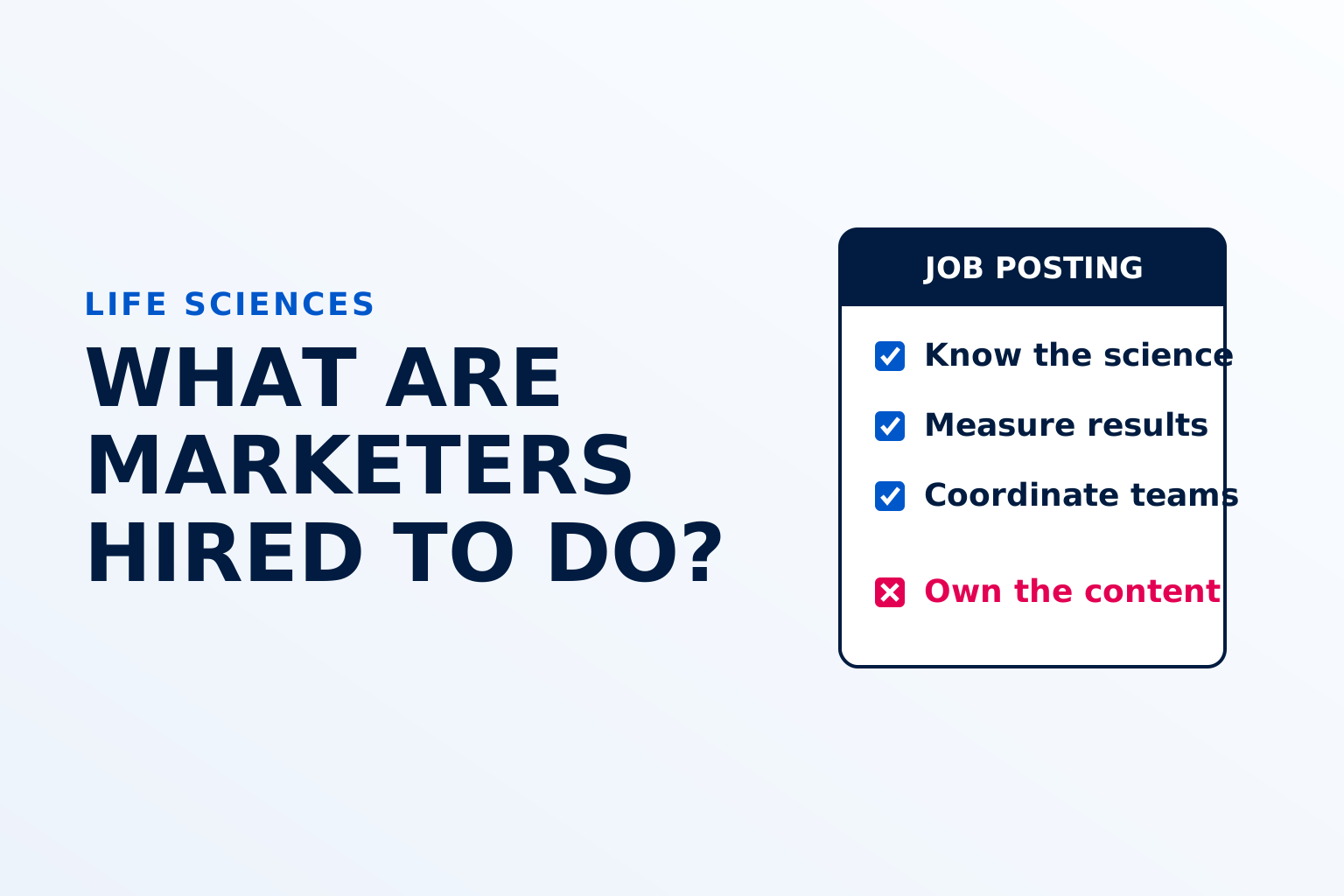
The CEOs Guide to Effective B2B Content Marketing
Ready to make content a CEO‑level growth system (not a publishing hobby)? Let’s map your Content RevOps operating model.
Book a CallMost B2B companies don’t have a “content problem.” They have an operating model problem. When content lives as ad hoc blog posts, sporadic campaigns, and disconnected social updates, it can’t compound. It resets every quarter, drifts off-message, and rarely connects cleanly to pipeline, sales cycles, or retention.
A CEO should view content differently: not as a side project, but as quiet infrastructure that earns trust before market share, creates mindshare in your category, and makes your go-to-market (GTM) more efficient. In that sense, a CEO’s guide to content marketing starts with system design, not personal output. You don’t need to personally own every post, and you shouldn’t. Your job is to design the system so content becomes a reliable business function: predictable, measurable, and reusable across marketing, sales, and customer success.
This guide makes that manageable through four lenses you can control:
Content as a process (how work reliably gets from insight to impact)
Content as a system of tools (how assets stay findable, reusable, and scalable)
Content as a team function (who owns what, and how SMEs become a bench)
Content as a business function (how content pays back in revenue, efficiency, and retention)
This isn’t a creative how-to. It’s a practical blueprint for building a content motion that plugs into your GTM and produces measurable revenue impact.
Here’s the same section with light edits and embedded authority-building links (US spelling, minimal changes to structure and tone):
1. Content as a Process: How Work Reliably Gets Done
If content shows up as occasional “big swings,” it will never become a dependable GTM lever. The CEO move is to turn content into a repeatable operating process: insights in, decisions made, assets shipped, distribution executed, impact measured, learnings recycled. That’s how you get consistency without burnout, and content that actually supports revenue motions instead of filling calendars.
1.1 Shift from volume to value
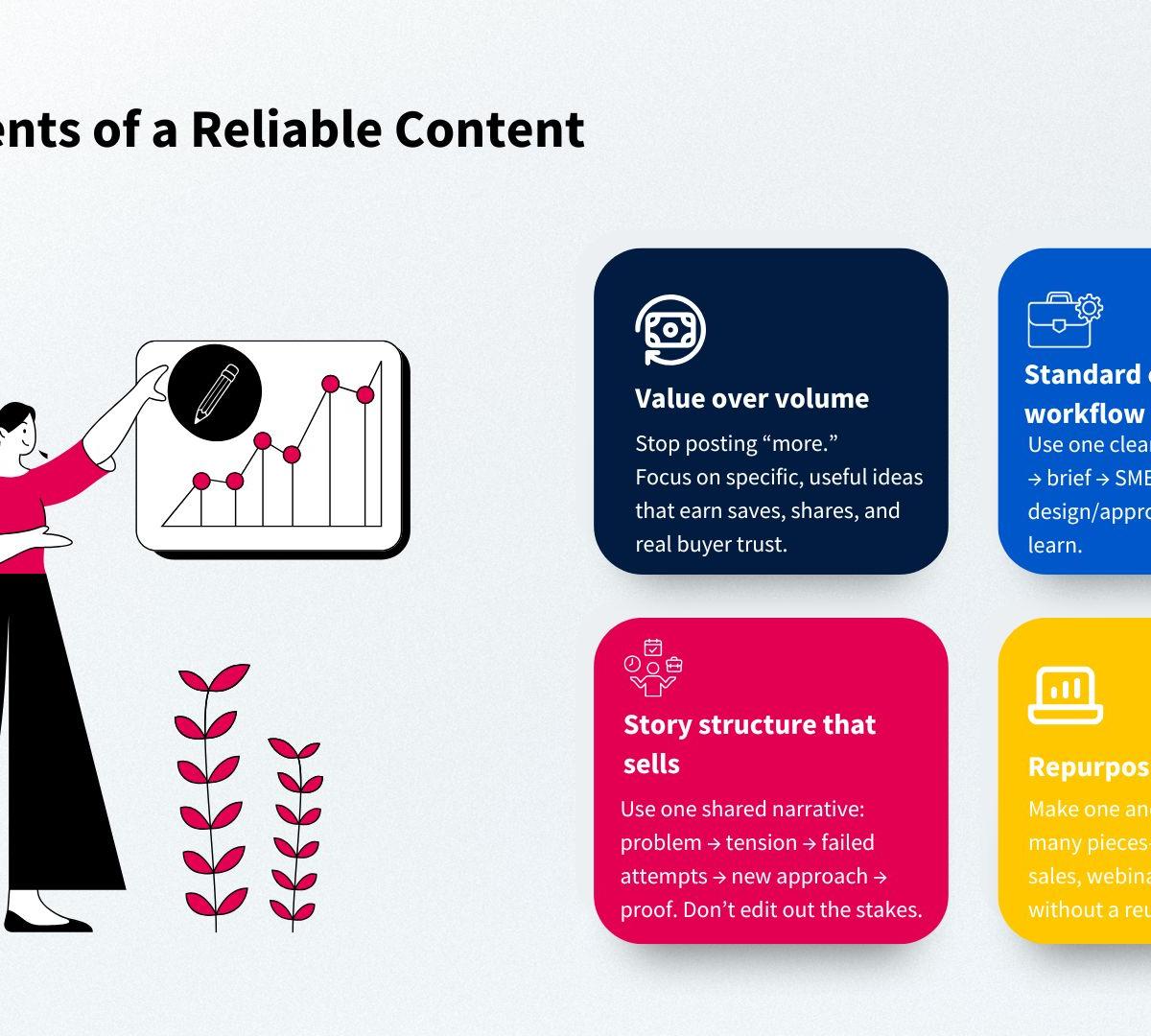
“More content” is usually a proxy for “we don’t know what’s working.” Output metrics can look healthy while hiding waste: shallow topics, unclear POV, endless revisions, and exhausted SMEs. Buyers don’t reward frequency; they reward specificity, depth, and practitioner-grade clarity. In B2B, decision-makers overwhelmingly prefer to learn from substantive articles rather than ads, and authentic storytelling can materially lift engagement and recall.
Reorient success toward business outcomes and engagement quality, not piece counts:
Engagement quality: time on page, saves/forwards, replies, repeat visitors, sales-shared links
Demand quality: qualified subscribers, demo requests, meeting creation, pipeline influenced
Sales impact: faster cycles, improved win rates, better conversion where content is used in deals
1.2 Standardize the lifecycle
A simple, documented workflow turns content from “random acts” into an assembly line. It also prevents pet projects, because every asset has to pass through the same gates. High-performing teams that treat content like an operational process, not ad hoc campaigns, are far more likely to report increasing ROI and consistent performance.
Your baseline lifecycle should include:
Insight capture: sales calls, CS tickets, product launches, competitive notes, and recurring customer questions
Briefs tied to GTM: ICP, buying stage, and a revenue objective (outbound support, launch, expansion, retention)
SME interview → draft → edit: edit for argument, tension, clarity, and accuracy, not just grammar
Design + approvals: include legal/compliance when needed, with clear guardrails so reviews don’t strip out the narrative
Distribution baked in: email, social, sales enablement, partners (planned from day one, not after the fact)
Measurement + repurposing loop: ship learnings back into the next brief so winning topics become series, playbooks, and enablement assets
1.3 Operationalize storytelling
Story isn’t decoration; it’s how you make information persuasive and usable. The key is separating story architecture from format. A blog post, case study, and sales deck can share the same underlying narrative. Teams that explicitly document story architectures (alongside templates and message houses) see far less content waste and far more consistency across channels.
Use one shared structure, such as: problem → tension → failed attempts → new approach → proof. CEO lever: ask to see that single architecture applied across multiple assets for the same ICP, and insist reviewers don’t “edit out the stakes.” In practice, the most effective B2B storytelling preserves tension and risk instead of sanding it down into generic “success stories.”
1.4 Build a repurposing flywheel
Treat one anchor asset as a quarterly engine, not a one-time launch. A detailed, ICP-specific playbook can become a blog series, webinar, email sequence, social clips, a sales one-pager, and an onboarding asset: same core idea, different moments in the journey. Flagship “big content” assets routinely drive thousands of downloads and sustained organic traffic when they’re supported by a system of spin-offs and distribution, not published once and forgotten.
Next 30 days: require a reuse plan and a clear business objective for every major asset before work begins. That single rule forces focus, improves distribution, and makes content compounding instead of disposable. It’s the same pattern used by teams that scale to very high output without sacrificing quality: standardized workflows, defined roles, and a mandate that every “big rock” asset unlocks a full slate of derivative pieces.
2. Content as a System of Tools: How Work Scales and Stays Findable
A CEO doesn’t need a giant martech stack to make content work. You need a minimal, intentional system that turns content into usable infrastructure for GTM: easy to find, easy to reuse, and embedded where teams already operate. When content lives in random drives, decks sit in inboxes, and “the latest version” is a guess, you don’t just lose efficiency. You lose deals, consistency, and speed. Analysts have found that marketers can lose more than three hours a week just searching for assets when systems are fragmented, and that teams with a digital asset management layer are far more likely to produce consistent, reusable content.
2.1 Unify the stack around GTM
The most common failure pattern is fragmentation: assets scattered across tools that don’t connect, which creates rework and slows launches. In many B2B organizations, this ends up mirroring the broader tech-bloat problem (dozens of overlapping tools with no clear operating model), which CFOs increasingly flag as an execution risk.
Build a lightweight system around one source of truth, then integrate outward:
A central asset library (DAM or a tightly structured drive) connected to your CMS and marketing automation so finished pieces, variants, and source files live in one place and stay in sync across channels
Simple, consistent tags by persona, industry, use case, and funnel stage, so any GTM team member can filter to “what works for people like this, at this stage”
A workflow board (Asana/Trello/Notion) that mirrors your content lifecycle stages, so handoffs don’t depend on tribal knowledge and you can see bottlenecks in real time
High-performing B2B teams that take this approach are measurably more efficient: they’re significantly more likely to report increased content ROI and to repurpose core assets across channels instead of recreating them from scratch. Treat the system as GTM infrastructure in the same way you treat CRM or ERP, not as a nice-to-have marketing convenience.
GTM payoff: Sales, CS, and partnerships can self-serve the right asset in seconds, and marketing can ship campaigns and product launches faster because the system reduces coordination friction. Over time, this becomes a competitive advantage: your stories, proof points, and playbooks are not just better. They are reliably available, on-message, and easy to use across the entire revenue organization.
2.2 Thoughtful use of AI and automation
AI is most valuable where it increases speed and organization, not where it replaces judgment. Teams that use AI to structure and organize work, rather than to generate unchecked copy, are already seeing better scale without sacrificing narrative quality or trust.
Use it for:
Auto-tagging and search across the library, so assets are consistently labeled and easy to surface by persona, problem, or stage
SEO and topic research to understand demand and buyer language, then feed that into briefs and outlines
Outlines and variants that SMEs and editors turn into real POV, shortening drafting cycles while keeping expertise at the center
Routing approvals, scheduling, and reporting to reduce manual ops and keep work moving without constant status meetings
CEO guardrail: make “AI for speed and organization, not originality” an explicit policy. Anything buyer-facing should have a human-owned narrative and expert review. This aligns with how leading finance and operations teams are adopting AI: as a force multiplier wrapped in clear controls and governance, not as a black box making unsupervised decisions.
2.3 Make discoverability the default
Findability isn’t a nice-to-have; it’s adoption. Standardize how content is named, tagged, and surfaced inside GTM workflows. Consistent metadata is what lets you treat content like an internal product line instead of a pile of disconnected assets.
Naming convention: [Persona] – [Problem] – [Format] – [Stage]
Required tags: ICP, problem, product area, deal stage
Integrate into CRM and CS tools so content appears where work happens, not buried in a separate system people forget to check
As you grow, this kind of structured approach is what lets a single flagship asset turn into a system (landing pages, sales enablement, email journeys, events, and evergreen resources) without losing track of what exists or which version is current. It also makes it far easier to measure which stories and formats actually move pipeline, because every asset is traceable by audience, use case, and stage.
CEO lever: sponsor a fast “content ops stack” review to remove duplicative tools and define three must-have automations (intake form, auto-tagging, pipeline-influence dashboard). That review should end with one clearly documented “content system of record” and a short list of workflows that every GTM leader recognizes as part of how the company operates, not as extra marketing overhead.
3. Content as a Team Function: Who Does the Work and How They Collaborate
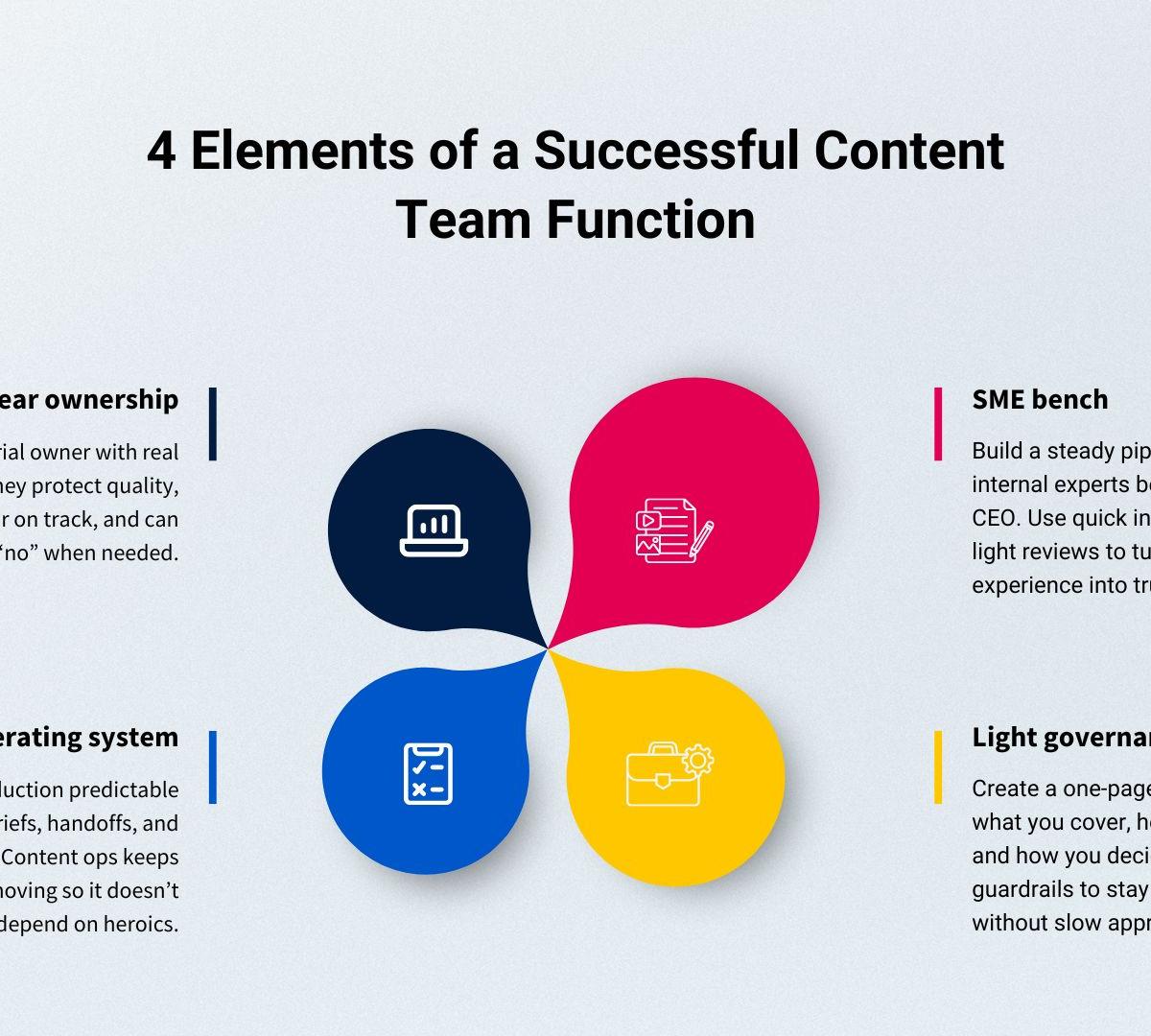
If content is going to shorten sales cycles and improve customer outcomes, it can’t live as “marketing’s side project.” It needs clear ownership, a steady SME pipeline, and lightweight governance so the work compounds instead of resetting every quarter.
3.1 Clarify roles and decision rights
A minimum viable content org is small, but not vague. You’re building a repeatable operating layer, not a pile of posts. In practice, teams that treat content as a defined function are more likely to see measurable ROI and sales impact than those that treat it as ad hoc output.
Core roles (in-house + partners):
Editorial owner (required): accountable for quality, narrative, and the calendar; has authority to say no.
Content strategist: maps topics to ICP needs, search demand, and revenue motions (acquisition, expansion, retention), often using demand and engagement data to prioritize where content will actually move pipeline.
Creators: writers, design, video turning briefs + SME input into shippable assets.
Content ops: workflow, tooling, handoffs, and reporting so production doesn’t stall, especially important once you move beyond a few posts a month into a predictable content engine.
External partners: used as strategic capacity (specialized production, editing, design), not commodity volume. Which partner fits turns on whether they treat content as pipeline infrastructure rather than production capacity, the screen behind our list of demand generation agencies for heads of content.
CEOs who deliberately invest in a multi-role content function (rather than expecting “a marketer who also writes the blog”) mirror how high-performing teams scale to meaningful output and traffic without sacrificing quality.
CEO lever: appoint an editorial owner with explicit decision rights, and protect their “no.” Without that cover, content becomes stakeholder-driven, inconsistent, and hard to measure.
3.2 Build a bench of internal thought leaders
CEO-only thought leadership doesn’t scale and creates key-person risk. Your strongest credibility often sits in the middle of the org: product, customer success, sales engineering, finance, HR, and operations. Companies that formalize programs to elevate internal SMEs as visible experts tend to see higher trust and better alignment between brand and reality.
How this plugs into GTM: practitioners answering real objections with real process turns content into sales enablement at the source, more specific, more trusted, and easier to reuse across deals. This is especially powerful in complex B2B sales, where decision-makers overwhelmingly prefer to learn from substantive articles and practitioner insight over ads or generic brand claims.
Practical moves:
Run a monthly SME interview cadence tied to your top ICP problems, and treat those sessions like productized “insight capture” that can be repackaged across channels.
Offer low-friction participation paths: 30-minute interview, draft review, co-host a webinar or customer panel. Over time, this builds a diversified bench of voices and reduces overreliance on one or two execs.
3.3 Make content a company sport
Turn sales and CS into inputs and amplifiers, not bystanders:
An idea intake form for objections, FAQs, and story leads so the field can continuously feed topics based on what buyers are actually asking.
Simple sharing guidelines so employees can distribute confidently: clear do’s/don’ts, sample language, and clarity on how sharing supports both the business and their own professional brand.
Recognition for teams whose insights become high-performing assets: callouts in all-hands, performance reviews, or spiffs when a piece materially influences deals or renewals.
Treat events and customer calls as content engines: record once, then clip, repackage, and route into nurture and sales sequences. High-performing teams routinely turn a single flagship asset (like a webinar or panel) into a system of derivative pieces that fuel campaigns, sales conversations, and onboarding for months instead of weeks.
3.4 Culture and governance
Create a one-page content charter that sets:
What we talk about: narrative, ICP focus, and what you will not cover, anchored in a simple message architecture so different teams aren’t telling conflicting stories.
How we work: workflow, tools, and turnaround SLAs so contributors know what to expect and content doesn’t depend on heroics.
How we decide: editorial board cadence and greenlight criteria (business impact first), including how you’ll weigh strategic relevance, search demand, and sales input when prioritizing work.
The goal is “governed autonomy”: enough structure that teams can publish without constant approvals, but enough guardrails that you don’t end up with off-message, low-impact content scattered across channels.
CEO lever: attend the first editorial board meeting to set the standard, then step back and review outcomes monthly. Executive sponsorship at the outset is often what turns content from a nice-to-have into a durable operating system that survives reorgs, shifting priorities, and budget cycles.
4. Content as a Business Function: Why It Exists and How It Pays Back
When content is treated as a business function, it stops being “marketing output” and becomes revenue-facing infrastructure: it creates trust before the first sales call, improves conversion during active deals, and reduces churn after launch. The CEO’s job is to make content answer to the revenue plan (new logos, expansion, and retention) on an operating cadence.
4.1 Content as decision infrastructure
In B2B, buyers self-educate across search, social, communities, and peer networks long before they want a demo. That means content’s real job is to support decision-making, not decorate the brand. Studies consistently show that senior decision-makers prefer to learn from substantive articles and resources rather than from ads, and that trusted, expert content materially shapes shortlists and vendor choice.
Content should consistently do three things:
Educate buyers on the problem, the constraints, and the realistic options
Differentiate your approach with proof (process, results, tradeoffs, and why you win)
De-risk the decision for every stakeholder: economic, technical, and operational
If your content can’t help a buyer justify “why change, why now, why you” internally, it’s not doing business work. That justification increasingly has to stand up to finance and operations scrutiny, so content needs to translate your story into hard levers like revenue efficiency, risk reduction, and total cost of ownership, not just marketing language.
4.2 Anchor plays and the demand engine
Most content programs fail because they operate as isolated campaigns. A stronger model is quarterly anchor plays: one substantial piece built for reuse and tied to a specific ICP and use case.
Example anchor: a deep playbook for a target role (say, RevOps leaders) solving a specific job (say, improving pipeline quality without adding headcount). This kind of “big content” asset is far more likely to generate sustained demand and organic discovery than a stream of disconnected posts, and it mirrors how high-performing B2B teams use cornerstone pieces to scale ROI-positive content systems.
Surround it with a planned reuse system:
Editorial newsletter themes
LinkedIn series (brand + executives + SMEs)
Webinar or panel to generate new angles and objections
Sales one-pager and talk track
Onboarding and adoption modules for customers
This same engine supports each GTM motion: acquisition (education, comparisons, ROI stories), expansion (advanced use cases, adoption playbooks), and retention (training, roadmap explainers, community programming). Treat these anchor plays as products with a lifecycle, not as one-off campaigns: validate demand, launch with a plan, and keep iterating the asset and its spokes based on performance and field feedback. CEO lever: approve two anchor plays per quarter, each with defined reuse and a measurable business outcome.
4.3 Measuring what the business cares about
Vanity metrics create busywork. Revenue metrics create focus. Modern content teams that outperform tend to tie their work to pipeline, deal velocity, and customer value creation rather than to sheer output or impressions.
Track:
Pipeline sourced and influenced by content
Win rate and sales-cycle length when specific assets are used
Expansion and retention lift tied to education and success content
Cost per qualified subscriber and longer-term CAC impact
Make it concrete with a simple content P&L: inputs (people, tools, production) vs outputs (opportunities influenced, deals accelerated, churn reduced). This mirrors how CFOs assess other growth investments: a small, integrated content stack connected to CRM and analytics makes it possible to see which assets consistently move opportunities forward, which messages resonate with executives, and where to reallocate budget.
4.4 From cost center to compounding asset
The payoff accelerates when content is built as an asset base, not a feed. Updated pillar guides, durable playbooks, original research, and practitioner conversations keep accumulating demand and credibility, while reducing reinvention across marketing, sales, and CS. High-performing teams treat these as long-lived “infrastructure assets” that can be refreshed and repurposed, rather than consumables that expire after a campaign.
CEO perspective: content is one of the few levers that can grow revenue and lower marginal acquisition cost over time, as long as you run it like a business function, not a publishing hobby. That means giving it a defined operating model, a minimal but coherent tool system, a cross-functional team mandate, and financial expectations, so the story you tell the market is as disciplined and repeatable as the way you build and sell the product.
Conclusion: Turning Content into a CEO‑Level Growth System
Content is not a campaign or a calendar. It’s a managed business capability. When you design it as a process, power it with the right systems, staff it as a cross‑functional team, and hold it to business outcomes, content becomes part of your GTM operating system, quietly compounding trust, intent, and revenue efficiency over time.
In many organizations, that shift mirrors how finance evolved from back‑office reporting to a strategic function that steers growth and resilience. The same is happening in content: leaders who treat it as infrastructure are already using it to shape markets, reduce acquisition costs, and support long‑term customer value.
In the next 90 days, the CEO levers are straightforward:
Nail the narrative and ICP focus (what you stand for, who it’s for, and what you want them to do). A clear point of view is now a primary trust signal in B2B buying, as decision‑makers increasingly look to expert content over ads.
Stand up a simple workflow and stack (briefs, editorial review, reuse plan, and basic dashboards) so content runs like an operating process rather than ad hoc publishing.
Empower an editorial owner with decision rights and access to SMEs, the same way high‑performing teams elevate a content lead to orchestrate thought leadership and sales enablement.
Fund a small set of anchor plays tied to clear revenue goals and repurposed across channels, turning one flagship asset into a portfolio of pipeline‑driving and customer‑education content.
This is the essence of treating content as infrastructure rather than output: an operating layer that runs across SEO, outbound, sales enablement, and customer success, much like a unified GTM “content demand engine” built around repeatable, long‑form plays. Our work follows this model, building content systems that educate buyers, trigger intent, support sales, and prove impact on pipeline, CAC, and retention, in line with how modern content‑led organizations measure ROI and scale.
Once you see content as an operating system, it stops being “something we should do more of” and becomes one of the most reliable levers for integrated, efficient growth, especially in markets where trust, clarity, and differentiated insight are now as critical to performance as product and pricing.
Is your content actually moving pipeline—or just filling calendars?
Build Content RevOps infrastructure that educates buyers, supports sales, and compounds revenue impact over time.