The best demand generation agencies for B2B SaaS companies in 2026
Buying software is a group decision. A team lead wants the feature, security wants the audit, finance wants the business case, and someone senior signs. Most of that happens before anyone talks to your sales team. Buyers read, compare, ask peers, and now ask AI, and they build a shortlist long before they fill in a form. Plenty of agencies say they do demand generation for B2B SaaS. Most run ads, or name one or two software logos and call it depth. We reviewed 683 agencies that serve B2B SaaS and kept 15 with real proof. Each one is explained in plain words below.

How we chose this list
We used the same checks on every agency, including our own. Here is what earns a spot and how we ordered them.
Who makes the list
Every agency here runs real demand generation for software companies and has a working content presence of its own. We left out lead-list sellers and ads-only shops.
How we rank them, in order
- Real depth in B2B SaaS, not one or two named logos
- Whether they run marketing for themselves, and it works
- Review proof, counting how many reviews back the score
- Whether they show prices and name their team
- Fit to your stage, size, and situation
What we promise on every entry
Every claim can be traced to a source. Ratings always show how many reviews they come from, and we dropped one agency's rating because its review profile no longer exists. Prices are shown, or marked not shown. We hold our own entry to the same checks.
The shortlist at a glance
All 15 entries, ranked by the criteria above. Full detail in the cards below.
| # | Name | Pros | Cons | Best for | Pricing |
|---|---|---|---|---|---|
| 1 | Content RevOps |
|
| B2B SaaS teams with long, committee-led sales cycles that want one connected system, and want to see the method and the price before the first call. | $4,100-8,500/mo |
| 2 | Refine Labs |
|
| Funded software companies past Series B that want demand strategy and paid media run as one connected motion, and can support a serious monthly commitment. | From $14,000/mo |
| 3 | Directive |
|
| Mid-market and enterprise software teams that generate plenty of leads and need the mix retuned toward qualified pipeline. | Not disclosed |
| 4 | 42 Agency |
|
| Funded software companies between Series A and Series C that want paid, lifecycle, and RevOps handled by one small team. | Not disclosed |
| 5 | Obility |
|
| Software companies that get traffic but not enough qualified demand from it, and want search handled by a team that only does B2B. | Not disclosed |
| 6 | Gripped |
|
| SaaS and AI companies, especially in the UK and Europe, that need a full outsourced growth team rather than one channel. | From GBP 3,500/mo |
| 7 | Walker Sands |
|
| Software companies at mid-market and above that need visibility and credibility built together, not just campaigns running. | Not disclosed |
| 8 | RevPartners |
|
| Software teams on HubSpot that generate demand already but cannot connect it to revenue, or need the systems rebuilt underneath. | Not disclosed |
| 9 | Omni Lab |
|
| Software companies with a real ad budget that want paid media run by specialists who work on nothing else. | From $4,800/mo |
| 10 | INFUSE |
|
| Mid-market and enterprise software companies that need reach and volume quickly across several regions. | Not disclosed |
| 11 | Kuno Creative |
|
| Software companies that want one experienced retained team covering content, campaigns, and the website rather than assembling specialists. | Not disclosed |
| 12 | Spiceworks Ziff Davis |
|
| Software companies selling to IT departments that want intent data and direct access to technology buyers. | Not disclosed |
| 13 | memoryBlue |
|
| Software companies that need outbound conversations started or a new region opened without hiring and training a team first. | Not disclosed |
| 14 | A88Lab |
|
| Early-stage software companies with technically complex products that want a specialist team rather than a large agency. | Not disclosed |
| 15 | Filament |
|
| Technology companies selling through resellers and managed service providers, particularly in Australia and the wider Asia-Pacific region. | Not disclosed |
The list
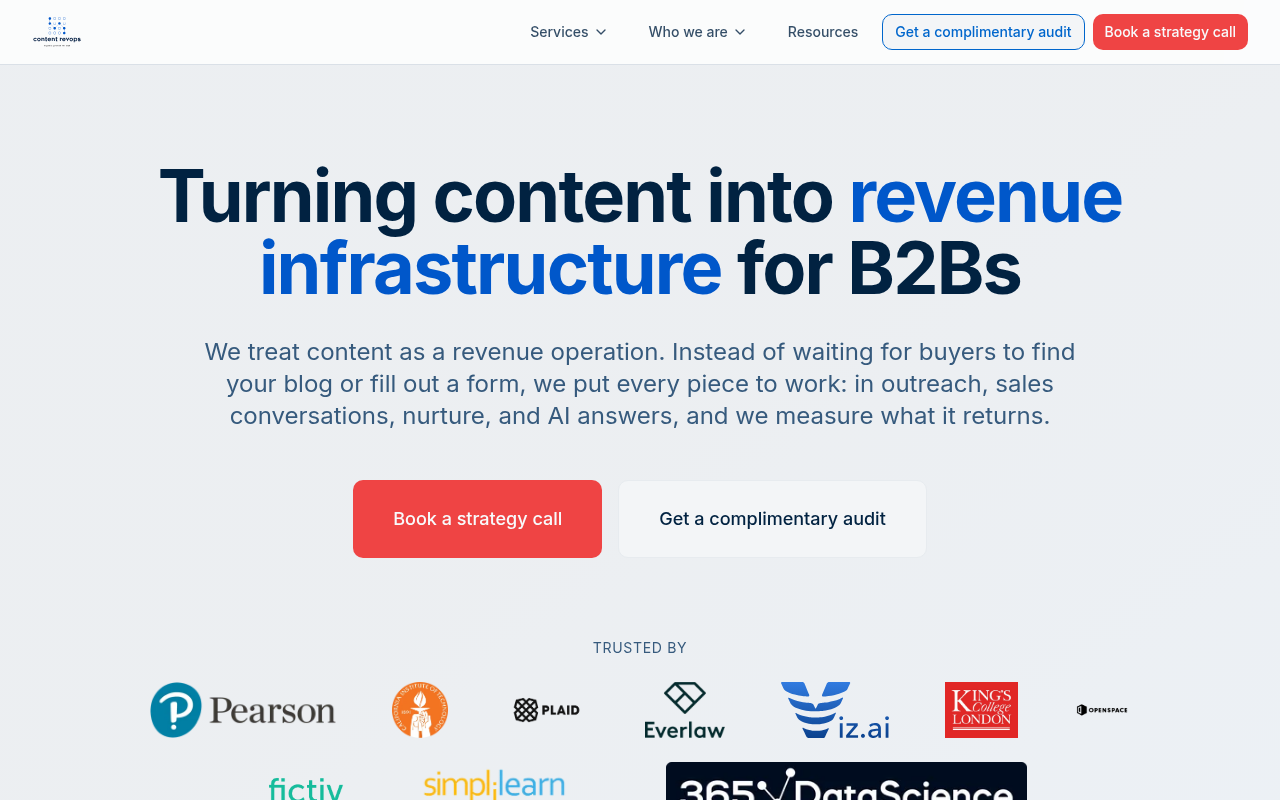
What they doContent RevOps is a content marketing and demand generation firm built for B2B companies with long, trust-led sales, and B2B SaaS is one of its main markets. It works with software companies selling into careful buying groups, from lean teams of one marketer to mid-market firms where content, the CRM, and sales enablement each sit in a different lane and rarely talk to each other. The starting point is that most software companies already own plenty of content. It just has no job. So the work is to give it one, and run it as revenue infrastructure rather than a campaign calendar. In practice that means mapping the whole buying group, then building the decision-stage material software buyers ask for and most vendors never publish, such as honest comparisons, real pricing context, security and implementation answers. That material is then placed where those buyers actually look, including search and AI answers, wired into the CRM so each piece is tracked to pipeline, and reused in outbound, nurture, and live sales calls. Nothing is written to fill a calendar slot, and every asset has a stated job before it is commissioned. The nine-step method and the prices are both published on the site rather than quoted on a first call.
Best forB2B SaaS teams with long, committee-led sales cycles that want one connected system, and want to see the method and the price before the first call.
Pros
- Treats content as revenue infrastructure and connects it to the CRM, so each piece is tracked to pipeline instead of to traffic. how we work ↗
- Publishes both its method and its prices. Most agencies on this list publish neither.
- Builds decision-stage material for the whole buying group, including the security, pricing, and implementation answers software buyers ask for.
- Has named case studies across software, education, and industrial clients carrying pipeline and revenue numbers alongside traffic growth. case studies ↗
- Backs the approach with its own published research on how B2B content performs. our research ↗
Cons
- Founded in 2024 and small, so it has a shorter track record than most agencies here and suits building a content-led system better than running large paid-ad budgets.
- Carries no third-party review profile, so there is no independent score to weigh against the rated agencies on this list.
- Works across several industries rather than software alone, so it is not a SaaS-only shop like some here.
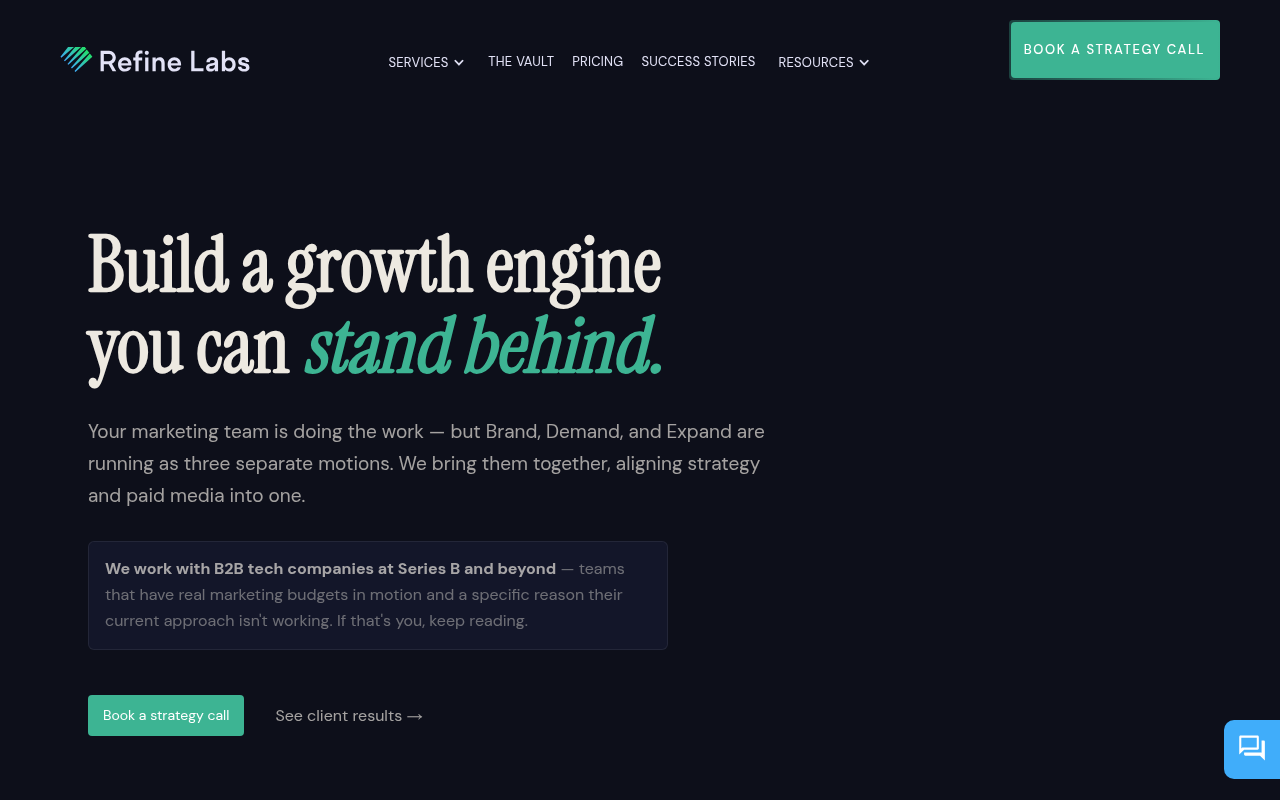
What they doRefine Labs is a demand strategy firm, not a general marketing agency. It works with B2B software companies at Series B and beyond, and says so plainly: its stated fit is 50 million dollars in annual revenue and up, with more than 300 companies served since 2019. The model, called Brand, Demand, Expand, argues that brand, demand generation, and customer growth usually run as three separate motions that compete with each other, and connects them into one. Named clients include Algolia, Cognism, BeyondTrust, Showpad, Vena, and Zappi, with deeper results published for Clari and Firstup. It is also one of the few firms here that publishes real prices, and it practises what it sells: it ranks first for demand generation agency, the exact term its buyers search.
Best forFunded software companies past Series B that want demand strategy and paid media run as one connected motion, and can support a serious monthly commitment.
Pros
- Names its fit precisely, at Series B and above with 50 million dollars in revenue or more, so you know quickly whether you qualify.
- Publishes real prices, including a six-week diagnostic at 35,000 dollars.
- Long named client wall with published results for Clari and Firstup.
- Ranks first for the exact terms its own buyers search, which is rare among agencies that sell demand generation.
Cons
- Management starts at 14,000 dollars a month on a six-month minimum, which rules it out for most early-stage teams.
- Built around paid media and demand strategy, so it is not the right choice if your main gap is organic content.
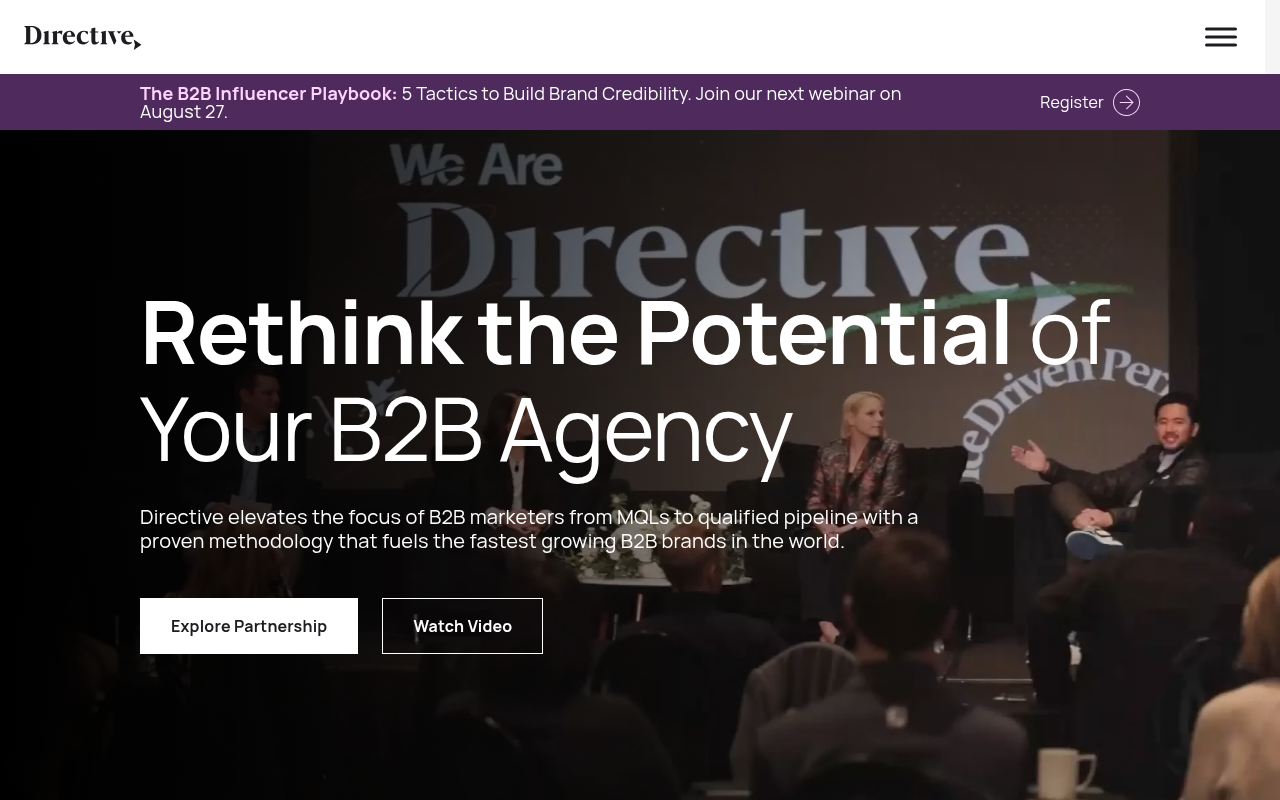
What they doDirective is a performance marketing agency for B2B, and one of the larger firms on this list at 51 to 200 people. Its argument is aimed squarely at software teams drowning in unqualified leads: a method it calls Customer Generation, which moves the target from marketing qualified leads to qualified pipeline, supported by its own reporting platform. It claims 420 brands served and more than a billion dollars in revenue influenced. Its own marketing is the largest engine here by some distance, with thousands of ranking pages, though much of that traffic comes from broad definition articles rather than terms a software buyer types when shortlisting. It holds 4.8 out of 5 from 56 reviews on Clutch.
Best forMid-market and enterprise software teams that generate plenty of leads and need the mix retuned toward qualified pipeline.
Pros
- 4.8 out of 5 from 56 reviews on Clutch, the deepest Clutch review base on this list.
- A named method and its own reporting platform, so the shift from lead counts to pipeline is built into how it reports.
- Large enough to staff several channels at once without bringing in another agency.
Cons
- Does not publish prices anywhere.
- Serves technology, industrial, and services alongside SaaS, so it is segmented delivery rather than a software-only shop.
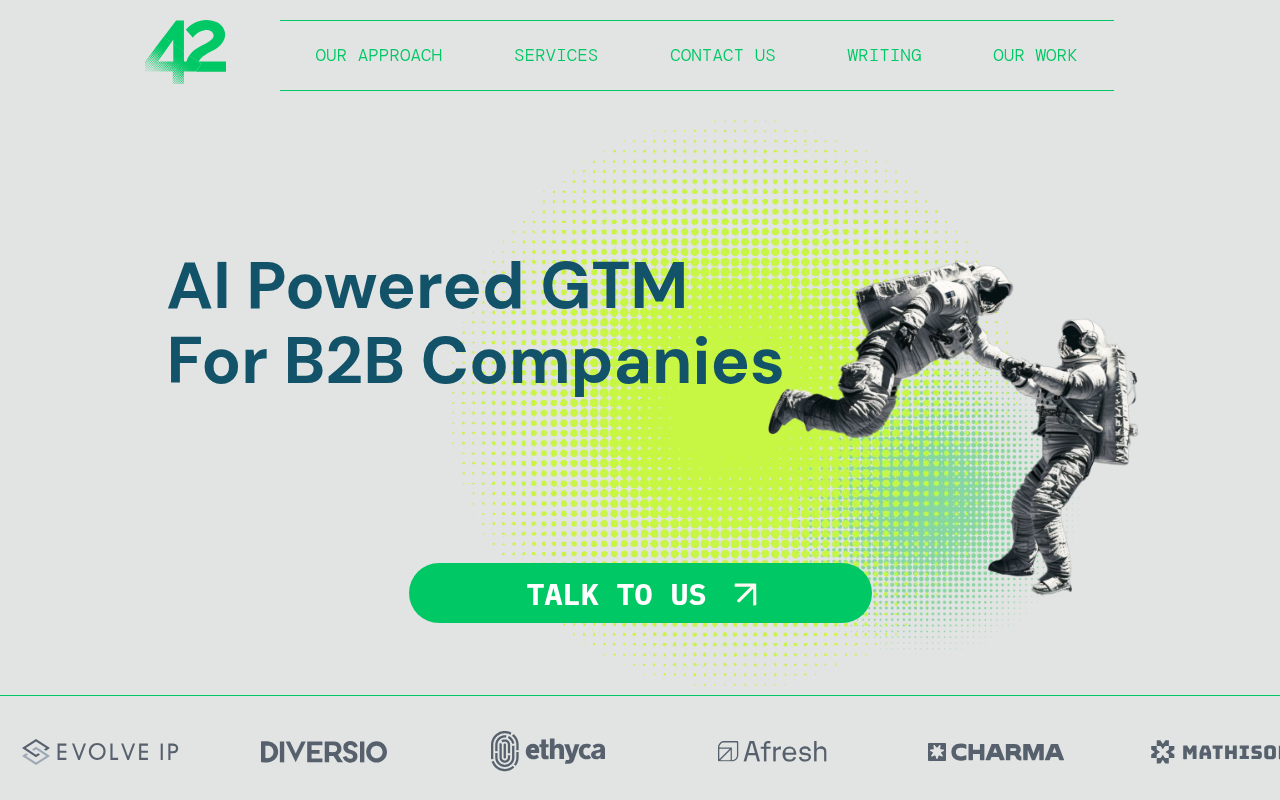
What they do42 Agency does one thing: demand generation and revenue operations for B2B software companies, usually between Series A and Series C. Everything on the site points the same way. The client roster is named and recognisable, including ProfitWell, Cin7, Teamwork, Float, Hubdoc, and SharpSpring, and the testimonials carry real numbers rather than adjectives: cost per qualified lead down 30 percent at Cin7, down 40 percent at ProfitWell, cost per activation down 76 percent at Charma. It also publishes benchmark research built on its own campaign data, described as real metrics from 87 B2B clients across 14 industries and more than 5 million dollars in managed ad spend, which is unusually specific for an agency of this size.
Best forFunded software companies between Series A and Series C that want paid, lifecycle, and RevOps handled by one small team.
Pros
- Software-only focus, so nothing on the roadmap is borrowed from another industry.
- Client results published with specific numbers and named companies, not rounded percentages.
- Benchmark research built on its own campaign data across 87 clients, which few agencies this size publish.
Cons
- Does not publish prices.
- Does not name its senior team on the site, so you cannot tell who would actually run your account before you talk to them.
What they doObility is a B2B-only agency built around search: paid search, paid social, SEO, and more recently answer-engine work and Reddit. It has run since 2011 and works with recognisable software names including Snowflake, Fastly, Hitachi Vantara, and Autodesk. What separates it from most search shops is structure: eight industry hubs, each with its own pages written to a specific buyer, covering SaaS, DevOps, cybersecurity, martech and salestech, HR and operations, and more. It is also the clearest example on this list of an agency ranking for what it sells, holding the first position for b2b seo services and b2b seo company. It holds 4.8 out of 5 from 27 reviews on Clutch.
Best forSoftware companies that get traffic but not enough qualified demand from it, and want search handled by a team that only does B2B.
Pros
- 4.8 out of 5 from 27 reviews on Clutch.
- B2B only since 2011, with eight industry hubs rather than one templated page per vertical.
- Ranks first for the search terms it sells against, which is direct evidence the approach works.
Cons
- Does not publish prices or name its senior team.
- Strong on structure and content but light on published client case studies, so proof comes from logos more than outcomes.
What they doGripped is a London agency that works only with SaaS, AI, and technology companies, and says it has worked with more than 160 of them. It runs as a full growth team rather than a single channel, covering strategy, paid media, SEO, content, and conversion work, which suits software companies that have no in-house marketing function yet. Named clients include Ideagen, Epicor, Ravelin, and Crownpeak. Two things make it easy to assess from the outside. It publishes a pricing page with three tiers starting at 3,500 pounds a month, and it ranks organically for competitive UK agency and SEO terms off its own hub pages rather than paying for that traffic. It holds 4.9 out of 5 from 32 reviews on Clutch.
Best forSaaS and AI companies, especially in the UK and Europe, that need a full outsourced growth team rather than one channel.
Pros
- 4.9 out of 5 from 32 reviews on Clutch.
- Publishes a real pricing page with three tiers, starting at 3,500 pounds a month.
- Works only with SaaS, AI, and technology, and names its senior team.
Cons
- The entry tier is 3,500 pounds a month plus project fees, so the real starting cost is higher than the headline.
- Centred on the UK and Europe, which matters if you need heavy coverage in United States time zones.
What they doWalker Sands has been running since 2001 and is the largest independent agency here at 201 to 500 people. It combines public relations with demand generation, which is a genuine difference rather than a longer service list: for software companies trying to create demand in a category buyers do not search for yet, earned coverage and analyst attention do work that ads cannot. Named technology clients include Paylocity, Semrush, and SoftwareONE. It publishes original research, including a benchmark on brand visibility in AI search, and ranks first for the Chicago public relations terms it competes on, which is a fair test of whether an agency can do for itself what it sells. It holds 4.8 out of 5 from 32 reviews on G2.
Best forSoftware companies at mid-market and above that need visibility and credibility built together, not just campaigns running.
Pros
- 4.8 out of 5 from 32 reviews on G2.
- Public relations and demand generation under one roof, which suits categories buyers do not search for yet.
- Publishes original research, including a benchmark on how brands appear in AI search.
Cons
- Does not publish prices, and a 200-plus person agency usually carries a higher minimum than a boutique.
- Serves manufacturing and professional services alongside software, so your team may not be SaaS specialists.
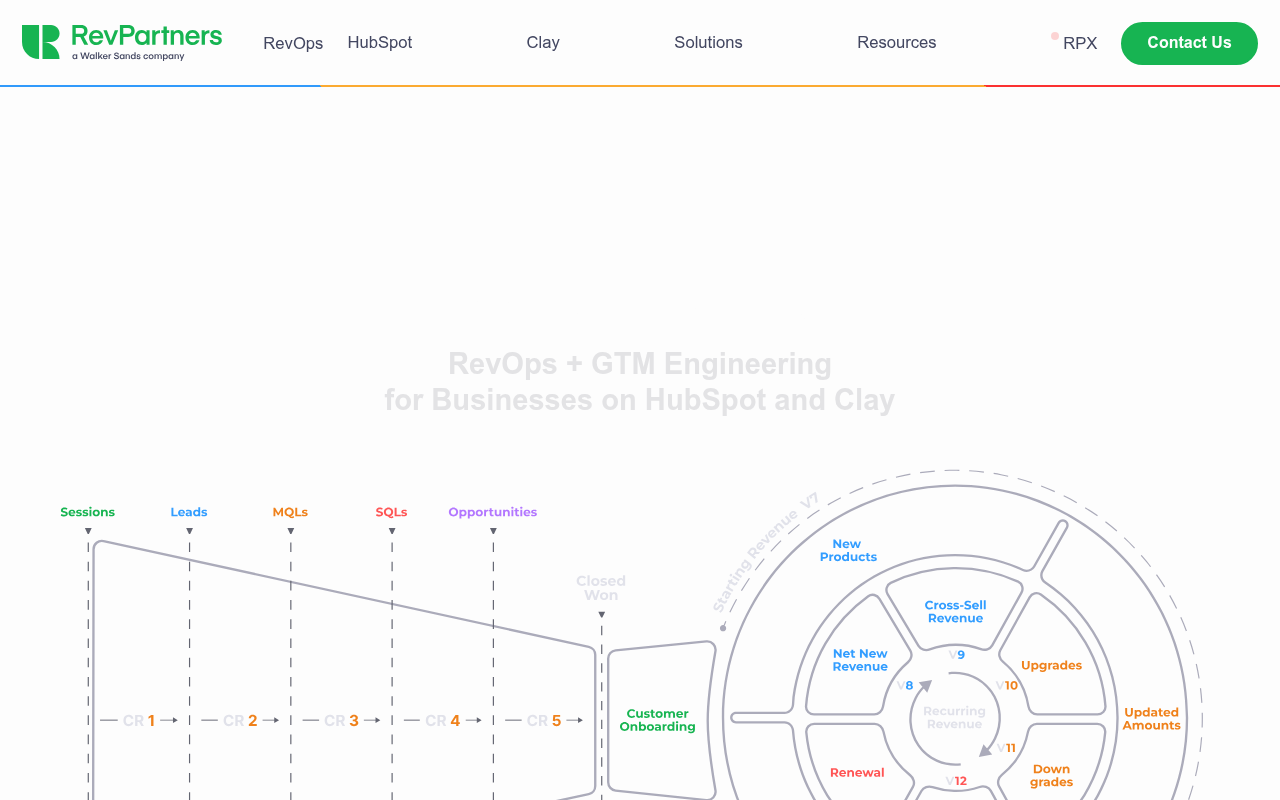
What they doRevPartners is a revenue operations firm rather than a campaign agency, and the difference matters. If your problem is that marketing and sales run on systems that do not talk, and nobody can prove what content or campaign produced a deal, this is the kind of firm that fixes it. The work is built on HubSpot, where it is an Elite partner with seven accreditations covering implementation, integration, and data migration, plus Elite partner status with Clay. Named clients include Eventbrite, Zoom, GardaWorld, and Alera Group. It carries 5.0 out of 5 from 487 ratings in the HubSpot Solutions Directory, by far the largest body of review evidence on this list, and it publishes a real research and article hub that ranks on RevOps terms.
Best forSoftware teams on HubSpot that generate demand already but cannot connect it to revenue, or need the systems rebuilt underneath.
Pros
- 5.0 out of 5 from 487 ratings in the HubSpot Solutions Directory, the deepest review evidence on this list.
- Elite HubSpot partner with seven accreditations, so the systems work is certified rather than claimed.
- Fixes attribution and pipeline reporting, which most demand agencies leave to you.
Cons
- The work is built around HubSpot, so it is a poor fit if you run Salesforce or something else.
- Depth is by platform rather than by industry, so do not expect software-specific market knowledge.
- Does not publish prices.
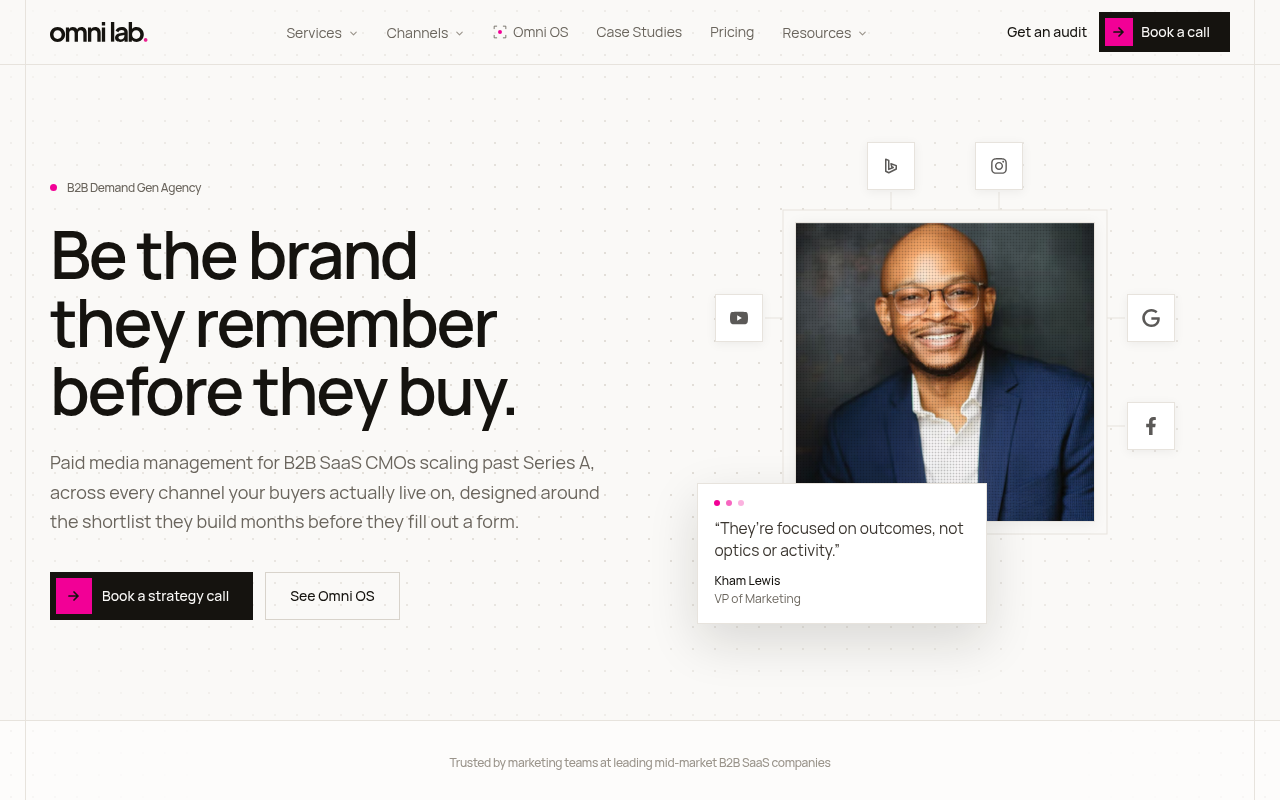
What they doOmni Lab runs paid media, and only for B2B software companies. Its position is that buyers build a shortlist months before they fill in a form, so the job of advertising is to be present during that period rather than to harvest whoever clicks today. Every service page, case study, and the pricing page is written for software specifically, and the client roster stays consistent with that: Shipwell, project44, Submittable, Broadsign, Synthace, and Workera among them. It is one of only four agencies here that publish real prices, with a core retainer at 4,800 dollars a month and a premium tier at 6,000, both quoted against a 10,000 dollar monthly ad budget. It also runs a podcast and ranks for the demand generation terms it sells against.
Best forSoftware companies with a real ad budget that want paid media run by specialists who work on nothing else.
Pros
- Publishes tiered prices openly, with the ad-spend assumption stated rather than hidden.
- Works only on B2B SaaS paid media, so the benchmarks come from comparable accounts.
- Ranks organically for demand generation terms despite selling paid media.
Cons
- Paid media only, so you still need someone else for content, lifecycle, and organic search.
- Retainers are priced against ad spend, so the cost rises as budgets grow.
- Its public review profile is thin, so there is little third-party evidence to weigh.
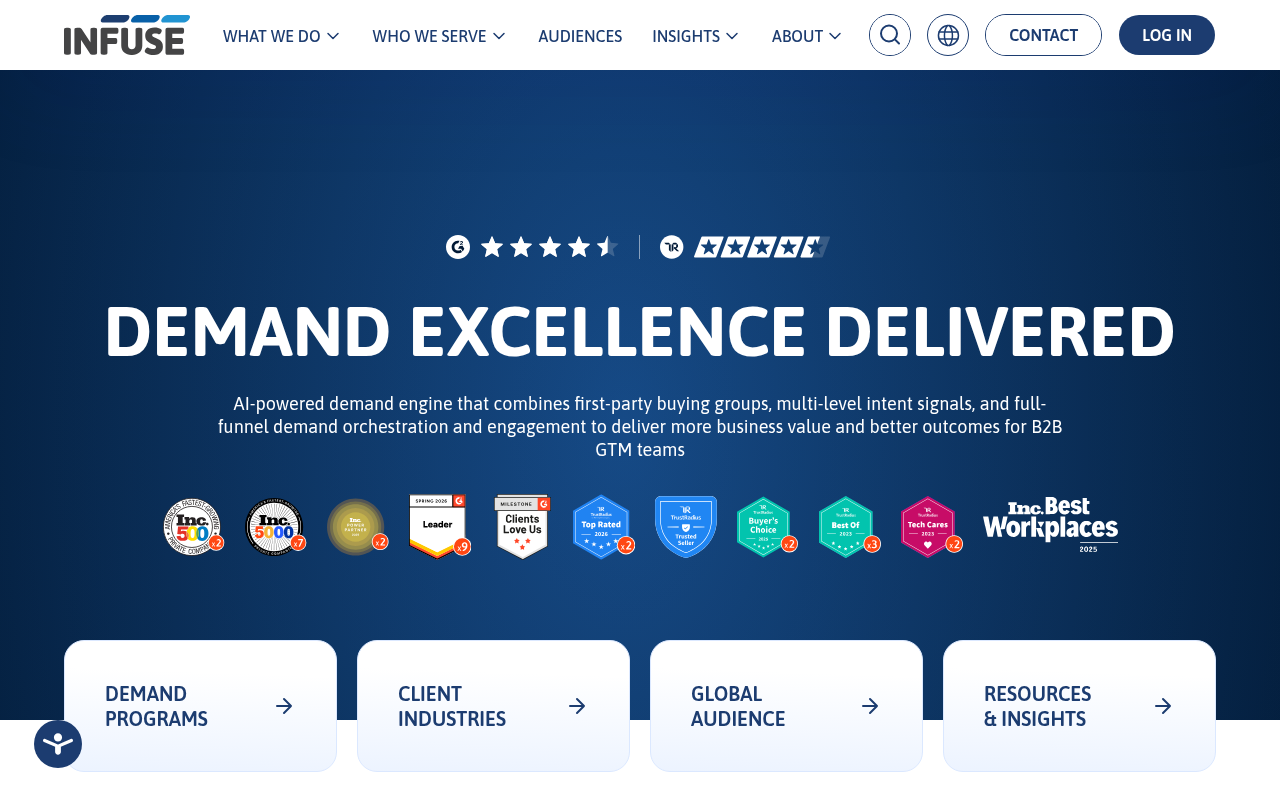
What they doINFUSE is a demand generation company operating at a scale nothing else on this list matches, with more than a thousand staff. The model is different too: alongside campaign work it runs content syndication and buying-group activation, which means it can put your material in front of audiences it already reaches rather than waiting for you to build one. That is useful when you need pipeline in a defined window and cannot wait for organic to compound. Named clients include DeepL, Veeam, Alation, and Freightos. It publishes real buyer research, including its Voice of the Buyer study, and it ranks organically for core demand generation terms, which is rare for a company this size.
Best forMid-market and enterprise software companies that need reach and volume quickly across several regions.
Pros
- Operates globally at a scale that can deliver volume quickly, across regions and languages.
- Publishes original buyer research rather than recycled industry statistics.
- Ranks organically for the demand generation terms it sells, unusual at this size.
Cons
- Covers a claimed 35-plus industries, so software is one market among many rather than a specialism.
- Does not publish prices, and a company this size is usually built around larger commitments.
- Syndicated leads need careful qualification, so plan for the follow-up work on your side.

What they doKuno Creative is a long-running inbound agency that works on retainer across four markets: technology and software, medical device, industrial, and sustainability. For a software buyer that mix is worth understanding, because it means the team has handled technical products with cautious buyers in several settings rather than only SaaS. The published proof is specific: 1.6 million dollars influenced across 61 deals for a software client, and separately a 1,373 percent increase in organic contacts for a medical technology company. Named clients include symplr, Eptura, Blackline Safety, and Aramark. It displays 156 verified reviews at an average of 5.0 on its own site, drawn from HubSpot and Google, with reviewers named and attributed to companies.
Best forSoftware companies that want one experienced retained team covering content, campaigns, and the website rather than assembling specialists.
Pros
- 156 verified reviews at 5.0 average, with individual reviewers named and attributed.
- Publishes deal-level results, including 1.6 million dollars influenced across 61 deals for a software client.
- Names its senior team and shows their seniority, which many agencies here do not.
Cons
- Does not publish prices.
- Software is one of four markets it serves, so it is less specialised than the SaaS-only firms here.

What they doSpiceworks Ziff Davis is not an agency in the usual sense, and that is the reason to consider it. It owns the audience: the Spiceworks community of IT professionals, the Aberdeen research business, and Ziff Davis Performance Marketing. So instead of building demand for you, it sells access to technology buyers it already reaches, backed by first-party intent data across more than fifty technology categories. For software companies selling to IT departments, that intent signal is hard to reproduce any other way. It publishes the annual State of IT report, which is widely cited, and targets the IT buying committee specifically rather than a single job title. The trade-off is that you are buying reach and signal, and someone still has to turn that into material a buyer wants to read.
Best forSoftware companies selling to IT departments that want intent data and direct access to technology buyers.
Pros
- Owns first-party intent data across more than fifty technology categories, which agencies have to buy in.
- Direct access to a large established audience of IT professionals.
- Publishes the annual State of IT report, a genuinely cited piece of industry research.
Cons
- It is a media and data business, so it supplies reach and signal rather than building your content or running your programme.
- Best suited to selling into IT, so it fits poorly if your buyer sits in finance, HR, or operations.
- Does not publish prices.
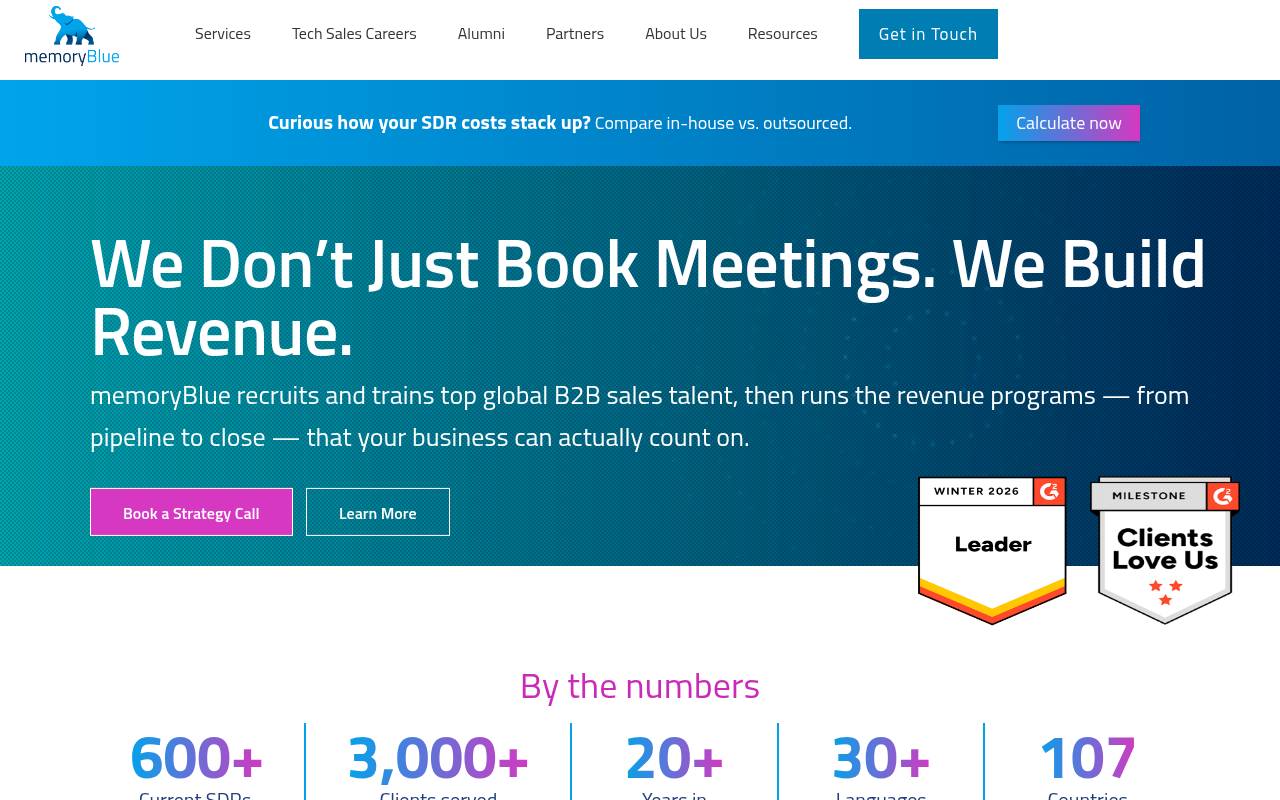
What they domemoryBlue is an outsourced sales development firm, which makes it the odd one out here and worth understanding on those terms. It recruits, trains, and runs sales development representatives on behalf of technology companies, so it creates conversations by reaching out rather than by pulling buyers in. It has done this since 2002 and reports more than 600 representatives, 3,000 clients, and coverage across 107 countries and 30 languages. For a software company that has demand but no one to work it, or that needs to open a new region quickly, that is a faster route than hiring. Its own content ranks for the vocabulary of its category, which suggests the pipeline engine it sells is the one it runs.
Best forSoftware companies that need outbound conversations started or a new region opened without hiring and training a team first.
Pros
- More than twenty years of running sales development specifically for technology companies.
- Coverage across 107 countries and 30 languages, useful for opening a new region.
- Recruits and trains the representatives, so you are not hiring into an unfamiliar role.
Cons
- This is sales development, not demand generation, so it starts conversations rather than making buyers come to you.
- Its Clutch review profile no longer exists, so we have dropped the rating it previously carried and there is no verified score to show.
- Does not publish prices.
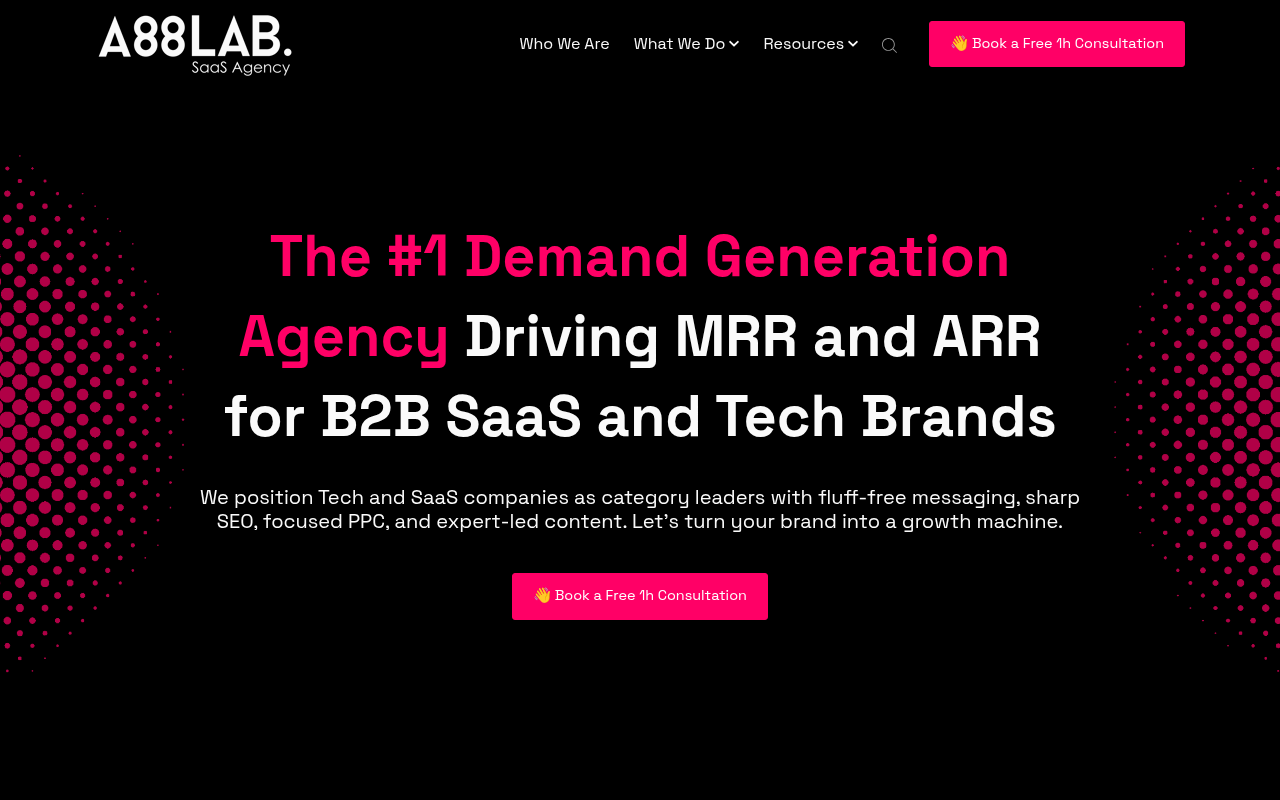
What they doA88Lab is a small Zurich team that works only with B2B software companies, and specifically with technically complex products: machine learning, artificial intelligence, and cybersecurity. That focus shows in the work. It publishes hubs on demand generation, go-to-market strategy, and community-led growth written for software specifically, and its six named clients, including Syntheticus, Acodis, Anapaya, and Modulos, sit in exactly those technical fields, each with a downloadable case study and an attributed quote from a founder or marketing lead. It also ranks for terms like category creation and SaaS go-to-market strategy off real pillar pages, so the content is doing the job it claims content should do, even though the absolute search volumes behind those terms are small.
Best forEarly-stage software companies with technically complex products that want a specialist team rather than a large agency.
Pros
- Works only with B2B software, with named clients concentrated in machine learning, AI, and cybersecurity.
- Case studies carry attributed quotes from named founders and marketing leads.
- Ranks for the go-to-market terms it sells against, off genuine pillar pages.
Cons
- A team of ten or fewer, so capacity is limited and a large programme would stretch it.
- Calls itself the number one demand generation agency for B2B SaaS on its own homepage.
- Does not publish prices.
What they doFilament is a Sydney agency that sells to B2B technology companies and, unusually, to their channel programmes. If you sell through resellers, managed service providers, or distributors rather than only direct, that second capability is the reason to look: most agencies have no idea how to market through a partner network. It publishes guides on managed service provider marketing and on channel versus direct, and names clients including Veeam, GlobalSign, AUCloud, and FujiFilm CodeBlue. Its own organic footprint is strong for its size, with eight first-place rankings earned from editorial pages rather than its brand name, and it has been recognised for content marketing at the Semrush Search Awards in Australia.
Best forTechnology companies selling through resellers and managed service providers, particularly in Australia and the wider Asia-Pacific region.
Pros
- Understands channel and partner marketing, which very few agencies on this list do at all.
- Named enterprise technology clients including Veeam and GlobalSign.
- Strong organic rankings for its size, earned from editorial pages rather than brand terms.
Cons
- A team of ten or fewer, so a large multi-channel programme would stretch it.
- Based in Australia, which affects time-zone overlap if your team and buyers are in North America or Europe.
- Does not publish prices.
Is your SaaS content bringing in pipeline?
Get a free Content RevOps audit. We show where your content leaks revenue and what a connected system would change, using your own numbers.
Frequently asked questions
What does a demand generation agency do for a B2B SaaS company?
It helps the right buyers find you and trust you before they talk to sales. For B2B SaaS that means content and campaigns built for a buying group, placed where those people already look, including search, review sites, and AI answers, then tied back to pipeline in your CRM.
How much do B2B SaaS demand generation agencies charge?
Most do not publish prices. Where a floor is public on this list it runs from about 3,500 pounds a month at the low end to 26,000 US dollars a month for full service, and one six-week diagnostic is priced at 35,000 US dollars. We mark pricing as not disclosed when an agency does not share it.
Should we hire a paid media agency or a content-led one?
It depends on what is broken. If you have demand and cannot capture it efficiently, a paid media specialist helps fastest. If buyers do not know you exist, or they find you and still do not trust you, ads rented month to month will not fix that. Several agencies here do one of these well and only one of them.
How did we choose and rank these agencies?
We reviewed 683 agencies that serve B2B SaaS, then kept the ones with real proof. We ranked them on depth in software, whether they run marketing for themselves, review evidence, transparency, and fit. The same checks apply to our own entry, and ranking below the top few is directional rather than exact.