Top B2B Demand Generation Tactics in 2026
Ready to turn demand gen tactics into a connected pipeline system? Let’s build your 2026 Demand OS.
Book a CallB2B demand generation in 2026 isn’t a tooling problem or a theory problem. It’s a tactics problem. The old playbook—gate everything behind forms, publish scattershot content, then hope marketing automation “nurtures” someone into a demo—keeps producing the same results: busy teams, noisy metrics, and pipeline impact that’s hard to defend.
Part of The Complete Guide to B2B Demand Generation Strategy.
Today, demand is generated when content, brand, and automation operate as one system. Practically, that means creating, capturing, and accelerating real buying intent across the channels your ICP actually uses—search (and AI discovery), LinkedIn, email, events, communities, and sales conversations—without breaking the buyer experience.
If you’re feeling the squeeze, you’re not alone:
You’re shipping “enough” content, but it’s not compounding.
Automation exists, but it’s clunky, linear, and easy to ignore.
AI and search changes are disrupting what used to work.
Leadership wants predictable pipeline, not more activity.
This article is a listicle of battle-proven, concrete tactics that treat content like infrastructure (not output) and connect distribution, data, and follow-up directly to revenue. We’ll cover flagship content products, modern distribution and discovery, LinkedIn and email automation, and experience-led plays—all tied to one clear commercial narrative.
1. Build “Flagship Content Products” That Drive Pipeline
Core idea: Create one or two premium, problem-solving content assets that your ICP would pay for — then give them away free and distribute aggressively.
Tactics extracted from B2BMX + webinar + data strategy content:
Design content as a product, not a PDF
Deep “state of the market” reports using your proprietary or partner data (e.g., unified data survey style), similar to recurring industry benchmark studies that become annual reference points.
Action-led playbooks or toolkits that map directly to “hidden moments” of the buying journey.
Serialized content (recurring benchmark, recurring show, recurring virtual series) to build habit.
Tie directly to ICP pains you can monetize
Use sales feedback and win/loss data to select topics (e.g., attribution under privacy, funnel blind spots, revenue leakage at handoffs).
Build calculators, templates, and frameworks that reduce time-to-value for your ICP and support clear ROI narratives that can be defended in budget conversations.
Distribute via a multi-channel engine (owned, earned, paid)
Owned:
Launch a recurring webinar series around the content theme, treating it like a “show” instead of one-off events.
Create a dedicated resource hub (SEO-friendly) and continuously optimize around problem-intent keywords and conversational queries aligned with how buyers actually research.
Turn the flagship asset into drip email sequences, nurture tracks, and in-app education.
Earned:
Place your data and insights in industry webinars, virtual events, and guest content (e.g., NetLine-style webinars).
Pitch key data points to industry newsletters and podcast hosts that already aggregate B2B demand gen and content marketing trends.
Paid:
Use LinkedIn ads, programmatic ads, and retargeting to promote “problem-first” angles of the asset (not just the title), aligning with how high-performing teams emphasize relevance and quality over volume.
Test persona-based creative and messaging by buying committees/function titles, reflecting how different roles weigh risk, ROI, and implementation effort.
2. Use AI-Orchestrated Campaigns To Align Content, Brand & Automation
Core idea: Demand is generated when content, brand and automation run in a single system instead of siloed tools.
Tactics inspired by Typeface’s Marketing Orchestration Engine & Gong’s Revenue AI OS:
Centralize campaign orchestration
Build playbooks that define: trigger → segment → message → channel → next best action.
Use an orchestration layer (or a rigorously documented internal process) to sync email, SDR outreach, ads, and website personalization around a single narrative, so every touchpoint reinforces the same commercial story instead of creating channel silos.
Use AI agents for repetitive, high-volume work
Draft variant copy for each channel (email, ads, landing pages) from your flagship content narrative, keeping humans focused on strategy and POV.
Auto-generate conversation summaries and objection libraries from call recordings (Gong-style) and feed these into nurture content to reflect real language and concerns from active deals.
Close the loop on revenue, not just leads
Map buyer interactions (webinar attendance, asset views, meeting recordings, email replies) to pipeline stages, not just MQL status.
Feed “what actually won deals” back into your flagship content topics and offer strategy, mirroring how the most effective B2B teams refine content based on performance and revenue impact, not production quotas.
3. Programmatic SEO / AEO / GEO for Always-On Problem Capture
Core idea: Capture demand by scaling content around real buyer questions, devices, and local considerations.
Tactics drawn from AI-in-action / data strategy themes:
Programmatic SEO
Identify repeatable query patterns (e.g., “[industry] demand gen benchmarks,” “B2B pipeline attribution for [tool]”) and auto-generate high-quality, structured pages.
Use your own product, usage, or survey data as unique content inputs to avoid thin pages and align with search quality expectations for original, evidence-backed information.
AEO (Answer Engine Optimization)
Structure pages to answer the exact tasks buyers ask AI/search for: “how to build X,” “checklist for Y,” “framework for Z.”
Use clear headings, step-by-step frameworks, and schema markup to increase answer extraction and position your content as a reliable source for assistants and answer engines.
GEO (Geographic & role-based variants)
Programmatically customize content for region, vertical, and role (same core playbook, different examples, regulations, and metrics).
Localize success metrics (e.g., “pipeline created in EMEA SaaS vs. US manufacturing”) so numbers feel real and relevant to how different markets measure impact.
4. LinkedIn Automation & Social-Led Demand
Core idea: Turn LinkedIn into a consistent, semi-automated demand gen system — not random posts.
Tactics:
Automated, but human-feeling outreach
Use narrow ICP lists and sequence 3–5 touch cadences: connection → value drop (no ask) → flagship asset → light CTA.
Personalize by role and “hidden moment” rather than by company name, staying aligned with social norms to avoid the spam behaviors that trigger platform scrutiny and hurt brand perception.
Content distribution at scale
Atomize flagship content into 30–60 LinkedIn posts per month across: personal profiles, executives, and company page.
Use scheduling/automation tools for timing and repurposing, but keep comments and DMs human so conversations stay authentic and move naturally into pipeline.
Engagement-based lead scoring
Track profile visits, comments, and post engagement and sync back to CRM/ MAP.
Trigger SDR follow-up or nurture emails when threshold engagement is reached, treating social signals as another intent layer alongside site behavior and email interaction.
5. Brand-Led Demand: Podcasts, Guest Spots & Webinars
Core idea: Use brand channels to seed a sharp POV and build trust before buyers enter a funnel.
Tactics from B2BMX tracks & webinar promotion:
Podcast guesting at scale (Podmatch / Featured-style)
Build a clear POV tied to your flagship content (e.g., “unified data is the antidote to sales vs. marketing misalignment”).
Use podcast-matching platforms to secure 2–4 guest spots/month where you:
Share data-backed insights.
Offer your flagship asset as a resource.
Include a memorable, simple CTA URL.
Thought-leadership webinars as demand magnets
Co-host with data or distribution partners (e.g., content syndication platforms) to extend reach and tap into audiences already primed on similar problems.
Design sessions around specific “invisible” problems (hidden funnel stages, dark social, privacy gaps).
Use post-webinar sequences: recap email → clip series → follow-up workshop invite, mirroring how experiential touchpoints are used to accelerate opportunities and increase close rates.
ICP relationship-building
Recruit ideal customers as speakers, panelists, and case study sources.
Post-event, route high-intent attendees into tailored 1:1 or small-group demos tied to webinar themes so the narrative from content to sales conversation remains consistent.
6. Automation-Driven Email & Nurture That Reflect Real Buying Journeys
Core idea: Replace linear drip with behavior-triggered, AI-assisted nurture.
Tactics referencing “hidden moments” & unified data content:
Behavior-triggered sequences
Dynamic nurture flows based on:
Pages visited (e.g., pricing, integration docs).
Content types consumed (strategic vs. tactical).
Engagement intensity.
Treat behaviors like “multiple deep visits plus ROI content” as signals to change tone from educational to commercial, in line with more advanced personalization approaches.
Buyer-committee-aware messaging
Detect role from form fills or intent data and route each persona into a tailored track (practitioner vs. VP vs. finance).
Adjust proof points and language to match how each persona evaluates risk, cost, and outcomes.
Feedback loop with revenue data
Identify which email topics and triggers correlate with meetings held and opps created.
Prune low-performing content and double down on sequences that move specific segments to sales conversations, using a small set of shared pipeline metrics as the source of truth.
7. Data Unification as a Tactic (Not Just Strategy)
Core idea: Make sales, marketing, and revenue data usable for frontline demand gen.
Tactics from “Unified Data Strategy” content:
Single activity timeline per account
Consolidate marketing touches, sales interactions, webinar attendance, and call insights into one view.
Give SDRs a short “why now” summary auto-generated from that timeline for outbound.
Lead-to-account routing based on signals
Route leads not only by territory, but by intent intensity and buying stage signals (e.g., multiple stakeholders engaging with flagship content).
Use these signals to prioritize accounts and adjust outreach style (educational vs. direct ask).
Operational SLAs powered by shared data
Create SLAs where both sales and marketing commit to response times and follow-up plays for certain signal thresholds.
Align these SLAs to clear revenue outcomes, not vanity metrics, reflecting how mature teams use first-party data to drive better targeting and personalization.
8. AI “In-Action” for Content, Targeting, and Sales Enablement
Core idea: Use AI not as a buzzword but to increase throughput and precision across the funnel.
Tactics inspired by the AI track & Gong Mission Andromeda:
Content generation & optimization
Use AI to:
Draft first versions of blogs, landing pages, and ad variations derived from one core narrative, then refine for voice and ICP nuance.
A/B test subject lines and CTAs faster based on live performance data so human teams can focus on message-market fit.
Keep AI most active on production and iteration, while humans own positioning, story, and quality control.
Conversation intelligence
Convert call transcripts into:
Objection and question libraries that inform content topics.
Snippets for case studies, social proof, and webinar talking points.
Feed recurring themes back into product marketing and sales enablement so content and talk tracks stay grounded in actual buyer language.
Guided selling prompts
Feed AI with account history + call notes to surface:
Best next questions to ask.
Best content to send post-meeting.
Treat guided prompts as a way to scale consistent, high-quality follow-up that reflects the same unified narrative prospects see across channels.
Key Meta-Insight:
Across the coverage, the most effective demand gen programs combine:
A few high-value flagship content products,
AI-enabled orchestration and automation, and
Brand-led thought leadership that builds trust and relationships — all tied back to measurable pipeline impact, not vanity metrics.
Tactic Cluster 1: Build and Orchestrate a Flagship Content Product
Tactic 1: Ship a flagship content product your ICP would pay for
A “flagship content product” is a premium utility that solves a painful, specific job for your ideal buyer—so useful they’d normally expense it. Think: an ROI calculator, a benchmark report with real methodology, a teardown kit your team can apply in an hour, a mini-course or certification, or an always-on industry index that updates monthly.
To choose the right concept, start with one validated commercial theme and tie it to a clear job-to-be-done: “prove ROI to the CFO,” “build a 12-month roadmap,” or “pick the safest migration path.” Then sharpen the scope using intent signals you already have—high-intent keyword patterns, sales call recordings, and the questions showing up in communities and threads. If your flagship doesn’t map to a buying conversation, it won’t create demand; it’ll just create traffic.
Treat it like a product, not a PDF:
Roadmap + versioning: ship v1 fast, then iterate (v1.1 with new benchmarks, new templates, updated assumptions), similar to how mature teams update recurring benchmark programs.
UX that buyers can reuse internally: fast load, simple inputs, outputs that drop into a deck or internal doc without cleanup—aligned with how buying committees evaluate vendors.
Smart data capture: progressive profiling for net-new users; nearly frictionless access for known contacts so usage stays high, especially as first-party data becomes more critical.
Reliable instrumentation: tag events (start, completion, share/export) so you can tie engagement to revenue outcomes in your CRM or MAP.
Measurement has to move past downloads. Track pipeline influence: opportunities touched, deal velocity, and win-rate uplift among accounts that used the flagship versus those that didn’t—mirroring how advanced teams attribute content’s impact on revenue.
Tactic 2: Wrap your flagship in a simple content system
The flagship is the anchor. The system is what makes it compound.
Build a small ecosystem around it instead of publishing “related” posts at random:
One pillar explainer framing why the problem matters now and how to think about it, structured like a topic cluster hub page.
3–5 supporting guides/teardowns that show the flagship in real scenarios (role-based and industry-based), borrowing the narrative depth of strong case-study-style content.
Objection pages that answer the exact pushback you hear on calls (price, switching cost, risk, timeline).
Operationalize it inside your funnel. Deep-link the flagship into sales sequences, email onboarding, customer success playbooks, and retargeting—so content, brand, and automation reinforce each other, in line with how high-performing demand gen teams integrate channels.
Finally, connect it to data and governance. Use a standard field set (role, seniority, key pain, timeline) so every interaction enriches first-party data and improves personalization across email, ads, and outbound, matching the direction of modern B2B personalization and ABM programs.
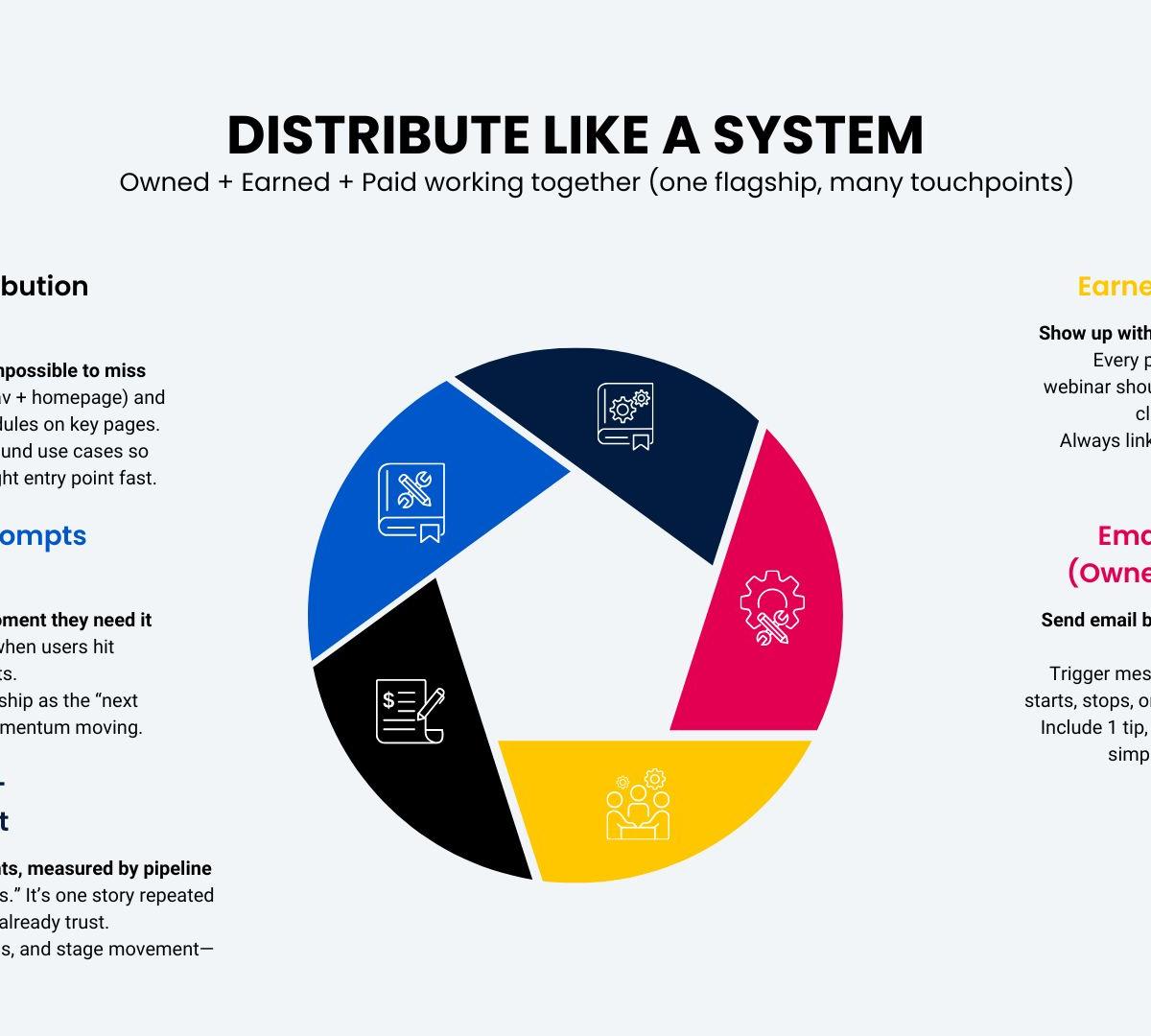
Tactic Cluster 2: Distribute Like a System – Owned, Earned, Paid Working Together
A flagship asset only generates demand when it’s wired into distribution loops your buyers actually live in: your site, inbox, trusted third parties, and tightly governed paid retargeting. The goal isn’t “more channels.” It’s one narrative, one flagship, many repeatable touchpoints—measured by pipeline movement, not activity.
Turn your website and email into a flagship distribution engine
Your website should behave like a product-led distribution surface, not a brochure. Start with onsite activation that makes the flagship unavoidable and contextually relevant.
Onsite activation tactics
Feature the flagship sitewide (nav + homepage hero variant), and add problem-first modules on relevant product pages (“Trying to reduce X? Start here.”). Consistent, prominent placement of core assets mirrors how high-performing teams treat their best content as ongoing “products,” not one-off campaigns, which aligns with what many B2B content leaders report in recent content performance benchmarks.
Build a topic cluster around it with interlinked pages targeting specific permutations like use case X for industry Y. This compounds organic discovery and supports newer answer-style search results, especially as buyers increasingly rely on conversational queries and answer-engine experiences to solve specific jobs-to-be-done.
If you have a product, add in-product prompts that fire when users hit predictable friction points, pointing them to the flagship as the “next best action.” Product-led companies use similar “help moments” to drive expansion and retention, and data from multiple SaaS growth studies shows that timely, contextual prompts can materially improve activation and feature adoption rates.
Then turn email into behavior-led distribution, not linear nurture.
Email automation tactics
Trigger onboarding emails based on flagship behavior (started, abandoned, finished). Include tactical tips, a small proof snippet, and a soft “reply to this” invite to talk. Behavior-based sequences like this tend to far outperform batch sends on engagement and revenue metrics, in line with findings from practitioners tracking lifecycle email performance by trigger type.
Use dynamic newsletter modules so different segments (role, industry, lifecycle stage) see different flagship angles and examples. This kind of segment-level personalization reflects how pacesetter teams are moving beyond generic blasts toward contextual, multi-variable personalization across roles and stages.
Run reactivation journeys for stalled leads: deliver a tailored “flagship bundle” and ask one reply-first question like “What changed in your priority this quarter?” Replies become sales tasks; clicks alone don’t. Shifting emphasis from opens and clicks to replies and meetings lines up with how advanced demand gen programs are reorienting around pipeline and revenue outcomes instead of surface engagement.
Use earned brand plays to spread a sharp POV
Earned demand works best when every appearance is anchored to a differentiated point of view and a concrete artifact (your flagship), not generic thought leadership.
Use niche podcast matching platforms to land targeted shows; enter with one sharp claim, one counterintuitive takeaway, and one clear next step tied to the flagship. Consistent guesting on tightly targeted shows has become a core channel for many B2B brands as podcast consumption among business decision-makers continues to grow, according to recent audio and podcast audience research.
Pitch the flagship as “research” to trade newsletters and publications by leading with a benchmark, a methodology, or a surprising data point. Editors at B2B outlets routinely prioritize submissions that package proprietary data or clear benchmarks over opinion pieces, which is reflected in how often data-led flagship reports appear in industry roundups and trend coverage.
Keep it consistent with a simple POV doc: what you believe, what you reject, and the proof stories you’ll repeat across webinars, guest posts, and panels. From each appearance, ship a tight repurposing kit: 1 recap, 3–5 clips, 1–2 LinkedIn carousels, and 1 objection-handling asset for sales. Teams that standardize this kind of repurposing tend to see significantly higher ROI from each appearance, echoing the way leading content organizations systematize reuse across owned, earned, and paid channels.
Layer paid media without wasting budget
Paid should amplify what’s already resonating—then retarget proof to people who engaged.
Build a creative matrix: role × core problem × proof (stat, case, quote). Rotate winners weekly based on cost per opportunity/meeting, not CTR. Optimizing to deeper-funnel metrics like opportunities and revenue aligns with how more mature advertisers now evaluate B2B media effectiveness, rather than stopping at impressions or clicks.
Constrain spend with uploaded ICP lists and intent filters; suppress customers and open opportunities using cleaned first-party data. This kind of disciplined audience design mirrors best practices in modern ABM and demand gen programs that rely on first-party data and firmographic filters to reduce waste.
Retarget flagship engagers with testimonial and usage-proof ads, then match back exposure to opportunity creation and stage progression to see where paid actually moves pipeline. Closing this loop—especially by connecting ad platforms with CRM and opportunity data—is a hallmark of high-performing revenue teams tracked in recent demand generation and pipeline acceleration studies.
Tactic Cluster 3: Win the New Search & LinkedIn Landscape with Smart Automation
Buyers now research in three places at once: traditional search, AI answer engines, and LinkedIn. The tactical edge in 2026 is building one core “problem asset” (often your flagship content product) and using automation to consistently show up wherever that research happens—without turning your GTM into spam ops.
Tactic 6: Programmatic SEO, AEO, and GEO built around your core problem
Programmatic doesn’t mean “mass content.” It means mapping your main commercial theme into repeatable, buyer-intent problems and generating highly structured pages that are easy to discover, skim, and cite.
Programmatic SEO plays
Turn your core problem into clusters like: “[problem] for [role]” and “[problem] in [industry]” that mirror how long‑tail queries actually form in search and AI chat.
Build page templates such as “How to [job] in [industry]” and populate them via CMS fields (role, industry, tools, constraints), keeping each page genuinely useful so it doesn’t get treated as thin or duplicative content.
Interlink aggressively: each page should point to the flagship, 2–3 adjacent cluster pages, and one proof asset (case, teardown, benchmark) to build topical authority and keep users moving.
AEO (Answer Engine Optimization) plays
Add FAQ, HowTo, and Product schema to your core guides and flagship landing pages so they’re machine-readable for rich results and AI answers.
Write “direct answer” blocks (2–4 sentences) near the top, plus skimmable steps and concise expert quotes—so snippets and AI Overviews can lift cleanly and still reflect your POV.
GEO (Generative Engine Optimization) plays
Publish original benchmarks and methodologies from the flagship (rates, timelines, conversion ranges), with clear sourcing and reuse notes, so generative systems can confidently surface and attribute your data.
Create dedicated “stats” pages with quotable numbers and consistent structures so AI tools and journalists naturally reference you when they look for category benchmarks.
Tactic 7: Operationalize LinkedIn with human-first content and light automation
LinkedIn works when you treat it like distribution and relationship ops—not vibes.
Execution
Build precise ICP lists in Sales Navigator by role, industry, and pain signals, so outreach aligns to how B2B buyers actually assemble buying committees.
Run a low-friction cadence: personalized invite → value drop (flagship slice) → soft, context-aware CTA that fits longer, multi-touch buying cycles.
Clip webinars and flagship walkthroughs into 30–60 second posts and test 3–5 angles per insight, leaning into narrative hooks, data points, and contrarian takes that consistently outperform generic product updates.
Give leaders and reps a simple playbook: weekly POV, weekly story/case, weekly flagship tip—anchored in the same core narrative to compound reach and recognition.
Layer paid to amplify what already resonates: run Conversation Ads to 2–3 buyer roles with problem-first hooks that reference the flagship, then use site and engagement signals to identify warmed accounts and push them into the CRM for follow-up via your existing opportunity routing rules.
Tactic 8: Make email automation behavior-led and reply-first
Replace linear nurtures with behavior-triggered flows: pages visited, depth of flagship usage, webinar attendance, repeat visits. Use conditional blocks to swap examples and CTAs by segment and intent, so messages reflect where accounts actually are in the buying process.
Keep execution human:
Plain-text emails from real people
One high-value asset
One precise question
Use AI for hygiene and routing (dedupe, enrichment, UTM checks), but keep humans in charge of voice, offer, and qualification logic so automation scales relevance instead of generic volume.
Tactic Cluster 4: Turn Conversations and Experiences into a Persistent Demand Surface
Most teams treat conversations (sales calls, webinars, DMs, office hours) as disposable. In 2026, the teams winning demand treat them as infrastructure: every live moment becomes an asset, a sales assist, and a measurable pipeline lever. The goal isn’t “more events.” It’s turning real buyer language and real proof into a persistent surface buyers keep bumping into—across social, email, search, and sales follow-up.
Convert thought leadership into a pipeline engine
Thought leadership moves deals when it looks like execution, not opinions. Build live formats that create confidence fast—ideally using your flagship content product as the diagnostic backbone, and aligning with how top performers increasingly measure thought leadership on business impact and brand authority, not just reach.
High-converting formats:
Monthly “how we actually did X” sessions with customers (numbers, tradeoffs, lessons) that mirror the unscripted, story-led formats outperforming generic webinars in B2B experiential programs
Unscripted teardown events where you audit a volunteer prospect’s funnel/stack live, leaning into the kind of practical, problem-solving content formats that consistently rank among the most effective for B2B marketers
Then operationalize repurposing so each session becomes a mini-campaign:
1 searchable recap article (built to rank and to sell), structured around the specific questions buyers ask in search and AI assistants
3–7 short clips for LinkedIn (different angles per role/problem), matching the shift toward social as a primary B2B research and vendor-discovery channel
1–2 email sequences (reply-first, not newsletter fluff)
1 sales asset (objection explainer, ROI example, or “what changed?” narrative) mapped to the buying committee members who increasingly expect self-serve proof before talking to sales
Measure it like revenue ops, not content:
Sourced + influenced pipeline by episode, reflecting the move from vanity metrics to revenue attribution for content and events
Deal velocity and cycle time for attendees vs. non-attendees, similar to how mature experiential programs benchmark acceleration impact
Build objection-killing assets straight from conversation intelligence
Your best content brief is already in your call recordings and chat logs. Mine them for recurring objections, anxieties, and proof requests—then turn those into dedicated “objection pages” your team can deploy mid-deal. Teams using conversation intelligence to systematically capture objections and next steps see meaningful lifts in win rates and deal size when that insight flows back into enablement content.
Each objection page should include:
A 60–90 second expert video answering the concern plainly, matching the growing buyer preference for short-form explainer video during evaluation
Visual proof (screenshots, charts, before/after) grounded in the same kind of benchmark and ROI data buyers already use to justify investments internally
Credibility signals (customer quotes, third-party validation) that function like scaled social proof, which has become a core trust driver in B2B purchase decisions
Activation is the multiplier: train SDRs/AEs to drop the exact deep link in follow-ups, sequences, and live threads—and build light retargeting pools around those pages to keep evaluators engaged, using the same behavioral and account-level signals that power modern ABM and intent-based advertising.
Use community and micro-experiences as always-on demand
Small, high-signal experiences consistently outperform big one-off events because they map to revenue moments: accelerate open opps, revive stalled ones, or warm net-new accounts. High-performing B2B programs are shifting budget from large conferences to more intimate, problem-solving formats that demonstrably shorten sales cycles and improve close rates.
Run:
VIP roundtables (10–12 ICP peers), designed as peer-learning environments that mirror the executive councils and councils-style communities senior buyers already rely on for vendor-safe advice
In-product workshops and customer office hours that function as experiential proof-of-concept, a format associated with faster deal timelines in experiential-led programs
A focused Slack/Discord or recurring peer call anchored by teardowns, templates, and flagship updates—structured like the niche, practitioner-led communities where B2B buyers increasingly research solutions outside vendor-controlled channels
Make it measurable by connecting it to your revenue system: tag attendees in CRM, watch for intent surges and site return frequency, and compare stage progression versus non-members. Treat these signals the same way advanced teams operationalize first-party behavioral data for scoring, routing, and ABM orchestration.
Conclusion
In 2026, the teams winning demand aren’t running “a bunch of tactics.” They’re running a connected operating system where each move reinforces the next. A flagship content product generates intent and first-party data. Programmatic SEO/AEO/GEO turns that product into always-on discovery. LinkedIn and email automation turn signals into timely, human conversations. And conversation-led experiences (webinars, teardowns, roundtables) create proof that sales can reuse to move deals forward. None of it works in isolation because it all needs one core commercial narrative and shared data flowing through the CRM.
When content is treated as infrastructure—wired into governance, events, outbound, and sales enablement—it stops being noise and starts compounding into measurable pipeline impact, mirroring what many B2B teams report as a shift from “content campaigns” to always-on engines that drive pipeline and revenue over time.
What actually differentiates teams now isn’t more tools. It’s an operating model that connects:
Research → creation → distribution
(e.g., customer and market research feeding a flagship content product, which then becomes the backbone for SEO, social, and experiential programs)Automation → routing → follow-up
(behavioral and intent signals flowing into rules-based and AI-assisted workflows that support faster, more relevant outreach)Measurement → sales feedback → iteration
(closed-loop reporting on what content and experiences influence opportunities, deal velocity, and win rates)
That’s the philosophy behind our services: building flagship content products, architecting the connected campaign system around them, integrating automation and outbound, and reporting on MQL quality and pipeline movement—not vanity metrics. The most effective B2B teams are already emphasizing content quality, strategy refinement, and first-party data as primary growth levers, while using AI to improve operational efficiency rather than chase superficial engagement metrics. Teams that adopt this Content-as-RevOps approach now will build demand engines that get more efficient (and more defensible) as AI and buyer behavior keep shifting, especially as more buying journeys move into “dark social,” self-serve research, and non-linear, multi-stakeholder paths.
Is your demand gen compounding—or just producing activity?
Build a Content RevOps engine that captures intent, routes it to sales, and proves pipeline impact—without more noise.
Frequently Asked Questions
About the Author

Founder & CEO, Content RevOps
Stefan Kalpachev is the founder and CEO of Content RevOps, where he helps B2B SaaS companies transform their content into predictable pipeline. With a background in content marketing and revenue operations, Stefan has developed a unique methodology that bridges the gap between content creation and revenue generation.
Connect on LinkedIn