How We Help You Own What AI Says About You

This summer I sent a cold email built on one claim. I had asked ChatGPT who it recommends in the reader's category, and their company was not on the list.
Eleven people wrote back. Five of them had asked ChatGPT the same question and found their company in the answer.
"We're at the top of the list," one said. "Except we are #1," said another, who then logged out and checked again to be sure.
They were right. I was also right, on the day I asked. The assistant had given each of us a different answer to the same question.
That campaign did not survive, and it changed how we work. We stopped asking whether a company is named in an AI answer and started asking a better question: who wrote the answer?
This page is what we have learned since, inside our content marketing engagements and audits: 855 AI answers collected for nine B2B companies, and the same test run on ourselves. Our page on showing up in AI search covers the full method. This one covers the part most teams never see.
Why was "you're not on the list" the wrong thing to say?
Because one answer is one draw. Ask again and the list changes.
One of the five worked at an industrial machinery maker. She had tested ChatGPT, Perplexity, and Gemini, and her company was named in all three.
I wrote back: "One run is not a finding. My email stated it as one, and that was wrong."
We ran the same test on ourselves
While writing this page I asked the assistants a question one of our own buyers might ask: a B2B education company with a one-person marketing team, a website that brings in almost no inquiries, looking for an agency that builds content systems connected to its CRM.
We asked it 15 times across ChatGPT, Perplexity, Gemini, Claude, and live ChatGPT. Content RevOps was named in none of them.
Then I opened ChatGPT in a browser to take a screenshot for this page, and we came first. "Best initial fit," with our published starting price quoted correctly and another company's logo next to our name.
About a minute later I asked again in the same browser. We were gone, and a different agency held first place. A third run produced a third winner.
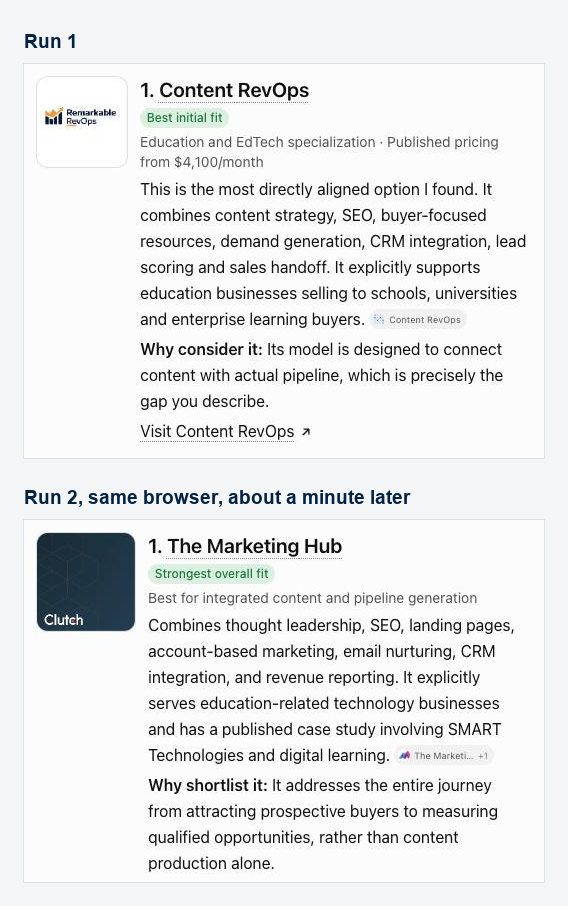
That is one mention in 18 runs. A verdict based on any single one of them would have said either that we lead the list or that we are not on it.
How often do the lists change?
Across the nine companies, every question ran three times on each assistant. The answers named about ten vendors each.
The same list of names came back in fewer than 7% of repeat runs.
On average, only 36% of the vendors named across a question's three runs appeared in all three.
When a company was named at least once, it was missing from at least one of the three runs 28% of the time.
A much larger study found the same thing. SparkToro and Gumshoe had 600 volunteers run 12 prompts 2,961 times and put the odds of getting the same list of brands twice at less than 1 in 100.
So a single screenshot proves very little, in either direction. That includes the one your team took last month.
Where does an AI answer come from?
The woman at the machinery maker stayed in the conversation for one reason. We stopped talking about whether she was named and started looking at what the answers were built from.
Her US homepage was a source in nine answers out of ten. Alongside it sat a 2015 brochure hosted on a distributor's site and a rival's application pages.
Names move between runs. Sources are pages you can open, and the same few keep coming back. In 91% of the questions we asked three times, at least one source appeared in all three answers, and the average was 3.6.
To see why, it helps to know what the assistant does between your buyer's question and its answer.
It searches in its own words
The assistant does not look up the question as typed. Google calls the step "query fan-out": "issuing multiple related searches across subtopics and data sources." OpenAI says ChatGPT "typically rewrites your query into one or more targeted queries."
The tools we use record those rewritten searches. Here are two from our own test, as live ChatGPT ran them.
What the buyer asked | What ChatGPT searched | What came back first |
Which demand generation agencies are best for edtech companies? | "best demand generation agencies for edtech companies education technology B2B marketing agency" | Two of our own comparison lists, two other agencies' lists, and a LinkedIn post |
We're a B2B education company with a one-person marketing team. Which agencies build content marketing systems that connect to our CRM? | "B2B content marketing agencies CRM integration HubSpot demand generation agency" | An agency's "Top 10 HubSpot Agencies" list, the same agency's HubSpot partner pages, a HubSpot customer story, and another "best HubSpot agencies" list |
The buyer in the second row never said HubSpot. The assistant did, and from that moment it was going to build the answer from HubSpot partner lists. We have no page written for that search, which explains 15 misses better than anything about our reputation does.
It reads a handful of pages and writes from them
The answers in our set cited about eight sources each. Whatever those pages say about the category, and about you, is the raw material.
It checks the names it already knows
Of the 2,343 searches we logged, 40% were restricted to a single website, usually a vendor's. The assistant picks up a name from a list, then goes to that company's site to read more.
This is why well-known vendors keep getting named. The assistant arrives with their names already in hand.
Who writes the answer about your category?
We sorted every source behind the 699 answers to buyer questions, 5,694 sources in all, by who published it.
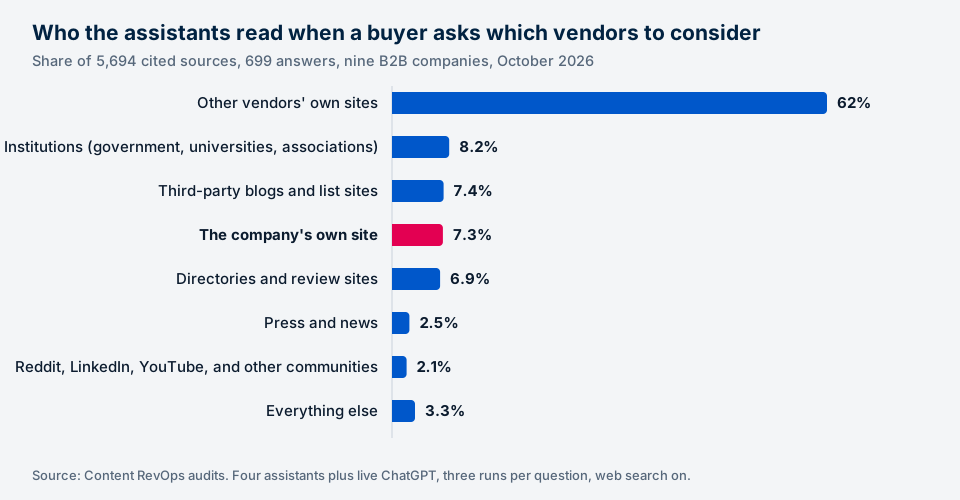
Your own site is about 7% of it
For every source that came from the company we were auditing, about thirteen came from someone else.
A far bigger dataset lands in the same place. Foundation and AirOps tracked 50 B2B brands across 57.2 million citations and found that 10.15% linked to the brand's own domain. On questions that did not mention the brand, the figure was 2.2%.
Most of the rest is your competitors
62% of the sources were other vendors' own websites. About 60% of those were product pages and homepages, and about a quarter were the comparison, "alternatives," and buying-guide pages vendors publish about their own category.
In B2B, the answer to "who should I consider" is written largely by the companies hoping to be considered.
Lists and directories carry more weight than their share suggests
Directories and review sites were 7% of sources, and third-party blogs and list sites another 7%. They matter beyond that share because they are where the assistant collects names before it visits anyone's site.
The mix shifts with how the question is asked. Overthink Group ran 1,263 software shortlist prompts and found that 70.8% of citations were "best" or "top" lineups, with the well-known review sites at 8.6%. Our questions described a buyer's situation, and vendor product pages took the larger share.
Communities barely registered
Reddit, LinkedIn, YouTube, and similar sites supplied 2% of sources in these nine categories. Consumer questions and how-to questions behave differently. For a B2B shortlist, the assistant mostly reads vendors.
What happens when a buyer asks about you by name?
This is the question a buyer asks after an introduction, a conference conversation, or a first call. We ran it 156 times across the nine companies.
The company's own site was about a third of the sources (34.5%).
In 36 of the 156 answers, the company's own site was not among the sources at all.
So even when the question is about you, two-thirds of the reading is someone else's account of you.
What it said about us
We asked what Content RevOps is and whether it is a good agency for a B2B company. All 15 answers read our site, and 12 of the 15 added that most of the evidence was our own.
ChatGPT put it this way: "much of the evidence available is published by the agency itself." It is the same sentence our clients' buyers read about them.
Claude went further. It dated us to a batch of press releases from April 2026 and told the buyer it could find no case studies, while our case studies page sits one click from the homepage. Syndicated copies of those releases on news sites had become its version of us.
How do you end up named without being the source?
Across the buyer questions, the companies we audited were named in 330 answers. In 118 of them, 36%, their own site was not among the sources.
Someone else had supplied the description. We have seen three versions of this.
A rival's page describes your product
For an HVAC coil manufacturer, ChatGPT named the company's patented product and cited a competitor's page for it. Perplexity credited a reseller.
Your dealers tell your story
A dental imaging manufacturer came ninth of nine in one answer, and not one source was its own site. The description came from its dealers and a Reddit thread.
A listing you forgot fills in the blanks
ChatGPT ranked a recruiting firm first and cited a Nextdoor page for it. It did not cite the firm's own website.
How do you end up as the source without being named?
The reverse also happens. Semrush and Kevin Indig call these "ghost citations": the assistant uses your page and leaves your name out. In their study of 3,981 source appearances, 61.7% were ghosts.
We have our own. Perplexity used our list of demand generation agencies for manufacturers as a source in three answers out of three, and named us in none of them.
We wrote four of our competitors' entries
The edtech question shows the same mechanism working the other way.
We publish a comparison of demand generation agencies for edtech companies. We are on it ourselves, at the top, as any vendor's own list would have it.
When I asked live ChatGPT which agencies are best for edtech, it named nine. We were fifth. Under four of the other eight, the source it showed was our comparison.
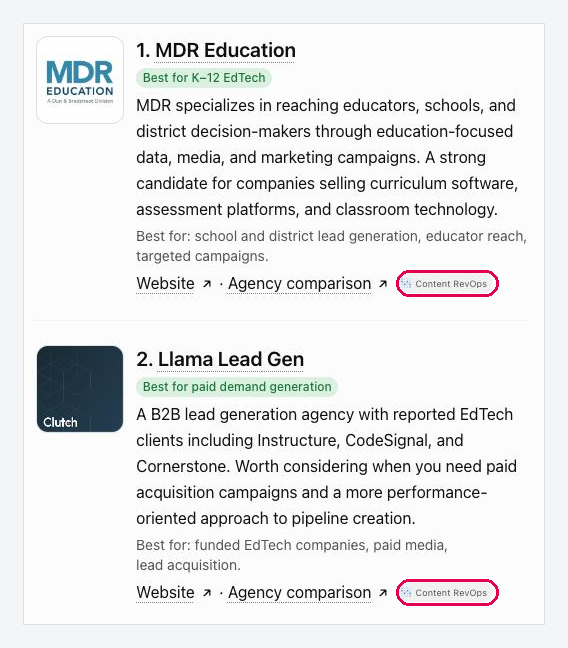
The facts in those entries are the ones we chose. The three client names ChatGPT gives for the second agency are the three on our list, and the two it gives for another are the two we named.
Across 15 runs of that question, our lists were a source in seven answers and we were named in six. Perplexity put us first all three times. Gemini and Claude never mentioned us.
A page that compares the options fairly is one of the few things a small company can publish that the assistants will read on a buying question. It will also earn mentions for your competitors, and we think that is the cost of being a source.
What do we do about it?
Every part of go-to-market now runs on what a company has published and can prove, and the assistants make that literal. So we treat the sources as the thing to manage, and we install the pieces that manage them inside the client's own site and CRM.
What we install | What it does |
A source map, re-run every month | Each buyer question asked three times on each assistant, recording who is named, which pages are read, and which searches the assistant ran. It shows which pages to build and which lists to get onto. |
Decision pages and proof in your CMS | Comparisons, alternatives, how-to-choose guides, published pricing, and customer results with names and numbers. These are the pages an assistant can lift from, written the way your buyers describe their situation. |
One version of every fact | The same founding date, price, customers, and description on your site, your profiles, and the directories the assistants read when a buyer asks about you by name. |
Outreach to the people who own the lists | Editors, directory owners, partners, and the authors of the comparison pages already being read. A research feature or a contributed data point gets you onto a page faster than waiting to be discovered. |
Tracking into the CRM | AI referrals and a "how did you hear about us" field on every form, so a buyer who arrives from an AI answer is counted as one. |
The fourth row is the one teams skip. Getting onto the pages the assistants already read is relationship work, and content is what opens those conversations. Our page on competitor and category content analysis shows how we find those pages.
The last row matters because nothing in standard analytics records it. One prospect's chief growth officer found us through a ChatGPT search this autumn, and we only know because we asked on the first call. Our page on seeing which page started the deal covers that wiring.
How do you find out who writes yours?
You can start this afternoon. Ask the question your buyer would ask, in their words, three times in each assistant. Then ignore the names and open the sources.
Write down which pages keep coming back, who published them, and what they say about you. That list is your real competition for the answer.
The first stage of our free content revenue audit does this at scale: several buyer questions, three runs each, four assistants plus live ChatGPT, with every source classified and a number on what the gap costs.
Request the free audit or book a discovery call and we will run your buyer's question live on the call.
Frequently asked questions
Why does ChatGPT give a different answer every time I ask?
The assistant rewrites your question into its own searches, reads a handful of the results, and composes a fresh answer each time. Small differences in the searches or the pages returned change the names.
In our data, the same list of vendors came back in fewer than 7% of repeat runs.
How many times should I run a prompt before I trust the result?
We run every question three times on each assistant and report counts, such as "named in 4 of 15." Treat one run as an anecdote.
The sources are steadier than the names, so record those as well.
Which sources do AI assistants use for B2B vendor recommendations?
In 699 answers for nine B2B companies, 62% of sources were other vendors' own websites, 7% were directories and review sites, 7% were third-party blogs and list sites, and 7% were the company's own site. Reddit, LinkedIn, and YouTube together were 2%.
What is a ghost citation?
An AI answer that uses your page as a source without naming your company. Semrush's 2026 study found this in 61.7% of the source appearances it examined.
The opposite also happens: in our audits, 36% of the answers that named a company did not use its site as a source.
Can I control what AI says about my company?
You can influence it. The assistant writes from the pages it reads, so the work is making sure the right pages exist, on your site and on other people's, and that they agree with each other.
When a buyer asks about you by name, about two-thirds of what the assistant reads is published by someone else.