The best demand generation agencies for EdTech companies in 2026
EdTech is a crowded market with slow, careful buyers. Districts, universities, and learning teams buy by committee, budgets follow the academic year, and every claim gets checked. Our State of Content Marketing in Education 2026 study of close to 2,000 education and EdTech websites shows the gap: awareness content outnumbers decision content by more than two to one, comparison pages exist on fewer than one in twenty sites, only about 29 percent publish original research, and about 85 percent of high-intent queries such as best LMS for now show an AI Overview. Agencies have their own gap. In our study of 1,700 demand generation agencies, about 70 percent ran no real demand engine of their own. So we checked each one. We reviewed more than 130 agencies that list EdTech or education among their markets and kept the 14 with real proof: named EdTech clients, a working content presence of their own, and results a buyer can verify. Institutions and education companies rather than software vendors fit the education list. Each one is explained in plain words below.

How we chose this list
We used the same checks on every agency, including our own. Here is what earns a spot and how we ordered them.
Who makes the list
Every agency runs real demand generation, names at least one EdTech or education client, and keeps a working content presence of its own. We left out lead-list resellers, appointment-setters, and agencies that only list EdTech as an icon on an industries page.
How we rank them, in order
- Real depth in EdTech and education, not one or two logos
- Whether they run marketing for themselves, and it works
- Review proof, counting how many reviews back the score
- Whether they show prices and name their team
- Fit to your stage, size, and situation
What we promise on every entry
Every claim can be traced to a source. Ratings always show how many reviews they come from. Prices are shown, or marked not disclosed. We do not give any agency a made-up score, and we hold our own entry to the same checks. Positions below the top five are directional, not a precise science.
The shortlist at a glance
All 14 entries, ranked by the criteria above. Full detail in the cards below.
| # | Name | Pros | Cons | Best for | Pricing |
|---|---|---|---|---|---|
| 1 | Content RevOps |
|
| EdTech companies, from seed stage to mid-market, that sell into districts, universities, or learning teams and want one connected system built by people who came from education. | $4.1-8.5k/mo |
| 2 | MDR Education |
|
| EdTech companies that need reach into teachers, schools, and district buyers, and want data and campaigns from one place. | Not disclosed |
| 3 | Ellison Ellery |
|
| EdTech and online program management companies that sell into universities and want a partner who knows how enrolment really works. | Not disclosed |
| 4 | Literal Humans |
|
| Mission-led EdTech companies that want a content-first partner and less dependence on paid ads. | $5-10k min project |
| 5 | Llama Lead Gen |
|
| Funded EdTech companies that want a small, well-reviewed paid media team with EdTech accounts behind it. | $25-50k min project |
| 6 | SCHERMER |
|
| Enterprise EdTech and education brands repositioning or standing up a new go-to-market motion. | Not disclosed |
| 7 | SaaScend |
|
| EdTech companies whose CRM, lead routing, and reporting are the bottleneck, and who need the operations layer built before more demand. | Not disclosed |
| 8 | Level Agency |
|
| EdTech and learning companies that sell to students and learners and need lead quality and cost per enrolment fixed. | Not disclosed |
| 9 | strategicabm |
|
| EdTech companies selling to a defined list of large districts, universities, or enterprises that want a true ABM specialist. | Not disclosed |
| 10 | CDM Media Group |
|
| Early-stage EdTech companies on a lean budget that want content-led demand generation from an offshore team. | $1-5k min project |
| 11 | Growleads |
|
| EdTech companies that need booked meetings and are open to an outbound-heavy motion. | $1-5k min project |
| 12 | The Marketing Hub |
|
| EdTech hardware and enterprise vendors running channel or multi-country programmes in Europe. | $5-10k min project |
| 13 | Partner in Growth |
|
| Seed to Series A EdTech companies in the UK that need senior marketing leadership before they can hire a full-time CMO. | Not disclosed |
| 14 | Wonkrew |
|
| Learner-facing EdTech and training companies, especially in India and Asia, that want a low-cost full-service team with prices shown. | $1-5k min project |
The list
What they doContent RevOps builds content-led demand generation systems for EdTech and education companies: K-12 and higher education platforms, online programme teams, training and workforce learning providers. Education is where the method comes from. Our founder, Stefan Kalpachev, started as a content writer at Pearson Online Learning, holds an Oxford MSt, and built the Content RevOps operating model largely on education work before applying it to other sectors. Pearson, King's College London, Caltech, Simplilearn, and 365 Data Science have all trusted that work. How we do it: we map your buyers and the proof each one needs, build the decision-stage content the sector lacks (comparisons, ROI tools, case proof, compliance answers), place it where buyers look (search, AI answers, LinkedIn, and email), and wire it into your CRM so leads are scored, routed, and measured back to pipeline. One connected system from first search to closed revenue, not five campaigns that do not talk to each other. What it has done here: for Ori Learning, a K-12 EdTech company selling to US districts, we rebuilt inbound after a rebrand collapse: organic traffic up 4,500 percent, inbound leads up more than 500 percent, and 32 sales-qualified leads in the first month. For King's College London we built a content-led microsite that drove an estimated 6 million pounds in attributable revenue in 2023, about 20 percent of online programme revenue, with cost per lead down from 320 to 185 pounds. You work directly with Stefan on strategy and system design, prices and the method are published, and we benchmark your content against our own education dataset.
Best forEdTech companies, from seed stage to mid-market, that sell into districts, universities, or learning teams and want one connected system built by people who came from education.
Pros
- Built and proven in education first: the founder started at Pearson Online Learning and the model was tested on Pearson, King's College London, Caltech, and Simplilearn work. about us ↗
- Ori Learning, K-12 EdTech: organic traffic up 4,500 percent and inbound leads up more than 500 percent in 12 months. case study ↗
- King's College London: about 6 million pounds in attributable revenue in one year, cost per lead down from 320 to 185 pounds. case study ↗
- Publishes first-hand education research on close to 2,000 sites, so strategy starts from real sector data. our data ↗
- One connected system from first search to closed revenue, with prices and method published. Almost every other agency here hides both. how we work ↗
Cons
- Young and small as a company, so it fits building a content-led system better than running large paid-ad budgets.
- No public review score yet on Clutch or G2.
What they doMDR does one thing: education. It pairs a large education contact database, covering teachers, administrators, parents, librarians, and daycare directors, with an agency arm that runs the campaigns, and it owns the We Are Teachers media brand, so it can put an EdTech product in front of an audience it already has. It publishes its own research, such as the yearly school open and close dates study and EdTech positioning tips, and its own site ranks for real education searches, with tens of thousands of organic visits a month. It sells education marketing and clearly runs it for itself.
Best forEdTech companies that need reach into teachers, schools, and district buyers, and want data and campaigns from one place.
Pros
- Education only, end to end: data, campaigns, and an owned media audience.
- Publishes its own education research and ranks for real education searches, so its own marketing works.
- Reach into K-12 and higher education buyers that most agencies cannot match.
Cons
- Does not show prices on its site.
- Names no senior team on the site, so you cannot see who would run your work.
- Strongest on reach and lists. Less of a fit if you need positioning or a full content system built.
What they doEllison Ellery works on higher education enrolment for universities and for the companies that serve them. Its client list names both sides: University of Arizona Global Campus, Western Carolina, and Rasmussen University on one, and Wiley Education Services, EducationDynamics, Zovio, and BoardOnTrack on the other. It does value proposition work, student journey mapping, paid media, and CRM setup, publishes a Wiley case study with video testimonials from UAGC and Wiley leaders, and names its team on the site.
Best forEdTech and online program management companies that sell into universities and want a partner who knows how enrolment really works.
Pros
- Named clients on both sides of the market: universities and the EdTech firms that serve them.
- Team is named on the site, so you know who you would work with.
- Case study and video testimonials from real client leaders.
Cons
- Small team of fewer than 10, so capacity is limited.
- Does not show prices on its site.
- Its own search presence is modest, mostly how-to posts rather than agency terms.
What they doLiteral Humans is a small content-led growth agency and a certified B Corp. Its clients cluster in three markets, and EdTech is one of them, with CORE Learning named and a published piece on scaling edtech, fintech, and healthtech responsibly. Case studies carry hard numbers, such as Wise going from zero to more than a million organic visits. Its own site is the proof: a weekly blog earns hundreds of non-brand rankings and close to 900 organic visits a month, so it runs the content play it sells.
Best forMission-led EdTech companies that want a content-first partner and less dependence on paid ads.
Pros
- Runs the content play on itself, with a weekly blog that earns real non-brand rankings.
- Case studies with hard numbers, and a named EdTech client.
- Certified B Corp, which many education buyers care about.
Cons
- Small team of fewer than 10, so capacity is limited.
- Does not show prices on its site. Clutch lists a 5,000 dollar project floor.
- EdTech is one of three focus markets, with no dedicated EdTech hub.
What they doLlama Lead Gen is a Brooklyn growth team focused on paid media across LinkedIn, Google, and Meta, plus strategy. It keeps an education industry page and its client roster backs it with real EdTech names: Instructure, CodeSignal, and Cornerstone, next to Reddit, Rakuten, and TikTok. It holds a 4.9 rating from 33 Clutch reviews and runs a podcast, Lead Gen in the Wild. Its blog ranks for a handful of mid-funnel terms in the disciplines it sells. The industry pages are thin against the size of the claims.
Best forFunded EdTech companies that want a small, well-reviewed paid media team with EdTech accounts behind it.
Pros
- 4.9 rating from 33 Clutch reviews, the strongest review proof on this list.
- Named EdTech clients including Instructure, CodeSignal, and Cornerstone.
Cons
- High floor. Clutch lists a 25,000 dollar minimum project size.
- Names no senior team on the site.
- Paid-media led, so a weaker fit for an organic and content-led plan.

What they doSCHERMER is an award-winning B2B agency in Minneapolis, named 2025 ANA Small B2B Agency of the Year. Its sharpest specialism is launching and scaling business lines inside large companies. Education proof comes from named clients and published case studies rather than a hub: Pearson and Logitech Education, next to Thomson Reuters, Cargill, and 3M. Its own search presence is almost all brand terms, so an agency that sells growth marketing runs mostly on awards and relationships rather than its own inbound.
Best forEnterprise EdTech and education brands repositioning or standing up a new go-to-market motion.
Pros
- Named EdTech clients at enterprise scale, including Pearson and Logitech Education.
- Strong third-party recognition: ANA Small B2B Agency of the Year 2025.
- Nearly 30 years in business.
Cons
- Does not show prices on its site.
- Its own site ranks for brand terms only, so it does not show its inbound method working on itself.
- Enterprise scale and budget, not a fit for early-stage EdTech.
What they doSaaScend is a revenue operations firm for SaaS go-to-market teams. It builds the strategy and the systems across sales, marketing, and customer success, on a documented Five Pillars model and a maturity model. Named clients carry titles and quotes, and one is EdTech: SchoolMint, alongside DTEX Systems, HEAVY.AI, and Asana. Its team is named. Its own content is real but thin and mostly from 2022 and 2023, and it is a RevOps partner rather than a demand creation partner.
Best forEdTech companies whose CRM, lead routing, and reporting are the bottleneck, and who need the operations layer built before more demand.
Pros
- Documented RevOps method and a named team.
- Named EdTech client with a quote, SchoolMint.
Cons
- Does not show prices on its site.
- RevOps focus. It will not build the content or campaigns that create demand.
- Own content is thin and mostly from 2022 and 2023.

What they doLevel is a large performance agency built for high-consideration purchases with long decision cycles. Its proven education work is on the learner side: StrataTech saw a 72 percent higher lead-to-enrolment rate and a 24 percent lower cost per lead, and it names C2 Education, CSU, and the Aviation Institute of Maintenance. That makes it a fit for EdTech products sold to students and learners rather than to districts. It runs a test-and-learn system and names its senior team. Its own site draws real traffic, though much of it comes from general posts rather than category terms.
Best forEdTech and learning companies that sell to students and learners and need lead quality and cost per enrolment fixed.
Pros
- Named education case studies with enrolment and cost-per-lead numbers.
- Large team and a documented test-and-learn method.
- Senior team named on the site.
Cons
- Does not show prices on its site.
- Paid-media led, and its education proof is learner-facing, not district or enterprise sales.
- No public review score on Clutch or G2.
What they dostrategicabm is a UK specialist in account-based marketing for B2B technology brands, with a documented six-step Modern ABM Journey. Its named clients include Kineo, the e-learning company, alongside SAP, Cloudflare, AVEVA, and GlobalSign, and its AVEVA programme won Forrester's 2025 B2B Program of the Year. It runs a real publishing operation, an ABM magazine, two podcasts, and a glossary, and ranks for ABM category terms, so it practises what it sells. ABM is the whole offer, so it suits companies selling to a known list of large accounts.
Best forEdTech companies selling to a defined list of large districts, universities, or enterprises that want a true ABM specialist.
Pros
- Ranks for the ABM category it sells and runs a real publishing operation.
- Award-winning enterprise programme record, Forrester 2025 B2B Program of the Year.
- Documented six-step method.
Cons
- Does not show prices on its site.
- ABM only, so not a fit for broad inbound or early-stage demand creation.
- One named e-learning client, so EdTech depth is narrower than its enterprise software depth.
What they doCDM Media Group is a small content marketing agency in Pune that sells content-led demand generation to SaaS, IT services, and product engineering firms. Its client wall includes iSchoolConnect and Aptara, and one anonymised case study reports 2 million monthly active users for an EdTech firm. Its blog is live and current, with 2026 posts on AI search visibility, and it ranks for a few content marketing terms it sells. Case study clients are anonymised and no senior team is named.
Best forEarly-stage EdTech companies on a lean budget that want content-led demand generation from an offshore team.
Pros
- Content-led and current, with a live blog that ranks for terms it sells.
- Named EdTech-adjacent clients and an EdTech case study with a result.
- Low entry point. Clutch lists a 1,000 dollar project floor.
Cons
- Case study clients are anonymised, so results are hard to verify.
- Names no senior team on the site, and the team is small.
- Only 1 Clutch review behind the 5.0 rating.
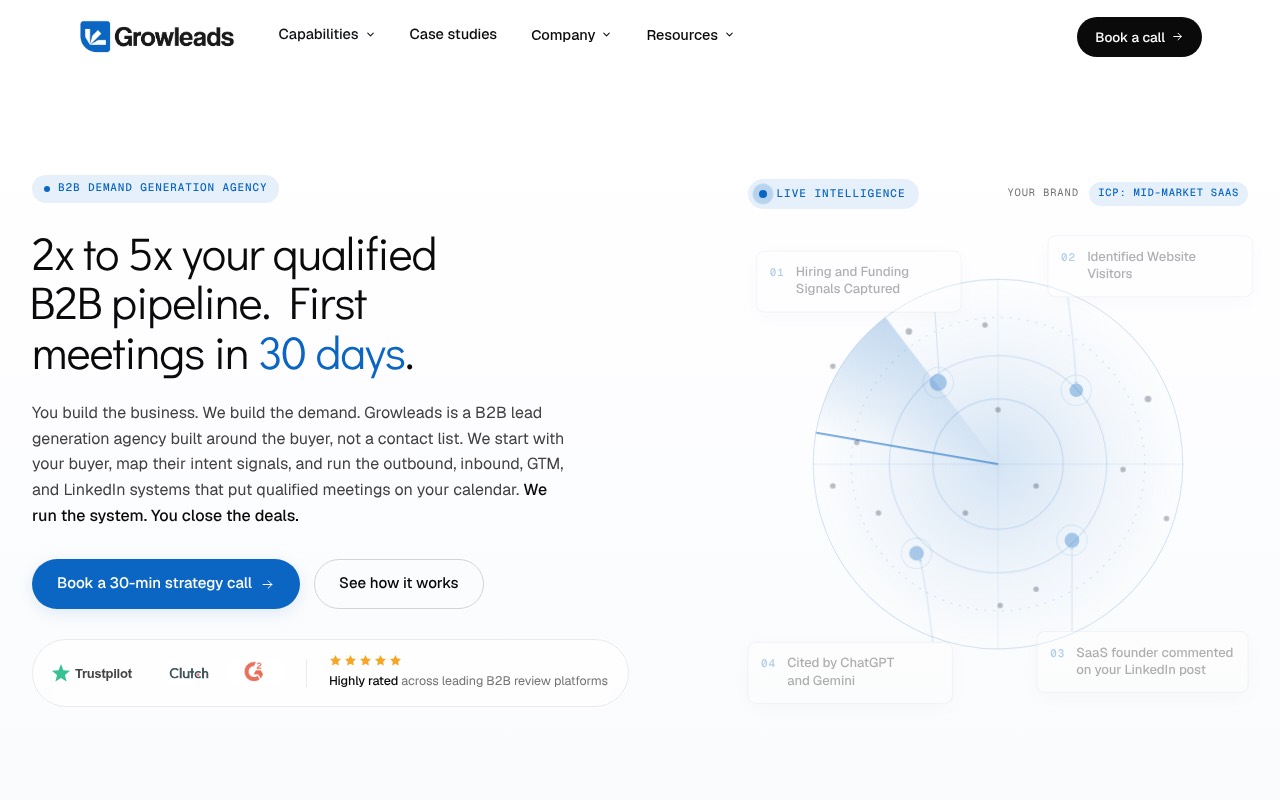
What they doGrowleads is a young New York demand generation firm that books meetings through cold email, LinkedIn outbound, Google Ads, and AI search work, after defining the ICP and positioning first. It publishes nine case studies with numbers, including Aauti in EdTech and a UK student housing client. It holds a 4.9 rating from 6 Clutch reviews and shows Trustpilot and G2 badges. Its blog draws real traffic but for tool-comparison terms, not for the demand generation it sells.
Best forEdTech companies that need booked meetings and are open to an outbound-heavy motion.
Pros
- Case studies with numbers, including a named EdTech client.
- 4.9 rating from 6 Clutch reviews.
Cons
- Founded in 2024, so a short track record.
- Does not show prices on its site. Clutch lists a 1,000 dollar project floor.
- Outbound-heavy. Its own content ranks for adjacent tool terms rather than its category.
What they doThe Marketing Hub is a Madrid-based B2B agency that runs sales and marketing programmes for large technology companies. Its named client stories include SMART, the interactive display maker for classrooms, and its logo wall is a strong tech roster: Fortinet, Veeam, AWS, Red Hat, HPE, IBM, and SAP. It holds a 4.7 rating from 5 Clutch reviews. It has no blog or resource hub, so the inbound engine it sells is not one it runs for itself.
Best forEdTech hardware and enterprise vendors running channel or multi-country programmes in Europe.
Pros
- Named EdTech client story, SMART, and a strong enterprise tech roster.
- Experience running multi-country programmes.
Cons
- Does not show prices on its site. Clutch lists a 5,000 dollar project floor.
- No blog or resource hub of its own, so no proof of its inbound method working on itself.
- Only 5 Clutch reviews behind the 4.7 rating.
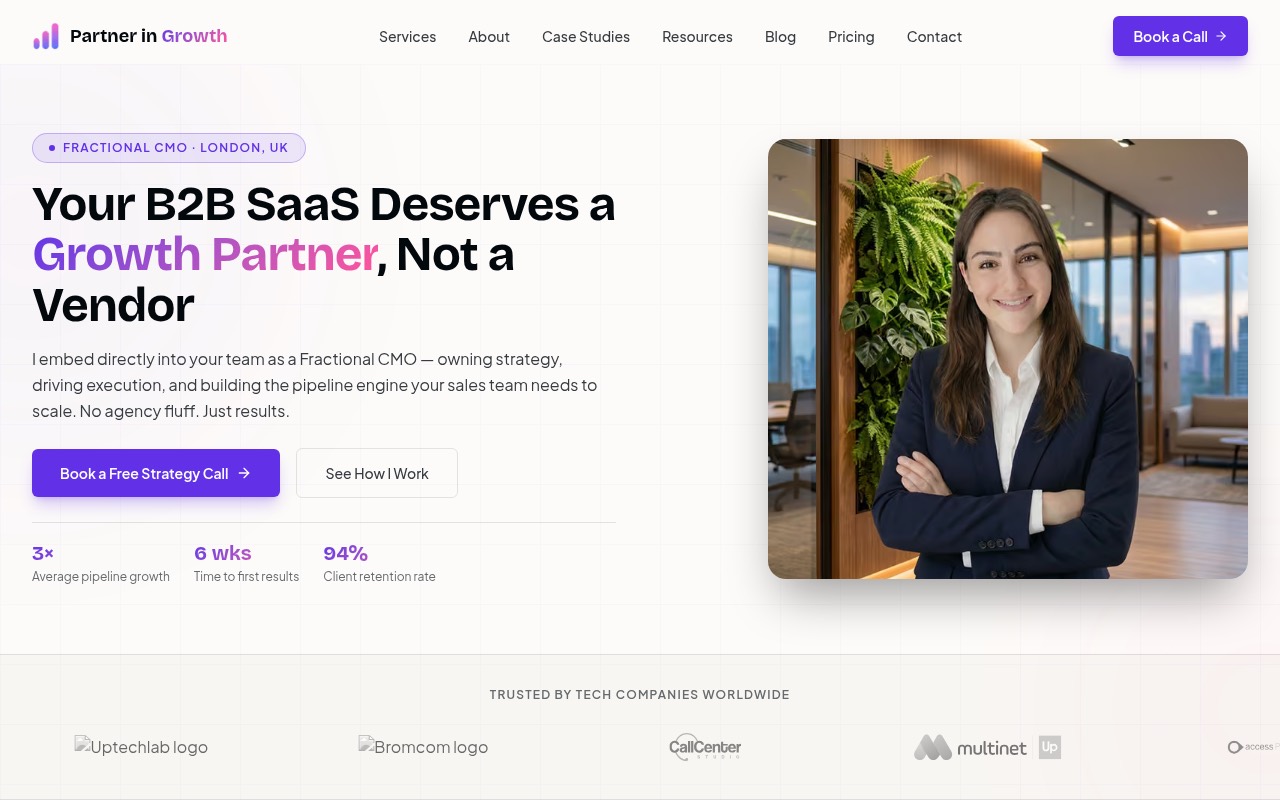
What they doPartner in Growth is an embedded fractional CMO practice in London, one operator who sits in your standups and owns the pipeline number rather than an agency delivering campaigns. Six named clients carry numbers, including Bromcom, the school management software company, alongside fintech and SaaS firms. Case studies name real competitors and cite measured results. It publishes a blog and sells organic growth, but its own site has no measurable search footprint.
Best forSeed to Series A EdTech companies in the UK that need senior marketing leadership before they can hire a full-time CMO.
Pros
- Senior leadership embedded in your team, with named case studies and numbers.
- One named EdTech client, Bromcom, with results.
Cons
- Does not show prices on its site.
- A single operator, so capacity and continuity depend on one person.
- Its own site has no measurable search footprint, despite selling organic growth.
What they doWonkrew is a full-service digital agency in Chennai that publishes its prices and names its senior team, both rare on this list. It shows more than 60 client logos and 71 case studies, including an EdTech build for an ACCA and CMA training brand that reports 662 percent enrolment growth. It spans a dozen industries, so it is a generalist, and its blog draws traffic for general explainers rather than for the services it sells.
Best forLearner-facing EdTech and training companies, especially in India and Asia, that want a low-cost full-service team with prices shown.
Pros
- Publishes its prices and names its senior team.
- Named EdTech case study with an enrolment growth number.
Cons
- Generalist across a dozen industries, so EdTech is one of many.
- Own content ranks for general explainers, not for what it sells.
- Based in India, so best for teams comfortable with an offshore partner and time zones.
Is your EdTech content bringing in pipeline?
Get a free Content RevOps audit. We show where your content leaks revenue and what a connected system would change, benchmarked against our education 2026 data.
Frequently asked questions
What does a demand generation agency do for an EdTech company?
It helps the right buyers find you and trust you before they talk to sales. For EdTech that means content built for administrators, IT directors, and teachers who research on their own, placed in search, AI answers, LinkedIn, and email, then tied back to your CRM and pipeline so you can see which pages started which deals.
How much do EdTech marketing agencies charge?
Most do not publish prices. Where a floor is public it tends to sit between about 1,000 and 50,000 US dollars per project or per month, depending on scope and team size. We mark pricing as not disclosed when an agency does not share it, and we show the published floor when it does.
How did we choose and rank these agencies?
We reviewed more than 130 agencies that list EdTech or education among their markets, then kept the 14 with real proof. We ranked them on depth in EdTech, whether they run marketing for themselves, review evidence, transparency, and fit. The same checks apply to our own entry. Positions below the top five are directional.