The best demand generation agencies for enterprises in 2026
Enterprise deals are decided by a group, not a person. A dozen or more people sign off, procurement and legal join late, and the whole thing can take a year or more. Most of that group reads on their own before anyone calls sales, and much of what they read is not on your website. Plenty of agencies say they serve enterprise. Most mean they once had a large logo. We looked at 204 agencies that work with enterprise buyers and kept the 14 that can show it: named clients at that size, marketing that works for their own firm, and proof you can check. Below we explain each one in plain words, including where it does not fit.

How we chose this list
We used the same checks on every agency, including our own. Here is what earns a spot and how we ordered them.
Who makes the list
Every agency runs real demand generation, has named clients at enterprise size, and has a working content presence of its own. We left out lead-list sellers, appointment-setters, and ads-only shops.
How we rank them, in order
- Named enterprise clients you can check, not a client-size checkbox
- Whether they can staff enterprise work: team size, regions, and years at it
- Whether they run marketing for themselves, and it works
- Review proof, counting how many reviews back the score
- Whether they show prices and name their team
What we promise on every entry
Every claim can be traced to the agency's own site or to a review platform. Ratings always show how many reviews they come from. Prices are shown, or marked not shown. Every agency here, ours included, carries at least one real drawback. Below the top few, the order is directional rather than exact.
The shortlist at a glance
All 14 entries, ranked by the criteria above. Full detail in the cards below.
| # | Name | Pros | Cons | Best for | Pricing |
|---|---|---|---|---|---|
| 1 | Content RevOps |
|
| Enterprise revenue teams whose content, CRM and sales enablement sit in separate lanes with separate vendors, and who want one connected system and one report rather than another campaign. | From $8,500/mo |
| 2 | tmp (The Marketing Practice) |
|
| Very large technology companies running brand and demand across several regions that want one agency accountable for the whole programme. | Not disclosed |
| 3 | Walker Sands |
|
| Enterprise and growth-stage B2B companies that want brand, PR, demand and the CRM plumbing handled by one accountable partner rather than four vendors. | Not disclosed |
| 4 | strategicabm |
|
| Enterprise marketing teams building or scaling account-based programmes into a defined list of large accounts, who have to show a return on them. | Not disclosed |
| 5 | Hotwire Global |
|
| Large technology companies launching in several countries at once that need earned coverage and demand generation planned together rather than by separate agencies. | From $10,000 |
| 6 | Position2 |
|
| Enterprise technology brands that want one partner covering paid, search, ABM and analytics at volume, with reporting pulled into a single dashboard. | Not disclosed |
| 7 | Twogether |
|
| Enterprise technology vendors running demand, account-based marketing and partner or channel programmes across several regions. | Not disclosed |
| 8 | The Pedowitz Group |
|
| Enterprise marketing teams whose reporting and marketing technology have drifted out of shape and who need the plumbing fixed before more demand is poured in. | Not disclosed |
| 9 | Inverta |
|
| Enterprise marketing leaders starting or rebuilding an account-based programme who want senior strategists hands-on rather than supervising. | Not disclosed |
| 10 | Ironpaper |
|
| B2B companies with long, committee-led sales cycles that want demand generation, content and sales enablement measured as one system. | Not disclosed |
| 11 | Closed Loop |
|
| Enterprises spending seriously on paid media that want media buying, creative production and measurement handled by one senior team. | Not disclosed |
| 12 | Directive |
|
| Enterprise and mid-market software companies that want paid and search planned against pipeline rather than lead volume. | Not disclosed |
| 13 | Ledger Bennett |
|
| Large B2B revenue teams that need both agency delivery and specialists embedded inside the team, often because hiring is blocked. | Not disclosed |
| 14 | Obility |
|
| Enterprise software teams that want search and paid media run well by a B2B specialist, rather than a full agency relationship. | From $5,000 |
The list
What they doContent RevOps is a content marketing and demand generation firm that works as a systems layer inside large B2B organisations. We serve enterprise revenue teams in education, life sciences, fintech, legal, construction, manufacturing and professional services, where an in-house marketing team, a media agency, a RevOps function and a sales enablement group all already exist and all report different numbers. We do not replace any of them. Large companies have spent years and real money making content. Most of it was built to raise awareness, so it has no job once a buying group starts deciding, and nobody can say what it earned. We give that content a job again, as revenue infrastructure. The work runs in six steps. We map the buying group and write one definition of a qualified lead that sales signs. We mine the expertise your people already have into research your market will cite. We build the decision-stage material almost nobody publishes: the comparisons, the ROI models, the procurement answers, the proof packs. We place it where your buyers look, including AI assistants, and inside the sequences your sellers already run. Then we wire attribution into your Salesforce, Marketo or HubSpot and report pipeline page by page, including a plain line on what cannot be traced.
Best forEnterprise revenue teams whose content, CRM and sales enablement sit in separate lanes with separate vendors, and who want one connected system and one report rather than another campaign.
Pros
- Works as a layer between your in-house team and the agencies you already use, rather than replacing them, with one written definition of a qualified lead and one monthly report. how we work ↗
- Named case studies with large organisations. King's College London's online master's programmes, run through the university's partnership with Pearson, credit the content system with 6 million pounds of attributable revenue, about 20 percent of the programme total. case study ↗
- Publishes its method and its prices. The full system starts at $8,500 a month, single modules at $1,200, month to month, and the audit is free. our pricing ↗
- Backs the method with published research: seven B2B sectors, close to 14,000 company websites, and a separate study of 1,700 demand generation agencies. our research ↗
Cons
- A small team. It plugs into an enterprise as a systems layer and does not act as a global agency of record, so it will not staff a multi-country paid media programme or a large creative production line.
- Founded in 2024, so it has a much shorter track record than the twenty and thirty year old firms on this list, and no public review score to point at.
What they dotmp is the agency formerly called The Marketing Practice, rebranded after a run of mergers that pulled several B2B shops, including 90octane in the United States, into one global firm. It is a full agency rather than a specialist: strategy, creative, media, and demand generation under one roof, run for very large technology companies. Its own site names AWS, ServiceNow, Splunk, Palo Alto Networks, Verizon, Capgemini, Thomson Reuters and Commvault as clients, which is the strongest enterprise roster on this list. It works across the United Kingdom, the United States and Europe, so it can run one programme across regions instead of stitching local agencies together. It describes its own aim as marketing coherence, meaning brand and demand planned as one thing rather than by two teams with two budgets.
Best forVery large technology companies running brand and demand across several regions that want one agency accountable for the whole programme.
Pros
- Names AWS, ServiceNow, Splunk, Palo Alto Networks and Verizon among its clients, the clearest enterprise proof here.
- Runs brand, creative, media and demand as one programme, so the strategy and the campaigns come from the same team.
- Genuinely multi-region, with UK, US and European teams on one account.
Cons
- No published pricing, and at this scale the entry point will be far above what a single business unit can approve alone.
- The recent rebrand and mergers mean the team you meet may sit in a different legacy agency than the case study you liked.
- Built for very large programmes, so a focused single-channel project is a poor fit.
What they doWalker Sands has run B2B marketing out of Chicago since 2001 and is now a few hundred people. It joins brand, demand generation, PR, social, digital and analytics into one offer it calls outcome-based marketing, which in practice means it agrees the business result first and works back to the campaigns. Its named clients include John Deere, KUKA, Korn Ferry, Paylocity, Semrush, AspenTech, SoftwareONE, West Monroe and e2open, a mix of industrial and software names at real size. In 2026 it bought RevPartners to add revenue operations and go-to-market engineering, so CRM architecture and HubSpot work now sit inside the same agency as the campaigns. It also publishes its own research, including a benchmark on how visible B2B brands are in AI search.
Best forEnterprise and growth-stage B2B companies that want brand, PR, demand and the CRM plumbing handled by one accountable partner rather than four vendors.
Pros
- Deep, named client list across both industrial and software, including John Deere, KUKA, Korn Ferry and Semrush.
- Bought RevPartners in 2026, so revenue operations and CRM engineering sit in-house alongside the campaigns.
- Publishes real original research, including a benchmark on B2B visibility in AI search.
- PR and demand generation under one roof, which matters when a category has to be explained before it can be sold.
Cons
- Does not publish pricing anywhere on its site.
- Almost entirely a United States agency, so a programme that has to run across Europe or Asia needs another partner.
- Broad by design, so a team that only wants one channel run extremely well may be better served by a specialist.
What they dostrategicabm does one thing: account-based marketing, meaning campaigns aimed at a named list of large accounts rather than at a market. It runs a documented six-step method it calls the Modern ABM Journey, covering objectives and ROI modelling, ideal customer profile, account selection, value proposition, playbook, and activation. Its own site names SAP, Cloudflare, AVEVA, Acxiom, GlobalSign and BICS as clients, and it says the AVEVA programme won the Forrester 2025 B2B Program of the Year. You can hire it four ways: it runs the whole programme, it works alongside your team, it trains your marketers, or you use its ABM software. It also publishes a great deal in the open, including a podcast and a magazine aimed at ABM practitioners.
Best forEnterprise marketing teams building or scaling account-based programmes into a defined list of large accounts, who have to show a return on them.
Pros
- Names SAP, Cloudflare and AVEVA as clients, and says the AVEVA programme won Forrester's 2025 B2B Program of the Year.
- A documented six-step method rather than a vague promise, so you can see what you are buying before you sign.
- Four ways to engage, including training your own team, which suits enterprises building an internal ABM function.
- Publishes heavily in the open, so you can judge the thinking before you talk to anyone.
Cons
- No published pricing.
- Account-based marketing only. If you also need broad demand capture, search, or a website rebuilt, that is a separate vendor.
- United Kingdom base, so a United States team may work across time zones for day to day contact.
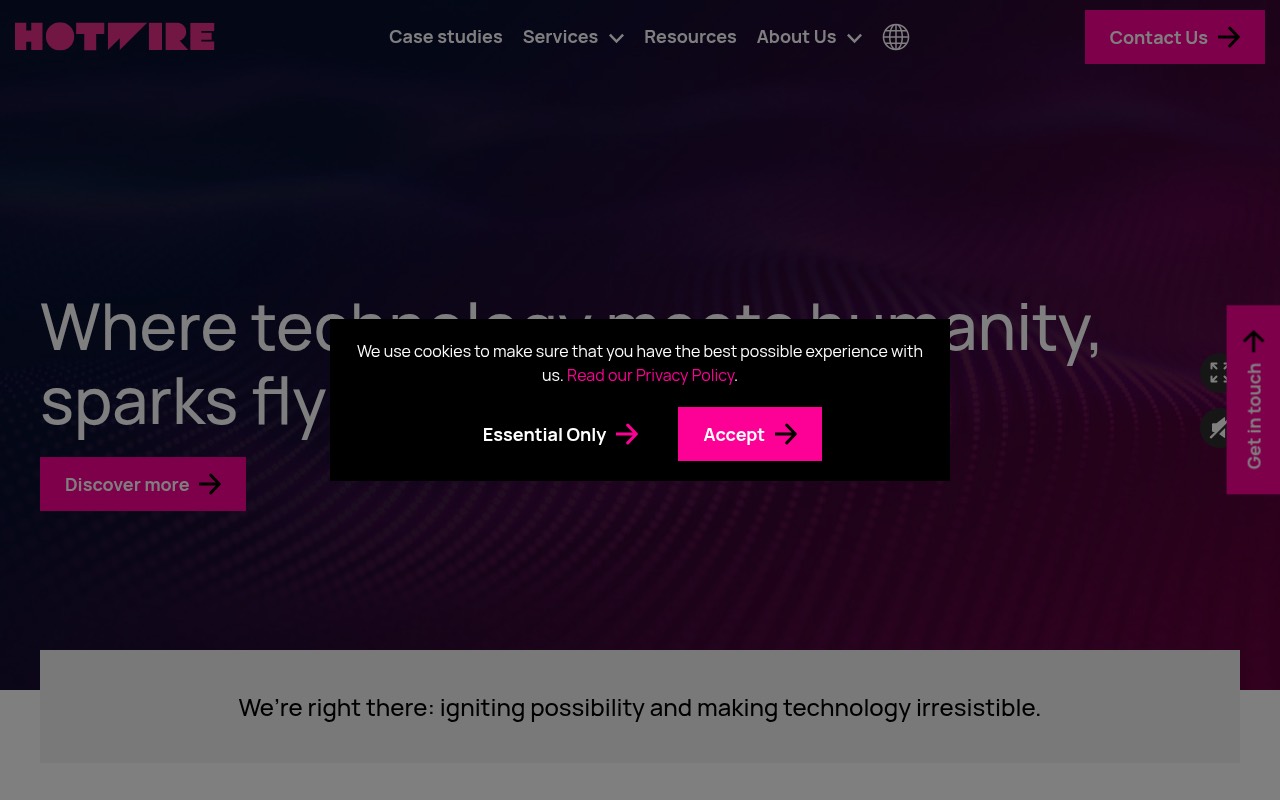
What they doHotwire has been a technology communications agency since 2000 and works in offices around the world. Its centre of gravity is public relations and corporate communications, with content, social and demand generation built around that. Its site features large technology brands including Adobe, SAP, Qualcomm, Akamai, Honeywell, Cloudera and Bentley Systems. It publishes its own research, including reports on how companies are adopting AI, which it uses to earn coverage rather than to fill a blog. For an enterprise the appeal is running reputation and demand from one team in several countries at once, which matters when the same launch has to land in the United States, Europe and Asia in the same quarter. It lists a 10,000 dollar minimum engagement, one of the few here to show any figure.
Best forLarge technology companies launching in several countries at once that need earned coverage and demand generation planned together rather than by separate agencies.
Pros
- Works with large technology brands including Adobe, SAP, Qualcomm and Akamai.
- Real global coverage, so one team can run a launch across regions.
- Publishes its own research and uses it to earn coverage, which is the discipline it sells.
- Shows a minimum engagement figure, which most agencies at this size will not do.
Cons
- PR and communications lead the offer. If you want pipeline as the first measure, demand generation here is a supporting service, not the core one.
- The minimum is a floor, not a price, and the full cost is not published.
- Its size means a smaller account may not get the senior people who won the business.

What they doPosition2 has been running growth marketing for about twenty years from Santa Clara, with a large delivery team in India. That structure is why it can cover a lot at once: paid media, SEO, account-based marketing, marketing automation, conversion work, creative, video and 3D. Its named clients are among the biggest here, including AWS, Google Cloud, Lenovo, American Express and Cohere. It also builds its own products rather than only renting tools, notably Arena Calibrate for pulling marketing reporting into one dashboard and StudioX for 3D content. For an enterprise with budget spread across many channels and no single view of it, that combination of breadth plus its own reporting layer is the main reason to look.
Best forEnterprise technology brands that want one partner covering paid, search, ABM and analytics at volume, with reporting pulled into a single dashboard.
Pros
- Names AWS, Google Cloud, Lenovo and American Express as clients.
- Very broad service range, so one contract can cover paid, search, ABM, automation and creative.
- Builds its own analytics product, Arena Calibrate, to pull scattered marketing reporting into one view.
- Around 200 to 500 people, with the delivery capacity to run high-volume programmes.
Cons
- Its own organic marketing is weak for a firm that sells search. Its visibility leans on paid rather than on ranking for what it sells.
- Not B2B only. The client list also includes consumer brands, so B2B depth varies by team.
- No published pricing.

What they doTwogether works with technology companies and nothing else. Its site names Adobe, Dell, Hitachi, Juniper, Lenovo, NetSuite, Sage and Salesforce, which is a serious enterprise roster for an agency of fifty to two hundred people. Alongside demand generation and account-based marketing it does a lot of channel work, meaning marketing that runs through resellers and partners rather than direct. That is a real specialism and it matters, because most large technology vendors sell a large share of their revenue through partners and most agencies have no idea how that motion works. It also built its own tool, PartnerView, to track how partners are performing. It works across the United Kingdom, Europe and North America.
Best forEnterprise technology vendors running demand, account-based marketing and partner or channel programmes across several regions.
Pros
- Names Adobe, Dell, Salesforce, Hitachi and Juniper as clients.
- Real channel and partner marketing depth, which few demand generation agencies have.
- Built its own partner performance tool, PartnerView.
- Technology only, so the team already understands the products.
Cons
- No published pricing, and no senior team named on the site, so you cannot see who would run your account.
- Technology only. If you are an enterprise outside tech, this is not your agency.
- Its own marketing is moderate rather than strong, so it does not fully demonstrate the demand generation it sells.
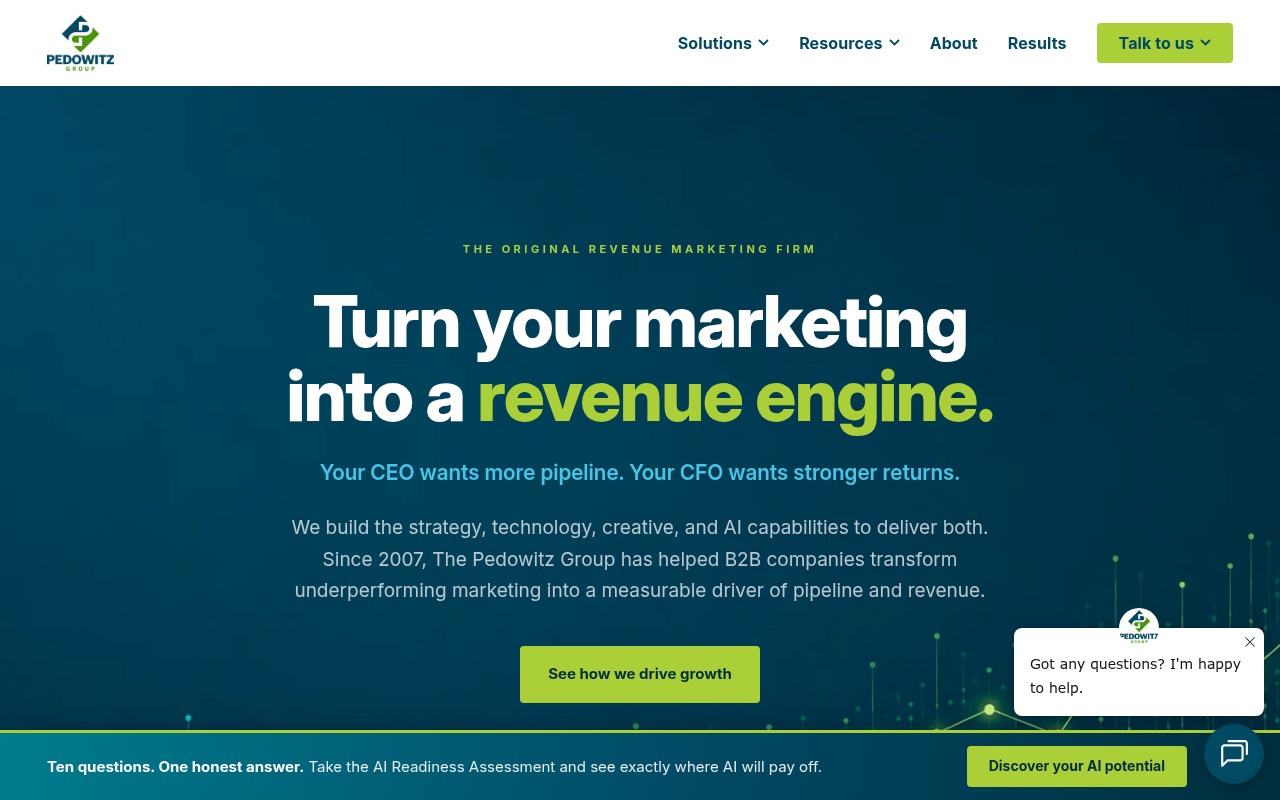
What they doThe Pedowitz Group is closer to a consultancy than a campaign agency. Since 2007 it says it has worked with more than 1,500 B2B companies on what it calls revenue marketing, using a maturity framework called RM6 to grade where a marketing function is and what to fix next. Its real strength is marketing technology: it holds hundreds of certifications across HubSpot, Marketo, Eloqua and Salesforce, which is the exact stack most enterprises are stuck inside. Named clients include Charles Schwab, Pitney Bowes, Broadridge, Zoetis, Billtrust and TraceLink. If your problem is that three systems report three different numbers and nobody trusts the pipeline figure, this is the kind of firm that fixes that before anyone talks about campaigns.
Best forEnterprise marketing teams whose reporting and marketing technology have drifted out of shape and who need the plumbing fixed before more demand is poured in.
Pros
- Names Charles Schwab, Pitney Bowes, Broadridge and Zoetis as clients.
- Deep enterprise martech coverage across Marketo, Eloqua, Salesforce and HubSpot, not HubSpot alone.
- A published maturity framework, RM6, so the diagnosis is structured rather than improvised.
- Working since 2007, with a very large number of B2B engagements behind it.
Cons
- No published pricing.
- Consulting-led. If you want a team to run campaigns week to week, you may still need a delivery agency alongside it.
- Broad across industries rather than deep in any one, so sector knowledge will come from you.
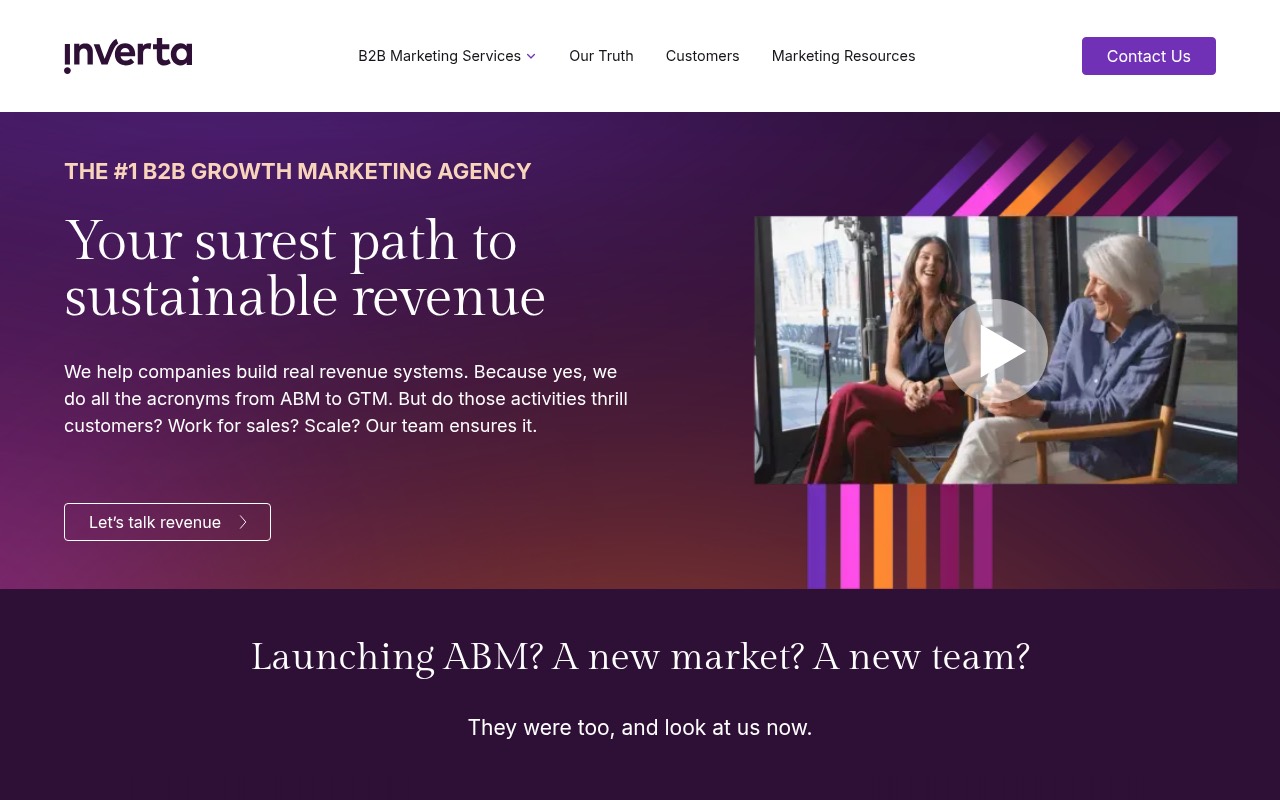
What they doInverta calls itself the original account-based marketing agency and points to two decades of it. It is a small senior team rather than a large delivery shop, and it names its leaders on the site, including Kathy Macchi and Jessica Fewless, both long-standing figures in account-based marketing. That is the trade it offers: you get people who have run these programmes many times, working directly on yours, rather than a large team with juniors doing the day to day. It pairs strategy with actually implementing the technology, which many strategy firms hand off. Named clients include Procore, Sysdig and Actian, and it works with companies from emerging through to enterprise. It cites one client sourcing 75 percent of all pipeline from account-based marketing.
Best forEnterprise marketing leaders starting or rebuilding an account-based programme who want senior strategists hands-on rather than supervising.
Pros
- Names its senior people publicly, so you can check who will actually work on your account.
- Two decades of account-based marketing specifically, not a recent pivot into it.
- Does the martech implementation as well as the strategy, so the plan gets built rather than handed over.
- Names Procore, Sysdig and Actian as clients.
Cons
- A small team of eleven to fifty. It cannot staff a large multi-region programme on its own.
- No published pricing.
- Calls itself the number one agency in its category without an independent source for that claim.
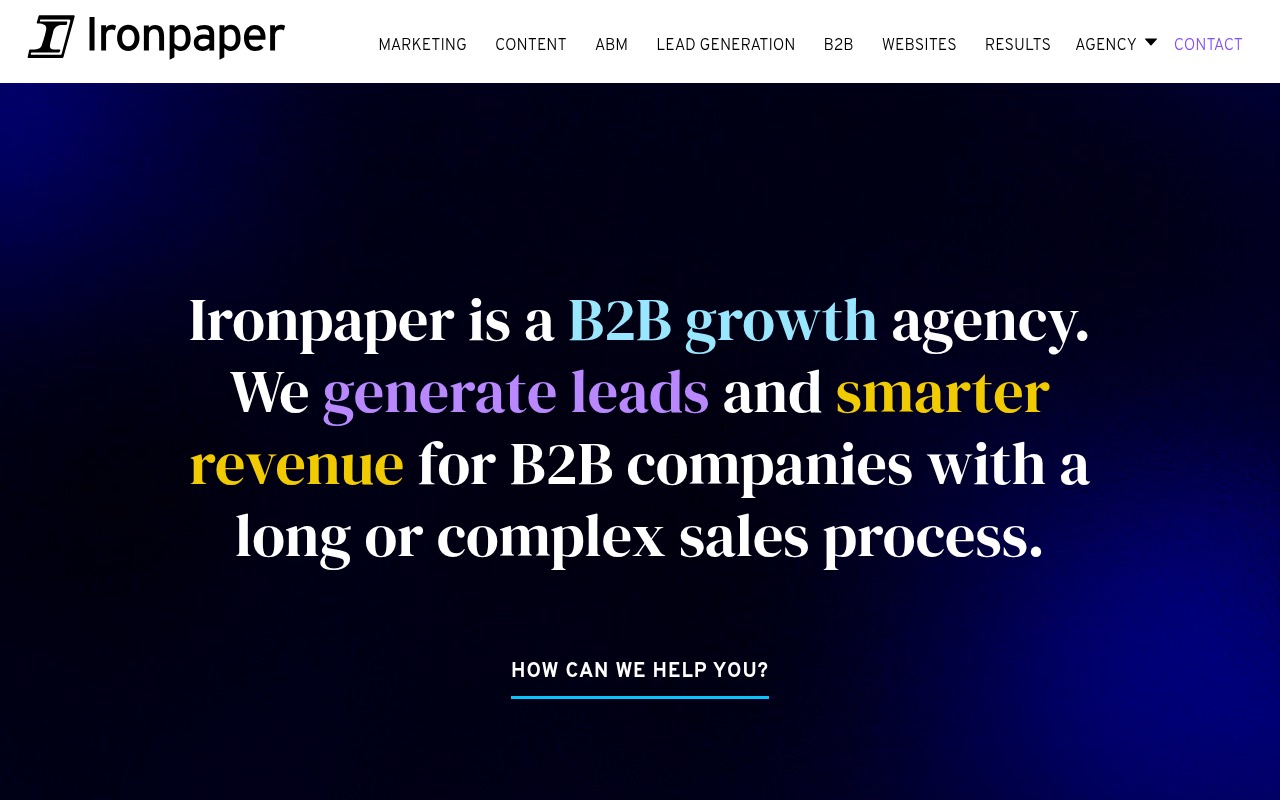
What they doIronpaper has been going since 2002 and is about seventy people, based in New York and spread across the United States. It only works in B2B, and it specifically targets companies with long or complicated sales processes, which is the enterprise situation. It runs account-based marketing, demand generation, content, websites and sales enablement together, and it treats the sales handover as part of the job rather than someone else's problem. It publishes its own research on B2B marketing, which is unusual at its size and gives you something to judge the thinking by before you buy. Named clients include Steelcase, Mobilewalla, Solartis and Sitex, a smaller and less famous roster than the large integrated agencies above it here.
Best forB2B companies with long, committee-led sales cycles that want demand generation, content and sales enablement measured as one system.
Pros
- Built specifically around long and complex sales cycles, which is the enterprise problem rather than a general one.
- Publishes its own original research, so you can judge the thinking before you engage.
- B2B only since 2002, with named senior people on the site.
- Treats sales enablement as part of demand generation rather than a separate project.
Cons
- Its named client list is smaller and less recognisable than the agencies above it, so enterprise proof is thinner.
- No published pricing.
- United States only, so it cannot run a European or Asian programme for you.
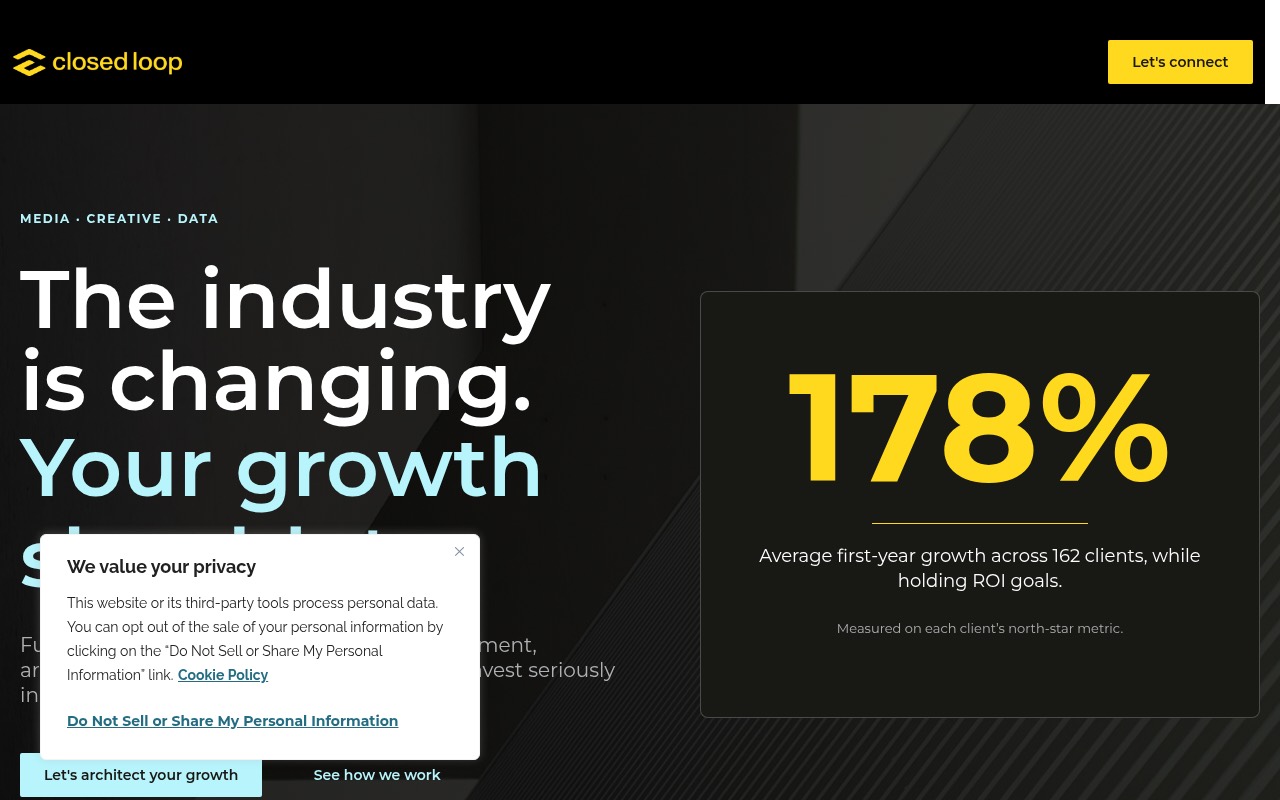
What they doClosed Loop is a paid media agency with its own creative and measurement teams attached. It has been running for about twenty-five years and says it has managed more than two billion dollars of media spend, which is the number that matters if you are handing over a large enterprise budget. Two other figures on its site are worth noting: its people average nearly thirteen years of experience, and an account team averages six people. That is a deliberately senior, small-team model rather than a large pyramid with juniors. Named clients include Amazon, Slack, Rakuten, FICO, Fiserv, Worldpay, Calendly and Drata. It has been named an Ad Age Best Place to Work seven times, which is a reasonable proxy for whether the team stays long enough to learn your business.
Best forEnterprises spending seriously on paid media that want media buying, creative production and measurement handled by one senior team.
Pros
- More than two billion dollars of managed media spend, so the scale is proven.
- Names Amazon, Slack, FICO, Fiserv and Worldpay as clients.
- A deliberately senior team, averaging close to thirteen years of experience, with small account teams.
- Creative production sits in-house next to media buying, so ads can be changed as fast as the data says to.
Cons
- Paid media is the core. If you want organic search, content or an account-based programme, this is not the right shop.
- Not B2B only. Its client list includes consumer brands, so B2B depth varies by team.
- No published pricing, and no senior leaders named on the site.
What they doDirective works with software companies and measures itself on pipeline rather than leads. Its argument is that most agencies optimise one channel at a time while the business needs the whole funnel to move, so it plans paid media, search, content and conversion work against a single revenue target under a method it calls Customer Generation. It says it has served more than 420 brands. It is fifty to two hundred people in Irvine, California, and it has the strongest independent review evidence on this list: 4.8 out of 5 from 56 reviews on Clutch, which is far more than most agencies here can show. Its own marketing is genuinely strong, ranking well for the terms it sells, which is a fair sign it can do the same for you.
Best forEnterprise and mid-market software companies that want paid and search planned against pipeline rather than lead volume.
Pros
- 4.8 out of 5 from 56 Clutch reviews, the deepest independent review evidence on this list.
- Strong organic visibility of its own, which is direct evidence it can do the work it sells.
- Plans channels against one revenue target rather than optimising each in isolation.
Cons
- No published pricing. Clutch lists its project minimum as undisclosed too.
- Software focused, so an industrial or services enterprise is a weaker fit.
- United States only.
What they doLedger Bennett runs global demand generation for large B2B companies, and it does one thing the others here do not. Alongside the agency it offers embedded talent, which it calls Fluid Talent: it places its own specialists inside your marketing team for a period rather than delivering the work from outside. For an enterprise that has a headcount freeze or cannot hire a marketing operations specialist fast enough, that is a practical answer. On the agency side it runs full-funnel demand programmes across paid media, content, marketing automation and analytics, so the embedded people are not the whole offer. Named clients include GE Digital, GE Vernova, Canon, Trend Micro, John Crane and Acxiom. It is a few hundred people and works across the United Kingdom and North America.
Best forLarge B2B revenue teams that need both agency delivery and specialists embedded inside the team, often because hiring is blocked.
Pros
- Names GE Digital, GE Vernova, Canon and Trend Micro as clients.
- Embedded talent alongside agency delivery, which solves a hiring problem most agencies cannot touch.
- Names its senior team publicly.
- Works across the United Kingdom and North America on one programme.
Cons
- No published pricing.
- Its own website is thin and has not been meaningfully updated in some time, which is a poor advertisement for a demand generation agency.
- The embedded talent model means part of what you buy is staffing, so compare it against a recruiter as well as against other agencies.
What they doObility is a specialist rather than a full agency. It runs paid search, paid social, search engine optimisation, content and, more recently, work aimed at getting cited in AI answers, all for B2B software and technology companies. It is a smaller team of ten to fifty people, and it has been doing this since 2011. It has solid independent proof: 4.8 out of 5 from 27 reviews on Clutch, with a stated minimum engagement of 5,000 dollars, which is more than most firms here disclose. For a large company the fit is narrow but useful. If your paid and organic search is being run badly by a generalist and you want one channel handled properly by people who only work in B2B, this is a sensible and comparatively affordable choice.
Best forEnterprise software teams that want search and paid media run well by a B2B specialist, rather than a full agency relationship.
Pros
- 4.8 out of 5 from 27 Clutch reviews.
- Discloses a 5,000 dollar minimum, one of only three agencies here to show any figure.
- B2B only since 2011, so no consumer habits leaking into the work.
- Already working on visibility in AI answers, not just Google rankings.
Cons
- No senior team named on the site, so you cannot see who runs the work.
- Search and paid only. Strategy, content systems, martech and sales enablement are not covered.
- Ten to fifty people, so it is a specialist supplier to an enterprise rather than a lead agency.
Is your enterprise content bringing in pipeline?
Get a free Content RevOps audit. We show where your content leaks revenue and what a connected system would change, benchmarked against close to 14,000 B2B websites.
Frequently asked questions
What does a demand generation agency do for an enterprise?
It helps a whole buying group find you and trust you before anyone talks to sales. At enterprise size that usually means account-based programmes aimed at named accounts, decision-stage content for each role in the group, and the marketing operations work to tie it all back to Salesforce, Marketo, or HubSpot so finance can see what it produced.
How much do enterprise demand generation agencies charge?
Almost none of them publish a price. Of the 14 here, only three show a number: Content RevOps lists its full system from 8,500 US dollars a month, Hotwire lists a 10,000 dollar minimum, and Obility lists a 5,000 dollar minimum. Enterprise programmes at the large integrated agencies commonly run well into six figures a year. We mark pricing as not disclosed when an agency does not share it.
Should an enterprise hire one agency or several specialists?
Both patterns work, and they fail in different ways. One integrated agency gives you a single plan and a single report, but you take whatever it is weakest at. Several specialists give you the best of each, but somebody inside your company has to join them up, and in most enterprises nobody owns that job. Decide who joins them up before you decide how many to hire.
How did we choose and rank these agencies?
We reviewed 204 agencies that work with enterprise buyers, then kept the ones that could show named clients at that size. We ranked them on that proof, on whether they can staff enterprise work, on whether they run marketing for themselves, on review evidence, and on transparency. The same checks apply to our own entry, which is why it carries the drawbacks it does.