How do you find content ideas before the topic is already saturated
Want help turning real audience questions into a content strategy that drives pipeline? Let’s talk.
Book a CallMost people ask this question the wrong way.
They think the job is to find a topic no one else has touched yet.
It is not.
That idea sounds clever. It feels strategic. It feels safe. But it comes from a basic misunderstanding of how content works now.
In a world where AI can help anyone make blogs, posts, guides, and newsletters in minutes, almost every topic looks crowded. If you wait for a clean, empty topic, you will wait forever. Worse, you will build your whole strategy on fear. You will spend more time trying not to sound repetitive than trying to be useful. That is one of the fastest ways to kill a content strategy before it even starts.
The better question is this:
How do I find the questions, pains, and gaps my audience still cares about?
That is where good content starts.
Why this question causes so much trouble
A lot of small businesses never get their content strategy off the ground. The reason is not always lack of effort. Often, they get stuck at the very first step. They keep asking, “What should we talk about?” and never move past it.
Research suggests that a big share of SMBs have no documented marketing plan at all, and many also have no clear content strategy. Depending on the study, around 40% to 70% of small SMBs may have no content program or strategy. Around 50% to 70% may have no documented marketing plan.
That matters because “what are we going to talk about?” sounds like a small question, but it hides a deeper problem.
It often means:
We are not sure who we are helping
We do not know what matters most to them
We are scared of sounding fake
We do not trust that content will work
We want certainty before we start
So when someone asks, “How do I find content ideas before the topic is saturated?” the deeper truth is often this:
I do not want to waste time making content no one cares about.
That is a fair fear. But the answer is not to chase novelty.
The answer is to get closer to your market.
Why blue ocean thinking fails in content
The dream sounds nice.
Find an untouched topic. Be first. Own the conversation. Win the market.
But content does not work like that for most SMBs.
You are not launching a new continent. You are entering a discussion that already exists. Your buyers already have problems, questions, worries, and half-formed opinions. They are already talking to peers, searching online, reading threads, checking vendors, and trying to make sense of their options. Your job is not to invent that discussion. Your job is to join it well.
This is why blue ocean thinking can hurt early content strategy.
It pushes you to ask:
What has nobody said yet?
What topic is still empty?
How do we avoid overlap?
When you should be asking:
What does our audience keep struggling with?
What do they not understand yet?
What do they wish someone would explain clearly?
Where are they still frustrated, even after reading other content?
That is a much better place to start.
Because markets do not reward “never-been-said-before” nearly as much as they reward “finally explained in a way that helps me.”
Why content is not the same as ads or cold outreach
This part trips people up.
Ads and cold emails often win by interruption.
They catch attention fast. They try to create urgency fast. They try to get a click, a reply, or a meeting fast.
Content is different.
Content works by helping people think.
It meets people earlier. It helps them learn. It helps them compare. It gives them language for a problem. It helps them feel less confused. Over time, it builds trust. It also shortens the road to a buying conversation because the person already understands more when they arrive. This fits your broader view that content should act as infrastructure, a sales layer, and part of the go-to-market system, not just as “stuff marketing publishes.”
That means commercially viable content does not need to feel flashy. It needs to feel useful.
It does not need to feel like a pitch. It needs to feel like progress.
It does not need to say something no one has ever heard. It needs to help the right person make sense of something that matters.
What should your goal be instead
Your goal when starting content is simple.
Serve a community.
Not a channel.
Not an algorithm.
Not a calendar.
A community.
That means you start with the people, their questions, their fears, their language, and their daily problems.
This lines up with your ICP notes. Your best-fit buyers are often founder-led SMBs with small teams, long sales cycles, weak lead capture, unreliable channels like referrals or events, and a real need for better nurture and clearer education. They are often wary of marketing, unsure what to do, and tired of tactics that feel expensive or fake.
If that is your market, then your content ideas are not hiding in a trend tool.
They are hiding in the friction your audience feels every week.
Where do the best content ideas actually come from
They come from the places where your audience speaks freely.
That is why community mining matters.
But Reddit is one of the easiest places to start because people ask blunt questions there. They complain there. They admit confusion there. They share failed attempts there. That is exactly the kind of raw material you need.
For example:
SMB owners may hang out in r/entrepreneur or r/smallbusiness
Marketers may hang out in r/marketing or r/askmarketing
B2B sales people may hang out in r/sales or r/b2bsales
When you mine these spaces, do not just look for popular topics.
Look for pain.
Look for tension.
Look for lines like:
“We tried this and it did not work”
“Why is this so hard?”
“What are we doing wrong?”
“How do I fix this?”
“Is anyone else dealing with this?”
“What tool should I use for this?”
“Why are our leads ghosting us?”
“How do we get better-fit leads?”
Those are not just content ideas.
They are signs of demand.
A practical way to do this fast
Here is a simple workflow.
Step 1: Pick the communities
Choose 5 to 10 places where your audience already talks.
Do not overthink this part. Start with the obvious places.
Step 2: Scrape the posts and comments
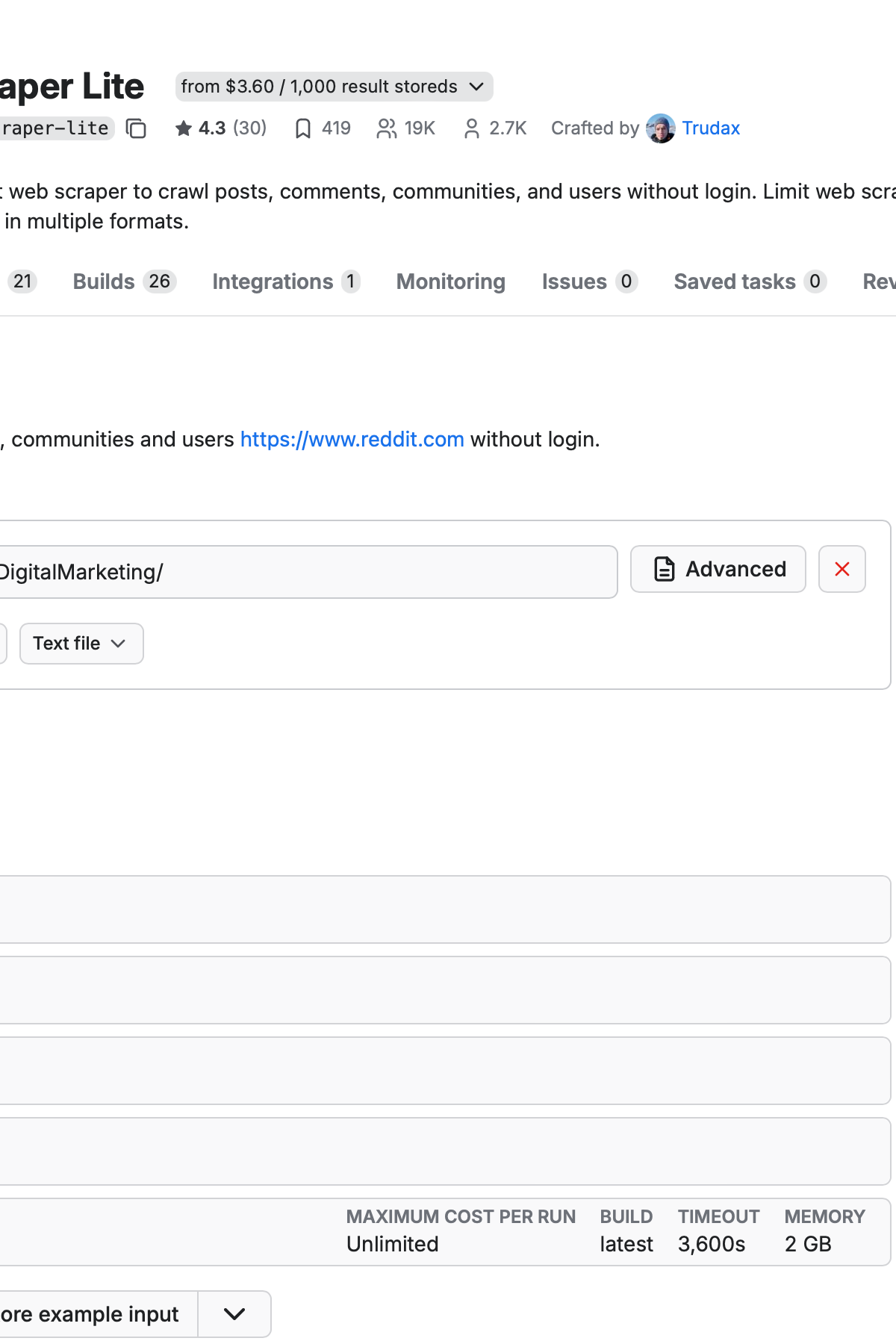
Example of a Reddit scraper inside the Apify platform.
Use a tool like Apify to scrape as many relevant posts and comments as you can.
You are not scraping for vanity metrics. You are building a research base.
Step 3: Pull out the real questions
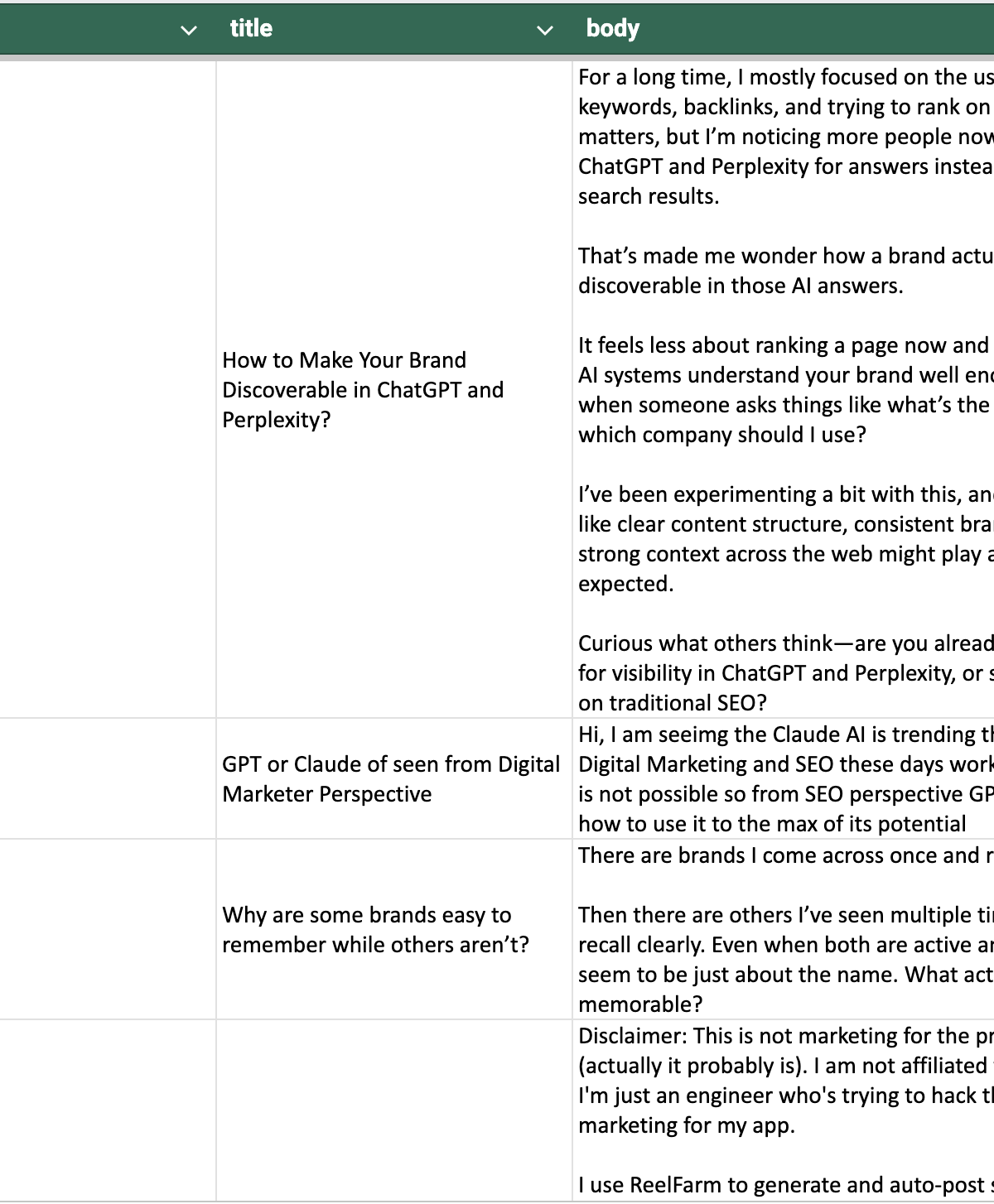
Example dataset from the Reddit scraper. You can convert it to a table and filter by number of comments or upvotes.
Now go through the raw data and extract:
questions
complaints
frustrations
failed attempts
repeated themes
language people use again and again
This part matters because your audience will often tell you exactly what hurts. You just have to notice it.
Step 4: Group the patterns
Put similar questions together.
For example:
lead quality problems
content that does not convert
confusion about SEO
distrust of agencies
outbound that gets ignored
expensive conferences
long sales cycles
not knowing where to start
Those themes line up closely with the jobs to be done in your notes.
Step 5: Use a strong research model
Feed the raw posts and comments into a good research model and ask it to synthesize the top 200 questions your audience has.
That gives you something far more useful than a random list of topic ideas.
It gives you a question bank.
Step 6: Turn the question bank into your strategy
Now you have the start of a real content system.
Not because you found a magical new topic.
But because you found real demand.
Step 7: Push it further with search tools
If you want to go one step further, upload your cleaned list of questions or problems into a tool like AnswerThePublic.
That can help you find related searches, useful phrasing, and topic clusters.
Now you are combining community language with search behavior.
That is a much smarter way to build content than guessing in a spreadsheet.
Why this method works better than shortcut tools
A lot of people try to skip the hard part.
They open an SEO tool. They type in a seed keyword. They export a list. Then they call that strategy.
That can help, but it is not enough on its own.
Because keyword tools show demand in a narrow way. They show what people typed. They do not always show why they typed it. They do not show the emotion behind it. They do not show the failed attempts, the shame, the anger, the confusion, or the real-world mess around the question.
Community mining fills that gap.
It helps you hear the buyer as a person, not just as a query.
That is where better content comes from.
So what does originality actually mean now
Originality does not mean finding a topic no one has covered.
Originality means bringing clear thought, real empathy, and sharp pattern recognition to a problem people still have.
You can write about a common topic and still sound fresh if:
you use the language your audience actually uses
you speak to a real fear others ignore
you explain the trade-offs clearly
you connect the topic to the buyer’s real job
you say what most content avoids saying
you make the reader feel understood
That is why an original voice usually appears after you stop trying so hard to be original.
It appears when you get close enough to the market that you can speak plainly about what is really going on.
Ready to build a content strategy people actually care about?
Book a call to see how Content RevOps helps you find real buyer questions and turn them into content that supports revenue.
Frequently Asked Questions
About the Author

Founder & CEO, Content RevOps
Stefan Kalpachev is the founder and CEO of Content RevOps, where he helps B2B SaaS companies transform their content into predictable pipeline. With a background in content marketing and revenue operations, Stefan has developed a unique methodology that bridges the gap between content creation and revenue generation.
Connect on LinkedIn