Fintech Content Marketing for B2B Fintechs That Already Have Content
See where your fintech's content stands. Score your content against other fintechs in 12 inputs with our fintech content benchmarking tool and get your top three fixes.
Book a CallFintech content marketing, for a B2B fintech, means publishing what a buying committee needs to trust you with money, risk, and integration, then wiring that content into your CRM, sales, partner motions, and AI answers so it starts and moves deals. Most fintechs already own the raw material. In our 2026 study of fintech websites, only about 1 in 4 (25.5%) run content as a system, while whitepapers, blogs, resource hubs, and case studies each appear on roughly a quarter of sites. The formats exist, and the buyer journey that connects them mostly does not. The fastest gains come from putting the content you already paid for to work.
What is fintech content marketing for a B2B fintech?
Fintech content marketing for a B2B fintech is the work of publishing what your buyers need to believe you, and then connecting it so it produces conversations, target accounts, and referrals. The buyer is a committee at a bank, a lender, a platform, or a finance team. The content has to help that committee agree.
Most explanations of fintech content marketing describe the consumer version: articles that teach people about budgeting, credit scores, or savings to win app downloads. That job is real, and it is a different one. A B2B fintech sells payments infrastructure, banking software, financial data, or compliance tooling, and the people reading are deciding whether to stake their own reputation on you.
Who reads B2B fintech content
The Hoffman Agency's Fintech Catalyst survey, published by CCGroup, asked 500 senior technology decision-makers at banks and larger fintechs in the UK, US, and Singapore who sits in a purchase. Finance joins 67% of decisions, IT 65%, operations 33%, procurement 30%, and compliance 24%.
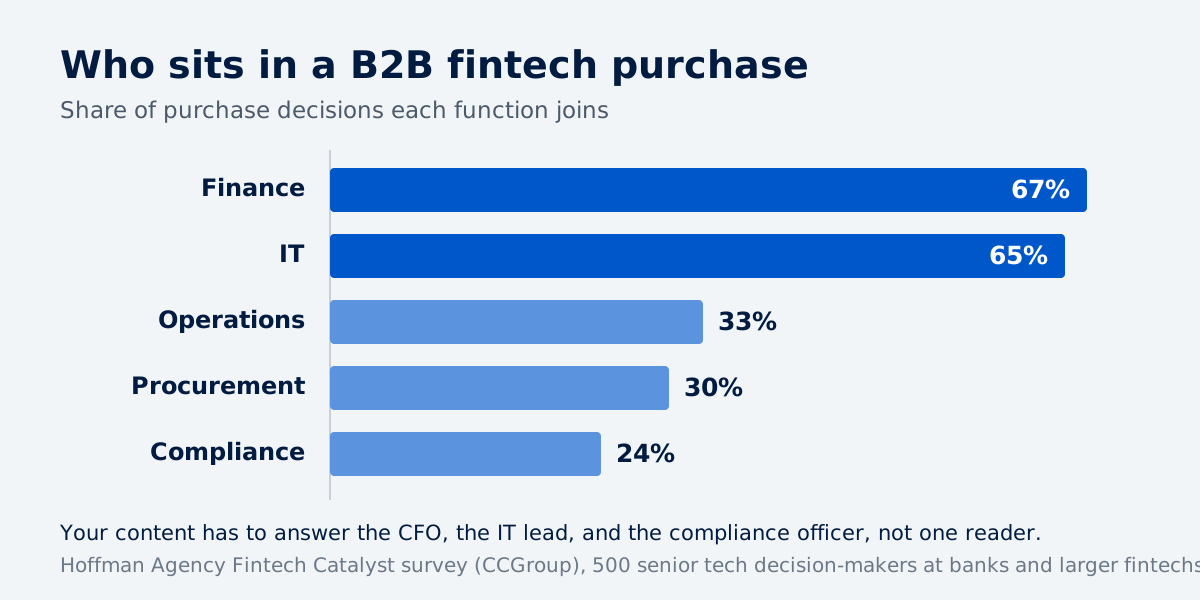
The same buyers named their biggest obstacles: ensuring compliance (44%), supplier due diligence (42%), and ease of integration (41%). Price did not lead the list. For a fintech marketer, that means your content has to answer the CFO, the IT lead, and the compliance officer, and the questions that stall deals are about risk and fit.
Why B2B fintech is different
Practitioners describe the same pressures in plainer words. A B2B fintech thread on r/b2bmarketing lists "6-12 month sales cycles", "compliance/legal as a hard gate", and "buyers ghosting anything that feels generic".
Put together, B2B fintech content works under four conditions a general marketing blog rarely faces:
- A committee spanning finance, IT, operations, procurement, and compliance, each with its own doubts
- A compliance review on both sides of the deal
- Cycles that run six months to well over a year
- Buyers who research, and increasingly ask AI tools, before they talk to sales
Fintech content as a system
Our fintech study found that only 25.5% of fintechs run active, systematic content. A system here means each asset has a named buyer, a next step, and a place in the CRM, so sales and marketing can see what it did.
Fintech employers already hire for that. Cross-functional collaboration appears in about 91% of the fintech marketing roles in our hiring study, which means the job is to connect content to sales, product, and compliance.
We call that wiring plus the content Content RevOps: the RevOps side is the wiring, and the content is what everything else in go-to-market runs on.
Should a fintech publish more content or put existing content to work first?
Put existing content to work first. A B2B fintech with a few years behind it already owns posts, whitepapers, webinar recordings, case studies, sales decks, and product docs. The first decision is what to keep, rewire, refresh, or retire, and what job each asset does for a named buyer on the committee.
This is activation work on an estate you already own. In our fintech study, 39.5% of fintechs publish in a minimal or incidental way. They have something, and it does little. Another figure explains why: 71.5% of fintech content reads as generic, with no clear buyer it was written for.
What your fintech content is already worth
Our fintech performance benchmarks show the median fintech ranks for about 110 keywords. The median fintech's ranking content is already worth about $4,900 a month in equivalent ad spend.
Equivalent ad spend is what you would pay Google Ads to buy the same clicks you earn for free. So the median fintech already holds a working asset. The question is whether those visitors meet a next step that suits them.
Older content tends to carry more of the load than teams expect.
When HubSpot studied its own blog, 92% of its monthly blog leads came from posts published before that month.
Fintech teams report the same. Chelsea, a senior content creator at Intrinio, a B2B financial data company, said on Intrinio's own show that they have content written "six seven years ago that still gets us leads as long as you are keeping things updated".
Four tests for existing fintech content
Each asset gets one plain test. Run the whole estate through it before you brief a single new piece.
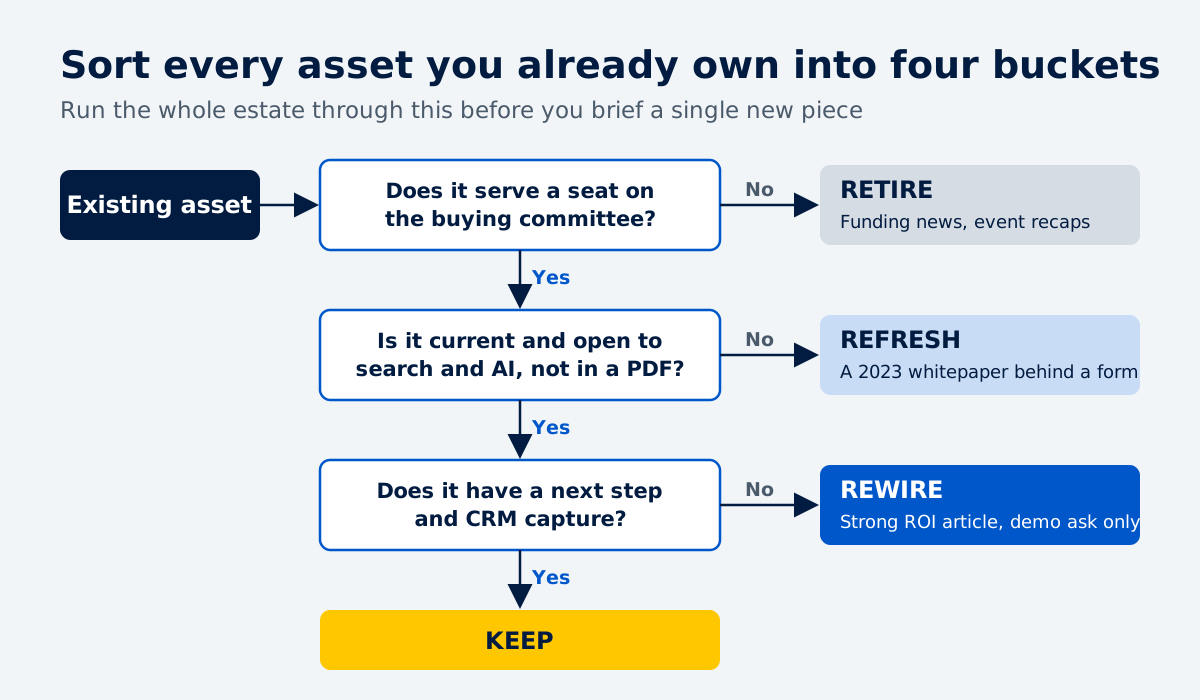
Bucket | The test | Typical fintech asset |
Keep | It ranks, and it speaks to a named buyer on the committee | A regulatory explainer that compliance leads find and read |
Rewire | The substance is good, but there is no next step and no CRM capture | A strong ROI article that ends with "book a demo" and nothing else |
Refresh | The substance is accurate, but it looks stale or the depth sits locked in a PDF | A 2023 whitepaper on open banking behind a download form |
Retire | It serves no seat on the buying committee | Funding announcements and event recaps written as blog posts |
Refresh signals in fintech content
Freshness is visible to buyers and to search engines. Our study found recent content on 46.8% of fintech sites and stale-content signals on 22.2%. Only about 8% of active fintech sites show an update date at all, so even accurate pages can look abandoned.
Whitepapers are the most common fintech format, on 27.0% of sites, yet they lock that depth in formats search and AI cannot read. Turning the best whitepaper sections into open pages, with the PDF kept as the download, is often the highest-yield refresh a fintech team can do.
Fewer, better-supported fintech pieces
Cutting volume can raise results. Will Thompson, then running content and communications at regtech company ComplyAdvantage, cut a summer webinar series from seven sessions to four and spent the time on promotion and database clean-up; registrations rose 60%, and viewing time grew from 23,000 to 64,000 hours.
Reactivation with existing fintech content
The biggest wins from an existing estate often sit in the CRM. For Banking Crowded, a banking and fintech intelligence company, we used its resource hub to restart conversations with opportunities that had gone quiet. About 25% of its closed deals came from that reactivated pipeline.
The sharpest insight for that hub sat trapped in sales call recordings, where customers explained their problems in their own words. We describe how we pull that out in extracting raw assets from your data and team, and the mechanics of the restart in our guide to lead nurture and database reactivation.
Which formats do B2B fintech buyers need, and how do you connect them into a buyer journey?
B2B fintech buyers need proof formats matched to each seat on the committee, connected so that one page hands the reader to the next with an ask that fits their stage. Most fintechs have the formats. Very few have the path between them.
Our study of fintech content execution shows the spread. Whitepapers appear on 27.0% of fintech sites, blogs on 26.2%, resource hubs on 26.0%, and case studies on 24.5%. Every format sits at a similar, modest share, and presence is not a program.
The leak shows at the end of each page. About half of fintech sites have no clear next step for the reader, and between 40% and 46% rely on a demo or quote request. A CFO reading a research article is rarely ready for a demo, so that reader leaves. It is the same pattern we see when a blog gets traffic but fails to generate demos.
What fintech buyers say is missing
Fintech buyers notice the gap. One reader in an r/fintech thread on what is missing in fintech content described "blog posts that are 80% buzzwords and 20% actual insight". In the r/b2bmarketing fintech thread, another marketer put it as "You're missing the most critical element of de-risking a purchase: customer evidence."
Our own numbers agree. Among active fintech publishers, about 44% of content targets awareness and only about 16% targets the decision stage.
Proof formats by fintech committee role
The scarce formats are the ones a committee uses to say yes. Here is each one, ranked by the role it serves, with how often it appears on fintech sites in our fintech study.
Format | Share of fintech sites | Who it serves |
ROI or business case | 34.2% | The champion, who has to win over the CFO |
Original research | About 35% of active fintechs | The CFO and executives, who want a view of the market |
Objection handling | 25.8% | Risk and compliance, who need their doubts answered in writing |
Case studies | 24.5% | The whole committee, as proof someone like them succeeded |
Technical documentation | 46.0% | Engineers, and engineers only |
Comparison pages belong in the same set, since they serve the evaluator building the shortlist. Technical documentation is the most common fintech asset, which pulls effort toward the people who check integration and away from the proof the rest of the committee needs.
Case studies carry more weight than their 24.5% share suggests. In the Hoffman Agency's fintech buyer survey, 25% of technology buyers at banks and larger fintechs said they have ruled out a vendor for lacking relevant case studies. With case studies on only about a quarter of fintech sites, most fintechs hand buyers that reason.
One fintech buyer journey, end to end
Picture one committee buying payments infrastructure. The CFO reads your original research and then your ROI page. The compliance lead reads your regulatory explainer and your objection-handling page. The engineer reads the docs.
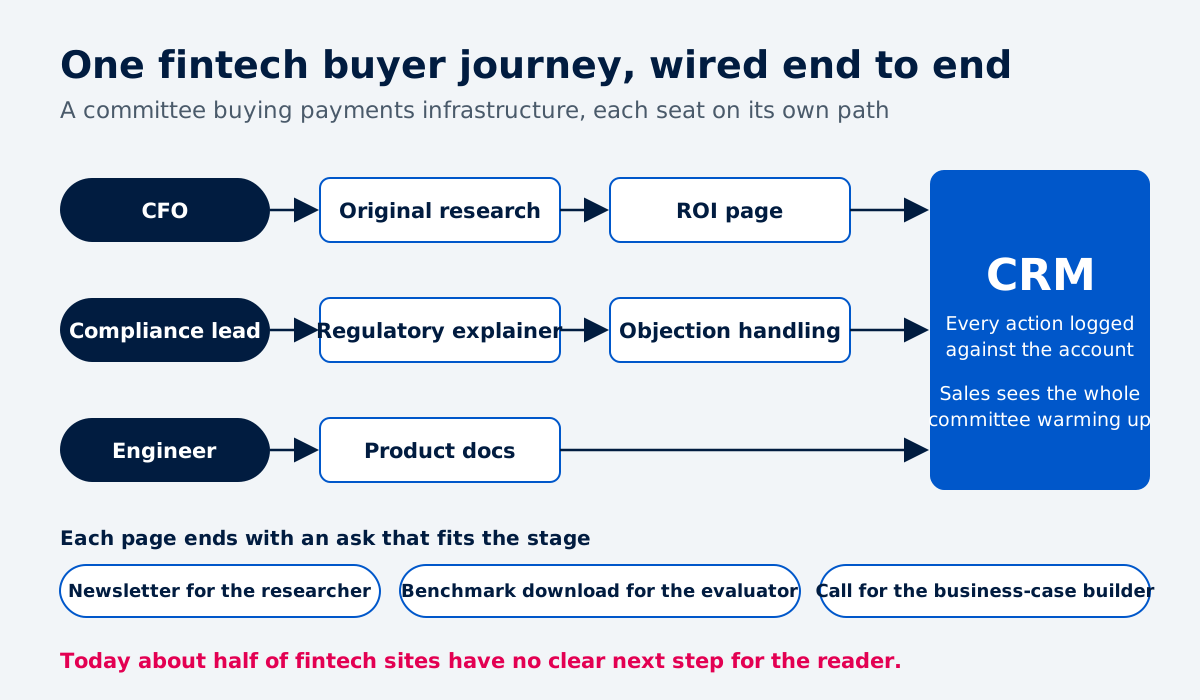
Each page hands the reader to the next one with an ask that fits their stage: a newsletter for the researcher, a benchmark download for the evaluator, a call for the person building the business case. Every one of those actions lands in the CRM against the account, so sales sees the whole committee warming up.
The parts mostly exist. About two in three active fintechs run a resource hub, yet only about 41% use in-body calls to action and about 18% match those calls to the buyer's stage. Newsletter capture appears on 28.7% of sites.
Fintech examples of a connected journey
For Banking Crowded, we built conversion steps wired into the CRM, from a soft subscribe at the top to pain-specific downloads deeper down. The program produced more than 1,500 MQLs at a cost per lead under $15, down from $180-220. It drove 65% of site traffic, and organic traffic grew 340%.
ComplyAdvantage, a regtech company, runs content in two layers. An always-on layer of search content, a newsletter, and partner content covers baseline inbound, and three or four campaigns a year each tie to a commercial priority, with every download routed through a nurture that leads people to matching case studies.
Brex organises its resources hub by role, with a CFO and finance leader page beside pages for controllers, accountants, and procurement managers, which is what a committee-shaped hub looks like from the outside. We treat a hub like that as a content product with an owner and a roadmap, not a blog with a nicer name.
How does fintech content marketing work with sales, partners, and outbound?
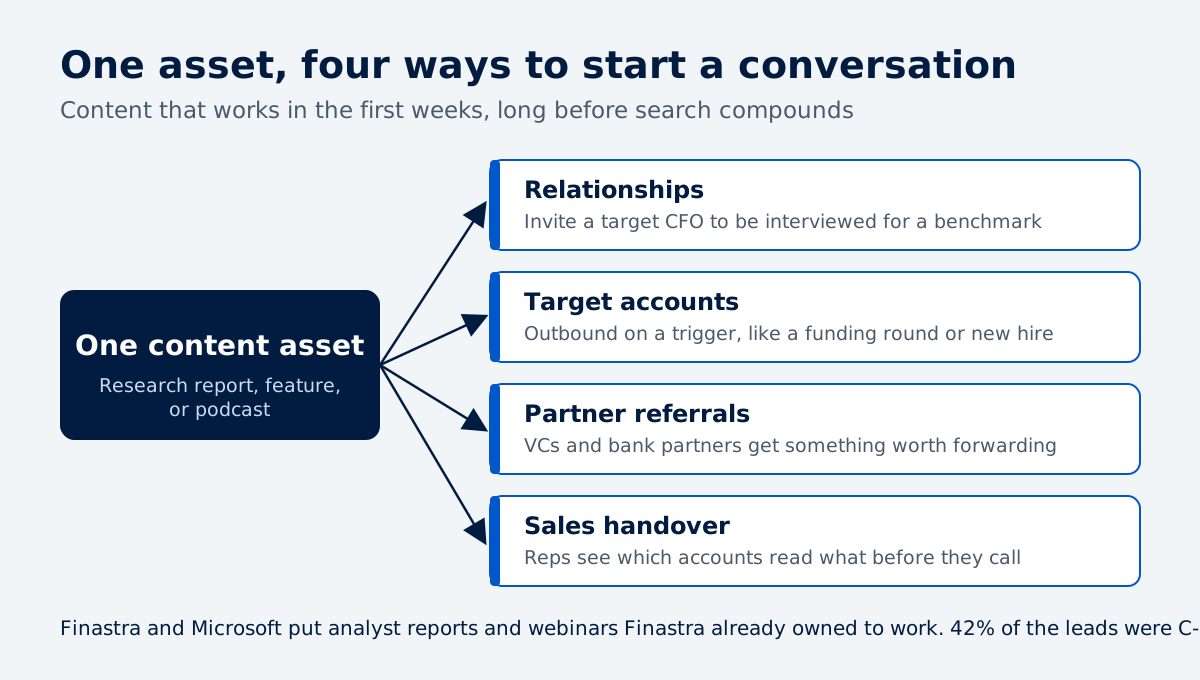
Fintech content marketing works with sales, partners, and outbound by giving each of them a reason to start a conversation. Used this way, content produces results in the first weeks, long before search traffic compounds. It opens relationships, reaches named target accounts, earns partner referrals, and gives outbound something worth sending.
Fintech hiring already points this way. In our hiring study, partnerships (about 44%) and events (about 40%) are the channels fintech employers name first, because fintech buys trust through proximity. Content should feed those channels.
It mostly does not yet. Our fintech performance benchmarks show referral at about 1% of visits and paid search at about 2%, and only about 8% of active fintechs promote content through LinkedIn ads. Our guide to distribution channels for B2B content covers where else that content can travel.
Content as a gateway to fintech relationships
A research project, a feature, or a podcast gives you a reason to contact people you want to know. Inviting a target CFO to be interviewed for a benchmark report is a warmer first touch than a cold pitch.
An Entail AI breakdown of Mesh Payments' B2B fintech marketing makes the same point: inviting prospects onto a podcast as guests opens introductions that a sales email would not.
Partner and VC referrals for fintechs
The same video notes that referrals from your VC to its other portfolio companies can convert at a very high rate. Content gives the partner something to forward.
Banks and platform partners work the same way. Finastra and Microsoft, co-selling payments as a service, put analyst reports and webinars Finastra already owned to work in three account-based campaigns over 14 weeks, and 42% of the resulting leads were C-level.
Signal-led outbound for fintech
Outbound works best when a trigger gives you a reason to write and a piece of content gives you something to offer. One marketer in a thread on LinkedIn strategy for B2B fintech targets CFOs "right after their company closes a funding round or hires a new head of compliance", and pairs that with "monitoring hiring posts and funding announcements".
Other fintech signals follow the same logic: a vendor migration, a new market licence, or a regulatory deadline. Each one maps to a page you already have. We set out how we turn those signals into first conversations in reaching net new leads and in the content-led outreach system that outperforms cold email.
We saw the effect of a strong asset in outbound with Lucid, a B2B SaaS company rather than a fintech. One original data report lifted outbound reply rates from 3-4% to 14-18% and reactivated 30-35% of stalled deals.
Handover from fintech content to sales
For Banking Crowded, content supported sales before, during, and after outreach. Enrichment and engagement signals guided the handover, so reps knew which accounts had read what before they called. That is the wiring underneath every motion above: the CRM, the tracking, and the rules that tell sales when to act. Our lead handover process shows the rules, and our six-step guide to aligning sales and marketing in a fintech firm shows how both teams agree on them.
How do you get fintech content through compliance without it stalling?
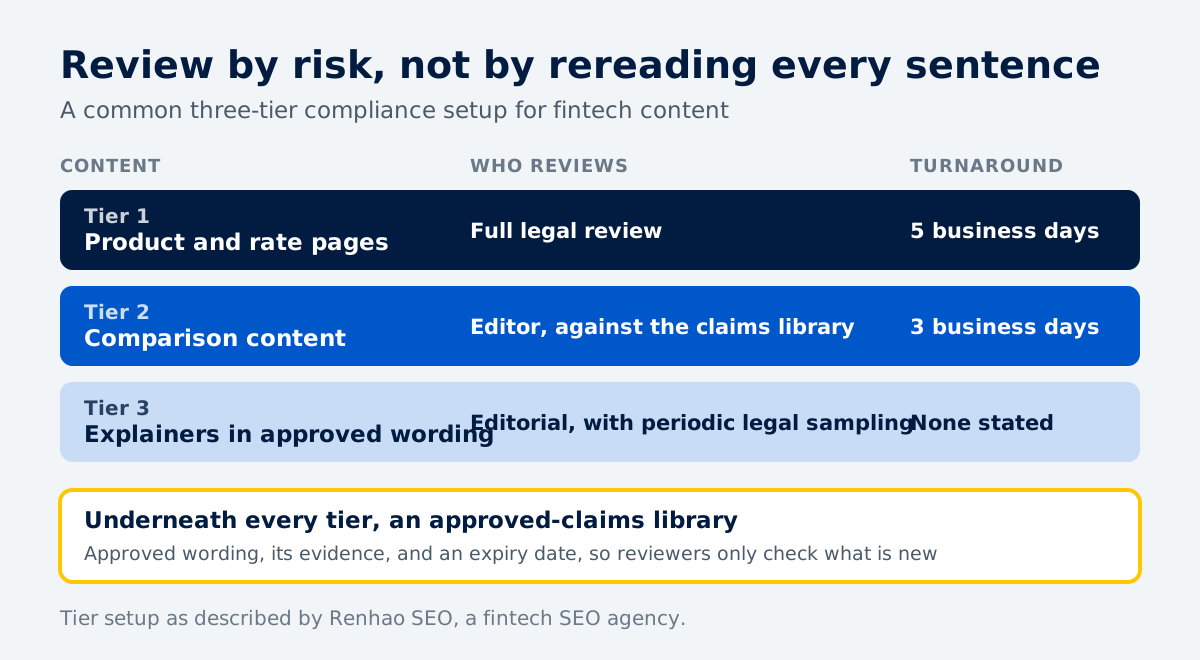
You get fintech content through compliance by designing review into the workflow, so reviewers check new claims against approved evidence instead of rereading every sentence. Compliance works as a design constraint, and teams that plan for it publish faster than teams that treat it as a final hurdle.
Compliance is also a content opportunity for fintechs. Our study of fintech content execution found compliance topics on about 57% of fintech sites, yet only about 23% reach expert depth. Credentialed author bios appear on only about 28%.
Employers see it too. About 41% of fintech marketing roles in our hiring study ask for compliance fluency.
Which rules apply to B2B fintech content
The rules depend on what your company is and who you sell to. Broker and adviser marketing rules usually do not bind a B2B fintech that sells software to banks. They bind its bank and broker customers, whose compliance teams will review any co-branded or customer-facing claims.
- FINRA Rule 2210 covers communications by FINRA member broker-dealers, with retail communications approved by a registered principal before use.
- The SEC Marketing Rule covers SEC-registered investment advisers only.
- The UK FCA financial promotions regime covers promotions of regulated products, including payment services and e-money, which must be "clear, fair and not misleading".
- The CFPB's UDAAP standards cover covered persons and service providers in consumer financial products.
The rules bind your fintech directly if it is itself authorised, for example as an FCA-authorised payment or e-money firm, if it offers a consumer product, or if it acts as a service provider inside one.
A compliance workflow that keeps fintech content moving
In practice, the fintech teams that publish steadily share the same five habits.
- An approved-claims library. Approved wording, its evidence, and an expiry date, so reviewers only check what is new.
- Pre-cleared proof. Customer quotes, case study figures, and product claims cleared once and reused many times.
- Evidence-first drafting. Writers start from the approved facts, so review checks facts rather than tone.
- Review built into the pipeline. Tiers by risk, named reviewers, and a set turnaround.
- Reuse of approved assets. The keep and refresh buckets from your existing content clear review faster than new pieces.
One fintech SEO agency describes a common three-tier setup: product and rate pages get full legal review, comparison content gets editor review against the claims library, and educational explainers using only approved language get editorial review with periodic legal sampling. It sets written turnaround of five business days for the first tier and three for the second.
How do you get your fintech content into AI answers like ChatGPT and AI Overviews?
You get fintech content into AI answers by publishing pages an AI tool can quote and trust, then checking the prompts your buyers actually use to see who gets named. The goal is to appear when a buyer asks AI which vendor to pick, not only when they ask what a term means.
This matters at the shortlist. In the Hoffman Agency's fintech buyer survey, a quarter of technology buyers at banks and larger fintechs say they have ruled out a vendor that AI tools did not suggest, even though only about one in six use AI tools for vendor research today.
Where fintechs stand in AI answers
Our fintech study found that about 60% of established fintech brands already surface in AI answers. So for most established fintechs, the question is what gets you named over a rival.
The hubs exist, as the buyer-journey section showed. Yet only about 1 in 10 active fintechs use the blocks AI tools lift cleanly, such as summaries, key takeaways, and FAQs. About 35% publish original research, and only about 26% rate as excellent on trust signals like named authors and visible sources.
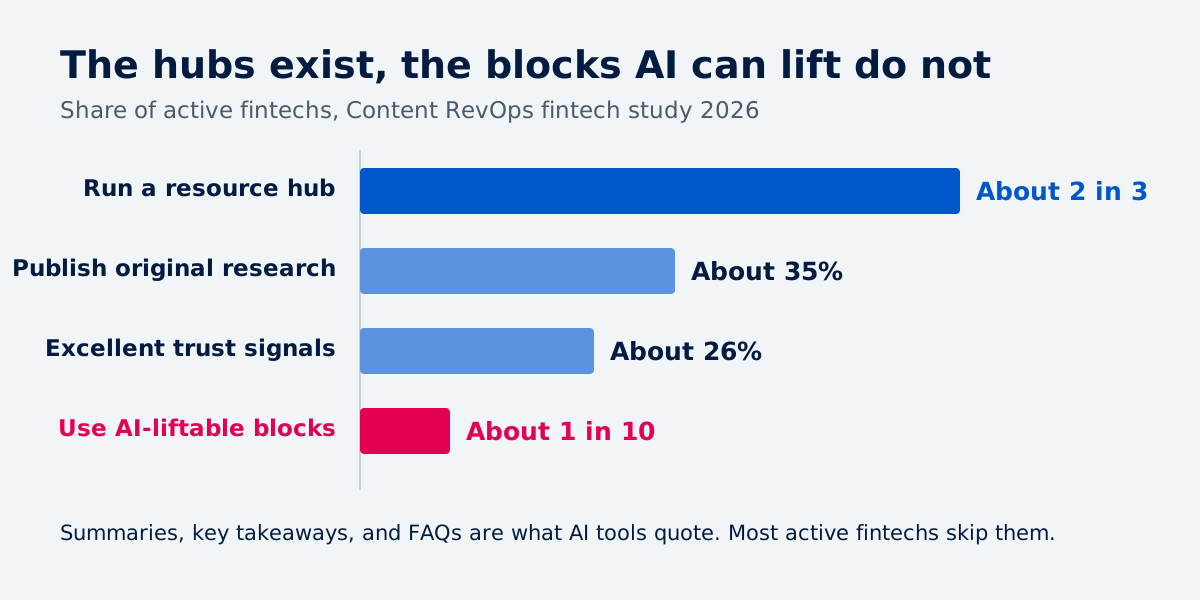
Format matters here. Conductor's 2026 benchmark for financial queries found Google AI Overviews on about a quarter (25.8%) of financial queries, with articles the most-cited page type. Fintech articles already exist; most lack the structure an AI tool can lift. Our AEO guide and our piece on optimising for AI Overviews without wrecking the page for readers show how to add that structure.
How to check fintech AI visibility
Start with the prompts that name vendors. Araminta Robertson, founder of Mint Studios, notes on the Demand-Genius podcast that AI tools use content targeting "what is open banking" without naming any brand. Her framework starts from bottom-of-funnel prompts instead.
A plain check looks like this:
- List the vendor-choice and comparison prompts your buyers would type, such as the best payment orchestration platform for a mid-size lender.
- Run each prompt several times across ChatGPT, Gemini, and AI Overviews, because answers change between runs.
- Note who the tools name instead of you, and which pages the tools cite.
- Estimate what a shortlist place on those prompts is worth, using your deal size and win rate.
We explain how we do this in how we help you show up in AI search and how we help you own what AI says about you, and how to pick the prompt set in which prompts to track for AI search visibility.
What AI visibility is worth for a fintech
For Banking Crowded, we built the hub for answer engines from the start. About 22% of its inbound traffic now comes from AI and LLM referrals, and those leads convert at about five times the rate of other sources. To tell that kind of result apart from mentions that never reach a deal, see whether AI citations are driving real pipeline.
Few fintechs staff for this yet. AEO appears in only a low single-digit share of fintech marketing postings in our hiring study.
How do you measure fintech content marketing on a long sales cycle?
Measure fintech content marketing by accounts, opportunities, and pipeline across the full sales cycle, not by monthly traffic. A B2B fintech deal takes too long for last month's clicks to tell you anything. You need to see which target accounts engage, which content open deals touched, and how that pipeline moves.
The tools are usually installed already. Our fintech performance benchmarks found HubSpot on about 34% of fintech sites and Google Tag Manager on about 77%, with a median of about 75 technologies per site. The pipes are in. Content is the missing input, because few teams connect pages to accounts and deals inside those tools.
How long fintech cycles run
In the Hoffman Agency's fintech buyer survey, 56% of technology buyers at banks and larger fintechs report a typical sales cycle of 6-12 months. Will Thompson of ComplyAdvantage says cycles run 18 to 24 months for some companies at the larger end.
That creates real pressure. One marketer asked in the r/b2bmarketing fintech thread how to justify "12-18+ months before you can clearly attribute pipeline" when "leadership is still pushing for near-term pipeline". The answer is to report leading signals that sit inside the pipeline itself.
What to report on fintech content
These measures show progress on a 6-12 month cycle:
- Named target accounts engaging with content, and how many people per account
- Content touched by open opportunities
- Stalled deals reopened after a content touch
- Self-reported source on demo and contact forms
- Presence in AI answers across repeated runs of your buyer prompts
- Content-influenced pipeline and sales cycle length
Thompson's team compares influenced pipeline from each campaign against the same campaign a year earlier, measured at the stage where a deal has a dollar value. That year-on-year view fits long cycles better than any monthly report. Our guide to reporting on content marketing success and our list of metrics to track and not to track go deeper on the report itself.
Self-reported source deserves a place because software misses a lot. When Refine Labs compared buyer answers with its software attribution, buyers credited 98% of its closed-won revenue to social, podcasts, word of mouth, and community, which is Refine Labs' own result for its own business.
What fintech employers judge content on
Fintech employers judge content on pipeline. In our hiring study, growth appears in about 75% of fintech marketing roles and analytics in about 69%, and the postings name Salesforce (about 16%) and HubSpot (about 12%).
When the wiring is in place, the effect shows in the numbers sales cares about. For Banking Crowded, content shortened sales cycles by 30-35% and influenced $3-4M in pipeline. We walk through how we connect pages to deals in how we help you see which page started the deal.
Should a fintech run content marketing in-house, with an agency, or both?
Most B2B fintechs do best with a hybrid: an in-house owner who holds the buyer knowledge and compliance relationships, and a partner who installs the system and the wiring that the team then runs. Pure in-house works when you can staff every part. Pure agency works when you need a full system fast and have no one to own it yet. Our honest comparison of in-house and outsourced teams sets out the trade-offs in more detail.
The choice gets easier when you list what a working fintech content system needs:
- Strategy and positioning for each seat on the committee
- Subject-matter extraction from product, sales, and customer calls
- A compliance workflow with an approved-claims library
- Production of research, proof, and decision-stage pages
- CRM, CMS, and tracking wiring
- Sales, partner, and outbound use of the content
What in-house fintech content costs
Our hiring study puts the median advertised fintech marketing salary at about $143K, with leadership roles at about $220K and the smaller-company band at about $85K. A full in-house bench covering every item above means several of those salaries.
Content and SEO each appear in only about 16% of fintech marketing postings. Fintechs name the work, but few hire someone to own it.
Size matters too. Our fintech study found about 57% of fintechs with 101-250 staff run active content, against about 18% of those with 11-50 staff, and only about 13.6% of seed-stage fintechs. With B2B fintech acquisition costs around $2K-5K per customer and clicks at about $4.50, an under-built organic estate is an expensive gap.
AI is now part of the job description too. About three in five fintech marketing roles mention AI, with about 28% naming AI for content and about 30% for workflow.
Decision rules for fintech content teams
Run it in-house when you already have a content owner, a compliance reviewer who turns pieces around reliably, and someone who can wire HubSpot or Salesforce to content.
Use an agency when you have no content owner, need the system built in a quarter, or need research and proof production your team cannot staff.
Go hybrid when you have an owner and a backlog of existing content, and need help with the system, the wiring, and the first round of decision-stage pages.
Whichever route you choose, the partner should install a system your team owns: the claims library, the hub structure, the CRM fields, and the reporting. Araminta Robertson of Mint Studios hears the same shift from clients, who now ask how to connect content to revenue, not only how to get great writing.
That is the work we do. We build fintech content systems and the go-to-market wiring around them, so what you publish turns into conversations, accounts, and referrals. You can see how we work with financial services companies, and if you are comparing partners, our lists of demand generation agencies for fintech and content marketing agencies for fintech set out the options.
The quickest way to see where you stand is our fintech content benchmarking tool. It takes 12 inputs and returns a score against other fintechs, plus your top three fixes.
Ready to put the content you already have to work?
We build fintech content systems and the go-to-market wiring around them, so what you publish turns into conversations, accounts, and referrals. Start with the fintech content benchmarking tool.
Frequently Asked Questions
About the Author

Founder & CEO, Content RevOps
Stefan Kalpachev is the founder and CEO of Content RevOps, where he helps B2B SaaS companies transform their content into predictable pipeline. With a background in content marketing and revenue operations, Stefan has developed a unique methodology that bridges the gap between content creation and revenue generation.
Connect on LinkedInRelated Articles
How Can I Tell Whether AI Citations Are Driving Real Pipeline or Just Vanity Mentions?
Nov 11, 2026
Which Prompts to Track to Know Whether Your AI Search Visibility Is Improving?
Nov 10, 2026
Marketing for Asset Management Firms: Where to Start
Oct 26, 2026