How Can I Tell Whether AI Citations Are Driving Real Pipeline or Just Vanity Mentions?
Not sure which of your AI citations bring pipeline and which are vanity? Start with a content revenue audit.
Book a CallYou are showing up in AI answers. ChatGPT names your brand, Perplexity links your page, a Google AI Overview quotes your guide. The dashboard is green, the citation count climbs every week, and someone on the team screenshots it for the board deck.
Part of The Ultimate AEO Guide (2026).
Then the sales pipeline does not move, and you cannot tell whether those AI citations are doing anything at all.
That is the real question underneath the hype. Not "are we visible in AI search," but "which of these AI citations bring buyers, and which are just numbers going up." This guide answers it, using the method we apply when we build content systems that earn pipeline from AI answers. It gives you two plain tests to separate a pipeline citation from a vanity mention, and a way to measure the difference when the click data you would normally lean on is missing.
What is the difference between an AI citation that drives pipeline and a vanity mention?
An AI citation happens when an answer engine like ChatGPT, Perplexity, or a Google AI Overview names your brand or links your page as a source inside its answer. A vanity mention is any appearance that never changes what a buyer does next.
Both look identical on a tracker. Both add to the count. Only one is worth anything to revenue.
One quick clarification, because the phrase gets tangled. We mean citations of your brand inside AI answers, the kind you want more of. We do not mean the fake or hallucinated references an AI model invents inside a document it writes, which is a separate problem people also call an "AI citation." This page is about the first thing.
The common advice sorts your appearances into two buckets. A mention is when the model names you with no link, and a citation is when it links or attributes your page. Tools like Quattr put it cleanly: citations drive traffic, mentions drive awareness. Chase the citations.
That advice is half right, and the missing half is where the money leaks. A citation earns pipeline when two things are true: it sits under a buying decision the AI answer cannot finish on its own, and it points to a page that gives the buyer a next step. When either is missing, the citation is a vanity mention wearing a link. The rest of this guide is about telling the two apart.
Why can an AI citation still be a vanity metric?
Because most citations sit on questions where the buyer never needs to click, and the AI answer settles the matter on the spot. It is the same trap as any metric that looks good on a dashboard but never touches pipeline.
The sharpest illustration comes from a marketing team that pulled its own numbers and wrote them up in r/GEO_optimization. They spent four months celebrating citation counts, then checked the referral data. Seventy-three percent of the pages cited by at least one AI engine sent zero measurable traffic in ninety days. Not low traffic, zero. Some of those pages had fifteen or more citations.
They named the pattern the "encyclopedia entry problem." The AI borrows a stat or a definition from your page to build a larger answer, the reader gets what they came for, and nobody clicks. Your page did real work, as a fact-checking layer inside someone else's answer, and earned nothing for it. As one commenter put it, you get cited, the user gets their answer, and everyone "celebrates in the wrong meeting."
AI cites the pages that inform, not the pages that convert
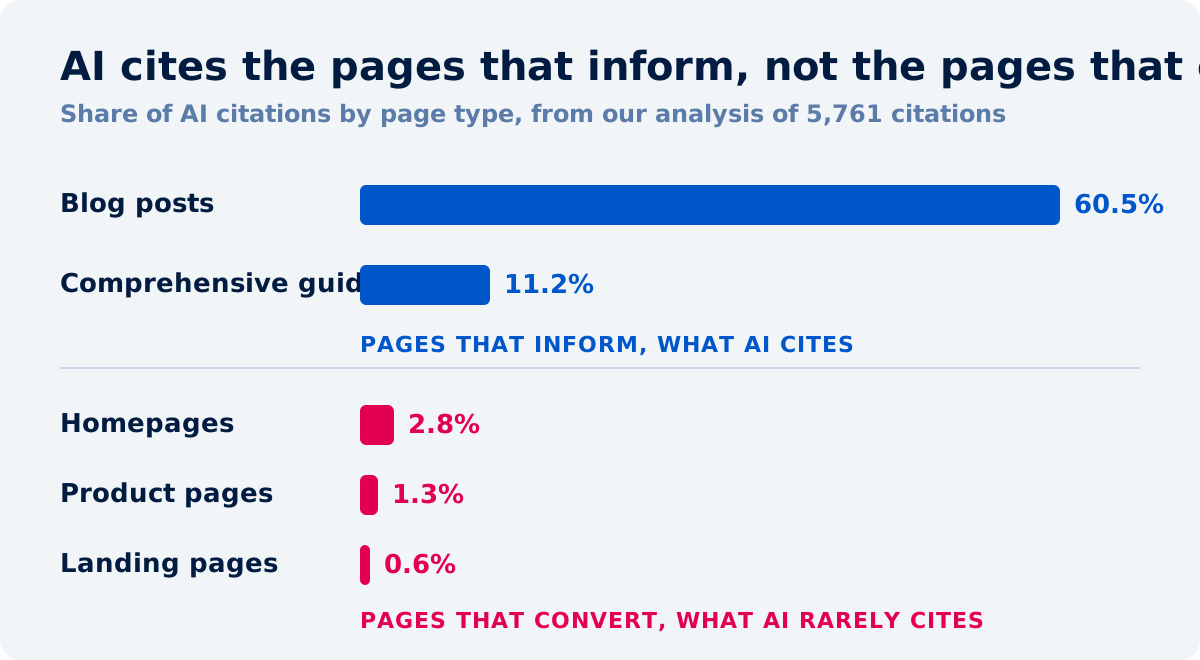
Our own research shows why this happens by design. In our analysis of 5,761 AI citations across 800 B2B queries on Perplexity, blog posts made up 60.5% of all cited pages, and comprehensive guides another 11.2%. The pages built to move a buyer barely register: homepages were 2.8% of citations, product pages 1.3%, and landing pages 0.6%.
Read those two facts together. The pages an answer engine loves to cite are the ones you wrote to teach, and the pages that actually convert a visitor are the ones it almost never cites. That is also why strong SEO pages and AI-ready pages are not always the same thing. So a rising citation count is, by default, a rising count of informational appearances. That is closer to an impression than a click, and counting impressions as pipeline is how the vanity problem starts.
None of this means citations are worthless. The right citation, under the right question, does move real behavior. Seer Interactive's analysis of 3,119 queries across 42 organizations found that brands cited in a Google AI Overview earned 35% more organic clicks and 91% more paid clicks than the same brands when they were not cited, a real lift in attention and consideration though not a direct pipeline figure. The value is real, which is why it pays to optimize for AI Overviews without wrecking the page for human readers. It just does not spread evenly across your citations, which is exactly why you have to sort them.
Test 1, which query does the AI citation sit under?
The first test is the buying stage of the question behind the citation. It decides more than any other single factor whether a citation can drive pipeline.
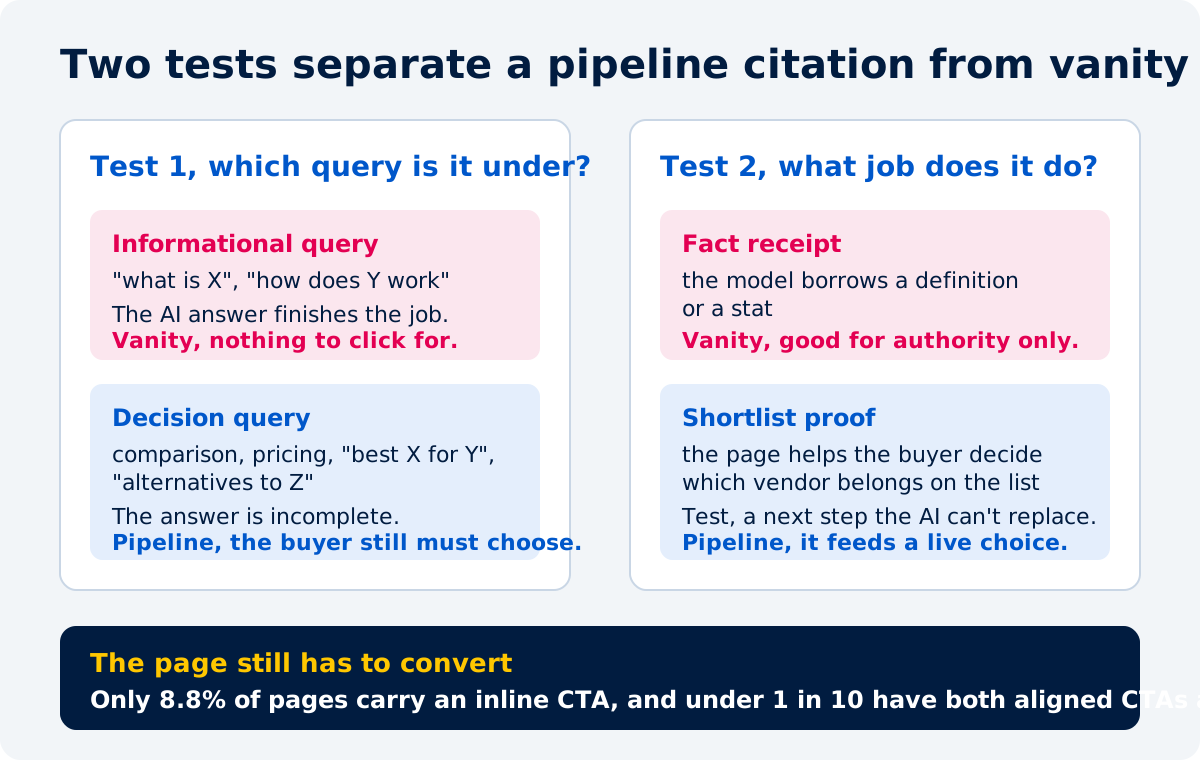
A citation under an informational query has a ceiling. Questions like "what is X" or "how does Y work" get fully answered by the AI summary, so there is nothing left to click for. You can be cited beautifully and still send no one anywhere, because the reader's curiosity is already satisfied on the results page.
A citation under a decision query behaves differently. Comparison questions, pricing questions, "best X for Y," "alternatives to Z," and evaluation questions all leave the AI answer inherently incomplete. The buyer still has to choose, and choosing means leaving the answer to check you out. That is the citation worth having.
The team in that Reddit thread found the same split in their traffic. Informational citations flatlined. Comparison, pricing, and "best X for Y" citations still sent people through, because the answer alone could not close the loop.
The pipeline citations are the ones almost nobody can earn
Here is the uncomfortable part. The pages that would earn a decision-stage citation are the pages most companies never build, which is a large part of why one brand gets cited in AI answers while a better-known competitor gets ignored.
Across our state of content marketing research, decision-stage content is about one in six of a typical content library, the thinnest shelf in nearly every industry. Comparison pages, the single asset a buyer uses to choose between vendors, sit nowhere above one in twenty. Meanwhile the share of ranked keywords that are informational runs from 56% all the way to 95%.
So the math is stacked against you before an answer engine ever runs. Most companies publish overwhelmingly at the top of the funnel, earn their citations there, and then wonder why the citations do not convert. The scarce, decision-stage pages that would produce pipeline citations are the ones sitting unbuilt.
Test 2, what job does the AI citation do once someone reaches the page?
The second test is the job the citation does, and it has two parts: the role the citation plays in the answer, and whether the page it points to can actually convert.
Fact receipt or shortlist proof
Sort each citation into one of two roles.
Fact receipt. The model borrowed a definition, a statistic, or a phrase from your page to support a bigger answer. Good for authority, weak for pipeline, because the reader already has what they needed.
Shortlist proof. Your page helped the buyer decide which vendor, tool, or option belongs on the shortlist. This is the citation that creates demand, because it feeds a choice the buyer is actively making.
The one-line test that separates them: does the cited page give the buyer a next step the AI cannot replace? A comparison, a real price, a template, a calculator, a demo path. If the AI answer can fully stand in for your page, you have a fact receipt. If the buyer still needs your page to move forward, you have shortlist proof.
The page it points to has to be able to convert
A decision-stage citation still leaks to vanity if the page behind it has no way to convert the visitor. This is the failure we see most often, and our data sizes it.
In our study of B2B blog conversion, inline contextual CTAs, the kind that sit inside the content where a reader actually is, appeared on only 8.8% of pages. Fewer than one in ten pages had both CTAs aligned to visitor intent and a clear path from the blog to a conversion point. Most pages, 85% of them, did carry a CTA, but the ask was wrong for the moment, a demo button pushed at a reader who came for a definition. It is the same pattern behind SaaS blogs that get traffic but fail to generate signups or demos.
So even when you earn the good citation, under the right query, with shortlist-proof intent, the buyer often lands on a page that gives them nowhere to go. A citation can only pay off if the page it points to can.
This is why we design the funnel before the content and build fast-track exits for buyers whose intent is already clear, a demo or a quote path that does not force a warm buyer through a long nurture. It is also why we build a content hub where every page has one primary purpose and several sensible next steps, rather than one page with one generic "Contact Us." That is the job of the conversion layer. A pipeline citation deserves a page ready to catch it.
Why can't you just count the clicks from your AI citations?
Because AI referral data is dark, and last-click measurement breaks on it.
When someone clicks through from an AI answer, that visit often does not arrive labeled. ChatGPT referrals frequently show up cleanly in analytics, but Claude and Gemini referrals are largely invisible, folded into direct or organic traffic. So a citation that genuinely sent a buyer can register as zero.
Ross Simmonds, the founder and CEO of Foundation Marketing, says it plainly: "AI search strips referral data too often, so if you're not tying lift back to CRM pipeline and assisted conversions, the numbers are fake." His team stopped trying to force a last click out of AI search and started reading it the way you read PR, watching what moves after a citation lands rather than demanding a clean clickable trail.
That reframes the "73% drove zero traffic" number too. Zero traffic conflates two very different states: nobody wanted the page, and somebody wanted it but the visit was never attributed. A last-click mindset scores both as failure, and only one of them is.
The measurement gap was there before AI
The join from a click to a deal was already weak. Google Analytics sits on about 75% of B2B sites, but a traffic tag never answers whether a visit became pipeline, and roughly 45% of B2B firms show no web-detectable CRM at all. If you could not reliably connect a normal organic visit to a closed deal, an unlabeled AI visit has no chance. The instrument for the question you are asking was missing before answer engines arrived.
As James Scherer, VP of Strategy at Foundation, puts it, multi-touch attribution breaks down when the touch happens outside your ecosystem. AI answers are exactly that, a touch you do not own and cannot tag.
How do you measure whether your AI citations drive pipeline?
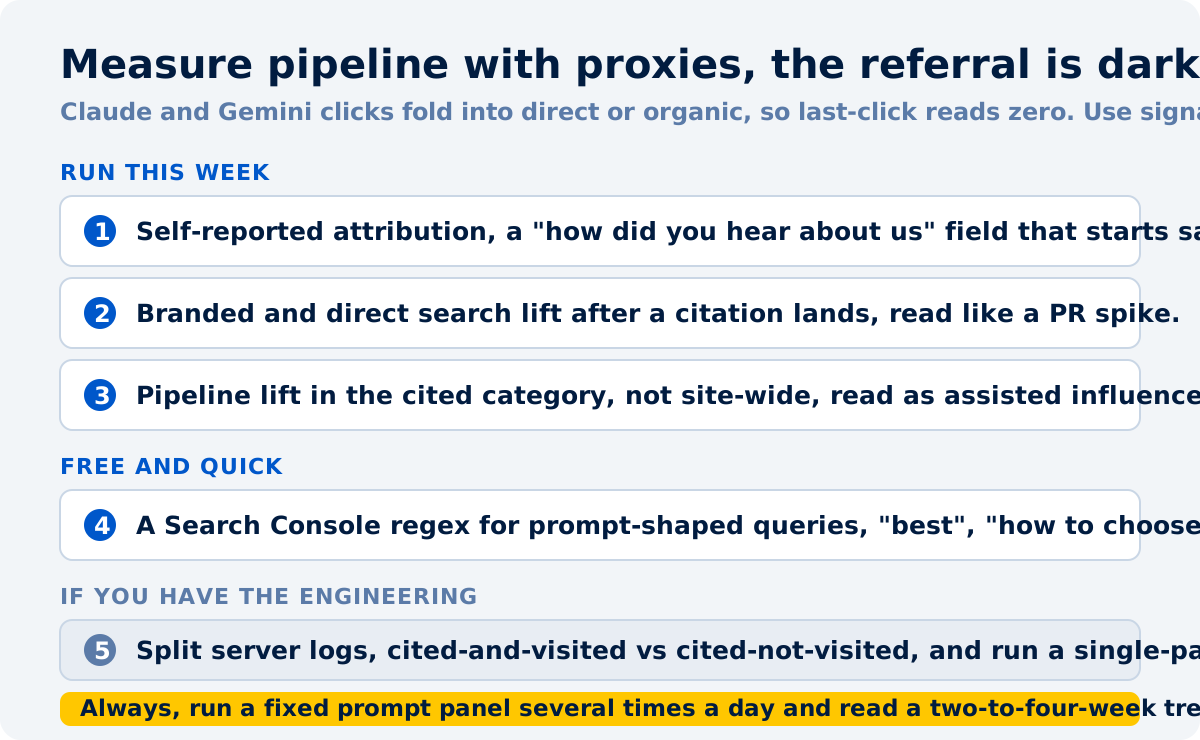
You measure it with proxies, not a last-click report. No single proxy is "the number." Together they move in a way you can defend to a CFO, the same standard we apply when reporting on content marketing success. Start with the three you can run this week.
Self-reported attribution
Add a "how did you hear about us" field to your demo and contact forms, then read it. When answers start saying ChatGPT, Perplexity, or "an AI tool," you have the most direct signal available that an AI answer sent a buyer, and it catches the dark-referral visits your analytics miss.
It works. The form-building company Tally credits AI tools with roughly a quarter of its new users, confirmed through its onboarding survey, and the learning platform Docebo reports that 13% of its high-intent leads come through AI discovery. Both numbers exist only because someone asked the buyer directly. No tag would have found them.
Branded and direct search lift
When your AI visibility climbs, branded searches and direct visits usually climb with it, because people discover you inside an answer and then look you up by name. Track that correlation over time.
One team in the GEO community reported a 40% lift in branded queries after they ramped up AI visibility. Read branded search and direct traffic as the lagging footprint of citations you cannot click-track, the same way you would read a spike after a PR hit.
Pipeline lift in the cited category
Watch CRM pipeline and qualified leads in the specific category or accounts where your citations concentrate, not across the whole site. AI influences the journey without being the final click, so read assisted influence rather than last touch. If citations for "best [your category] for [segment]" are climbing and pipeline in that exact category is climbing a few weeks behind, that is a connection worth reporting, even without a clean referral path between them.
The Search Console prompt check
Question-shaped queries now surface in Google Search Console. Run a regex on your performance report for prompts that start with "best," "how to choose," "X vs," "alternatives to," and similar, and you will see the decision-stage, prompt-shaped demand you are already catching. It is free, and it tells you which buying questions you show up for.
If you have the engineering, two deeper reads
Two proxies need more setup, so treat them as the next tier rather than a starting point. Split your server access logs into pages that were cited and visited versus cited and never visited, so "unattributable" stops being counted as "unwanted." And run a single-page holdout: change the content on one cited page or category, watch AI visibility move, then connect it to inquiries through a simple before-and-after or a marketing-mix read. The team at Gumshoe AI walks through this experiment approach, connecting visibility changes to sales through mix modeling rather than a click trail.
Run a fixed panel of prompts, repeatedly
Whatever you track, do not trust a single check. AI answers are probabilistic, so the same prompt asked twice can name different brands and cite different pages.
The University of St. Gallen study Don't Measure Once makes the point with data. Roughly 65% of the sources an engine cites today are gone tomorrow, and the same prompt re-run minutes apart overlaps only about a third of the time. Most of the movement on an AI visibility dashboard is sampling noise, not the market changing. The authors recommend running each prompt several times a day and reading a two-to-four-week trend before you conclude anything.
So build a fixed panel of buyer-intent prompts, grouped by the topics you care about, and run it on a schedule. The fixed panel turns infinite conversational prompts into something you can actually trend. Building and recording that panel is a companion job worth doing properly, and we cover it in which prompts to track to know whether your AI search visibility is improving. Pull your prompts from your buyers' real questions, the way we mine the problem space, not from your keyword list.
How do you turn AI citations into a pipeline number your CFO will accept?
You translate visibility into money with the assumptions shown on the page, so the number reads as a model, not a claim.
This is how our content revenue audit prices every content gap. It converts each gap into a dollar figure with the inputs visible: a default visitor-to-lead rate of about 2%, a lead-to-customer rate of about 20%, and an average contract value set by category. AI-search invisibility is one of those lines, priced as the share of category prompts where the brand is absent, run through the same funnel math. The buyer argues with the inputs, not the output, and that is what makes the number credible instead of salesy.
Apply the same logic to a citation. Value it by the demand behind its query and the economics of the buyer it could bring, not by the raw citation count. A shortlist-proof citation under a high-value comparison query is worth modeling as pipeline. A fact receipt is worth its awareness value and no more, so book it as awareness and stop reporting it as pipeline.
The stakes are not small. Our research finds that AI Overviews trigger on close to 100% of tested industry queries while most company sites are absent from the answers in six of seven verticals, often for the reasons we set out in why your brand is not showing up in ChatGPT or Perplexity answers when you rank on Google. The invisibility line is often the largest one on the page, precisely because so few companies hold decision-stage ground in AI answers yet.
How do you sort your own AI citations into pipeline or vanity?
Run each citation through three plain checks. It takes a minute per citation and it settles the argument.
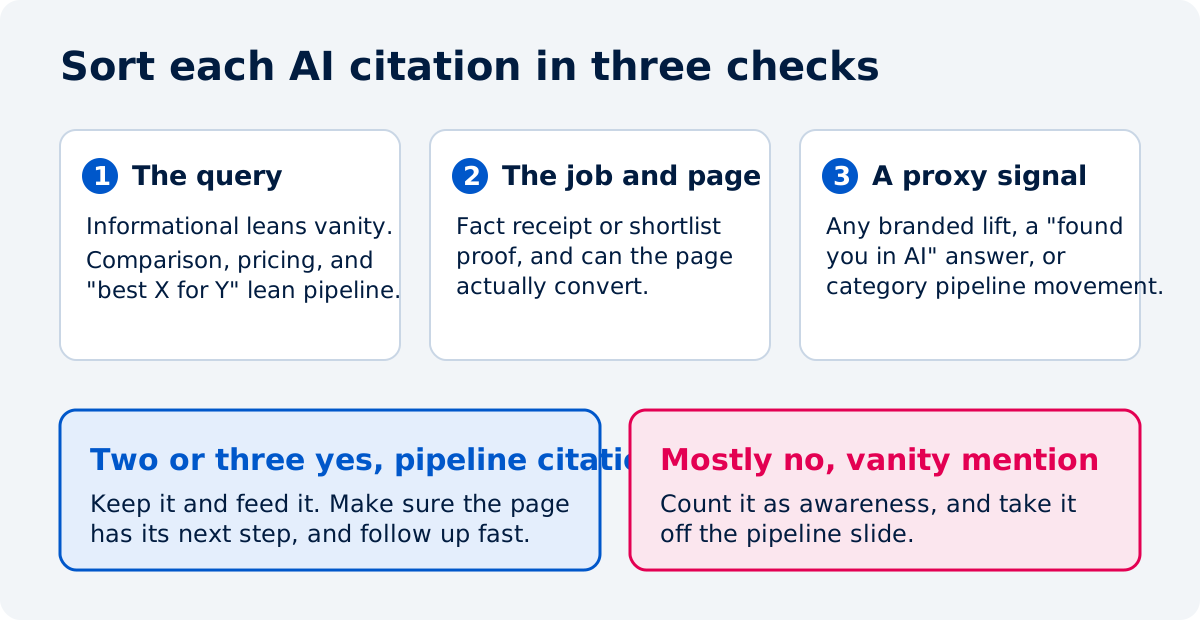
The query. Is the citation under an informational question or a decision question? Informational leans vanity. Comparison, pricing, evaluation, and "best X for Y" lean pipeline.
The job and the page. Is it a fact receipt or shortlist proof, and can the page it points to actually convert, with a next step aligned to the buyer's intent?
A proxy signal. Is there any branded-search lift, self-reported "found you in AI" answer, or category pipeline movement you can tie to it?
Two or three yeses, and you have a pipeline citation. Keep it, and feed it: make sure the page has its next step, and follow up fast when the buyer arrives. Mostly noes, and you have a vanity mention. Count it as awareness, and take it off the pipeline slide.
Feed the pipeline citations
A pipeline citation is only worth what you do after it lands. When we ran a gated-report campaign with Mango PD, we treated the first touch as the start of the funnel rather than the finish, with an automated follow-up and a webhook that dropped each fresh signal straight into a sequence, because speed of first follow-up is the lever that moves reply rates. When we tested filling in competitor contact forms, only one rival followed up quickly. Most pipeline leaks there, in the hours after a buyer raises a hand, not in the citation itself.
What this is really about
Content earns its keep when it holds a job in the revenue system. An AI citation is not that job. It is a signal that your content is doing the job, or a sign that it is sitting idle, cited all day for facts while the buying questions go to someone else.
Sorting pipeline citations from vanity mentions is how you tell which. Do it, and AI search stops being a vanity dashboard and starts being infrastructure that produces pipeline you can name.
Want the revenue-at-risk number behind your AI citations without building the tracking rig by hand?
Our content audit finds the buying prompts where your category is deciding, the ones where you are absent, and the money riding on the gap.
Frequently Asked Questions
About the Author

Founder & CEO, Content RevOps
Stefan Kalpachev is the founder and CEO of Content RevOps, where he helps B2B SaaS companies transform their content into predictable pipeline. With a background in content marketing and revenue operations, Stefan has developed a unique methodology that bridges the gap between content creation and revenue generation.
Connect on LinkedInRelated Articles
Which Prompts to Track to Know Whether Your AI Search Visibility Is Improving?
Nov 10, 2026
Marketing for Asset Management Firms: Where to Start
Oct 26, 2026
SEO for Asset Managers: A 2026 Digital Marketing Playbook
Oct 25, 2026