Which Prompts to Track to Know Whether Your AI Search Visibility Is Improving?
Not sure which AI search prompts are deciding your deals, or what a miss costs you? Start with a content revenue audit.
Book a CallTrack the questions your buyers actually ask an AI assistant at a real buying decision, grouped by the stage they sit on, and weighted by the revenue riding on each one. Your AI search visibility is improving when you show up, get recommended, and are described correctly on more of those buying-decision prompts over time, measured across enough runs to be real. A rising count of mentions on prompts nobody in your market types is not improvement. It is noise with a nice chart.
Part of The Ultimate AEO Guide (2026).
That is the short answer. The rest of this piece is the method we use when we build content systems that show up in AI answers: how to build the prompt set, how to weight it, what to record, and how to know the movement is real and not luck.
What does it actually mean for your AI search visibility to be "improving"?
AI search visibility means one thing. When your buyers ask an AI assistant a question, do you show up, does it recommend you, and does it describe you correctly? The surfaces where this happens are ChatGPT, Google's AI Overviews and AI Mode, Gemini, Perplexity, and Claude. The work of earning a place in those answers goes by a few names that all mean roughly the same thing, and the vocabulary is still settling: AEO (answer engine optimization), GEO (generative engine optimization), and the term now rising fastest, AI visibility.
Two words get used loosely, so pin them down first. A mention is your brand appearing anywhere in an AI answer. A citation is the source the model links to hold up its answer. You can be mentioned without being cited, and cited without being recommended. Those are different events, and a tracking setup that blurs them will mislead you.
The headline number most tools report is an AI Visibility Score, expressed from 0 to 100 percent. ZeroRank frames it simply as the share of tracked answers where your brand appears, supported by your average position in the answer and the sentiment around your mention. That is a fine summary metric. It becomes a lie the moment the prompts underneath it are the wrong prompts.
We measure this at scale ourselves, so this is not theory. Our analysis of 800 B2B queries captured 5,761 citations across 5,470 URLs, and the pattern was clear: a small number of well-structured pages earn most of the answers, and most brands are simply absent. In our State of Content Marketing 2026 work, AI Overviews triggered on effectively every tested query in some categories while the companies in those categories surfaced almost never. For a lot of businesses, invisible is the literal reading.
So "improving" means showing up, correctly, on more of the questions that decide a purchase. Everything below is how to pick those questions.
Which prompts should you not track?
Before the method, the filter. Three kinds of prompts waste your tracking budget and inflate your score.
Why leave out short, keyword-shaped prompts?
People do not talk to an AI the way they type into Google. The SEOLeverage team puts it plainly at 0:02: "Pick the wrong prompt and your entire AI visibility report is going to reflect data that's completely unrelated to your potential buyers." Their working rule is a minimum length of about eight words, because that is where a query turns conversational. A four-word phrase like "best email marketing tool" is a search query. A twelve-word phrase like "what email marketing platform works best for an e-commerce store under 10k revenue" is an AI prompt. Track the second kind.
Why leave out prompts about topics you will never sell against?
If a prompt describes a problem you do not solve or a buyer you do not serve, a mention on it tells you nothing about pipeline. It adds to your score and subtracts from your judgment. Leave it out.
Why do branded-only prompts mislead?
Asking an AI "what does [your company] do" and celebrating that it names you is measuring a foregone conclusion. Your brand showing up in its own branded answer is table stakes. It belongs in your tracking as a data-quality check, not as evidence your visibility is improving. The rule for handling branded prompts alongside the rest comes next.
Step 1, where do the prompts worth tracking come from?
The prompts worth tracking come from your own demand, not from a generic list. This is the same discipline we use to mine the problem space before writing anything: collect the real language first, let software organize it second, never let a tool invent the audience for you.
Pull your raw material from where buyers already tell you what they ask:
Won-deal notes and sales-call recordings. The exact phrasing a buyer used before they chose you is the highest-value prompt source you own.
Support and customer-success tickets. The questions people ask after they buy are the questions others ask before.
Your "how did you hear about us" field. When buyers write "ChatGPT recommended you," you have found a live prompt to reverse-engineer.
Google Search Console queries. The longer, question-shaped queries already point at conversational intent, the same raw material we use in keyword and topic research.
Community questions. Reddit, Slack groups, and industry forums carry the unpolished version of every buying question.
Then rewrite each one the way a person actually speaks to an assistant. The SEOLeverage walkthrough is a clean worked example of the mechanical version: export commercial-intent keywords from a tool like Ahrefs, keep only the phrases of eight words or more, and rewrite them into AI-native questions with buyer context added, for example "generate ten prompts a marketing director at a mid-size e-commerce brand might type." Their team narrows each category to ten to fifteen solid prompts.
Aim for real coverage of your buying questions, not volume for its own sake. A tight set that mirrors how your buyers actually talk beats a sprawling one every time.
Step 2, how do you sort prompts by the buying stage they sit on?
A single blended visibility score hides the only thing you need to know: which buying conversations you win and which you lose. We design content around explicit funnel stages for exactly this reason, and the same logic applies to prompts. Sort them by the decision each one sits on, then report each stage on its own line.
Here is a starter map for a B2B set.
Buying stage | Example prompt | What a win looks like |
Category and problem discovery | "how do B2B companies get found in AI search" | You appear among the named approaches |
Comparison | "[your category] alternatives for a regulated industry" | You appear beside the named options |
Shortlist and recommendation | "best [category] for [buyer type]" | You are named in the recommended set |
Integration and fit | "does [category] work with [the system they run]" | You are named as a genuine fit |
Pricing and budget | "how much should [category] cost" | You are named with accurate ranges |
Objection and risk | "is [approach] worth it for a small team" | You are named on the reassuring side |
Branded | "what does [your company] do" | You are described correctly (table stakes) |
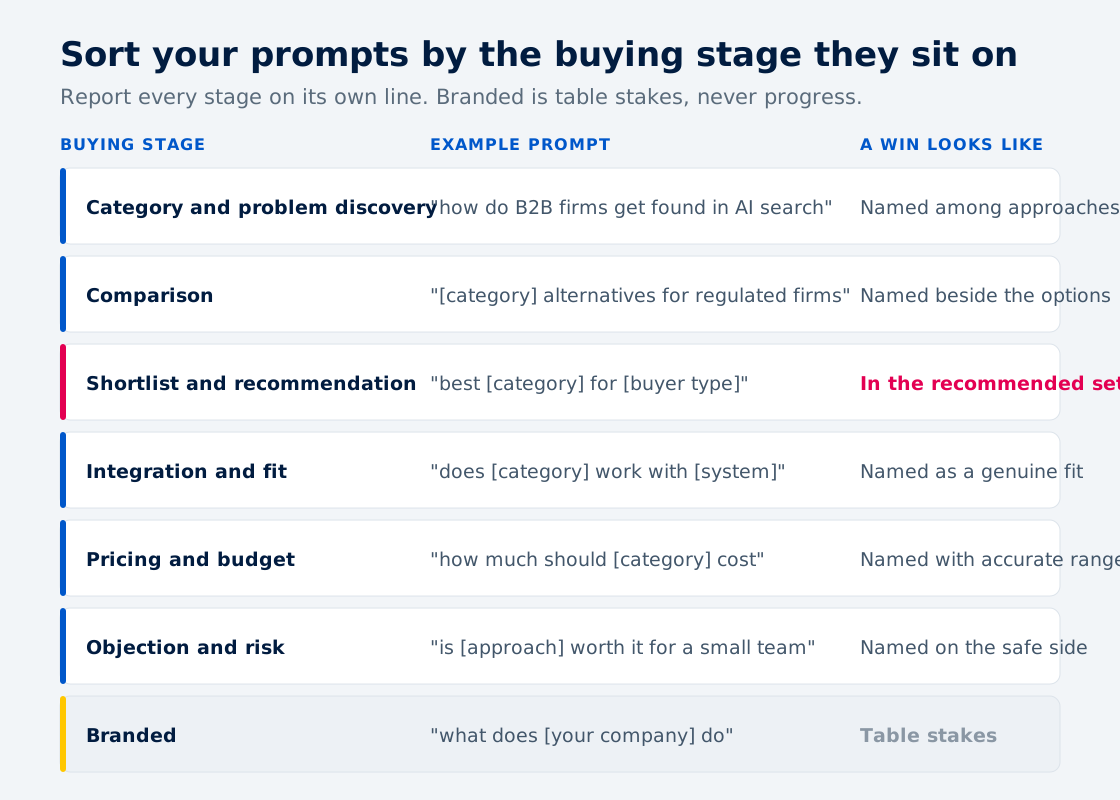
Report these separately. Pooling them is the most common way a report lies to you. As one practitioner in an AI search optimization thread put it, tracking brand, category, and comparison prompts as one pool "buries the signal because brand visibility tends to dominate any combined average." Your branded prompts will always score high, so a blended number drifts up while your shortlist visibility, the stage that actually moves revenue, stays flat. Named prompt taxonomies like the maxaeo intent groups organize the same idea, but the rule is what matters: segment by stage, and never let branded prompts flatter the average.
Step 3, how do you rank each prompt by the revenue riding on it?
Not every prompt is worth the same. A miss on a shortlist prompt, where a buyer asks for the best option for their situation, costs you a deal you were in the running for. A miss on a top-of-funnel definition prompt costs you a little early awareness. Treat them the same and you will optimize the cheap one because it moves the score faster.
So weight each prompt by the buying decision it sits on, then report your AI search visibility as revenue at risk, not as a mention percentage. This is the whole premise of our content audit: every gap becomes a number, not an adjective. We price AI-search invisibility as a specific line, the share of your category's buying prompts where you are absent, run through your own funnel economics, with the assumptions shown on the page so you can argue with the inputs instead of dismissing the output.
The practical version you can run yourself:
Tag each prompt with its stage and a rough deal value. A shortlist prompt for your core offer carries your average contract value. A discovery prompt carries a fraction of it.
Record where you are absent, weighted by that value. Ten misses on discovery prompts and one miss on a shortlist prompt are not equal, and your report should not pretend they are.
Report the weighted gap in money. "We are missing from forty percent of shortlist prompts for our category" is a sentence a revenue leader acts on. "Our visibility score is 38 percent" is not.
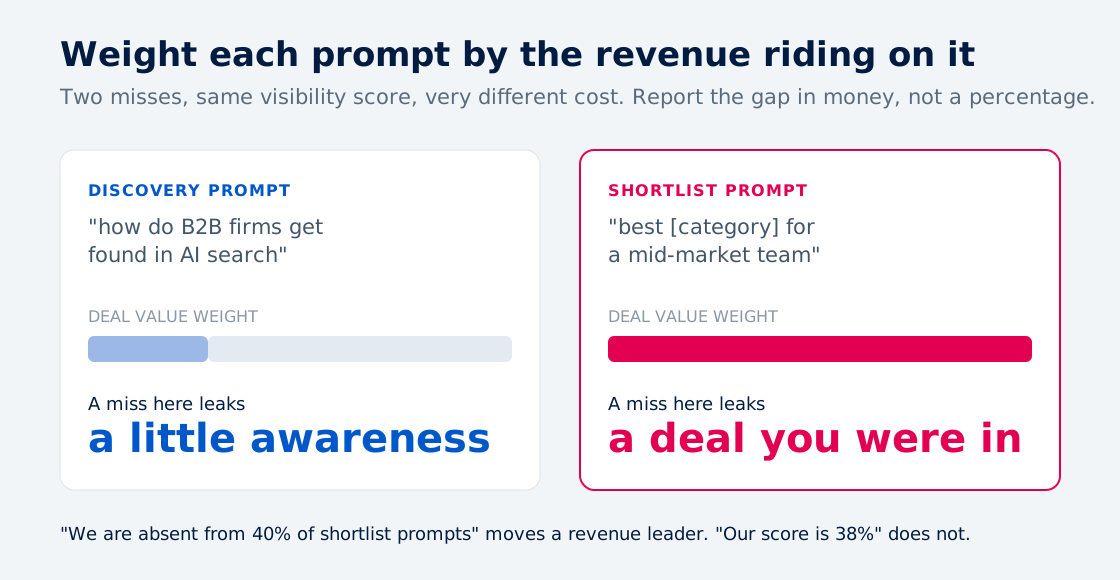
This is the question buyers keep asking and almost no tool answers. It is the difference between a vanity metric and a number tied to pipeline, and it is why we treat content as revenue infrastructure rather than a dashboard to admire.
Step 4, what should you record for each prompt you track?
A single yes or no per prompt throws away most of the signal. For every prompt, on every platform, record four separate things.
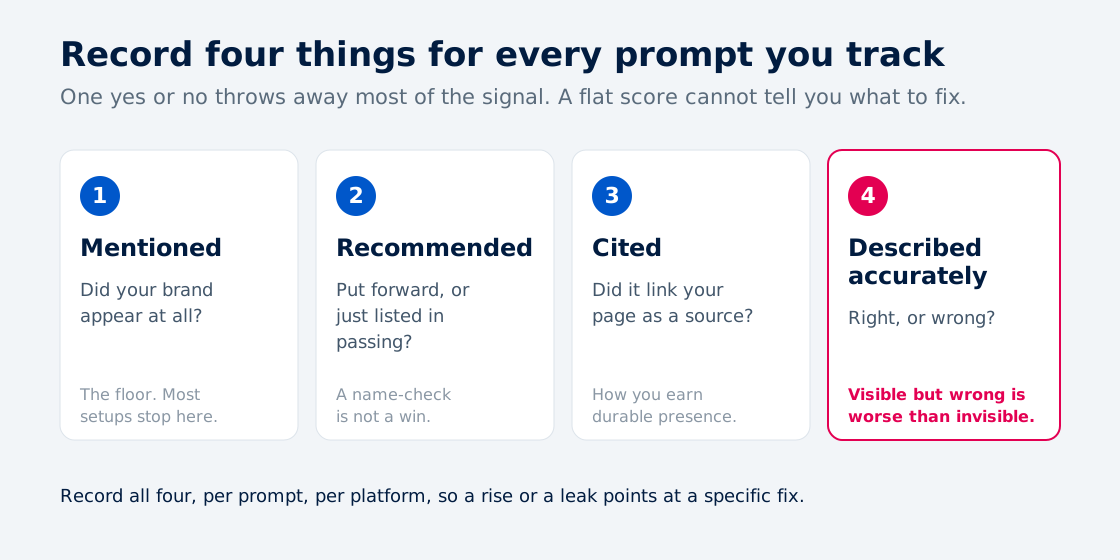
Were you mentioned?
Did your brand appear at all? This is the floor, and it is the only thing a lot of setups capture.
Were you recommended?
Did the model actually put you forward as an answer, or just list you in passing? These are different outcomes. The SEOLeverage team calls this out directly: "A brand mention is not the same as a recommendation, and knowing the difference is where most visibility tracking falls apart." A prompt where a competitor gets recommended and you get name-checked is a loss wearing the costume of a win.
Were you cited?
Did the answer link to your page as a source? Citation is how you earn durable presence, because the model keeps pulling from pages it trusts. Our citation analysis found the pages that get cited share a shape: comprehensive, well-structured guides with clear headings are pulled far more often than thin posts, and a handful of high-authority domains earn a large share of all citations. If you are never the cited source, your visibility rests on the model's memory, which is the fragile kind.
Were you described accurately?
This is the one almost everyone skips, and it can matter more than the other three. Being visible while the model explains your product wrongly is worse than being invisible. A marketer in an AI search thread said it well: "Being visible while the model confidently explains your product incorrectly is arguably worse than being invisible." A wrong answer at a buying moment actively sends the deal elsewhere, and it points at a fixable cause, usually unclear entity information or inconsistent descriptions of you across the web.
Record all four, per prompt, per platform. A flat score cannot tell you whether to fix your structure, your recommendations, or your accuracy. These four columns can.
Step 5, how do you know the improvement is real?
This is the step we treat as non-negotiable in our own audits, because it is the difference between a real trend and a lucky screenshot. Before we ever price an AI-search gap for a client, we make sure the movement is real. Here is the discipline.
Why run each prompt several times?
AI answers are non-deterministic. Ask the same question twice and you can get two different answers, so a single run is close to a coin flip. This is now measured, not asserted. The University of St. Gallen study Don't Measure Once shows that AI-search visibility is a distribution, not a number, and that reading it reliably means aggregating over several runs rather than trusting one observation. So run each prompt a handful of times and read the rate, for example "we appeared in nine of thirty answers this week," not "we showed up when I checked."
Why read the inclusion rate instead of the snapshot?
Because the answer varies, the honest metric is a rate across runs. Twelve appearances out of forty tracked prompts is thirty percent AI visibility. The number only means something when the same prompt set runs the same way each period. As maxaeo frames it, nine of thirty on Monday against eleven of thirty on Tuesday is variance. Nine of thirty climbing to twenty-one of thirty over two weeks while competitors stay flat is a signal.
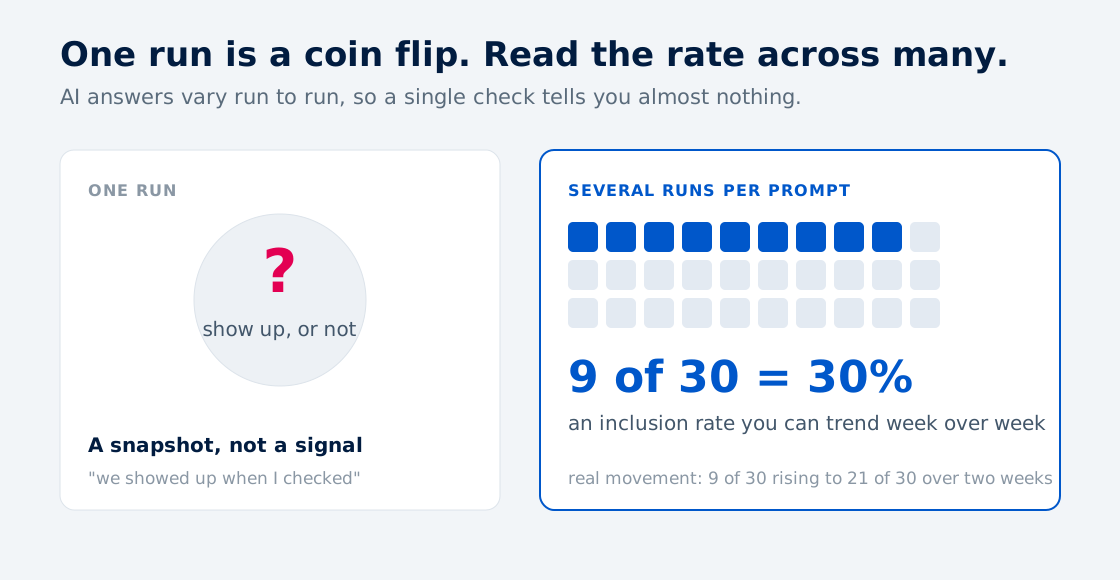
How often should you check, and what should you annotate?
Monthly is too slow to catch movement, and daily is mostly noise given how much generation varies. Weekly is the cadence that shows trends without chasing static. The MQL Magnet team is blunt about it: "If you're tracking AI search visibility with a monthly screenshot, you ain't got tracking, you got anecdotes." Mark every content publish, schema change, and PR placement on the same chart, so a rise has a cause you can repeat instead of a coincidence you cannot.
Why does source concentration matter?
If most of your citations come from one or two pages, you have a fragile position. MQL Magnet again: "If four-fifths of your citations come from two pages, you don't have visibility. You got lucky on two pages, and one refresh or one competitor update can wipe out most of your presence." The cited sources behind AI answers churn heavily from one day to the next, so a position resting on a couple of pages can vanish overnight. Spread the pages that earn you citations, and the trend gets sturdy.
Step 6, which platforms and tools should run the tracking?
Track the surfaces your buyers actually use, and weight the mix toward them. A developer audience lives in different assistants than a hospital procurement team, so do not split your attention evenly out of habit.
A tool makes this bearable at scale, and several do prompt-level tracking well, including Profound, Peec AI, Otterly, and the Semrush AI visibility toolkit. One instrumentation point is worth knowing before you buy. These tools refresh on a schedule, usually daily or weekly, which builds a distribution over time. Most of them do not run each prompt many times per pull, which is the discipline Step 5 requires. So the tool gives you the cadence, and you still enforce the run count and the stage segmentation yourself.
The tool is not the method. When you evaluate one, or an agency offering to run this for you, ask the single question a marketer in an advertising thread nailed: ask what they would actually change based on the data, and how they would measure whether it worked. "Publish more content" is not an answer. Connecting a specific missed prompt to a specific action, with a way to check the result, is.
What does tracking the right prompts get you?
It tells you which buying conversations you are losing inside AI answers, and what that costs you in pipeline. That is the job your content should hold now, and it is the one most content lost when AI changed how buyers search. If you want the revenue-at-risk number without standing up the whole tracking rig by hand, that is what our content audit produces: the prompts where your category is deciding, the ones where you are absent, and the money riding on the gap.
Want the revenue-at-risk number without building the whole tracking rig by hand?
Our content audit finds the prompts where your category is deciding, the ones where you are absent, and the money riding on the gap.
Frequently Asked Questions
About the Author

Founder & CEO, Content RevOps
Stefan Kalpachev is the founder and CEO of Content RevOps, where he helps B2B SaaS companies transform their content into predictable pipeline. With a background in content marketing and revenue operations, Stefan has developed a unique methodology that bridges the gap between content creation and revenue generation.
Connect on LinkedInRelated Articles
How Can I Tell Whether AI Citations Are Driving Real Pipeline or Just Vanity Mentions?
Nov 11, 2026
Marketing for Asset Management Firms: Where to Start
Oct 26, 2026
SEO for Asset Managers: A 2026 Digital Marketing Playbook
Oct 25, 2026