What Is Fintech Marketing? A Guide for B2B Fintech Teams
See where your fintech's marketing stands. Score your content against other fintechs in 12 inputs with our fintech content benchmarking tool and get your top three fixes.
Book a CallFintech marketing is the go-to-market function that gets a financial technology product chosen by the people who buy it. In B2B fintech, that buyer is usually a committee at a bank, credit union, insurer, lender, merchant, or finance team. The function covers positioning, demand creation and capture, partners, events, sales handover, and expansion, all shaped by trust, proof, and regulation.
Part of Fintech Content Marketing for B2B Fintechs That Already Have Content.
This guide covers B2B fintech only. That means companies that sell payments, banking software, lending platforms, regtech, and finance tools to institutions and businesses, not consumer apps fighting for downloads.
B2B fintech marketing does two jobs. It creates demand among buyers who are not shopping yet, and it captures the demand that already exists. Both jobs have to show up in the CRM as pipeline, or the board will treat marketing as a cost.
What does fintech marketing include in a B2B fintech company?
Fintech marketing in a B2B company includes everything that moves a buying committee from "never heard of you" to "signed, live, and renewing". It works as a system of parts that hand work to each other.
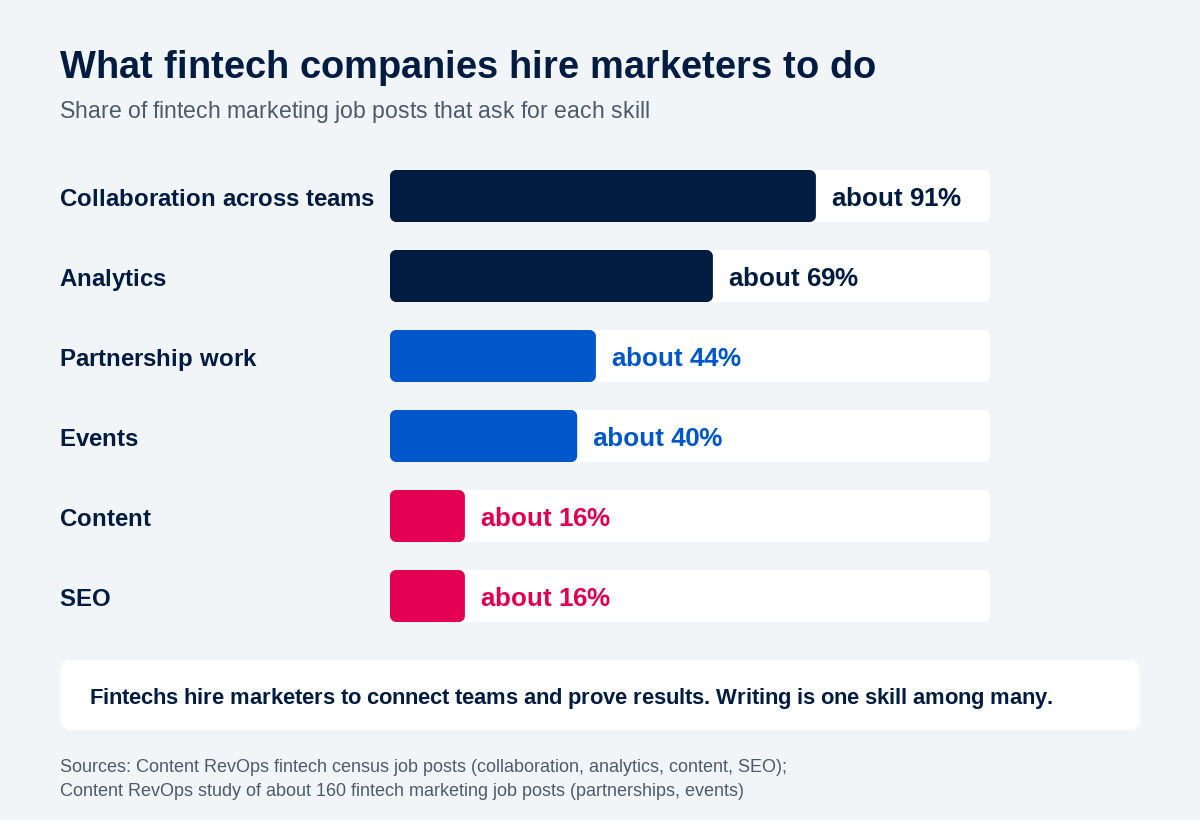
Hiring managers already see it that way. In our study of about 160 fintech marketing job posts, about 44% ask for partnership work and about 40% ask for events. In the job posts summarised in our fintech census, about 91% ask for collaboration across teams and about 69% ask for analytics, while content and SEO each show up in only about 16%. Put simply, fintech companies hire marketers to connect teams and prove results, and writing is one skill among many.
The parts of the function
Here is what a full B2B fintech marketing function covers, and who each part reaches.
Part of the function | What it does | Who it reaches |
Positioning and messaging | Says who the product is for, what it replaces, and why it is safe to buy | Every member of the buying committee |
Demand creation | Makes buyers aware of the problem and of you before they shop (research, executive visibility, podcasts, events, education) | Buyers who are not in a buying cycle yet |
Demand capture | Gets you found and chosen when buyers look (search, AI answers, review sites, demo and quote paths) | Buyers already comparing vendors |
Partner and co-sell marketing | Markets with and through core banking platforms, cloud marketplaces, resellers, and integration partners | Partners' customers and sales teams |
Events and field marketing | Puts your team in the rooms where banks and finance teams meet | Named target accounts and their committees |
Outbound support | Gives sales the signals, messages, and material for targeted outreach | Named accounts showing a buying signal |
Passes qualified accounts to sales with context and proof attached | Your own sales team | |
Customer marketing and expansion | Drives adoption, upsell, and the references the next buyer asks for | Existing customers |
Partner marketing carries more weight in fintech than in most B2B categories. Fintech Digital points out that embedded-finance providers market through partners, with co-marketing content, partner case studies, technical documentation, and developer relations, because the people choosing infrastructure are often technical.
A good example is the Finastra and Microsoft co-sell program run by Merit Mile. It put analyst reports and webinars Finastra already owned to work in three account-based campaigns over 14 weeks. A lead counted only after two content interactions, and 42% of leads were C-level.
Where content fits
Content is the material every part of the function runs on. The sales deck, the partner one-pager, the event talk, and the page that ranks for a buying question all draw on it.
Few fintechs have built it that way. Our fintech content maturity research found that only 25.5% of fintech companies run content as a system.
The wiring underneath
The tools are usually installed already. Across the fintech census, Google Tag Manager shows up on about 77% of fintech websites and HubSpot on about 34%.
What separates a system from a set of activities is the wiring between the parts: shared definitions in the CRM, tracking that ties a webinar or a ranked page to an opportunity, and a CMS that sales and partners can pull from. That wiring is what turns separate activities into one fintech marketing system.
How is fintech marketing different from financial services marketing and B2B SaaS marketing?
Fintech marketing in B2B differs from both because the buyer is often a regulated institution, the deal is large and slow, and regulation reaches the vendor through the customer.
What financial services marketing is
Financial services marketing is how banks, insurers, and asset managers market their own products, very often to consumers. Those firms are regulated directly, so their compliance team reviews their ads, emails, and web pages.
5WPR's comparison puts the difference this way: fintech marketing has to explain something new while building trust, and traditional financial services marketing has to stand out in a category people already know. That holds, but it skips the B2B side, where the bank is the buyer, not the seller.
Where B2B fintech differs from SaaS
B2B fintech looks like SaaS on the surface. It sells software, often by subscription, to businesses. The differences sit in the deal.
The Hoffman Agency "From promise to proof" survey asked 500 senior technology decision-makers at larger fintechs and banks in the UK, US, and Singapore how they buy. Here is what it found:
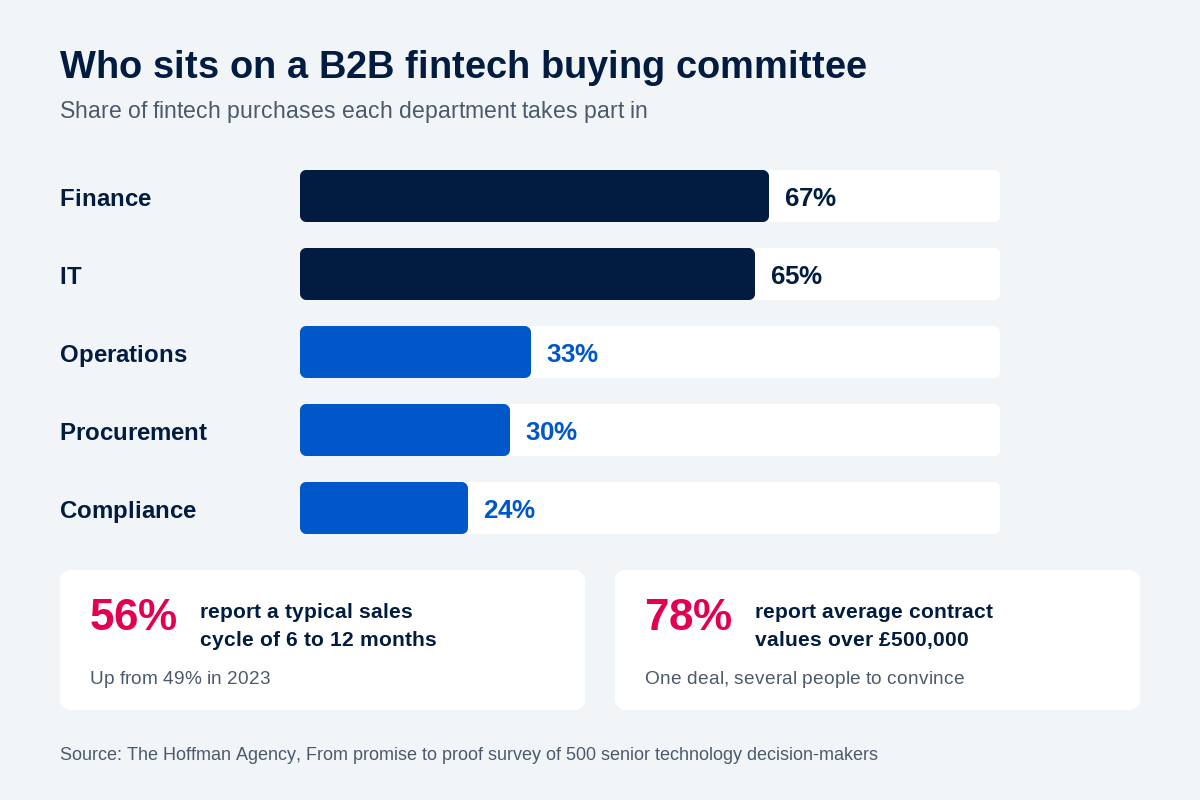
56% report a typical sales cycle of 6 to 12 months, up from 49% in 2023. None of those surveyed reported cycles over 18 months.
78% report average contract values over £500,000.
The biggest obstacles to buying are ensuring compliance (44%), due diligence on the supplier (42%), and ease of integration (41%).
Practitioners describe the same thing. Nicole Heringer, VP Brand and Communications at Enfuce, said on the 11:FS Fintech Insider podcast that Enfuce sees buying cycles of six to 18 months, and that "you're addressing a whole village" rather than one persona.
How regulation reaches a B2B fintech
Many B2B fintech vendors are not regulated the way their customers are. Regulation still reaches them, through the bank's vendor checks.
In the US, the Interagency Guidance on Third-Party Relationships from the Federal Reserve, FDIC, and OCC names fintech relationships directly. It tells banks to check whether a third party can comply with all applicable laws, and it says using a vendor does not reduce the bank's own responsibility. That is why supplier due diligence ranks as the second-biggest buying obstacle above.
For fintech marketing, this means the claims on your site, in your decks, and in your case studies will be read by a compliance and risk team. Hiring reflects it: about 41% of fintech marketing job posts ask for compliance fluency.
Financial services marketing | B2B SaaS marketing | B2B fintech marketing | |
Who the buyer is | Consumers and businesses buying a bank's or insurer's own products | Business teams buying software | Committees at banks, credit unions, insurers, lenders, merchants, and finance teams |
Cycle length | Short for consumer products | Varies widely by deal size | Commonly 6 to 12 months, up to 18 |
How regulation reaches you | Directly, through the firm's own regulator | Rarely, beyond data and privacy rules | Mostly through the customer's vendor due diligence and compliance review |
Route to market | Branches, direct, brokers | Direct, product-led, resellers | Direct sales plus core banking platforms, marketplaces, and integration partners |
What marketing is judged on | Accounts opened, assets, retention | Pipeline, trials, and conversions | Pipeline, win rate, cycle length, and references |
Who does B2B fintech marketing have to convince?
B2B fintech marketing has to convince a committee, not a single champion. Your positioning works only if each person on that committee can find the proof they need.
The buying committee
The Hoffman survey shows the share of fintech purchases each department takes part in:
Finance, in 67% of purchases
IT, in 65%
Operations, in 33%
Procurement, in 30%
Compliance, in 24%
Lucy Heavens, CMO at Vixio, described the shift on the same 11:FS episode. Vendors are no longer selling to one champion; they are selling to IT, legal, compliance, and several executives at once.
Positioning that names the buyer
Most fintechs do not say clearly who they are for. In our census of fintech websites, 71.5% show generic positioning with no clear buyer, and only 9.5% show high specificity about the customer they serve.
That matters more with a committee. A head of payments, a CFO, and a CISO each scan your homepage for one thing: is this for a company like mine? Generic copy gives none of them a reason to keep reading.
Heavens also warned that fintech and regtech companies mix up sounding technical with sounding credible. Dense product language can feel safe to write, but a buyer trusts plain claims about who you serve and what changes for them.
One way to name the buyer is to organise material by role. Brex's resources hub tags content for finance leaders and CFOs, with a CFO Corner series and a podcast for controllers.
Proof each role looks for
Each committee member needs different proof before they say yes.
Finance wants a business case: cost, payback, and risk in money terms.
IT and security want integration detail, architecture, and security documentation.
Compliance and risk want evidence that you can meet the bank's obligations.
Procurement wants clear terms, references, and vendor stability.
The business owner wants proof that a company like theirs got the result.
The Finance case is often the thinnest. In our census, about a third of fintech websites (34.2%) publish ROI or business-case content. On the rest, a champion finds no ready business case to forward to Finance.
What is the difference between demand creation and demand capture in fintech marketing?
Demand capture in fintech marketing means being found and chosen by buyers who are already looking. Demand creation means making the committee aware of the problem, and of you, before they start looking. A B2B fintech needs both, and most build only a thin version of either.
Chris Walker, then CEO of Refine Labs, defined demand creation as getting net-new accounts aware of your company and your difference before they talk to a sales rep.
What demand capture looks like in fintech
Capture is the work aimed at buyers who are already in a cycle. In B2B fintech, it includes:
Pages that rank for buying questions, such as "core banking migration vendors" or "payment orchestration for marketplaces"
Being named in AI answers when a buyer asks for options
Review site profiles and comparison pages
Paid search on buying terms
Clear demo and quote paths
What demand creation looks like in fintech
Creation reaches the people who will be on a committee next year. It includes original research, executive visibility on LinkedIn, podcasts, industry events, partner co-marketing, and education about the problem your product solves.
ComplyAdvantage runs both jobs on purpose. Will Thompson described two layers: always-on work (SEO, a newsletter, and partner content with bodies like UK Finance) plus three or four campaigns a year, each tied to a commercial priority. When the team cut its webinars from seven to four, registrations rose 60% and viewing grew from 23,000 to 64,000 hours.
Why so many fintechs lead with the demo ask
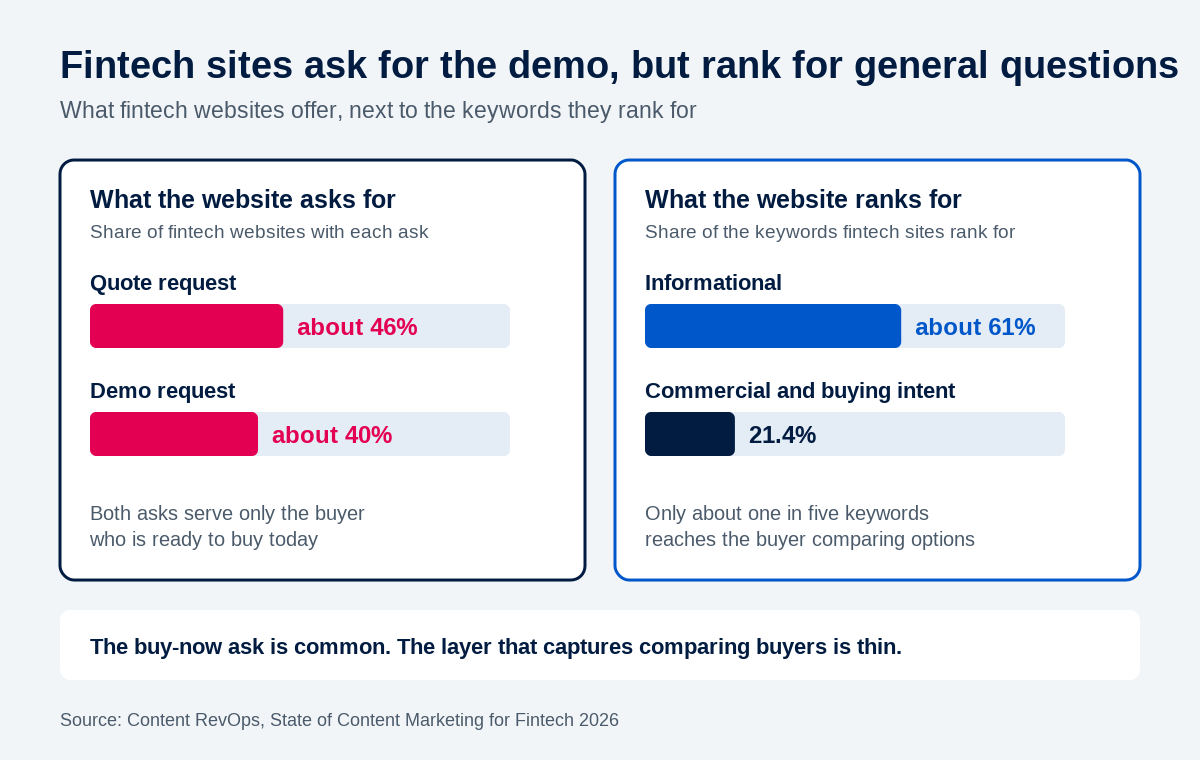
Many fintechs lead with the buy-now ask. In our fintech census, a quote request shows up on about 46% of fintech websites and a demo request on about 40%. Those asks only work for the buyer who is ready today.
Capture is thinner than it looks, too. Two numbers from the same research show it:
Across 500 fintech websites, direct and organic visits make up about 84% of traffic. Paid search brings about 2% and referrals about 1%. Most visitors already know the brand or searched for something.
About 61% of the keywords fintech sites rank for are informational. Commercial and buying-intent keywords together make up only about one in five (21.4%).
Put together, the demo ask is common, while the keywords fintech sites rank for lean toward general questions, with only a thin layer for the buyer who is comparing options.
Heavens described the old habit as putting a load of content out there and hoping it would generate demand. Walker explained why teams keep doing it: attribution software is built on trackable digital touches, so it over-credits organic search, direct traffic, and paid search, and the creation work never gets the budget.
How to split the two
The answer is to build both jobs properly, with their own budgets and measures.
Demand capture | Demand creation | |
Who it serves | Buyers in a cycle now | Future committee members |
Main channels | Buying-intent search, AI answers, review sites, paid search, demo paths | Research, executive visibility, events, podcasts, partner co-marketing |
How fast it pays | Weeks to months | Quarters to years |
What it is judged on | Sourced pipeline and conversion rate | Influenced pipeline, account engagement, cycle length, win rate |
A practical rule is to fix capture first, because buyers who are looking today are the closest to revenue. Then fund creation as a standing program with its own measures, so it does not get cut the first quarter it fails to show up in last-click reports. Walker's simple fix helps here: add a "how did you hear about us?" field to high-intent forms and read it next to your software attribution.
Which fintech marketing channels matter most for B2B companies?
The fintech marketing channels that matter most depend on which job they do. Some help buyers notice you; others help them pick you.
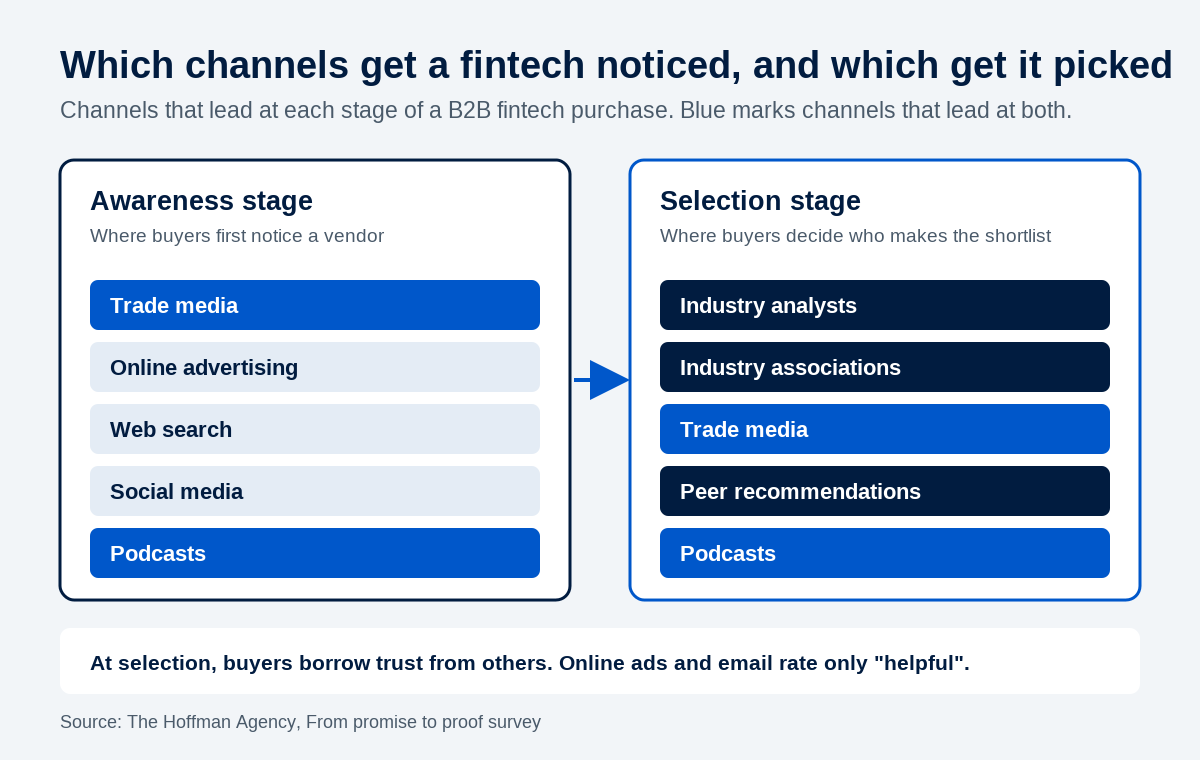
The Hoffman survey shows the split. At the awareness stage, trade media, online advertising, web search, social media, and podcasts lead. At the selection stage, industry analysts, industry associations, trade media, peer recommendations, and podcasts carry the most weight, while online advertising and email are only "helpful". Around 16% of buyers use AI tools to find and compare vendors.
Channel | Main job | What it does in B2B fintech |
Search on buying terms | Capture | Puts you in front of buyers comparing options; commercial and buying-intent terms are only about one in five fintech keywords |
AI answers | Capture | In our census, about 60% of established fintech brands show up in AI answers |
Creation | In a LinkedIn-commissioned survey of 350 payments buyers, 85% use LinkedIn at least weekly for payments-solution information, ahead of specialist press at 76% | |
Analysts, associations, and trade media | Both | Carry the most weight at selection; worth a planned program, not one-off press releases |
Partner and marketplace listings, co-sell | Both | Reach buyers through core banking platforms, cloud marketplaces, and integration partners |
Events and industry conferences | Both | Money20/20, Sibos, Finovate, and regional bank associations put you in the room with named accounts |
Podcasts | Creation | Rank among the influential channels at both stages |
Capture | Reaches named accounts showing a buying signal, with content as the reason to talk | |
Email to your own list | Both | Keeps past leads, event contacts, and customers warm; only "helpful" for winning new selections |
Paid search and paid social | Capture | Useful for buying terms and retargeting; in our census, only about 1 in 13 fintech LinkedIn advertisers promote content |
No single channel carries a B2B fintech. The channels that help a bank pick you are the ones that borrow trust from someone else, such as an analyst, an association, a partner, or a peer.
How does fintech marketing hand over to sales and support customer expansion?
Fintech marketing hands over to sales by passing a qualified account with the context and proof attached, fast. After the contract, it keeps working on adoption, expansion, and the references the next buyer will ask for.
What a clean handover includes
A clean handover in B2B fintech has three parts:
An agreed definition of a qualified account that marketing and sales both signed off.
Context that travels with the lead: which content the committee read, which roles engaged, and which objection they seem to have.
Follow-up material ready to send, matched to the deal stage and the objection.
We built this for Banking Crowded, a company serving banking and fintech professionals. Lead scoring ran on content interaction, nurture journeys matched each deal stage, and follow-ups mapped to known objections. Content supported sales before, during, and after outreach.
Why response speed matters to banks
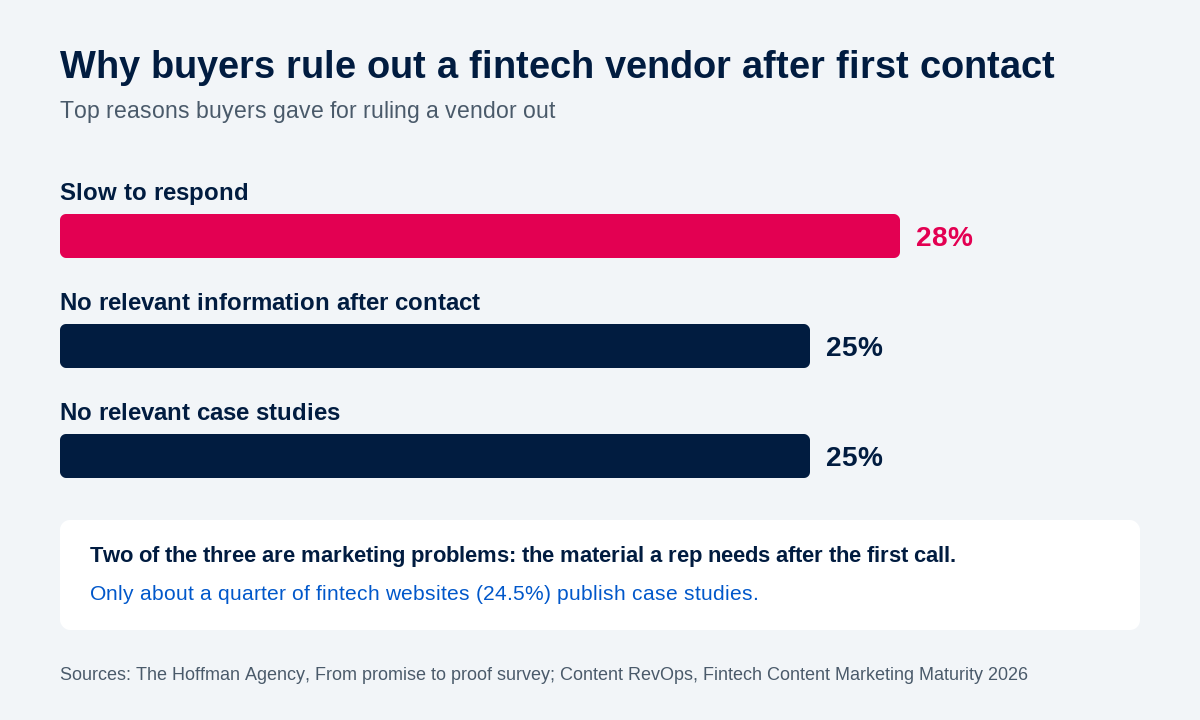
Banks punish slow vendors. In the Hoffman survey, being slow to respond was the top reason buyers ruled out a vendor (28%). Another 25% ruled out a vendor for "lack of relevant information after contact", and 25% for "lack of relevant case studies".
Both of those are marketing problems as much as sales problems. If the material a rep needs after the first call does not exist, the rep either sends nothing or writes it from scratch while the buyer waits.
Marketing after the contract
In fintech, today's customer is tomorrow's proof. The Hoffman report calls case studies the most important content format at the vendor selection stage. In our maturity research, about a quarter of fintech websites (24.5%) publish case studies.
Post-sale content is thin as well. In our census, about one in ten pieces (10.6%) that active fintechs publish is aimed at existing customers. Marketing after the contract means onboarding material, adoption programs, expansion campaigns, and turning happy customers into named references and case studies.
How do you measure fintech marketing?
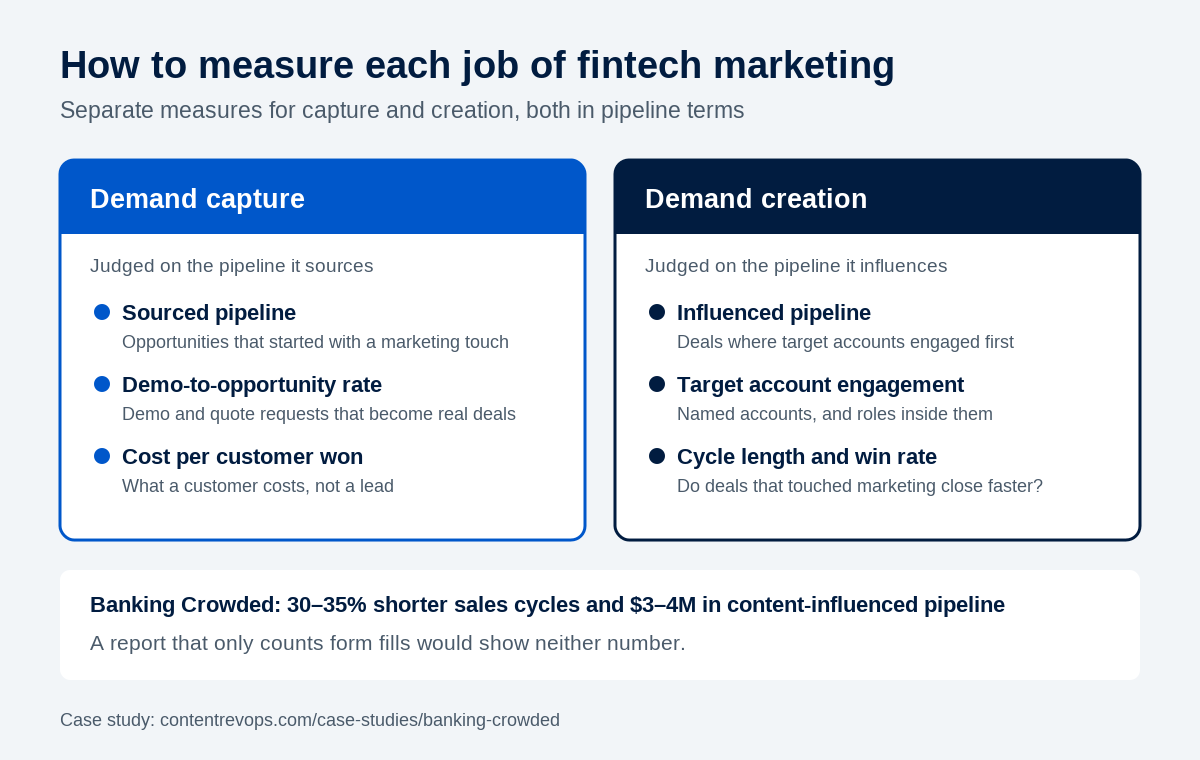
You measure fintech marketing in pipeline terms, with separate measures for each job. Capture is judged on the pipeline it sources. Creation is judged on the pipeline it influences and on how it changes the speed and win rate of deals.
Metrics for demand capture
Sourced pipeline: the value of opportunities that started with a marketing touch
Demo-to-opportunity rate: the share of demo and quote requests that become real opportunities
Cost per customer won: what it costs to win a customer, not a lead
Metrics for demand creation
Influenced pipeline: the value of opportunities where target accounts engaged with marketing before or during the deal
Engagement on the target account list: how many named accounts, and how many roles inside them, engage
Sales cycle length and win rate: whether deals that touched marketing close faster and more often
At Banking Crowded, the work led to 30–35% shorter sales cycles and $3–4M in content-influenced pipeline. A report that only counts form fills would show neither number.
Measuring AI answers
Track whether your company is named when buyers ask AI tools about your category, and track branded search next to it. Treat both as leading signals, not conversions.
Heavens described the pattern at Vixio: branded search and AI visibility went up, but conversion did not follow, because buyers went back to Google to click through to a source they trusted. AI answers shape the shortlist; the click and the conversion often happen somewhere else.
Why attribution breaks on long deals
Multi-touch attribution struggles when a deal runs for a year or more and involves many people. Heringer called it so complex for exactly that reason. Thunes has seen some accounts pass over 200 touch points before revenue.
ComplyAdvantage's answer is simple. With cycles of 18 to 24 months at the larger end, the team compares influenced pipeline for a campaign against the same campaign a year earlier, measured at the stage where a deal has a dollar value.
To see where your fintech content stands against peers before you set targets, use the fintech content benchmarking tool.
Should a B2B fintech build an in-house marketing team or hire a fintech marketing company?
Most B2B fintechs end up with a mix. The team inside owns the truth about the product, the customer, and the risk. A fintech marketing company or firm can own the build and much of the running, as long as you are clear about which kind of firm you are hiring.
What to keep in-house
Some work cannot leave the building:
Product truth: what the product does, what it does not do, and what is on the roadmap
Compliance sign-off: the final check on claims, case studies, and data use
Sales follow-up: the relationship with the committee once a deal is live
Customer relationships: the trust that turns customers into references
What a fintech marketing company can own
An outside firm can own much of the rest:
Building the system in your CMS and CRM, including tracking and lead definitions
Research and thought leadership that buyers and analysts cite
Search and AI-answer work on buying questions
Campaign production and event programs
Partner and outbound motions, with the content that supports them
There are two kinds of fintech marketing firm. One produces campaigns and assets on request. The other builds the system, wires it to your pipeline, and then runs it or hands it over to your team. The first adds output; the second adds a function. At Content RevOps we work the second way: we build content systems and the GTM engineering around them, so what you publish turns into conversations, accounts, and referrals.
5WPR suggests a specialist agency is most useful when a fintech has to coordinate product education, financial media, executive visibility, digital acquisition, and reputation at the same time.
Which setup fits your stage
Capacity tends to arrive with size. In our fintech census, fintechs with 101 to 250 staff publish content actively about three times as often as those with 11 to 50 (about 57% against about 18%).
The 51 to 200 staff band is where the gap shows most. Median advertised marketing pay there is about $85K, against about $131K at 1 to 50 staff and about $135K at 201 to 1,000. Our report reads that as the band with the least senior firepower in-house.
Your situation | Setup that usually fits |
Early stage, founder-led sales, no marketer yet | An outside firm builds the system; one person inside owns product truth and compliance |
51 to 200 staff, a small marketing team with a junior bench | A firm builds and runs the system with your team, then hands parts over as you hire |
Larger fintech with a full team in separate lanes | A firm plugs in as a systems layer across content, CRM, and sales enablement |
If you want to compare specialist firms, our list of the best demand generation agencies for fintech sets out who does what. For how we approach the sector, see our financial services industry page.
Ready to turn fintech marketing into pipeline?
We build fintech content systems and the go-to-market wiring around them, so what you publish turns into conversations, accounts, and referrals. Start with the fintech content benchmarking tool.
Frequently Asked Questions
About the Author

Founder & CEO, Content RevOps
Stefan Kalpachev is the founder and CEO of Content RevOps, where he helps B2B SaaS companies transform their content into predictable pipeline. With a background in content marketing and revenue operations, Stefan has developed a unique methodology that bridges the gap between content creation and revenue generation.
Connect on LinkedInRelated Articles
Fintech Social Media Marketing for B2B Companies
Nov 23, 2026
Fintech Content Marketing for B2B Fintechs That Already Have Content
Nov 19, 2026
How Can I Tell Whether AI Citations Are Driving Real Pipeline or Just Vanity Mentions?
Nov 11, 2026