How Much Should a Construction Company Spend on Marketing?
Not sure whether your construction marketing budget is too small or just aimed at the wrong things? Start with a content revenue audit.
Book a CallMost construction companies should put roughly 3% to 12% of revenue into marketing. The percentage is the wrong place to start, though. Two things decide whether a construction marketing budget actually works: whether you spend enough to fund a real system, and whether the money builds an asset you own or rents leads you lose the day you stop paying.
Part of Content Marketing for Construction: The Complete 2026 Guide.
Most construction firms get both wrong. In our analysis of the construction content landscape, only about 1 in 3 firms runs content as an operating system. The rest treat marketing as a cost line to keep small, which is exactly backwards. As the U.S. Small Business Administration puts it in its own marketing budget guidance, "Marketing isn't an expense; it's an investment, one that drives your sales." This guide gives you the number, the split by company size, where to allocate it, and how to know it is working.
How much should a construction company spend on marketing?
A construction company should spend between 3% and 12% of revenue on marketing, and the right number inside that band depends mostly on what kind of work you do.
- Remodeling, design-build, and custom-home builders: about 3% to 5% of revenue.
- Specialty trades and firms chasing growth: about 8% to 12% of revenue. This covers roofing, siding, windows, fencing, and any contractor pushing hard to take market share.
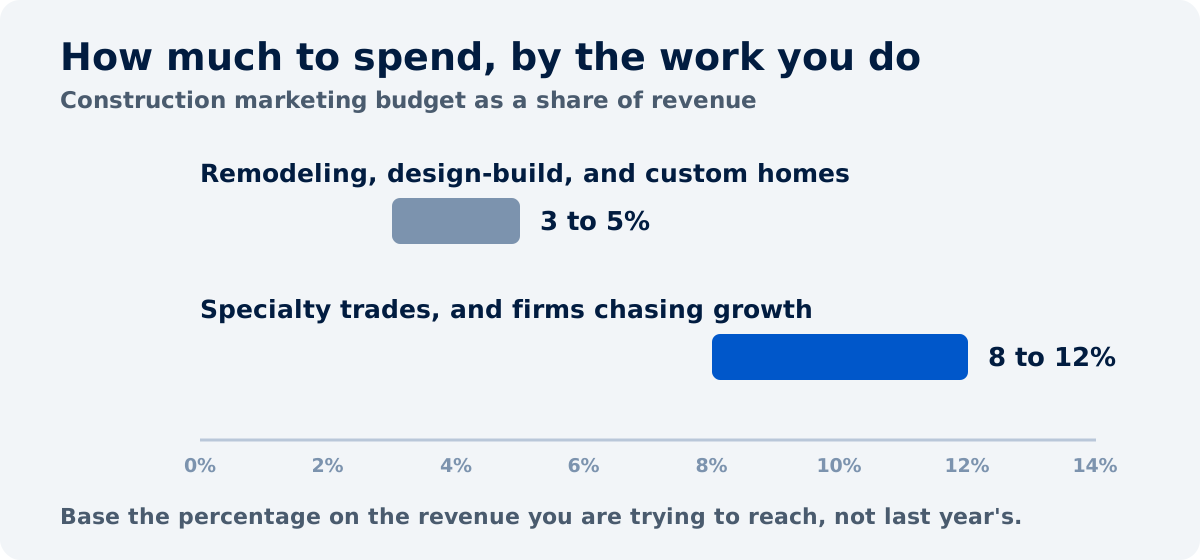
Spencer Powell, CEO of the construction marketing agency Builder Funnel, lays out this same split. He starts from a general small-business baseline and adjusts it down for builders and up for specialty trades, because those businesses face very different competition and cost per lead.
The published rules look like they disagree wildly. You will see 2% to 3% in one place and 15% to 20% in another. That spread is not a real disagreement. It comes from lumping different business types together. The SBA page does not name a single figure at all; it points to average marketing spend of about 7.9% of revenue across businesses, and notes there is no hard and fast answer. A cleaner size-tiered version, summarized by the agency WebFX, lands small businesses around 7% to 8%, mid-sized firms near 10%, and enterprises near 15%.
The low anchor holds up in the field too. The Association of Professional Builders, drawing on nearly 2,000 building companies, settles on a 3% rule for custom-home builders, which on a $750,000 build works out to $22,500 in marketing.
Two things matter more than the exact figure. This is a "should" number, and you tie it to the revenue you are trying to reach, not last year's. The next section explains why the range moves, and the one after that shows what construction firms actually spend today, which is a very different number.
Why does the right percentage range so widely?
The right construction marketing budget ranges widely because three things move it, and every firm sits in a different spot on all three.
Your growth goal
Base the percentage on the revenue you are trying to reach, not the revenue you already have. Powell makes this point plainly: a firm at $1.5 million aiming for $2 million should budget its percentage against $2 million, not $1.5 million. Budget against last year and you fund standing still. The same logic runs through a construction marketing strategy built on pipeline math: start from the revenue target and work backwards.
A firm holding steady can sit at the low end of its band. A firm trying to grow 30% or 40% needs the high end, because you are paying to create demand that does not exist yet.
Who your buyer is
A homeowner searching Google for a remodeler buys very differently from a commercial general contractor won through relationships and bid platforms. The residential buyer rewards visibility in search and reviews, so that budget leans digital. The commercial buyer rewards references, case studies, and a presence on the platforms where projects go out to bid, so that budget leans toward relationships and proof. Which buyer you sell to is the first call in any go-to-market strategy for a construction firm.
How referral-dependent you are today
The more of your work comes from word of mouth, the bigger the catch-up spend to build a channel you control. A firm doing 80% of its revenue from referrals has almost no marketing muscle, so getting to a real budget is a jump, not a nudge.
This tracks in our data. In the construction landscape study, marketing maturity rises with growth: the firms pulling ahead are the ones already treating marketing as a system, not the ones treating it as an afterthought.
How much do construction companies of your size actually spend today?
Here is the number almost nobody publishes. This is what construction firms actually run today, and it sits well below the 3% to 12% a growth-minded firm should target.
Company revenue | Typical annual marketing budget today |
Small, under $10M | about $8,000 |
Mid, $10M to $50M | about $35,000 |
Large, $50M to $500M | about $150,000 |
Enterprise, $500M+ | about $750,000 |
Those figures come from our construction content marketing study. Read the gap between them and the "should" number and the underspend jumps out. A $5 million contractor at even 3% of revenue would budget $150,000 a year. The median firm that size runs a fraction of that. The agency AB Marketing Group puts a growth-minded $5 million contractor at $240,000 to $540,000 a year, which is 4.8% to 10.8% of revenue. The distance between that target and what firms actually run is the whole problem.
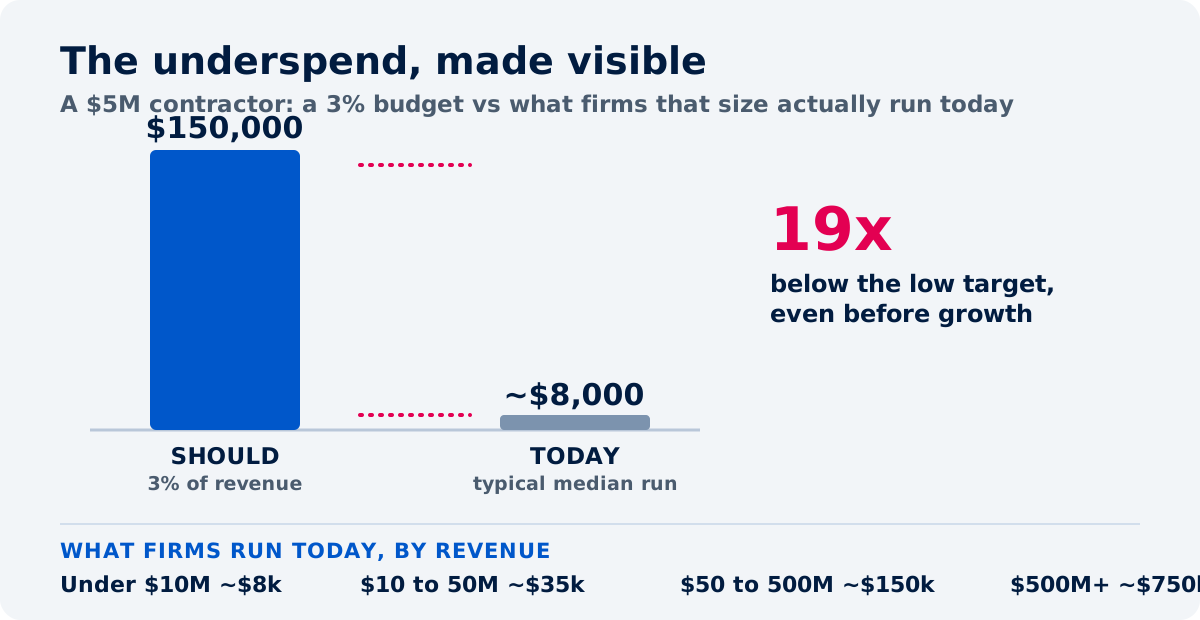
Each band tells you something different about where a construction marketing budget goes next.
- Small, under $10M. Lean, founder-led budgets. This is where activating an estate you already own, your website, your project photos, your past-customer list, pays back fastest, because the fixed cost of building it is spread over every future lead.
- Mid, $10M to $50M. The first real marketing function appears here. This is the moment to set a system, not just add spend, because the habits you build now decide whether the next $100,000 compounds or leaks.
- Large and enterprise, $50M and up. Multi-channel teams and full in-house operations. At this scale the question stops being how much to spend and becomes what the spend returns.
We are building a construction marketing budget calculator to turn these bands into a number for your exact revenue and growth goal. For now, take the band above, then read the next section before you spend a dollar of it, because where the money goes matters more than how much there is.
What should you actually spend the construction marketing budget on?
Put the largest share of your construction marketing budget into the assets you own, and a smaller, measured share into paid channels that fill gaps. That single rule separates the firms that compound from the firms that keep starting over.
One general contractor said it better than any agency: "2% to 5% of gross revenue is a decent guideline. But how you spend it is much more important than what you spend it on." He then listed organic first: a good website, a weekly blog answering the questions clients actually ask, a case study for every completed project, then paid campaigns built only on the posts that already worked.
Our data shows what the leading construction firms actually do with the money. Here is the allocation the strongest estates run, from the construction landscape study.
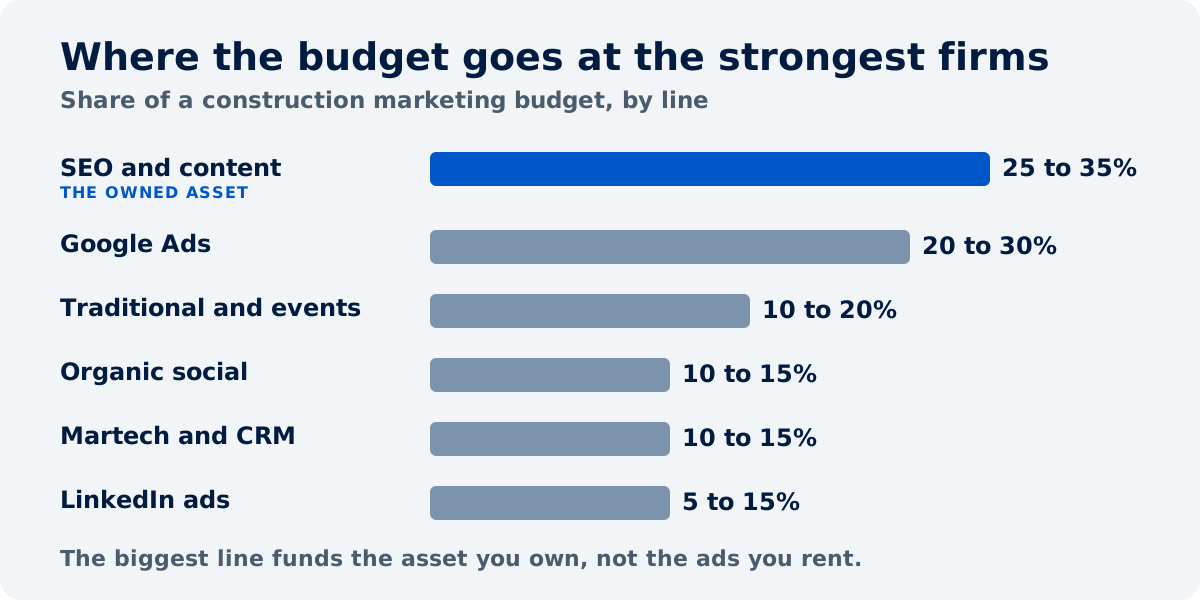
SEO and content, 25% to 35%
This is the single largest line at the leaders, and it is the owned asset. A website, search visibility, and content that answers buyer questions keep working after you stop paying, which is why the best firms fund them as durable infrastructure rather than a campaign. The same owned content is what decides whether your firm shows up in AI answers when a buyer asks for a shortlist. The line only pays if the site converts, so check first whether yours is one of the construction websites that get traffic but no leads.
Google Ads, 20% to 30%
A fifth to a third goes to paid search. Paid search is efficient only when your content is already doing the work of creating and warming demand. On its own it is rented traffic that stops the moment the budget does. Content is also what makes an expensive channel work harder.
Everything else, in smaller measured lines
- Traditional and events, 10% to 20%. Trade shows and local presence still command real budget in construction.
- Organic social, 10% to 15%. Steady, but only worth it when social media feeds a path to a real conversation.
- Martech and CRM, 10% to 15%. The tools to connect content to pipeline.
- LinkedIn ads, 5% to 15%, and video, 5% to 10%, for firms whose buyers live there.
Spencer Powell's own sample budget lands in the same place. For a firm moving from $1.5 million to $2 million, he puts about half of an $80,000 budget into the website, SEO, and content, and only about $12,000 into ads. The biggest line is the asset, not the ad account. The same principle holds outside construction, as our demand generation budget allocation best practices show.
Why do most construction companies underspend, and what does it cost them?
Most construction companies underspend on marketing because they treat it as a cost to minimize, and it costs them the one thing they cannot buy back: control over where their next job comes from.
The scale of the underspend is clear in the data. Only about 1 in 3 construction firms runs content as a system, roughly 2 in 5 publish in fits and starts, and close to 3 in 10 show no meaningful marketing signs at all. The smallest firms are the most absent. Among sub-$1M construction companies, fewer than 14% show active content marketing.
Practitioners see the same pattern up close. Eddie Boka, founder of the contractor agency Contracting Empire, describes contractor groups as a race to the bottom over who can spend the least, and puts it bluntly: "You can't save your way to success."
The failed-test trap
The most expensive version of underspending is the failed test. A contractor puts $500 into Google Ads, gets one weak lead or none, decides marketing does not work, and walks away for years. Chuck, who runs a Google Ads agency for contractors, calls this out directly: "Your small budget is probably the reason why you're not making more money." His point is that on Google you are competing with your dollars, so a micro-budget that cannot even buy one qualified lead was never a fair test of the channel.
The margin red flag
If your marketing budget is under 1% of revenue and your profit is only just where you want it, you are not charging enough to fund proper marketing. Powell flags this as the real problem hiding under a small budget. The fix is not just more marketing spend; it is stronger margins that make the spend possible.
The cost of all this is dependence. When your pipeline runs on referrals and word of mouth, a slow quarter has no faucet to turn on. You cannot control it, you cannot predict it, and you cannot scale it.
Are you paying for leads, or building an asset you own?
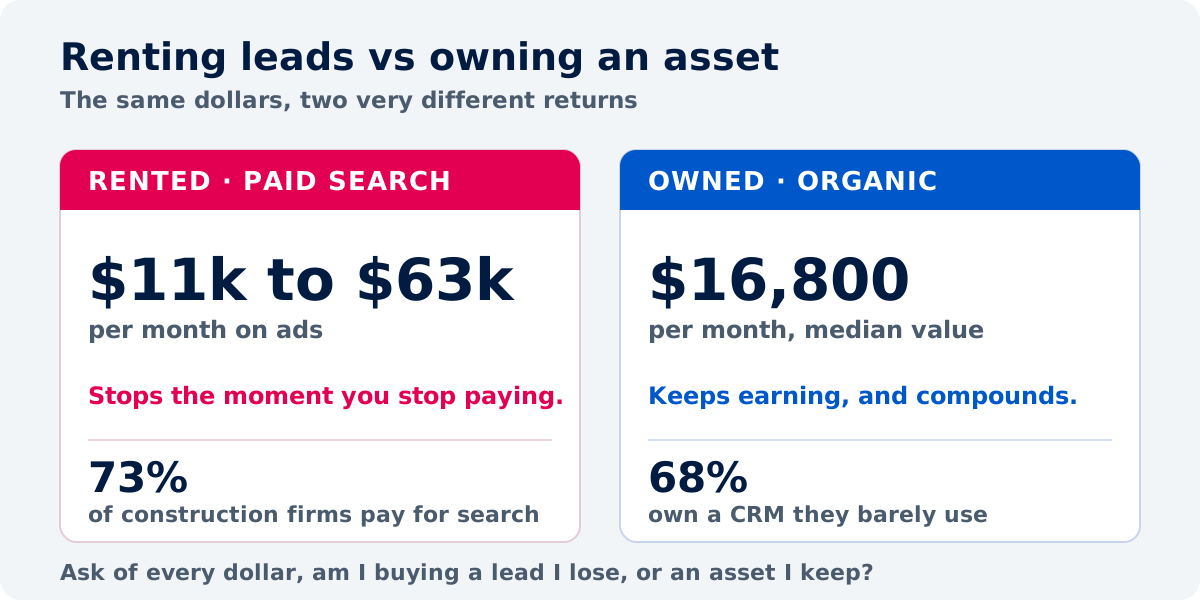
Every dollar of a construction marketing budget does one of two things: it buys a lead you lose the moment you stop paying, or it builds an asset you keep. Most construction firms spend too much on the first and too little on the second.
The numbers make the trade brutal. About 73% of construction firms pay for search, running roughly $11,000 to $63,000 a month on ads. That is often more than the owned asset would cost to build. Meanwhile the median construction firm's organic presence is worth about $16,800 a month in equivalent paid traffic, an asset it could own instead of rent.
Then there is the shared-lead problem. Eddie Boka argues that a contractor's real competitors are the lead aggregators, platforms like Angi, HomeAdvisor, Yelp, and Thumbtack. By his account, every dollar you send them buys their authority, not yours, and they resell the same lead to several contractors; he estimates they earn several times over what each contractor pays, though those are his figures. His advice for any firm over $1 million in revenue is to invest in your own brand, not theirs.
Contractors describe the same pain in plainer words. One called Thumbtack out for reselling leads that were already sold and even seeding fake ones: "Never again." Another ran the scattered version of the same mistake, spending over $7,000 across ads, flyers, and word of mouth "without landing a single job."
There is a quieter version of the trap sitting inside most firms already. About 68% of construction companies own a CRM, but few wire their content into it, so an asset they already pay for does no work. Wiring it up is how you see which page started the deal. The budget test is simple: is this dollar buying a lead you rent, or an asset you keep?
How do you know your construction marketing budget is working?
You know your construction marketing budget is working when it returns more gross margin than it costs, measured on gross margin and not on sales.
That distinction is the one most contractors miss, and Spencer Powell builds his construction ROI formula around it:
ROI = (gross margin − marketing spend) ÷ marketing spend
Use gross margin, not revenue, because marketing is an overhead cost. You have to clear the cost of the work first before the marketing counts as a return.
Here is his worked example. A $3 million design-build remodeler spends $75,000 on marketing, which is 2.5% of revenue. It lands three extra projects at $100,000 each, so $300,000 in new revenue. At a 30% gross margin, that is $90,000 in gross margin. Subtract the $75,000 spent and you are left with $15,000, a 20% return, and that is after the cost of the work.
Two plain checks turn this into a decision.
- Break-even. How many jobs must the budget land just to pay for itself? If your average job carries $20,000 in gross margin and you budget $60,000, you need three jobs before the marketing is free.
- The compounding line. Paid channels stop the day you stop paying. The owned asset does not. The median construction firm's organic presence is worth about $16,800 a month and keeps earning, which is why the return on owned assets climbs over time while rented lead costs only rise.
Our forthcoming construction marketing budget calculator will run this math for your numbers automatically. Until then, the formula above is enough to judge any budget you are handed. For the wider measurement picture, see our guide to reporting on content marketing success.
How to set your construction marketing budget this year
Setting your construction marketing budget comes down to five steps, in order.
- Pick the revenue you are aiming to reach. Not last year's number. The one you want to hit this year.
- Choose your percentage band. 3% to 5% for remodeling, design-build, and custom builders. 8% to 12% for specialty trades and firms chasing growth. Push higher if you are behind your market or fighting in a competitive metro.
- Split it with the allocation framework. The biggest line goes to the owned asset, your website, SEO, content, and email or CRM. A smaller, measured line goes to paid search to fill capacity gaps.
- Cap the rented lead platforms. Shared-lead marketplaces can bridge a slow start, but they are a tax, not a strategy. Hold them to a small, deliberate slice.
- Track the return on gross margin, not sales. Judge every dollar by the margin it brings back, and shift spend toward what compounds.
A construction marketing budget is not a cost line to shrink. It is the amount you invest to own demand instead of renting it. Firms that get this right stop living quarter to quarter on referrals they cannot control.
If you want a second read on where your current budget leaks and what a construction-specific allocation should look like for your firm, that is the conversation we have, and our construction industry page shows how the work runs for firms like yours. You can also see how your estate stacks up against the field with our construction marketing benchmarking tool.
Ready to turn your construction marketing budget into demand you own?
Our content revenue audit maps your spend against the buying decision, finds where the budget leaks, and puts a number on what your owned assets are worth.
Frequently Asked Questions
About the Author

Founder & CEO, Content RevOps
Stefan Kalpachev is the founder and CEO of Content RevOps, where he helps B2B SaaS companies transform their content into predictable pipeline. With a background in content marketing and revenue operations, Stefan has developed a unique methodology that bridges the gap between content creation and revenue generation.
Connect on LinkedInRelated Articles

A Go-to-Market Strategy for Construction Firms
Oct 10, 2026

Why Construction Brands Almost Never Show Up in AI Answers
Oct 9, 2026

How to Turn Before-and-After Construction Project Photos Into a Marketing Strategy
Oct 8, 2026