How to Turn Before-and-After Construction Project Photos Into a Marketing Strategy
See where your before-and-after proof is leaking. Route your construction project photos to the moment buyers decide instead of a dead camera roll. Get a content revenue audit.
Book a CallAI made it cheap to produce construction marketing. Blog posts, service pages, and stock photos of hard hats now flood every feed, and buyers trust almost none of it. The one asset AI cannot manufacture is a real before-and-after of your own work, the ripped-out kitchen next to the finished one, the corroded panel next to the clean upgrade. That is why proof sits at the center of every content marketing system for construction firms we build.
Part of Content Marketing for Construction: The Complete 2026 Guide.
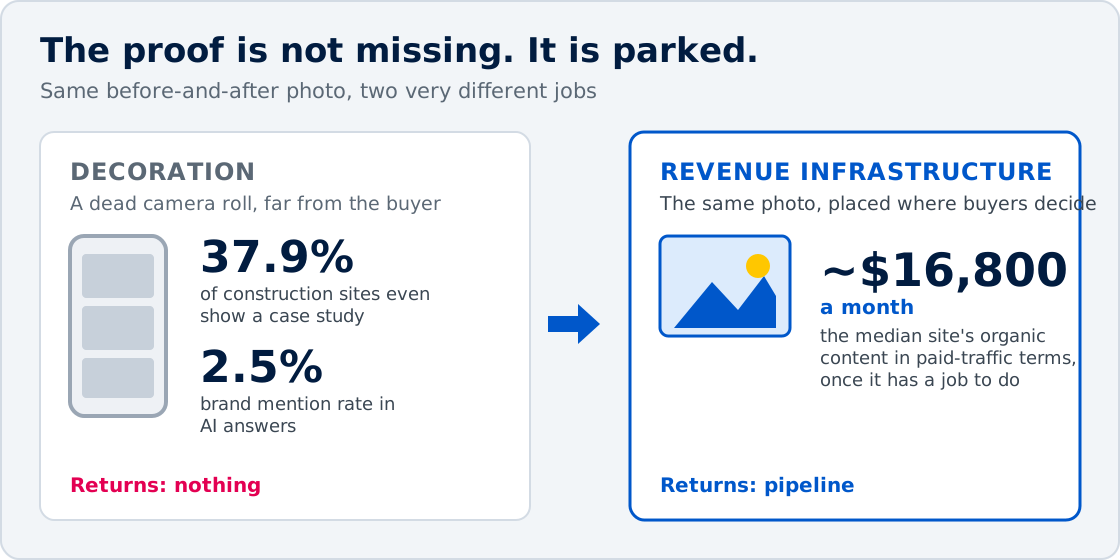
Yet most construction firms waste that proof. Case studies sit on only 37.9% of construction websites, and construction brands show up in AI answers only about 2.5% of the time. The photos exist. They are just parked in a dead camera roll or a social feed, far from the moment a buyer decides.
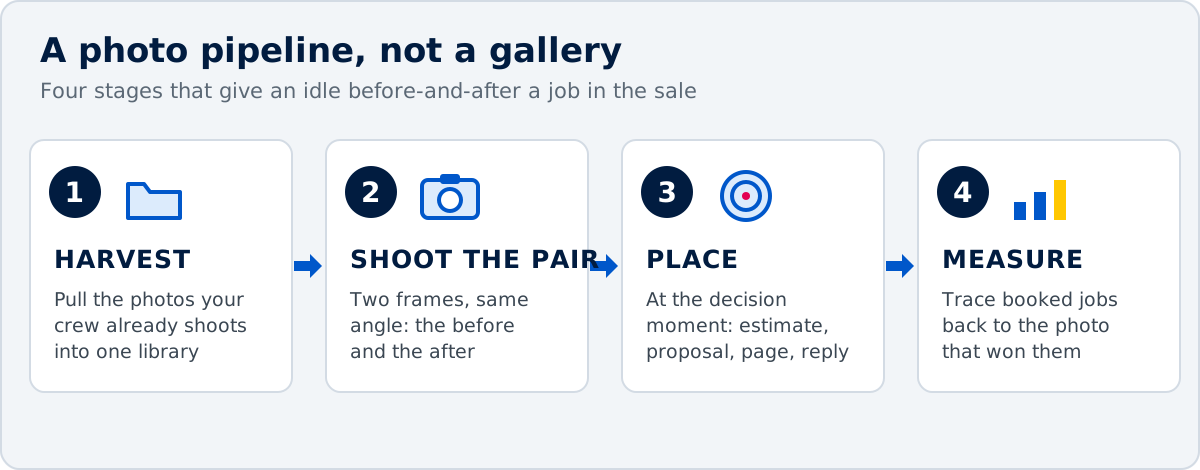
This is the system that gives those photos a job. Not a gallery, a pipeline: you harvest the before-and-after construction project photos your crew already takes, shoot a repeatable matched pair, place each photo at the point in your sales process where it changes a decision, and measure what it earns.
What a before-and-after photo marketing strategy means for a construction firm
A before-and-after photo marketing strategy is a system that routes each project photo to a specific job in your sales process, instead of leaving it as decoration in a portfolio. The photos are the proof a buyer needs to choose you, so the strategy is about where that proof sits, not how many likes it gets.
Most firms treat before-and-after construction project photos as content to post. Treat them instead as revenue infrastructure, the same way you treat a CRM or an estimating tool, and as one part of a wider construction marketing strategy that generates pipeline. A finished photo earns its keep when a buyer sees it at the moment they are choosing a contractor, and decides you are the safe one.
Why photos convince construction buyers when words do not
Construction buyers cannot read a structural drawing, and they rarely try. They judge your work by what they can see. A contractor on r/ConstructionManagers put it plainly: clients "don't really 'get it' until they see it, the moment photos come out, especially before/after shots, the conversation completely changes. Suddenly there's trust. Suddenly there are fewer questions."
Another builder in the same thread named the mechanism. A clean before-and-after "creates an emotional 'trust shortcut' that 1,000 words of documentation just can't touch." That is the whole case for a photo strategy in one line. The proof does the selling faster than any claim you could write.
Where the money leaks
The gap is not that construction firms lack proof. It is that the proof sits away from the decision moment, so it never gets paid for. Strong content marketing for construction turns that proof into pipeline, and the numbers show how rare that is: most firms sit low on the construction content maturity curve.
The median construction site's organic content is worth about $16,800 a month in equivalent paid traffic once it has a job to do. A camera roll full of unused before-and-afters returns nothing. What closes that gap is a system for putting the proof to work, not a bigger pile of photos.
Start with the before-and-after photos your construction crew already takes
You almost certainly have thousands of usable photos already. Before you shoot anything new, harvest the pile your crew takes every day, because that is where the real failure lives. The photos get taken, they just never reach marketing or the buyer. We call this raw asset extraction: the proof already exists inside the business, and the work is getting it out.
Contractors say this out loud. "Taking photos was never the problem," one wrote on Reddit. "Crews already do that. The friction was keeping them organized and easy for the client to find later." Another was blunter about why the pile stays useless: "the only photos I take are of bad work to send to the sub for fixing." A third described the dead camera roll exactly: "I have so many pictures, I don't really go back and look through stuff though."
This matches what researchers find on real job sites. A 2022 survey of construction professionals found that photos flow to project stakeholders for documentation and cover, not to marketing or the buyer. The proof gets captured and then filed where no customer will ever see it.
A no-tool routine to turn the pile into a library
You do not need software to fix this. You need a place for photos to land and one person responsible for filing them. ContentDrive lays out a simple three-part system that buys nothing new:
Set a short shot list before the job. Decide the five to ten shots you want from every project so the crew is not guessing on site. A before of the worst spot, progress on the hard part, the finished result, a wide shot, and a detail shot covers most jobs.
Make contributing frictionless. Use tools the crew already has: a per-job group text or WhatsApp thread, a shared Google Photos or iCloud album, or a three-field Google Form with upload, a quick note, and the job name.
Route everything into one cloud folder. Make that folder the single source of truth, with a plain structure like /Projects/Year/Month/[Address]_[ServiceType]/, a naming convention any contractor can follow.
Then name one person the asset librarian. They spend about thirty minutes a week pulling photos out of the chats and albums and filing them in the folder. That single habit turns a scattered pile into a library of raw assets you can actually pull marketing from.
How to shoot a before-and-after construction pair that sells the work
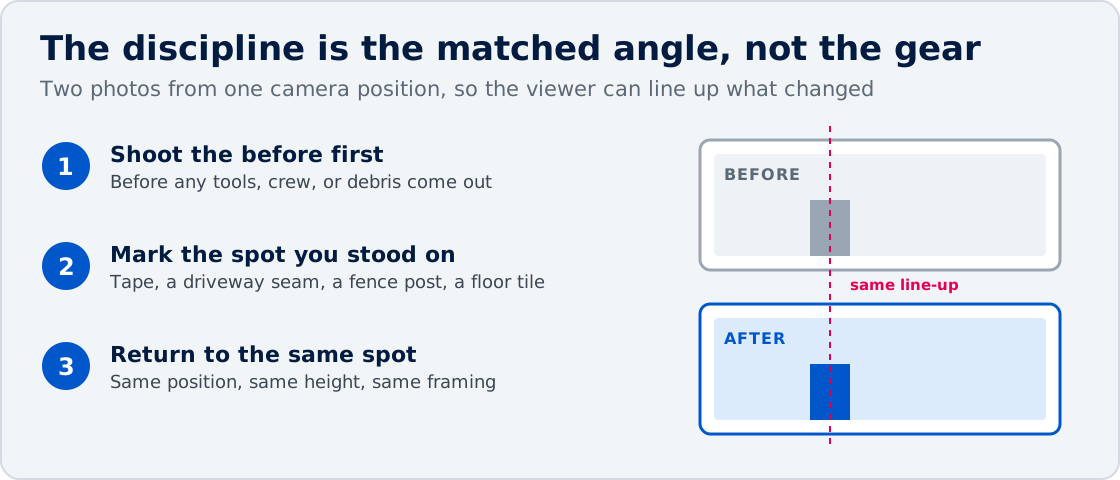
Shoot two photos, not thirty, and make the after match the before. That is the entire format, and the discipline lives in the matching, not the gear.
The sharpest version of this rule comes from construction marketing consultant Darren Slaughter: "you don't need 30 pictures of a bathroom remodeling project, you want two pictures, a before picture and an after picture, and the after pic has to be the same angle from the same position as the before pic." If the angle is off, the viewer cannot line up what changed, and the proof falls apart.
Shoot the before first, and mark the spot
The hard part of a matched pair is that you shoot the before when you do not yet know what the after will look like. The fix is a plain habit, not a measurement protocol.
Shoot the before first, before any tools, crew, or debris come out.
Mark the spot you stood on with tape, a driveway seam, a fence post, or a floor tile you can count back to.
Return to that same spot, the same height, and the same framing for the after.
That is enough to get a clean pair every time. Practitioner guides for contractors say the same thing, and it works on a phone with no editing beyond a quick crop.
Phone or professional photographer
A modern phone is genuinely good enough for most before-and-afters, as long as you nail the matched angle, decent light, and a clean lens. One contractor who uses before-and-afters to close work in person said he just throws the photo "on photoshop with my laptop" and moves on.
Pay a professional for the marquee work, the jobs you would put on your homepage, enter in an award, or run behind paid ads, where polish translates directly into lead quality. That is the decision rule construction studios give: phone for progress, social, and smaller jobs, and a pro for anything that carries your reputation.
Commercial project photography is not cheap on its own. Architectural photographers charge roughly $1,500 to $4,000 per shoot day, with a single-party project landing around $2,000 to $5,000 all in. Licensing is what makes it affordable. The photographer keeps the copyright, and the architect, general contractor, and designer each buy their own license, so cost-sharing drops your share sharply. That is why one commercial firm called a set of professional photos "a few hundred dollars, a drop in the bucket for future advertising purposes," a cost-shared per-party price rather than the whole shoot.
Marketing specialist Matthew Muller of Royal Electric runs the pro version of this on his own shoots: "I always develop a production plan with a shot list, I stage my gear the day before." For a phone shoot you do not need his rig, but you do need his shot list.
Where before-and-after photos belong in the construction sales process
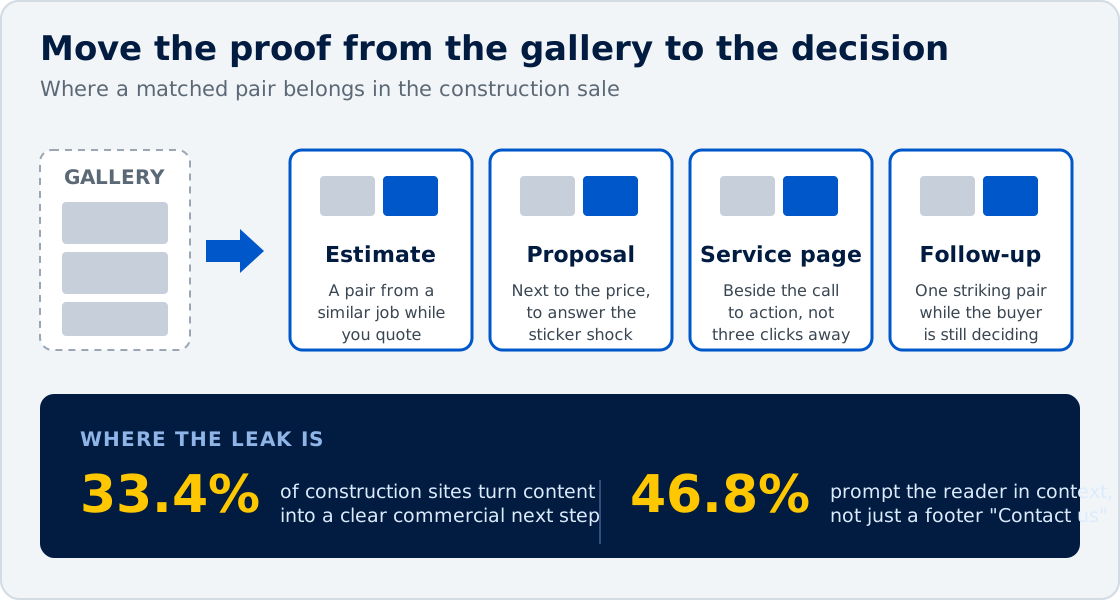
Before-and-after photos belong at the decision moments, not just in a gallery: on the estimate, inside the proposal, on the service page next to a clear call to action, and in the post-job follow-up. This is the part every competitor skips, and it is where a pile of photos becomes pipeline.
The proof has to sit where the buyer is choosing. When it does, it does the selling before you ever pick up the phone. Construction coach Jesse Lane describes buyers who have already seen the work: "they know you like you trust you before they even call you, and then they call you, they're kind of already 80% sold." A contractor who shows before-and-afters face to face in the first meeting said the same, that being able to show a customer what you are capable of "gives them confidence."
Why a photo out-converts a written claim
There is a real reason a photo beats a sentence at the decision moment. A related photo placed next to a claim raises how true people judge that claim, in seconds, a peer-reviewed effect cognitive scientists have measured repeatedly. A photo lets the buyer verify the outcome for themselves instead of taking your word for it. As one marketing team put it, a testimonial asks the visitor to trust a claim, while a before-and-after lets them look at the outcome directly and draw their own conclusion.
Put the proof next to the ask
The construction data shows how few firms wire proof to conversion. Only 33.4% of construction sites turn content into a clear commercial next step, and under half, 46.8%, prompt the reader in context rather than falling back on a footer "Contact us." That is the leak, and it is the same one behind a construction website that gets traffic but no leads. The photo is on the site, and the ask is nowhere near it. Fixing it is what we mean by a conversion layer.
Fix it by placing a matched pair at each of these points:
The estimate or site visit. Bring a short before-and-after set from a similar job so the buyer sees your work while you are quoting theirs.
The proposal. Put a relevant pair on the page where you name the price, so the proof answers the sticker shock.
The service page. Set a gallery beside the call to action, not buried three clicks away.
The follow-up. After the visit, send one striking before-and-after with the next step, while the buyer is still deciding. The same pairs make strong anchors for email marketing for construction companies.
How to tell whether your construction photos are winning work
You know your photos are working when you can trace a booked job back to the moment a buyer saw them. You do not need an analytics stack to do this. You need one question and one spreadsheet.
Only 33.3% of construction sites capture a lead at all, and where capture exists it is usually a newsletter signup, not a reason to act next to the proof. So the first fix is a way for a photo to turn into a contact, a gallery that leads to a quote form or a call, not a dead end. Our notes on lead capture and qualification cover the mechanics.
Then track the source. The simplest method for a non-technical contractor needs no tools:
Add "How did you hear about us?" to your intake script and your web form, with a short fixed list of sources plus a one-line detail note, so a lead reads as source "Facebook," detail "before-and-after deck post."
Log every lead in one spreadsheet by source, then estimate, then booked revenue.
Make one person responsible for filling it in daily.
Self-reported answers are often wrong, so add a hidden tracking field on the gallery and quote form and, where the phone is your main path, one call-tracking number, so the spreadsheet is not the only record. That is the whole measurement system: which photos ran, which leads named them, and which of those leads paid. For a fuller version, see how we help you see which page started the deal, and our guide to reporting on content marketing success. To see how your numbers stack up against peers, run them through the construction marketing benchmarking tool.
Before-and-after photos or video for construction marketing
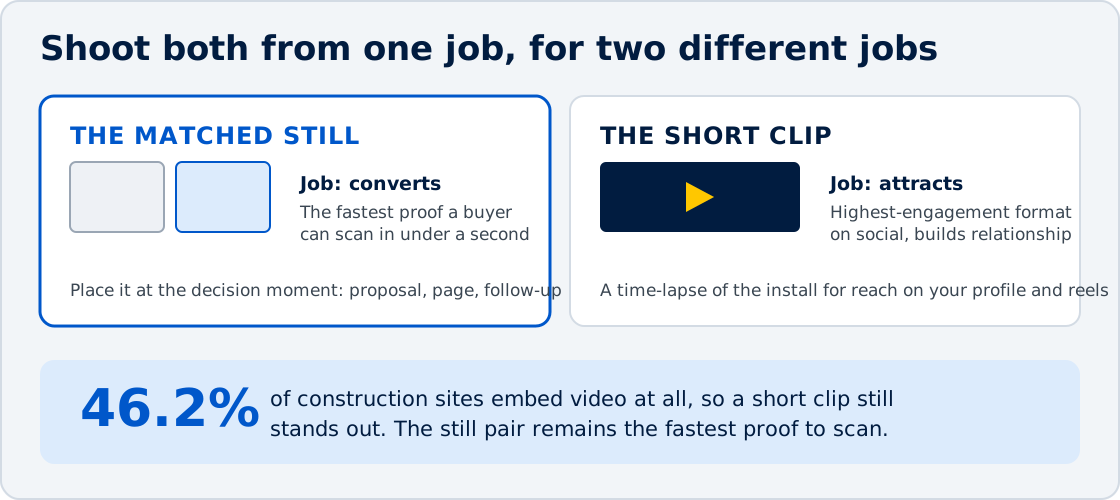
Shoot both, from the same job. The still before-and-after and a short clip do different jobs, so the real decision is how you pair them.
Short video is the fastest-growing, highest-engagement format on social, and 21% of marketers say short-form video delivers the highest ROI of any format. Construction expert Mike Claudio argues buyers now want a face: "pictures don't work as well as they used to and videos are really skyrocketing, because they want to be able to build a relationship with a person."
He is right about reach, and it does not retire the still. Only 46.2% of construction sites embed video at all, and the matched before-and-after remains the fastest proof a buyer can scan in under a second on a service page or a proposal. So shoot the matched pair for the decision moment, and shoot a short clip or a time-lapse of the install for reach and relationship on your profile and reels, the channels covered in social media marketing for construction companies. The pair converts. The clip attracts. For where video itself earns its budget, see construction video marketing: where it actually pays.
Before-and-after proof for construction trades without a dramatic transformation
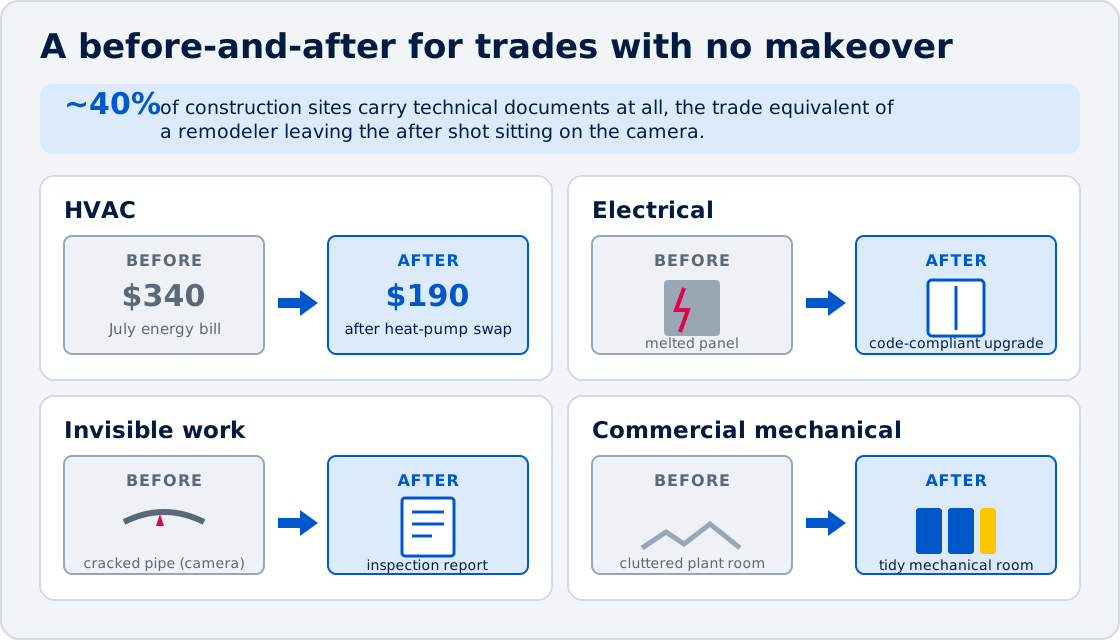
When the finished work has no visual makeover, the before becomes the problem evidence and the after becomes the documented outcome. HVAC, electrical, AV, and commercial construction management all have a before-and-after, it just is not a kitchen.
Their deepest asset is technical proof, and it sits dormant. Technical documents appear on only about 40% of construction sites, which is the trade equivalent of a remodeler leaving the after shot on the camera. Here is the before-and-after for work you cannot photograph as a makeover, drawn from creative built for home-service trades:
HVAC. A $340 July energy bill next to $190 after a heat-pump swap, or a corroded, duct-taped 1990s unit beside a clean modern system.
Electrical. An overloaded or melted panel beside a code-compliant upgrade, captioned "this is what was inside the wall."
Invisible work like pipe relining or spray foam. A camera image of the cracked pipe, a thermal image of the cold cavity, a water-quality test, or an inspection report as the after.
Commercial mechanical. Clean installs of ductwork, furnaces, and heat-pump conversions photograph well, and a tidy mechanical room reads as competence to a commercial buyer.
Commercial AV firms have found this pays beyond direct leads. One team "bit the bullet and added photography as a marketing expense," and the payoff was press: "publishers love them, we almost always get published." A time-lapse of a rack build or a room fit-out works the same way, a moving before-and-after for a trade with no single dramatic reveal. If you are hunting for more formats like this, our list of construction marketing ideas that aren't just project photos picks up where this one stops.
Consent and rights for posting construction project photos
Get permission before you post, because who owns the photo and who appears in it are two different questions, and the commercial rules are stricter than most contractors assume. Three plain rules cover almost every job.
Residential work needs a release
You almost always own the copyright to a photo your crew shot, since an employee's photos are work made for hire. Privacy is the separate issue. The line runs roughly at the front door. An exterior shot from the street is generally fine, while interior photos of a private home carry a high expectation of privacy and need consent. Best practice is a written photo release naming where the images will run, plus cropping out house numbers and plates and removing personal paperwork, family photos, and valuables before you shoot.
Commercial images are licensed, not owned
On a commissioned commercial shoot, the photographer keeps the copyright and each party buys a single-party, non-transferable license. A contractor who was not on that license cannot legally reuse the architect's photos, and a standard right-to-photograph clause can require owner consent even to name the property. If you want to use commercial images, get on the license before the shoot.
Sensitive and public sites need sign-off
For public, secure, or high-profile work, confirm the owner approved publication and the contract permits publicity, and do not post images that reveal security systems or safety violations, which is standard professional-liability guidance. Matthew Muller's airport shoots are the field version, they need operations-team guidance and client and owner approval for any restricted area.
Where does the proof go next?
For a fuller picture of the system these photos plug into, see what good content marketing for construction looks like, and how proof travels across search, social, and email in digital marketing for construction companies. The same matched pairs also give AI engines something concrete to cite, which matters when construction brands appear in so few answers, as the construction search and AI visibility data shows.
Your crew already shoots the most persuasive marketing asset you own, and AI cannot fake it. The job ahead is to give that idle proof a role at the moment your buyers decide, rather than produce more content nobody trusts. If you want to see where your own before-and-after proof is leaking, get a content revenue audit or book a call.
Give your idle proof a job
Your crew already shoots the most persuasive asset you own, and AI cannot fake it. Get a content revenue audit or book a call to wire it to your sales process.
Frequently Asked Questions
About the Author

Founder & CEO, Content RevOps
Stefan Kalpachev is the founder and CEO of Content RevOps, where he helps B2B SaaS companies transform their content into predictable pipeline. With a background in content marketing and revenue operations, Stefan has developed a unique methodology that bridges the gap between content creation and revenue generation.
Connect on LinkedIn