How to Build a Construction Marketing Strategy That Generates Pipeline
Building a construction marketing strategy on a pile of tactics? Start with a content revenue audit to find where the plan leaks before you spend another dollar.
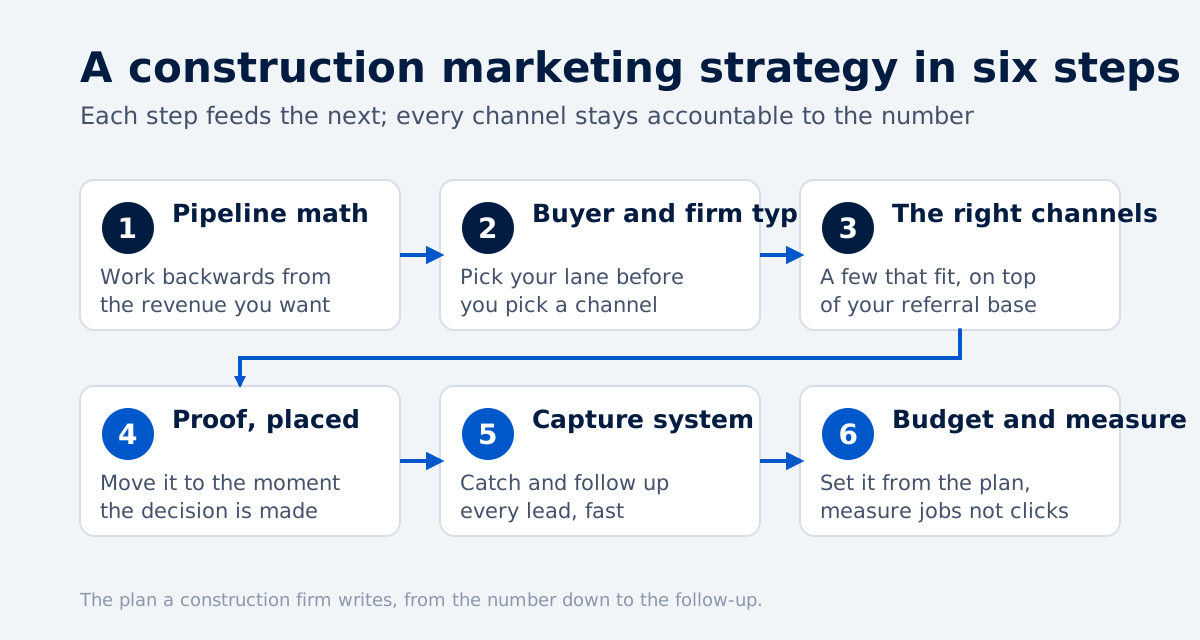
Book a CallA construction marketing strategy is the plan that turns a revenue goal into the specific marketing that will hit it. You build it in six steps: start from your pipeline math, decide who you sell to and what kind of firm you are, pick the few channels that fit, place your proof at the decision moment, build a system that catches and follows up every lead, and set the budget from the plan. The one thing that separates a strategy from the "20 tactics that work" lists is where you start. A tactic list starts from the menu. A strategy starts from your number.
That difference matters, because most construction firms do not have a strategy at all. In our study of the construction content estate, about two-thirds of firms run no real marketing system, and only about one in three have a clear path from their marketing to a signed commercial step. The rest is activity that leaks. This guide is how you build the version that does not.
What makes a construction marketing strategy different from a list of tactics?
A tactic is a thing you do. A construction marketing strategy is the decision about which things to do, in what order, for which buyer, aimed at a number you can name. The tactic lists you have read are all real tactics. They just skip the part that makes them a plan.
Here is the proof that skipping it hurts. When we looked at 500 construction firms, only about one in three ran marketing as a system; the other two-thirds were either publishing in fits and starts or showing no real signs of a plan at all. Doing more tactics does not fix that. A pile of tactics with no number behind it is still a pile.
The usual objection is that construction runs on referrals, so who needs a strategy. Referrals are real, and they should stay the base of your plan. The problem is that they are unpredictable. As one contractor put it on r/ConstructionManagers, "you can't control the volume. Good month, bad month, no real way to predict it," and firms that lean on referrals alone "hit a wall when a few key relationships dried up and they had nothing else coming in." Jesse Lane, who runs one of the most-followed construction marketing channels, calls relying entirely on word of mouth the biggest mistake he sees.
A strategy is what makes your pipeline predictable on top of the referrals you already get. The six steps below build it. If you want the wider version, where marketing sits inside sales, operations, and how you win the whole job, read our go-to-market strategy for construction firms. This piece is the marketing plan itself, and our complete guide to content marketing for construction covers the content engine underneath it.
Step 1. Start from your pipeline math, not the tactic menu
Begin with the number you want, then work backwards to the marketing that produces it. This is the move almost no construction marketing plan makes, and it is the whole difference between a strategy and a wish.
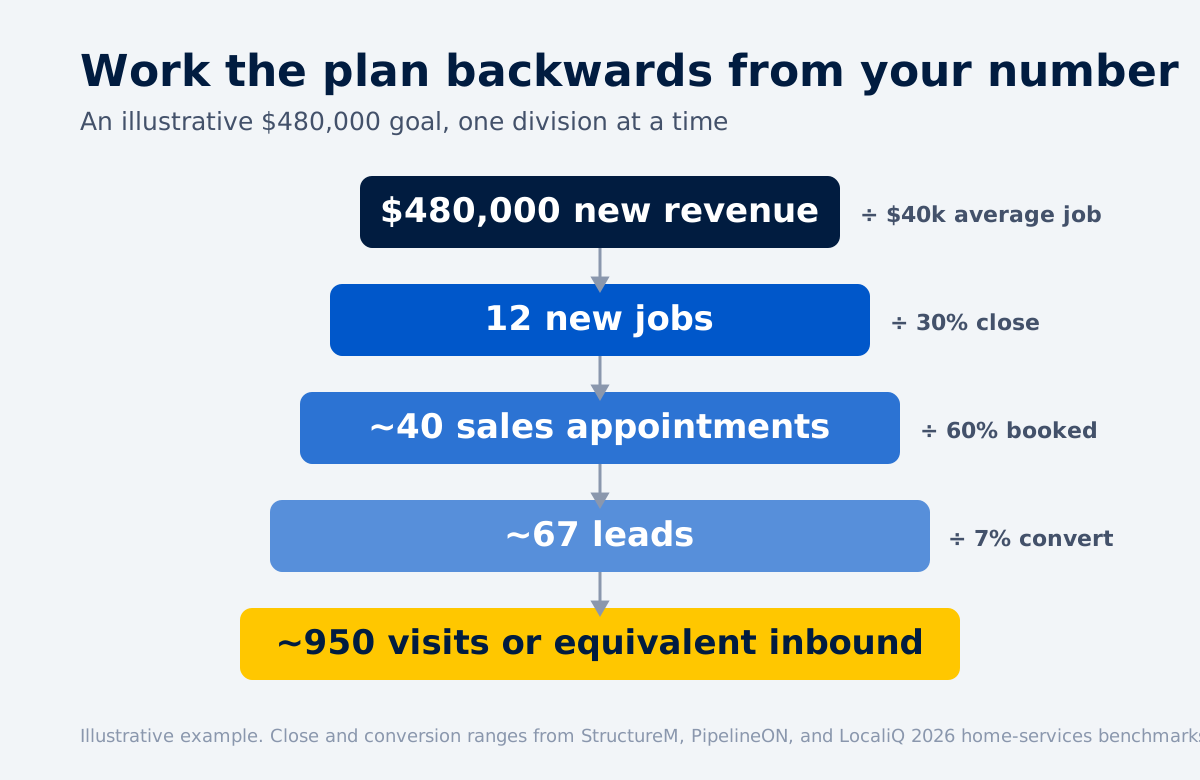
The math runs in one direction: revenue goal, then jobs, then sales appointments, then leads, then the marketing activity that creates them. It is the same logic as any lead pipeline, read from the bottom up.
Work an example backwards
Say a remodeler doing about $2 million a year wants to add $480,000 in new work next year. These are illustrative numbers to show the method, not benchmarks to copy.
$480,000 in new work, at a $40,000 average job, is 12 new jobs.
At a 30% appointment-to-close rate, the low end of the 30 to 50% range remodelers report, that is about 40 sales appointments.
At a 60% lead-to-appointment rate, that is about 67 leads.
At a 7% website conversion rate, close to the 7.33% average for home-services search traffic, that is about 950 visits or equivalent inbound.
Now you have a target you can plan against: roughly a thousand relevant visits, sixty-odd leads, forty appointments. Every channel choice later gets measured against those numbers instead of against a feeling, the same way a demand generation funnel is judged stage by stage.
Why most firms cannot do this yet
They cannot see the numbers. Lead-to-close rates in construction sit around 25 to 40% for remodeling and 20 to 35% for roofing, and they swing hard by trade and lead source, so a firm that does not track its own rate is guessing at the top of the funnel.
It shows in the traffic. The median construction firm gets about 155 organic visits a month, and more than a quarter get effectively none. At those levels you cannot tell whether your marketing is producing enough leads to hit a revenue goal, because you have never done the division.
Do the division first. It tells you how big the job is before you spend a dollar on any tactic.
Step 2. Decide who you sell to and what kind of construction firm you are
Pick your buyer and your firm type before you pick a single channel, because they change everything downstream. A luxury custom-home builder and a commercial subcontractor need different channels, different proof, and different math. Treating "construction" as one audience is why so many plans read as generic, and it is why choosing the right buyer comes before any channel decision.
Most firms skip this. Only about a third of construction firms make it clear who they serve, and fewer than a third have pages built for a specific service or vertical. That is a problem, because more than 90% of construction search is for the category, not for your brand; the work is won by whoever shows up clearly for a specific buyer, not by whoever is best known.
Contractors say the same thing in plainer words. On r/ConstructionManagers, one put it this way: "Handymen and renovation work probably get a lot through advertising. Homebuilders and commercial happens through word of mouth. If you are looking for a contract larger than $10K, advertising won't do much for you other than name recognition."
Match the strategy to the firm
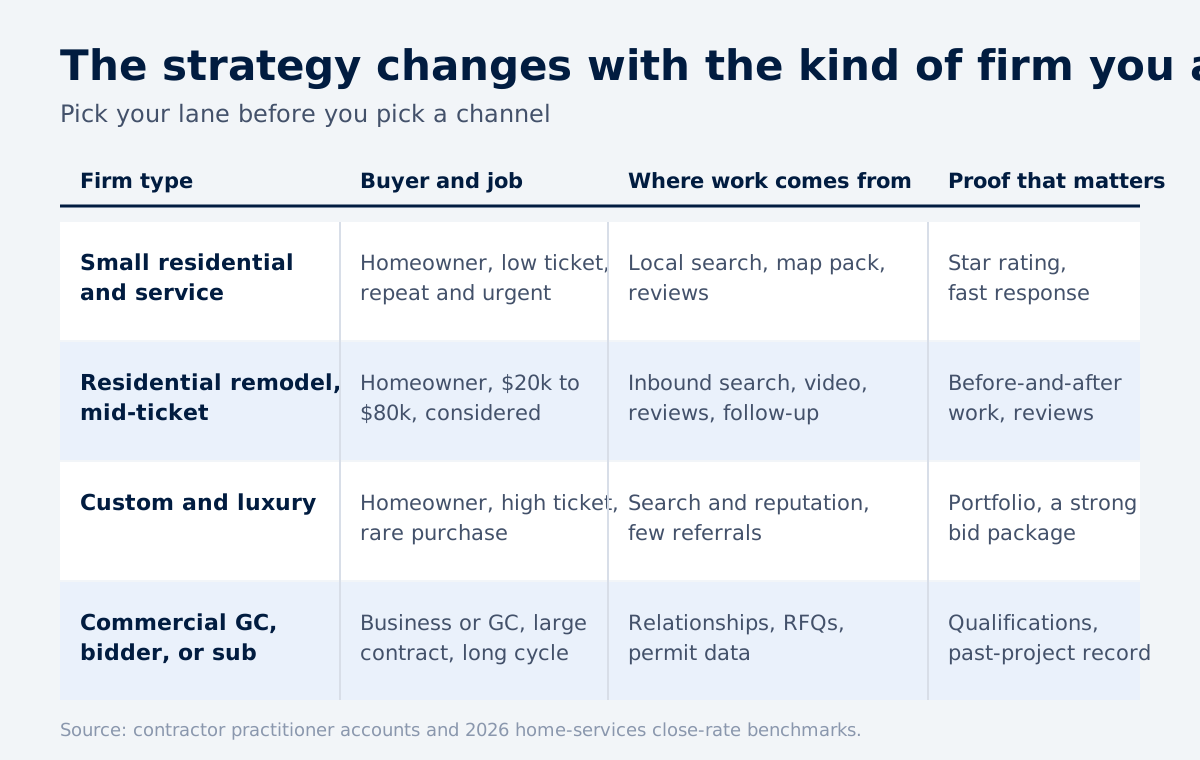
Four broad firm types, and how the plan changes for each:
Firm type | Buyer and job | Where work comes from | Proof that matters |
Small residential and service | Homeowner, low ticket, repeat and urgent | Local search, map pack, reviews | Star rating, fast response |
Residential remodel, mid-ticket | Homeowner, $20k to $80k, considered | Inbound search, reviews, project video, follow-up | Before-and-after work, reviews |
Custom and luxury | Homeowner, high ticket, rare purchase | Search and reputation, few referrals | Portfolio, a strong bid package |
Commercial GC, bidder, or specialty sub | Business or GC, large contract, long cycle | Relationships, RFQ and proposals, permit data | Qualifications, past-project record |
The high end proves the point. A luxury remodeler on r/ConstructionManagers explained that his $200,000 projects are "once in a lifetime for most people. There aren't a lot of referrals there," so he lives on search instead: "big net, many fish, toss back the small ones." A high-end custom builder in the same thread said he wins million-dollar jobs on the strength of the presentation, not the lowest price. A commercial firm chasing public work is playing a different game entirely, closer to a race to the lowest bid.
Write down which one you are. Everything in Steps 3 through 6 hangs on it.
Step 3. Pick the few channels that fit your firm, on top of referrals
Choose two or three channels that match your firm type, and build them on top of your referral base. Not all twenty. The tactic lists tell you to do everything; a strategy tells you which few things will move your number, and lets you ignore the rest for now. Our breakdown of digital marketing for construction companies rates each channel on what it actually returns.
Referrals stay the foundation. More than half of construction work still comes through referrals, and you are not trying to replace that. You are adding channels that make the flow steady when referrals go quiet.
Owned beats rented, and rented worst of all is a marketplace
The cleanest way to choose is to look at how leads from each source actually close.
Referrals close at 50 to 70%. The warmest leads you will ever get.
Your own search and inbound close at 45 to 60%. These are the numbers home-services firms report by source.
Marketplace leads, from Angi or Thumbtack, close at 10 to 20%. The same data shows bought leads convert worst, because the buyer is comparing several firms and shopping on price.
That ranking is your channel strategy in one line: protect referrals, build owned demand you control, and treat rented marketplace leads as a stopgap, not a plan.
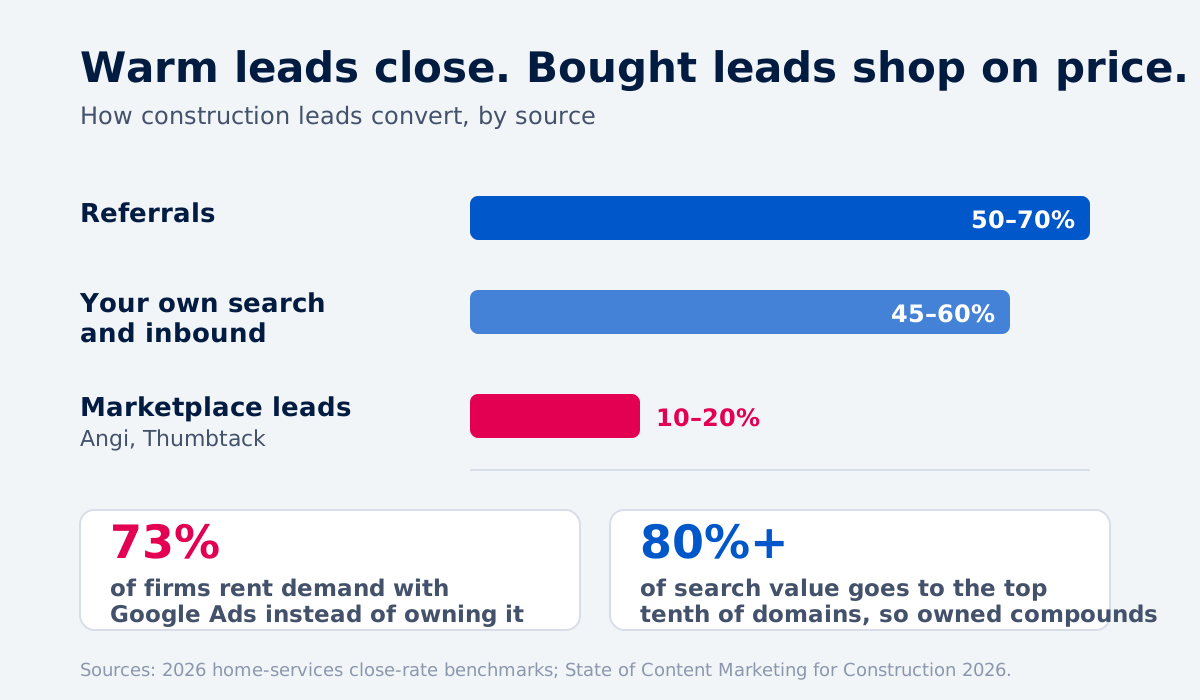
Most of the industry does the opposite. About 73% of construction firms run Google Ads, renting demand at an average cost per click around $6.24, while the owned channel that would earn that demand for free sits unbuilt. And owned search compounds: the top tenth of construction domains capture more than 80% of the category's search value, so the firms that build it pull away from the ones that rent.
One remodeler on r/Contractor described exactly this trade: he spends about $36,000 a year on search engine optimization plus $10,000 on his website, and as a result ranks first for his keywords across a 1,500 square mile area, while his ad spend is a token $150 a month "only to boost seo." A newer contractor in the same community warned about the other end, the lead sellers who "prey on guys trying to make a living before they even know their market," pitching an $800-a-year subscription he turned down; sixty dollars of business cards kept him "booked months out" instead.
The channel shortlist by firm type
Small residential and service build the map pack first: a complete Google Business Profile, local search, and a steady flow of reviews. Chuck the Contractor makes the case for owning that local footprint rather than buying leads.
Residential remodel adds inbound search, project video, and disciplined follow-up to reviews.
Custom and luxury lean on search, reputation, and proof carried into the bid, with social media keeping finished work in front of the people who refer you.
Commercial, bidders, and subs work relationships, RFQ and proposal quality, and permit-data outreach, because advertising does little for contracts over $10,000.
Content is the owned channel that feeds most of these, and it is the one construction firms most often skip. If it is new to you, our guide to content marketing for construction is the deeper build.
Step 4. Turn the proof you already have into assets at the decision moment
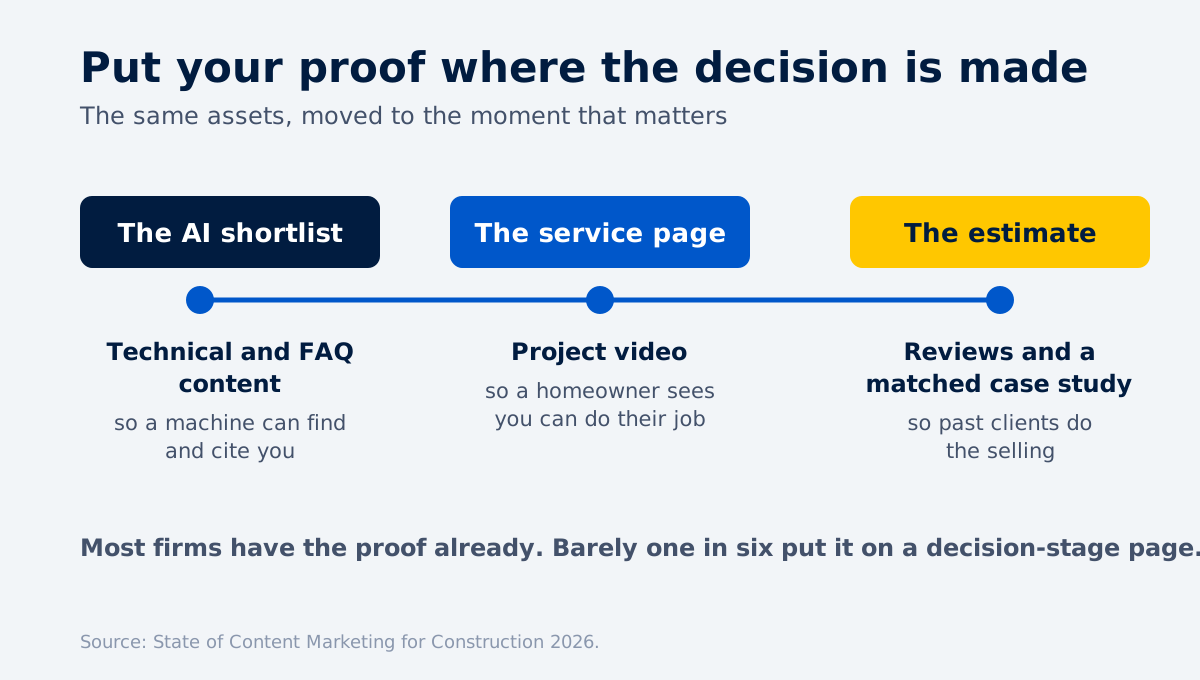
Move your proof to where the decision gets made. Construction firms sit on exactly the proof buyers want, reviews, project photos, and hard technical know-how, and then leave it in the wrong place. The strategy move is placement, not collecting more of it.
The gap is measurable. Case studies exist on nearly four in ten construction sites, but they are parked on a portfolio page, away from the moment a buyer is deciding. Decision-stage content, the material that helps someone ready to act, sits on barely one in six sites. Meanwhile more than half of active firms already publish real technical substance, the raw material for authority, doing no commercial work.
A contractor on r/ConstructionManagers named the waste precisely: firms have "50 to 200-plus 5-star reviews, but none of them are actually using those reviews when they're sitting at the kitchen table giving estimates. They're explaining everything from scratch instead of letting past customers do the selling for them." Another described winning multi-million-dollar contracts because his numbers were competitive and his bid package was "gorgeous," full of finished-project photos and video.
Where each piece of proof belongs
Reviews and a matched case study travel into the estimate and the bid. Put the review that mentions the same kind of job in front of the buyer while you are quoting, not just on a page they may never open.
Project video goes on the service page, where a homeowner is deciding whether you can do their job. That page is your conversion layer.
Technical and specification content, plus a plain FAQ, feeds the AI shortlist. Around 36% of buyers of architecture, engineering, and construction services now use tools like ChatGPT to build their shortlist before a firm even knows a project exists, so the content that answers their questions has to be findable by a machine. Our benchmark on why construction brands rarely show up in AI answers covers the gap, and what gets one brand cited over a better-known competitor covers the fix.
Trust has to be visible before the conversation starts. Roughly half of buyers rule a firm out before ever speaking with it, which means the proof either does its job early or does not get a chance to. The Ultimate AEO Guide shows how to make that proof findable in AI answers.
Step 5. Build the system that catches and follows up every lead
Own what happens after the lead arrives. This is where most construction marketing loses the money it spent at the top, and it is the least glamorous part of the plan, so it usually goes unbuilt.
Speed is the single biggest lever. Contractor sales data shows winning quotes close in a median of two days while losing quotes linger for 29, which makes a fast follow-up the highest-impact fix in the whole process. Put another way, same-day and next-day quotes close at roughly twice the rate of quotes that take three days or more, and every extra day of delay drops the close rate.
Then persistence. High-ticket home buyers typically need six to eight follow-up touches before they decide, and most contractors stop after one or two. That gap, between two touches and seven, is where a large share of the close rate lives. The classic finding holds here too: in an audit of thousands of firms, the average first response to an online lead took more than 40 hours, and nearly a quarter of leads were never contacted at all.
The gap is a system, not a tool
Construction firms already own the tools. Around two-thirds run a CRM, but few wire their marketing into it. On the website, lead capture is present on only about a third of sites, and most of the rest fall back on a generic "Contact us" in the footer instead of a clear next step where the reader actually is, which is why so many construction websites get traffic but no leads. It shows downstream, where more than 40% of construction firms have no documented sales process at all.
The minimum capture system is small and worth building:
One form that asks for the four things you need: name, phone, address, and a short project description. Our approach to lead capture and qualification starts here.
One CRM that every lead lands in, tagged with where it came from.
A first-response rule: someone replies within the day, even if it is only to book the visit. A clean lead handover makes that rule stick.
A short follow-up sequence of three or four touches across the weeks a quote stays alive. Email marketing for construction companies shows how to write it, and nurture and reactivation covers the quotes that go cold.
None of that is marketing in the usual sense. It is the plumbing that decides whether the marketing you paid for turns into signed work.
Step 6. Set the budget from the plan and measure against pipeline
Let the budget fall out of the math and the channel choices you have already made, instead of picking a percentage off a blog. Steps 1 through 5 tell you what you need to build and buy; the budget is what that costs, not a number you set first.
A revenue-percentage rule is a sense-check, not a starting point. The median remodeler runs about $1.7 million in revenue with five people, and 4 to 5% of revenue on marketing is the floor for growth, not the ceiling. Use that to gut-check the number your math produced, then move on.
The spend by firm size tells the same story. A small construction firm typically runs a marketing budget near $8,000 a year, and a mid-sized firm around $35,000 a year. What matters is not the total but where it goes. At the firms treating marketing as a system, the single largest line is search and content at 25 to 35% of budget, funding the owned asset, with Google Ads at 20 to 30% renting demand while that asset builds.
Measure jobs, not traffic
Here is the trap at the end. Almost every construction firm has analytics installed, and almost none measure the contribution to pipeline. They watch traffic go up and cannot say whether it produced a job, which is why the metrics worth tracking are the ones tied to revenue.
Tie every channel back to the number from Step 1, so you can see which page started the deal. A contractor who turned marketer on r/ConstructionManagers put the whole strategy in one line: "stop looking at SEO, ads, referrals, reviews as separate. When they're all accountable to revenue, then suddenly it's easier to see patterns that improve decision making." That is the difference between a budget and a bet.
If you want to see how your spend and output compare with your peers, the construction marketing benchmarking tool scores your firm against the study. And the six steps here are the shape of a one-page construction marketing plan; a downloadable template you can fill in is coming.
Why are the firms pulling ahead running a system, not more tactics?
The construction firms growing fastest are not the ones running the most tactics. They are the ones running marketing as a system that is accountable to pipeline; the higher-growth firms in our study were markedly more likely to treat content and marketing as an operating system rather than a set of one-off activities.
Your website, your reviews, your project photos, and your technical know-how are assets already sitting on the books. A construction marketing strategy is what gives them a job.
Want to see where your construction marketing strategy leaks between getting found and winning the work?
Our content revenue audit maps your firm's content against the buying decision, finds the stages that should convert and do not, and puts a number on the gap.
Frequently Asked Questions
About the Author

Founder & CEO, Content RevOps
Stefan Kalpachev is the founder and CEO of Content RevOps, where he helps B2B SaaS companies transform their content into predictable pipeline. With a background in content marketing and revenue operations, Stefan has developed a unique methodology that bridges the gap between content creation and revenue generation.
Connect on LinkedIn