Content Marketing for Construction: The Complete 2026 Guide
Not sure which parts of your construction content are actually built to win work? Start with a content revenue audit.
Book a CallContent marketing for construction is the work of turning what your firm already knows, about building, codes, costs, and how projects really go, into published material that pulls the right buyers toward you and gives them a reason to act. Done well, it is not a blog nobody reads. It is a revenue system, and it is the content marketing work we install for construction firms.
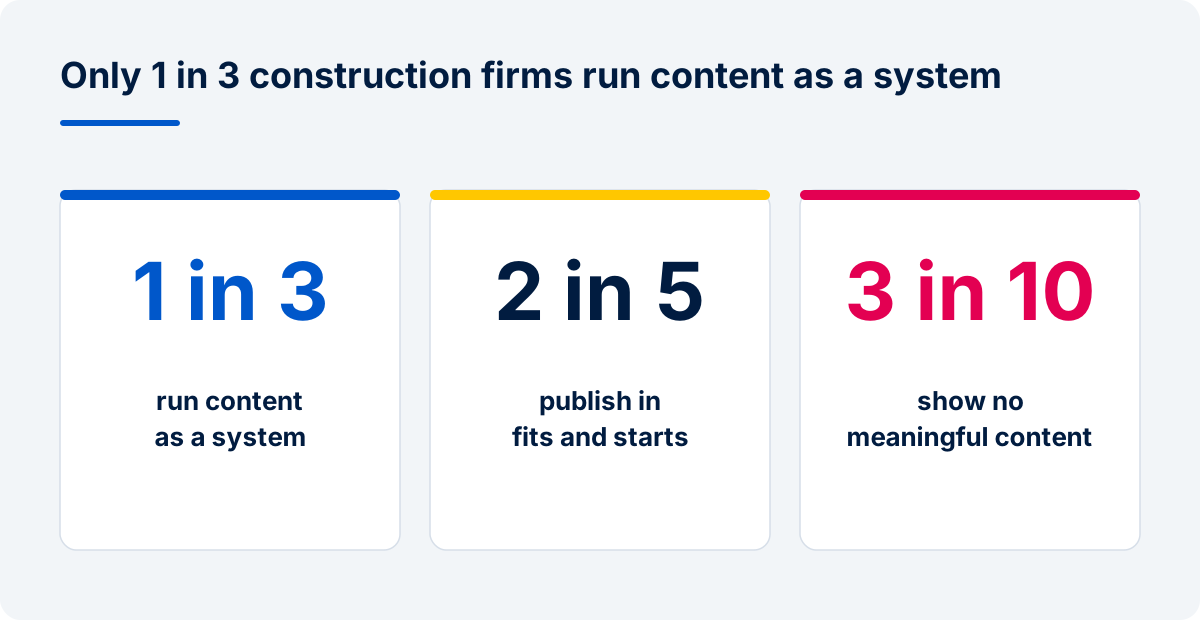
Here is the problem most construction firms have. They are not short of expertise, and often not even short of content. They are short of a system that connects the two to pipeline. In our study of how construction firms actually market, only about one in three run content as an operating system. The rest publish in fits and starts, or not at all, and even the active third usually leak the reader straight back out with no path to a next step.
This guide walks through the decisions a construction owner or marketer actually faces: what content marketing is, whether it beats word of mouth, what to publish, where it goes, how to turn it into leads, how to show up in AI search, how to tell it is working, and what it costs. The firms that get this right are pulling away from the ones that do not.
What is content marketing for construction?
Content marketing for construction is a strategic approach to creating and sharing useful, relevant, consistent material that attracts a defined audience of buyers and moves them toward hiring you. The Content Marketing Institute defines it as content built to "attract and retain a clearly defined audience, and, ultimately, to drive profitable customer action." Those three words matter for construction: useful, relevant, and consistent, across a buying cycle that runs for months.
The thing that separates content marketing from marketing in general is ownership and intent. You publish assets you own, a guide, a project story, a build video, and you publish them to do a job in a purchase, not to fill a feed. That is the difference between a content strategy and a stream of content.
Most construction firms are not there yet. In our data, only one in three construction firms run content as a system. Another two in five publish in fits and starts, random acts of marketing rather than a program. And close to three in ten show no meaningful content at all, a site, a form, and an estate waiting to be activated.
So when a competitor treats content as a real system and you treat it as an occasional blog, you are not in the same category. That gap is the whole opportunity in this guide.
How is content marketing different from SEO, digital marketing, and social media for construction?
These four terms get used as if they mean the same thing, and construction buyers pay for the confusion. Here is the clean version.
Digital marketing is the umbrella. Every online thing you do to win work, paid and organic, sits under it. Our guide to digital marketing for construction companies covers the whole umbrella.
Content marketing is one discipline inside that umbrella. It is the valuable material itself, the guides, videos, case studies, and answers you create.
SEO is how that material gets found in search. HubSpot frames the relationship well: SEO is a tactic content marketing uses, but not all content marketing runs through search, and the two are distinct disciplines that overlap.
Social media is a distribution channel, one of the places you push content so people meet it mid-scroll. Shopify draws the useful line: content marketing is a "pull" play where buyers find you through search, and social is a "push" play where you reach people who were not looking. More on that split in content marketing vs social media marketing, and on the construction version in social media marketing for construction companies.
For a construction firm, the practical read is simple. Content is the asset. SEO and social are how people find it. Digital marketing is the whole system those pieces run inside. You need all of it, but the asset is the part that compounds and the part you own.
Does content marketing actually work for construction, or is word of mouth enough?
This is the real objection, and it deserves a straight answer. Yes, content marketing works for construction, and no, word of mouth is not enough on its own. Referrals are a ceiling you do not control. Content is how you get onto the shortlist a referral never reaches.
Construction people say the quiet part out loud. On a thread in r/ConstructionManagers about whether marketing does anything for contractors, one contractor put it plainly: "Referrals carry almost everything early on. The problem is you can't control the volume. Marketing starts mattering when you want to grow beyond what referrals can reliably deliver. Seen contractors ignore it for years and do fine, then hit a wall when a few key relationships dried up." That wall is the reason content matters.
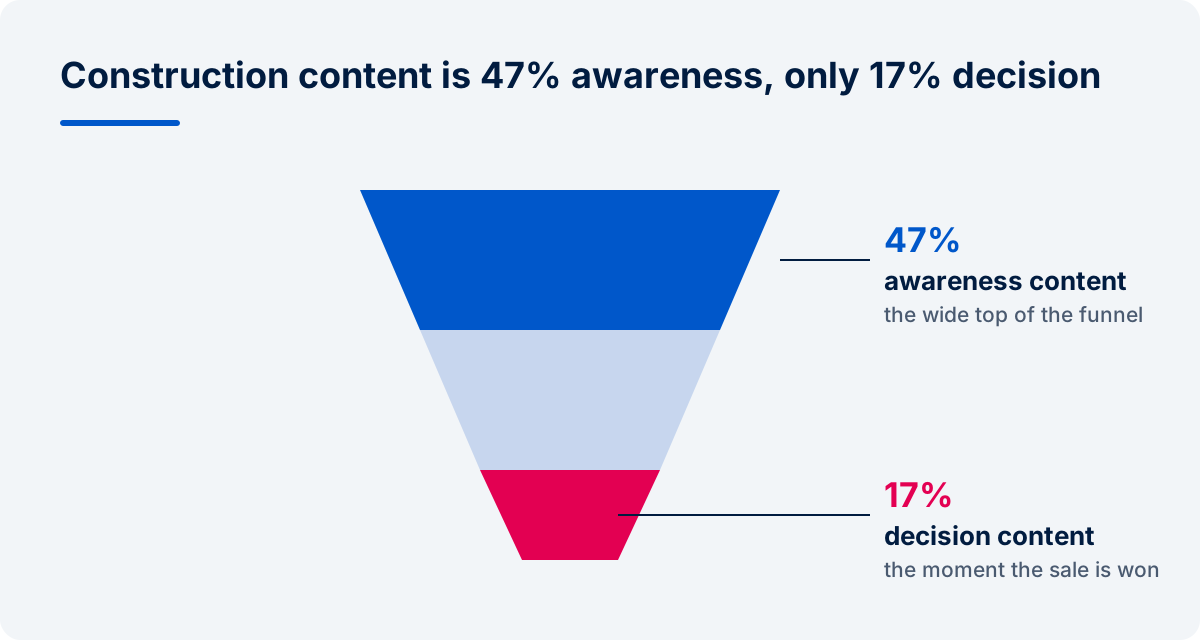
Here is where most construction content breaks down. Firms publish mostly top-of-funnel awareness material, about 47% of the content mix, while only 17% supports the decision a buyer makes right before they hire. So the estate never reaches the moment the sale is won. It talks to people who are curious and goes quiet on the people who are ready, the same shape we see across the whole demand generation funnel.
And even when the content is good, the path is missing. Only one in three construction firms turn content into a clear commercial next step. For the other two thirds, reading leads nowhere; it is a polite dead end.
Named operators who fixed this are easy to find. Matt Risinger, an Austin custom builder, described the effect on the Buildertrend channel: prospects "already made a decision after watching a couple videos," walking into meetings feeling like they already knew him and trusted his work. He now has well over a million subscribers on the Build Show YouTube channel and, as he says in that interview, three to four million views a month on his website. That is a builder who shortened his own sales cycle by publishing.
Adam Cooper, a former electrician who founded the Atlanta firm Ascent Consulting, told the Grow IT Podcast that "my biggest competition is anonymity." His fix was content. He wrote about specific problems he had solved on jobs, earned backlinks from trade publications, and, in his words, pillar-based content "has been the driver of all the growth." Today he says over 90% of his customers arrive as inbound leads because of that content, across a seven-figure consultancy, per the interview's framing, that made the 2024 Inc. 5000.
Neither of them out-built their competitors. They out-published them.
What content should a construction company publish?
Publish the things you already know that a buyer cannot get anywhere else. Construction's deepest asset is hard, specific knowledge, how you build, what the codes require, what a job really costs, and most of it sits unused.
The raw material is already in hand. In our data, 56% of active construction firms publish genuine technical content, real engineering substance. But that expertise is often parked where it does no commercial work. Technical documents sit on about four in ten sites doing nothing, and the most common published format is the press release, companies talking about themselves instead of answering a buyer.
Here is what actually earns attention and trust in construction, and what the active third of the industry does differently.
Project case studies
The proof buyers ask for. Yet case studies appear on under four in ten sites, and where they exist they are usually parked on a portfolio page away from the decision, not driving it. A strong case study names the client problem, the numbers, the timeline, what went wrong, and how you fixed it. One contractor on Reddit described his own version of this: "write a detailed case study for each project you complete, including costs, timeline, what went wrong and how you fixed it." He also noted almost nobody does it. For more formats beyond the portfolio, see our list of construction marketing ideas that are not just project photos.
Codes and compliance explainers
Codes-and-compliance content is a credible, hard-to-fake edge most other industries cannot claim, and about 44% of active firms publish it. Translating a code change or a permit process into plain language is exactly the kind of expertise a buyer trusts and a general blog cannot copy. It is also the kind of thought leadership that holds up under scrutiny.
Build-process video
Construction is a visual, high-trust sale, and video is the format complex buyers prefer. Matt Risinger's Build Show is the clearest example: a running library of build-science and build-process explainers that works as demand generation, not decoration. Video still shows up on under half of construction sites, so it remains an opening.
Pricing and cost content
Most construction firms withhold pricing; only about 38% publish any cost information. That is friction at the exact moment a high-intent buyer is trying to qualify you. You do not have to post a rate card, but a "what a project like this costs and why" page removes a real barrier.
The pattern across all four is the same. Capture the knowledge once, from the people who already have it, and publish it where a buyer is deciding.
Where does construction content actually get seen?
Publishing is half the job. Distribution is the half most construction firms skip, and it is why good content sits unread. A real content distribution strategy is what separates a library from a channel.
Right now, distribution in construction means LinkedIn and little else. LinkedIn shows up on about 77% of active firms, treated as a posting habit rather than a system. Meanwhile the channels that build an owned audience go idle.
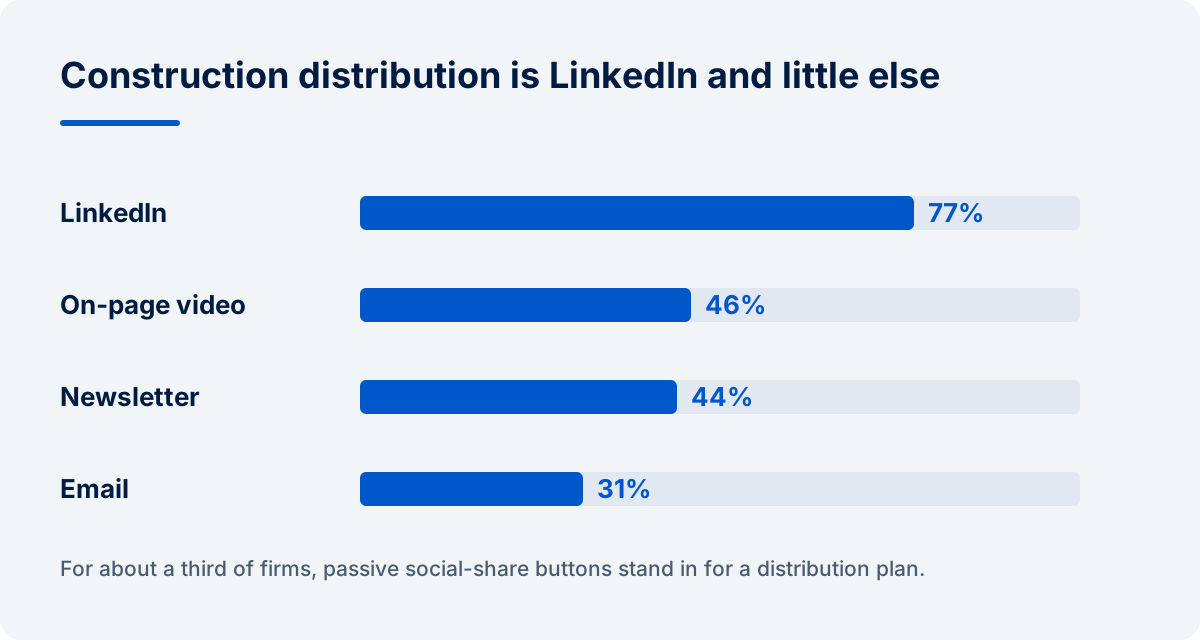
Owned email reaches an audience you actually control, and under a third of firms run it. Email tooling sits on about 31% of construction firms. Most cannot reach the readers they have already earned. Our guide to email marketing for construction companies shows how to fix that.
Newsletters are on about 44%. Fewer than half own a channel; the rest rent reach from platforms that can change the rules overnight.
On-page video is on about 46%, despite being the format complex construction buyers prefer.
For about a third, passive social-share buttons stand in for a distribution plan. A share button is a hope, not a channel.
The lesson is not "post more on LinkedIn." It is to build at least one owned channel, email or a subscribed audience, so a piece of content reaches the same buyers twice without paying for the privilege each time. That is the logic behind how we approach content distribution and the B2B distribution channels that actually compound.
How do you turn construction content into pipeline instead of just traffic?
Traffic is not the goal; a booked conversation is. The gap between the two is conversion architecture, and it is where "content as a revenue system" stops being a slogan and starts being wiring.
The tooling is already paid for. About two in three construction firms own a CRM, but few wire content into it, so a reader who is ready to talk never becomes a tracked lead. The gap is integration, not software.
Three fixes turn a reading audience into pipeline.
Contextual calls to action
Even among active publishers, about two thirds do not prompt the reader in context. The content ends and the reader is left to find the footer "Contact us" on their own. Every strong piece needs a next step tied to what the reader just read, a relevant guide, a consult, a quote request. That is the job of a proper conversion layer.
A reason to convert, not just a form
Where lead capture exists in construction, it is usually a bare newsletter signup, presence rather than a reason to act. Give the reader something worth an email address, a cost guide, a checklist, a project planner, and capture becomes an exchange instead of a hope. See how lead capture and qualification fit together.
Content wired to the sales motion
Measurement is where this falls apart. Every firm can track traffic; almost none measure what content contributes to pipeline. Connect content engagement to the CRM so sales knows which reading buyers are warm, and marketing knows which pieces start deals. Without that wire, content and sales run on separate tracks and neither can prove the other works. This is the core of how demand generation and content marketing work together.
How do construction companies show up in AI search and AI Overviews?
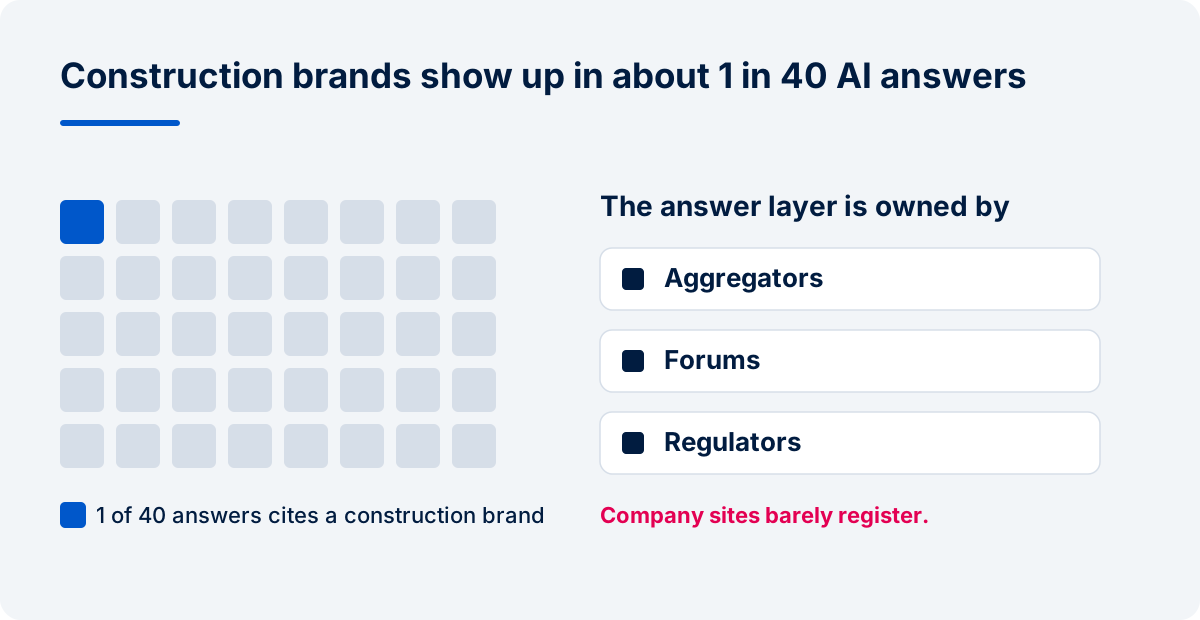
Buyers now ask AI before they ask you, and construction firms are almost absent from the answer. In our data, construction brands surface in roughly one in forty AI answers, and rarely as the cited source. The answer layer is owned by aggregators, forums, and regulators; company sites barely register.
What actually gets a page quoted is structural, not a matter of being clever. On-page.ai's citation study, which tested what AI answer engines cite, found citation is largely decoupled from how "original" the writing is on everyday queries. What matters is how the page is built. CXL's analysis of AI Overview sources found that about 55% of the passages cited come from the first third of a page. So the levers are practical, and our Ultimate AEO Guide covers each in depth.
Answer first. Put a clear, complete answer to the question near the top of the page, in the first paragraph or two, so a model can lift it cleanly. Here is how to do that without wrecking the page for human readers.
Attribute plainly. Name your sources and cite specific numbers inline; pages that do this get pulled more often.
Show up where AI already looks. YouTube and Reddit dominate the construction answer layer. A build channel and honest participation in trade communities put you where the citations come from.
First-party data plays a specific role here. Publishing a number no one else has, your own project costs, your own timelines, a small survey of your market, does not guarantee a citation, but it makes you the source an AI has to reach for when the question comes up, because you are the only place the number lives. That is why one brand gets cited while a better-known competitor gets ignored. In construction, where only about one in eight active firms publish any original data, that is a wide-open lane.
How do you know your construction content is working before it pays off?
Content takes months to pay off, and the wait is where most construction firms lose their nerve. One contractor investing in content said it out loud on r/GeneralContractor: "Honestly as of yet no results. SEO takes time from what I've researched. We're only in month 3. Treating it as an investment right now hoping for it to pay off in the long run." You do not have to run on hope. You can read leading indicators.
Leading indicators are early signs that direction is right, before revenue lands. Read them as a picture of progress, not a checklist you execute. Marketing measurement guides converge on the same early signals:
Search impressions rising. More people are seeing your pages in search, even before they click.
Keyword positions climbing. Your pages are moving up for terms buyers use.
Branded search lifting. More people are searching your firm's name, a sign content is building recognition.
Assisted conversions appearing. Content shows up in the path to a lead, even when it is not the last click.
Decision-page engagement. Buyers are reaching and spending time on your case studies and cost pages.
Sales cycle shortening. Buyers who read your content first show up warmer and close faster.
Pipeline and closed-won are lagging signs; they arrive later. A new page usually needs a few months to gain search traction, so judge the first stretch on the leading signals above. If they are moving, the content is working even though the revenue has not caught up. Our guide to reporting on content marketing success and the breakdown of which metrics to track and which to ignore go deeper.
One more habit separates the firms that improve from the ones that do not. In construction, only about 4% ever test or revise a page after publishing it. Content ships once and is never touched again. Reading these indicators and acting on them is most of the edge, and the construction benchmarking tool shows where your firm sits against the field today.
What does construction content marketing cost, and who should run it?
Cost depends less on a price list than on who does the work, so decide that first. Construction firms waste real money getting it wrong. One owner described firing agencies after burning through $180k: "There are too many of them that don't actually know what the heck they are doing. The money can go down the drain fast." Others spend thousands with nothing to show. The verdict matters as much as the number.
Here is the honest read on who should run construction content marketing.
Do it yourself when the owner or a partner has the expertise and the discipline to capture it consistently. The knowledge is the hard part, and you already own it. A minimum viable content plan keeps it to the hours you actually have.
Hire a freelancer or contractor for production once there is a system to feed. As one construction marketing channel put it, do not try to shoot every video yourself, because you will not stay consistent; get help with the making once you know what to make.
Bring in an agency or an integrated partner when the job is wiring content to pipeline, not just producing more of it. That is a different skill from making things. Our shortlist of the best demand generation agencies for construction companies and the in-house vs outsourced comparison help you choose.
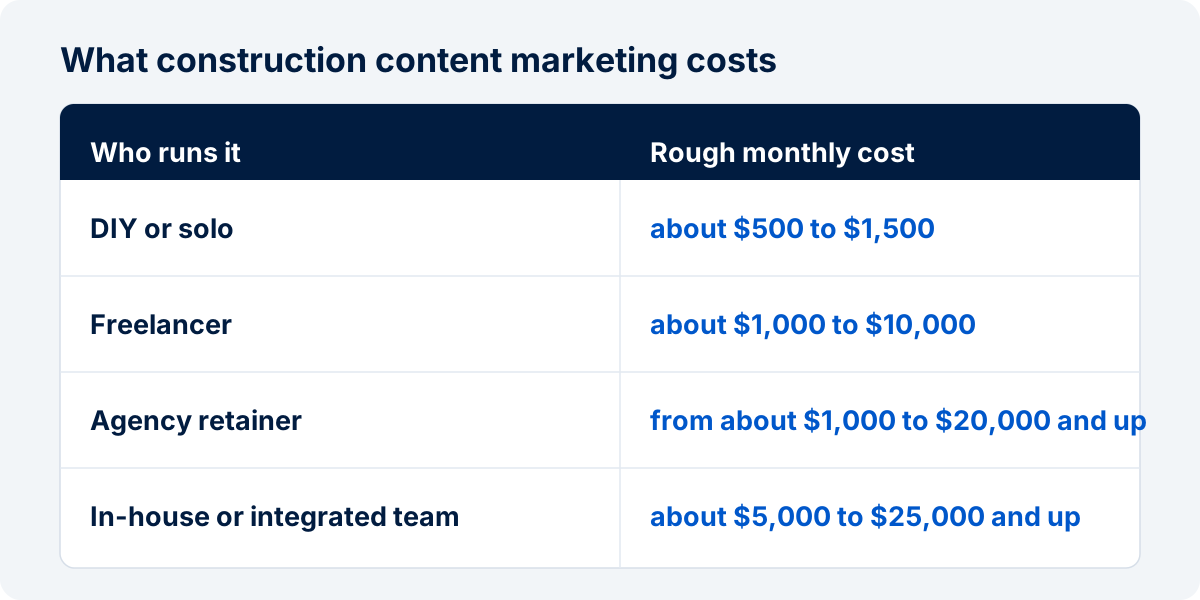
On the money itself, outside benchmarks for content marketing (general B2B, not construction-specific) land roughly here.
Who runs it | Rough monthly cost |
DIY or solo | about $500 to $1,500 |
Freelancer | about $1,000 to $10,000 |
Agency retainer | from about $1,000 to $20,000 and up |
In-house or integrated team | about $5,000 to $25,000 and up |
Set that against what content returns. Content compounds, and a clear return usually takes twelve to eighteen months, but most firms that invest in it report being satisfied with the result. Our own construction data prices the payoff directly: the median construction firm's organic search presence would cost about $16,800 a month to rent through ads, and a tenth of firms capture more than 80% of the category's search value. Meanwhile about 73% of firms pay for traffic through Google Ads, renting demand that the right content would earn for free. You are choosing between renting attention forever and owning an asset that keeps paying.
Small firms are not exempt. The smallest construction firms are the most likely to have no content at all, and the most obvious estates to activate, because the expertise is already there and the budget to start is modest. If you are weighing a hire instead, the construction marketing hiring data shows what the industry is actually recruiting for.
Content marketing for construction is not a marketing project you run once. It is infrastructure, the same way a CRM is infrastructure. AI made content cheap to produce, which is exactly why an undifferentiated blog is worthless and a system that turns your real expertise into pipeline is worth more than ever. The firms treating content that way are the ones a buyer, and an AI, will find first. The cross-vertical State of B2B Content Marketing 2026 shows the same pattern in every industry we measured, and our construction practice is built to close it.
Want to know what your construction content is worth, and where it leaks?
Our content audit maps your estate against the buying decision, finds the pages that should convert and do not, and puts a number on the gap.
Frequently Asked Questions
About the Author

Founder & CEO, Content RevOps
Stefan Kalpachev is the founder and CEO of Content RevOps, where he helps B2B SaaS companies transform their content into predictable pipeline. With a background in content marketing and revenue operations, Stefan has developed a unique methodology that bridges the gap between content creation and revenue generation.
Connect on LinkedIn