Content Marketing vs Social Media Marketing: What Is The Difference?
Ready to stop “doing social” and start building a content engine? Let’s map your Content RevOps system.
Book a CallA lot of teams claim they’re “doing social,” but what they usually mean is they’re posting on a schedule. The issue is that a packed content calendar can look like a strategy while creating very little compounding value, especially when it isn’t mapped to the buyer journey, anchored in owned channels, or measured against revenue. That’s the real story in content marketing vs social media marketing: one builds durable assets that keep working over time, while the other is often just distribution that fades fast without a clear path to outcomes.
Here’s the cleaner way to think about it: content marketing is the broader business function, and social media marketing is one of its most powerful surfaces for distribution and rapid testing. Content marketing sets the narrative, priorities, quality bar, and measurement against business goals. Social helps that system get discovered, stress-tested in the real world, and accelerated through organic reach, community, creators, and paid amplification.
In this article, we’ll break down:
Where the scope differs (strategy and infrastructure vs. channel execution)
How social becomes a distribution engine and funnel-builder (including paid social, influencers, and UGC)
How high-performing teams use social as an R&D lab to validate hooks and angles fast, then up-purpose winners into blogs, emails, landing pages, and sales assets
The core philosophy is simple: content is infrastructure and a revenue lever, not just posts. Social is often the fastest way to prove what works and route attention into owned, measurable outcomes.
Content Marketing vs Social Media Marketing – Scope, Not Sides
Content marketing as the operating system
Content marketing isn’t “blogs” or “posting more.” It’s a business function that plans, produces, distributes, and measures information and stories against outcomes like revenue, retention, and brand trust. In a Content RevOps mindset, content is infrastructure: connected to your CRM, sales motion, nurture, and attribution, so assets earn their place by moving pipeline forward or making buying decisions easier.
That’s why content marketing can include (and coordinate) many tactics and formats, such as:
Website and SEO content designed to capture intent and answer buyer questions
Email and lifecycle content that converts attention into subscribers and customers
Sales enablement assets that reduce friction in the deal cycle
Video, webinars, and product education that build confidence
Influencers and UGC that add credibility and proof
Social content (organic and paid) that accelerates distribution and learning
The key is governance and measurement. Content marketing sets the narrative, the quality bar, the journey map, and the metrics that matter (pipeline influence, conversion, sales velocity, retention), not just output volume. Mature teams treat it as the umbrella system that already fuels “everything else” in marketing, from brand to demand to customer success.
Social media marketing as a channel within that system
Social media marketing is the use of social platforms (organic and paid) to distribute content, reach new audiences, and spark interaction. It’s powerful, but it’s not “the strategy.” It’s a distribution vector and discoverability surface that works best when it routes people into owned experiences (your site, email list, community, product).
Industry data backs up this framing: most marketers now point to content (blogs, reports, video, tools) as the assets that drive leads and engagement, with social as one of several ways those assets travel through the world. At the same time, marketers rate social skills as significantly more overrated than content marketing skills, which signals how often businesses mistake “being good at platforms” for having a real content engine.
A social-only approach is fragile because platforms change the rules: algorithms shift, policies tighten, and organic reach gets throttled. Platform volatility around APIs, moderation, and even potential bans has made it harder and more expensive to rely on social alone, which in turn strengthens the case for a content-first, channel-agnostic strategy anchored in owned properties and brand-owned communities.
Anchoring your strategy in owned content makes your growth less dependent on rented land.
Why the distinction matters
When teams treat social as the content strategy, they often optimize for vanity metrics (followers, likes) instead of buying signals and business impact, while neglecting durable, searchable, reusable assets that support real decisions. Studies of content output consistently show that a small minority of assets generate the vast majority of engagement, which suggests the problem isn’t “not enough posting” but unfocused production with no system to test, learn, and scale what actually works.
The better model: content marketing defines the plan; social executes distribution and fast feedback loops.
“Posting daily on LinkedIn” = activity without a system
“Using LinkedIn to distribute a narrative mapped to ICP problems and funnel stages” = a content engine with social as the accelerator
In practice, that looks like treating social feeds as a high-velocity testing ground for hooks, angles, and stories; promoting content that answers search and Zero Moment of Truth–style questions; and then “up-purposing” the top 5–10% of proven ideas into richer, enduring assets across web, email, video, and community.
Social as a Distribution Engine for Content-Based Funnels
Social as top-of-funnel reach and discovery
For most buyers, social is the first contact with your narrative because it surfaces ideas to people who aren’t searching yet. Short clips, threads, carousels, and creator posts act like an attention surface: they introduce a problem, name a new angle, or challenge an assumption in-feed, functioning as the discoverability layer of a broader content system rather than the system itself. Research on digital customer narratives consistently frames social as the place where content is encountered and stress-tested, not where the core strategy lives.
The job isn’t to “win the post.” It’s to route the right people into deeper, owned content where you can actually educate, build trust, and change buying behavior (site pages, resource hubs, email, webinars, community). When social is treated as a discoverability layer inside a broader content system, you stop optimizing for likeability and start optimizing for movement down the journey, exactly the kind of content-based funnel that outperforms channel-first campaigns in most B2B and B2C studies.
What to measure here (beyond vanity metrics):
Click-throughs to owned content and subscriber growth
Saves/shares and comment quality (as leading indicators)
Content-assisted demos, trials, and pipeline influence (as outcome metrics)
Social ads and sponsored content as accelerants
Paid social works best as paid distribution for proven content, not as a replacement for it. When your content is designed to do real work (educate, qualify, and trigger intent), ads become less about impressions and more about pipeline efficiency, a pattern reflected in benchmarks where content-led sponsored social is rated significantly more effective than display alone.
A simple content-led funnel often looks like this:
Discovery: a short-form video or post that frames the problem or introduces a sharp insight (short-form consistently ranks among the highest-ROI social formats for this role)
Exploration: click-through to a guide, comparison page, or case study on your site, built to “end the search” by fully answering the question or need
Evaluation: retargeting with more specific assets (demo stories, calculators, webinars) based on what they engaged with
This structure turns social into a controllable on-ramp: you buy targeted attention, then let your owned content do the heavy lifting of answering questions and reducing perceived risk, while social ads and creator posts simply keep feeding qualified visitors into that content engine.
Influencers, creators, and UGC as distribution layers
Influencers and micro-creators are best viewed as additional distribution nodes for your core narratives. They localize your message to specific communities, add credibility, and produce assets you can reuse across ads, landing pages, and nurture, mirroring how the most effective influencer programs treat creators as content partners, not just rented reach.
UGC and reviews function as portable social proof, useful not just “on social,” but throughout the same content system that supports evaluation and conversion. Data on micro-influencers and peer recommendations shows that this kind of third-party content can materially lift consideration and conversion when it’s integrated into product pages, email flows, and research-style assets, not left stranded in feeds.
Avoiding the “rented land” trap
Algorithms change, reach gets throttled, and rules shift. That’s why social should point back to owned experiences where you control the data and the relationship. Think of content as infrastructure: social is how people find it, not the infrastructure itself. As platform volatility, API restrictions, and declining organic reach make “building on social” riskier, brands that treat social as a traffic system into brand-owned communities, email, and content hubs are better insulated and see more durable returns from the same creative effort.
Social Media as Your Fastest Content R&D Lab
Speed and signal: what social uniquely offers
Social isn’t where your content strategy lives, but it is where your strategy can get the fastest feedback. In hours (not weeks), you can see how real people react to an idea through both quantitative and qualitative signals: likes, comments, shares, saves, watch time, profile clicks, DMs, and the language people use when they agree, push back, or ask follow-up questions.
That speed matters because slower channels often delay validation. SEO can take months to confirm whether an angle actually earns attention and intent, even though search still drives the bulk of blog traffic for many brands. Email can be quicker than search, but you’re still constrained by list size, send cadence, and deliverability. Social gives you a high-velocity discoverability surface to test hooks, angles, and proofs (not just “stay visible”) and then route people into deeper content assets and funnels that compound over time.
What to watch (beyond vanity metrics):
Comment quality from your ideal buyers (questions, objections, “how do I…”)
Shares/saves (signals of usefulness, not just entertainment)
Clicks, replies, and next-step actions (newsletter signups, demo requests)
Testing narratives and hooks at scale
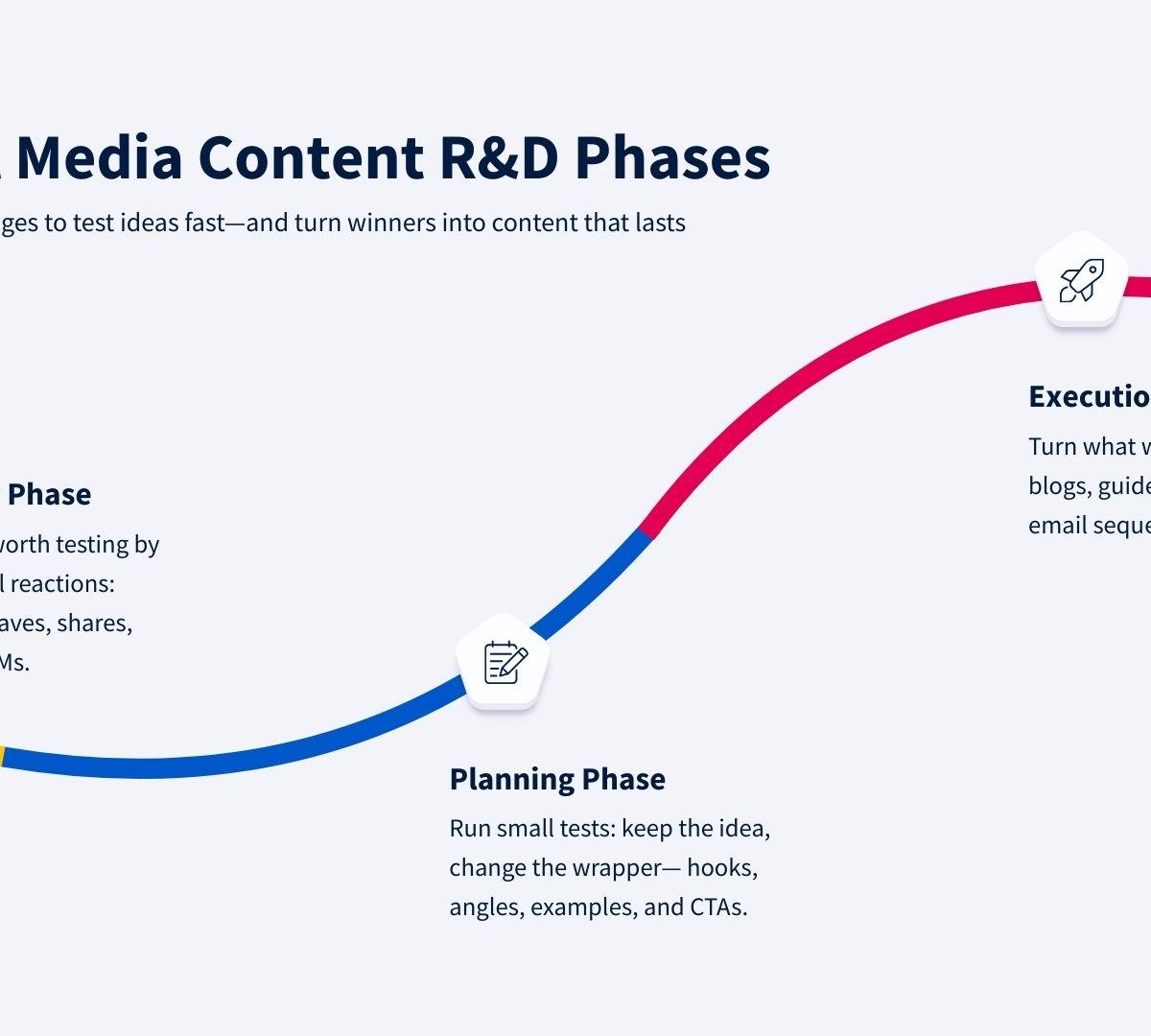
Treat social like controlled experimentation. Keep the core idea the same, then vary the wrapper:
A/B different hooks across multiple posts or short videos
Swap problem framings (symptom vs root cause), objections, and analogies
Test CTAs (comment-to-get, DM keyword, click-through to a guide, “reply with…”)
Short-form video and carousels are especially useful here: you can trial multiple explanations of the same concept quickly, then double down on the version that attracts the right attention. Social’s fast feedback loops make it an ideal place to test narratives before you invest in longer-form assets, a pattern echoed in many content programs that turn breakout posts into ebooks, webinars, and video series. The goal isn’t maximum engagement. It’s buyer-aligned engagement that correlates with downstream intent.
Up-purposing: turning social winners into heavyweight assets
Once a narrative wins on social, you can “up-purpose” it into durable assets that compound over time. That reduces the risk of investing in big pieces that flop because you’re scaling what already resonates.
Common pathways:
High-performing LinkedIn thread → long-form blog post, resource page, or sales one-pager
Popular TikTok/Reels explainer → webinar segment, onboarding video, or help-center article
Engaging X conversation → FAQ section, comparison page, or email sequence
This mirrors how many teams now treat social as an idea lab and their site, blog, and email as the core content engine: lightweight, platform-native posts validate interest, then the strongest concepts become in-depth, searchable, and evergreen assets.
Closing the loop: from social tests to operating model
To make this repeatable, build a lightweight system: log your top posts and why they worked (topic, angle, format, CTA), then feed patterns into quarterly planning, SEO roadmaps, and sales enablement. Finally, connect social signals to CRM and attribution so you learn which narratives influence pipeline, not just impressions. That’s content as infrastructure: iterated in public via social, then hardened into long-term assets you own, with social acting as the distribution and discovery layer rather than the entire strategy.
Measuring What Matters Across Content and Social
The vanity metrics trap
Social media makes it easy to “win” on paper: followers up, impressions up, likes up. But those numbers mostly measure visibility, not qualified interest or purchase intent. They also create bad incentives: trend-chasing, off-brand hot takes, and content designed to spark reactions instead of moving buyers forward.
If content marketing is the operating system and social is a distribution and discovery surface, then social metrics are only useful when they help you understand whether the system is generating real opportunities. That’s the shift a lot of teams are making as they move from “old wine in new bottles” broadcasting to more deliberate, content-led journeys across channels.
Revenue-facing metrics for a content-led social program
Shift measurement from platform popularity to business impact. The strongest content-led social programs track:
Reach within your ICP (by role, industry, company size), not total reach. This aligns social reporting with the way content programs define audience and buying committees, instead of treating “everyone on platform” as equally valuable.
Clicks from social to owned content and what happens next (scroll depth, time on page, next-page paths). Teams that treat the site or blog as the “storefront” and social as the street outside focus on whether social traffic actually engages, subscribes, or moves toward a next step.
Subscribers and sign-ups sourced from social (newsletter, waitlist, community, demo interest). Social becomes an on-ramp into owned lists and communities, not a dead end where followers stay trapped in feeds you don’t control.
Content-assisted pipeline and revenue (deals where buyers engaged with social-distributed assets). High-performing programs treat research, guides, and video as acquisition tools (mapped to search and ZMOT as well as social), then measure how often those assets show up in closed-won journeys.
Sales impact: faster cycles, higher win rates, or fewer objections when content is used in active deals. When social-distributed resources reduce “time to trust,” you see it in shorter paths from first touch to opportunity and in more confident, better-informed buyers.
Social-native signals still matter (saves, shares, meaningful comments, repeat viewers), but treat them as leading indicators that a message is resonating enough to justify deeper investment (and repurposing into bigger assets). Studies of content performance consistently show that a small minority of assets generates the vast majority of engagement, so social metrics are most useful as a way to identify that top tier early and double down.
Building a simple cross-channel view
You don’t need perfect attribution to get useful clarity. Start with a lightweight operating pattern:
Tag your core assets and campaigns consistently across social, email, and site so you can see which narratives travel best from feed to search to inbox.
Connect social touchpoints to CRM/automation to see how engagement maps to pipeline stages and where social-sourced contacts drop off or accelerate.
Review closed-won and expansion journeys to spot which narratives and formats keep reappearing. Case studies, calculators, explainers, or creator content often show up at multiple points when content is doing real acquisition work.
When content is infrastructure and social is the test-and-distribution layer, measurement becomes about how efficiently the system converts attention into intent, and intent into revenue, not how loud you are on any one platform. That framing also makes it easier to adapt as algorithms, formats, and even entire networks change, because the core of your strategy lives in durable content and owned channels rather than in any single social feed.
Conclusion: Integrating Content and Social into a Single Growth System
The clean way to separate these terms is scope. Content marketing is the larger business function: the operating system that sets the narrative, builds the assets, and ties them to revenue outcomes. In most modern orgs, it’s the discipline that owns long-lived, search-friendly, ZMOT-ready content and the systems around it. Social media marketing is one of its most powerful channels: a distribution vector, a discoverability surface, and a fast R&D lab for those narratives.
In an integrated model, content becomes decision infrastructure across the entire journey: before, during, and after sales. That means articles, tools, videos, customer stories, and onboarding experiences designed as a coherent, strategic, planned, measurable content layer, not one-off posts. Social then makes that infrastructure findable, stress-tests it with faster feedback loops than most channels, and routes the right people into content-based funnels (often with paid social, creators, and customer content acting as accelerants).
The payoff is leverage, not noise:
Fewer, stronger stories that get multiplied through social and repurposed into durable assets (emails, blogs, landing pages, enablement), instead of feeding the “more content, same engagement” treadmill where 5% of assets drive 90% of results
Clearer attribution because social touchpoints drive to owned content that qualifies demand and supports sales, not vanity metrics, which is closer to the model where content is built to “end the search” and drive acquisition rather than just entertain in-feed
This is what it looks like when content stops being a calendar and becomes the growth engine: reliable infrastructure other teams can build on, with social operating like high-speed rail that delivers the right audience into it. Social spend, influencer programs, and creator collaborations then sit inside a content-first architecture: sponsored posts become feeders into content-based funnels, social trends become inputs to your editorial roadmap, and platform volatility is buffered by a portfolio of owned, compounding content assets and communities.
When teams make that shift (treating content as the operating system and social as distribution, discovery, and testing), they align with how high-performing marketers already work: a single content function orchestrating search, social, email, and community, instead of channel-first silos chasing separate goals.
Is your social calendar building pipeline—or just filling feeds?
Turn content into revenue infrastructure: owned assets, social as distribution + R&D, and measurement tied to pipeline.
Frequently Asked Questions
About the Author

Founder & CEO, Content RevOps
Stefan Kalpachev is the founder and CEO of Content RevOps, where he helps B2B SaaS companies transform their content into predictable pipeline. With a background in content marketing and revenue operations, Stefan has developed a unique methodology that bridges the gap between content creation and revenue generation.
Connect on LinkedIn