A Go-to-Market Strategy for Construction Firms
Running a construction go-to-market strategy on ads alone? Start with a content revenue audit to find where the system leaks.
Book a CallA go-to-market strategy for a construction firm is the system it uses to get found, earn trust, capture interest, and win work across a long buying cycle. It is not a product launch, and it is not an ad budget you switch on. Construction buyers pre-qualify firms, check references, and build a shortlist over months, often before you know a project exists. So the firms that pull ahead do not run a louder campaign; they run a connected system, which is what demand generation means for a firm that sells on trust. In our study of construction content, only about one in three firms operate that way. This guide lays the system out stage by stage, in construction terms, for the firm that wins projects and for the construction software company that sells to them.
Part of Content Marketing for Construction: The Complete 2026 Guide.
What is a go-to-market strategy for a construction firm?
A go-to-market strategy for a construction firm is the plan for how you turn strangers into shortlisted, then into won work. It covers who you serve, what you say, where buyers find you, how you capture their interest, and how you convert it into signed projects. It sits one level above a construction marketing strategy: the marketing plan sets the channels and the budget, and the go-to-market system decides how the whole route from stranger to signed project connects.
Most definitions of go-to-market were written for software. Salesforce calls it "a step-by-step plan for introducing a new product to buyers." That fits a launch, a moment when a product goes live. A construction firm does not launch. It sells the same work, over and over, to buyers who decide slowly and buy on trust.
Why the sale is long and trust-led
Construction is a relationship business with a long cycle. A general contractor, a specialty trade, or an engineering firm is chosen after references, past projects, and a sense of who is safe to hire. The decision starts long before a call.
It now starts online. In the 2nd Annual AEC Buyers Survey 2026 from SMPS, 36% of buyers of architecture, engineering, and construction services said they use AI tools such as ChatGPT and Claude to build an initial shortlist of firms with the exact expertise they need, in the survey's words "long before your AEC firm knows a project even exists."
Read that plainly. A buyer can form a shortlist, and leave you off it, while you are still busy on the last job. That is the pattern behind why construction brands almost never show up in AI answers. A go-to-market strategy is how you make sure your construction firm is on that list before the phone rings.
Who this guide is for
The word "construction" here covers three different sellers, and the strategy differs for each.
- A construction services firm that wins projects: general contractors, specialty trades, design-build firms, and engineering or professional-services firms in the built environment. This is the main reader, and most of the guide speaks to them.
- A construction products or materials company selling into the same market.
- A construction software company, sometimes called contech, that sells a tool to the industry. That reader has a different motion, and gets a dedicated section later.
Why can't a construction firm just advertise its way in?
Because ads rent demand that a system would earn, and rented demand stops the moment you stop paying. Advertising has a place, mostly as demand capture, not demand creation, but a construction firm that leans on it alone plateaus, and the data shows why.
Presence is common, a system is rare
Having a website and running some ads is normal. Running content and demand as a connected system is not. In our study of construction content marketing, only one in three firms run content as an operating system. Two in five publish in fits and starts, random acts of marketing rather than a program. Close to three in ten show no meaningful signs at all, a site and a contact form and little else.
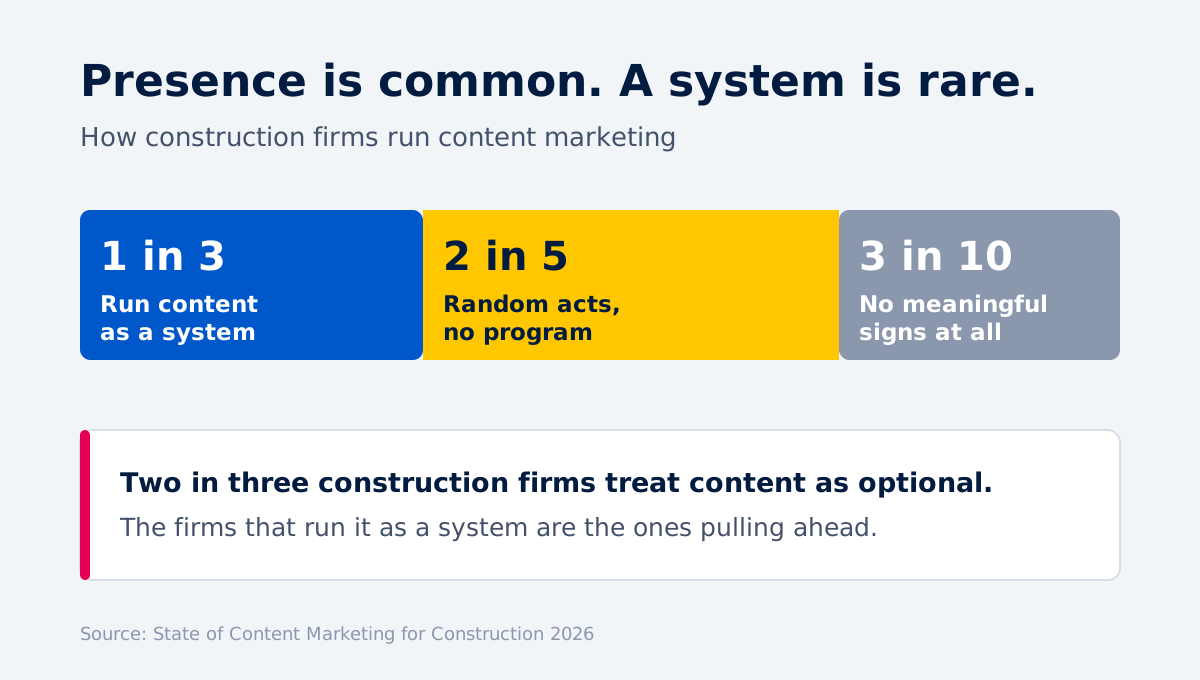
The split matters because it tracks with growth. The construction firms treating content as a system are the ones pulling ahead; among high-growth firms, 39% run a mature content operation, well above the field. Presence is table stakes. The system is the advantage, and what the active third does differently is specific enough to copy.
Rented demand versus owned demand
Ads are rented demand. You pay for each visit, and when the budget stops, the visits stop.
About 73% of construction firms run Google Ads, often spending somewhere between $11,000 and $63,000 a month on paid search, at an average cost per click near $6.24. That is real money for traffic that ends the day you pause the campaign.
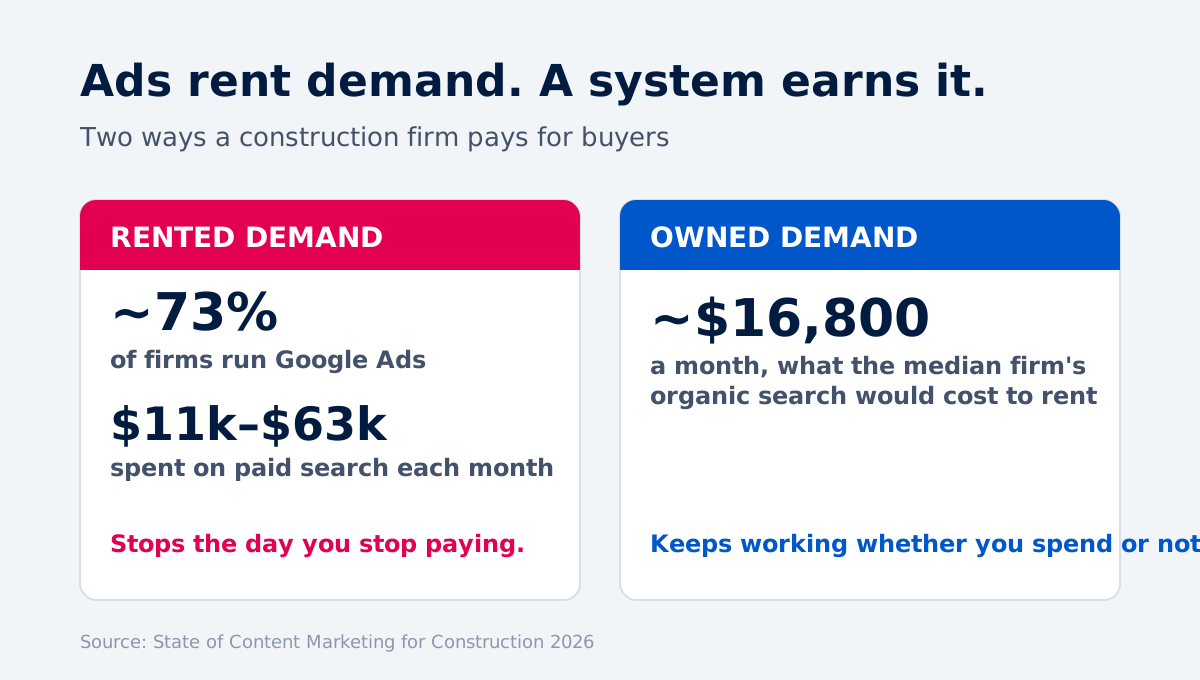
Owned demand behaves differently. The median construction firm's organic search presence would cost roughly $16,800 a month to rent through ads, and it keeps working whether or not you are spending that month. Chuck the Contractor makes the same point about lead sellers like HomeAdvisor, Angi, and Thumbtack; he calls them "lead reselling middlemen" selling the same lead "to five other contractors at the same time," and argues rented leads "shouldn't be your main source." The same logic applies to the list you already hold, which is why email is the one channel a construction company owns outright.
You can hear the plateau in the field. One construction software owner described paid campaigns that had "plateaued despite a significant budget increase," with no lift in cost of acquisition or lead quality. More spend on rented demand does not fix a missing system. It just raises the rent.
What does a go-to-market system for a construction firm actually look like?
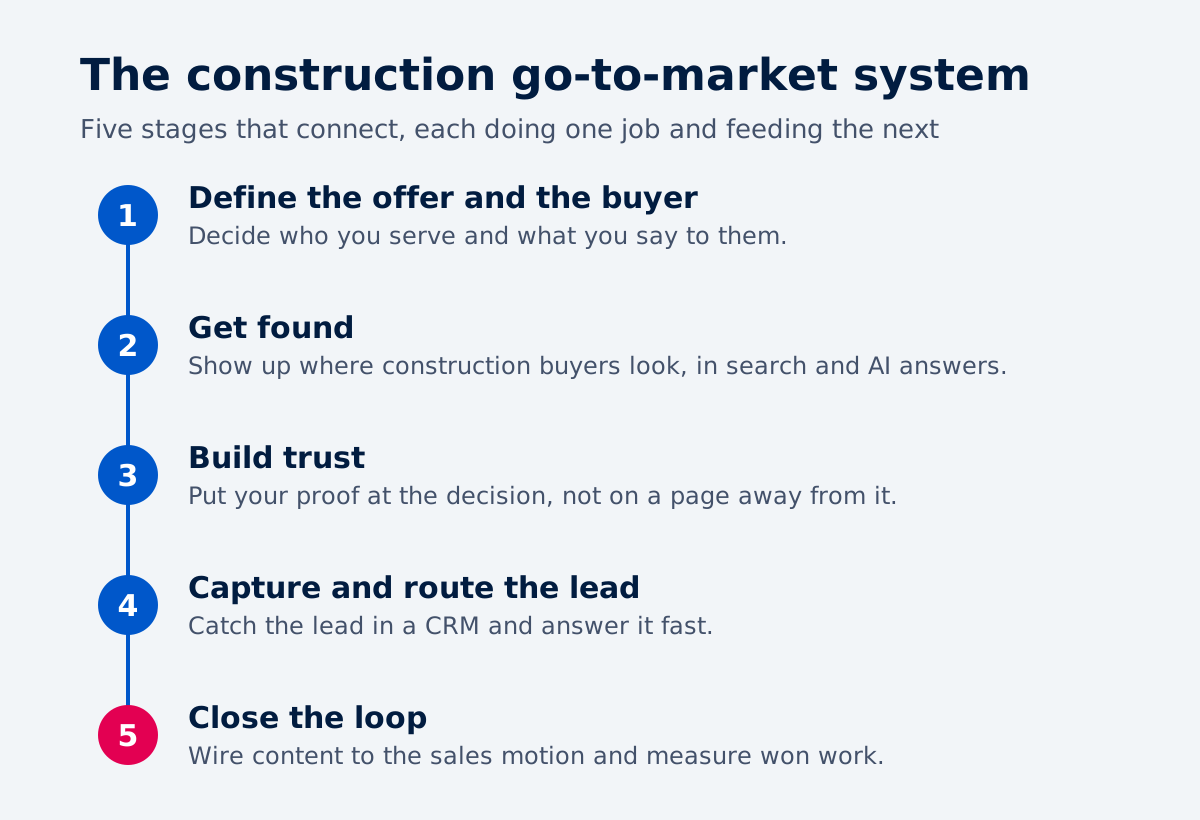
It looks like five stages that connect, each doing one job and feeding the next. The way we think about it is to plan from the top down and publish from the bottom up; when you reverse that order, you get activity that never compounds. It is the same reason most teams build their demand generation framework backwards.
Here are the five stages of a construction go-to-market system.
Define the offer and the buyer
Start by deciding who you serve and what you say to them, because everything downstream inherits it. This is the step most firms skip. Only about a third of construction firms send a clear signal about who they serve; the rest pitch everyone and land with no one. Vertical or industry-specific pages, the pages that say "we do this kind of project, for this kind of owner," appear on only 30% of construction sites, in a market that buys on specificity.
A contractor on Reddit put it better than any framework. Before you spend a dollar, he wrote, nail down "your message, unique selling proposition, offer," because otherwise "you are wasting your time and your money." The way we do this is to choose the buyer first and write the difference down: who the work is for, the problem it solves, and why you over the firm next door. That positioning statement becomes the spine every page and proposal hangs on.
Get found where construction buyers look
Once you know who you serve, make sure they can find you. Most construction firms cannot be found. Over a quarter have no organic search traffic at all, and the median firm pulls around 155 organic visits a month, which would not fill a webinar room. Another 41% sit in a low band of a few hundred visits, technically ranking, practically unseen.
The opening is wide. Around 91% of construction search demand is non-branded, people searching for the work rather than for a company name, which means it is winnable by whichever firm actually shows up for it. Yet the educational content that captures that demand is thin; only 16% of the category's search value is top-of-funnel.
Getting found now includes AI answers. Construction brands are named in only about one in forty AI answers, and rarely as the cited source, which is the same shortlist problem the SMPS buyers described. Short term, local search and Google Ads can put you in front of buyers while your owned pages climb, and our guide to digital marketing for construction companies covers which of those channels earn their cost. Long term, the owned pages are what keep you found for free.
Build trust across the long cycle
Getting found is not the same as getting hired. In a long, trust-led construction sale, the middle of the system is proof, and most firms leave their best proof unused.
Case studies, the exact evidence a buyer asks for, sit on only 38% of construction sites, and where they exist they are usually parked on a page away from the decision, not placed where the choice gets made. Technical documents, the industry's deepest asset, appear on about 40% of sites doing no commercial work. Most active firms already publish genuine engineering substance; the raw material for authority is in hand. And the format that suits a high-trust, long-cycle sale best, the webinar, is the least used of all, on under a fifth of sites.
Trust also has to survive a referral. Even a warm introduction gets checked; Hinge's research found about 52% of buyers rule out a referred firm before ever speaking with it, after looking at the website, the search results, and the reviews. The referral gets you considered. What buyers find decides whether you make the shortlist.
This is why a firm builds trust as a system, not a brochure. Jesse Lane, who coaches construction businesses, describes marketing as "a package, it's not just one thing," where the pieces "start tying together" so a buyer comes to "know you, like you, trust you before they even call you." Finished work is the fastest place to start, and before-and-after project photos become proof once they are routed to the moment a buyer decides. Video does the same job when it shows the work and the people behind it.
Capture and route the lead
When trust lands, capture it, or the whole system leaks. A construction firm that earns attention and then drops it is paying to fill a bucket with a hole in the bottom.
The bucket has a hole in most firms. Around two-thirds own a CRM, yet few wire their content into it. Lead capture, where it exists, is usually just a newsletter signup on about a third of sites. Fewer than half prompt the reader in context; 47% use a contextual call to action, and the rest fall back on a generic "Contact us" in the footer. That gap is the usual reason a construction website gets traffic but no leads.
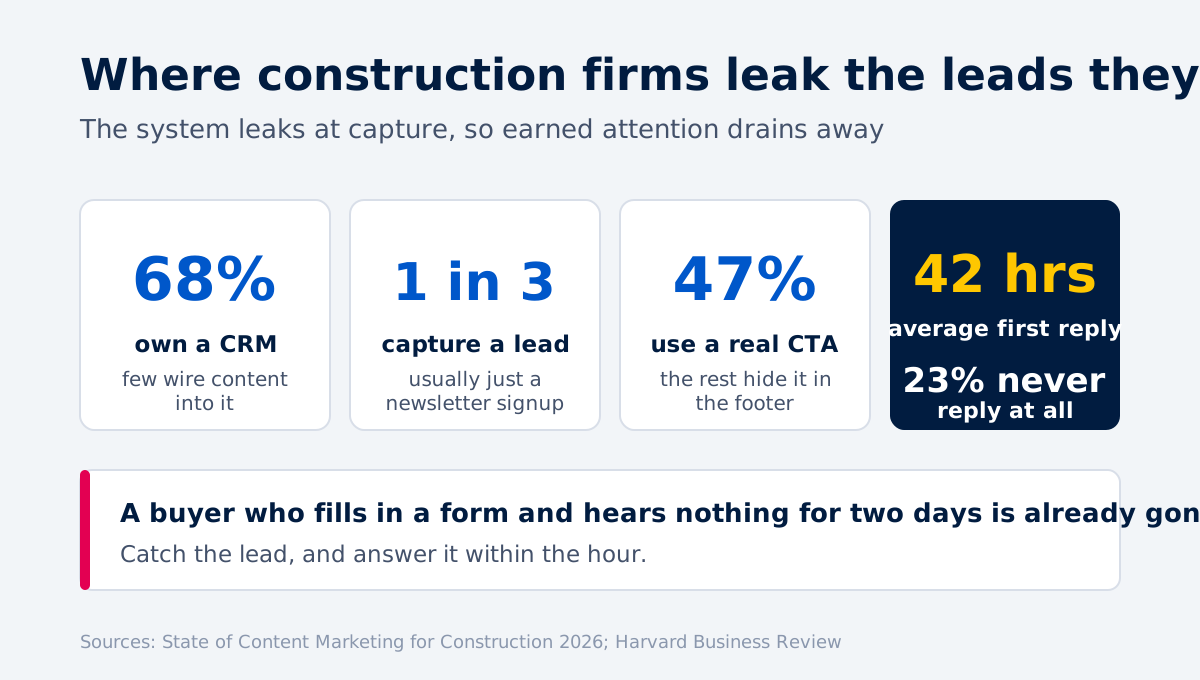
Then there is speed. When a lead does come in, most firms answer slowly. A Harvard Business Review audit of 2,241 companies found the average first response took 42 hours, and 23% of companies never responded at all. A construction buyer who fills in a form and hears nothing for two days has already moved on to the firm that called back.
The fix is to design the movement before you make the content. We map how a lead should travel, from aware to interested to engaged to a real sales conversation, with fast-track exits for buyers who already want a quote. Working with one client on a gated report, we treated the download as the start of the funnel, not the finish, and wired the follow-up so a fresh lead dropped straight into a nurture sequence the client never had to run by hand. As one contractor asked on Reddit, if you spend money to bring leads in, "are you set up on the back end to properly handle any influx of new leads? Is there a system in place?" That question is the capture stage.
Close the loop from content to won work
The last stage connects the system to revenue: wire content into the sales motion, and measure pipeline instead of traffic. This is where a construction go-to-market strategy either pays for itself or leaks the work it earned.
Right now it mostly leaks. Only about a third of construction firms turn content into a clear next step; a matching third publish with no route from reading to buying at all, so the effort runs straight back out. Everyone can measure traffic, since analytics tooling is on every site, but almost no one measures the contribution to pipeline, and only 4% run any kind of A/B testing, so content ships once and is never improved.
Closing the loop means marketing and sales read from the same page: content is built for the questions that come up in the sales conversation, the handover to sales carries which pages a lead has seen, and the number that matters is projects won, not visits. It also means being able to see which page started the deal. This is content earning its keep as revenue infrastructure. Do this well and the same buyers you educated for months arrive ready to sign.
How is go-to-market different for a construction software (contech) company?
The trust-led truth still holds, but the motion changes: for a construction software company, relationships, ecosystem partners, and peer proof beat paid channels, because the buyer is not sitting online waiting to be retargeted.
The buyer is the tell. Site managers and small-firm owners are rarely on LinkedIn and not very digitally engaged, so standard software playbooks, including most of what works in SaaS demand generation, underperform. One contech founder found paid campaigns plateaued "despite a significant budget increase," precisely because the audience does not live in the channels the ads run on.
There is a budget trap underneath it. As a general contractor told investor Nick Durham, "I have all of the Op-Ex in the world to spend for a given project but not generally across the company." Construction spends per project, so a contech firm that sells to corporate IT, or to owners who hold little project budget, aims at the wrong pocket.
What works is meeting the buyer where they already are. A practitioner who has sold into the space put it well on Reddit: construction is "relationship-driven," digital channels "will always have their limits," and a trade-show conversation is "worth 10x the leads you'll get from Meta." Put your existing customers front and centre, since a case study or a survey of the contractors already using your tool draws in their peers with proof that no ad creative can match.
For the mechanics of a software go-to-market motion, pilots, contract values, and land-and-expand, the SaaS Hero contech GTM playbook and Shovels' guide to using building-permit data as a buyer signal are useful next reads. The through-line is the same as for a services firm: a system that earns trust over time beats a campaign that rents attention.
What's the best go-to-market move for a construction company right now?
There is no single best tactic, and the marketing-framework questions that fill search results, the 3-3-3 rule, the 70/20/10 split, the 5 C's, miss the point for a construction firm. A list of construction marketing ideas only pays once each idea has a job inside the system. The best move is to run the system: define who you serve, get found, build trust with the proof you already own, capture and answer leads fast, and connect it all to won work.
The good news is that most construction firms are not starting from zero. You likely already have the technical knowledge, the finished projects, and the CRM. What is missing is the wiring that turns them into a system, and activating an estate you already own pays back faster than buying more ads. A small construction firm running a lean marketing budget near $8,000 a year gets more from putting one strong case study where buyers decide than from another month of clicks.
So start small and start this month. Pick your one clearest offer and the buyer it is for. Take your two best projects and write them up as proof. Put a contextual call to action on the pages that matter, and make sure someone answers a new lead within the hour. That is the smallest version of a construction go-to-market strategy, and it is a system, not a strategy deck you admire and never run.
For the deeper build, our study of construction content marketing shows where the whole category leaks, and our construction industry page lays out how we install the system with firms like yours. The firms that win the long, trust-led sale are the ones that stopped running campaigns and started running a system.
Want to see where your construction go-to-market leaks between getting found and winning the work?
Our content revenue audit maps your firm's content against the buying decision, finds the stages that should convert and do not, and puts a number on the gap.
Frequently Asked Questions
About the Author

Founder & CEO, Content RevOps
Stefan Kalpachev is the founder and CEO of Content RevOps, where he helps B2B SaaS companies transform their content into predictable pipeline. With a background in content marketing and revenue operations, Stefan has developed a unique methodology that bridges the gap between content creation and revenue generation.
Connect on LinkedInRelated Articles

Why Construction Brands Almost Never Show Up in AI Answers
Oct 9, 2026
How to Turn Before-and-After Construction Project Photos Into a Marketing Strategy
Oct 8, 2026
How to Build a Construction Marketing Strategy That Generates Pipeline
Oct 7, 2026