The 2026 Construction Marketing Benchmark: Where You Actually Stand
Two-thirds of construction firms are absent or inconsistent in content marketing. Punch in twelve numbers and see which third your team is in with our construction marketing benchmarking tool.
Book a CallMost construction firms think their marketing is roughly keeping pace with everyone else. The data says otherwise. In our State of Content Marketing for Construction 2026 study, only one construction firm in three runs content marketing as a real system. The typical company website pulls about 155 organic visits a month and ranks for roughly 33 keywords, most of them its own name. And the industry as a whole runs a demand-capture engine, not a demand-generation one: nearly half of all construction content sits at the top of the funnel while three-quarters of the search value it chases sits at the bottom.
Part of Content Marketing for Construction: The Complete 2026 Guide.
This page is the construction marketing benchmark you score yourself against. It covers six plain dimensions, gives you the industry numbers for each, and shows what the top third of construction marketers do differently. The six dimensions are your marketing maturity tier, your lead-source mix, your funnel shape, your conversion mechanics, your organic performance, and your spend. Read each one, place yourself, and you will know where you actually stand. To put a number on it, our construction marketing benchmarking tool scores you against the 2026 benchmark of 500 firms in about ninety seconds.
What a construction marketing benchmark is, and what it is not
A construction marketing benchmark measures how your marketing compares to other construction firms, so you can answer four questions: where do we stand, how far ahead or behind are we, what do better performers do differently, and what should we fix first. That is the job of a benchmark, and it is the job of this page.
It is worth clearing up one confusion straight away. Search for "construction benchmark" and most of what you find is about construction cost and project benchmarking, comparing unit rates, productivity, and schedule performance across jobs. That is useful, and it is a different subject. This benchmark is about your marketing: the content you publish, the demand you create, and the pipeline it feeds.
We built the numbers below from our own analysis of hundreds of construction company websites, job postings, and search footprints. Everything that follows leads with that data, so you are placing yourself against the real industry, not against a list of tips. If you want the raw figures without the scoring, our construction marketing statistics for 2026 collect them in one place.
Which construction marketing maturity tier you are in
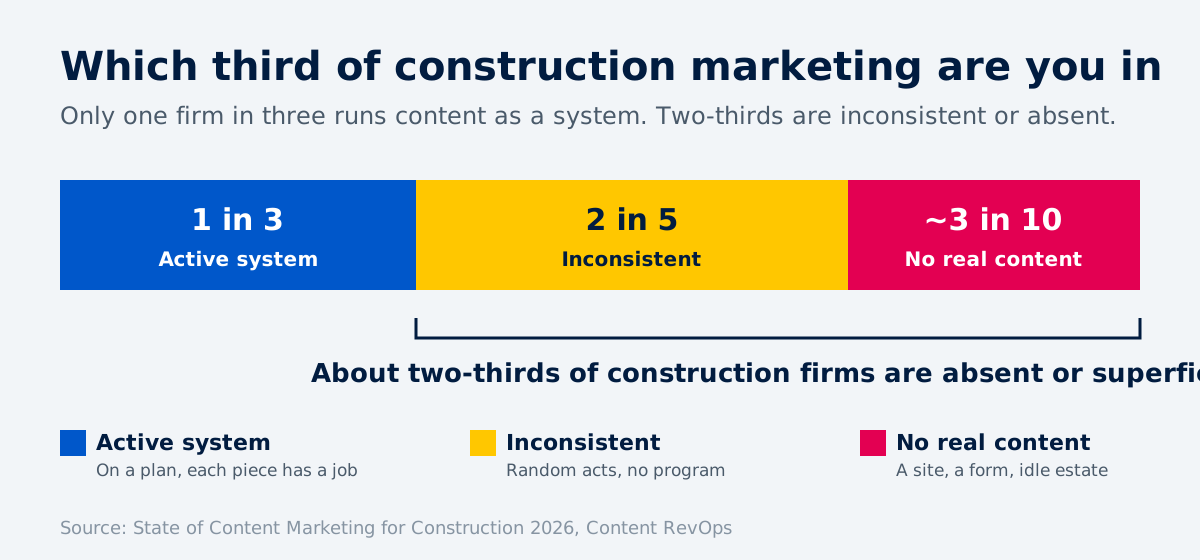
Construction marketing splits into three tiers, and most firms are not in the top one.
- About one in three runs content as an operating system. These firms publish on a plan, map content to a buyer journey, and treat marketing as a function that creates demand.
- About two in five publish in fits and starts. This is random acts of marketing, a blog that goes quiet, a social account that posts when someone remembers, with no program underneath.
- About three in ten show no meaningful signs of content marketing at all. They have a site and a contact form, and a content estate sitting idle.
Put the bottom two together and roughly two-thirds of the construction industry is either absent from content marketing or doing it superficially, as our construction content maturity breakdown shows. That is the single most important number on this page, because it means the bar to stand out is far lower than most owners assume.
Maturity also tracks growth. In our construction study, 39.1% of high-growth firms show active content marketing against 30.9% of low-growth firms. The firms pulling ahead are the ones treating content as a system, and the gap widens with company size: content maturity sits at 13.8% among firms under $1M in revenue and rises to 56.5% in the $500M to $1B band.
How to score your maturity
- Tier 1, system: you publish on a schedule, every piece has a job, and you can name the pipeline it supports.
- Tier 2, inconsistent: you publish sometimes, with no plan connecting the pieces.
- Tier 3, brochure: your site exists, but it does no marketing work.
If you are honest and land in Tier 2 or Tier 3, you are in the majority, and the rest of this benchmark shows you the fastest way up. Our guide to building a construction marketing strategy that generates pipeline covers the plan that moves a firm from Tier 2 to Tier 1.
Is your construction marketing still running on word of mouth
Most construction firms still generate work the way they always have, through referrals and reputation. Among residential builders, 53% rely on referrals or word-of-mouth to generate new business, and 35.3% say generating quality leads is their biggest sales challenge, according to Buildertrend's 2026 construction data report on residential builders.
Our construction marketing hiring data shows the same habit from the inside. When construction firms staff marketing, they hire for presence and production, not for demand. Looking at construction marketing job postings, events and field marketing is the number one hire at 69%, brand and communications follows at 63%, and design sits at 44%. The roles that would own durable demand barely appear: SEO is named in just 7.5% of postings, content in 13.6%, marketing automation in 7%, and answer-engine optimization in 0.4%. The industry is buying attention in person and staffing to make things, not to capture search demand online. If you are weighing who should own that work, our comparison of in-house vs agency for construction marketing lays out the trade-offs.
Word of mouth is not wrong. It is the highest-quality lead most construction firms get. The problem is that you cannot control the volume, and it breaks at predictable moments. Treating good work as the whole marketing plan is the first of the mistakes construction business owners make about marketing.
When word of mouth stops being enough
It stops being enough when you want to grow past the owner's own network. As one contractor put it on Reddit, word of mouth is fine "if it's just you and another guy," but once you have employees to keep busy, "especially in the slower months, you'll lose them all if you can't keep them busy."
It also breaks at the top of the market. A luxury remodeler with a $200,000 average ticket explained on Reddit that high-ticket work is a once-in-a-lifetime purchase for most clients, so there are few referrals to go around: "We thrive on SEO primarily. Big net, many fish." Reputation still matters, but it shows up as five-star reviews, not as "I know a guy." Our list of construction marketing ideas that aren't just project photos shows how to build channels on top of referrals instead of replacing them.
How to score your lead-source mix
- Referral-only: nearly all new work comes through word of mouth, and you cannot predict next quarter.
- Mixed: you have one or two other channels running, but you do not measure them.
- Diversified and measured: referrals, search, and owned content all feed the pipeline, and you know what each one returns.
Where the construction marketing funnel runs dry
The construction marketing funnel is top-heavy, and it runs dry exactly where deals are won. In our construction study, 47.4% of content is awareness-stage, 30.5% is consideration, and only 17% supports the decision. Read the search footprint and the imbalance flips: 75.3% of the industry's organic search value is bottom-of-funnel, against 16.5% at the top and just 8.2% in the middle.
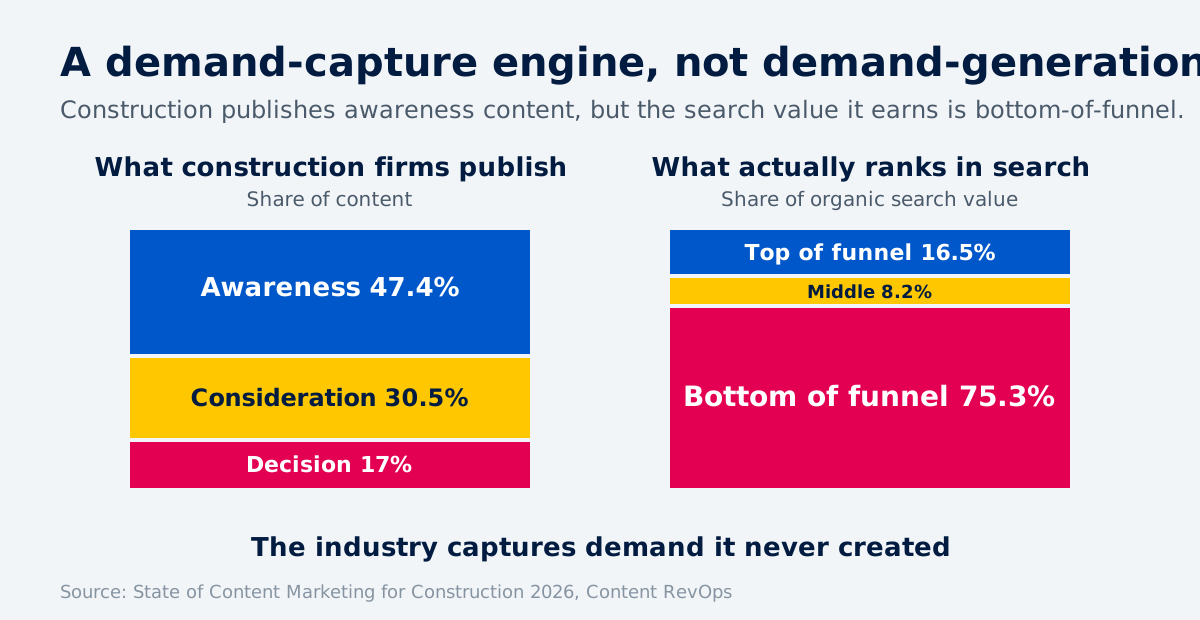
Put those two readings together and you get the core finding. The industry publishes awareness content while the demand it actually ranks for is people ready to buy. Construction marketing runs a demand-capture engine, not a demand-generation one, and it captures demand it never created. If the distinction is new, our explainer on demand generation vs demand capture sets it out, and our go-to-market strategy for construction firms shows how to build both.
The hole is at the bottom, not the middle. Among firms that are active in content marketing, 21.5% offer nothing at all to a buyer who is ready to act, while only 2.8% are missing consideration-stage content. The funnel is not thin in the middle, it is empty at the end. Our method for mapping the funnel is how we find those gaps on a real site.
The sales data from residential builders tells the same story from the other side. Builders need 21 to 25 leads to close a single contract, only about 30% of incoming leads become sales-qualified, and 40.8% have no documented sales process, per Buildertrend's 2026 report on residential builders. More leads at the top do little when the bottom of the funnel leaks.
How to score your funnel
- Awareness-heavy: most of your content introduces topics, and little helps a buyer choose you.
- Balanced: you cover awareness and consideration, with some decision-stage pages.
- Decision-ready: you have comparison pages, pricing guidance, proof, and clear next steps for a buyer who is ready.
How much of your construction content actually converts
Publishing is not the constraint in construction marketing. Converting is. Only 33.4% of construction firms have a strong path from content to a commercial next step, and an equal 33% publish with a weak path or none at all, so the effort leaks straight back out. For most firms, reading something on the site and becoming a lead are two disconnected events, which is exactly why so many construction websites get traffic but no leads.
The wiring is missing more than the tools. Two-thirds of construction firms own a CRM or marketing automation platform, at 68%, yet few connect their content to it; the gap is integration, not tooling. Owned email reaches only 31% of firms and live chat 13%, so high intent arrives on the page and goes unmet. Our guide to email marketing for construction companies covers the owned channel most firms skip.
Even where content invites action, it rarely routes by intent. Contextual calls to action appear on 46.8% of sites, but calls to action tailored to the buyer's funnel stage show up on just 12.8%. Almost no one sends a first-time reader and a ready-to-buy reader to different next steps. That routing is what we mean by a conversion layer.
The proof that closes deals is collected and then parked. Case studies sit on 37.9% of construction sites, usually away from the decision moment instead of driving it. A contractor on Reddit described the pattern precisely: most firms have "50 to 200+ 5-star reviews" but none of them use those reviews "sitting at the kitchen table giving estimates," explaining everything from scratch instead of letting past customers do the selling. Turning finished jobs into proof is the subject of our piece on before-and-after construction project photos.
How to score your conversion wiring
- No path: your content informs, and nothing captures or routes the reader.
- Capture-only: you gather emails or form fills, but nothing is wired to sales.
- Wired to pipeline: content routes by intent, feeds the CRM, and proof sits at the decision moment.
What a typical construction site pulls in organic traffic
Here is the performance tier most construction firms will not enjoy reading. The median construction company website pulls about 155 organic visits a month and ranks for roughly 33 keywords, most of them its own brand name. That would not fill a webinar room.
The spread across the industry is steep:
Organic traffic tier | Share of construction firms |
No organic traffic | 26.9% |
Low, 1 to 500 visits a month | 41.5% |
Medium, 501 to 5,000 | 22.2% |
High, 5,000 to 50,000 | 7.6% |
Very high, 50,000+ | 1.8% |
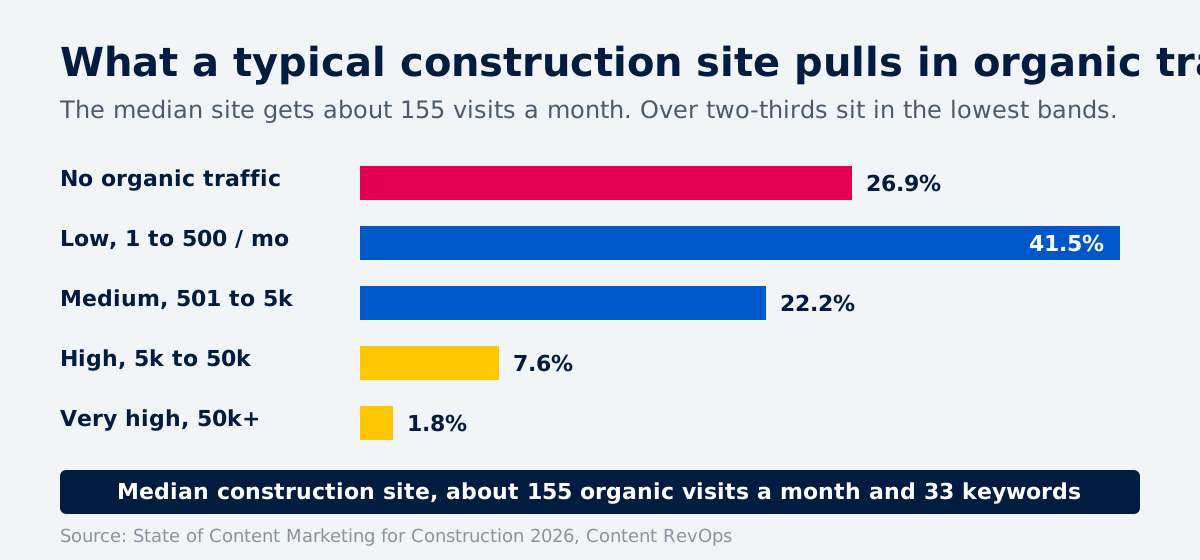
More than a quarter of construction sites are effectively invisible in search, and over two-thirds sit in the no-traffic or low band. This is a winner-take-most market: the top tenth of domains captures more than 80% of the category's search value, as our construction search and AI benchmark details. The median firm's organic traffic would cost roughly $16,800 a month to rent through ads, which is the clearest proof that the channel pays for the firms that win it.
The same absence shows up in AI answers. Construction brands surface in only about 2.5% of AI search answers, and rarely as the cited source. When buyers ask AI engines about construction topics, the answers lean on aggregators, forums, and reference sites such as Reddit, Wikipedia, Angi, and Indeed, not on the firms that do the work. The operators' own expertise is missing from the answer layer, which is wide-open ground for any firm that shows up for it. We unpack the causes in why construction brands almost never show up in AI answers, and the channel mix that fixes them in digital marketing for construction companies.
How to score your organic performance
- Invisible: little or no organic traffic, ranking only for your own name.
- Ranking but unseen: some traffic, mostly low-intent, no category terms owned.
- Category contender: you rank for the terms buyers search, and you appear in AI answers.
How much construction companies spend on marketing, and on what
There is no single right number, but there is a defensible range, and knowing it beats arguing from anecdotes. Marketing budgets in construction scale with company size. In our construction study, typical annual marketing budgets run near $8,000 at firms under $10M in revenue, around $35,000 in the $10M to $50M band, roughly $150,000 at $50M to $500M, and about $750,000 at enterprise firms above $500M.
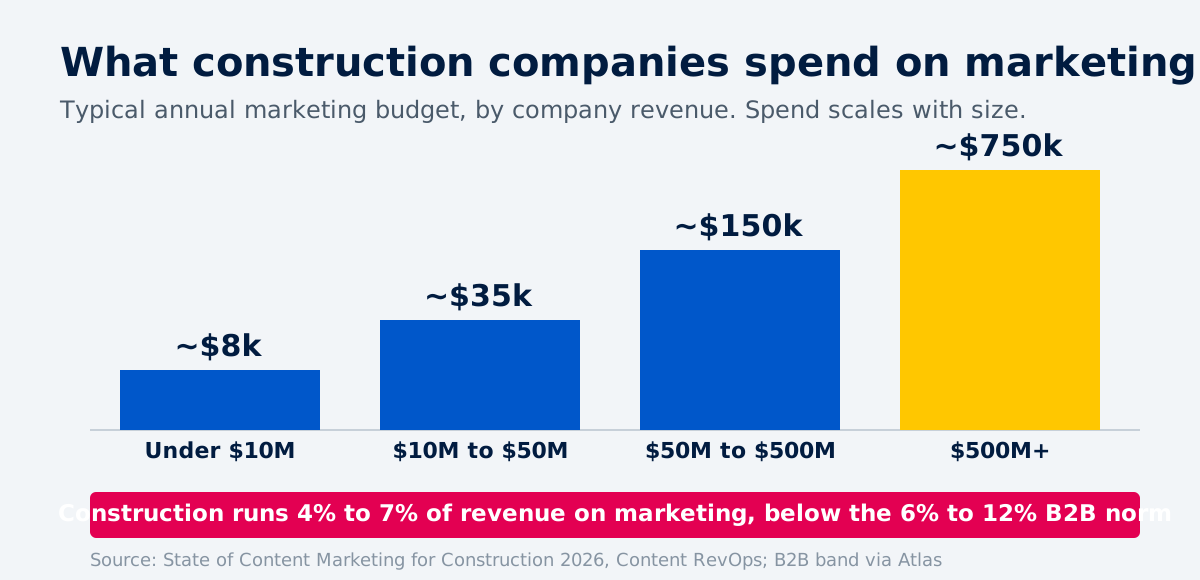
Construction also under-invests relative to other B2B sectors. Most B2B companies spend between 6% and 12% of revenue on marketing, while construction and manufacturing typically run lower, in the 4% to 7% range, with the Small Business Administration's own guidance landing at 7% to 8% for firms under $5M, per Atlas. If you are at the bottom of that band, you are normal for the industry and behind the wider B2B world. Our full breakdown of how much a construction company should spend on marketing goes line by line.
Where the money goes matters as much as how much there is. The firms that win treat search and content as their single largest line, putting 25% to 35% of spend into SEO and content as durable infrastructure. Most firms instead rent demand: about 73% run Google Ads, with estimated paid search spend of roughly $11,000 to $63,000 a month, buying traffic that stops the moment the budget does.
How to score your spend
- Under-invested: you spend well under the industry norm for your size and treat marketing as a cost.
- Renting demand: you spend, but mostly on ads that stop producing when you stop paying.
- Funding the asset: a real share goes to content and search that keeps compounding.
What the top third of construction marketers do differently
The construction firms in the top maturity tier are not doing more tactics. They are running a system, and three habits separate them, all visible in our look at what good looks like in construction content marketing.
They fund content as infrastructure
The leaders put their single largest marketing line, 25% to 35% of spend, into SEO and content, and they treat it as durable infrastructure rather than a campaign. That is why their organic traffic compounds while competitors restart their paid spend every month.
They turn their expertise into content
Construction firms sit on the raw material for authority and mostly leave it dormant. Among active firms, a third pair genuine technical depth with regulatory and compliance knowledge, which is a defensible, hard-to-fake edge most other industries cannot claim. Technical documents already sit on 40.5% of construction sites doing no commercial work. The top third turn that expertise into content buyers and AI engines can find, the process we describe in raw asset extraction.
They publish what nobody else has
Original, proprietary research appears on only 12.8% of construction sites, and it is the single biggest lever for owning a category and earning AI citations. The demand-generation layer at the top and middle of the funnel is wide open, which our study calls the clearest organic opening in the category. The firms that move first take ground that stays taken. Our guide to building your flagship content product shows how a firm turns its own data into that asset.
Underneath all three habits is one shift. Most construction marketing is a pile of scattered tactics with no system connecting them. The firms pulling ahead treat content as revenue infrastructure, the same way they would treat a CRM or a project management platform, as something you build once and run, not a cost you approve and forget.
Score your own construction marketing against the benchmark
You now have the six dimensions and the industry numbers for each. Run yourself through them quickly:
- Maturity: system, inconsistent, or brochure.
- Lead-source mix: referral-only, mixed, or diversified and measured.
- Funnel shape: awareness-heavy, balanced, or decision-ready.
- Conversion wiring: no path, capture-only, or wired to pipeline.
- Organic performance: invisible, ranking but unseen, or category contender.
- Spend: under-invested, renting demand, or funding the asset.
If you scored in the lower band on most of them, you are in the two-thirds of construction firms that are absent or inconsistent, which is the opportunity, not the verdict.
To place yourself properly, use our construction marketing benchmarking tool. You punch in twelve numbers and it scores your construction marketing against the 2026 benchmark of 500 firms, gives you a score out of 100, your maturity tier, and your top three gaps, in about ninety seconds. The full dataset behind it lives in our State of Content Marketing for Construction 2026 study, and our construction industry page shows how the system fits together.
The next step after that is to turn those gaps into numbers. A content audit prices each gap as lost pipeline, so you can see what being in the bottom band actually costs you in a year, and decide what to fix first. That is the move that takes a construction firm from the bottom two-thirds into the top third.
Want to turn your construction marketing gaps into a number?
Get a Content RevOps audit, your maturity scored, your funnel and conversion gaps found, and every one priced as lost pipeline so you fix the gaps that cost you most.
Frequently Asked Questions
About the Author

Founder & CEO, Content RevOps
Stefan Kalpachev is the founder and CEO of Content RevOps, where he helps B2B SaaS companies transform their content into predictable pipeline. With a background in content marketing and revenue operations, Stefan has developed a unique methodology that bridges the gap between content creation and revenue generation.
Connect on LinkedIn