How to Develop Your Demand Generation Program
Developing a demand gen program you can't afford to watch get defunded? Let's build one that compounds.
Book a CallThere's a line in an r/marketing thread that explains why most demand generation programs quietly fail. A marketer, asked for his honest hot take, writes: "Companies say they want to create demand but they really just want leads." A few comments down, another adds the part everyone feels but rarely says out loud — "it's more that companies don't have the patience for it."
That's the whole problem in two sentences. The hard part of developing a demand generation program was never choosing the tactics. The tactics are well documented, and you can find a competent ten-step checklist on the first page of Google in about thirty seconds. The hard part is building something that's still funded in month nine — long enough for the work to compound — when the people who approved it expected leads in month two.
So this guide is not another channel list. It's about how to develop a program: what "a program" actually is, how to sequence it so it earns trust as it grows, and how to measure it so finance doesn't cut it the first time a quarter looks soft. If you're starting completely from zero, our step-by-step engine build covers the cold-start mechanics; this piece is about developing and maturing the thing once it exists, and keeping it alive while it does.
A demand generation strategy is an operating system, not a campaign
Start with the word, because most of the confusion lives there. A campaign has a start and an end, and a demand generation campaign is the time-bound execution layer inside the larger system. A tactic is one move, and demand generation tactics are the individual moves a program coordinates. A program is the operating system those things run on: in a demand gen program, it's a holistic, strategic process for deciding who you're for, what you create, where the money goes, who owns it, and how you'll know it's working. Campaigns come and go. The program is what makes them add up to something instead of cancelling each other out, building brand awareness and creating awareness, interest, and desire over time.
This distinction isn't academic — it's the single biggest predictor of whether content turns into pipeline. When we analysed the construction market's content, only about one in three companies ran content as an actual operating system. Two in five published in fits and starts — what we ended up calling random acts of marketing: disconnected marketing efforts that never added up because they weren't run as a system. In asset management the systematic share was lower still — roughly one firm in twenty-eight. And the firms running content as a system were consistently the ones pulling ahead on growth. The maturity wasn't a side effect of growth; it looked a lot more like a cause.
The practical takeaway: developing your program means making a small number of standing decisions once and then defending them, rather than relaunching a new "initiative" every quarter. Everything below is one of those standing decisions.
The split every program is really managing: create vs. capture
Here's the decision that sits underneath all the others, and the one the SERP's checklists almost never name. Every dollar in your program is doing one of two jobs: creating demand, or capturing it. And the right balance between them isn't a matter of taste — it's set by a fact about your market you don't control.
At any given moment, only about 5% of B2B buyers are actually in the market for what you sell. The other 95% aren't shopping — they're not bad leads, they simply don't have the need yet, which is why demand creation means creating awareness, building trust, and educating potential customers before they are in-market. The Ehrenberg-Bass Institute and Professor John Dawes put that number on it, and it reframes the whole job. Demand capturing competes for the 5%, while lead generation captures contact information from interested individuals already showing intent through lead generation tactics like gated, high-value resources, paid search, bottom-of-funnel SEO, review sites, and retargeting — intercepting people already looking. Demand creation plays for the 95% through inbound marketing and other long-term efforts that create awareness to build brand awareness through education, valuable resources, and thought leadership that help potential customers solve problems and trust you before they are ready to buy.
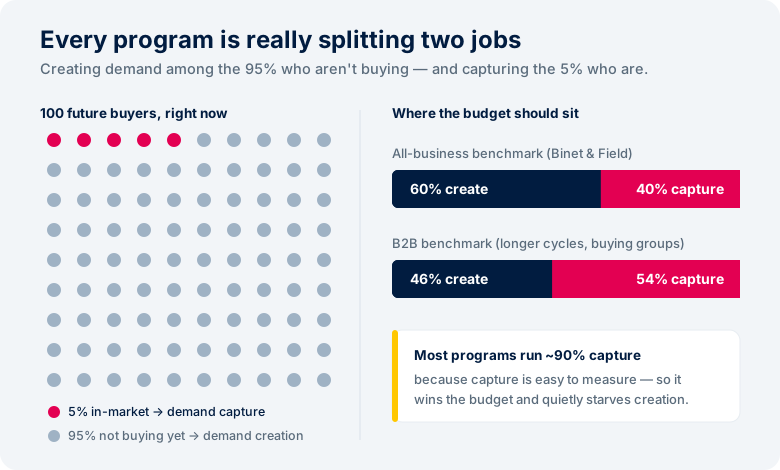
Most programs are wildly tilted toward capture, for a reason that has nothing to do with strategy: capture is easy to measure, so it's easy to defend, so it gets the budget. You can draw a clean line from a search ad to a demo. You cannot draw a clean line from a year of showing up usefully to the deal it eventually produced. So the measurable thing wins the budget, the program slowly becomes a capture engine wearing a demand-gen title, and then everyone wonders why customer acquisition keeps getting more expensive — even though demand creation is what helps generate demand and drive long-term revenue growth, not just short-term lead volume.
We can see the tilt in our own data. In the construction market, the content companies publish skews toward awareness — but the search value they actually earn is about three-quarters bottom-of-funnel. Read together, that's an industry running a demand-capture engine while telling itself it does demand generation: fighting over the 5% who are already looking, and creating almost nothing for the 95% who aren't. It feels like growth. It's mostly harvesting demand instead of creating it with modern buyers before they enter the market.
How much should go to each? The most useful benchmark comes from Les Binet and Peter Field, whose IPA work produced the famous 60/40 rule — roughly 60% of budget to long-term brand/demand creation, 40% to short-term activation. Their later B2B-specific research nudges that closer to a more even split — in the region of 46% creation to 54% activation — because B2B cycles are longer and buying groups larger. Don't treat those as exact dials; treat them as a corrective. If your program is 90% capture, the science says you've under-built the thing that fills the pond, and you'll feel it as rising costs about a year from now. We go deeper on the line between the two in demand generation vs. demand capture.
Develop in stages — don't try to run the whole thing on day one
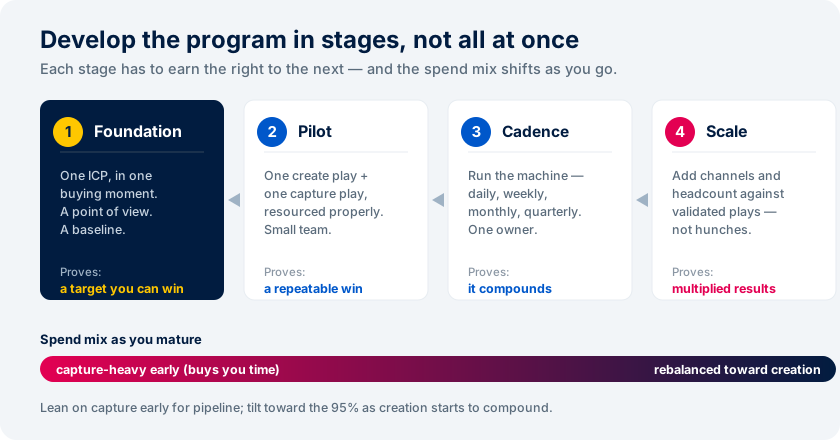
The fastest way to get a program killed is to launch twenty things at once, spread yourself thin across all of them, and have nothing to show when someone asks. Developing a program is a sequence, not a big bang. Four stages, each of which earns the right to the next.
Stage 1 — Foundation. Before any channel, lock the standing decisions: one primary ICP for a defined target market and your ideal customers in one high-stakes buying moment, a point of view worth holding, and a baseline you can measure against later. This is unglamorous and it is the stage teams most want to skip. Don't. "B2B buyers" is not a target; it's a way to make everything downstream vague. This work should be informed by customer pain points, behaviors, and jobs to be done so you can identify and reach the specific dream customers.
Stage 2 — Pilot. Pick one creation play and one capture play that fit the buying group, since B2B purchases often involve 5-11 stakeholders across departments. Resource them properly rather than starving five plays at once. The capture play funds the near-term pipeline that buys you patience; the creation play starts the slow compounding. Keep the team small — two people who own it beats ten who touch it. The goal here isn't scale, it's proof and a repeatable process.
Stage 3 — Operating cadence. Once a play works, the job shifts from launching to running. This is where most of the value actually accrues, and where most programs fall apart — they keep chasing new tactics instead of compounding the ones that work. (More on the cadence below.)
Stage 4 — Scale. Only now do you add channels and headcount — against validated plays, not hunches. Scaling a system multiplies results only after you know which audiences or accounts to prioritize; scaling chaos just multiplies the chaos.
Notice that the create/capture mix and the metrics shift as you move through the stages. Early on you'll lean harder on capture because you need pipeline to survive the political clock. As the creation work starts to compound — branded search rising, more deals arriving already aware of you — you can rebalance toward the 95%. A program isn't a fixed recipe; it's a thing you develop along a curve. For how the headcount and cost build across these stages, see our breakdown of demand generation team structure and costs.
The operating cadence is what actually keeps it alive
Ask the practitioners and the answer is strikingly consistent. The marketer in that same Reddit thread who'd run programs for years put it bluntly: "Great content is only 20% of success. 80% of success comes from content distribution."Developing a program is mostly about building the boring machine that does that 80% on a schedule — and keeping it running when it's tempting to chase something shinier.
A real cadence has rhythm at four frequencies: something daily (engaging where your buyers already are), something weekly (a newsletter, an episode, a piece of net-new thinking), something monthly (a flagship asset, a customer story, a partner webinar), and something quarterly (a step back to rebalance spend and retire what isn't working), with a multi-channel approach so revenue teams maintain visibility across the customer journey. The specific moves matter less than the consistency. You can't expect a muscle to grow by going to the gym once a month, and demand creation works the same way — it compounds only if it's continuous.
Two non-negotiables hold the cadence together. First, one owner. If nobody is accountable for the program as a whole, it gets quietly deprioritised by everyone with a busier quarter, and it dies of neglect rather than failure. Second, alignment between marketing and sales teams, with the sales team actively involved. Buyers spend only about 17% of the buying journey meeting with any potential supplier, according to Gartner — and across a shortlist that's a sliver of time per vendor, because buyers expect to complete much of their research independently before talking to a rep. Gartner now finds that 67% of B2B buyers prefer a rep-free experience for parts of the journey, and a typical buying group runs to six to ten people each arriving with their own research. Automated lead nurturing and AI-driven personalization help deliver timely education while buyers research independently across 8-10 channels, with sales engagement providing the coordinated handoff when human help is actually useful. Your program isn't feeding a salesperson leads to call; it's doing the educating that used to happen in sales conversations, for a committee you'll mostly never meet, including in the dark funnel where educational content can address buyer questions and shorten cycles. Authentic user generated content helps there too, because peer perspectives often carry more credibility than brand messaging. That only works if sales and marketing teams are running off the same account list, the same definition of a good opportunity, and a shared view of intent signals across accounts. Shared dashboards on the same platform give marketing teams and sales involvement a single source of truth, and regular joint pipeline reviews help marketing and sales teams deliver a consistent experience. That makes the cadence executable only when marketing and sales data and strategic content stay synchronized, so timely sales outreach can be triggered when those signals appear.
Lead scoring and measurement in demand generation: the part that decides whether your program survives
This is where programs live or die, and it's the part the checklists wave at and move past. Go back to the founding tension: the program needs patience, and patience is granted by whoever controls the budget, and they grant it based on what they can see. So your measurement system isn't a reporting afterthought — it's the thing that keeps the program funded long enough to work, which means consistently tracking key metrics across the demand generation process.
The trap is measuring what's easy. In our construction data, essentially every active company could measure traffic — and almost none could connect content to pipeline. (Tellingly, about 4% did any structured A/B testing.) Analytics that count visits are everywhere; analytics that tie effort to revenue are rare. A program reported on traffic and MQLs gets cut the first time those numbers wobble, because nobody in the room can connect them to money. A solid marketing technology stack is what lets you manage measurement, attribution, and handoff across the program.
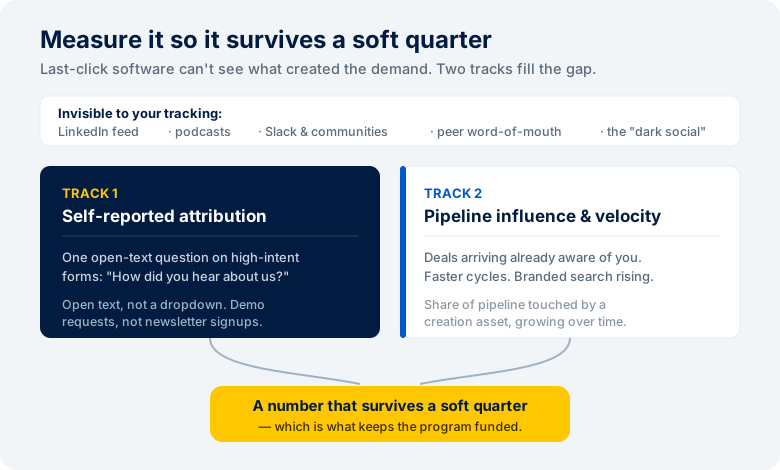
The fix is a two-track measurement model that accepts something most attribution setups refuse to: a lot of what works is invisible to your software. The 95% you're creating demand for engage on LinkedIn, in podcasts, in Slack groups and peer conversations your tracking will never see — the dark social that no last-click model captures, even if some high-value intent data still shows when accounts move from passive awareness into active evaluation.
Track one is self-reported attribution — a single open-text "How did you hear about us?" on your highest-intent forms (demo requests, not newsletter signups). Dreamdata's work on this is clear: an open text field beats a dropdown, you collect it at the moment of high intent, and you need three to six months before the patterns are trustworthy. It's the only practical way to catch the dark-social touches that created the demand your capture channel got credit for closing.
Track two is pipeline influence and velocity — not "how many MQLs," but signals that help teams prioritize accountsshowing stronger buying urgency: are deals arriving already aware of you, is the sales pipeline filling with qualified leads, is pipeline quality improving, is qualified pipeline growing, are they closing faster, is branded search rising, is the share of pipeline that touched a creation asset growing over time. These are the leading indicators that the 95%-work is compounding, and they're the numbers that earn you the patience the program needs. Pipeline velocity measures how quickly opportunities move through sales stages, and sales cycle length matters when you judge the result. (One marketer in that Reddit thread described spending months building exactly this kind of attribution and finally proving most new opportunities were marketing-influenced — "felt good, man." That's not vanity; that's the work that keeps the lights on.) For the specific metrics worth tracking and the vanity ones to drop, see what to track and what to ignore.
Supporting signals matter too: indicators like branded search, direct traffic, lead quality, and conversion rates help, especially when lead scoring is shared with sales and assigns points based on engagement to surface high quality leads, using those patterns in the same workflow to guide account prioritization. In practice, that also helps teams audit where prospects drop off between marketing and sales. Multi-touch attribution matters most in long B2B buying journeys, and revenue impact is still the metric that matters most. A simple efficiency check is customer lifetime value divided by acquisition cost.
Why programs die — and how to make yours the exception
Almost none of the common failure modes are about tactics. They're about the gap between how demand creation pays off (slowly, then all at once) and how organisations evaluate it (quarterly, impatiently). Three patterns account for most of it.
The first is impatience dressed up as pragmatism. A program is stood up, generates few leads in the first quarter because creation hasn't compounded yet, and gets quietly defunded — right before the curve would have bent. As one practitioner put it, companies "are not ready to invest the same time in doing the right things that produce long-term wins." The antidote isn't a louder promise; it's the measurement model above, plus setting expectations honestly up front: the capture track pays the bills early, the creation track pays off later, and here's the leading indicator that proves it's on track.
The second is demand gen that's secretly lead gen. The team is told to create demand but rewarded only on MQL volume, so webinars become pitches, the blog chases keywords instead of answering real questions, and the whole thing collapses back into capture — a demand generation vs lead mindset failure that turns high-value content and educational resources into thin lead capture devices instead of using them to establish stronger brand authority. The fix is to give creation work its own leading metrics so it isn't judged on a scoreboard built for capture.
The third is measuring the wrong thing so well that you optimise yourself into a corner — pouring budget into the channels that attribute cleanly (capture) and starving the ones that don't (creation), until you've maximised harvesting from a pond nobody's refilling. You can't manage a pipeline you can't see, but you also can't let the things you can see crowd out the things that matter.
Developing a demand generation program, in the end, is two jobs running in parallel. One is the marketing — the ICP, the creation and capture plays, the cadence. The other, just as important, is political: building the measurement and the trust that give the demand generation approach enough time to build relationships for sustainable growth, especially in account based marketing when teams align around target accounts. Get only the first right and you'll have a beautifully designed program that dies in month nine. Get both right and you'll have the thing your competitors keep starting over from scratch — a system that's still standing, and still compounding, while theirs resets every year.
If you'd rather not learn the survival part the hard way, that's most of what we do — see how our demand generation services approach it, or browse real examples of programs that built pipeline.
Is your demand generation program built to survive its first year?
We develop demand programs as revenue infrastructure—create and capture balanced, staged to mature, and measured so finance never cuts it mid-compound. Let's design your Content RevOps system.
Frequently Asked Questions
About the Author

Founder & CEO, Content RevOps
Stefan Kalpachev is the founder and CEO of Content RevOps, where he helps B2B SaaS companies transform their content into predictable pipeline. With a background in content marketing and revenue operations, Stefan has developed a unique methodology that bridges the gap between content creation and revenue generation.
Connect on LinkedIn