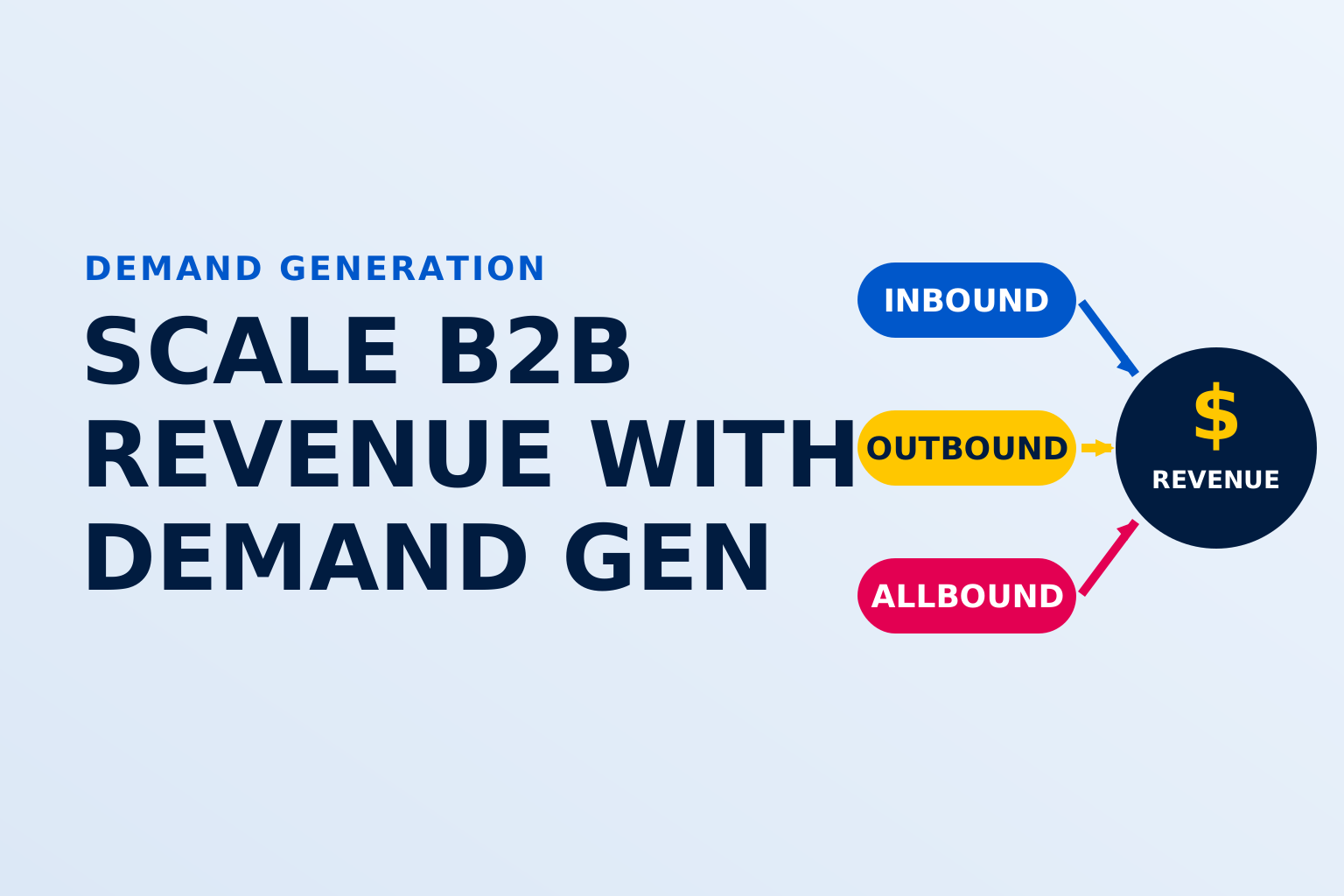
12 Demand Generation Ideas for B2B SaaS and Professional Services, With the Numbers Each One Produced
Not sure which of these to run first? Find the one program that fits your bottleneck, then run it end to end.
Book a CallMost "demand generation ideas" lists hand you the same nouns. Content marketing. Webinars. Paid ads. SEO. Referral programs. Each one gets a sentence, a borrowed statistic, and a tidy logo. You already knew those words before you opened the page, so you close it no closer to a decision about what to do on Monday.
Part of The Complete Guide to B2B Demand Generation Strategy.
This is a different kind of list. Every item below is a program we have actually run for B2B SaaS and professional services companies, the kind with long cycles, buying committees, and deals that take most of a year to close. Each one comes with the real mechanism, the part you can copy, and the real number it produced. Not "host a webinar" but "make the webinar invite your outbound, and watch cold reply rates go from under 1% to over 12%." Ideas you can lift, not vocabulary you already have.
They are grouped into three jobs, because the right idea depends on where you are stuck. Create demand is for reaching buyers who are not searching yet. Capture demand is for catching the ones already in motion. Convert and expand is for turning attention you already earned into booked pipeline. Find the bucket that matches your bottleneck, and start there.
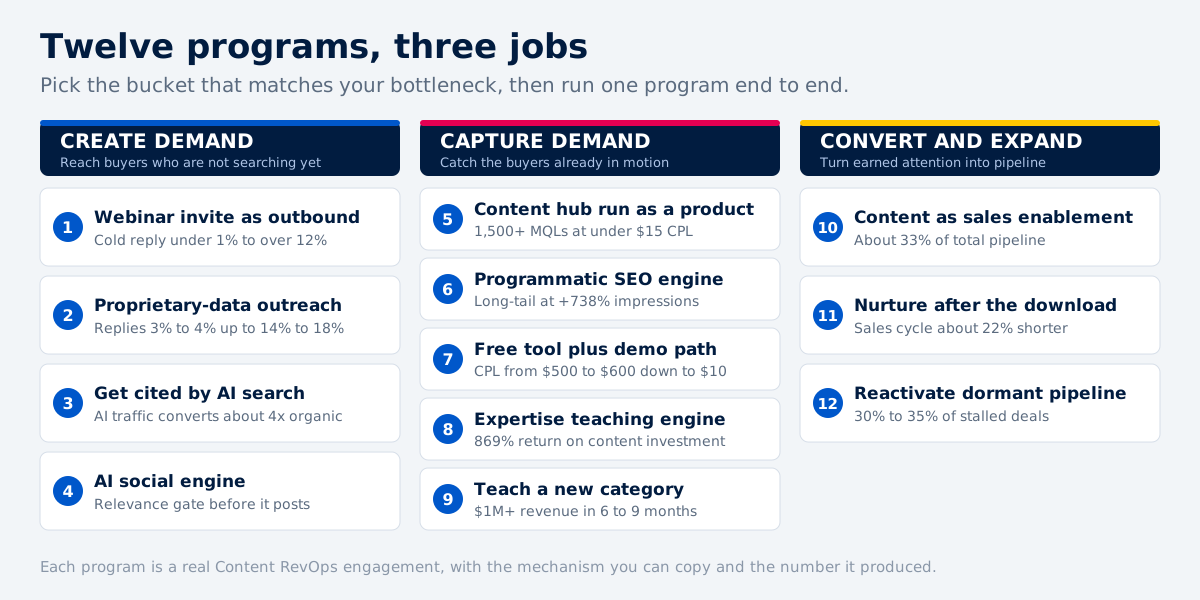
Create demand, reach buyers who are not searching yet
These four programs manufacture interest where there was none. They are the right place to start if your problem is that nobody knows you exist, or that the people who should buy from you have no reason to think about you this quarter.
1. Make the webinar invite your outbound
Run a webinar where the invitation itself is your cold outreach, so demand creation and demand capture become a single motion instead of two budgets. The usual webinar is a content event you then have to fill. Flip it. Invite your highest-value targets to speak or join a panel, and the ask stops being "give me an hour of your time" and becomes "share your expertise in front of your peers."
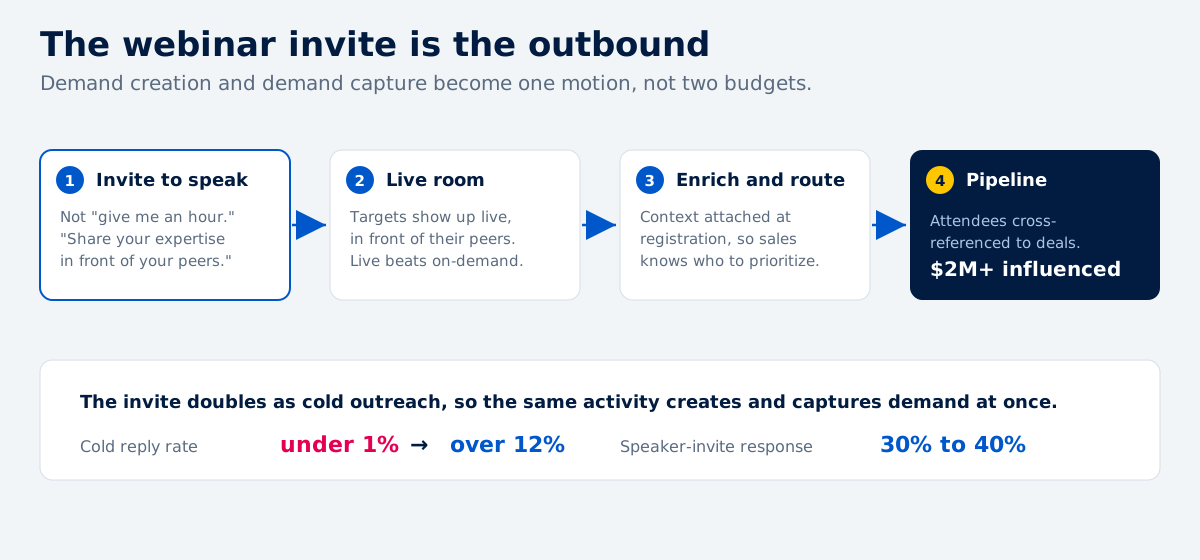
We built this for Heliogen, a concentrated-solar manufacturer, and the numbers held at every stage. AI-built personalization on the invites took cold reply rates from under 1% to over 12%, and speaker invitations specifically drew a 30% to 40% response. A nine-email reminder sequence over four weeks turned registrations into attendance. Enrichment at the moment of registration meant every attendee arrived with context attached, so the two-person sales team knew exactly who to prioritize. Cross-referencing attendees against the deal pipeline attributed over $2 million in influenced pipeline, and the whole engine stood up in about six months.
The live room is the part that matters, not the recording afterward. Across 19,531 webinars from 418 B2B brands, webinar volume jumped 225% in a year, and live attendance drives 67% higher pipeline entry than on-demand viewing, with roughly 12% of attendees entering pipeline within 90 days. A founder-led SaaS engagement we ran on the same model produced 14 to 18 demos per webinar and around $2.5 million in influenced pipeline, with about 90% of attendees fitting the ideal customer profile because the invite list was built from the right pool in the first place.
2. Build your cold outreach around one proprietary data asset
Build a single piece of first-party data, then lead every cold touch with a specific finding instead of asking for time. This is the highest-leverage outbound program there is, and almost nobody runs it. Around three in ten B2B companies build any original research or proprietary data, which makes it the most defensible, most quotable asset most of your market will never bother to create.
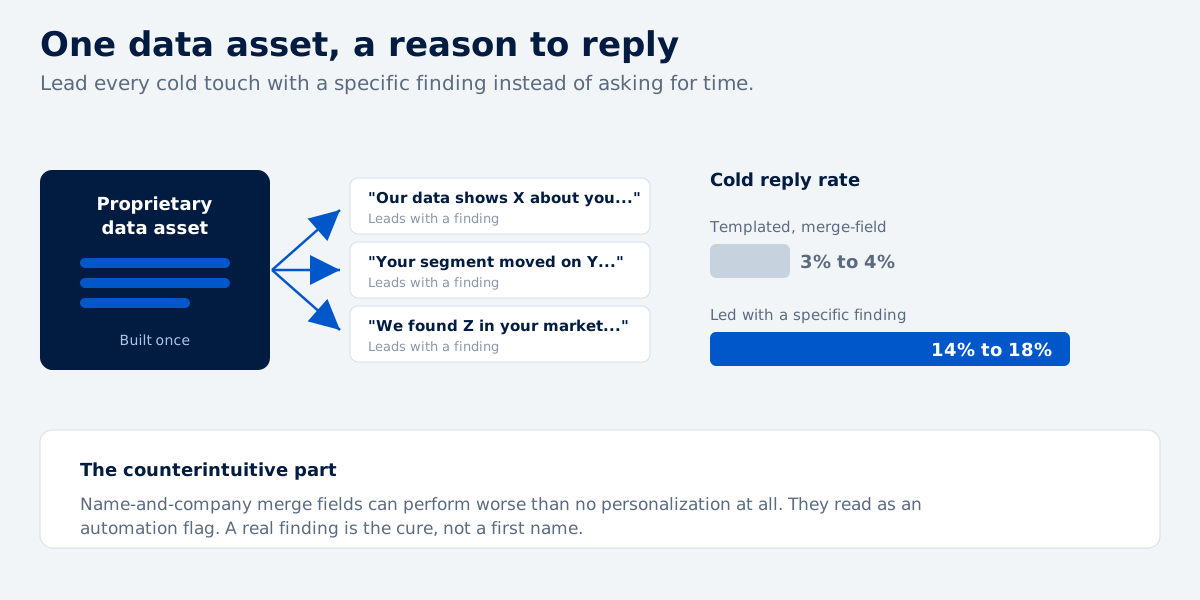
For Lucid, one flagship original-data asset rewrote the outbound math. Cold reply rates moved from 3% to 4% up to 14% to 18%, and positive responses more than quadrupled. The same asset drove 65% more booked meetings with no added headcount. The reason is simple. Founder-level buyers ghost outreach that has no reason to exist beyond asking for their calendar; a sharp, specific finding gives the email a reason to exist.
The pattern is not unique to us. An analysis of roughly 11,000 first-touch cold emails found templated, merge-field personalization replied at 3.1%, while emails that opened with a specific, timely signal replied at 19.4%. The counterintuitive part is the warning underneath it. A Lavender study of 4.2 million emails found that messages carrying only first-name and company-name tokens performed 12% worse than emails with no personalization at all, because the merge fields read as an automation flag. Generic personalization is not a small win. It is a tell. A real finding is the cure.
3. Engineer your content to get quoted by AI search
Treat AI Overviews and chatbot answers as an acquisition channel you can win, not a threat to survive. The job is to be cited inside the answer, which means structuring content for answer engines, feeding the model expertise it cannot generate on its own, and embedding a tool or dataset it cannot reproduce.
This is already paying out in two very different engagements. In a fintech program, around 22% of inbound traffic now arrives from AI and LLM referrals, and those leads convert roughly five times better than the baseline, because the model pre-qualifies and pre-trusts the brand before the click. In an education program, the brand holds about 35% share of voice in AI answers, appears in 40% of the relevant AI Overviews, and gets cited 20 to 30 times a week. What both have in common is a refusal to publish what the model already knows; AI retrieval rewards a distinct method and genuine expertise, not generic coverage, and an embedded tool the model cannot recreate is a durable edge.
The buyer shift is real and measurable. 38% of B2B technology buyers used a generative AI tool at least once during an active purchase evaluation in early 2025, up from 19% a year earlier, per Gartner. And the traffic it produces converts above its weight; AI-sourced visitors became MQLs at 4.4% versus 1.0% for traditional organic in one B2B SaaS attribution study, which lines up with the five-times lift we saw directly. Keep the expectations honest, though. LLM referral traffic is still a small slice of total sessions even as 94% of buyers report using these tools, so the win is the citation inside the answer, not a flood of referral clicks this month.
4. Run an AI social engine that judges relevance first
Stand up an AI workflow that watches for timely, topical moments, decides whether each one is genuinely relevant to your audience before it posts, and ships social content on the back of it at near-zero human cost. The relevance gate is the entire trick. It is the difference between a presence that compounds authority and the automated slop everyone is right to fear.
We built this for Ori Learning, a special-education software company, scoped so the system judged relevance before drafting anything. The posts it produced landed among the better performers in the feed, not as filler but as content people engaged with, and the human cost stayed close to zero. The discipline that keeps AI-assisted output credible is not volume; it is a tight brief and a hard relevance filter at the front.
That filter is also the whole reason to bother. Most teams point AI at production, which only deepens the glut of forgettable content; the leverage comes from pointing it at judgment first, then production. An engine that asks "is this worth saying" before it asks "write this" is a small build with an outsized return, and it is one of the few genuinely new programs on this list.
Capture demand, catch the buyers already in motion
These five programs catch intent that already exists. They are where to focus if you have a market that is searching, comparing, and reading, but your share of that attention is thin or your pages do not convert it.
5. Stand up a content hub you run like a product
Build one operationalized content hub and run it like a product that compounds, not a campaign that ends. Most companies already have a resource hub; what they lack is the conversion and distribution wiring around it. The difference between a blog and an engine is whether topic intelligence, a real conversion hierarchy, and a reactivation loop are built into it from the start.
A fintech platform we worked with, Banking Crowded, turned this into its single biggest channel. The hub generated more than 1,500 MQLs at under $15 cost per lead, down from $180 to $220, and became the number-one acquisition channel outright. Organic traffic climbed 340%, with 65% of all site traffic flowing through the hub, and monthly lead volume went from around 15 to 120 to 150. Because it was wired into the deal cycle rather than parked at the top of the funnel, it compressed the sales cycle by 30% to 35% and influenced $3 million to $4 million in pipeline. Treating the hub as a product, with its own roadmap and its own reactivation mechanics, is exactly what let it keep compounding instead of plateauing.
6. Build a programmatic SEO engine for long-tail demand
Build a data-to-CMS pipeline that generates genuinely useful pages at a scale manual content can never reach, capturing thousands of high-intent long-tail searches without shipping thin doorway pages. The capture ceiling here is enormous, and the trick that separates it from spam is retrieval grounding, so every page is built from real data rather than padded out by a model.
For Radius, a product-led education company, a custom build pipeline produced SEO-complete pages across thousands of keywords and lifted search impressions 738%. A two-person team shipped it in three months and drove a 609% traffic increase. The grounding step is what kept quality high; pulling real, retrieved data into each page is the line between a useful resource and a thin doorway. The sharpest version of this hands the searcher straight into the product doing the exact thing they searched for, which is how that same engine converted roughly 10% of free users to paid. A separate education program built on the same approach drove its biggest traffic spikes this way, peaking above 20,000 visitors a month.
7. Pair every page with a free tool and an instant demo path
Put a genuinely useful free tool on your highest-intent pages, then wire a demo-on-demand path right beside it so peak interest converts without waiting for a booked call. This is content as product. The tool earns rankings, doubles as a moat against AI summarization, and tells you the exact pain a visitor has before a rep ever makes contact.
For Behavior Advantage, a behavioral-science training company, pairing each article with a usable tool turned the content into something practitioners actually use, and the flagship page ranks number one for its keyword. The demo-on-demand layer captures intent at the peak instead of letting it cool, and the system books two to three demos a week from a non-salesperson, because the content supplies all the context a rep would otherwise have to gather. The economics moved hard. Cost per lead collapsed from $500 to $600 down to about $10, and customer acquisition cost fell from over $2,500 to around $600. The download itself becomes an intent signal, telling sales the precise problem before the first conversation starts.
8. Turn your team's trapped expertise into a teaching engine
Extract the expertise sitting in your senior people's heads and turn it into an education engine that does the pre-sales teaching your reps currently repeat by hand. This is the program for professional services and technical firms whose entire USP lives in a handful of experts and dies the moment those experts are in a meeting.
Westlab, a life-sciences supplier, is the clearest case. Operationalizing the knowledge trapped in the team returned an 869% return on content investment. Traffic grew 205% in a narrow, technical market, and a motion that used to depend on cold outbound produced 241 inbound leads in three months and $120,000 in influenced quoted pipeline. A human-plus-AI pipeline shipped 40 expert-grade pieces in two months without losing credibility. The engine room is a documented extraction method that pulls eight specific inputs out of a subject-matter expert, the problem, the contrarian view, the core idea, the stakes, the framework, the proof, the objections, and the implications, so the expert shapes the logic once and the system reuses it everywhere.
9. Teach a brand-new category into existence
When the buyer does not yet understand the problem you solve, build an education-first hub mapped to their knowledge journey, with an intent-matched next action at every step. Product credibility alone does not convert in a category the market has not learned yet; the company that teaches the market is the one that wins it.
We ran this for GRC, a deep-tech governance and risk platform whose buyers arrived without the vocabulary to evaluate it. Mapping content to the knowledge journey, with every learning step carrying its own next action, drove over $1 million in attributable revenue in six to nine months. The model projects more than 800 MQLs at roughly 2.5 times the prior conversion rate, with a 40% drop in early-stage fall-off, because pre-sales education does the work that expensive technical reps used to do on every call. Removing the knowledge barrier let a genuinely better product convert at the rate its merits deserved, instead of stalling on a buyer who could not yet tell why it mattered.
Convert and expand, turn earned attention into booked pipeline
These three programs work on demand you have already created or captured. They are the right focus if your traffic and engagement look healthy but too little of it becomes pipeline, or if deals stall and go quiet.
10. Make your content a sales-enablement engine, not just a lead source
Use the same content that captures demand to arm sales across the entire deal, and let the engagement it produces route warm accounts to reps automatically. Done this way, content stops being a top-of-funnel support function and becomes a co-equal pipeline channel.
For FacilityGrid, a facilities-software company, the content that captured demand also armed sales through the full deal lifecycle, and engagement scoring plus routing put SDRs on the accounts that were actually warming up rather than guessing. Enriched briefs let reps open with relevance instead of a cold introduction. The result was content contributing roughly 33% of total pipeline, a genuine third of the number, sitting alongside sales-led and paid channels rather than underneath them. The closed loop between sales and content is what compounds both; every deal teaches the content what to make next, and every piece teaches sales who to call.
The wiring is where most teams lose this. Funnel-segmented calls to action are rare across B2B, the default ask stays "Contact Us," and fewer than one page in ten carries both intent-aligned CTAs and a real path to conversion. Closing that gap is most of the program.
11. Stop letting the download be the finish line
Treat a gated download as the start of the funnel, not the conversion, and build an automated nurture plus a fast first follow-up your team never has to run by hand. The speed of that first touch is itself the edge, and most companies surrender it.
We built this for Mango PD, a professional-development company, on exactly that premise. The download triggers an automated nurture and a fast first follow-up the client never manages manually, and a test of competitor sites showed only one of several firms followed up quickly at all, which is the whole opening. Speed and consistency are the moat precisely because so few teams bother. A separate B2B engagement automating post-call nurture removed the human inconsistency that quietly kills deals and compressed the sales cycle by about 22%. The owned channel that compounds, a real nurture program, is operated by only about a third of B2B companies, which is why the ones who run it well pull away.
12. Reactivate dormant pipeline with a single asset
The cheapest pipeline you will find this quarter is the deals you already have, stalled and gone quiet. A single fresh asset, a data drop or a webinar invite, is a low-friction, non-needy reason to restart a stalled conversation, because in long cycles opportunities die from silence far more often than from objections.
We have seen one flagship data asset reactivate 30% to 35% of stalled deals and drive about a quarter of new meetings in a B2B outbound engagement. A founder-led webinar invitation, in a different program, restarted high-value conversations that had gone dark and accelerated re-engagement by roughly 30%. The mechanism is the same in both cases. You are not chasing the prospect for an update; you are handing them something new and useful, which gives them a reason to re-engage that does not feel like a needy check-in. Build the asset once, then point it at the graveyard of deals everyone else has written off.
Where to start
Twelve programs is not a to-do list; it is a menu. The fastest way to waste a quarter is to sample all of them at once. Pick the one bucket that matches your actual bottleneck right now, no audience yet, traffic but no capture, or attention but no conversion, and run a single program end to end before you reach for the next.
The thread running through every one of these is the same. None of them is a tactic you bolt on; each is a program you operate, with a mechanism you can copy and a number it produced for a real B2B SaaS or professional services company. For several of these programs traced end to end, from starting conditions to measured result, see our full B2B demand generation case study walkthroughs. Owning the tactic was never the hard part. Running the program is. If you decide to run one of them with an outside team instead, our review of demand generation agencies for B2B SaaS narrows 683 agencies down to the 15 that could show the work. The same screen run across 98 agencies serving professional services firms left 14 standing.
Want these programs built for your pipeline, not just listed?
Get a Content RevOps audit: we map which demand generation program fits your funnel, the mechanism to run it, and the number to expect, before you spend a quarter on it.
Frequently Asked Questions
About the Author

Founder & CEO, Content RevOps
Stefan Kalpachev is the founder and CEO of Content RevOps, where he helps B2B SaaS companies transform their content into predictable pipeline. With a background in content marketing and revenue operations, Stefan has developed a unique methodology that bridges the gap between content creation and revenue generation.
Connect on LinkedIn