Life science email marketing
Two thirds of this sector has no way to reach a buyer between purchases. Want to know which side you are on?
Book a CallA marketer at a sequencing and bioinformatics company has a list of four or five thousand people. Past customers, conference badge scans, a few form fills. Real names, real labs, nobody bought. They send a set of case studies showing what the company can do, and almost nothing comes back.
The instinct after that send is to blame the writing. Better subject line, shorter copy, more segmentation. It is worth saying at the top that this is an owned-audience and marketing automation problem before it is a copy problem.
Part of Content marketing for life sciences, the complete guide.
The writing was not the problem. On the other side of that send, a scientist has already routed the sending domain into a folder they never open, and could not switch reagents this quarter even if the email were perfect, because their assays are validated against what they already buy.
Here is what we think is actually going on. Life science companies own the one distribution channel nobody else can throttle, and most of them are using it to chase strangers instead of feeding the audience that asked to hear from them. It is the same pattern we described in what life science marketing actually is, showing up in the one channel the company controls outright.
The numbers behind that are ours. In our study of content marketing across the life sciences, distribution scores 1.72 out of 4, the lowest of any dimension we measured. That score covers whether a company does anything at all with what it publishes: repurposing, amplification, owned channels.
The clearest symptom sits inside it. A newsletter appears on about 33% of sites, roughly one in three.
Two thirds of the sector has no standing way to reach a buyer between purchases without paying someone for the privilege.
What is life science email marketing?
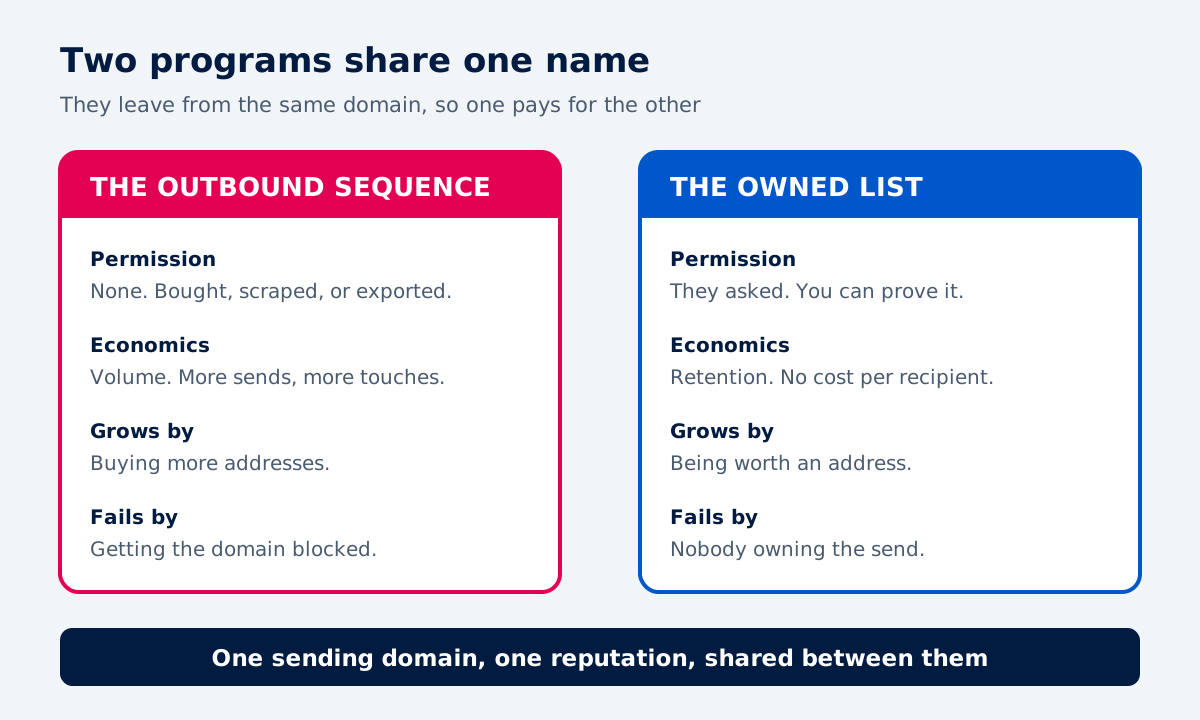
Two completely different programs share the name, and treating them as one thing is why most advice on the topic misses.
The outbound sequence
The first program is a sequence fired at a list the recipient never agreed to join. Addresses bought, scraped from author lines on papers, pulled from a conference attendee export, or lifted from a job title filter. It runs on cadence logic: touch someone a set number of times, log the activity, move on.
It is a sales motion wearing marketing's clothes, and its economics are volume. Done with an account list and real research behind it, that motion has a legitimate shape, which is the subject of account-based marketing for life sciences. Fired at a scraped list, it is something else.
The owned list
The second program is a recurring send to people who asked for it. It runs on permission, it grows slowly, and its economics are retention. Nobody throttles it, nobody charges per recipient, and no algorithm decides how much of your audience sees this week's edition.
That last point is what "owned" actually means, and it is the reason we treat email differently from the LinkedIn audience most life science companies have already built, where the platform decides who sees what. You can rent reach into a scientific audience, and Springer Nature will send a dedicated email to more than 240,000 science and healthcare professionals on your behalf.
That is a real product and it works. It is also a single send at a price, and the addresses stay with the publisher.
Why the two programs damage each other
Both leave from the same domain. So the true cost of the outbound program is rarely the send itself. It is the reach it burns for everything else the company sends, including the newsletter it has not built yet.
The sector's posture explains how it got here. Only about 9% of life science companies, roughly one in eleven, show strong distribution or repurposing. Publishing gets budget, moving what you published to the people who would value it does not. That is the gap a distribution strategy is supposed to close.
The staffing shows the same shape. Email marketing and nurture appears in about 9% of pharma marketing job posts, roughly one in twelve. A company can believe email matters and still have nobody whose job it is on Monday morning. The pharma end of that problem, where the rules are tightest, is covered in pharma email marketing.
We see the default motion often enough to recognise it on sight. Westlab, a life science manufacturer we worked with, grew through manual research, cold calling, conferences, and lab visits.
That is a high-effort, rep-dependent way to grow, and it is the one most of this sector still runs on. Email inside it is not a channel. It is a faster way to do the cold calling.
Why do our emails end up in spam or get no reply?
Because in this sector the people you are emailing have industrialised their defences, and the damage lands at the level of the institution rather than the person.
Everywhere else, deliverability advice is hygiene. Clean your bounces, remove inactives, watch your sender score. That advice is fine and it is not what is happening to you here.
The inbox you are sending into
Two studies from the same academic pathology group put numbers on it, and they are the most useful numbers available.
In the larger one, 17 faculty and 9 trainees saved seven consecutive days of unsolicited email from journals, conferences, and webinars, 755 messages in total. 44.4% of them were flagged as potential spam by the institution's default settings.
Not by the recipient. By the institution, before anyone read a word.
The heaviest load was 158 messages in a week, about 8,200 a year, and it fell on the most senior people. Seniority attracts volume, so the person you most want to reach is the person best defended against you. One department, one institution, one week, so it points a direction rather than fixing a rate.
The second study is smaller and blunter. Two clinicians logged every message for a fortnight, and one averaged 50 inbox messages a day while the other averaged 113. Vendor solicitations made up 22.8% of one author's junk folder. That is a two-person self-study, so take it as scale rather than as a rate.
What a recipient's report actually does
Here is the mechanism most senders never learn, and it is documented by Microsoft rather than inferred.
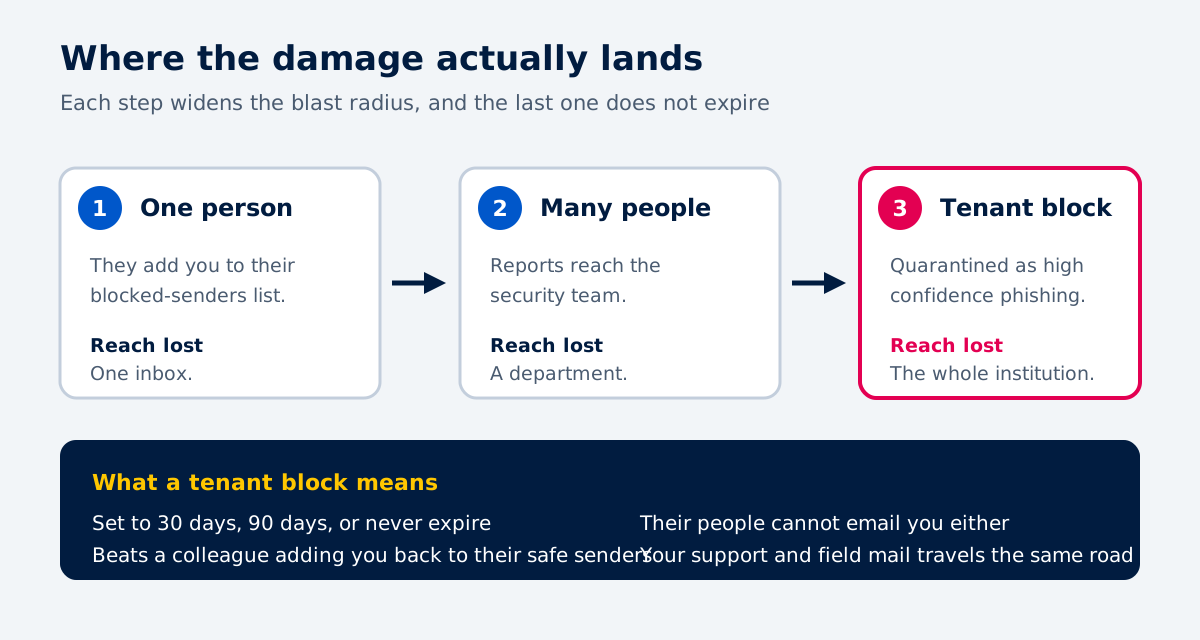
An individual's blocked-senders list moves your mail to their junk folder.
A tenant-level block entry is a different animal. An administrator or security team creates it from user reports, and mail from a blocked domain is then treated as high confidence phishing and quarantined for the whole organisation.
Three details make that permanent rather than temporary:
- Block entries default to 30 days, and an administrator can set them to 90 days or to never expire.
- A block entry beats an allow entry, including a colleague's own safe-sender entry. One person adding you back does not undo it.
- Users inside that organisation also cannot email you. Their message bounces with 550 5.7.703. The relationship closes in both directions.
A scientist on r/labrats described the outcome without knowing the machinery: "I have done such a good job of block sender and report spam that our institutional filters are catching more and more of these."
That is the sentence to sit with. The unit of loss is not a contact. It is a university, a hospital system, or a company.
The threshold you can actually hold yourself to
Google publishes the clearest number anyone has put on this. Since February 2024, senders to personal Gmail accounts must keep user-reported spam below 0.10% and never let it reach 0.30%. Cross 0.3% and you become ineligible for delivery mitigation until the rate holds under it for seven consecutive days.
Send more than 5,000 messages a day to Gmail addresses and the bar rises again: SPF and DKIM together, a DMARC record, one-click unsubscribe on marketing mail, and unsubscribe requests honoured within 48 hours.
One honest caveat. Google states those rules govern personal Gmail accounts, not Google Workspace tenancies, and most life science recipients sit on institutional Workspace or Microsoft accounts.
So treat 0.3% as the best published proxy you have, not as the rule governing every recipient on your list.
The sending subdomain, and what it does and does not fix
Moving marketing mail to info.yourcompany.com or news.yourcompany.com is legitimate engineering. Separating streams helps receivers learn each pattern, and a Microsoft block on yourcompany.com does not automatically extend to a subdomain.
It also does not do the thing people hope it does. ActiveCampaign, which sells the sending software, states it plainly: "Subdomains are not a way to avoid a bad domain reputation."
Reputation flows reliably downward from root to subdomain and probabilistically upward, weighted by volume, and domain blocklists frequently list the parent.
There is a second cost that has nothing to do with engineering. Recipients read the subdomain as a confession.
A sales representative on the same thread explained why. Mass blasts arrive from a subdomain precisely because filters catch the main domain, and when a company blasts hard enough, its own service representatives and field application scientists stop reaching existing customers.
Nobody has measured how often the support inbox pays for the marketing volume, so take the scale as a practitioner's observation. The direction is documented: a tenant block covers a domain across an entire organisation, and root reputation bleeds into every stream beneath it.
How do you build a list of scientists who actually want to hear from you?
Mostly offline, slowly, and by giving something away that is worth an address.
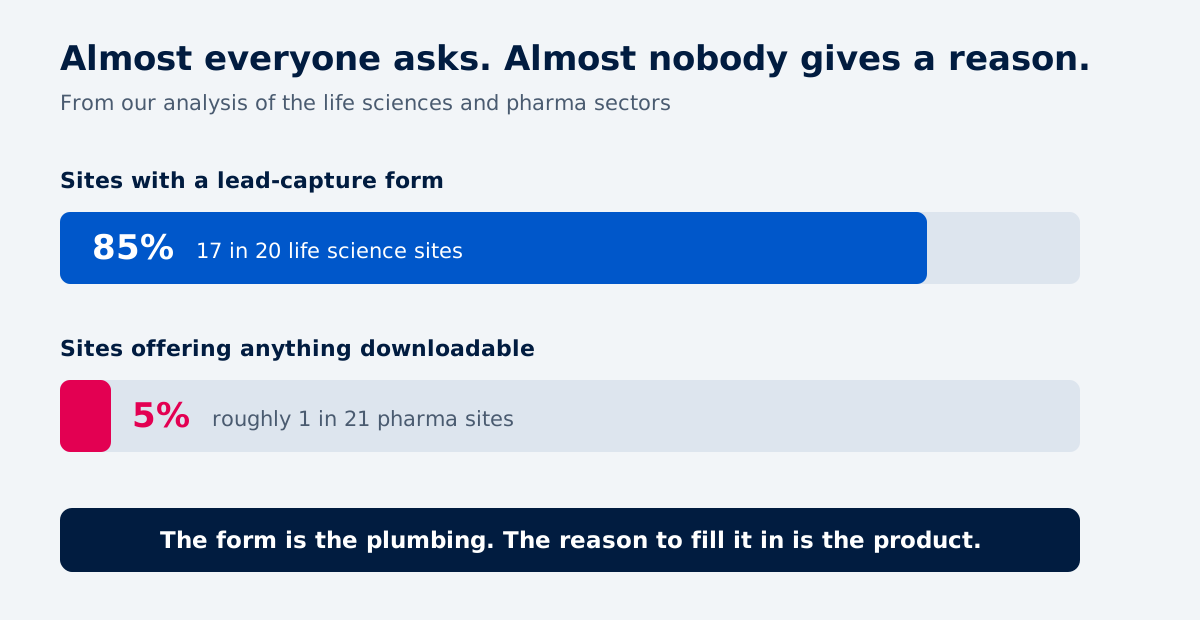
Our own numbers show a sector that built the plumbing and skipped the reason. A lead-capture form sits on about 85% of life science sites, 17 in 20, while only about 5% of pharma sites, roughly one in twenty-one, offer anything downloadable.
Those two figures are the whole problem in one line. Almost everyone asks. Almost nobody gives a reason. It is the same fault line that runs through inbound marketing for life sciences, where the capture machinery is built and the reason to use it is not.
Make the exchange worth making
When we built this for Westlab, the move was not a bigger form. It was wiring downloadables and practical guides as problem-specific lead magnets against real day-to-day lab problems, so the thing behind the form solved something on the bench that week.
We also think the capture point should follow the reader rather than live in the footer. An article about a method wants an offer about that method, not a generic newsletter box that treats a first-time visitor and a returning evaluator identically. That is the whole argument behind how we approach lead capture and qualification.
Do not spend the permission the moment you get it
A download is the one moment a scientist volunteers an address. It is also the moment the sector most reliably burns it.
The complaint is specific and it repeats: "God forbid you download a white paper from them. Fifteen minutes later, hey, we saw you looked at our website, wanna see it in person." Another lab scientist: "I get a call within 30 mins from their rep after requesting a white paper."
We should be straight about a tension in our own practice here. In other B2B work, speed of first follow-up genuinely is the lever, and we have wired inbound triggers straight into a sequence for exactly that reason, which is the pattern behind the content-led outreach system we run elsewhere.
On a gated report campaign, we tested filling in contact forms on competitor sites and found only one competitor followed up quickly at all. Speed was the gap.
In a lab audience, that same speed reads as surveillance. Both things are true, and the reconciliation is not about the clock. It is about what arrives, and about who the lead is handed to and with what context.
A fast message that delivers the thing, adds the next useful piece, and names a human who understands the science is welcome at fifteen minutes. A fast message that asks for a meeting is what gets a domain filtered.
Can we buy a list of scientists?
Not really, and the reason is more useful than the answer.
What the market actually sells is a send, not a list. The publisher or community mails your creative to their own opted-in audience and keeps the addresses. ILADS states it directly: "Email addresses are not provided directly to the advertiser."
Read that as good news. List rental is an acquisition channel with a conversion step, not a shortcut around building an audience. It belongs on the same shelf as every other rented distribution channel, judged on what it sends people back to.
Whoever fills in the form afterwards is the only part you keep, so design the landing page as though it is the whole point, because it is.
What the rules actually say
The compliance section of most guidance on this topic leads with HIPAA. For a tools, reagents, instrument, or CRO email program that is largely beside the point, because HIPAA governs covered entities and business associates handling protected health information, not B2B marketing to a lab. If your programme sits on the services side of that line, the CDMO and CRO version of this problem is a closer read.
The rules that do bite are simpler than they look.
In the UK and Europe, B2B email to a company is not the consent problem people assume. The ICO is explicit that PECR's electronic-mail rule does not apply to corporate subscribers, so you do not need PECR consent to email a limited company.
Two catches follow. Sole traders and most partnerships count as individual subscribers and do need consent. And you are still processing a named person's data, so UK GDPR still applies.
The ICO marks legitimate interests as likely appropriate for business contacts, subject to a three-part test, and the individual's right to object overrides it.
In Canada, the rule speaks directly to the paper-scraping habit. Under CASL, an address published openly gives implied consent only if the publication carries no statement declining unsolicited messages and your message is relevant to that person's role, functions, or duties.
The CRTC's own worked example is a company harvesting addresses from websites and publications, and the burden of proof sits with the sender, down to keeping dated screenshots.
That relevance test is where the sector's favourite tactic fails. Mailing every author who used a competitor's reagent is defensible when the product does that person's job. It is not defensible at scale, which is how you end up with an electrophysiologist writing "I do not need your genetic engineering services, Jean."
Two more CASL details worth knowing, since implied consent expires:
How you got the address | How long implied consent lasts |
Business card handed over at a conference | Two years |
An enquiry or application from the person | Six months |
Express opt-in | No time limit, until they withdraw it |
Penalties run to CAD $1 million per violation for an individual and $10 million for a corporation.
What should you actually send to scientists and lab buyers?
Something useful in the long gap between purchases, because the buying moment you are writing toward mostly is not available.
Why a discount cannot move a validated method
The reason sits in the work, not in the inbox. A scientist on r/labrats put it in one sentence: "I just spent a year validating my assays with Qiagen reagents. I'm not wasting another year doing it all over again so we can buy reagents from some random nobody company."
That is not stubbornness. Under CLIA and ISO 15189, a clinical laboratory has to verify a method's performance in its own hands before it can report a patient result, and a research group has protocols, controls, and published work resting on the reagents already in the freezer. It is the same switching cost that shapes how diagnostics companies have to sell.
Independent work outside the forums says the same thing. A study of cell culture researchers' buying behaviour found the process splits sharply between repeat and new purchases, with researchers reluctant to adopt new reagents because established products and processes already existed.
Whatever adoption did happen came through the scientific community rather than through vendors. It is a master's thesis built on a small number of interviews, so it corroborates rather than proves.
Then there is the pricing floor. Two more lab scientists, unprompted: "Our university has pre negotiated pricing with preferred vendors. Either I'm buying from you already, or you can't beat the preferred pricing." And, after opening an attachment: "we get better prices through our institutional agreements."
Against all that, a promotional email has nothing to act on.
The job the email is actually doing
The best description of that job we have seen came from a science-trained sales representative describing his own role: making people aware of what is possible to do these days, of when prices for formerly expensive techniques drop, and of the pitfalls in a project.
That is a newsletter brief, written by accident, and it survives every constraint above. It does not require a buying moment. It does not ask anyone to re-validate anything. It arrives useful and it compounds, because the reader who learns a technique got cheaper this year is the reader who specifies it next year.
Content that survives in this audience tends to be one of five things:
- Method and application updates. What changed, what it now costs, what it replaces.
- Troubleshooting and pitfalls. The failure modes nobody publishes.
- Honest comparison. Including where your product is the wrong choice.
- Access to a person. A named scientist who answers the question behind the question.
- The thing they already asked for. Delivered properly, then followed by the next useful piece.
That list is the email-shaped version of the decision layer we argue for in how to market a life science product, and it is the reason the newsletter and the product content have to be planned together rather than by two different people.
Keep the real competition in mind. Your email is not competing with other vendors' emails, it is competing with the literature.
Researchers report roughly 20 article readings a month, find about 34% by browsing and 29% by searching, and rate journal articles as the most important source they have while ranking social media posts next to last.
An email earns its place by pointing at something in that world, not by announcing a promotion. We also think one email should do one job and ask for one step. When an email carries three offers, it is usually because nobody decided what it was for.
Why the case-study blast disappoints
Which brings us back to the marketer at the top of this page. Their list was warm, built from past customers and people met at conferences, and the case studies were real.
The reply they got in the marketing forum was the right one. Scientists are flooded, so the better bet is a recurring educational newsletter carrying content they actually want to read, and pure sales outreach in the shape of "here is what we did for another client" gets ignored almost every time.
A case study answers a question a buyer asks in the last third of a decision. Send it to four thousand people and most of them are not in a decision at all. Sequencing that properly is one of the five choices in a life science marketing strategy.
How often should you send, and why do life science newsletters keep dying?
They die because nobody owns the send and because the cadence was designed against the review process instead of around it.
Review throughput sets the ceiling, and it is not fixed
The standard advice recommends a drip and never mentions that a promotional claim about a regulated product has to clear medical, legal, and regulatory review first. That review is the reason programs stop at issue four, and it is the same constraint we unpick in content marketing for pharmaceutical companies.
It is also far more variable than people assume. In Veeva's 2024 survey of commercial leaders at medical device and diagnostics companies, 60% of organisations running manual or homegrown review processes take more than four weeks per asset, with three to five rounds.
That share falls to 30% for companies on a commercial cloud system, and to 10-15% for companies with managed claims libraries. Veeva sells the software that produces those gains, so read the direction rather than the decimal. If devices are your world, medical device marketing covers what that review cycle does to everything else.
The same regulatory obligation produces four weeks at one company and under two at another. Cadence is a design decision that companies have been treating as a law of nature.
Separate the streams, because the regulator already told you to
The most useful instruction on this comes from an unexpected place. In its January 2025 final guidance on scientific communications about unapproved uses, the FDA works through how firms should share that information, and one of its worked examples is about email specifically.
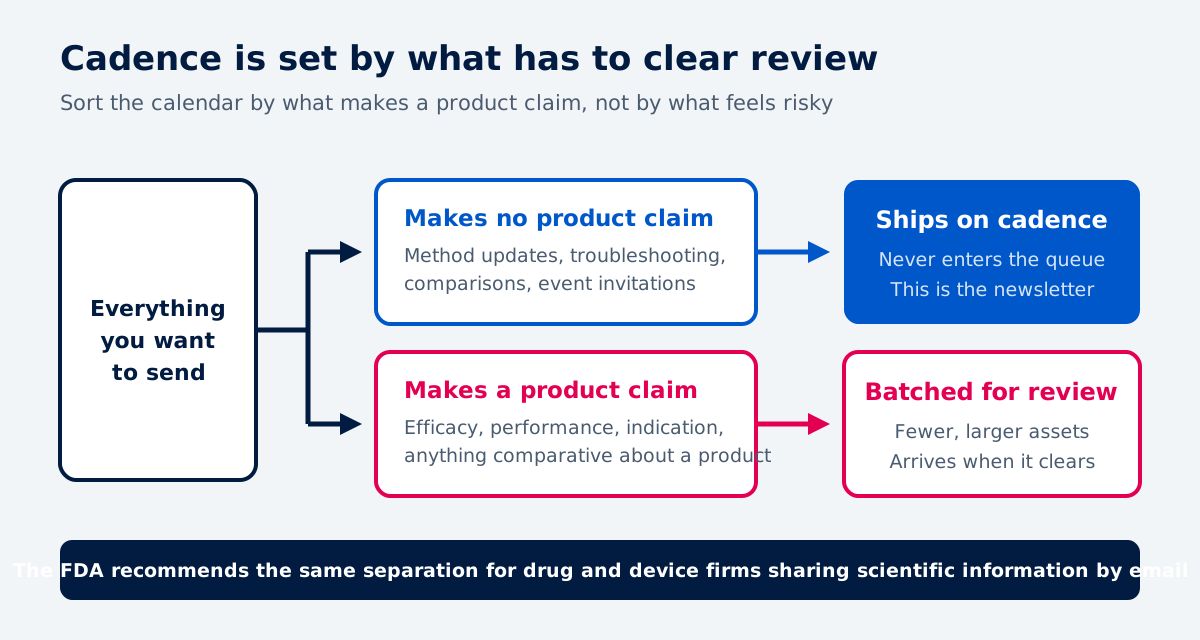
Where a firm shares both scientific information about unapproved uses and promotional information about approved ones, FDA recommends that the scientific emails be separate from the promotional emails, each clearly identified.
It gives the same recommendation for web pages, and adds that firms should not link from promotional pages to scientific ones.
Scope it honestly. That guidance covers drug and device firms communicating about unapproved uses of approved or cleared products. A reagent supplier is not bound by it.
The architecture is still the point. A regulator working purely from the risk of confusing a clinician arrived at the same design an audience-first marketer arrives at from the other direction: education and promotion are two different sending streams, and mixing them degrades both.
Practically, that gives most teams more sending capacity than they think:
- Sort the calendar by what makes a product claim, not by what feels risky. Method education, troubleshooting, and event invitations usually make none.
- Batch the claims. Put them into fewer, larger reviewed assets rather than scattering them across every send.
- Build the recurring stream from material that never enters the queue, and let the claims-carrying pieces arrive when they clear.
If you want the mechanics of turning one reviewed asset into a stream of sends, our approach to content distribution and the email-specific version of it both describe the same batching logic.
Somebody has to own it
The hiring data says this is where it breaks. Email and CRM appear in about 15% of life science marketing job postings, so roughly six in seven of the roles this sector hires never name the channel at all.
A weekly cadence nobody owns becomes a monthly cadence, then a quarterly one, then an apology. Pick the cadence the owner can hold in a bad month, not the one that looks right on a plan.
How do you measure life science email marketing?
Not by open rate, and, in this audience specifically, not by raw click rate either.
Open rate stopped being a measurement in 2021
Apple's Mail Privacy Protection downloads remote content in the background "regardless of whether you engage with the email", which fires the tracking pixel whether or not a human ever looked. Litmus put Apple Mail at roughly 49% of tracked opens in January 2025.
One precision that matters, because it is commonly garbled. Mail Privacy Protection pre-loads images. It does not pre-fetch links. So it inflates opens and leaves clicks alone. Click inflation is a separate problem with a completely different cause.
Click rate is broken too, and this audience has it worst
Corporate and institutional email security tools open every link in a message before the recipient sees it. Microsoft Defender Safe Links, Proofpoint URL Defense, Mimecast, and Barracuda all do this, and from your platform's point of view each check looks exactly like a person clicking.
Four independent measurements agree on the scale, and one of them should change how anyone in this sector reads a dashboard.
GlueLetter analysed 105,432,741 newsletter link clicks between January and May 2026 and found 56% of all click events were artificial. Broken down by the recipient's domain, the picture is not evenly spread at all:
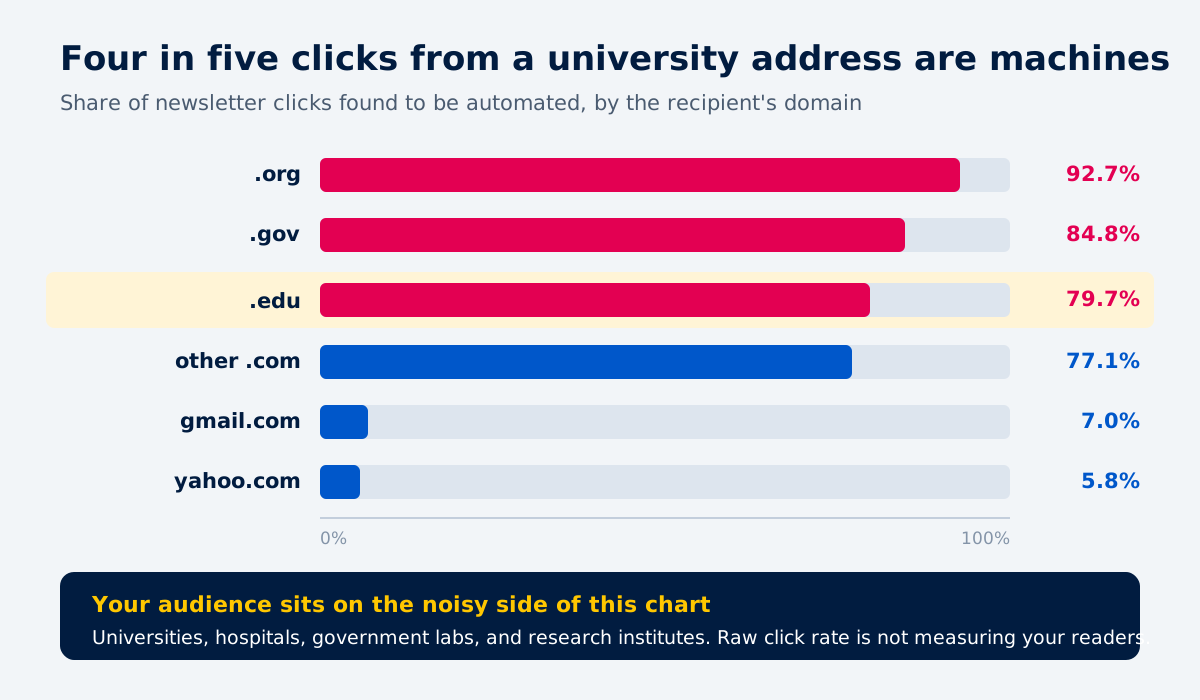
Recipient domain | Share of clicks that were not human |
.edu | 79.7% |
.org | 92.7% |
.gov | 84.8% |
Other .com | 77.1% |
gmail.com | 7.0% |
yahoo.com | 5.8% |
Four in five recorded clicks from a university address are machines. Your audience is universities, hospitals, government labs, and non-profit research institutes. The distortion in your reporting is close to the worst in the industry, and it is a property of who you serve rather than of anything you did.
The corroboration is consistent. Omeda found 87.3% of recorded click activity across 1.77 billion emails in Q1 2026 came from non-human sources, and the M3AAWG working paper the industry still cites puts non-human interaction at 20-80% of B2B clicks.
You can test it yourself. On a clean 8,505-person opt-in list, an invisible link was placed in the footer, coloured to match the background. Of 968 reported clicks, 691 landed on the link no human could see. The reported click rate was 24%. The real one was 7%.
Both GlueLetter and Omeda sell bot filtering, so their incentive runs toward a large number. That is precisely why two independent datasets agreeing, plus a reproducible test anyone can run, is worth more than either alone.
The part that is not a reporting problem
Fake clicks do not just flatter a dashboard. They trip the automation.
Most nurture logic branches on clicks: click this, you are engaged, enter the warm sequence. A security scanner clicks everything, so a recipient who never opened the message gets scored as your most engaged contact and routed into a sequence built for someone in a buying conversation. Then the sales team calls them. It is worth auditing how your nurture and reactivation logic scores engagement before you trust any of it.
The fix is narrow. Invalidate the click, never the subscriber. Omeda argues explicitly against the popular rule of suppressing anyone who clicks within five seconds, because scanners also re-scan on a delay of days or weeks, and some fast clicks are a real person on a phone.
So what is a good open rate for a life science email?
The two most defensible numbers available answer that question by refusing it.
MailerLite's median across 3.6 million campaigns from 181,000 accounts puts the overall open rate at 43.46%, the click rate at 2.09%, and unsubscribes at 0.22%, with medical, dental, and healthcare senders at 43.75% and 2.25%.
SciLeads surveyed people selling instrumentation, equipment, and consumables to scientists and found an average cold email open rate of 10.7% and a reply rate of 4.2%.
Both are honest, and they measure different things: opted-in marketing sends to a mixed audience, against cold outreach to scientists. Put them side by side and the useful conclusion appears.
A benchmark without a stated method and audience is not a benchmark. The figure still circulating for this sector, an 18.58% open and 2.25% click for "pharmaceuticals", is a platform aggregate published before any of the distortions above were understood. The same discipline applies to the rest of the dashboard, which is why we are so specific about which metrics are worth tracking and which are not.
Measure against your own history, cut by email type and by recipient domain.
What to watch instead
- Reply rate. No scanner writes a reply. In a technical sale it is the only unambiguous signal you get.
- List growth from your own properties. Subscribers from your site and events, tracked separately from anything imported.
- Complaint and unsubscribe rate. Complaints below 0.10%. Unsubscribes tell you about cadence and relevance, and they are honest.
- Engagement handed to sales as context. Not a score, the actual thread of what someone read.
- Human clicks only, segmented by receiving domain, with the institutional segment read separately.
Tying those back to spend is its own exercise, and how life science companies justify and measure marketing spend walks through what a finance team will actually accept.
You cannot measure any of it without the plumbing
The reason most life science teams cannot answer "did email do anything" is infrastructural rather than analytical.
Fewer than one in ten pharma sites run detectable marketing automation, and under 9% run a detectable CRM. Even above $500 million in revenue, CRM adoption reaches only about 29%.
Without automation, a nurture sequence is a series of one-off sends. Without a CRM, an engagement signal has nowhere to land and nobody to reach. It is the same missing layer we describe across our life sciences work, and in content marketing for biotech, where the story is usually strong and the system underneath it is not.
When we built the connected version of this for Westlab, the engagement and readiness signals from the resource hub told sales which leads were genuinely serious. That is the difference between a list and a system.
In three months it produced 241 inbound leads in a market that had run on cold outbound and influenced $120,000 in quotes.
The email was not the clever part. The email was the part that had somewhere to go.
Is your email an owned audience, or just a faster way to cold call?
Get a Content RevOps audit, your owned-distribution position, capture architecture, and answer-layer visibility benchmarked against the life sciences 2026 data, with every gap priced in numbers your board can argue with.
Frequently Asked Questions
About the Author

Founder & CEO, Content RevOps
Stefan Kalpachev is the founder and CEO of Content RevOps, where he helps B2B SaaS companies transform their content into predictable pipeline. With a background in content marketing and revenue operations, Stefan has developed a unique methodology that bridges the gap between content creation and revenue generation.
Connect on LinkedIn