Content marketing for diagnostics companies when the lab is modelling its own next three years
Your buyer is modelling their own next three years, not reading your spec sheet. Do you know what they find when they check you?
Book a CallA lab is not evaluating your test. It is modelling its own next three years, and that single fact should decide every choice in your content marketing programme.
Part of Content marketing for life sciences, the complete guide.
The inputs to that model are the validation study your test will force it to run, the money it will collect each time the test fires, the send-out volume it can pull back in-house, and the contract it signed four years ago and cannot leave. Your sensitivity and specificity are in there somewhere, near the bottom.
Almost all diagnostics content is written to describe the test. That content arrives after the question it answers has already closed.
There is good evidence for how early it closes. A survey of US labs offering hemochromatosis testing, published in Nature with a 93 percent response rate, found a mean of 14 months from the key scientific publication to clinical adoption. Sixty percent of the labs offering the test had adopted it before any patent issued.
Publication starts the clock. Your launch does not.
This piece is about business-to-business diagnostics, companies selling assays, analyzers, and lab services to hospital labs, reference labs, and health systems. Direct-to-consumer testing is a different sale to a different buyer, and it sits in the wider territory covered by what diagnostics marketing actually means. Everything below is part of how we work with life sciences companies.
Who signs off on a new diagnostic test, and why it is not the ordering clinician
The person who orders your test almost never buys it.
That single misalignment produces more wasted diagnostics content than any other decision. The ordering physician is a genuine audience, and they are worth writing for once the test is live. They are just not the party that signs, and content aimed at them will not move a purchase. It is the same structural mistake that stalls content marketing for medical device companies, where the clinician champion gets persuaded and the committee that decides never does.
The purchasing structure sits somewhere else entirely.
The seats, and what each one actually controls
- The system contract manager tracks expiry dates across the whole system, runs the RFP, and contacts vendors when ready.
- The lab director, commonly an MD or PhD pathologist, owns the technical verdict.
- Finance owns price and whether you get a backup instrument.
- Biomed owns serviceability and the end-of-life cliff.
- The payer decides, later and separately, whether any of it gets reimbursed.
- Bench techs decide nothing and shape your reputation more than anyone.
Published capital policies show how little of this happens in the moment. At Denver Health, an unbudgeted purchase of $1 million or more goes to the board, but anything already on the approved capital list for that year skips executive approval entirely.
Read that carve-out closely. The decision that mattered happened months earlier, in a budget meeting your team was not in. Getting this map right is the whole of mapping the buyer world you are writing into.
Group purchasing adds another layer. The US Government Accountability Office reported a 2009 study finding that roughly 73 percent of hospital nonlabor purchases run through group purchasing organization contracts. GAO has also noted that hospital GPO membership estimates vary widely by source, so treat it as the shape of the market rather than a precise share.
One caution on this map. We could not find a credible published figure for how many people sit in one of these decisions, and the numbers circulating that claim to know it trace back to nobody. Understand the seats rather than trusting a committee size no study produced.
Going over the technical buyer''s head ends the relationship permanently
Escalation is standard enterprise sales advice. In clinical labs it reads as betrayal.
A decision-maker at a large retail health company put it without ambiguity: "never try to go ''up the line'' and bypass us to the c-suite. They have no idea who you are, and when we hear about it then it''s an automatic no for life for that vendor."
Others in the same discussion ranked the channels, and the ranking inverts most outbound playbooks. LinkedIn approaches read as inappropriate. One lab professional called cold calls "extremely rude" and said they make him "instantly not want to consider a vendor." Email is merely tolerated.
Another was blunter about the whole category: "Leave us alone, salesman. There''s like one person who makes these decisions and they will find you if they want your stuff."
Read that last clause as a brief rather than an insult. They will find you. The question is what they find.
Why awareness content underperforms when the buyer already knows you exist
Lab leaders describe discovery as something that happens between labs, not between vendor and lab.
One professional with 17 years in clinical labs: "I do not think in the 17 years I have worked in clinical labs I have heard a manager or director say, ''hey this company reached out to me about this new product I think we should try.'' Instead, it is almost always ''Such and such lab just wrote a paper about this new product that they have tried out and I think we should give it a try and see what we think.''"
That last clause is the important one. The paper does not just create awareness, it produces the decision to try.
Two-thirds of life science sites already cite peer-reviewed literature
When we studied life science websites, about 65 percent cited peer-reviewed literature.
So a director reading your white paper is not encountering rigor for the first time. Adding a fourteenth citation does not move them, because the register itself is saturated. What is scarce is evidence with someone else''s name on it. Biotech runs into the same wall, which is why content marketing for biotech has to work against readers trained to discount claims rather than absorb them.
The highest-value asset in this category is often not written by you
If credibility transfers lab to lab through published work, the content job changes shape. It becomes editorial support for customers who are already generating evidence about your product and have neither the time nor the incentive to publish it well.
That means covering poster costs, drafting alongside their team, handling figures, and then making the resulting paper findable rather than burying it behind a form. The output carries their name, which is exactly why it works. Mechanically it is the same discipline as working with subject matter experts, except the expert belongs to your customer.
There is a relay effect worth planning around. In interviews with twenty lab managers about a specific CAP laboratory practice guideline, eleven had heard about it from their own pathologist rather than from CAP directly.
Twenty interviews is a small base, and it matches how these buildings work anyway. Your material often has to survive being retold by a pathologist to a lab manager, which means writing the version a pathologist can retell. Give them something quotable rather than something comprehensive.
What a lab is actually modelling when it evaluates your test
Three of those four inputs get settled before your performance data enters the conversation. The fourth, what they collect per run, is large enough to need its own section and gets one below. Where those inputs leak money is the first question a life science marketing strategy has to answer.
The validation study you are asking them to run
Before a lab can report a single patient result from your test, it has to prove the test performs in their hands.
42 CFR 493.1253 sets the bar, and the way it splits is the most commercially loaded fact in diagnostics.
For an unmodified FDA-cleared test, a lab must verify three performance characteristics, accuracy, precision, and reportable range, then confirm the reference interval. For a laboratory-developed test, or any cleared test the lab modifies, it must establish seven.
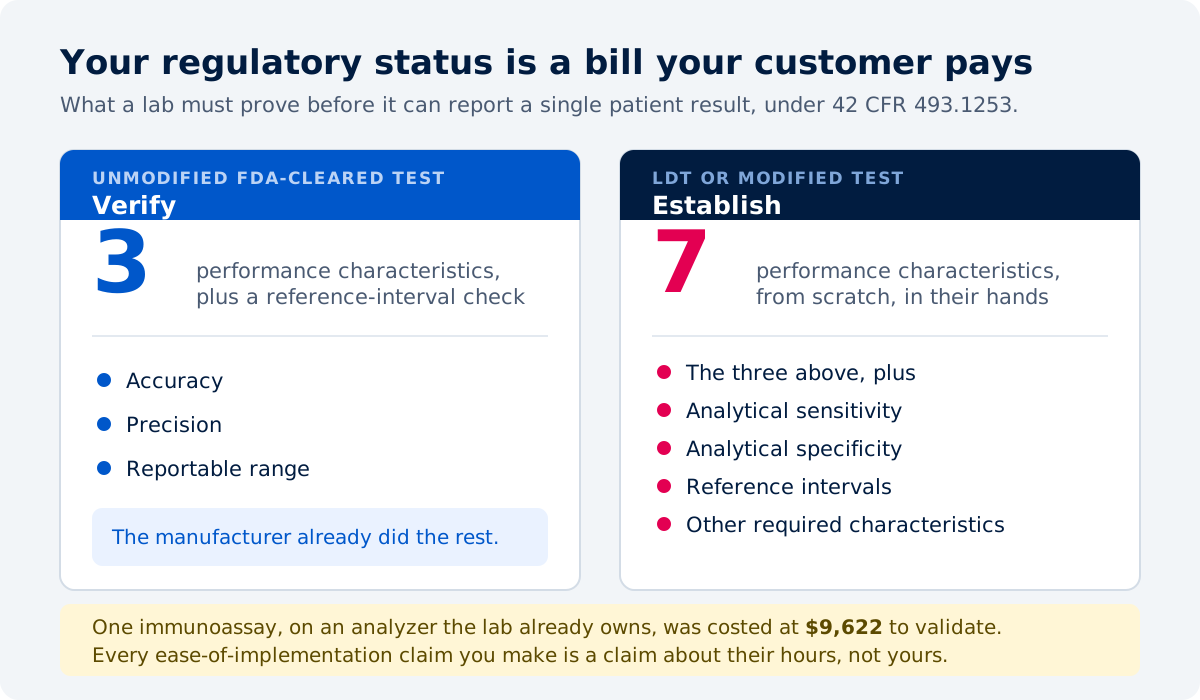
That gap is a bill your customer pays, and your regulatory status decides its size.
The bill has been costed. A 2024 study in Archives of Pathology and Laboratory Medicine put the validation of a single immunoassay, on an analyzer the lab already owned, at $9,622, using 100 patient and 50 control samples. Micro-costing work on next-generation sequencing puts amortized validation, maintenance, and overhead at $56 to $410 per sample.
Accreditation adds constraints that change your commercial model. CAP requires validation per instrument, including loaners, and in the location where testing occurs. Your applications specialist can run the study, but the checklist still requires the lab''s own personnel to confirm performance on known specimens.
Every ease-of-implementation claim you make is therefore a claim about their hours, not yours. So the content job here is not a claim, it is a document. Publish the validation protocol you would run, the sample counts, the expected hours, and the comparator method.
The send-outs they get to bring back in-house
This is the actual business case a lab builds, and most vendors leave the customer to construct it alone.
An eight-year review at Massachusetts General Hospital found that send-out testing was 1.06 percent of test volume but 12.4 percent of the laboratory budget, with an average unit cost roughly 13 times that of in-house testing.
Those figures come from one academic center and run to 2002, so treat them as the shape of the problem rather than your customer''s arithmetic. The ratio has held up well enough that later work in Applied Clinical Informatics still restates it.
A lab director recognizes that shape instantly. Send-outs are a small slice of what they do and a large slice of what they spend, which is why insourcing is the argument that gets budget attention.
Turnaround time usually improves too. Bringing heparin-induced thrombocytopenia testing in-house cut average turnaround from 3.12 days to 1.02 days in the study above.
Your buyer also knows where that argument breaks. A study that cut Candida auris identification from three days to ten hours could not demonstrate a significant length-of-stay reduction after adjustment.
Faster is not automatically cheaper for the hospital. Saying so is how the rest of your economics stays credible.
The contract they are already inside
Most diagnostics content assumes the buyer is free to choose. Frequently they are not.
Core-lab analyzer placements typically run three to five years, with five-year terms standard on core-lab and total-automation contracts. One filed reagent-rental agreement shows the structure clearly: a four-year non-cancellable term, monthly standing purchase orders, an annual price escalator, and an instrument the lab never owns.
The best description of what that lock-in feels like comes from a buyer, in public.
Cardiff and Vale University Health Board justified a £99.65 million non-competed five-year extension by stating on the record what switching analyzer platforms would cost them: 12 months of specification writing, 24 to 36 months of tender, 12 to 24 months of implementation, and up to 12 months of several senior staff working full time. Staying put required, in their words, simple correlation checking.
You are not being compared against another assay. You are being compared against doing nothing, and doing nothing is extremely cheap.
That has a direct publishing consequence. Content that helps a lab build the internal case for a switch, the migration plan, the parallel-running period, the correlation study, the staffing ask, does work that no performance claim can do. You are lowering the cost of the comparison, not winning it. That is the same decision layer every life science product needs, and the sector mostly does not build it.
How reimbursement decides whether your test survives
A test that works and cannot be billed is a test that dies on the menu.
Two systems decide this, and diagnostics teams routinely mistake one for the other. Getting a code is not getting paid. The American Medical Association, which runs the CPT process, states it directly: its panel "does not consider payment or coverage policy as part of this process."
Codes come from one body. Money comes from another. Winning the first feels like progress and guarantees nothing.
Worth naming the boundary of this section, since it is easy to slide past. What follows is about making the coding and coverage path legible to the lab that is deciding whether to run your test. It is not an argument for publishing health-economic dossiers at payers, which is a different job with a much weaker return, for reasons the evidence below makes plain.
What a new code actually buys you
Codes are easier to get than they look. Across four quarterly releases between October 2025 and July 2026, the Proprietary Laboratory Analyses code set added 99 new codes.
Timelines are slow in both lanes. A standard CPT application runs roughly 14 months from submission to a usable code, since applications are due 12 weeks before one of three annual panel meetings and most codes take effect on 1 January. The quarterly PLA route still takes about seven months.
A code is a listing. It tells a payer your test exists and what to call it, and it commits nobody to paying for it.
For molecular tests, MolDX is the gate that decides the money. It covers four Medicare administrative contractors across 28 states plus several commercial payers, and it requires registration, a Z-Code, and then a technical assessment, with claims held while that review runs.
Palmetto GBA reports that technical assessment succeeds for roughly 30 to 40 percent of submissions. That is the real pass rate on getting paid, and it is the number to plan against.
Clearance does not clear the bar that gets you paid
This is the sentence most diagnostics companies discover too late, and MolDX publishes it in its own FAQ.
"The FDA approval and clearance processes ensure only the clinical and analytical validity of the test. The FDA does not include clinical utility in their review, which is required for a technical assessment."
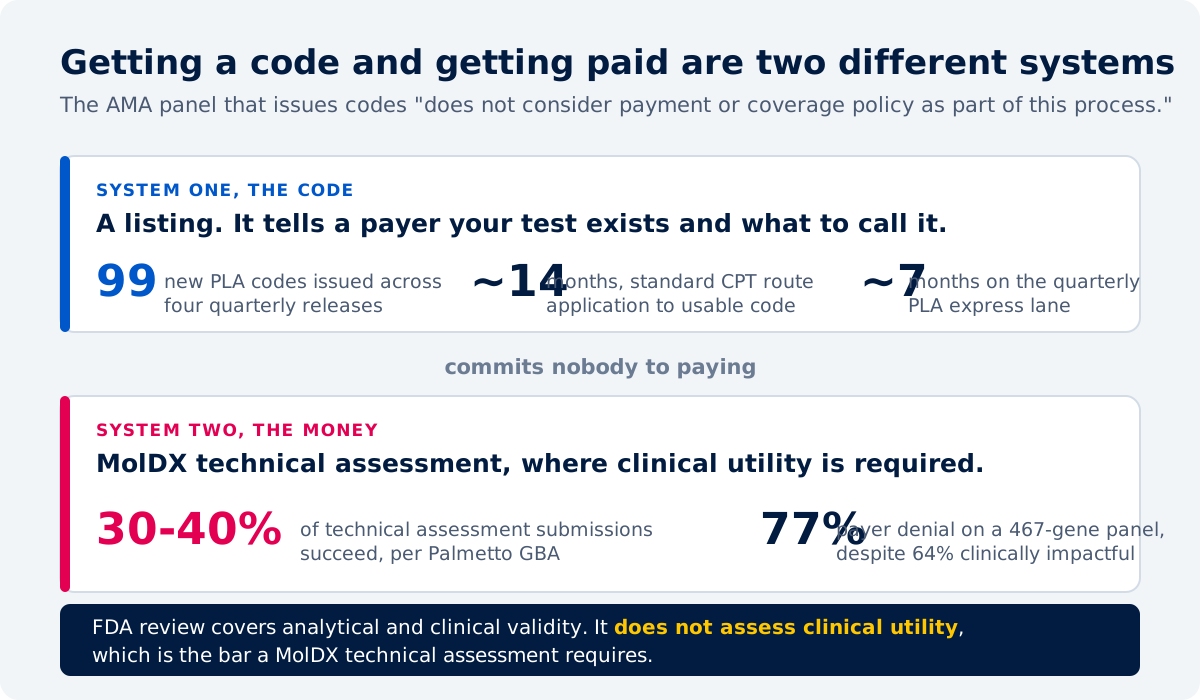
Analytical validity asks whether the test measures what it claims. Clinical validity asks whether the measurement tracks the condition. Clinical utility asks whether using the test changes what happens to the patient. FDA does not assess the third. Payers require it.
That gap is where tests die. A 467-gene panel study in JCO Precision Oncology recorded a 77 percent payer denial rate, with insurers reimbursing 10.75 percent of charges, even though results were clinically impactful in 64 percent of cases.
The evidence also says something specific about what to publish. Analysis of payer coverage policies for genomic panels found they cite clinical guidelines in 84 percent of cases, clinical studies in 69 percent, and cost-effectiveness analyses in just 5 percent.
Guideline inclusion is what payers actually read. Economic modelling is what they reference least, which is why treating health economics as your content pillar spends effort where the decision does not happen.
Payer language is not a niche skill any more either. Across life science marketing job posts we analyzed, payer or market access communications appeared in about 40 percent. The industry is already hiring for a register its published content barely uses, a pattern that also runs through content marketing for pharmaceutical companies.
What you are legally allowed to claim about a diagnostic test
Your marketing page is a regulatory document. The FDA has said so, in writing, with company names attached.
What an RUO label actually restricts
An RUO label does not buy you freedom to describe clinical performance. Under 21 CFR 809.10(c), the exemption holds only while the product is not represented as an effective diagnostic product.
FDA''s 2013 guidance on RUO and IUO distribution names the conduct that breaks it, and marketers should read the list as a list of their own deliverables:
- clinical performance claims or interpretation in labelling, advertising, or promotion, explicitly including workshops and presentations
- statements suggesting a lab can validate the product into an LDT
- soliciting business from clinical laboratories
- offering clinical-validation support
The guidance then removes the escape route: "Mere placement of an RUO or IUO label on an IVD product does not render the device exempt... FDA may determine that the device is intended for use in clinical diagnosis based on other evidence, including how the device is marketed."
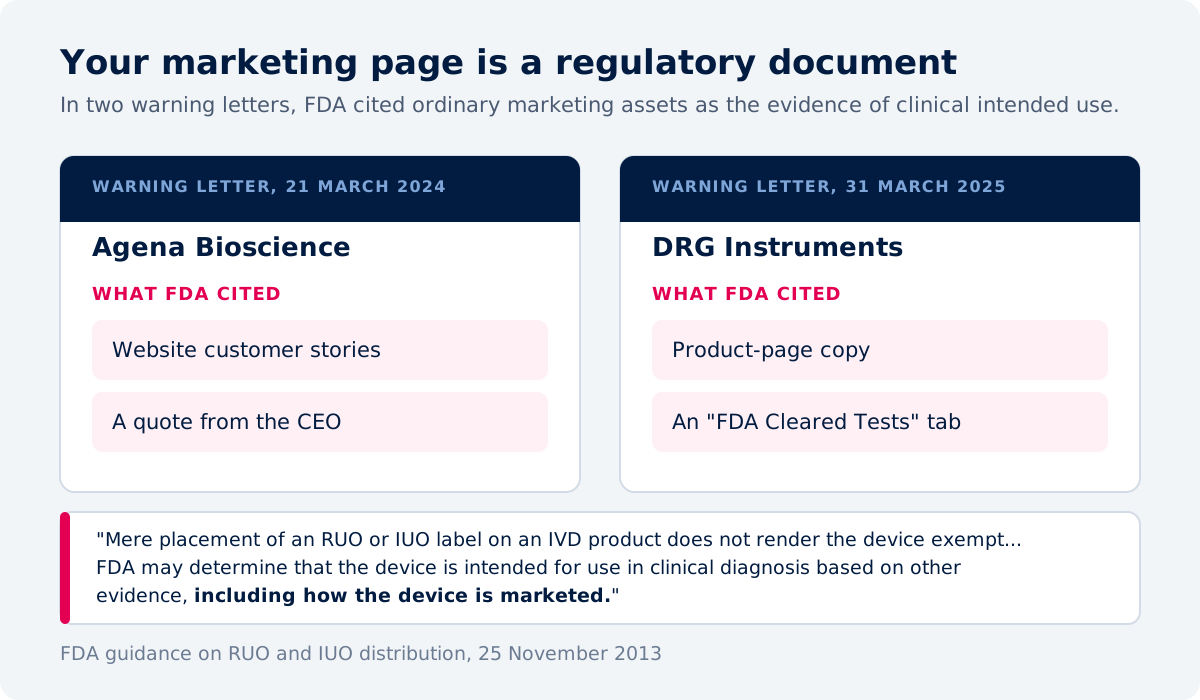
Two enforcement actions show what that means concretely.
In its March 2024 warning letter to Agena Bioscience, FDA cited the company''s own website customer stories and a quote from its CEO as evidence of clinical intended use. In March 2025 it wrote to DRG Instruments about product-page copy, including a tab labelled "FDA Cleared Tests" listing devices with no clearance on record.
Customer stories and product pages are ordinary marketing assets. In both letters, they were the evidence.
Cleared is not approved, and the difference is written into the regulation
Practitioners correct this constantly, and they are right to.
21 CFR 807.97 runs two sentences and says that a 510(k) determination "does not in any way denote official approval of the device. Any representation that creates an impression of official approval of a device because of complying with the premarket notification regulations is misleading and constitutes misbranding."
Writing "FDA approved" about a cleared assay is not a loose word choice. The regulation names it as misbranding.
The audience polices this independently, which makes it a trust event before it is ever a compliance one. One lab scientist described companies selling molecular products as though they were FDA approved, and pointed out that the FDA had never assessed them at all.
Whether you are an LDT or a cleared IVD changes what you may say
The regulatory ground moved recently, and content written before the shift now reads as dated.
FDA''s Laboratory Developed Tests final rule was vacated in full on 31 March 2025 by Judge Sean D. Jordan in the Eastern District of Texas, in American Clinical Laboratory Association v. FDA. FDA did not appeal, and in September 2025 it formally rescinded the rule.
Your audience is not reading from the same calendar. Since the vacatur, smaller labs have treated the matter as closed. Before it, an academic section running more than fifty LDTs across three genetics laboratories described exactly the burden the rule would have imposed, and said plainly that it had no funding to hire the staff to do it.
Both reactions are still live in the market. Content that assumes one settled position will land wrong with whichever half you did not write for.
Why a test on the menu still fails
Winning the account is not the same as winning the volume, and the gap between them is a content problem long before it is a sales problem.
The clearest demonstration in the literature is an accident. Researchers publishing in the Journal of Pathology Informatics reported that changing one checkbox in a computerized order set from optional to preselected moved post-transfusion platelet count ordering from 7.0 percent to 59.4 percent across 3,285 transfusions.
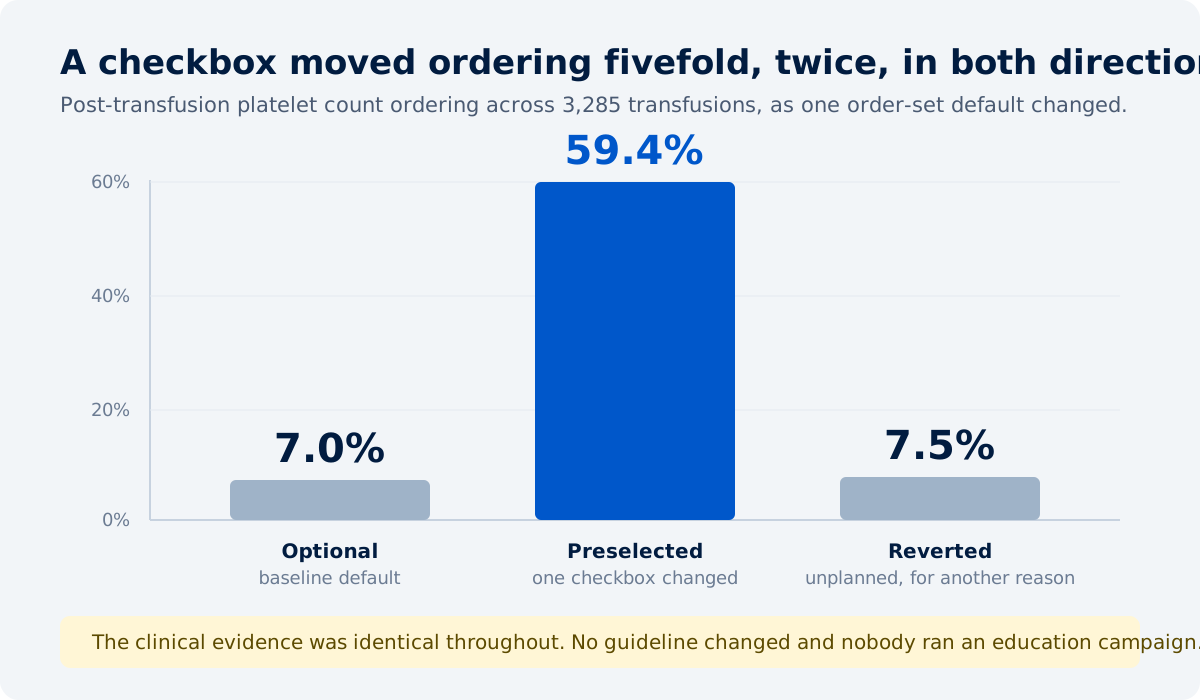
The default was later reverted for an unrelated clinical reason, and ordering fell back to 7.5 percent. Nobody designed that reversal, which is what makes it convincing.
The clinical evidence for the test was identical throughout. No guideline changed and nobody ran an education campaign. A checkbox moved ordering roughly fivefold, twice, in both directions.
The effect reproduces elsewhere. On a paper form, one hospital cut average monthly BUN orders from 1,221 to 448. A cluster randomized trial across 280 general practitioners and 280,804 tests improved ordering appropriateness by 21 percentage points through order-set design alone. Electronic ordering by itself, with no design change, moved nothing.
The practical consequence is that your test''s placement in the ordering workflow is a marketing surface, and almost nobody treats it as one.
Newly launched tests are exactly the tests that get ordered wrong
A systematic review in PLOS ONE covering 42 studies and 1,605,095 tests found that low-volume tests are mis-ordered at 32.2 percent, against 10.2 percent for high-volume tests. Initial testing goes wrong at 43.9 percent, repeat testing at 7.4 percent.
Every newly launched specialty assay is a low-volume test being ordered for the first time. Your product launches directly into the worst-performing cell of that table.
EGFR testing shows the scale. It reached the market in 2005, and by 2010 only 12 percent of 4,781 US acute-care hospitals had ordered it, covering 5.7 percent of guideline-directed patients. One hundred and forty-eight of the adopting hospitals ordered it exactly once.
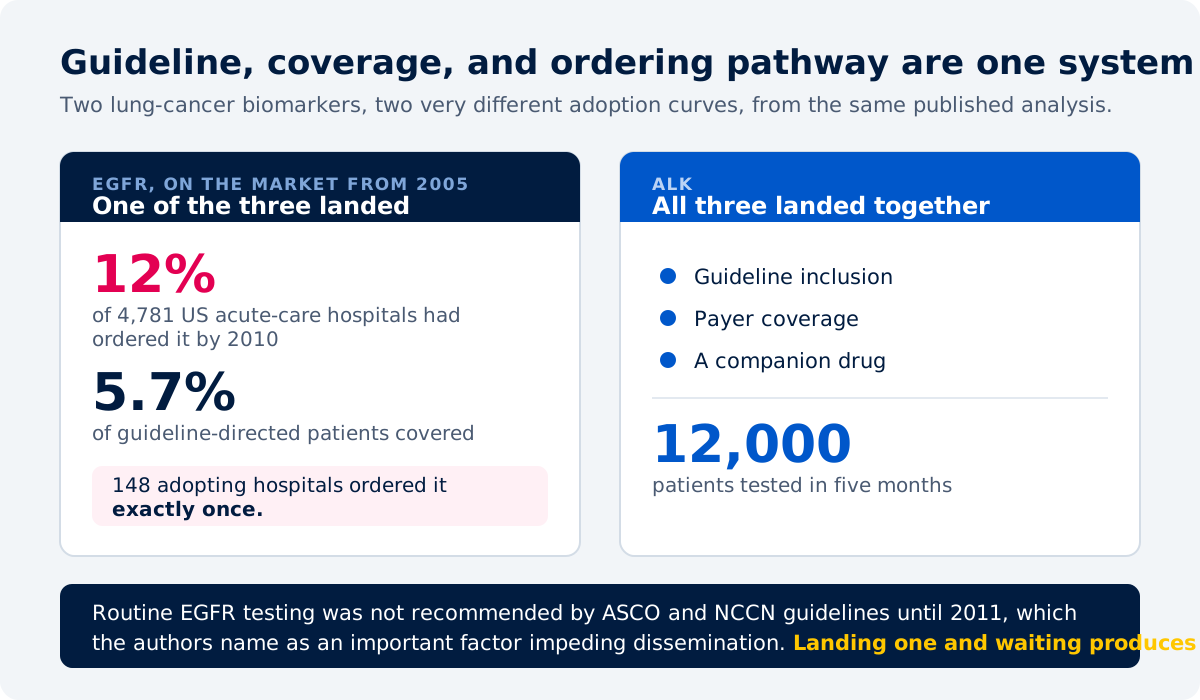
The authors name the reason directly. Routine EGFR testing was not recommended by ASCO and NCCN guidelines until 2011, and they identify that absence as an important factor impeding dissemination.
The same paper carries the counterfactual, and it is the part a marketer can act on. For ALK, guideline inclusion, payer coverage, and a companion drug arrived together, and roughly 12,000 patients were tested in five months.
Guideline inclusion, coverage, and an ordering pathway are one system. Landing one of the three and waiting produces EGFR. Landing all three together produces ALK.
High-sensitivity troponin shows how long the slow version takes, moving from 3.3 to 32.6 percent of registry hospitals over 11 quarters, with two-thirds still not implemented four and a half years after clearance.
The customer is mostly alone after signing
Between contract and steady-state volume sit the interface build, order-set placement, clinician education, and staff training. Each is a place the test stalls, and almost nobody staffs content against any of them.
In our analysis of life science websites, post-purchase material was around 10 percent of the content mix. The phase that decides whether your test gets ordered receives a tenth of the effort.
Integration is where this bites first. A device developer asking publicly how to connect an instrument to Epic was told that Beaker, Epic''s laboratory information system, requires a middleware tier, that Data Innovations dominates that layer, and that the customer almost certainly already runs it.
That answer is the content. "Connects to Epic" persuades nobody, while a page naming the middleware path, the interface specification, and the HL7 message types you support answers the question the integration team will actually ask.
Training is the second stall. Analyzer training commonly runs from a couple of days to a week, senior staff attend, and they return to teach everyone else. That cascade is where your product is either understood or resented, and it runs on materials you either supplied or did not. Treating those as real deliverables is what building supporting assets is for.
This is the phase we find teams underestimate most, because the sale feels like the finish line and the ordering behaviour that determines renewal is still months away.
Working with Westlab, a manufacturer whose customers are laboratory teams, the shift that mattered was treating education as the product rather than as support for it. Their real differentiator, acting as a discovery partner to labs, sat trapped inside the sales team where it could only be delivered one visit at a time.
We built a program around that expertise and brought lab managers into it as collaborators rather than an audience, through webinars and a flagship piece written with them. Education stopped being the thing that followed the sale.
What gets found when the contract clock runs out
The buying window opens on a date you do not control and cannot see.
A system-level manager tracks expiries, issues the RFP, self-researches, and then contacts vendors. One described the whole dynamic in a single clause: "The vital part for vendor is having visibility on the web or word of mouth." Everything else in that account, the calls and the emails, describes being deleted.
That clause is the entire brief. Being present, correct, and checkable on a day you did not choose. It is the same buying behaviour that governs content marketing for CDMOs and CROs, where the sponsor reads your material looking for a reason to rule you out.
There is a real opening in how buyers do this work.
A conference abstract reviewing device requests at one Brazilian teaching hospital found an average of 4.5 studies attached per request, and seven requests that attached only low-quality evidence. In four of those seven, the hospital''s own search later turned up randomized trials and systematic reviews that existed and simply had not been submitted.
That is one hospital and a small sample, so hold it loosely. It still describes something recognizable. The people building the internal case for your category often do it with worse material than the literature already contains, and supplying the better version shapes the comparison.
The test menu is the asset most diagnostics companies under-build
Someone searching a specific analyte, specimen type, method, or turnaround time is inside the buying window. A category brochure reaches nobody who is.
A structured, crawlable menu where every test has its own page, with specimen requirements, method, turnaround, comparator performance, and the code it bills under, is the highest-intent asset in this category. It is also, usually, a PDF. Built properly it behaves like a flagship content product rather than a catalogue.
Resource hubs do double duty here. With Westlab, the hub became a shared reference for buyers, sales, and internal teams at once, and organic traffic grew 205 percent in a narrow technical niche.
Sixty searches a month changes what winning looks like
Be honest about the arithmetic. Across every on-topic term in this space, monthly search volume runs to roughly sixty. This piece will not bring traffic, and neither will yours.
The work still pays, on a different scoreboard. Content in this category earns its keep three ways: answer engines cite it when a buyer asks a question with no good published answer, your own team has something linkable to send, and it sits waiting for the small number of people whose contract expires this quarter.
That first route is the one most diagnostics teams have not costed. Being the source a model quotes is a structural property of the page, not a volume game, which is what makes one brand get cited in AI answers while a better-known competitor is ignored, and the mechanics are set out in the AEO guide.
If you want to know where your own surface sits against the field, the life sciences benchmarks and the benchmarking tool will tell you in about ten minutes.
Write for the fifteen people who matter, not the fifteen hundred who will never search.
Is your content built for the lab's model, or for your product?
Get a Content RevOps audit, your evidence assets, claims posture, and AI-search visibility benchmarked against the life sciences 2026 data, with every gap priced in numbers your CFO can argue with.
Frequently Asked Questions
About the Author

Founder & CEO, Content RevOps
Stefan Kalpachev is the founder and CEO of Content RevOps, where he helps B2B SaaS companies transform their content into predictable pipeline. With a background in content marketing and revenue operations, Stefan has developed a unique methodology that bridges the gap between content creation and revenue generation.
Connect on LinkedIn