Content Marketing for Biotech: Beyond the Hype
Ready to make your biotech content easier to understand — and harder to ignore? Build a content system that turns complex science into clear market education, stronger trust, and higher-intent commercial conversations.
Book a CallMost advice about content marketing for biotech companies assumes someone is waiting at the end of it to buy something. Build a buyer persona. Map content to a funnel. Publish awareness pieces at the top and comparison pieces at the bottom, then measure what converts.
Part of Content marketing for life sciences, the complete guide.
For a company selling reagents or instruments, that holds up. For most biotech companies, nobody is waiting at the end of the funnel, because there is nothing to sell yet.
The US has more than 2,000 biotech companies, roughly 300 of them publicly listed. That leaves around 1,700 private and venture-backed firms, and those companies typically run one to three preclinical or research programs apiece. Having a scientific thesis, a burn rate, and no product is the ordinary condition of the industry.
That one fact changes everything about who reads what you publish. The people who make decisions about a pre-commercial biotech are investors, business development teams at larger companies, scientific collaborators, and senior candidates deciding whether to bet a few years on you. Every one of them has been trained to discount what a company says about itself.
Your content cannot talk them into anything. What it can do is give them something they are able to check.
This is usually written by the founder or CSO between everything else, or by one comms hire carrying it alongside their real job. The good news is that the work that matters here is closer to the science than to marketing, which is also why working directly with the scientists beats briefing a writer who has to learn the field first. If you are still working out what that role owns in the first place, we set out what biotech marketing covers as a function.
What is content marketing for a biotech company?
Content marketing for a biotech company means publishing the science and reasoning behind your platform or program so the people evaluating you can understand it, and verify it, without you in the room.
Three parts of that are doing work.
- You publish rather than pitch, because most of the reading happens when you are not there to explain.
- You lead with mechanism and data, because that is what your readers came for.
- The decision is whether to back you, not whether to buy from you.
If the definition itself is the thing in question, the broader version sits in what life science marketing actually covers.
How it differs from pharma marketing and from tools marketing
Three kinds of company get grouped under the same label, and they run on different logic. All three sit inside life sciences, which is a large part of why the advice gets mixed up in the first place.
Large pharma | Life science tools | Pre-commercial biotech | |
Approved product | Yes | Yes | No |
The decision being made | Prescribe, or add to formulary | Raise a purchase order | Fund, partner, collaborate, or join |
Who decides | Clinicians, payers | Scientists, lab managers, procurement | Capital and partners |
What content does | Supports an approved claim | Helps someone choose and purchase | Makes an unproven thesis assessable |
Main constraint | Promotional rules on an approved label | Technical accuracy | You may not claim your product works |
The third column is where most biotech companies live, and it is the one the standard playbook does not fit. The first column has its own rules, set out in content marketing for pharmaceutical companies. The middle column is a genuinely different job again, closer to what our work with Westlab, a laboratory supplier, involved.
Who reads a biotech's content, if not customers?
Four groups, none of whom behave like buyers.
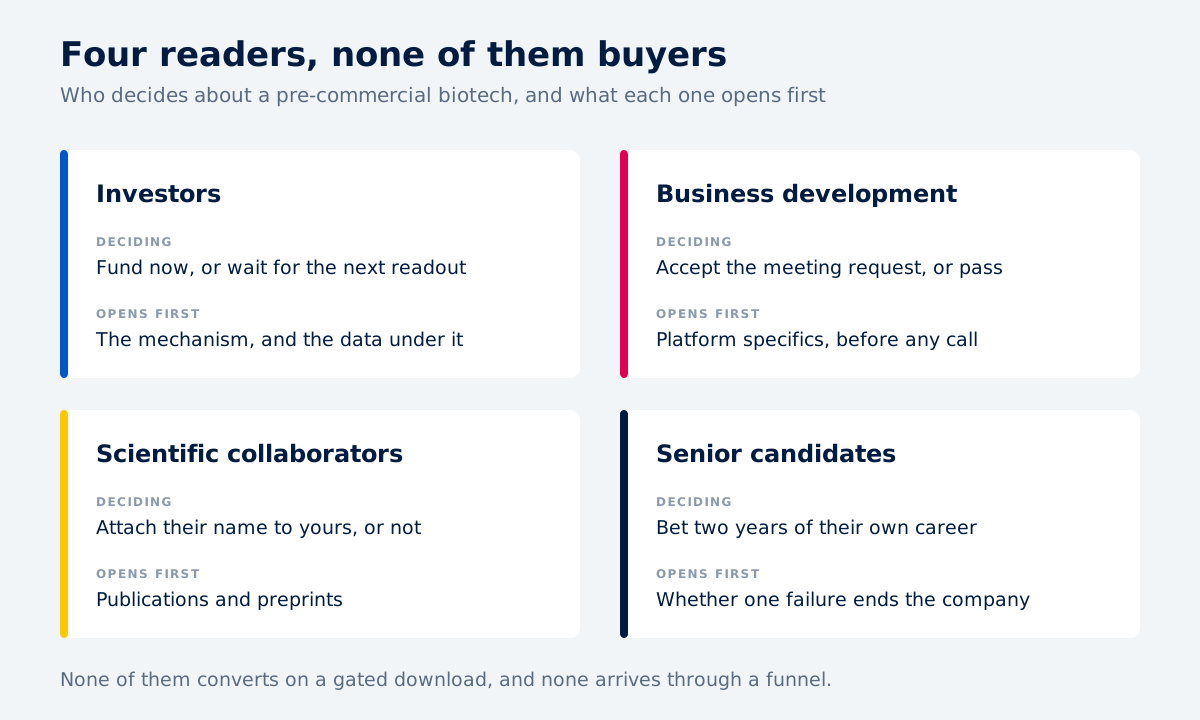
Start with how they arrive, because it is rarely through search. Among biotechs under $1M in revenue, the median sits at roughly 100 organic visits a month and about 13 ranked keywords. Companies at that stage are close to invisible in search.
That is not an SEO problem to fix. It tells you these readers reach you some other way, through a referral, a database, a conference, or a link someone sent them. The wider sector picture, including how little of this audience arrives through search and AI answers, says the same thing.
Whatever you publish has to work for a person who lands on it cold, already sceptical, with no journey behind them.
Investors, during screening
An investor is not reading your material carefully the first time. Aimee Raleigh, a partner at Atlas Venture, puts a founder's deck as one of 10 to 30 arriving in a given week, and notes that the point of it has to be obvious to a new reader without a voiceover.
Her complaint about what founders send runs against instinct. She writes that Atlas will "deeply diligence the mechanism and / or technology", and that she often sees pitches that are "too high-level, which makes it challenging to dig into details and assess differentiation".
She is describing material that says too little to evaluate. A page pitched at the altitude of "AI-powered platform for protein design" gives a specialist investor nothing to grip, however well it is written.
Business development, on both sides of the table
Business development teams describe the same problem, and there is survey data on it.
Inpart surveyed 113 biotech companies, 45% of them C-level and 30% working in business development. These are biotechs describing their own partnering experience, and since biotechs in-license as well as out-license, the complaint runs in both directions.
Two of the findings sit next to each other and explain a lot.
63% said they struggle to get meeting requests accepted before a conference. 47% said potential partner profiles lacked key information.
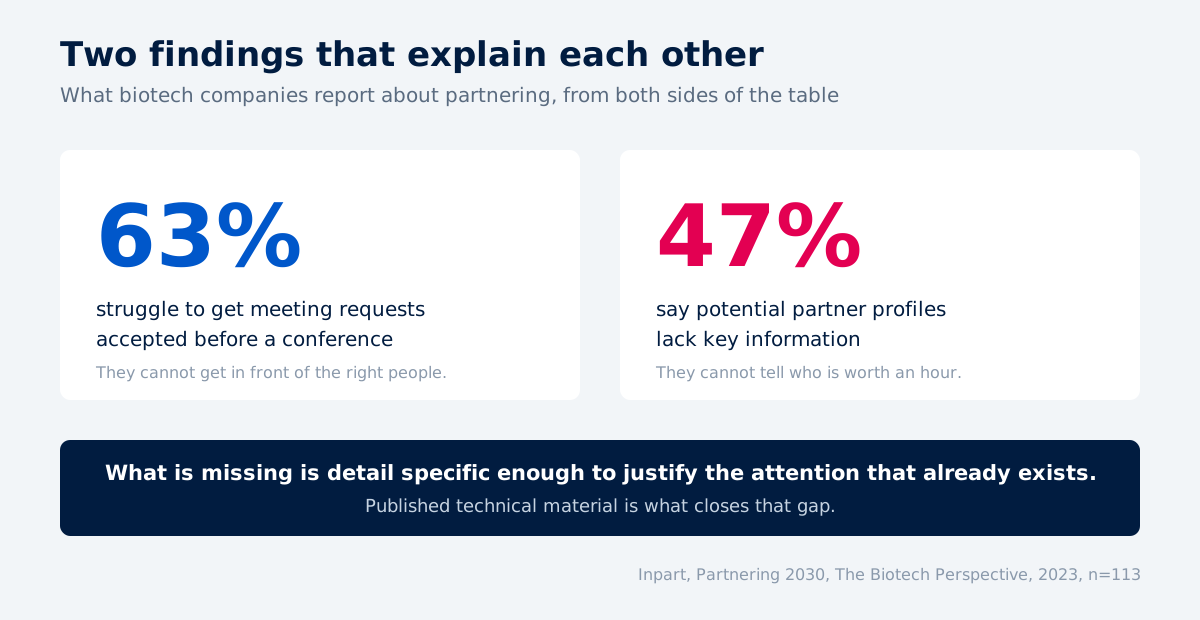
Read them together. One set of people cannot get in front of the companies they need, and the same population, looking outward, cannot find enough detail to decide who is worth an hour.
The shortage is information specific enough to justify spending attention that already exists. Published technical material is what fills that gap, which is why a real mechanism page outperforms a polished company overview.
A second pair of numbers looks discouraging at first. Biotechs rank partnering conferences as their most successful way of meeting a partner at 81%, against 30% for company websites.
That measures where meetings get made, not where evaluation happens. The meeting is arranged at BIO or JP Morgan. The reading happens in the weeks before, when someone decides whether to accept, and in the weeks after, when they work out whether to continue.
Treating your site as a lead source will disappoint you. Treating it as the thing that gets a meeting accepted, and then survives the follow-up, matches how the market actually behaves. That reframing is the first of the decisions a life science marketing strategy has to make.
Transparency ranked above scientific impact
The most surprising result in that survey is about what partners say they weigh. Asked to rank the components of a successful collaboration on a five-point importance scale, respondents put transparency and communication at 4.6 out of 5, ahead of scientific impact, speed and efficiency, long-term vision, and resources.
There is a mechanism behind that, and it is not sentiment. A partnering deal commits both sides for years, and the counterparty cannot independently verify most of what you tell them before signing. What they can price is your track record of disclosure. If your earlier statements held up when they were checked, your current ones are worth more.
For a company with no deal history, the only available evidence of transparency is what you have already published and how it has aged. Publishing your limits is the proof, not the virtue. This is closer to thought leadership in its original sense than to anything a campaign calendar produces.
It also connects directly to that 47% figure. A partner profile missing key information and a partner who is hard to get straight answers from are the same complaint at two different stages.
Collaborators and the people you want to hire
A principal investigator agreeing to work with you lends you a reputation built over decades. A senior scientist joining a company with eighteen months of runway makes a bet with their own career.
They read the same material an investor reads, and they apply different tests to it.
The PI is asking whether the science is sound enough to publish under their own name, and whether association with you costs them anything if the program fails. They open your publications and your preprints first, and they close the tab if the claims outrun the data.
The candidate is asking whether the platform survives one failed program. A company with a single asset and a single mechanism is a different proposition from one whose approach generates more shots, and your published science is where that difference shows.
Neither of them is served by a careers page about your mission.
Why does a polished story make a biotech look worse?
Because the audience has learned to treat polish as a signal worth investigating, and sometimes as a warning.
The usual advice says credibility comes from sounding authoritative. Use the right terminology, put credentials on your authors, cite the literature. All reasonable, and all describing how you sound. The people who matter are running a test.
What the reader is actually checking
One former biotech VC and equity research analyst described their default posture on r/biotech plainly. "We would go into all biotech companies assuming fraud and take things from there."
Their list of warning signs is instructive, because most of it concerns communication rather than science:
- Being unable to explain the technical science clearly
- Not being shown a lab, what is in it, and how things work
- Lots of affiliations, which they called "a marketing smokescreen that is often fake, expecting you not to do your due diligence"
- A famous founder whose own work is not closely related to the company's technology
- High turnover of directors
The affiliation point deserves attention from anyone about to add a fourth advisory board logo to a homepage. To a trained reader, a wall of names reads as a claim substituted for evidence.
Elsewhere in the same community, a scientist described a slick front and a thin lab as "style over substance", adding that a company spending its effort impressing visitors while short-changing the science has its priorities wrong.
There is a documented case of this checking working. FibroGen reported that its drug roxadustat had a superior cardiovascular safety profile compared with the existing treatment. FibroGen had changed the statistical stratification factors after the data were unblinded, and did not disclose the change. Analysed with the factors specified in advance, the drug was merely non-inferior.
According to the SEC's order, a pharmaceutical partner of FibroGen objected to the use of an undisclosed post-hoc analysis, citing industry guidance and practice. The partner ran the check and caught it. Everything else followed from there.
What makes a claim checkable
A checkable claim carries the conditions that produced it. An unchecked one carries only the result.
Clovis Oncology gives the cleanest illustration, because the same lung cancer drug, rociletinib, produced three different response rates depending on the method attached.
The response rate | What the number actually was |
60% | The figure in investor presentations, press releases, and SEC filings from mid-2015 |
42% | What internal data showed the CEO and CFO by early July 2015 |
28% | What the number came to when Clovis recalculated it under the methodology the FDA requires |
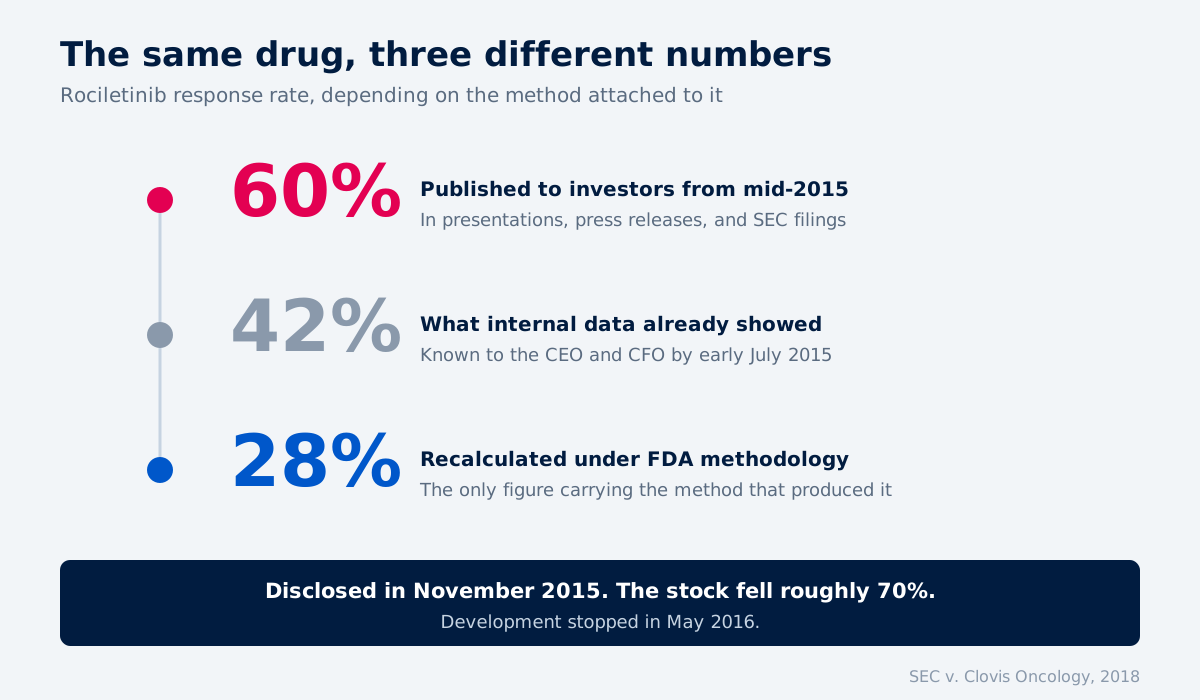
Clovis disclosed the 28% figure in November 2015 and the stock fell roughly 70%. Development stopped the following May, and the SEC later charged the company, which paid a $20M penalty.
The useful lesson sits underneath the enforcement action. "60% effective" was never a fact on its own. A response rate means nothing until you say which patients, measured how, and judged against what. A number published without its method is incomplete, and it stays incomplete until somebody recalculates it.
In practice, a claim your reader can check looks like this:
- The population and the sample size, rather than "in studies"
- The conditions and the system used, rather than "demonstrated"
- The comparator, and who chose it
- What the result does not show
- Whether the analysis was specified before you saw the data
Profluent's public description of its gene editor does this without ceremony. The editor showed "comparable on-target editing efficiency and higher specificity relative to SpCas9", when delivered via plasmids in HEK293T cells. That last clause is the whole difference. A specialist can immediately tell what was tested, and what was not.
If everyone oversells, does honesty cost you?
This objection gets raised by working scientists rather than cynics. As one put it on r/biotech, if everybody in the industry oversells their data as hard as they can, then not doing so puts you at a disadvantage.
The best experimental evidence points the other way, with a limitation worth stating. A 2023 study in Royal Society Open Science ran a survey experiment with 10,519 participants testing how communicating uncertainty affected trust. It measured a general-population audience reacting to COVID figures, not expert readers judging a company, so it transfers by argument rather than directly.
What it found is specific and useful. Presenting uncertainty as a numeric range slightly lowered how much people trusted the number itself, and had no measurable effect on how much they trusted the source. Statements that merely gestured at uncertainty, without quantifying it, reduced trust in both the number and the source.
Vagueness is the expensive part. "Results were promising, though early" costs you credibility. "Six of fourteen animals responded" costs you nothing with the source and buys you a reader who now believes your other numbers.
That is the answer to the objection. Life science investing and in-licensing is a small, repeat-play market. The partner who screens you now reads your next readout in two years, and being the company whose numbers hold up when recalculated compounds across those encounters. FibroGen's partner was always going to check.
What can a biotech say about a drug or device that is not approved yet?
Less than most companies fear in one narrow area, and far more than most companies use everywhere else.
Where the line sits for an investigational drug
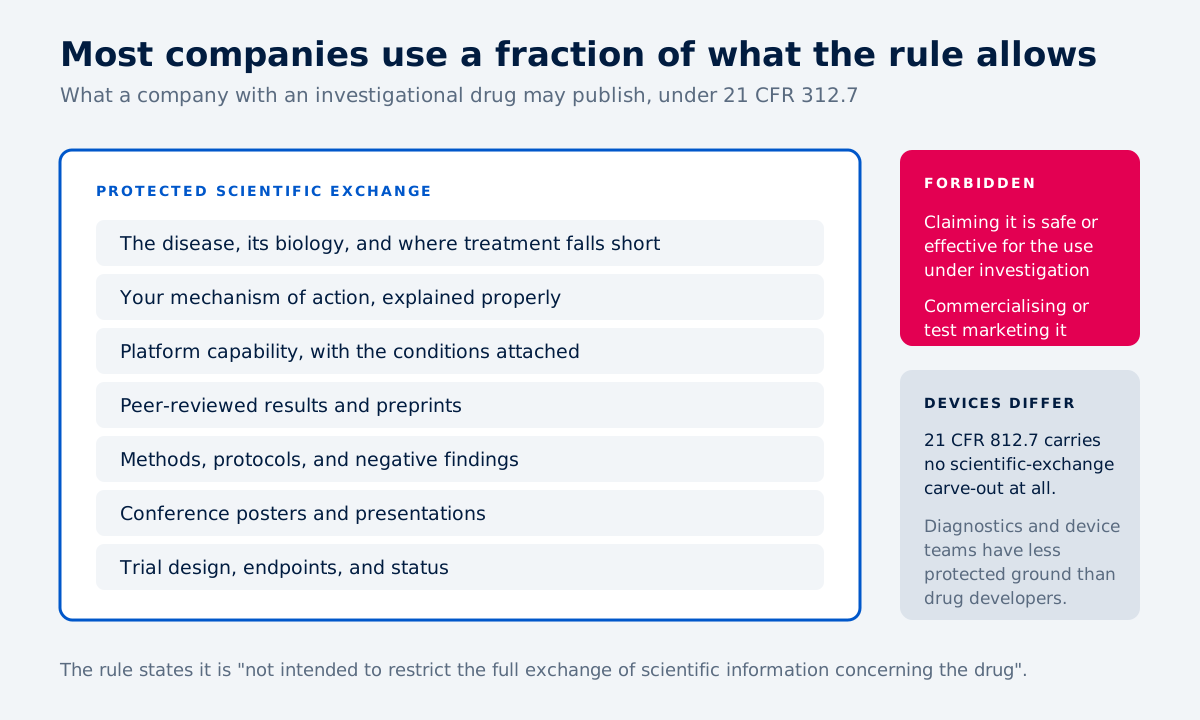
The governing US rule is 21 CFR 312.7(a). It prohibits a sponsor or investigator from representing "in a promotional context that an investigational new drug is safe or effective for the purposes for which it is under investigation".
The same paragraph then carries a sentence most people never reach: "This provision is not intended to restrict the full exchange of scientific information concerning the drug, including dissemination of scientific findings in scientific or lay media."
The regulation explicitly protects the thing biotech teams most often talk themselves out of. Publishing your science, including in plain language for a non-specialist audience, sits inside the rule.
What the rule forbids is narrow and specific: claiming safety or efficacy for the indication under investigation, and commercialising or test marketing the drug before approval. Patient testimonials about an investigational therapy are unavailable to you, and so is any before-and-after framing that implies the drug works.
What you can publish freely
The permitted space is large, and most companies use a fraction of it.
- The disease, its biology, and where current treatment falls short
- Your mechanism of action, explained properly
- Your platform's capability, with the conditions attached
- Peer-reviewed results and preprints
- Methods, protocols, and negative findings
- Conference posters and presentations
- Trial design, endpoints, and status
That list covers nearly everything an investor, a business development scout, or a collaborator wants from you. The constraint sits on the one claim you cannot make yet, and leaves the entire scientific case open. Turning that material into something people actually reach is a distribution question, not a permission one.
Devices and diagnostics work under a stricter rule
Companies developing a device or a diagnostic operate under 21 CFR 812.7, which prohibits promoting or test marketing an investigational device before approval, and representing that it is safe or effective.
The difference matters. That rule contains no equivalent of the scientific-exchange sentence in 312.7, so diagnostics and device teams have less protected ground than drug developers do. Worth knowing before you copy a therapeutics company's approach, and worth reading alongside the device-side version of this problem and the diagnostics side.
The one clearly contemplated exception is advertising to recruit study subjects, which an IRB must review, and which may not claim the device is safe, effective, or equivalent or superior to another device.
Once you are public, a second regulator reads the same sentence
For listed companies and those approaching a listing, the same words get judged again under securities law, where the test is different.
Kiromic BioPharma raised $40M in a follow-on offering without disclosing that the FDA had placed both of its drug candidates on clinical hold two weeks earlier. AVEO Pharmaceuticals concealed that FDA staff had recommended a second clinical trial; when that became public, the stock fell 31%.
Both companies omitted the regulator's actual position while describing the program optimistically. The practical consequence for anyone publishing is that once you are listed or raising, your website is a disclosure document.
Your pipeline graphic, your program status labels, and your press release boilerplate all carry that weight. A pipeline page still showing a program as enrolling after a hold is the same omission in visual form.
What should a biotech publish, and when?
Around events, mostly. A biotech does not have a content calendar in the way a software company does.
The milestones worth publishing around
Each of these gives you something real to say, and each is a moment when the people who matter are already looking at you.
Milestone | What it lets you publish |
Financing round | Why this capital, against which specific milestone |
Preclinical or clinical data readout | The result, with its method, population, and limits |
IND clearance or regulatory step | What the pathway is and what it means for timelines |
Partnership or licensing deal | What the partner is doing and what they are not |
Conference presentation | The poster and the talk, republished plainly |
Publication or preprint | The paper, plus a version a non-specialist can read |
Trial opening or enrolling | Design, eligibility, and a plain-language protocol summary |
The last three carry the most weight per hour spent and get the least attention. You have already done the work; turning a poster into a page that explains the finding costs an afternoon and outlives the conference by years.
The trial row deserves its own note, because it is the one place a pre-commercial biotech markets to an audience it can count. Emerging biotechs running paid search typically sit in the $2,500 to $7,500 a month range, aimed at clinical trial recruitment rather than brand or category. When these companies buy attention, they buy it to fill trials. Trial pages, eligibility explainers, and plain-language protocol summaries are the content that spend lands on, and they are usually thin.
What to do between milestones
Publish evergreen explanatory material, or publish nothing.
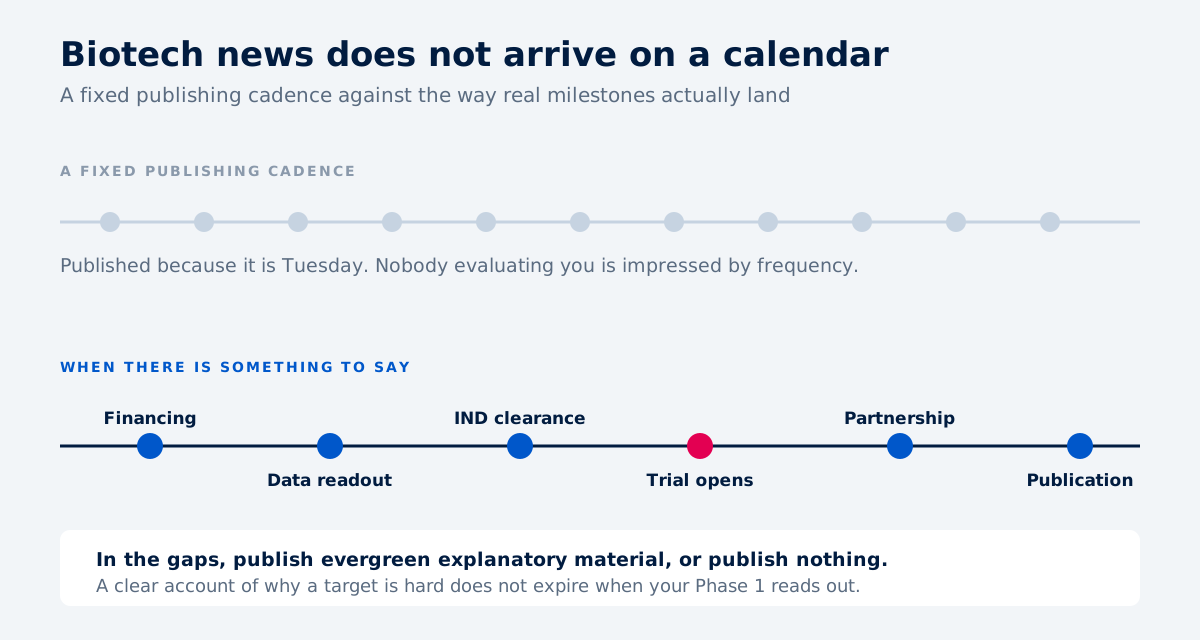
Between readouts there is frequently no news, and a real biotech may go many months without any. Manufacturing a post to keep a cadence is where credibility leaks. Nobody evaluating you is impressed by frequency, and the industry's own complaint about biotech communications is that too much of it says nothing.
What holds up across those gaps is explanatory content about the disease, the biology, and the platform. A clear account of why a target is hard does not expire when your Phase 1 reads out. It works for the investor who finds you in eight months, and for the candidate deciding whether your science is real. That is also the material most likely to get you cited when someone asks an AI assistant about your target, since explanation survives retrieval in a way announcements do not.
What does good biotech content marketing look like in practice?
Two companies show the pattern. Both are well-funded platform businesses, and the scale of what they published is not copyable by a twelve-person startup. The mechanic underneath it is, and that is the part worth taking.
Profluent published the thing itself, then signed Lilly
Profluent designs proteins with machine learning. Rather than describing its capability, it released OpenCRISPR-1, an AI-designed gene editor, free to license for research and commercial use, with the sequence available through a preprint, a GitHub repository, and working protocols. The underlying work was published in Nature in 2025.
Releasing the sequence changes what a counterparty is able to know about you. A diligence question that would normally sound like "does your platform actually work?" becomes an experiment the other side runs in their own lab, on their own timeline, at their own cost, before anybody takes a meeting.
A result someone generates themselves cannot be discounted as a company claim. That is the difference between an asserted capability and a demonstrated one, and a sceptical scientist can run it.
In April 2026 the company announced a multi-program collaboration with Eli Lilly to develop AI-designed recombinases, with Lilly taking an exclusive licence on selected candidates. The chain from open technical publication to a named pharma partner is visible from outside the company.
Manifold Bio published the number that was only half good
Manifold Bio open-sourced mBER, its antibody design library, and announced it alongside a preprint and a public code release.
The headline result is where the lesson sits. They designed antibodies against 145 targets and found specific binders for 65 of them, with success rates reaching 40% on the best epitopes. They described the performance as on par with existing approaches rather than better than them.
Roughly half the targets did not work, and they led with that.
It reads as more credible than a rounder claim would, for a mechanical reason. A company willing to publish its denominator is telling you it expects you to divide, which suggests the numbers it does report were calculated the same way. Precision about failure is the cheapest credibility available to a biotech, and almost nobody spends it.
If you want to know where your own published material sits against the rest of the sector before you change anything, the benchmark is the place to start.
Is your biotech content helping the right buyers understand your value?
Create a content system built around audience research, technical clarity, and high-intent conversion paths.
Frequently Asked Questions
About the Author

Founder & CEO, Content RevOps
Stefan Kalpachev is the founder and CEO of Content RevOps, where he helps B2B SaaS companies transform their content into predictable pipeline. With a background in content marketing and revenue operations, Stefan has developed a unique methodology that bridges the gap between content creation and revenue generation.
Connect on LinkedInRelated Articles
Digital marketing for pharma, channels that actually move pipeline
Sep 9, 2026
Pharma marketing analytics and ROI, connecting content to pipeline
Sep 8, 2026
AI in pharma marketing, where it helps and where it is just language
Sep 7, 2026