Content marketing for CDMOs and CROs when the buyer is looking for a reason to rule you out
Sponsors are reading your inspection record right now. Do you know what your site says next to it?
Book a CallA sponsor reading your website is not deciding whether to like you. They are deciding whether to keep you on a list, and the fastest way to shorten a list is to find something wrong. That single fact should shape every decision in your content marketing programme.
Part of Content marketing for life sciences, the complete guide.
That is a different job from the one most CDMO and CRO content is built to do, and it assumes a clear view of what the marketing function actually is at a contract-services firm.
A quick note on terms, because one of them is overloaded. In life sciences a CRO is a contract research organisation, the company running your studies. Everywhere else in marketing, CRO means conversion rate optimisation. This article means the first one, and it sits inside the wider question of what life science marketing is actually for.
Here is the argument. Sponsors rank on-time delivery, regulatory track record, capacity, and clean scale-up at the very top of their selection criteria, and those are close to the worst-performing attributes in the contract manufacturing industry. Your content either closes that gap by making your operating reality checkable in advance, or it decorates a decision that is being made somewhere else, using records you do not publish.
What is a sponsor actually doing when they read your site?
They are eliminating.
That claim is worth grounding in something firmer than instinct, and there is a dataset that does it. Industry Standard Research aggregated four annual CDMO benchmarking surveys. The pooled base covers 1,586 individual service encounters across more than seventy CDMOs, each scored against twenty-three performance metrics.
That produced two separate rankings. One is what sponsors say they select on. The other is how the industry actually performs, as rated by the people who used it.
The five attributes sponsors rank most important when choosing a CDMO:
- Reliable on-time delivery
- A strong regulatory track record
- The required dosage form or API manufacturing capability
- Capacity to meet demand
- The ability to scale up manufacturing smoothly
Now the same five, ranked by how well the industry performs on them: 16th, 8th, 10th, 6th, and 12th.
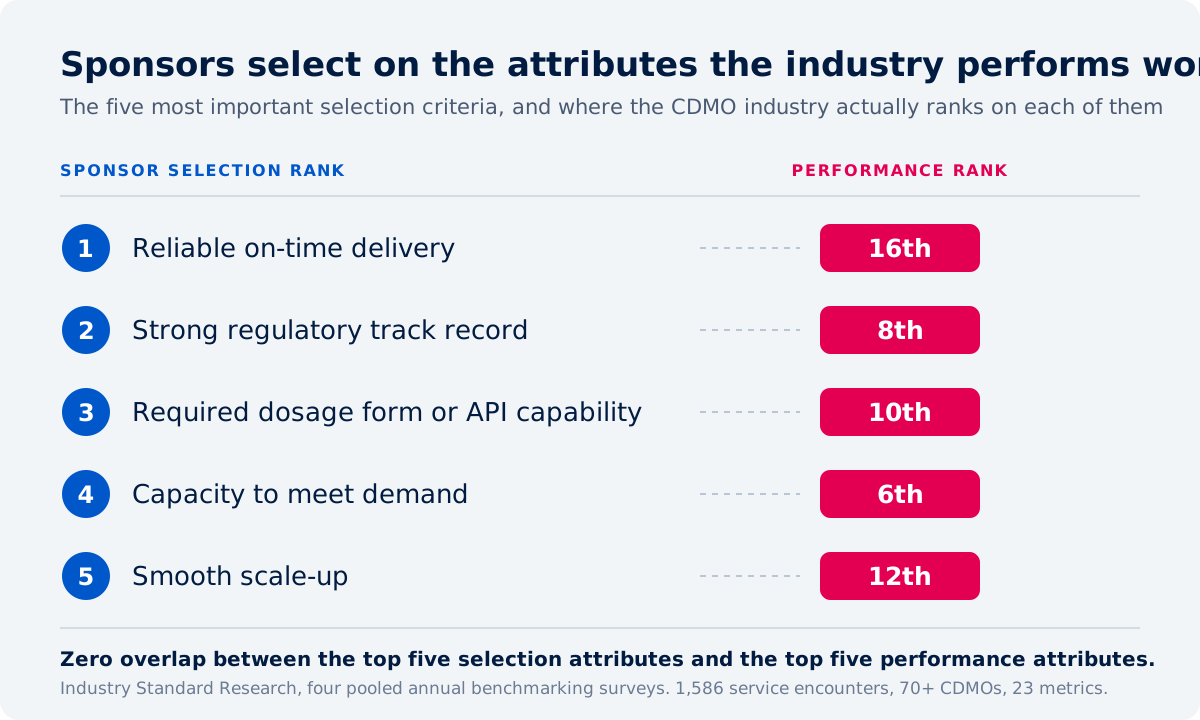
There is no overlap at all between the top five things sponsors buy on and the top five things the industry is best at. The attributes CDMOs score highest on include stability testing, scientific knowledge, regulatory filing support, and being well regarded in the industry. Those are genuine strengths. None of them is the thing being decided.
Sit with what that means for a content strategy. A site built to demonstrate scientific credibility and industry standing is competing hard on the axis where every competitor is already strong and no buyer is actually looking. The gap the reader is trying to resolve is operational. Will this land on time, will the regulators be comfortable, and can you take the volume.
Why "trusted end-to-end partner" fails an elimination read
Reading through how sponsors talk about vendors in their own forums, one thing stands out by its absence. The words the industry uses about itself barely appear. Nobody describes a vendor as an end to end partner, a trusted advisor, or a source of thought leadership. Those are seller words.
The word partner has taken on a specific edge. As Mike Radomsky put it in PharmaSource, the difference between a partner and a vendor shows up not in the proposal but in how the organisation behaves when something goes wrong.
So a homepage promising partnership is answering a question nobody asked, in vocabulary the buyer has learned to discount. It reads as unfalsifiable, and unfalsifiable claims are exactly what an eliminating reader skips.
Who is in the room, and which of them can end your candidacy?
Marketing tends to picture one technical buyer. The real group is much wider, and parts of it can remove you without ever meeting you. It is committee-shaped in the same way the group that decides medical device purchases is committee-shaped. A hospital lab buying a diagnostic splits the decision the same way, across a contract manager, a lab director, finance, and a payer who never meets you.
ISR's work on strategic outsourcing relationships puts the CDMO decision group at anywhere from four to a dozen departments. R&D and executive management together hold close to half the influence. The rest sits with procurement, quality assurance, discovery and preclinical, project management, regulatory affairs, and validation.
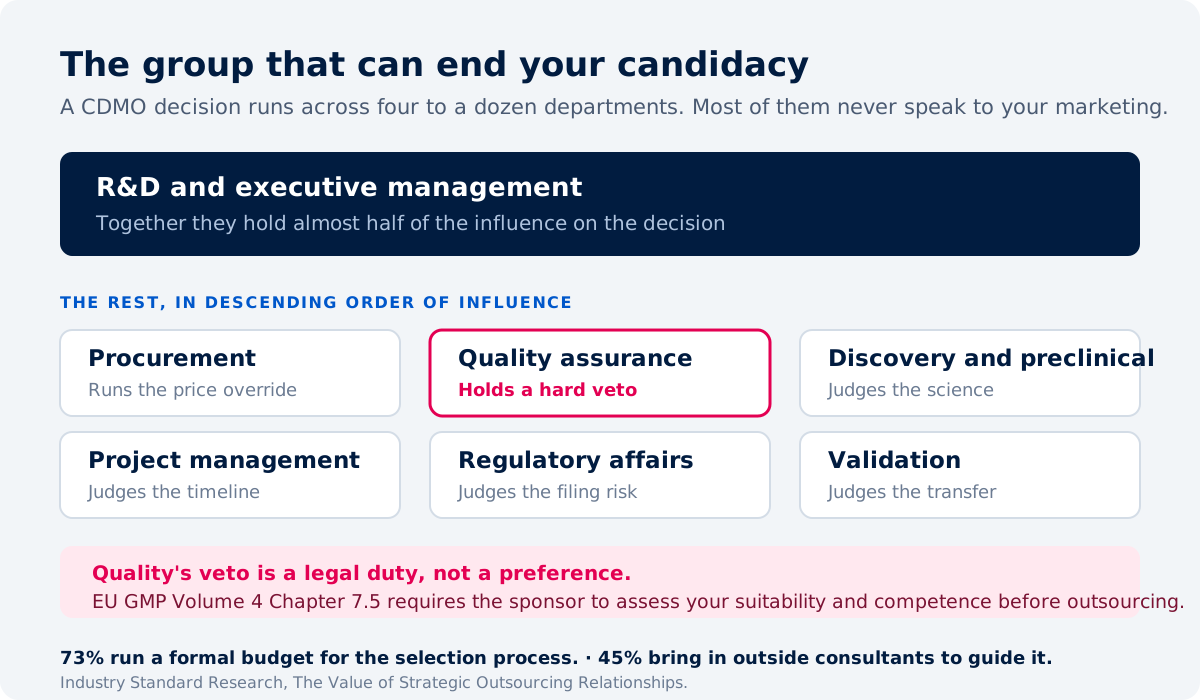
Two numbers from the same work reframe how formal this is. 73% of manufacturing outsourcers run a formal budget for the selection process itself, and 45% bring in consultants to guide the choice. Selecting a vendor is a funded internal project with its own staff, not an impulse that a well-timed webinar redirects.
The way we think about this is to write the buying group down before writing anything else. We list every plausible person on the decision, with their title, their decision power, and their actual role, split into buyer, user, influencer, and gatekeeper, then pressure-test that list against deals we won and lost rather than against instinct. Most content plans skip straight to topics and assume the champion is the decider.
Quality's veto is written into law, not into preference
The quality unit is not an obstacle your champion can route around, and this is the part most marketing teams have never been told.
Under EudraLex Volume 4, Chapter 7, the rules governing outsourced GMP activities in Europe, section 7.5 states that prior to outsourcing, the contract giver is responsible for assessing the legality, suitability, and competence of the contract acceptor. Section 7.17 requires the contract to permit the sponsor to audit the work. These have been in force since January 2013.
Read that as a marketer. The sponsor is legally obliged to assess you before awarding work. Their quality function is discharging a regulatory duty, not expressing a preference, which is why a quality objection ends a candidacy rather than starting a negotiation. Content that helps the champion but gives the quality reviewer nothing to work with leaves the decisive reader empty-handed.
The criteria they state and the override that actually happens
Honesty requires holding two facts together that do not agree.
ISR's drug product benchmarking, based on 302 respondents rating 673 service encounters across seventy CMOs, found regulatory track record ranked first among selection drivers and fewer than one in ten respondents named low cost as the most important factor. On the stated criteria, price is not the lever.
The people doing the work describe something else happening at the end. In their words, the technical team runs the evaluation and then the board, or the CEO, or the finance lead steps in and makes them hire the cheapest one.
Both are true, and the gap between them is useful. Your technical evaluator needs the operational evidence to score you well. Your champion then needs something they can carry into a room you are not in, against a cheaper name, that explains what the price difference buys. Those are two different assets, and most companies publish neither.
Why does the proof a sponsor wants sit on so few CDMO and CRO sites?
Because the industry publishes science, and the decision turns on operations. It is the defining content problem across life sciences, the same inversion that shapes content marketing for pharmaceutical companies, and contract services feel it hardest.
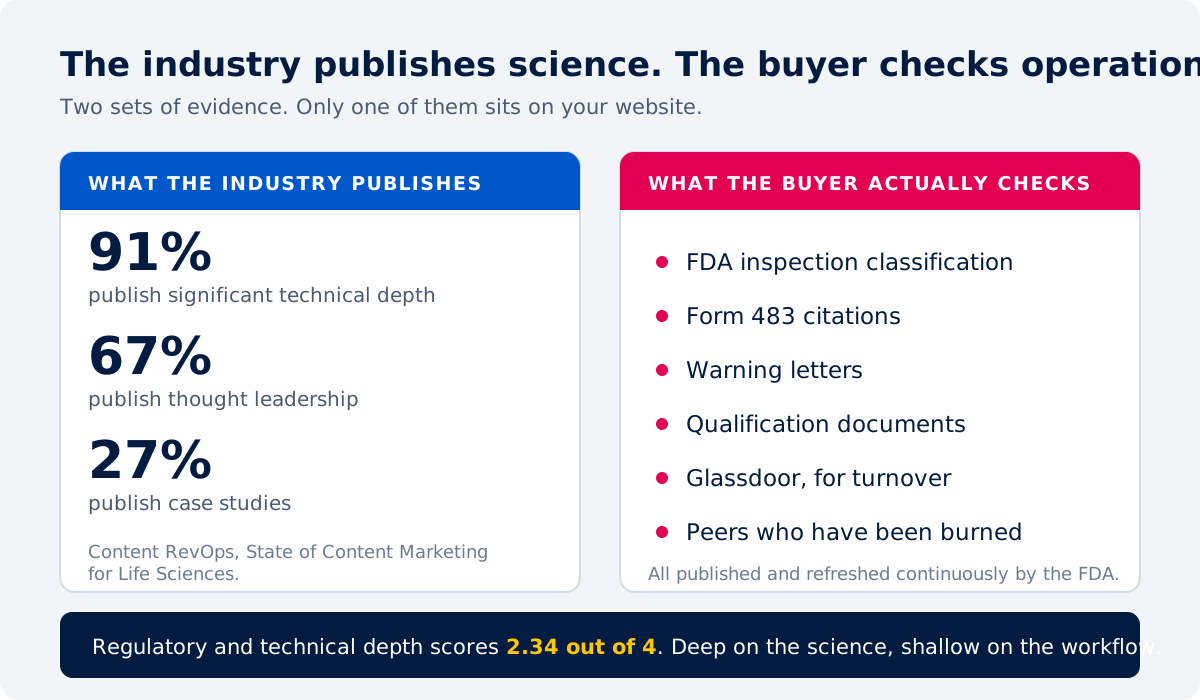
In our State of Content Marketing for Life Sciences analysis, about 91% of the active cohort publishes content with significant technical depth. Scientific substance is effectively a sector standard. Nearly everyone clears that bar.
Then the same analysis scores regulatory and technical depth at 2.34 out of 4. The sector is deep on the science and shallow on the workflow. Companies explain the molecule and the method, then stop before the part where the reader has to run something.
The same pattern shows up in what gets connected to a real job. Only about one in four life-science sites map their content to a compliance workflow, which means three quarters of the industry publishes the science without ever connecting it to the regulatory work the buyer is actually accountable for. You can see where you sit against that cohort with the life sciences content benchmarking tool.
Meanwhile thought leadership sits on around 67% of sites. Two thirds of the industry is investing in the format that, across an entire corpus of sponsors discussing how they choose vendors, never once gets credited with influencing a decision. That absence is the finding. People described checking documents, asking peers, and reading inspection records. Nobody described a whitepaper changing their mind.
The consequence shows up in our sales enablement score, which sits at 2.48 out of 4, with the summary that positioning is ready and the public proof behind it is thin. The story is written. The evidence is missing.
The record they check is not the one you publish
While the industry publishes science, sponsors go and read the regulator.
The FDA's State of Pharmaceutical Quality report for FY2024 describes a catalogue of 4,619 drug manufacturing sites worldwide. The agency ran 972 quality inspections that year, up 27% on the year before, with more than 62% of them at sites outside the United States, an all-time high. It issued 105 warning letters for quality reasons, the most in five years.
The number that should reframe your content plan is a different one. 93% of sites worldwide carry either NAI or VAI as their most recent classification, meaning no action indicated or voluntary action indicated. Almost everybody's record looks broadly acceptable at a glance, so the record does not differentiate you. What differentiates you is whether you explain yours before someone else interprets it.
And this is all public by design. Through the FDA data dashboard, inspection classifications, Form 483 citations, and warning letters are published and refreshed continuously. Since October 2018 the agency has committed to communicating a site's CGMP status within ninety days of an inspection, explicitly so that customers and sponsors can see it.
Buyers use it exactly as intended. Their advice to each other is blunt. Always check the qualification documents. They count 483s, they read Glassdoor for turnover, and they ask peers who has been burned.
None of that happens on your website. The honest conclusion is that your content is not competing with your competitors' content. It is competing with the public record, and it loses whenever it pretends the record does not exist.
How do you build proof when every client is under CDA?
This is the question the category actually has, and the standard advice ignores it.
Every guide says publish case studies. In this industry most work sits under confidentiality agreements, so naming a client, a molecule, or a result is frequently not something you are permitted to do. The advice is not merely hard to follow, it is often prohibited.
The data suggests almost nobody has solved it. Case studies appear on only about 27% of life-science sites, roughly one in four, which makes the single most requested proof point the one three quarters of the industry does not publish. That is not laziness. It is a structural constraint meeting a template that was written for software companies.
What you can publish without naming a single client
The constraint is on identity, not on substance. A surprising amount survives once you stop trying to name the account.
- Anonymised programme shapes. A monoclonal antibody programme moving from a 200L to a 2,000L scale, what changed in the process, where comparability got difficult, how long it took. No client, real engineering.
- Platform and method data from your own work. Yields, hold times, analytical method performance, and campaign turnaround, presented as your capability rather than anyone's project.
- Your qualification and inspection posture. Which authorities have inspected which sites and when, what your audit readiness process looks like, how you handle a client audit request. This is the material the quality veto needs and it belongs to you, not the client.
- Deviation and change behaviour. What happens when a batch goes out of specification, who the sponsor hears from, how quickly, and what a change order looks like before anyone signs one.
- Tech transfer track record in aggregate. How many transfers you have received in the last three years, how many landed on the original timeline, and what typically causes the slip.
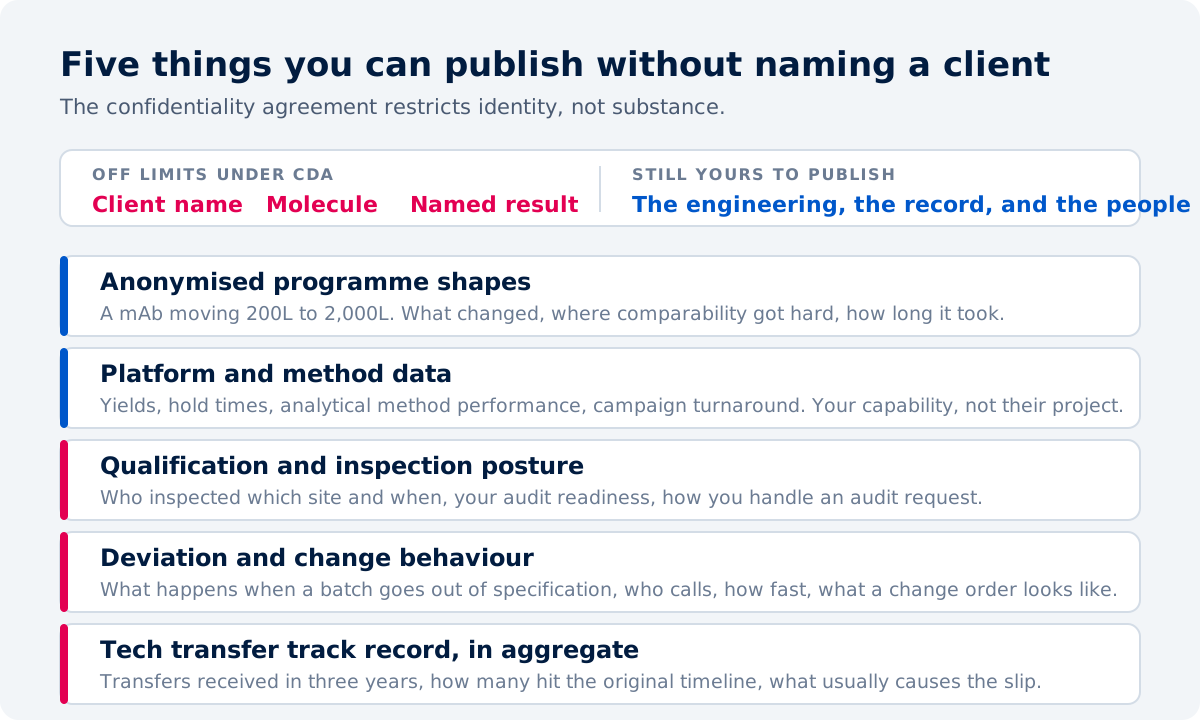
The last two matter most because they address what sponsors say they want to know. They are less interested in the glossy material and more in the day to day reality, meaning turnover on the study team, change orders, responsiveness, and timeline slippage.
Name your people instead of your clients
If you cannot name the client, name the team. The buyer is evaluating them anyway.
Corporate track record gets openly discounted in favour of the individual. A large CRO may have run twenty thousand studies, but if you are assigned the new starter, sponsors say the corporate number does not help you. One sponsor described dropping their CRO because it could not answer how many other studies the assigned medical monitors were supporting. A vague answer to a resourcing question lost the account.
Against that, only about one in five pharma sites maintains a dedicated experts or team page, according to our pharma analysis. It is a one-time editorial build that improves every asset published afterwards, and four in five companies have not done it.
A useful version is not headshots and job titles. It is the named people who would run the work, their years in the role rather than their seniority, the modalities they have personally handled, and how many programmes they carry at once. That last detail is the one buyers ask for and rarely receive.
Is your most valuable content actually the RFP response?
Almost certainly, and marketing usually does not own it.
Ask sponsors what earned their trust and they describe the reply, not the funnel. A CRO that does a thorough review of your RFP and comes back with genuinely useful feedback and questions, one sponsor explained, is generally a CRO that actually wants the business and will behave that way once the work starts.
Read that as an evaluation of a document. The proposal is where a sponsor sees how you think, how carefully you read, and whether you will tell them something inconvenient before the contract exists. No gated asset gets close to that.
The process is under strain from both directions. One sponsor described receiving a slide deck instead of a proposal document and being told this was the new industry standard, adding that they were not impressed. Proposals teams describe the mirror image, speculative RFPs issued to harvest free advice and bid defence meetings booked before anyone has read the submission.
And then there is the single most cited betrayal in this market, which is the A team appearing at the bid defence and vanishing after the award. Sponsors now write contractual protections against it. Every generic promise your marketing makes is read through that memory.
Getting the expertise out of the bid team
The material that wins is already inside the company, held by the people who answer RFPs and run capabilities calls. It just is not published anywhere.
We ran into exactly this with Westlab, a life-science manufacturer selling into laboratories. They were growing through manual research, cold calling, conferences, and lab visits, a high-effort motion with a high cost of acquisition that depended entirely on reps. Their genuine differentiator was that their people acted as discovery and consulting partners rather than sellers, and that expertise was locked inside the sales team, delivered one conversation at a time.
We operationalised it into a problem-led content system, so the engine did the pre-sales trust building that reps had been doing lab by lab. In three months it produced 241 inbound leads in a market that had run on cold outbound, and returned 869% on the content investment.
The mechanism transfers directly. Your proposals team already writes the most persuasive material in the building, tailored one sponsor at a time, then files it. The work is to extract the reusable parts, the feasibility reasoning, the honest constraint, the transfer plan, and publish those where a sponsor building a longlist can find them before an RFP exists.
Do CDMO buyers and CRO buyers want the same thing?
No, and the difference is what is scarce.
A CDMO sells access to physical assets. A CRO sells access to people. Everything downstream of that follows.
A CDMO sells a slot, and slots run out
Manufacturing capacity is finite and booked against clinical timelines.
BioPlan's twenty-second annual survey of biomanufacturing capacity, covering 203 respondents across twenty-one countries, found 30.4% of commercial production facilities operating under significant or severe capacity constraints, roughly three times the rate reported by early-clinical manufacturers. Facilities capable of antibody drug conjugate or multi-specific antibody work are, as Genetic Engineering & Biotechnology News reported in 2025, often booked months or even years ahead, while building new capacity takes two to three years.
Now add the switching cost. McKinsey's benchmarking of tech transfer found that transfers for sterile dosage forms run from 18 to more than 30 months, and that transferring to an external party takes on average 5.8 months longer than doing it internally.
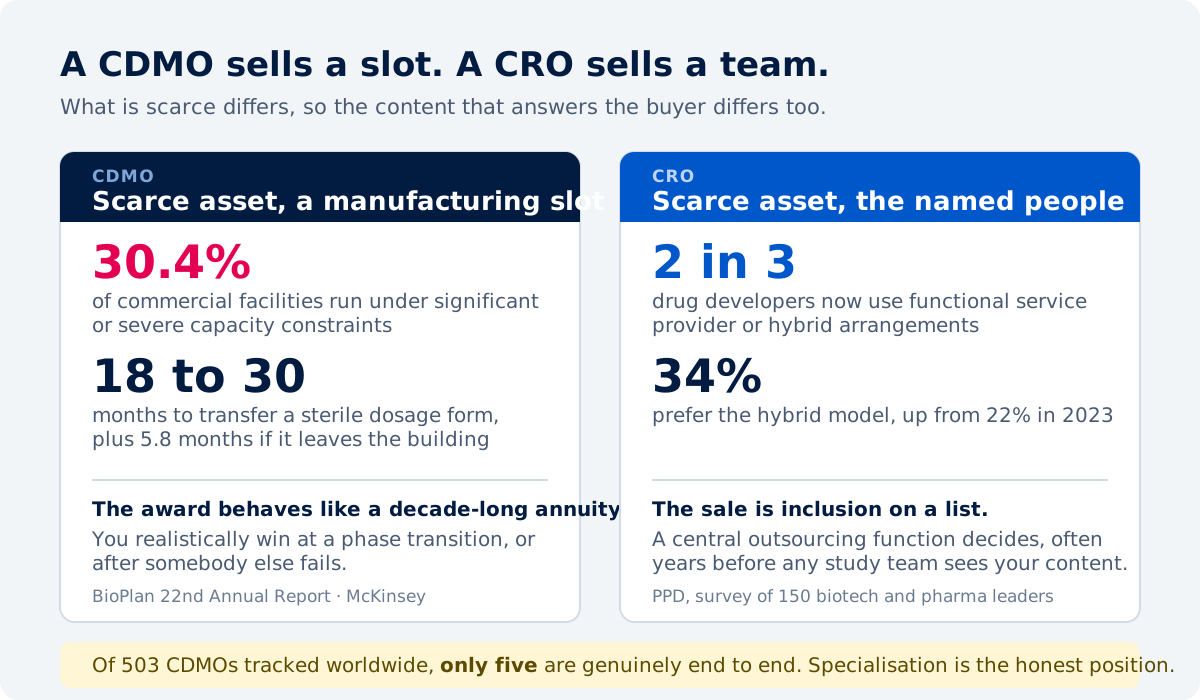
Put those together and the commercial reality is clear. A CDMO award is close to a decade-scale annuity, because moving a molecule once it is in your process and on your filings is expensive, slow, and regulatorily risky. You realistically win at a phase transition or after somebody else fails, which means content aimed at capacity, timing, and transfer risk is aimed at the actual decision.
The market is also far more specialised than its own marketing suggests. Nice Insight's State of the Industry 2026 tracked 503 CDMOs globally, up from 400 in 2024, operating 1,934 manufacturing sites.
Of all of them, only five offer mammalian production, API synthesis, conjugation, and high-potency fill under one roof.
Nice Insight and Pharma's Almanac are the same company, so read that as a well-built census rather than an independent audit. The shape survives the discount. Almost nobody is genuinely end to end, which makes the phrase both extremely common and usually untrue.
A CRO sells a team, usually into a list
Clinical outsourcing has consolidated around a different structure.
Research from PPD, surveying 150 biotech and pharma leaders, reports that two thirds of drug developers now use functional service provider or hybrid arrangements for clinical development, with 34% preferring the hybrid model, up from 22% in 2023. PPD sells FSP services, so treat the enthusiasm with appropriate caution while accepting the direction.
The consequence for marketing is structural. Under those arrangements the commercial event is often getting onto a preferred provider list or winning a functional scope, not winning an individual study. Content aimed at a study team can arrive years after the decision that mattered, which was made by a central outsourcing function evaluating you as a supplier of capability and people.
It also helps to remember who your sponsor often is. A large share of the work now comes from small, venture-funded companies, and what biotech marketing has to prove to its own investors shapes what it will ask you to prove in turn.
What is an honest no worth?
More than the deal it costs you.
The most repeated trust breaker in this market is business development agreeing to things the delivery team cannot do. Sponsors describe BD accepting crunched timelines without checking feasibility with the study team, purely to win the work, and vendors who overstated experience and then built the plane while flying it.
What they say they want instead is unambiguous. They would rather be told honestly that a CRA is over-allocated than be fed a comfortable answer.
That points somewhere uncomfortable for a marketing team, which is that published constraints do commercial work. Saying which modalities you are not set up for, where your capacity genuinely is, and what programme profile you serve badly filters out deals you would have lost expensively later, and it makes every other claim on the site more believable. When only five companies on earth are truly end to end, specialisation is the honest position for almost everyone, and choosing it is a life science marketing strategy decision before it is a content decision.
The objection is fair. Publishing limits removes you from consideration for work you might have won. The counterweight is that the expensive failure in a multi-year relationship is winning something you cannot deliver, and buyers already assume you will oversell. In a category where, by our count, around one in two hundred pharma sites publishes so much as a pricing page, the default is to disclose nothing. Disclosing something specific is therefore cheap to do and hard to fake.
How do you measure any of this when one decision takes two years?
Not with MQLs, which is why so many CDMO and CRO marketing teams cannot prove their case.
Nandini Piramal, chairperson of Piramal Pharma, described the shape plainly. CDMO is a long cycle business, and from RFP to contract finalisation to commercial revenue recognition the timeline runs about six months or longer, with the financial impact landing over 12 to 24 months rather than immediately.
A funnel metric measured monthly cannot describe that. Counting downloads against a decision that resolves two years later produces a number that moves for reasons unrelated to whether you are winning.
There is an infrastructure problem underneath it too. Fewer than 9% of pharma sites run a detectable CRM, by our analysis, which is the single largest constraint on connecting content to pipeline in this sector. You cannot attribute what you never recorded.
What to count instead follows from everything above. The useful measures are the moments elimination stopped.
- Qualified RFIs and invitations to bid. You were on a list and survived the cut.
- Bid defence appearances. You reached the room where the decision gets made.
- Programmes won, and later expanded. The only outcome the business recognises as revenue.
When we price the cost of content gaps for a client, we show every assumption on the page so they can argue with the inputs rather than dismiss the output. The same discipline applies here. A number a sceptical CFO can interrogate survives contact with the boardroom, and a number that arrives without its workings does not.
Which returns to where this started. The sponsor reading your site is looking for a reason to remove you. Give them the operational record, the named people, the honest constraints, and the transfer plan, and you are harder to eliminate. Give them scientific excellence and a promise of partnership, and they will go and check the regulator instead.
Is your content built to survive a shortlist, or just to look credible?
Get a Content RevOps audit, your funnel shape, proof gaps and AI-search visibility benchmarked against the life sciences 2026 data, with every gap priced in numbers your CFO can argue with.
Frequently Asked Questions
About the Author

Founder & CEO, Content RevOps
Stefan Kalpachev is the founder and CEO of Content RevOps, where he helps B2B SaaS companies transform their content into predictable pipeline. With a background in content marketing and revenue operations, Stefan has developed a unique methodology that bridges the gap between content creation and revenue generation.
Connect on LinkedIn