Medical Device Companies: Top Content Marketing Tips
Ready to make your medical device content easier to trust and easier to buy from? Let's chat!
Book a CallYour best content marketing persuades a surgeon. The surgeon cannot approve the purchase.
Part of Content marketing for life sciences, the complete guide.
In a US hospital, the clinician who wants your device is the user and the advocate. The body that decides is the value analysis committee, and it weighs outcomes, cost, and workflow. It meets without you in the room, and increasingly without your champion in the room either.
That gap explains a pattern most device teams recognize. The clinical interest is real, the meetings go well, the rep is optimistic, and then the file stops moving and nobody can say exactly why.
So the job of content marketing for medical device companies is to arm an economic argument that survives a room you will never attend. Clinical enthusiasm is the input to that job, not the finished product. For the wider function this sits inside, including the claims ceiling and the upstream work that happens long before clearance, start with what medical device marketing actually covers.
Who approves a medical device purchase, and why is it not your champion?
A value analysis committee approves it. The committee is a standing, multidisciplinary group that reviews every new product a hospital is asked to buy, and it exists specifically to take that decision out of any one clinician's hands.
This is not a large-hospital phenomenon you can route around. More than 90 percent of responding Premier member hospitals run one or more value analysis teams, with no relationship between bed count and how many teams they run.
When researchers surveyed US hospital decision-makers directly, combining 40 interviews with 76 survey responses, every hospital in the sample used a value analysis committee for all new products under consideration.
What the committee actually is
Picture a room of 12 to 24 people, organized by service line at 80 percent of hospitals, so cardiology, surgery, and women's health each get their own. Supply chain or purchasing chairs it at a plurality of them. Physicians rarely chair one at all.
That absence is deliberate. The same research reads it as an acknowledgment that close physician relationships with suppliers can work against standardization and price reduction.
Your champion is not merely outranked in that room. Often they are barely present, and 85 percent of the 1,635 healthcare leaders who answered the 2024 GHX and AHVAP value analysis survey reported less-than-strong physician engagement.
Why the committee exists at all
It exists because marketing to champions used to work, and hospitals decided that was a problem.
Before value committees became standard, surgeons could adopt more or less any technology they believed would help their patients. A surgical journal describes what followed as the adoption of costly innovations "often driven by sales teams and the marketing of features" that did little to improve overall value.
The financial stakes explain the response. Surgeon preference items account for 40 to 60 percent of a hospital's supply costs, and in 2016 the median US hospital ran a 2.7 percent margin. A hospital operating on that margin cannot let product choice sit with whoever the most persuasive rep reached last.
So the committee is a control that hospitals built in direct response to the tactic. Content that only builds clinical enthusiasm targets exactly what that control screens out.
The split most device marketing never makes
On any long, multi-stakeholder sale, and life sciences is full of them, we separate four roles before writing a single asset.
- The user works with the product daily and cares whether it performs.
- The influencer wants it and will spend some credibility asking for it.
- The gatekeeper can stop it without ever advocating for anything.
- The buyer signs, and answers for the money afterward.
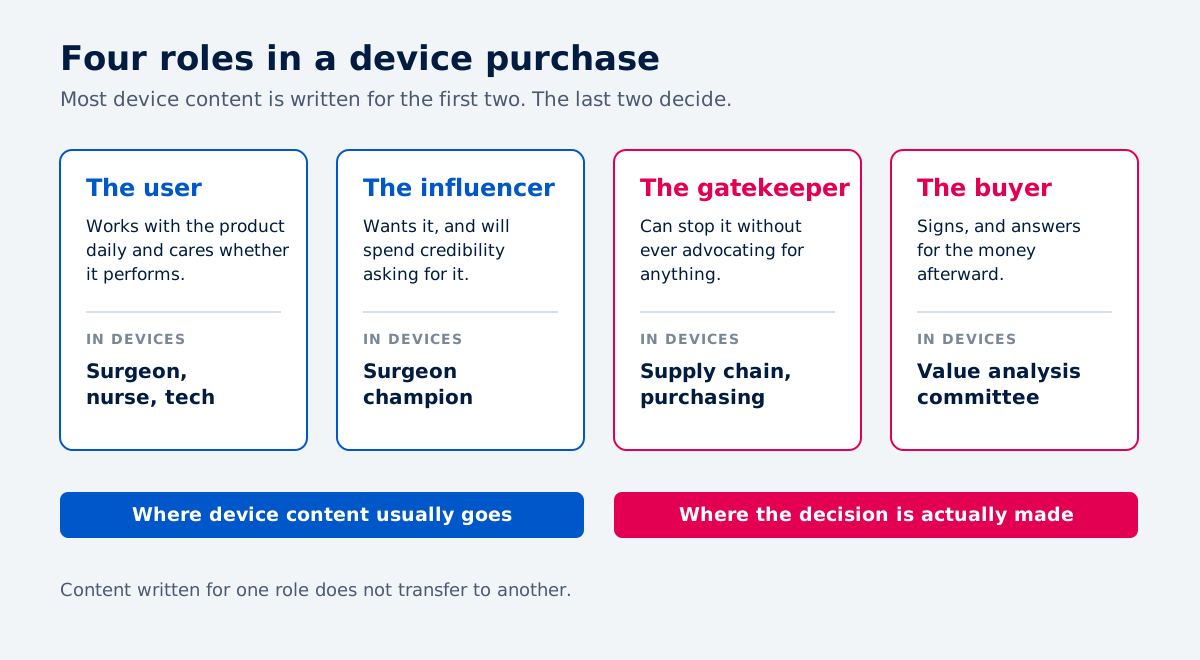
We list every plausible stakeholder with their title, their decision power, and which of those four roles they actually hold, then pressure-test the list against deals the client has already won and lost. It is unglamorous work and it reorders content plans more than almost anything else we do.
In devices, a surgeon is usually the user and the influencer, supply chain is the gatekeeper, and the committee is the buyer. Content written for one role does not transfer to another, so the practical question is what the gatekeeper and the buyer need to read. The rest of this piece answers that. If you also sell into the hospital lab, the roles are drawn differently again, and content marketing for diagnostics companies maps that set of seats.
That role split is one of the reasons life science marketing behaves so differently from ordinary B2B, and it shows up across the sector, not just in devices.
What does a health economic argument for a device actually contain?
It contains the total cost of the change. That means the price of the product plus everything adopting it alters downstream, which is the difference between an economic argument and a sales claim.
Most device content libraries are organized by format, meaning blogs, white papers, case studies, and webinars. A committee does not evaluate formats. It evaluates whether adopting your device leaves the hospital better off across a defined set of categories.
Hospitals publish those categories. Value analysis toolkits set out what a request gets assessed against, grouped into five areas.
- Needs. Why this product, and what alternatives already exist.
- Safety. FDA recalls and adverse event reports.
- Financial. Product cost, associated costs, contract eligibility, projected spend or savings, and price variance across facilities.
- Clinical. A literature review, a level of evidence rating, and a step to identify company-sponsored studies.
- Operational. Extra clinician training, changes to clinical workflow, storage needs, and inventory.
Read that clinical line again. Identifying company-sponsored studies is a flagging step, not a crediting step. The committee separates the research you paid for from the research you did not, before it weighs any of it.
The one artifact almost nobody publishes
When we studied pharma and life science websites, close to zero percent published an ROI calculator or a direct comparison page, meaning any page that lets a visitor put their own numbers in and get a cost answer out. Payer and committee audiences are the people asking for exactly that, and they find it almost nowhere.
We think that absence is one of the largest content openings in the sector, and it stays open because building an economic model is uncomfortable. A model invites the reader to check it.
What showing the math actually looks like
When we build a business case for a client, every gap has to become a number rather than an adjective, with the assumptions printed next to it so the reader can argue with the inputs instead of dismissing the output.
Device economics work the same way, and the inputs are simply different ones: case volume, procedure time, length of stay, complication rates, and the cost of the product you would displace.
One published example shows it cleanly.
Johnson & Johnson funded a budget impact analysis of its HARMONIC FOCUS+ surgical shears, published open access in PLOS One, modeling 100 breast surgery patients a year in an Italian hospital against the standard alternative, monopolar electrocautery.
The shears cost more than the electrocautery they replace. Switching adds EUR 43,268 to the hospital's device spend for those 100 patients.
The model still lands on EUR 100,043 of annual savings, because it prices what the device changes downstream: operating room time, postoperative length of stay, treatment of seroma, and management of chest wall drainage. Postoperative stay was the biggest single driver.
They also published the uncertainty. Running the model probabilistically returned savings of EUR 101,637, with an interquartile range of EUR 64,390 to EUR 137,093, and a 98 percent probability that the switch saves money at all. A hospital finance lead can take that range into a meeting and defend it.
The funding is disclosed at the foot of the paper, along with the five authors who work for Johnson & Johnson. That disclosure is not a weakness in the artifact, it is the condition that makes the rest of it usable.
How does a submission actually reach the value analysis committee?
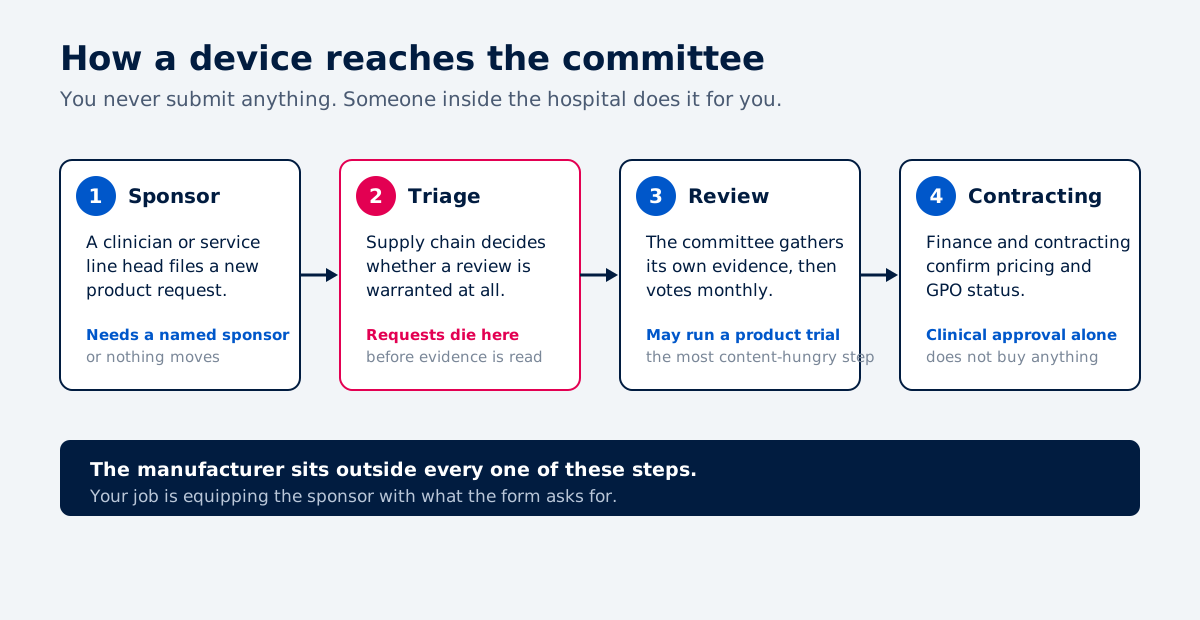
Through a clinician who files a form, then through supply chain, then through the committee, then through contracting. You do not submit anything. Someone inside the hospital does it on your behalf, using a document you never see.
This is the part of device selling that is genuinely hard to find written down. Someone researching it on r/MedicalDevices put the problem exactly:
"There's a lot of information online about what to provide value analysis committees to strengthen your position. But I can't seem to find out HOW to get in front of value analysis committees or even where to start at hospitals."
Here is the pathway, as hospitals and group purchasing organizations describe it themselves.
Step 1. A clinician sponsor files a new product request
The process starts when a clinician or a supply chain contact fills out an intake form covering why they want the product, what they use today, and the specifications. Without a named sponsor, nothing moves.
Most requests arrive through the service line head rather than any individual enthusiast. That matters for who you invest in, because a service line head sponsors a product on behalf of a department and has to defend it to peers, while an individual surgeon can want something badly and never be in a position to file for it.
Step 2. Supply chain decides whether the request deserves a review at all
Supply chain staff channel new product requests and determine whether value analysis is appropriate. They check whether the product duplicates something already on contract and whether the request clears a minimum documentation bar.
A submission can die here, before a single person reads your clinical evidence. Physician interest and expected financial impact are what trigger a review at all, and the depth of that review scales with the budget at stake.
Step 3. The committee reviews evidence it mostly gathers itself
Value analysis staff pull internal and external data, including peer-reviewed literature and clinical use data from the hospital's own electronic health record, and they ask end-user clinicians what they think.
Where the evidence is thin, the committee may run a trial of the product rather than decide. Treat that as the most content-hungry moment in the entire process, because it consumes an evaluation protocol, in-service training material, and a results summary the committee can read, and none of that is launch collateral.
Then the request goes to a committee meeting, usually monthly, for a vote.
Step 4. Finance and contracting confirm the money
Contracting checks group purchasing organization status and pricing. A product that clears clinical review and fails contract eligibility still does not get bought.
The obvious shortcut is to skip all of this and work the relationship instead. Hospitals have noticed. Premier's own member feedback lists "vendors going around the process to get product into the system" as a named obstacle that hinders value analysis, alongside staff and physicians working outside it.
What the form actually asks for
This is the most useful document in the whole process, and Premier publishes its version. Every field is a content brief.
The new product request tool asks the sponsor for:
- The diagnoses or procedures it will be used on, with the CPT code, and the anticipated units per year.
- The product currently in use, by name and catalog number, plus what is wrong with it.
- How the new product is more effective than the current one for the same patients.
- Which other physicians have agreed to change their practice if it gets approved.
- Whether it needs other equipment, and whether the hospital already owns that equipment.
- Whether it requires training or in-service.
- Whether funds are already budgeted.
Two of those deserve attention because most device marketing produces nothing that answers them.
"Which other physicians have agreed to change their practice." Your champion has to convince their peers before the form is even complete, which makes this a distribution problem wearing a procurement costume.
The supporting asset that follows is peer-to-peer material your champion can forward without embarrassment. A comparative summary against the incumbent product, a short procedural video from a recognized user, and society-meeting evidence their colleagues already respect. Sales collateral fails here because it is addressed to the wrong reader.
The conflict of interest block. The form asks the physician requester whether they have taken research support from the manufacturer, hold a consulting agreement, or sit on an advisory board.
So the closeness you spent years building gets recorded as a disclosure on the document that decides your fate. The brief that follows is evidence that survives the disclosure, meaning investigator-initiated studies, registry data, and independent literature your champion can point to without their own name attached to your payroll.
Where your own material ranks
The form also asks the sponsor to grade the evidence behind the claimed benefit, on a ranked scale. Meta-analyses and randomized controlled trials sit at the top. Below them come non-randomized trials, then integrative reviews, then peer-reviewed professional organizational standards.
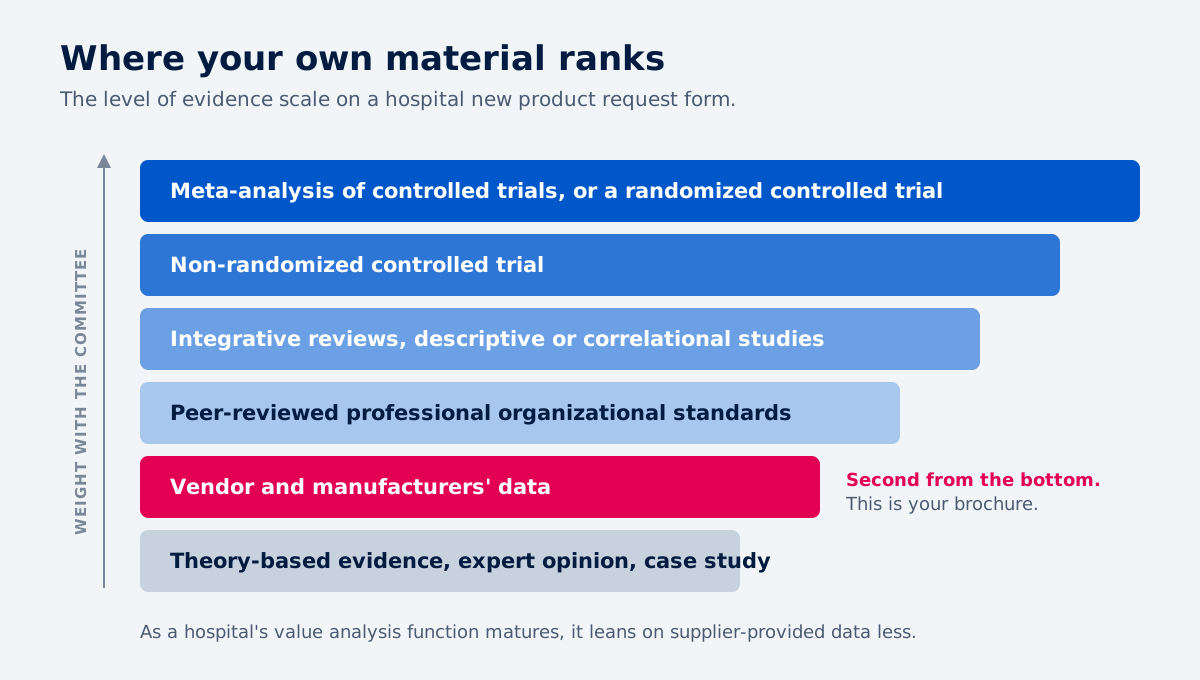
Vendor and manufacturers' data sits second from the bottom, above only expert opinion and theory, and the same guide places "reliance on supplier provided data" at the lowest rung of its program maturity curve. As a hospital's value analysis function improves, it leans on your materials less.
That discount is not unique to hospitals. It is the same instinct biotech audiences apply to anything a company says about itself, and it points at the same fix: publish material the reader can check rather than material they have to trust.
There is a constructive reading of all this, and it matters more than the discouraging one. A peer-reviewed study of hospital purchasing found that committees trying to be evidence-based lacked quality evidence and price data, fell back on expert opinion, and relied on sales representatives who introduced bias into the process.
They are not rejecting your evidence because they distrust you. They are short of usable evidence and nobody supplies it in a form they can act on. That gap is the work.
Does the same content work for a commodity and a therapeutic device?
No, and the difference is large enough that applying one playbook to the other wastes most of the budget.
A practitioner on r/MedicalDevices drew the line more precisely than most published advice does:
"You're going to get two different answers depending on if you are talking about commodities (bandages, needles, trays) or therapeutic devices (implants, therapeutic catheters, capital equipment). While 'procurement' is involved with all types the weight their opinion carries can vary. For commodities, price would be primary with considerations on supply stability and ease of doing business. For therapeutics the care teams will have a much more substantial voice."
Hospitals run the two categories through different machinery. Premier lists among value analysis best practices that teams are able to make commodity product changes with little or no evaluations.
A commodity switch often skips the evidence review entirely. So a health economic dossier aimed at a commodity buyer is effort spent on a gate that will not open for it.
Commodity | Therapeutic device | |
Who carries the decision | Supply chain and purchasing | Committee, with a clinical champion |
What wins | Price, supply reliability, ease of ordering | Outcomes, total cost, workflow fit |
Review depth | Often minimal or none | Full evidence review, sometimes a trial |
What content does the work | Availability, specs, service terms, contract fit | Economic models, comparative evidence, workflow and training detail |
The practical consequence is a portfolio question. Companies selling both categories need two content programs rather than one program with two audiences bolted onto it, and in our experience the therapeutic program is the one that gets built, even at companies whose revenue is mostly commodity. Deciding which of the two you are actually funding is one of the choices a life science marketing strategy exists to make.
What happens when there is no reimbursement pathway yet?
The economic argument cannot be made at all, and no amount of content fixes it. If the hospital has no reliable way to get paid for using your device, its cost is not a line to optimize. It is a loss to absorb. The same gate decides commercial life in diagnostics marketing, where a cleared test can sit unused for years while coverage is decided.
Reimbursement runs in three steps, and marketers rarely get taught them.
- Coverage. Does the insurer agree to pay for this at all? Medicare's statutory standard is that a service must be "reasonable and necessary" and fall inside a benefit category defined in law.
- Coding. Is there a unique identifier for it in the claims system? The American Medical Association creates procedure codes and CMS creates device codes.
- Payment. What monetary amount attaches to the covered, coded thing?
Each step can stall independently, and the coding step has a detail worth sitting with. More than 200 new codes get created every year, and creating one requires advocacy by physician societies plus a review and publication process lasting 12 to 15 months.
That is a content and coalition job hiding inside what looks like a regulatory problem. Physician societies do not advocate for a code because a manufacturer asked. They advocate when their members already believe the procedure matters, which is built over years, in the literature and at their meetings.
The finding that should reorder your evidence plan
A study in JAMA Health Forum tracked 281 technologies the FDA authorized between 2016 and 2019 through premarket approval, the de novo pathway, and breakthrough-designated 510(k). Sixty-four of them were genuinely new, meaning no coverage determination existed and hospitals billed them with temporary or miscellaneous codes.
Only 28 of those 64, about 44 percent, ever reached even nominal Medicare coverage. The median time to get there was 5.7 years.
The finding that should change how device teams plan evidence comes next. Company size predicted whether a technology achieved coverage, and so did product type. Having level 1 evidence at the point of FDA authorization did not, with no statistical association at all.
This is easy to over-claim, so be precise about it. The study does not say strong clinical evidence is worthless. It says the highest tier of clinical evidence, present at the moment of authorization, showed no association with later reaching coverage. Coverage is a separate contest on separate criteria, and running an excellent trial does not enter you into it.
For a device without a settled pathway, the work is building clinical consensus inside the specialty, because that consensus is what eventually moves a society to advocate for a code. In practice that means investigator-initiated studies, registry data, podium abstracts at the specialty meetings, and symposia where your users present to their peers. It runs over years and looks nothing like a launch campaign. It is thought leadership in its most literal sense, because the field's settled opinion has to move before the code does.
What does this look like from companies that have done it?
It looks like published, checkable economics with the manufacturer's name on the front.
One caveat first, because the honest version is more useful than a tidy one. Published analyses almost never trace a straight line to a specific hospital's approval, since those decisions stay private. What these examples show is the artifact and its quality, not a proven causal chain to a purchase order.
Johnson & Johnson published a model a hospital can rebuild
The HARMONIC FOCUS+ analysis covered earlier does something a brochure structurally cannot. Because every input is visible, a committee member can swap in their own hospital's operating room rate, their own bed-day cost, and their own case volume, and rerun it.
The output stops being the manufacturer's claim and becomes the hospital's own number. That is precisely what hospital decision-makers told researchers they needed when they said facility-specific value propositions, rather than general claims, are what secures approval.
Ethicon matched the model to the payment window
A second analysis, of the DERMABOND PRINEO skin closure system in hip and knee replacement, made a subtler choice. It modeled costs over 90 days.
That window is not arbitrary. Medicare's mandatory bundle for hip and knee arthroplasty holds the hospital accountable for quality and cost for 90 days after surgery, so a model built on any other timeframe answers a question the hospital is not being judged on.
Surgeons at four US practices co-authored it alongside a health economics author from the manufacturer, and it counted unglamorous things: staplers, steri-strips, dressings, outpatient visits, and home care visits.
What you are actually asking the committee to do
Keep the counterparty in mind. When a physician-driven technology assessment committee at one academic medical center standardized products, it cut physician preference item costs by 11 to 26 percent across service lines and saved more than $8 million a year.
That is the record the people in the room are measured against. You are asking a body with a documented eight-million-dollar savings history to approve a higher unit price on the strength of a total cost argument.
They will do it when someone hands them an argument they can defend to a CFO after you have left the building. Build that, and the champion you already have finally has something to carry. The wider life sciences picture says most companies still are not building it.
Is your content strategy built for how medical devices are actually bought?
Develop a medtech content engine that aligns education, evidence, and stakeholder-specific messaging around real buying decisions.
Frequently Asked Questions
About the Author

Founder & CEO, Content RevOps
Stefan Kalpachev is the founder and CEO of Content RevOps, where he helps B2B SaaS companies transform their content into predictable pipeline. With a background in content marketing and revenue operations, Stefan has developed a unique methodology that bridges the gap between content creation and revenue generation.
Connect on LinkedInRelated Articles
How to Turn Before-and-After Construction Project Photos Into a Marketing Strategy
Oct 8, 2026
How to Build a Construction Marketing Strategy That Generates Pipeline
Oct 7, 2026

Construction Video Marketing: Where It Actually Pays
Oct 5, 2026